
A Review of Binax NOW COVID19 Antigen Testing
A Review of Binax. NOW COVID-19 Antigen Testing in K-12 Schools Judy Guzman-Cottrill, DO Pediatric Infectious Diseases Infection Prevention & Control Contractor, Oregon Health Authority February, 2021
Question & Answer Portion of this Webinar Judy Guzman-Cottrill, DO Pediatric Infectious Diseases Infection Prevention & Control Contractor, Oregon Health Authority Jamekaa Baker-Flowers School Testing Coordinator, Operations and Policy Analyst 3 ODHS | OHA SHARED SERVICE COVID-19 Response and Recovery Unit (CRRU) Colt Gill Director of the Oregon Department of Education Deputy Superintendent of Public Instruction

Webinar Objectives 1. To understand the rationale for including on-site COVID-19 testing in K-12 schools 2. To know how the Binax. NOW COVID-19 antigen test will be performed in a school setting 3. To review the online training tools that are available for performing the antigen test 4. Question & answer (~30 minutes)
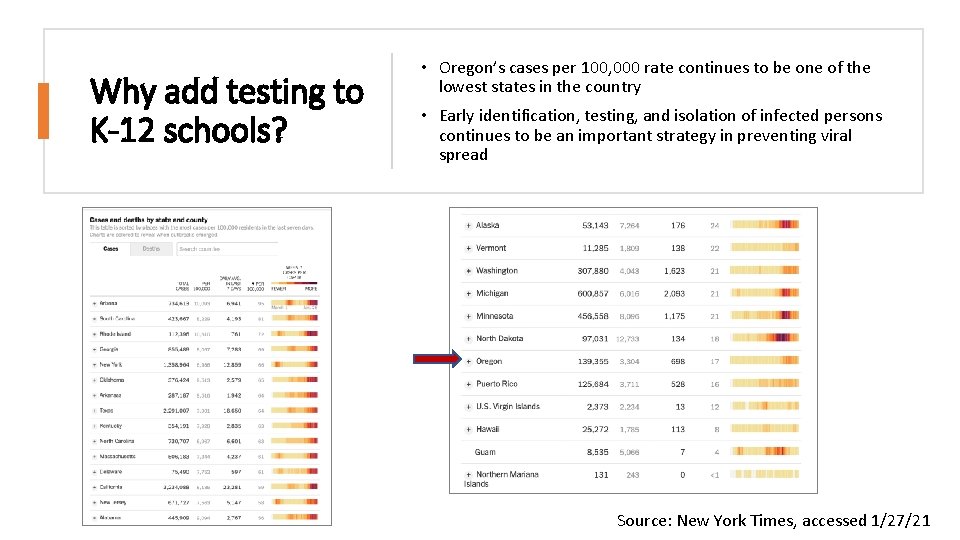
Why add testing to K-12 schools? • Oregon’s cases per 100, 000 rate continues to be one of the lowest states in the country • Early identification, testing, and isolation of infected persons continues to be an important strategy in preventing viral spread Source: New York Times, accessed 1/27/21
Why add testing to K-12 schools? • Ensure testing access to K-12 students across Oregon • Several barriers to testing access • • • Cost of test Lack of a primary care provider Wait time to establish appointment with primary care provider Long wait times at community testing sites Working parents/guardians inability to seek testing during “business hours” • Testing in schools will help with detecting community versus in-school transmission in Oregon

Why add testing to K-12 schools? • Students and staff spend many hours at school on a typical day. • It is possible that they may develop new symptoms, such as fever or cough, while at school. • In addition, when a student or staff member is diagnosed with COVID 19, their cohorts may be considered “exposed” and be required to quarantine. • Testing will help to quickly identify COVID-19 cases in schools, interrupt viral spread through households and in classrooms, and reduce the risk for students and staff returning to in-person instruction.
Testing Guidelines Posted January 19, 2021 • https: //sharedsystems. dhsoha. state. or. us/ DHSForms/Served/le 3560. pdf

Which schools should implement a testing program? • It is recommended that all K-12 schools in Oregon offering partial or full in-person instruction offer free, on-site COVID-19 testing through this program. • If a K-12 school is operating an On-Site or Hybrid Instructional Model but is located in a county that does not meet the RSSL general metrics (Section 0 b), the school must participate in this program to provide on-campus access to testing. • If mandatory, this program must be in operation by March 1, 2021.
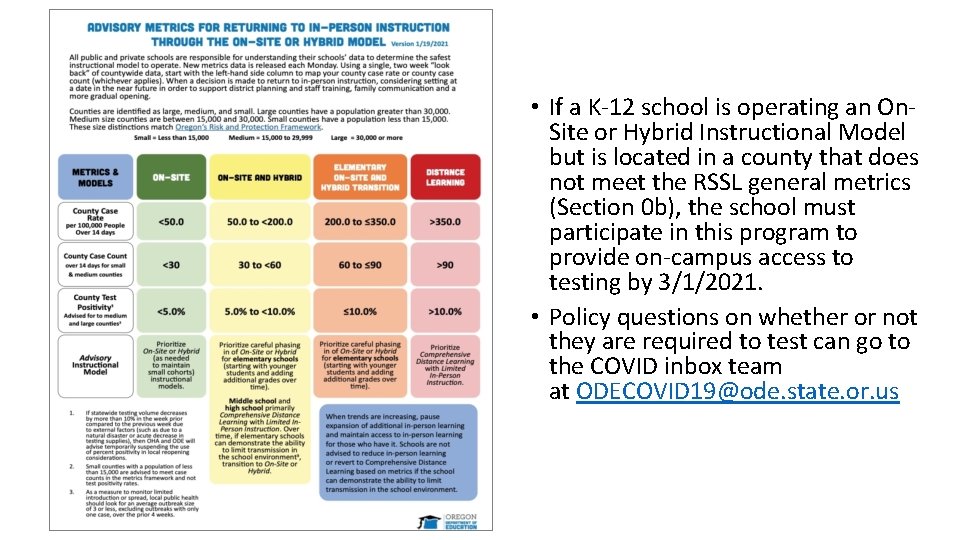
• If a K-12 school is operating an On. Site or Hybrid Instructional Model but is located in a county that does not meet the RSSL general metrics (Section 0 b), the school must participate in this program to provide on-campus access to testing by 3/1/2021. • Policy questions on whether or not they are required to test can go to the COVID inbox team at ODECOVID 19@ode. state. or. us

Binax. NOW point-of -care antigen test • The Federal Government has allocated Abbott Binax. NOW rapid point-of-care antigen tests to states to support COVID-19 testing. • These tests are available to support testing in K-12 schools during the 2020 -2021 school year.
What is the difference between the virus molecular test and a COVID-19 antigen test? • Molecular diagnostic tests (e. g. , PCR test) work by: • Finding very small pieces of genetic material from the SARS-Co. V-2 virus that is actively infecting a person • Machine creates millions of copies of small segments of the virus, and, if it is present in the patient’s sample, “amplifies” the signal • Detecting those millions of copies on specialized machines • Antigen diagnostic tests (e. g. , Binax. NOW) work by: • Finding larger pieces of evidence that the SARS-Co. V-2 virus is actively infecting a person • Detecting specific, 3 -dimensional viral proteins (“antigens”) on the outside of the virus
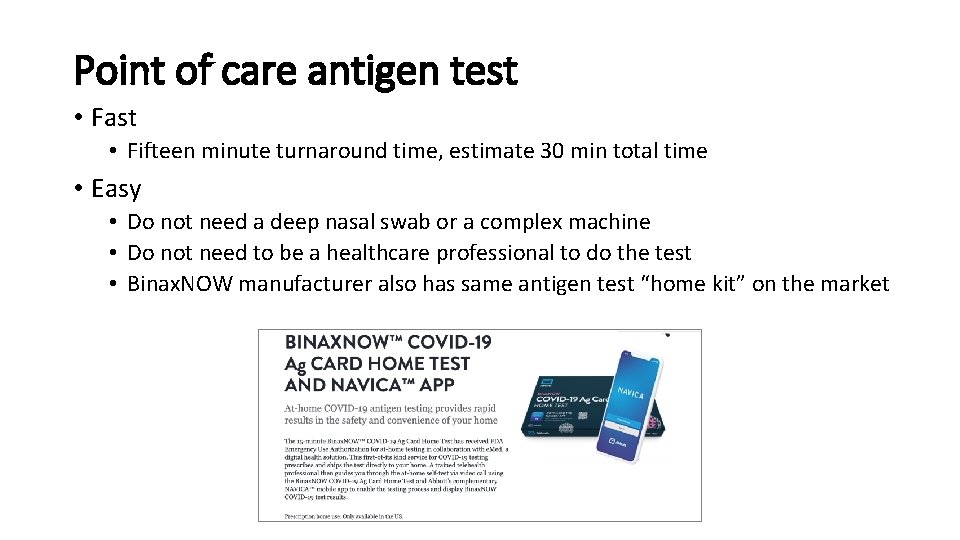
Point of care antigen test • Fast • Fifteen minute turnaround time, estimate 30 min total time • Easy • Do not need a deep nasal swab or a complex machine • Do not need to be a healthcare professional to do the test • Binax. NOW manufacturer also has same antigen test “home kit” on the market
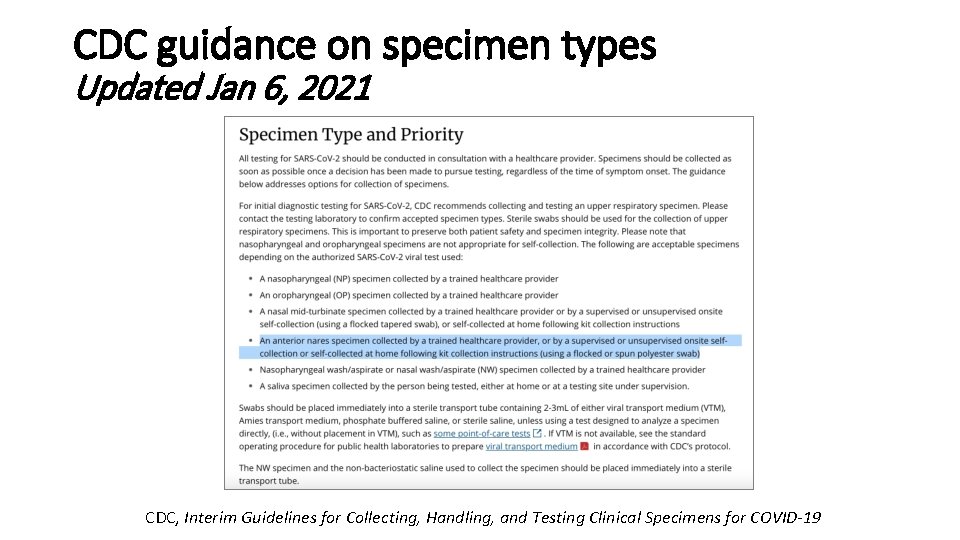
CDC guidance on specimen types Updated Jan 6, 2021 CDC, Interim Guidelines for Collecting, Handling, and Testing Clinical Specimens for COVID-19
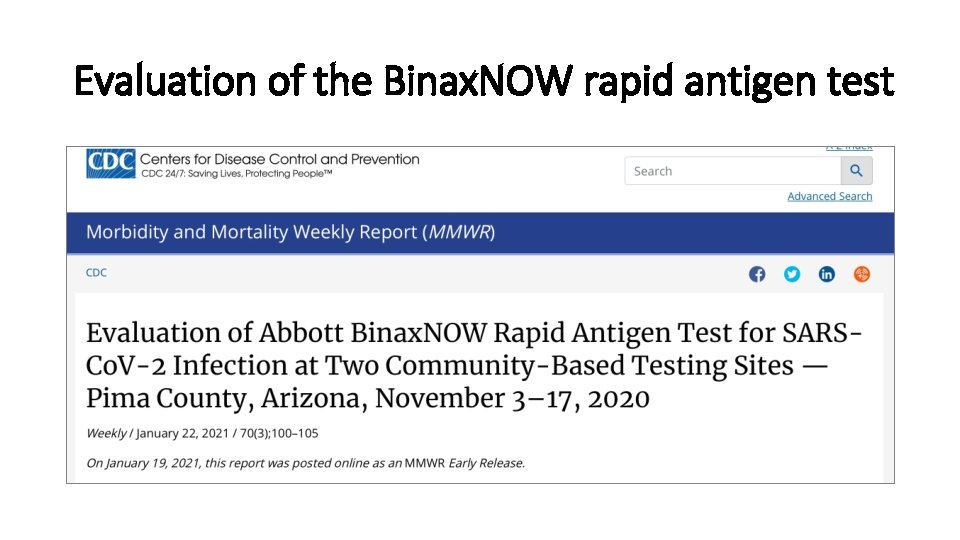
Evaluation of the Binax. NOW rapid antigen test
Evaluation of Abbott Binax. NOW Rapid Antigen Test • To evaluate the performance of the Binax. NOW rapid antigen test, it was used along with real-time reverse transcription–polymerase chain reaction (PCR) testing to analyze 3, 419 paired specimens collected from persons aged ≥ 10 years at two community testing sites in Pima County, Arizona, during November 3– 17, 2020.
Evaluation of Abbott Binax. NOW Rapid Antigen Test • Symptomatic persons • Compared with PCR testing, the Binax. NOW antigen test had a sensitivity of 64. 2% for specimens from symptomatic persons. • Specificity was 100% in symptomatic persons. • Asymptomatic persons • Binax. NOW antigen test had a sensitivity of 35. 8% for specimens from asymptomatic persons, and specificity 99. 8%. • The low sensitivity in asymptomatic people is why OHA does not recommend using this antigen test for a “screening program. ” • When recommended by the local public health authority (LPHA), testing may be used in order to consider early release from quarantine when an exposed cohort is identified at your school. This must be pre-approved by your LPHA.
Who should be offered a test in my school? 1. Student or staff who becomes ill while at school. Can offer testing before they go home (if signed consent is on file). 2. If approved by your LPHA: a student or staff in an exposed cohort, can be tested when considering a shorter quarantine period (shorter than 14 days). • This requires coordination with your LPHA • The exact timing of testing is very important, after a person is exposed in the school setting
Who should not be offered a test in my school? 1. If a student or staff is home sick, do not allow the ill person to come to school for testing. • Refer family to a healthcare provider for testing. 2. This test is not to be used as a “screening” test for healthy students. • Do not use to screen students for COVID 19 before returning to on-site learning. • Do not use to screen student before sports or other extra-curricular activities.
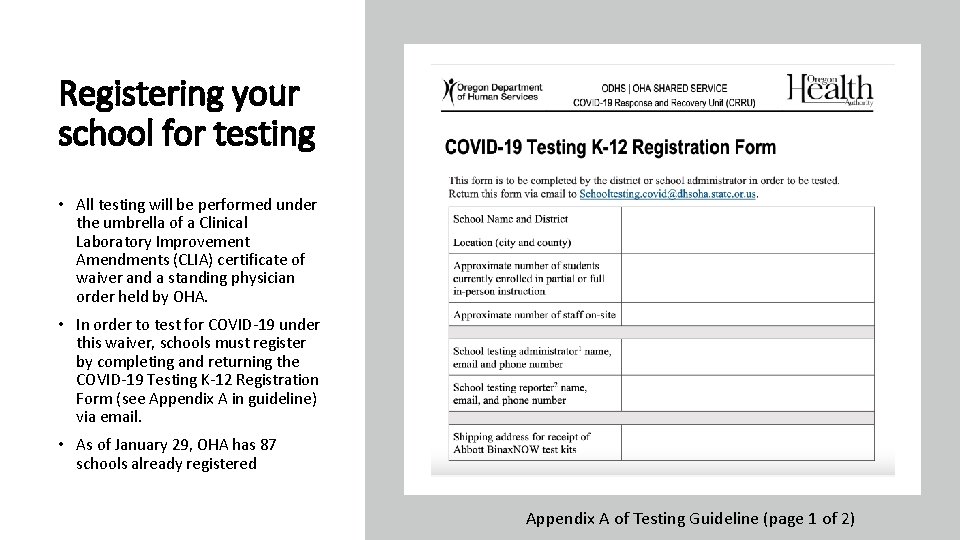
Registering your school for testing • All testing will be performed under the umbrella of a Clinical Laboratory Improvement Amendments (CLIA) certificate of waiver and a standing physician order held by OHA. • In order to test for COVID-19 under this waiver, schools must register by completing and returning the COVID-19 Testing K-12 Registration Form (see Appendix A in guideline) via email. • As of January 29, OHA has 87 schools already registered Appendix A of Testing Guideline (page 1 of 2)
Roles at each school: School testing administrator • The person assigned to perform and log all on-site COVID-19 testing. • If a school has a school nurse or trained medical professional on staff, that person could be the testing administrator. • School testing administrator does not need to be a medical professional. • If you have a school nurse who does not have the bandwidth to add this role, you can identify an alternate person • Districts or schools should designate a back-up school testing administrator in the event of absence of the primary testing administrator. • Training requirements: 1. Review the Binax. NOW training modules #1 -4 2. Review personal protective equipment (PPE) guidance in the testing guideline 3. Initial the attestation on Registration Form (page 2) that training has been completed
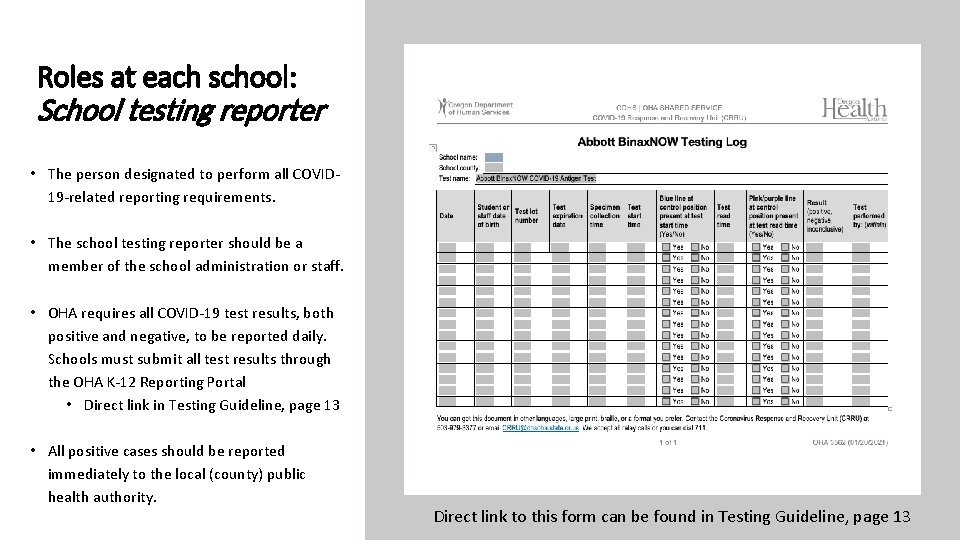
Roles at each school: School testing reporter • The person designated to perform all COVID 19 -related reporting requirements. • The school testing reporter should be a member of the school administration or staff. • OHA requires all COVID-19 test results, both positive and negative, to be reported daily. Schools must submit all test results through the OHA K-12 Reporting Portal • Direct link in Testing Guideline, page 13 • All positive cases should be reported immediately to the local (county) public health authority. Direct link to this form can be found in Testing Guideline, page 13
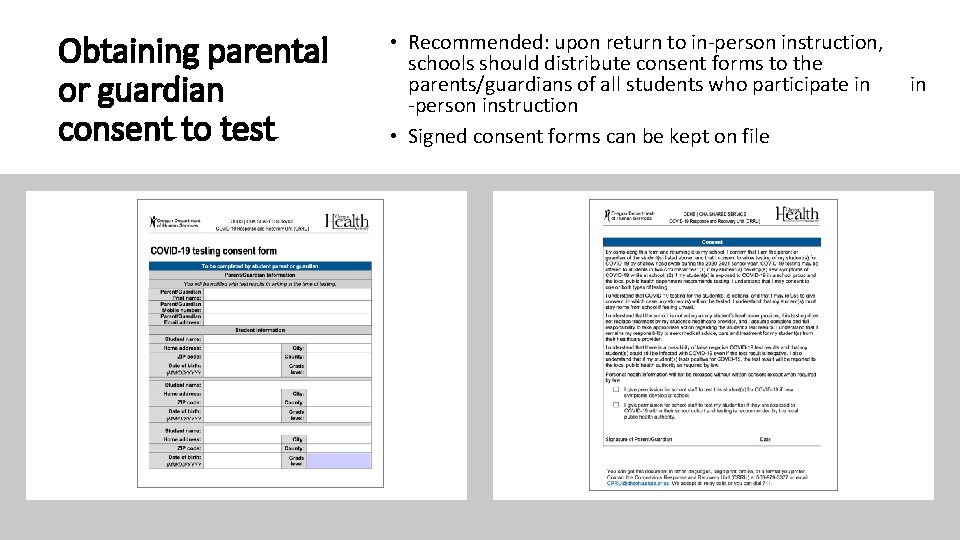
Obtaining parental or guardian consent to test • Recommended: upon return to in-person instruction, schools should distribute consent forms to the parents/guardians of all students who participate in -person instruction • Signed consent forms can be kept on file in
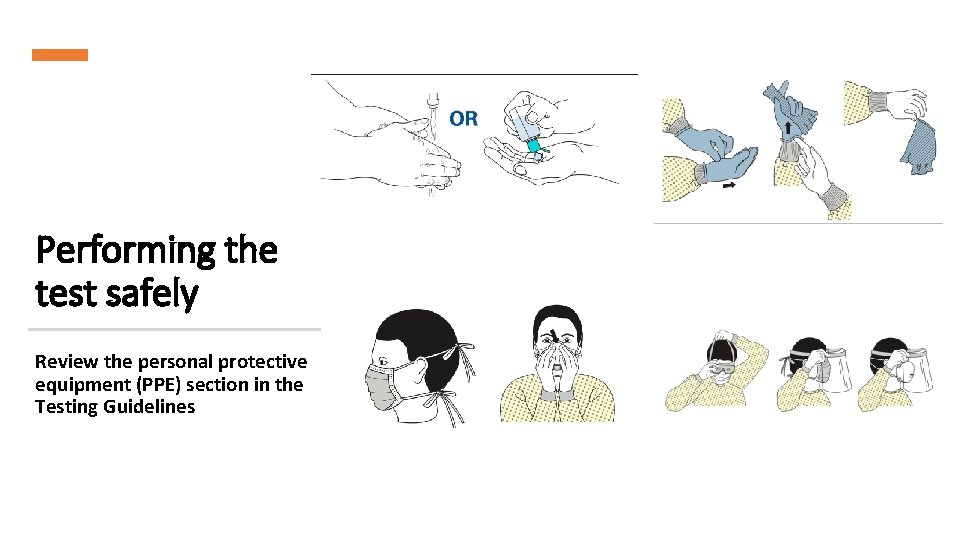
Performing the test safely Review the personal protective equipment (PPE) section in the Testing Guidelines
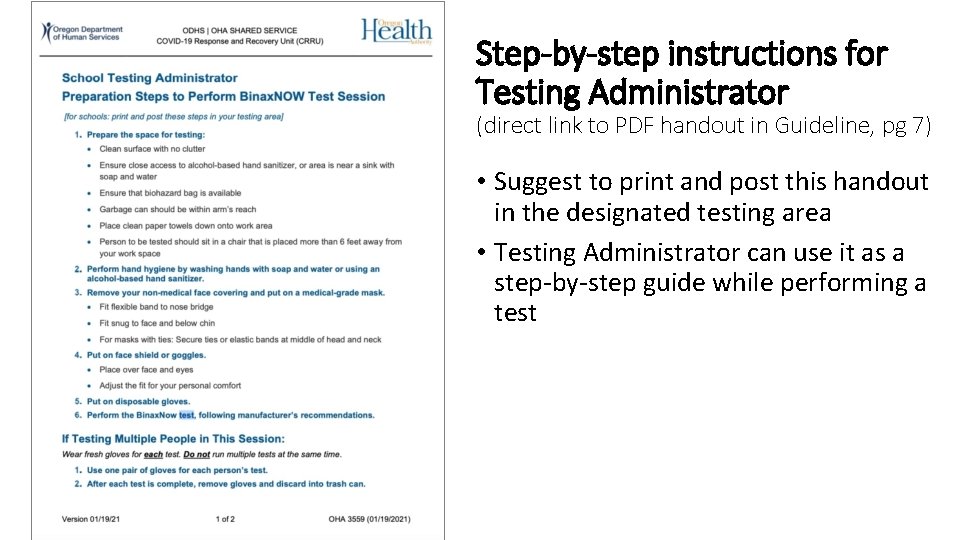
Step-by-step instructions for Testing Administrator (direct link to PDF handout in Guideline, pg 7) • Suggest to print and post this handout in the designated testing area • Testing Administrator can use it as a step-by-step guide while performing a test
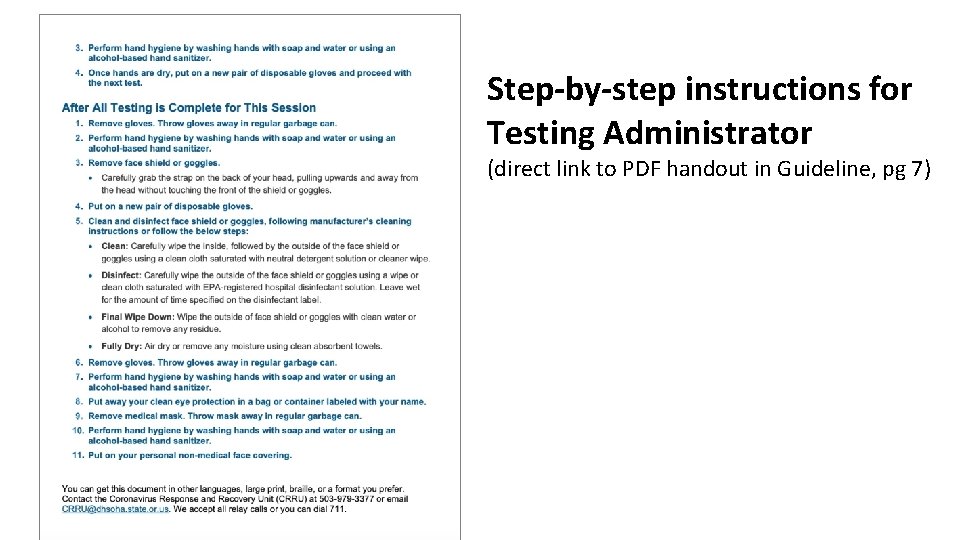
Step-by-step instructions for Testing Administrator (direct link to PDF handout in Guideline, pg 7)
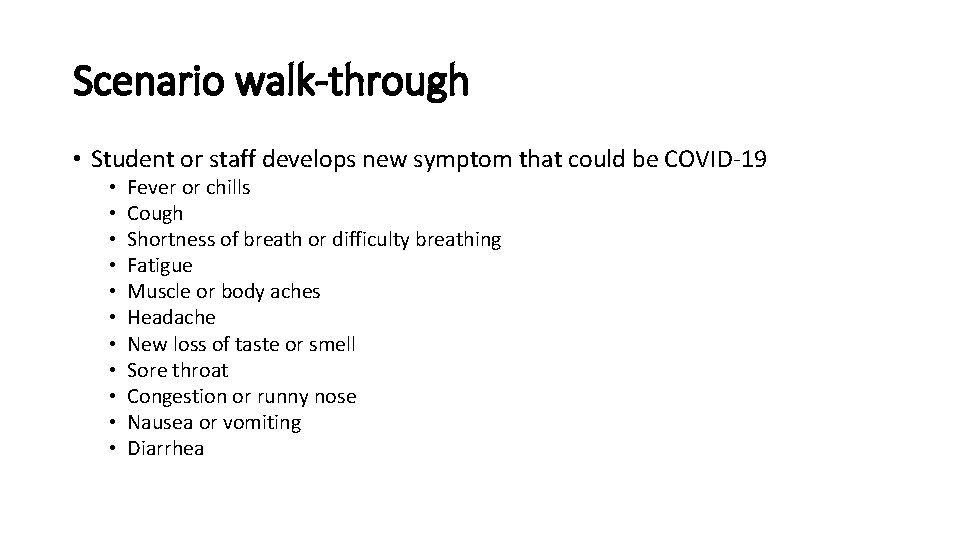
Scenario walk-through • Student or staff develops new symptom that could be COVID-19 • • • Fever or chills Cough Shortness of breath or difficulty breathing Fatigue Muscle or body aches Headache New loss of taste or smell Sore throat Congestion or runny nose Nausea or vomiting Diarrhea
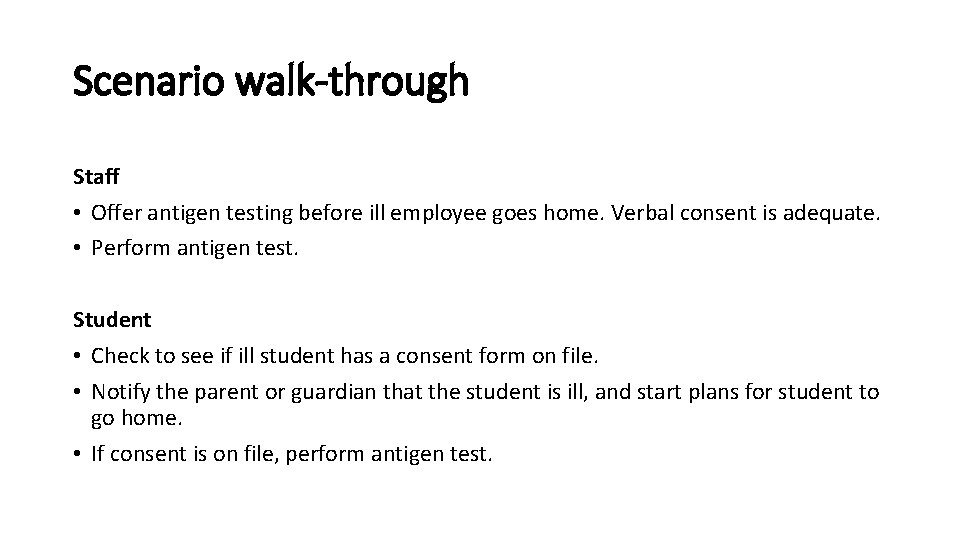
Scenario walk-through Staff • Offer antigen testing before ill employee goes home. Verbal consent is adequate. • Perform antigen test. Student • Check to see if ill student has a consent form on file. • Notify the parent or guardian that the student is ill, and start plans for student to go home. • If consent is on file, perform antigen test.
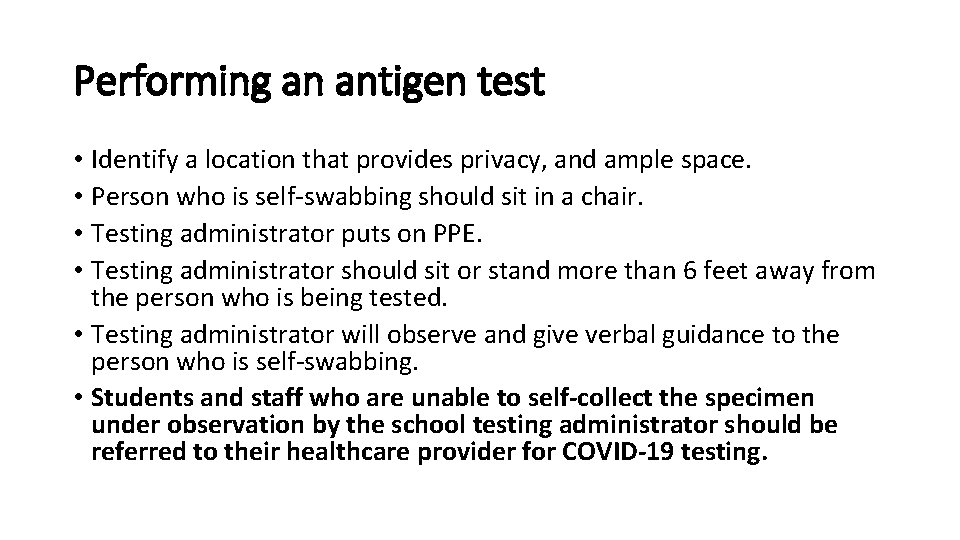
Performing an antigen test • Identify a location that provides privacy, and ample space. • Person who is self-swabbing should sit in a chair. • Testing administrator puts on PPE. • Testing administrator should sit or stand more than 6 feet away from the person who is being tested. • Testing administrator will observe and give verbal guidance to the person who is self-swabbing. • Students and staff who are unable to self-collect the specimen under observation by the school testing administrator should be referred to their healthcare provider for COVID-19 testing.

Negative test result • All COVID-19 tests are imperfect and false negative results may occur. • A negative COVID-19 test result should never be interpreted as evidence that a person is not infected with COVID-19, especially when symptoms compatible with COVID-19 are present. • Any symptomatic student who is tested (even if that test is negative) must leave school immediately and not return until allowed by the RSSL guidance. • Instruct parent/guardian to contact a healthcare provider if the student’s illness worsens or if they have any health questions or concerns.
Negative test result and no known COVID-19 exposures • Students or staff with symptoms compatible with COVID-19 who have not had close contact with a case of COVID-19 within the last 14 days should be asked to contact their healthcare provider and isolate from others until their symptoms improve. • The symptoms could be due to another infection, or might be due to COVID-19 (with a “false negative” antigen test) • They should be instructed to isolate at home until 24 hours after fever is resolved, without the use of fever- reducing medication, and symptoms are improving. • Refer to RSSL for more details re: return to school requirements
Negative test result and close contact to a case of COVID-19 in last 14 days • Students or staff with symptoms compatible with COVID-19 and who have had close contact with a case of COVID-19 within the last 14 days may meet criteria as a “presumptive case” of COVID-19. • Any student or staff with symptoms compatible with COVID-19 and who has had close contact with a case of COVID-19 within the last 14 days should be sent home and asked to contact their local public health authority for instructions.

Positive test result • Every positive test result should be reported directly to the local public health authority immediately • Local public health can follow-up with the family, link the family to quarantine and isolation support, and manage transmission within the school cohort. • A positive COVID-19 test result means that the student or staff member is infected with COVID-19 and should follow local public health instructions regarding isolation. • All students and staff who test positive for COVID-19 should contact their healthcare provider for additional health guidance. • Refer to RSSL for more details re: return to school requirements

Test result education to families
Video Module Reviews 1. Training modules 1 -4 provided by the manufacturer [total ~11 min] 2. Video walk-through of entire process [~8 minutes]
Summary 1. We reviewed the rationale for including on-site COVID-19 testing in K-12 schools 2. We reviewed how the Binax. NOW COVID-19 antigen test will be performed in a school setting 3. We reviewed the online training tools that are available for performing the antigen test 4. Questions & answers

Thank you! Questions? Schooltesting. covid@dhsoha. state. or. us
- Slides: 36