
A Review of Basic Atomic Structure Terms Atom
A Review of Basic Atomic Structure & Terms Atom – smallest piece of any element that still has the properties of that element § electrically neutral: # of protons = # of electrons § Atomic number - # of protons in an atom Determines what element it is. § Atomic weight (aka relative atomic mass) essentially tells how many protons & neutrons an atom has, but it’s never a whole number because natural elements have isotopes Isotope – versions of the same element containing different numbers of neutrons in the nucleus Ions – a charged atom § Positive ion – more p+ than e-, so lost electrons § Negative ion – more e- than p+, so gained electrons
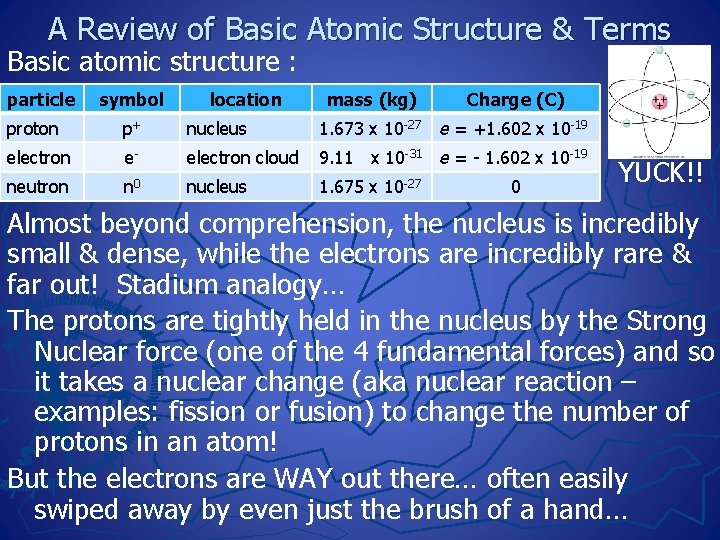
A Review of Basic Atomic Structure & Terms Basic atomic structure : particle symbol location mass (kg) Charge (C) e = +1. 602 x 10 -19 proton p+ nucleus 1. 673 x 10 -27 electron e- electron cloud 9. 11 x 10 -31 e = - 1. 602 x 10 -19 neutron n 0 nucleus 1. 675 x 10 -27 0 YUCK!! Almost beyond comprehension, the nucleus is incredibly small & dense, while the electrons are incredibly rare & far out! Stadium analogy… The protons are tightly held in the nucleus by the Strong Nuclear force (one of the 4 fundamental forces) and so it takes a nuclear change (aka nuclear reaction – examples: fission or fusion) to change the number of protons in an atom! But the electrons are WAY out there… often easily swiped away by even just the brush of a hand…
Electrostatics and Basic Behavior Electrostatics is the study of static electricity ► electro refers to electric charge the charge subatomic particles have… (e-, p+) ► static means ‘at rest’ as opposed to moving, which is called current electricity (Ch 18…) Like charges repel; opposite charges attract… with a force determined by Coulomb’s Law of Conservation of Electric Charge: While charge can be moved from one place/object to another, the total amount of electric charge will remain the same… charge can’t be created or destroyed.
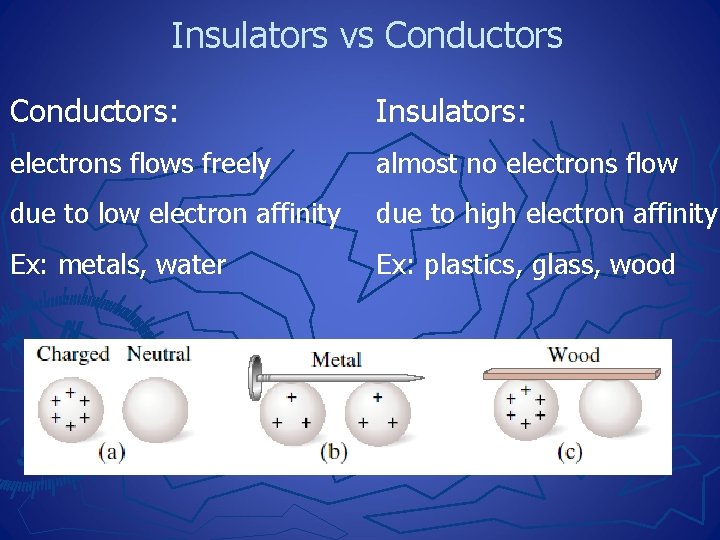
Insulators vs Conductors: Insulators: electrons flows freely almost no electrons flow due to low electron affinity due to high electron affinity Ex: metals, water Ex: plastics, glass, wood
3 Ways to Charge an Object 1. by Friction: rub 2 neutral objects together. If they’re different electron affinities, one will give up e’s becoming positive and the other will grab the extra e’s becoming negative. Ex: static cling in laundry or with clothes/hair plastic slides at a park playground water particles/clouds in a thunderstorm 2. by Conduction: touch charged object to a neutral one. The excess charge will be looking to repel farther away and so the neutral one’s surface becomes a great place to do that – it ends up charged as well, with the same charge as the originally charged object. Ex: metal leaves on an electroscope if you’re charged (by friction typically), then you touch (shock) something
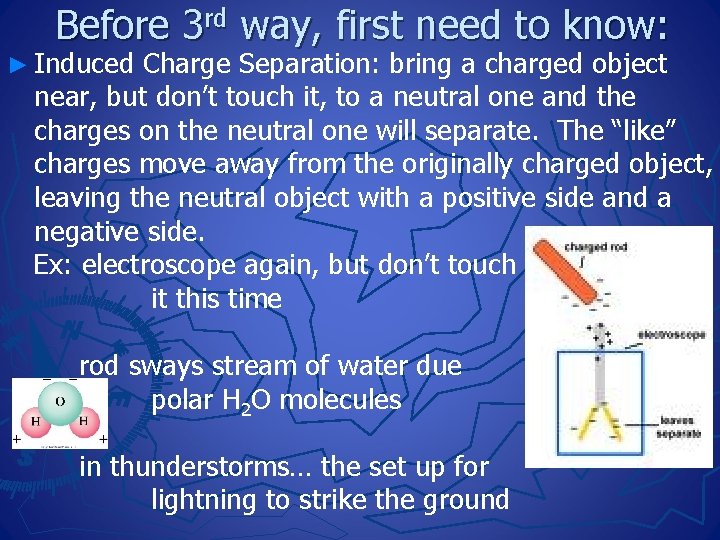
Before 3 rd way, first need to know: ► Induced Charge Separation: bring a charged object near, but don’t touch it, to a neutral one and the charges on the neutral one will separate. The “like” charges move away from the originally charged object, leaving the neutral object with a positive side and a negative side. Ex: electroscope again, but don’t touch it this time rod sways stream of water due polar H 2 O molecules in thunderstorms… the set up for lightning to strike the ground
1 Way to Discharge an Object ► Grounding: Connect it, either directly, or by means of a conducting material, to a much larger object, like the Earth, which is capable of accepting a lot of excess charge, but not becoming charged itself. Ex: lightning rod a shock from a anything (doorknob, person, etc) on a dry dangling wire from car/wheelchair 3 rd prong or polarized plugs
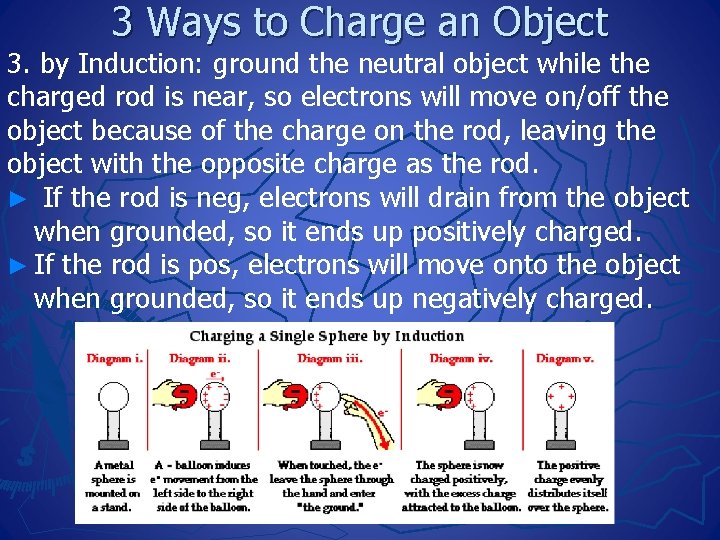
3 Ways to Charge an Object 3. by Induction: ground the neutral object while the charged rod is near, so electrons will move on/off the object because of the charge on the rod, leaving the object with the opposite charge as the rod. ► If the rod is neg, electrons will drain from the object when grounded, so it ends up positively charged. ► If the rod is pos, electrons will move onto the object when grounded, so it ends up negatively charged.
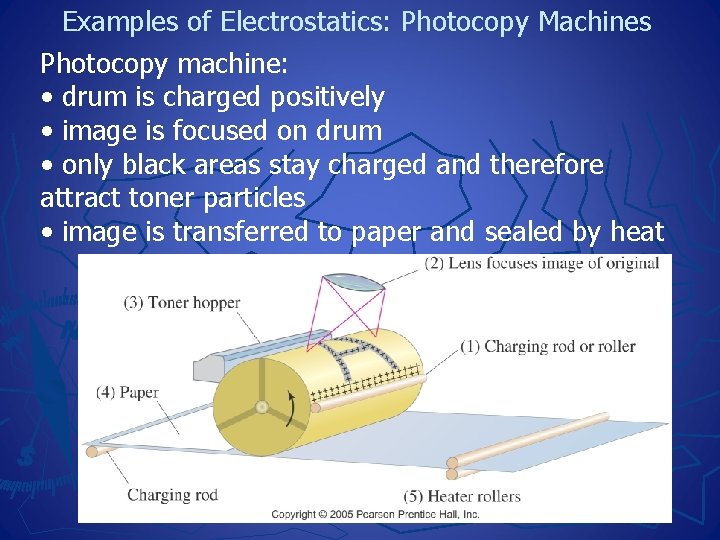
Examples of Electrostatics: Photocopy Machines Photocopy machine: • drum is charged positively • image is focused on drum • only black areas stay charged and therefore attract toner particles • image is transferred to paper and sealed by heat
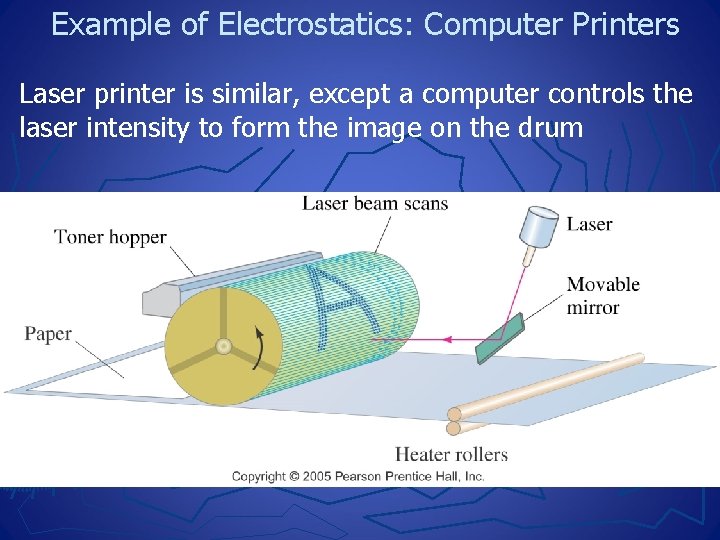
Example of Electrostatics: Computer Printers Laser printer is similar, except a computer controls the laser intensity to form the image on the drum
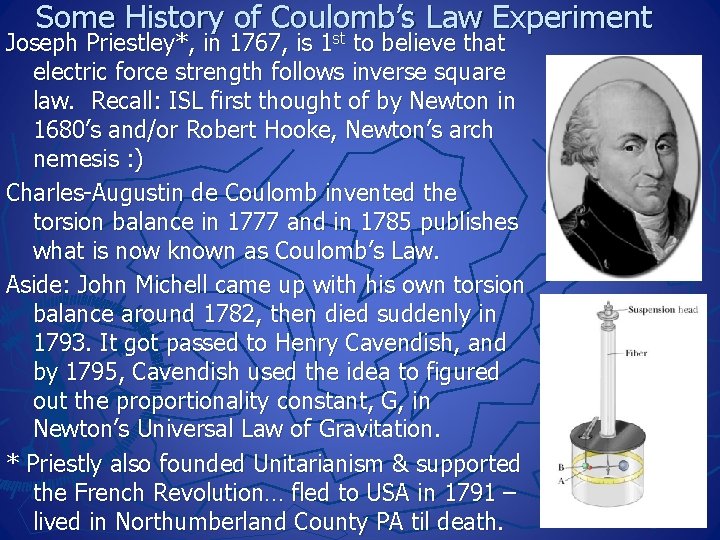
Some History of Coulomb’s Law Experiment st Joseph Priestley*, in 1767, is 1 to believe that electric force strength follows inverse square law. Recall: ISL first thought of by Newton in 1680’s and/or Robert Hooke, Newton’s arch nemesis : ) Charles-Augustin de Coulomb invented the torsion balance in 1777 and in 1785 publishes what is now known as Coulomb’s Law. Aside: John Michell came up with his own torsion balance around 1782, then died suddenly in 1793. It got passed to Henry Cavendish, and by 1795, Cavendish used the idea to figured out the proportionality constant, G, in Newton’s Universal Law of Gravitation. * Priestly also founded Unitarianism & supported the French Revolution… fled to USA in 1791 – lived in Northumberland County PA til death.
Coulomb’s Law Name after French Charles Coulomb; published in 1785: Coulomb’s Law is the mathematical relationship that is used to determine the strength of the electric force (Fe) between 2 charged particles (q) or objects. Extremely similar to Newton’s Universal Law of G! (p 507) NUL of G ► Any 2 masses attract CL for Electric Charges ► Any 2 charges attract or repel! ► FG = Gm 1 m 2/r 2 ► Fe = k q 1 q 2/r 2 ► Remember inverse square? ► So inverse square as well ► G = 6. 67 x 10 -11 Nm 2/kg 2 ► k = 9. 0 x 109 Nm 2/C 2 That’s a huge difference between constant values!! k ≈ 1020 bigger than G
That’s why… ► hair can stick up with balloon or sweater ► socks hang onto each other out of the dryer ► we can get pith balls to “dance” Correct interpretation of these phenomena: The Fg of the entire Earth is weaker than the Fe of the tiny charged particles (p’s & e’s) on these objects! We don’t hear much about Fe, even though it’s so much stronger than Fg, because most objects are electrically neutral, so Fe = 0, but objects always have mass, so there’s always Fg. But at the atomic/molecular level, it’s responsible for all the forces we’ve studied so far, except gravity! all contact forces (pushes & pulls) like: friction, tension, applied, elastic & normal force!
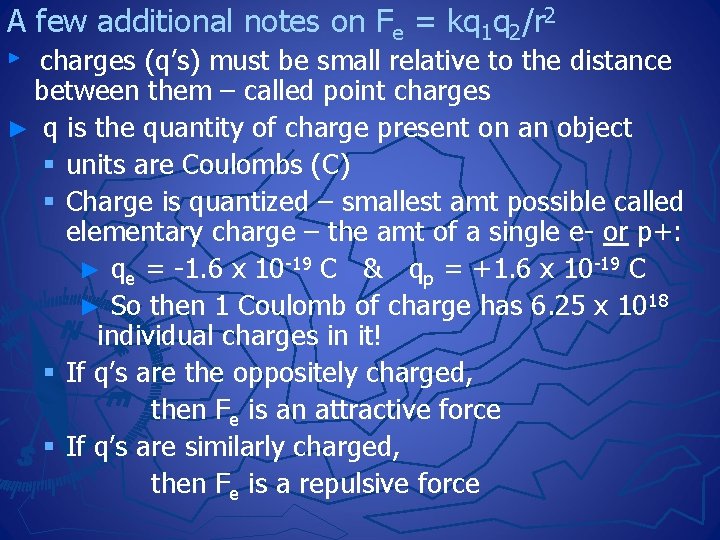
A few additional notes on Fe = kq 1 q 2/r 2 charges (q’s) must be small relative to the distance between them – called point charges ► q is the quantity of charge present on an object § units are Coulombs (C) § Charge is quantized – smallest amt possible called elementary charge – the amt of a single e- or p+: ► qe = -1. 6 x 10 -19 C & qp = +1. 6 x 10 -19 C ► So then 1 Coulomb of charge has 6. 25 x 10 18 individual charges in it! § If q’s are the oppositely charged, then Fe is an attractive force § If q’s are similarly charged, then Fe is a repulsive force ►
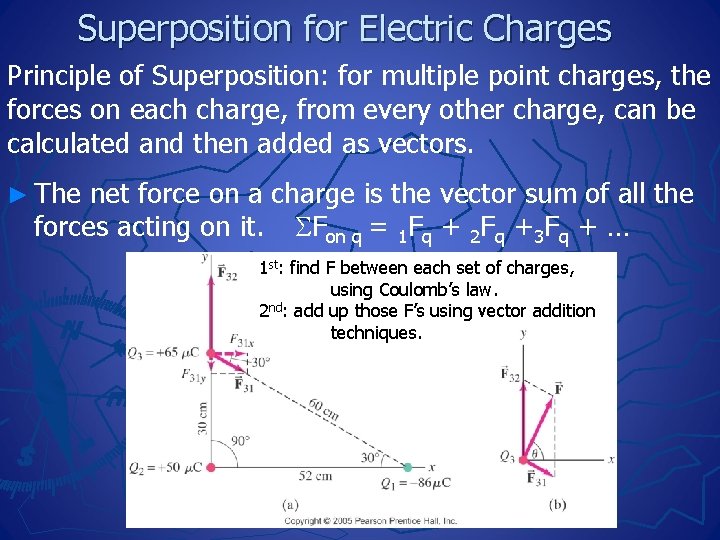
Superposition for Electric Charges Principle of Superposition: for multiple point charges, the forces on each charge, from every other charge, can be calculated and then added as vectors. ► The net force on a charge is the vector sum of all the forces acting on it. Fon q = 1 Fq + 2 Fq +3 Fq + … 1 st: find F between each set of charges, using Coulomb’s law. 2 nd: add up those F’s using vector addition techniques.
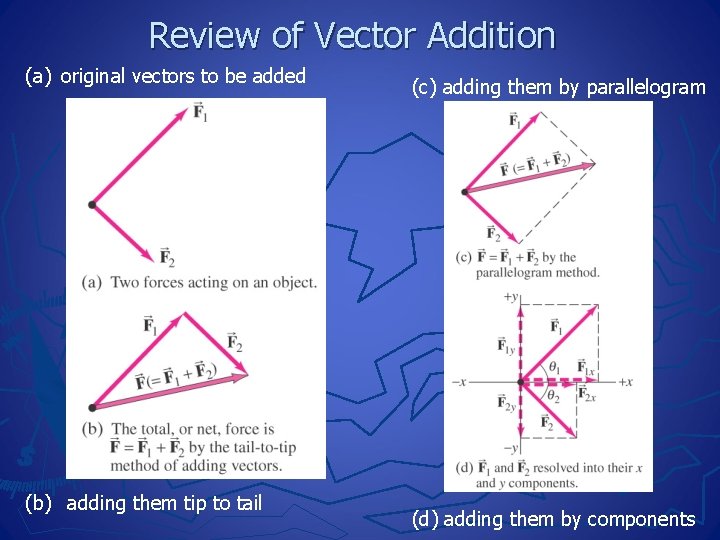
Review of Vector Addition (a) original vectors to be added (b) adding them tip to tail (c) adding them by parallelogram (d) adding them by components
- Slides: 16