
A Research Based Approach to Defining Effective Leadership
A Research Based Approach to Defining Effective Leadership David Burnham for
Objectives 1. To learn about the motives which underlie effective leadership and how they work. 2. To learn about the new model of effective leadership. 3. To learn about Organization Culture and how it affects performance. 4. To prepare for the workshop sessions where you will assess your organization culture and look at how you can affect it. © Burnham Rosen Group, 2007. All Rights Reserved. 1
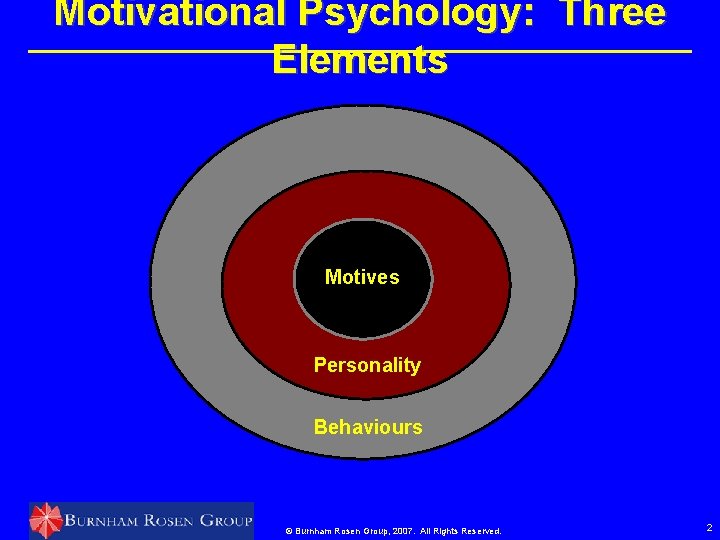
Motivational Psychology: Three Elements Motives Personality Behaviours © Burnham Rosen Group, 2007. All Rights Reserved. 2
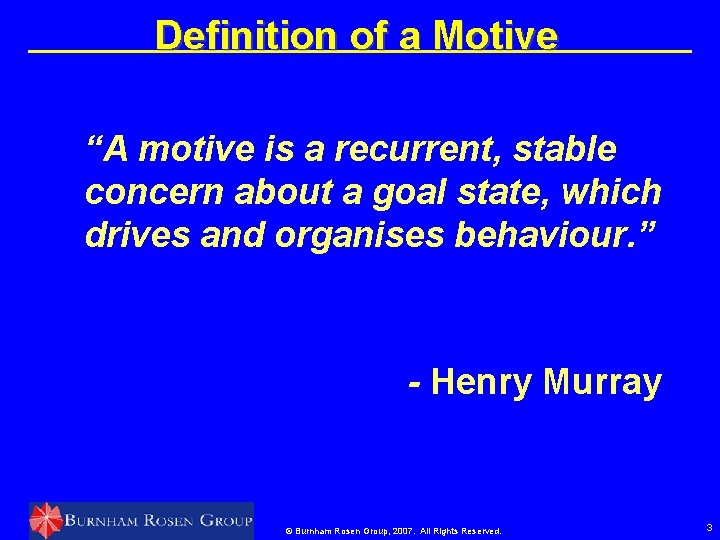
Definition of a Motive “A motive is a recurrent, stable concern about a goal state, which drives and organises behaviour. ” - Henry Murray © Burnham Rosen Group, 2007. All Rights Reserved. 3
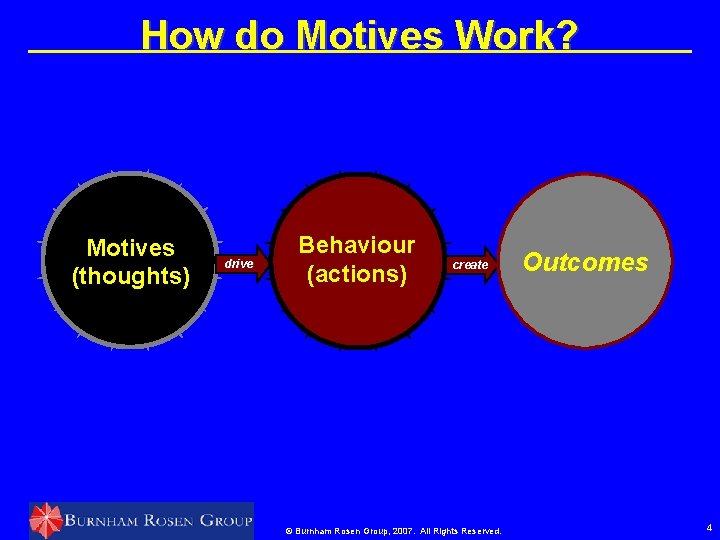
How do Motives Work? Motives (thoughts) drive Behaviour (actions) create © Burnham Rosen Group, 2007. All Rights Reserved. Outcomes 4

Dominant Motive Patterns Dominant Motive Occurrence in All People by Percentage • A Dominant Motive occurs 4 or 5 times more often in thought than a 'Minor' Motive © Burnham Rosen Group, 2007. All Rights Reserved. 5
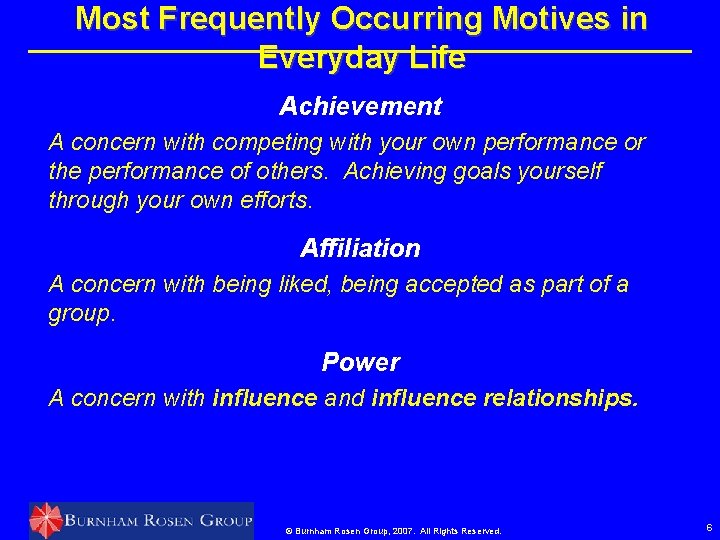
Most Frequently Occurring Motives in Everyday Life Achievement A concern with competing with your own performance or the performance of others. Achieving goals yourself through your own efforts. Affiliation A concern with being liked, being accepted as part of a group. Power A concern with influence and influence relationships. © Burnham Rosen Group, 2007. All Rights Reserved. 6
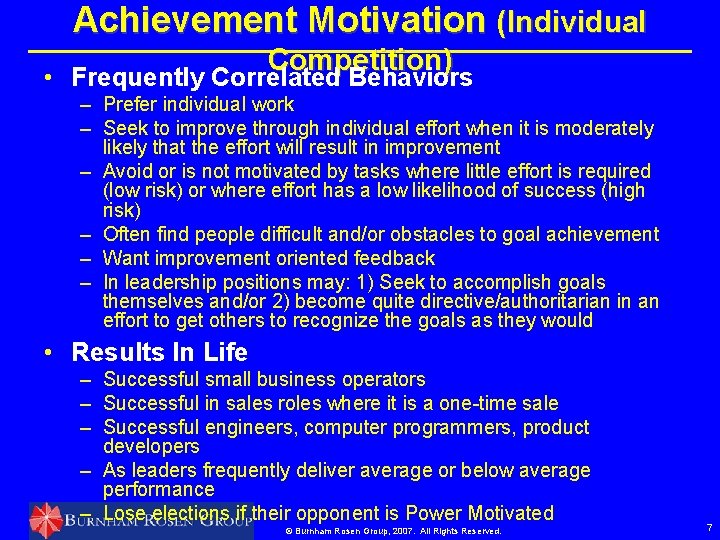
Achievement Motivation (Individual Competition) • Frequently Correlated Behaviors – Prefer individual work – Seek to improve through individual effort when it is moderately likely that the effort will result in improvement – Avoid or is not motivated by tasks where little effort is required (low risk) or where effort has a low likelihood of success (high risk) – Often find people difficult and/or obstacles to goal achievement – Want improvement oriented feedback – In leadership positions may: 1) Seek to accomplish goals themselves and/or 2) become quite directive/authoritarian in an effort to get others to recognize the goals as they would • Results In Life – Successful small business operators – Successful in sales roles where it is a one-time sale – Successful engineers, computer programmers, product developers – As leaders frequently deliver average or below average performance – Lose elections if their opponent is Power Motivated © Burnham Rosen Group, 2007. All Rights Reserved. 7

Affiliation Motivation (Being Liked) • Frequently Correlated Behaviors – Prefer to work in groups – Avoid conflict – Enjoy social settings where people like them, worry about those where they are not known or liked. – Want to fit in – avoid popularity, gossip – Not motivated by any development feedback. See it as personal – an evaluation of non-liking. – Uncomfortable in leadership roles – Have high E. Q. (emotional intelligence) • Results In Life – – – Effective primary school (reading) teachers – children do better Effective social workers, psychologists Live longer Better parents (children do better on life adjustment indexes) Ineffective leaders – poor performance, poor culture Lose elections © Burnham Rosen Group, 2007. All Rights Reserved. 8
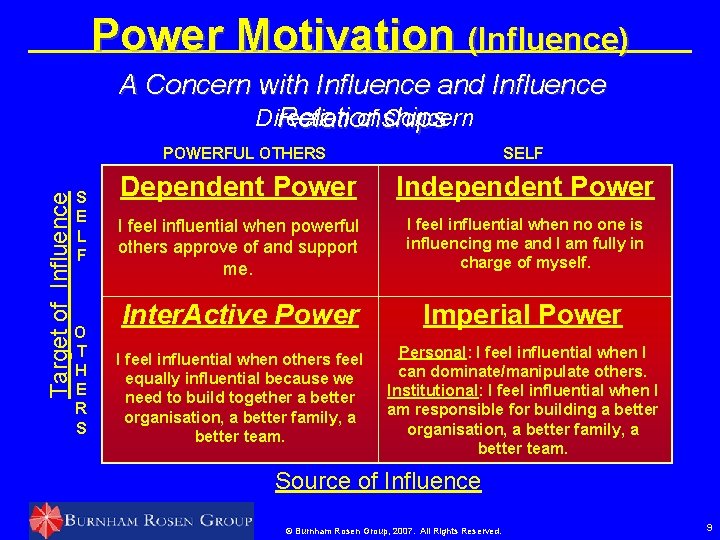
Power Motivation (Influence) A Concern with Influence and Influence Direction of Concern Relationships Target of Influence POWERFUL OTHERS S E L F O T H E R S SELF Dependent Power Independent Power I feel influential when powerful others approve of and support me. I feel influential when no one is influencing me and I am fully in charge of myself. Inter. Active Power Imperial Power I feel influential when others feel equally influential because we need to build together a better organisation, a better family, a better team. Personal: I feel influential when I can dominate/manipulate others. Institutional: I feel influential when I am responsible for building a better organisation, a better family, a better team. Source of Influence © Burnham Rosen Group, 2007. All Rights Reserved. 9
The Research: 1970’s / 1980’s Leaders of Large Organisations Delivering Superior Performance By Type of Power Dependent Independen t Imperial: Personal Imperial: Inter. Active Institutional © Burnham Rosen Group, 2007. All Rights Reserved. 10
Results of International Research Study Leaders by Performance* and Motivation Eight Countries, 1992 -2005 Motivation Key *Business Performance and Employee Morale © Burnham Rosen Group, 2007. All Rights Reserved. 11
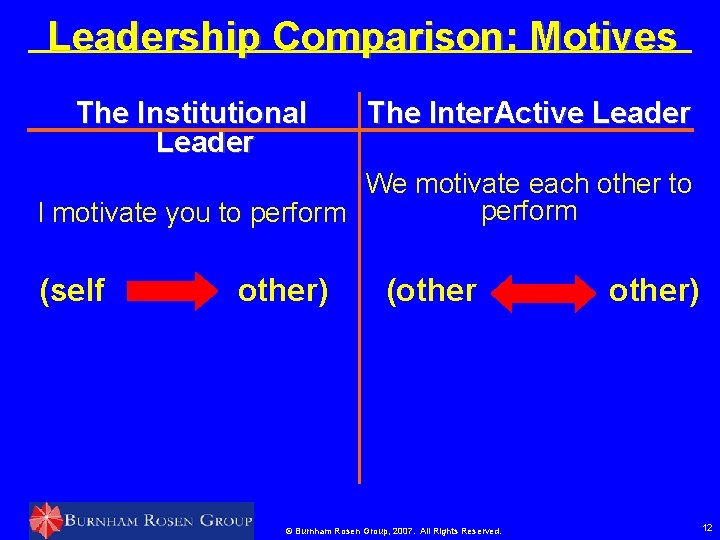
Leadership Comparison: Motives The Institutional Leader The Inter. Active Leader We motivate each other to perform I motivate you to perform (self other) (other © Burnham Rosen Group, 2007. All Rights Reserved. other) 12
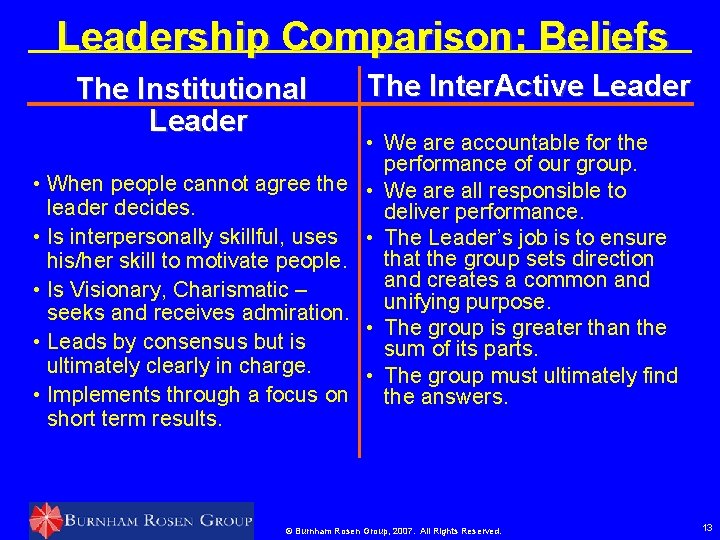
Leadership Comparison: Beliefs The Institutional Leader • When people cannot agree the leader decides. • Is interpersonally skillful, uses his/her skill to motivate people. • Is Visionary, Charismatic – seeks and receives admiration. • Leads by consensus but is ultimately clearly in charge. • Implements through a focus on short term results. The Inter. Active Leader • We are accountable for the performance of our group. • We are all responsible to deliver performance. • The Leader’s job is to ensure that the group sets direction and creates a common and unifying purpose. • The group is greater than the sum of its parts. • The group must ultimately find the answers. © Burnham Rosen Group, 2007. All Rights Reserved. 13
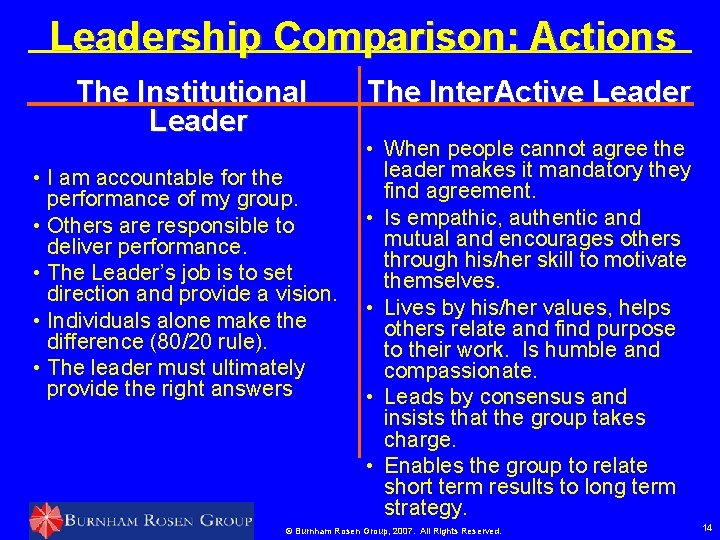
Leadership Comparison: Actions The Institutional Leader • I am accountable for the performance of my group. • Others are responsible to deliver performance. • The Leader’s job is to set direction and provide a vision. • Individuals alone make the difference (80/20 rule). • The leader must ultimately provide the right answers The Inter. Active Leader • When people cannot agree the leader makes it mandatory they find agreement. • Is empathic, authentic and mutual and encourages others through his/her skill to motivate themselves. • Lives by his/her values, helps others relate and find purpose to their work. Is humble and compassionate. • Leads by consensus and insists that the group takes charge. • Enables the group to relate short term results to long term strategy. © Burnham Rosen Group, 2007. All Rights Reserved. 14
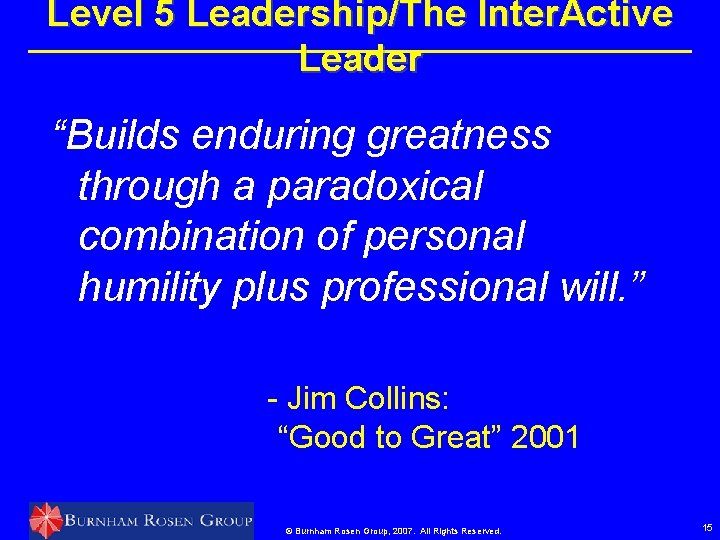
Level 5 Leadership/The Inter. Active Leader “Builds enduring greatness through a paradoxical combination of personal humility plus professional will. ” - Jim Collins: “Good to Great” 2001 © Burnham Rosen Group, 2007. All Rights Reserved. 15
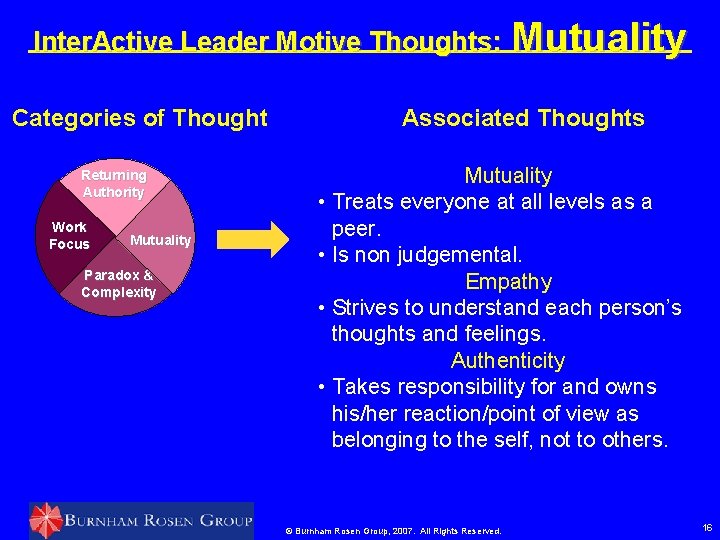
Inter. Active Leader Motive Thoughts: Categories of Thought Returning Authority Work Focus Mutuality Paradox & Complexity Mutuality Associated Thoughts Mutuality • Treats everyone at all levels as a peer. • Is non judgemental. Empathy • Strives to understand each person’s thoughts and feelings. Authenticity • Takes responsibility for and owns his/her reaction/point of view as belonging to the self, not to others. © Burnham Rosen Group, 2007. All Rights Reserved. 16
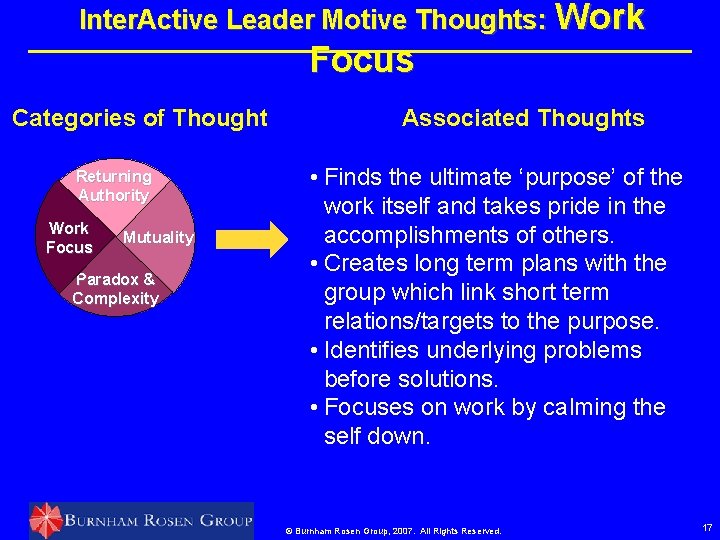
Inter. Active Leader Motive Thoughts: Work Focus Categories of Thought Returning Authority Work Focus Mutuality Paradox & Complexity Associated Thoughts • Finds the ultimate ‘purpose’ of the work itself and takes pride in the accomplishments of others. • Creates long term plans with the group which link short term relations/targets to the purpose. • Identifies underlying problems before solutions. • Focuses on work by calming the self down. © Burnham Rosen Group, 2007. All Rights Reserved. 17
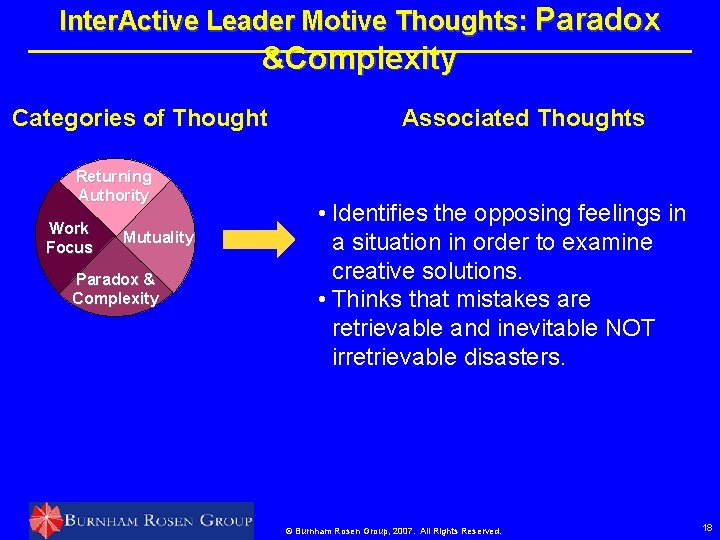
Inter. Active Leader Motive Thoughts: Paradox &Complexity Categories of Thought Returning Authority Work Focus Mutuality Paradox & Complexity Associated Thoughts • Identifies the opposing feelings in a situation in order to examine creative solutions. • Thinks that mistakes are retrievable and inevitable NOT irretrievable disasters. © Burnham Rosen Group, 2007. All Rights Reserved. 18
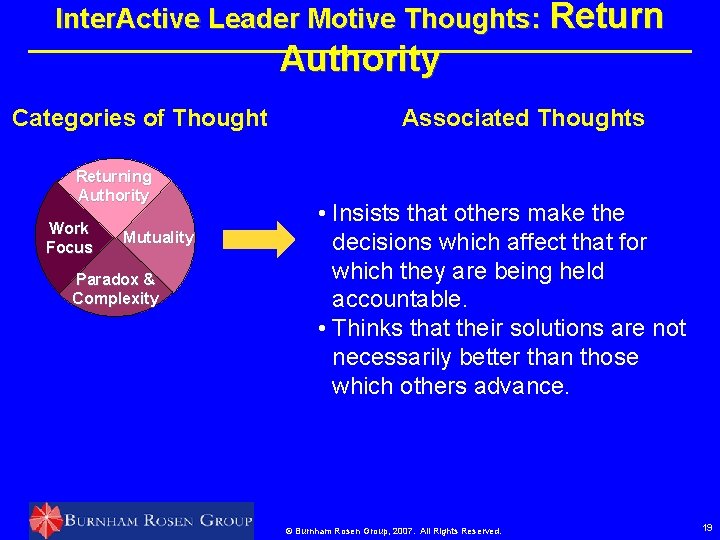
Inter. Active Leader Motive Thoughts: Return Authority Categories of Thought Returning Authority Work Focus Mutuality Paradox & Complexity Associated Thoughts • Insists that others make the decisions which affect that for which they are being held accountable. • Thinks that their solutions are not necessarily better than those which others advance. © Burnham Rosen Group, 2007. All Rights Reserved. 19
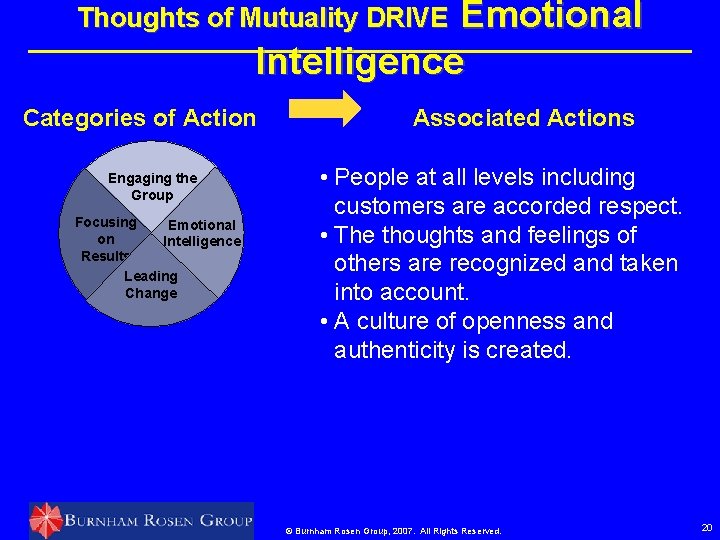
Emotional Intelligence Thoughts of Mutuality DRIVE Categories of Action Engaging the Group Focusing Emotional on Intelligence Results Leading Change Associated Actions • People at all levels including customers are accorded respect. • The thoughts and feelings of others are recognized and taken into account. • A culture of openness and authenticity is created. © Burnham Rosen Group, 2007. All Rights Reserved. 20
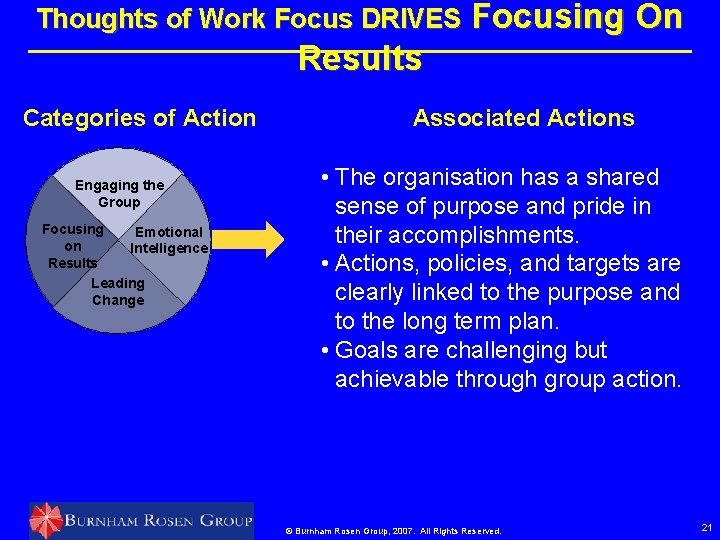
Thoughts of Work Focus DRIVES Focusing On Results Categories of Action Engaging the Group Focusing Emotional on Intelligence Results Leading Change Associated Actions • The organisation has a shared sense of purpose and pride in their accomplishments. • Actions, policies, and targets are clearly linked to the purpose and to the long term plan. • Goals are challenging but achievable through group action. © Burnham Rosen Group, 2007. All Rights Reserved. 21
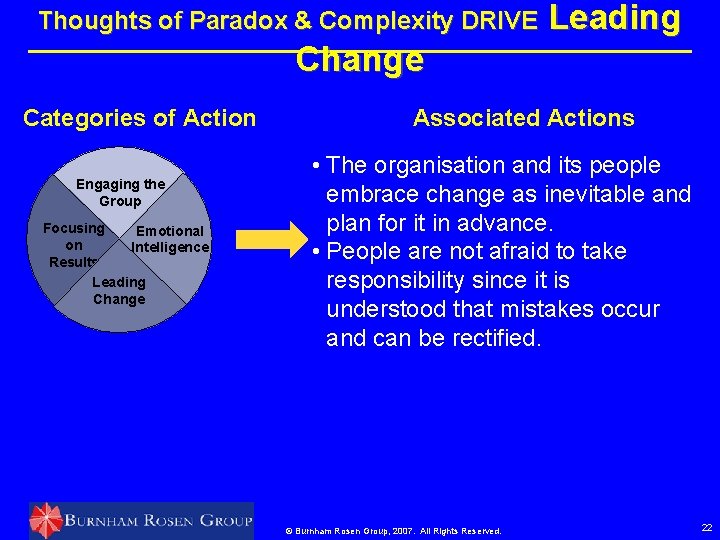
Thoughts of Paradox & Complexity DRIVE Leading Change Categories of Action Engaging the Group Focusing Emotional on Intelligence Results Leading Change Associated Actions • The organisation and its people embrace change as inevitable and plan for it in advance. • People are not afraid to take responsibility since it is understood that mistakes occur and can be rectified. © Burnham Rosen Group, 2007. All Rights Reserved. 22
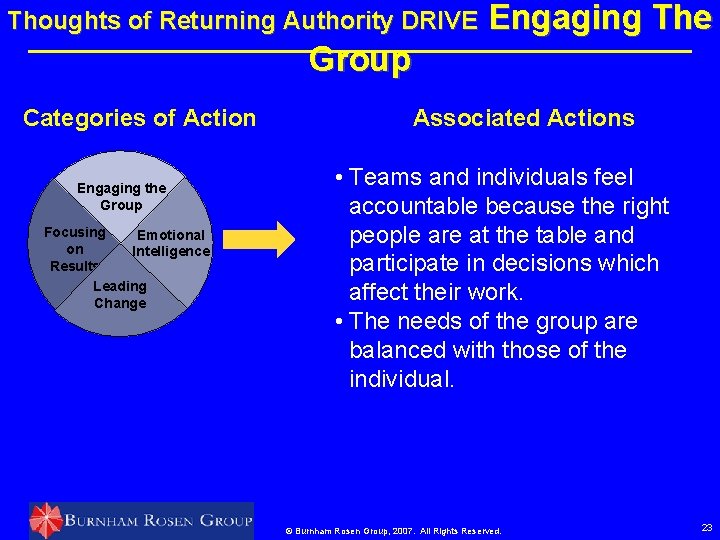
Thoughts of Returning Authority DRIVE Engaging The Group Categories of Action Engaging the Group Focusing Emotional on Intelligence Results Leading Change Associated Actions • Teams and individuals feel accountable because the right people are at the table and participate in decisions which affect their work. • The needs of the group are balanced with those of the individual. © Burnham Rosen Group, 2007. All Rights Reserved. 23
Your Assignment in Your Workshop • Assess your own culture – at present. • Identify your strongest area, your weakest. • Look together at what you can do to keep your strongest strong and improve your weakest. • Report back. © Burnham Rosen Group, 2007. All Rights Reserved. 24
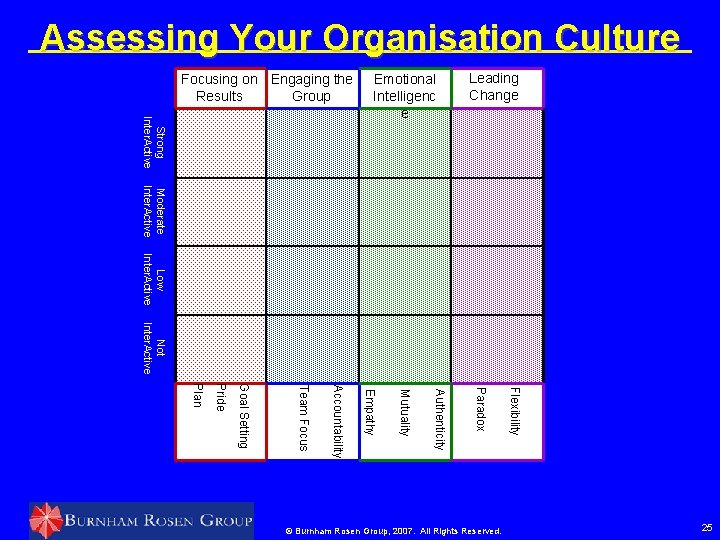
Assessing Your Organisation Culture Focusing on Engaging the Results Group Strong Inter. Active Emotional Intelligenc e Leading Change Moderate Inter. Active Low Inter. Active Not Inter. Active Flexibility Paradox Authenticity Mutuality Empathy Accountability Team Focus Goal Setting Pride Plan © Burnham Rosen Group, 2007. All Rights Reserved. 25
- Slides: 26