
A renormalizationgroup analysis of the magnetic catalysis Based
A renormalization-group analysis of the magnetic catalysis Based on KH, K. Itakura, S. Ozaki, [hep-ph/1706. 04913] (To appear in PLB) Koichi Hattori Workshop of Recent Developments in QCD and Quantum Field Theories @ National Taiwan Univ. , Nov. 10, 2017
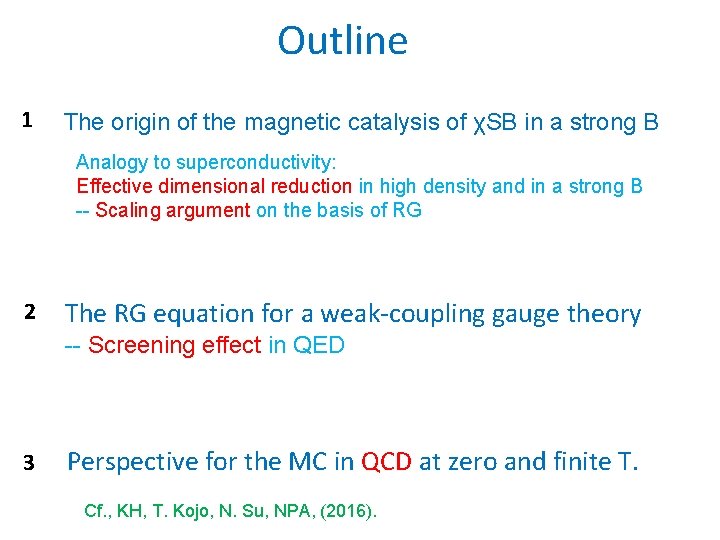
Outline 1 The origin of the magnetic catalysis of χSB in a strong B Analogy to superconductivity: Effective dimensional reduction in high density and in a strong B -- Scaling argument on the basis of RG 2 The RG equation for a weak-coupling gauge theory -- Screening effect in QED 3 Perspective for the MC in QCD at zero and finite T. Cf. , KH, T. Kojo, N. Su, NPA, (2016).

BCS theory Superconductivity occurs no matter how weak the attraction is. “Dimensional reduction” in dense systems -- (1+1)-dimensional low-energy effective theory + Low energy excitations along the radius [(1+1) D] + Degenerated states in the tangential plane [2 D] Quantum correction Phase space volume ~ p. D-1 dp Enhanced IR dynamics induces nonperturbative physics, such as superconductivity and Kondo effect.
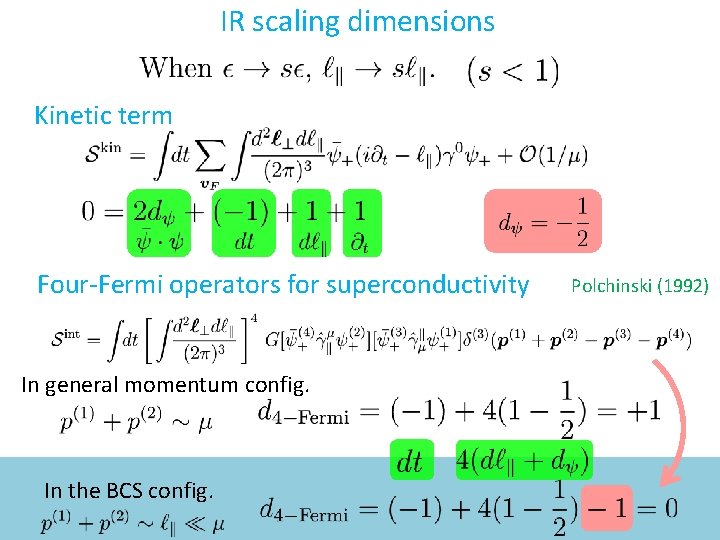
IR scaling dimensions Kinetic term Four-Fermi operators for superconductivity In general momentum config. In the BCS config. Polchinski (1992)
Landau-level quantization and “Dimensional reduction” in a strong magnetic field
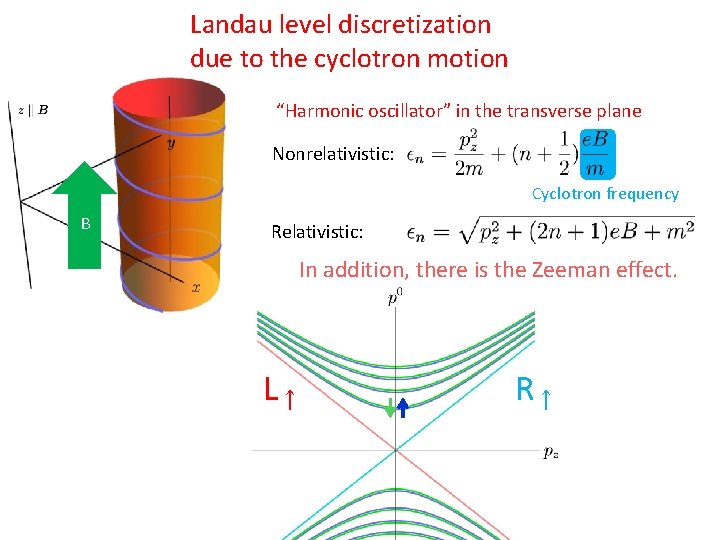
Landau level discretization due to the cyclotron motion “Harmonic oscillator” in the transverse plane Nonrelativistic: Cyclotron frequency B Relativistic: In addition, there is the Zeeman effect. L↑ R↑
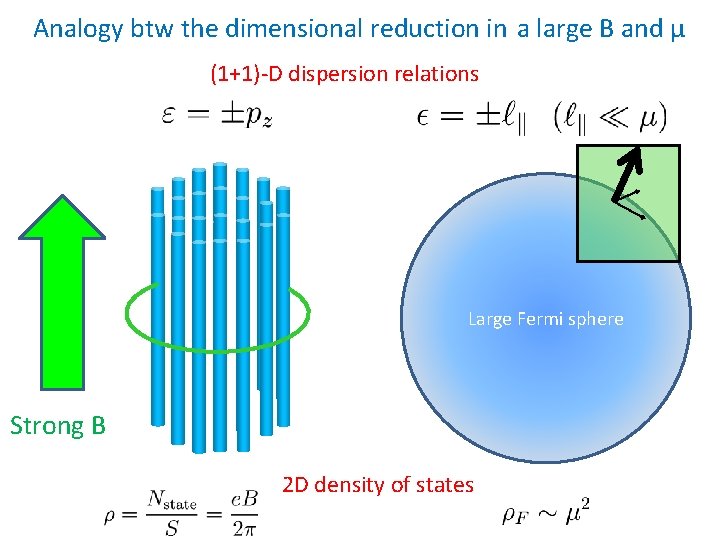
Analogy btw the dimensional reduction in a large B and μ (1+1)-D dispersion relations Large Fermi sphere Strong B 2 D density of states
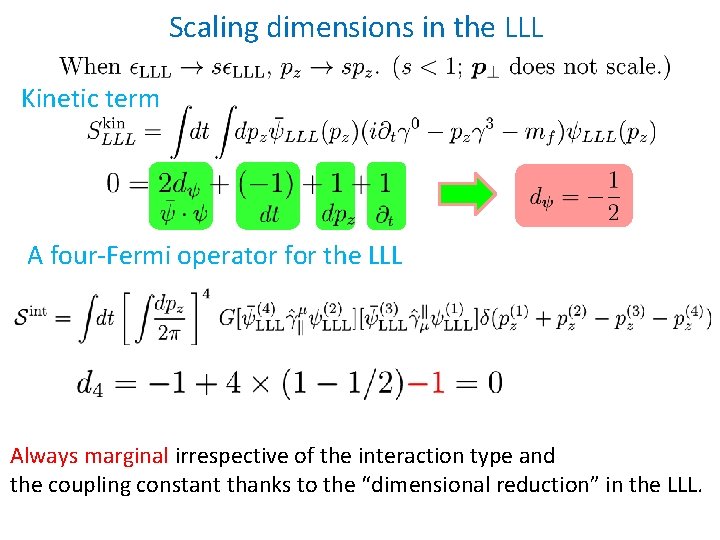
Scaling dimensions in the LLL Kinetic term A four-Fermi operator for the LLL Always marginal irrespective of the interaction type and the coupling constant thanks to the “dimensional reduction” in the LLL.
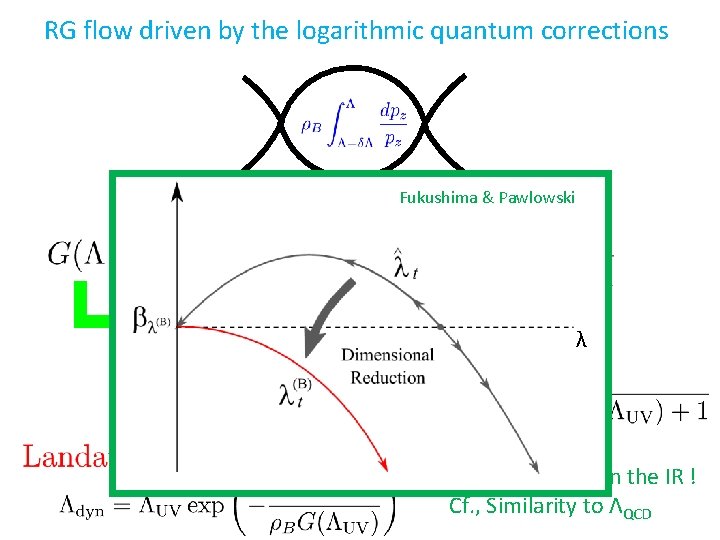
RG flow driven by the logarithmic quantum corrections Fukushima & Pawlowski λ Solution: Emergent scale in the IR ! Cf. , Similarity to ΛQCD
Magnetic catalysis Chiral symmetry breaking occurs solely for the dimensional reason as a consequence of the dimensional reduction in a strong B-field. Chiral symmetry is broken even in QED in a strong B-field. Gusynin, Miransky, and Shovkovy.
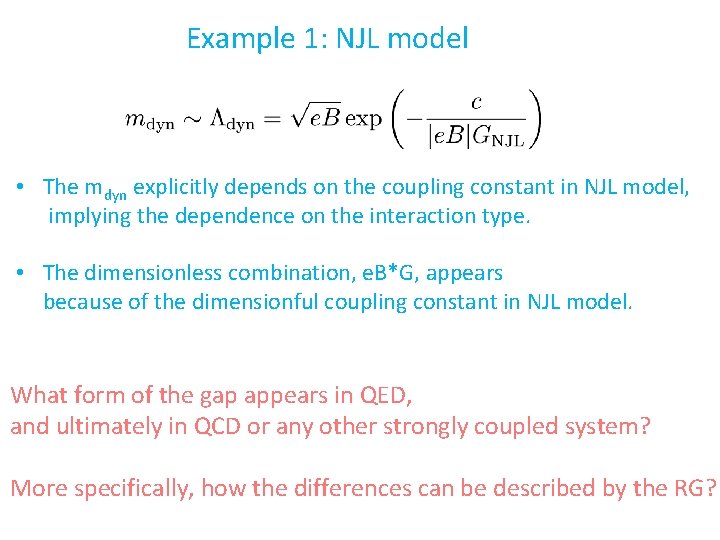
Example 1: NJL model • The mdyn explicitly depends on the coupling constant in NJL model, implying the dependence on the interaction type. • The dimensionless combination, e. B*G, appears because of the dimensionful coupling constant in NJL model. What form of the gap appears in QED, and ultimately in QCD or any other strongly coupled system? More specifically, how the differences can be described by the RG?
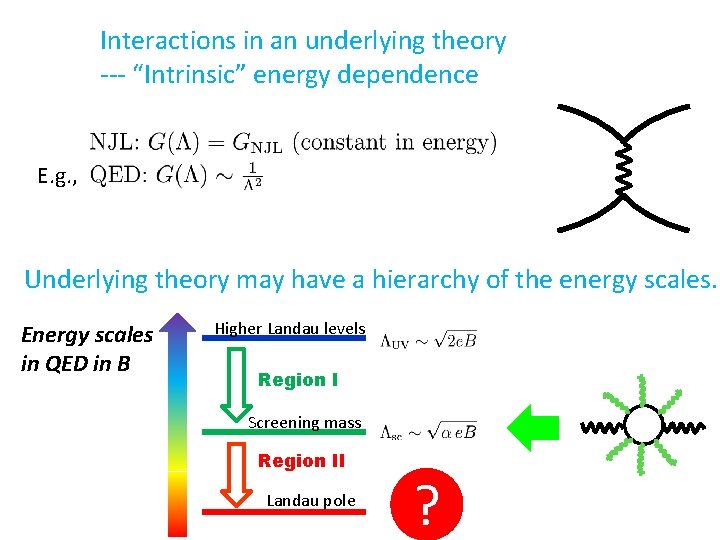
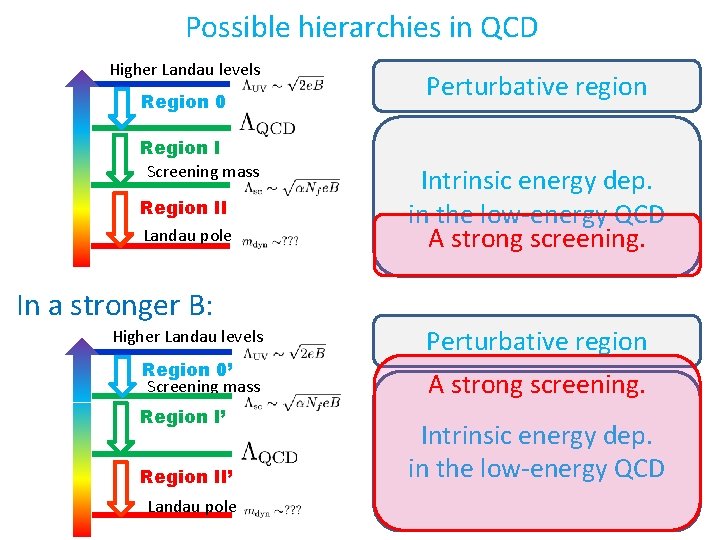
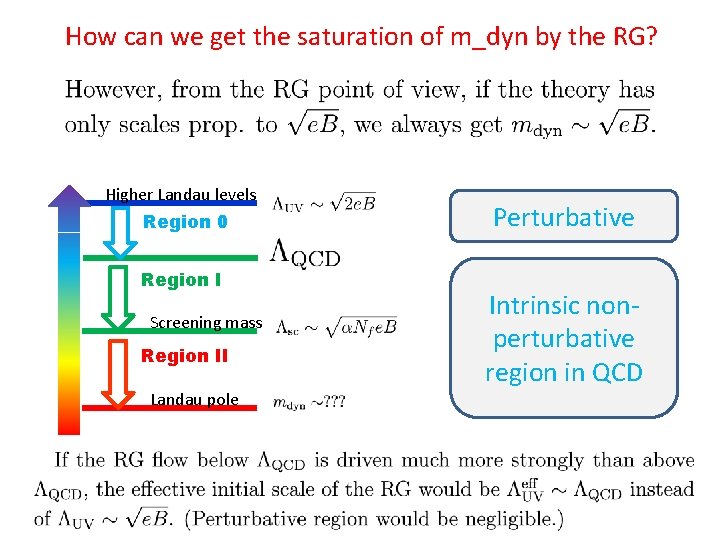
Interactions in an underlying theory --- “Intrinsic” energy dependence E. g. , Underlying theory may have a hierarchy of the energy scales. Energy scales in QED in B Higher Landau levels Region I Screening mass Region II Landau pole ?
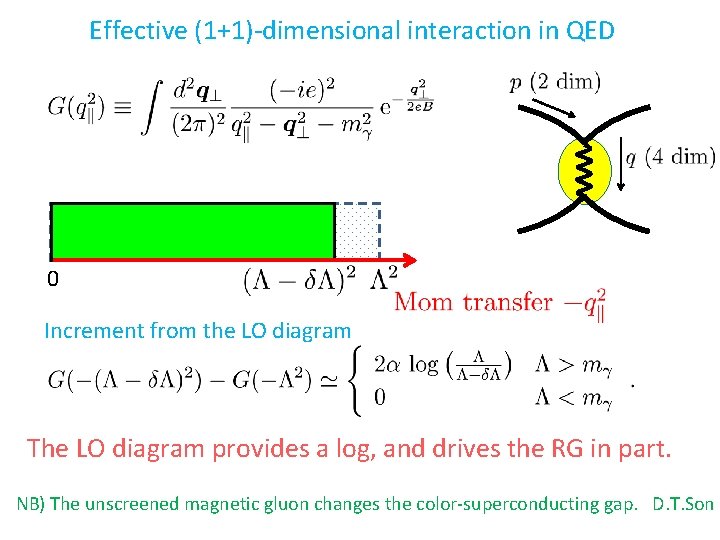
Effective (1+1)-dimensional interaction in QED 0 Increment from the LO diagram The LO diagram provides a log, and drives the RG in part. NB) The unscreened magnetic gluon changes the color-superconducting gap. D. T. Son
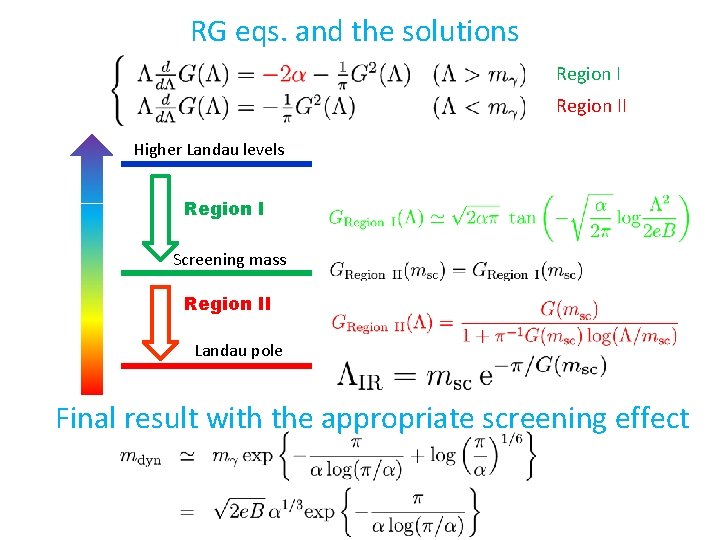
RG eqs. and the solutions Region II Higher Landau levels Region I Screening mass Region II Landau pole Final result with the appropriate screening effect
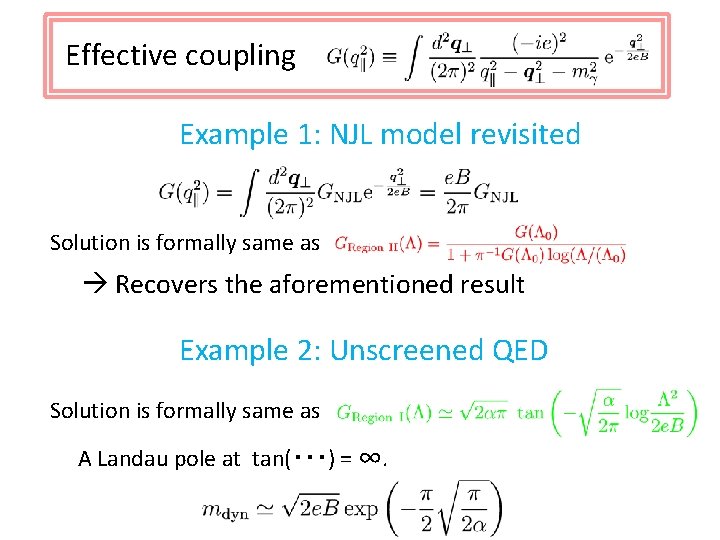
Effective coupling Example 1: NJL model revisited Solution is formally same as Recovers the aforementioned result Example 2: Unscreened QED Solution is formally same as A Landau pole at tan(・・・) = ∞.
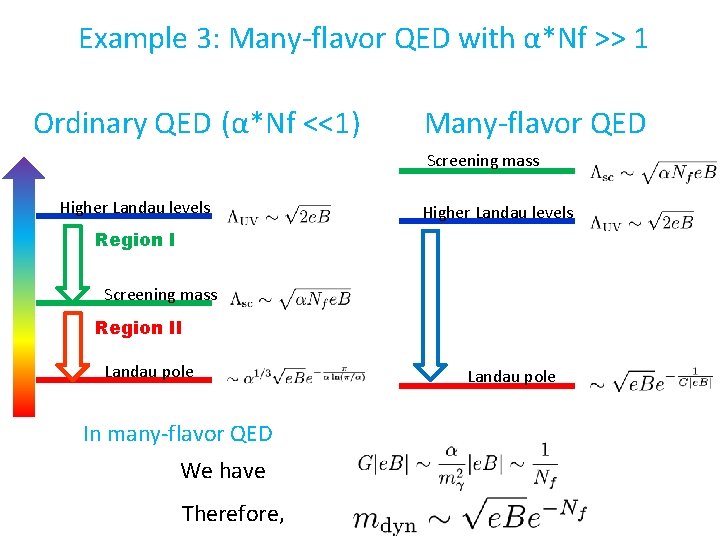
Example 3: Many-flavor QED with α*Nf >> 1 Ordinary QED (α*Nf <<1) Many-flavor QED Screening mass Higher Landau levels Region I Screening mass Region II Landau pole In many-flavor QED We have Therefore, Landau pole
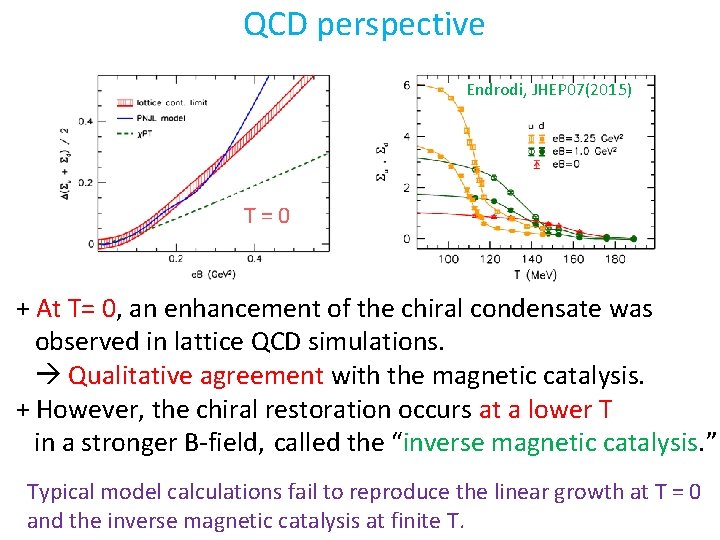
QCD perspective Endrodi, JHEP 07(2015) T=0 + At T= 0, an enhancement of the chiral condensate was observed in lattice QCD simulations. Qualitative agreement with the magnetic catalysis. + However, the chiral restoration occurs at a lower T in a stronger B-field, called the “inverse magnetic catalysis. ” Typical model calculations fail to reproduce the linear growth at T = 0 and the inverse magnetic catalysis at finite T.
Possible hierarchies in QCD Higher Landau levels Region 0 Region I Screening mass Region II Landau pole Perturbative region Intrinsic energy dep. in the low-energy QCD A strong screening. In a stronger B: Higher Landau levels Region 0’ Screening mass Region I’ Region II’ Landau pole Perturbative region A strong screening. Intrinsic energy dep. in the low-energy QCD
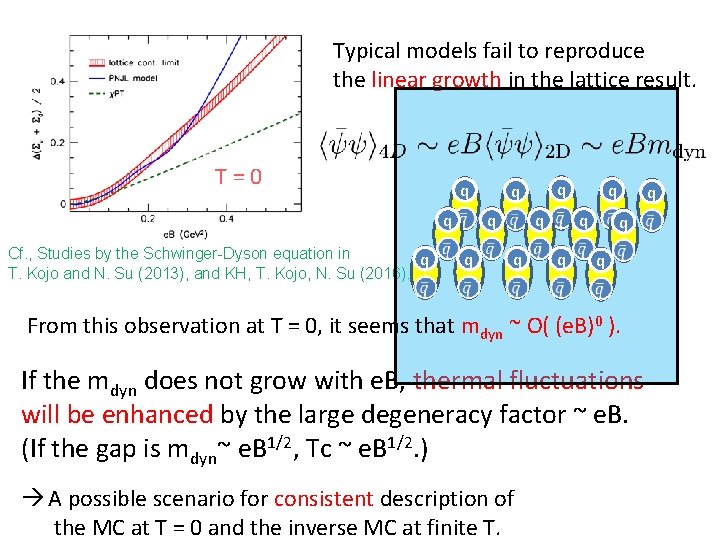
Typical models fail to reproduce the linear growth in the lattice result. T=0 q q Cf. , Studies by the Schwinger-Dyson equation in q T. Kojo and N. Su (2013), and KH, T. Kojo, N. Su (2016). q q q From this observation at T = 0, it seems that mdyn ~ O( (e. B)0 ). If the mdyn does not grow with e. B, thermal fluctuations will be enhanced by the large degeneracy factor ~ e. B. (If the gap is mdyn~ e. B 1/2, Tc ~ e. B 1/2. ) A possible scenario for consistent description of the MC at T = 0 and the inverse MC at finite T.
How can we get the saturation of m_dyn by the RG? Higher Landau levels Region 0 Region I Screening mass Region II Landau pole Perturbative Intrinsic nonperturbative region in QCD
Summary We explicitly saw the dimensional reason for the occurrence of the magnetic catalysis on the basis of the scaling argument. However, the precise form of gap depends the interaction. We discussed the implementation of the screening effect from the RG point of view. More generally, this is a diagnosis of the RG method (or EFT) to include the interaction properties of the underlying theory. To explain the lattice results [or mdyn ~ O( (e. B)0 )], an interaction beyond the four-Fermi (NJL) is important. Cf. , T. Kojo and N. Su (2013), and KH, T. Kojo, N. Su (2016).
- Slides: 21