
A Reinforcement Learning Algorithm for Cognitive Network Optimiser

- Slides: 18
A Reinforcement Learning Algorithm for Cognitive Network Optimiser (CNO) in the 5 G-MEDIA Project Morteza Kheirkhah University College London September 2019 5 G-MEIDA Coding Days 1
Topics • • • Machine learning techniques Reinforcement learning (RL) algorithm RL vs other ML techniques (e. g. supervised and semi-supervised) RL with offline vs online learning RL variants (e. g. A 3 C and DQN) Training A 3 C with parallel agents Key metrics (learning rate, loss function, and entropy) CNO Design for UC 2(state, action, reward) Hands-on exercises 2
Machine learning techniques • Supervised • It needs labeled datasets to train a model • Unsupervised • It does not need labeled datasets, but it needs datasets • Semi-supervised • It works with partially labeled datasets • Reinforcement learning • It does not necessarily need datasets to be trained. It can learn and behave appropriately towards a set of objectives in an online fashion 3
RL key terminologies • Action (A): All the possible decisions that the agent can take. • State (S): Current situation returned by the environment. Current situation is defined by set of parameters • Reward (R): An immediate return send back from the environment to evaluate the last action • Policy (π): The strategy that the agent employs to determine next action based on the current state. • Value (V): The expected long-term return with discount, as opposed to the short-term reward R. Vπ(s) is defined as the expected long-term return of the current state under policy π. 4
Reinforcement learning algorithm • An RL agent takes an action (at a particular condition) towards a particular goal, it then receives a reward for it. • This way, the agent tends to adjust its actions (behavior) to achieve a higher reward. • To make choices, the agent relies both on learnings from past feedback and exploration of new tactics (actions) that may present a larger payoff. 5
RL vs other ML techniques • Unlike supervised/unsupervised learning algorithms that require diverse datasets, an RL algorithm requires diverse environments to be trained • Exposing a RL algorithm to a large number of conditions in the real environment is a time-consuming process • It is typical to train an RL algorithm in a simulated and emulated environment 6
RL with offline vs online learning There are several ways to deploy an RL algorithm in real systems: 1. You can immediately deploy your algorithm in the real environment and lets your algorithm learn in an online fashion 2. You can initially train your algorithm offline by simulating real environment and then deploy your trained model in a real system with no more learning 3. You can initially train your model offline and then deploy it in a real system and continue learning afterwards 7
RL variants • • Asynchronous Advantage Actor-Critic (A 3 C)* Tabular Q-Learning* Deep Q-Network (DQN) Deep Deterministic Policy Gradient (DDPG) REINFORCE State-Action-Reward-State-Action (SARSA) … 8
RL variants • Tabular Q-Learning Algorithm: • All possible states and actions are stored in a table • A possible drawback is that the algorithm do not scale well when the state-action space is very large • A solution to the above issue is to decrease the state space by making some simplifications that often translate to unrealistic conditions. • For example, an RL algorithm assumes that the next action can be decided based on current state. • This often results in poor prediction of network condition and in turn wrong action may be selected 9
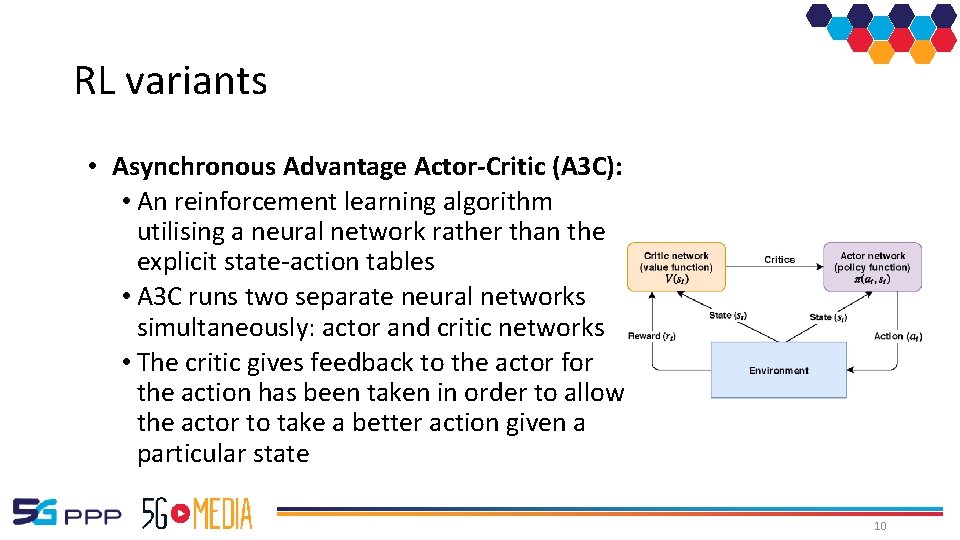
RL variants • Asynchronous Advantage Actor-Critic (A 3 C): • An reinforcement learning algorithm utilising a neural network rather than the explicit state-action tables • A 3 C runs two separate neural networks simultaneously: actor and critic networks • The critic gives feedback to the actor for the action has been taken in order to allow the actor to take a better action given a particular state 10
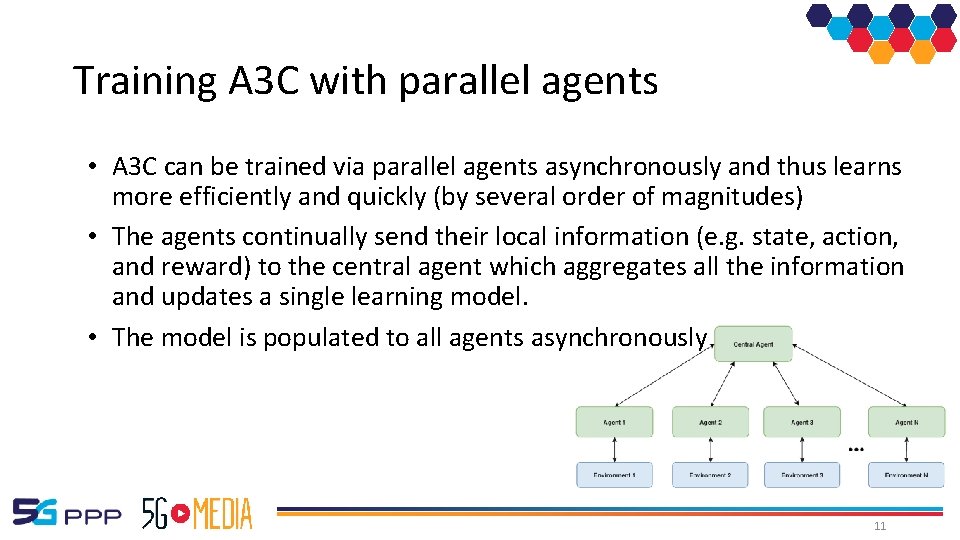
Training A 3 C with parallel agents • A 3 C can be trained via parallel agents asynchronously and thus learns more efficiently and quickly (by several order of magnitudes) • The agents continually send their local information (e. g. state, action, and reward) to the central agent which aggregates all the information and updates a single learning model. • The model is populated to all agents asynchronously 11
Key metrics: Learning rate • The amount that the weights are updated during training is referred to as the “learning rate”. It controls how quickly or slowly a neural network model learns a problem • During training, the backpropagation of error estimates the amount of error for which the weights of a node in the network are responsible. Instead of updating the weight with the full amount it is scaled by the learning rate • For example a learning rate of 0. 1 means that weights in the network are updated 0. 1 * (estimated weight error) 12
Key metrics: Loss function • A loss function is used for measuring the discrepancy between the target (expected) output and the computed output, after a training example has propagated through the network • The result of the loss function can be a small value if the value of computed and expected outputs are close 13
Key metrics: Entropy • We can think of Entropy as a surprising scenario, when an agent is really puzzled. For example when at a particular state a set of large actions with a very close probability can be selected. • Agent should explore other possibilities to get better knowledge of its state-action relationship. • When something surprising happens entropy should increase given that the value of entropy is a negative input to the loss function. 14
CNO goals for UC 2 (Smart + Remote Media Production) • The goal is to maximize the Quality of Experience (Qo. E) perceived by the user • To achieve the above goal we follow two key objectives: • Decrease packet drop by appropriately selecting the video quality level according to current network condition • Change video quality with smoothness. In other words, jumping from a very high video quality (bitrate) level to a very low one tends to be minimized 15
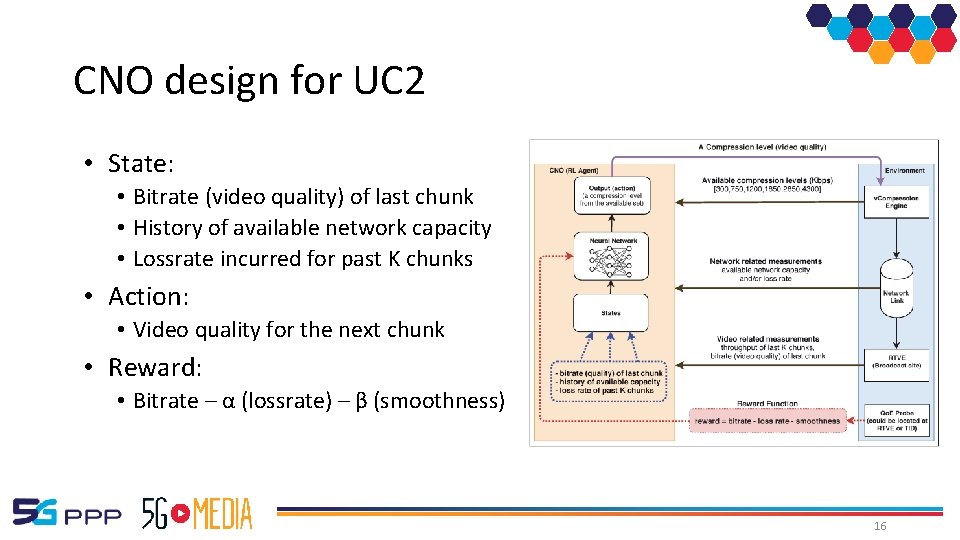
CNO design for UC 2 • State: • Bitrate (video quality) of last chunk • History of available network capacity • Lossrate incurred for past K chunks • Action: • Video quality for the next chunk • Reward: • Bitrate – α (lossrate) – β (smoothness) 16
No more theory Time to get your hands dirty with code CNO source code is available with the following link: https: //github. com/mkheirkhah/5 gmedia/tree/deployed/cno 17
March 2019 5 G-MEDIA Project Meeting in Munich 18