
A regular polygon is a polygon with all



- Slides: 38
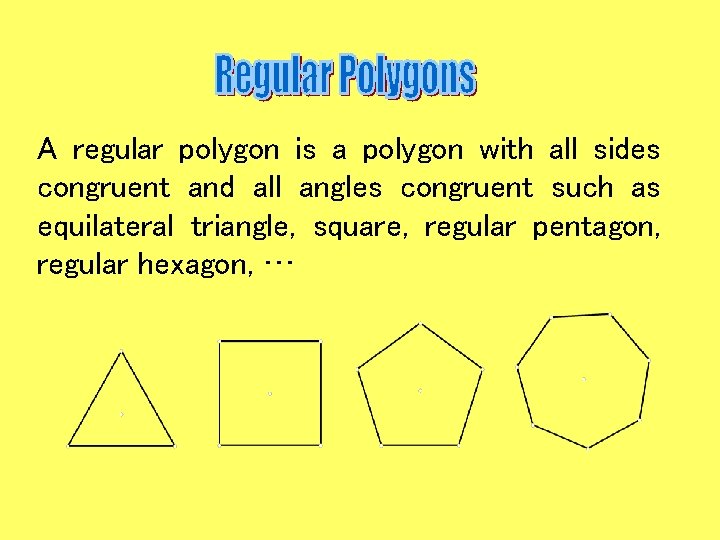
A regular polygon is a polygon with all sides congruent and all angles congruent such as equilateral triangle, square, regular pentagon, regular hexagon, …
By a (convex) regular polyhedron we mean a polyhedron with the properties that All its faces are congruent regular polygons. The arrangements of polygons about the vertices are all alike.
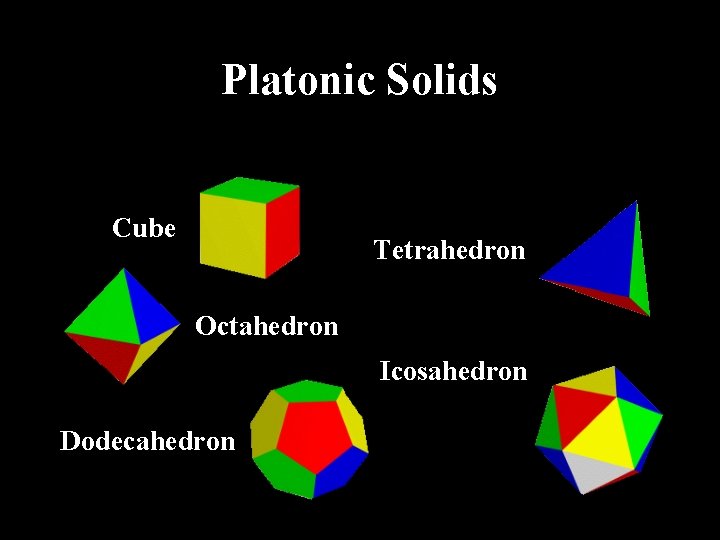
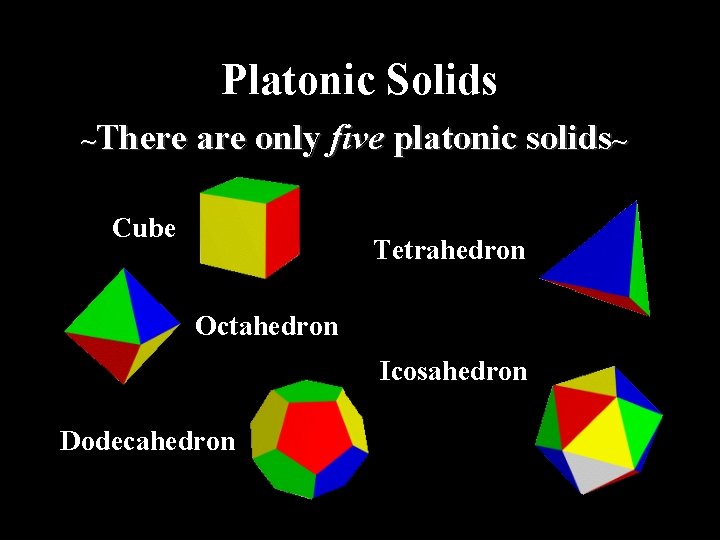
The regular polyhedra are the bestknown polyhedra that have connected numerous disciplines such as astronomy, philosophy, and art through the centuries. They are known as the Platonic solids.
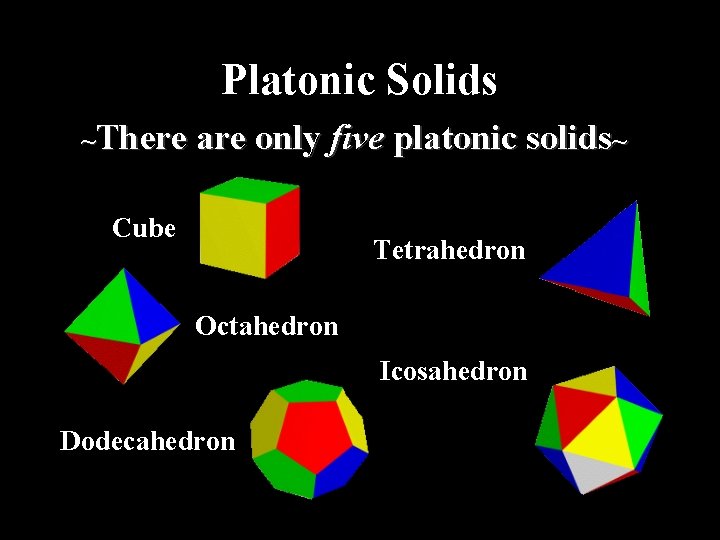
Platonic Solids ~There are only five platonic solids~ Cube Tetrahedron Octahedron Dodecahedron Icosahedron
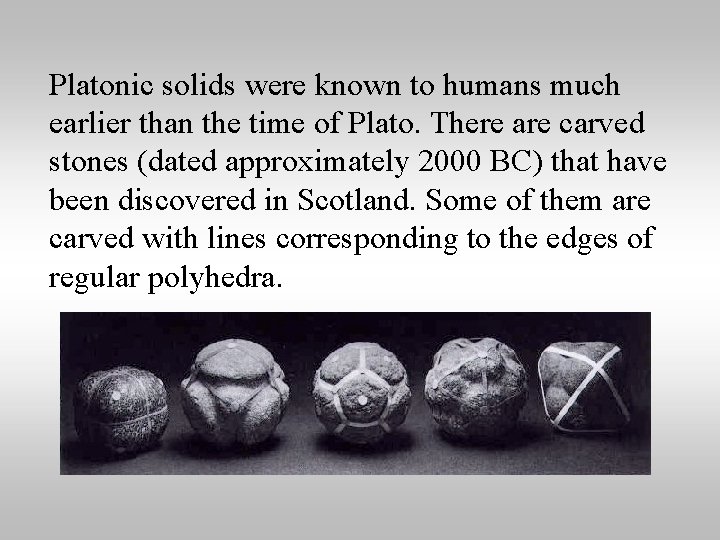
Platonic solids were known to humans much earlier than the time of Plato. There are carved stones (dated approximately 2000 BC) that have been discovered in Scotland. Some of them are carved with lines corresponding to the edges of regular polyhedra.
Icosahedral dice were used by the ancient Egyptians.
Evidence shows that Pythagoreans knew about the regular solids of cube, tetrahedron, and dodecahedron. A later Greek mathematician, Theatetus (415 - 369 BC) has been credited for developing a general theory of regular polyhedra and adding the octahedron and icosahedron to solids that were known earlier.
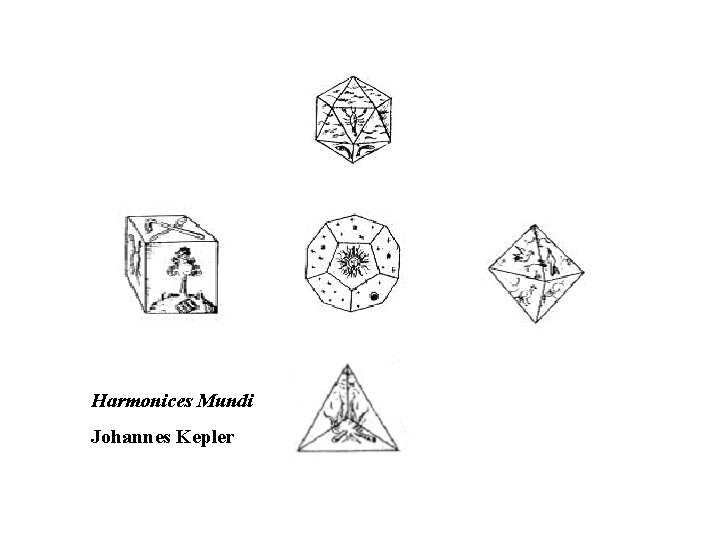
The name “Platonic solids” for regular polyhedra comes from the Greek philosopher Plato (427 - 347 BC) who associated them with the “elements” and the cosmos in his book Timaeus. “Elements, ” in ancient beliefs, were the four objects that constructed the physical world; these elements are fire, air, earth, and water. Plato suggested that the geometric forms of the smallest particles of these elements are regular polyhedra. Fire is represented by the tetrahedron, earth the octahedron, water the icosahedron, and the almostspherical dodecahedron the universe.
Harmonices Mundi Johannes Kepler
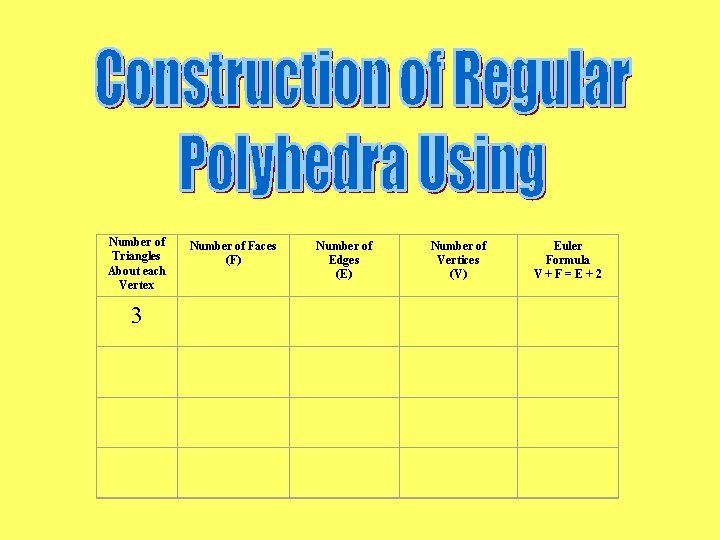
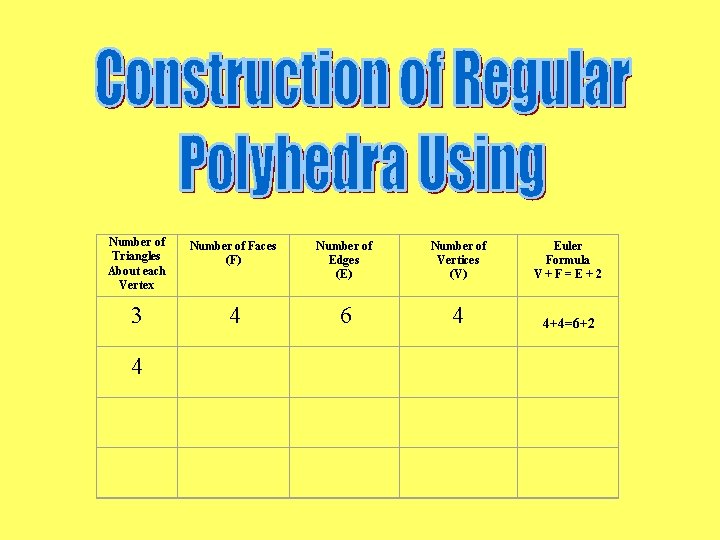
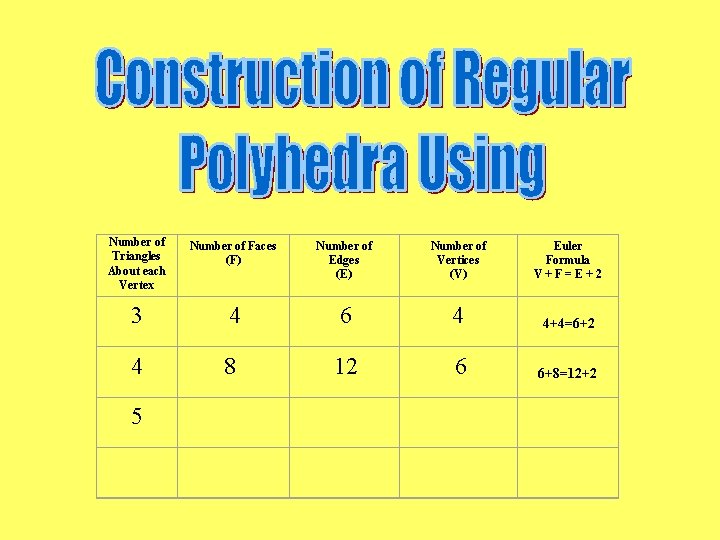
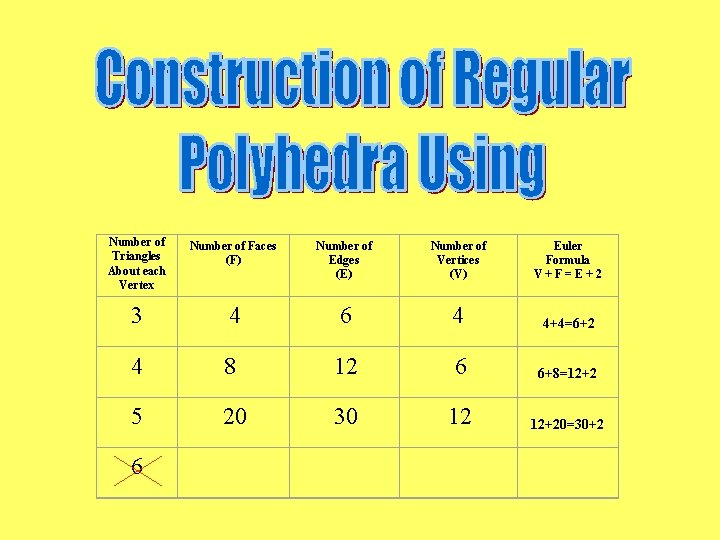
Number of Triangles About each Vertex Number of Faces (F) Number of Edges (E) Number of Vertices (V) Euler Formula V+F=E+2 3
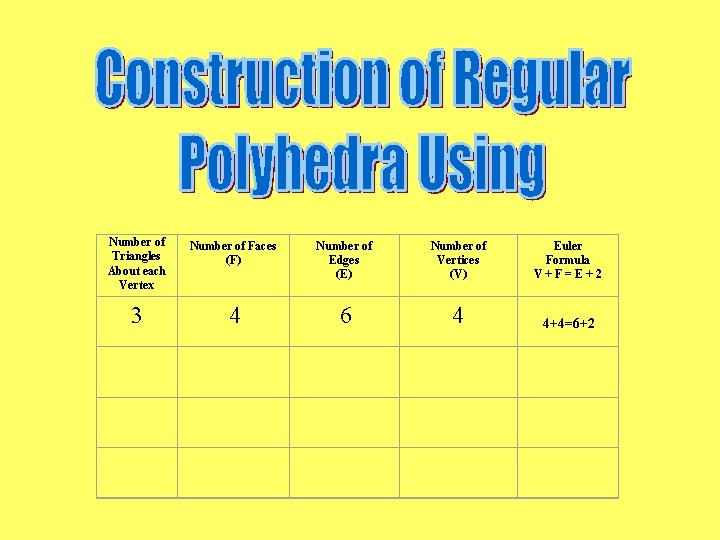
Number of Triangles About each Vertex 3 Number of Faces (F) 4 Number of Edges (E) Number of Vertices (V) Euler Formula V+F=E+2 6 4 4+4=6+2
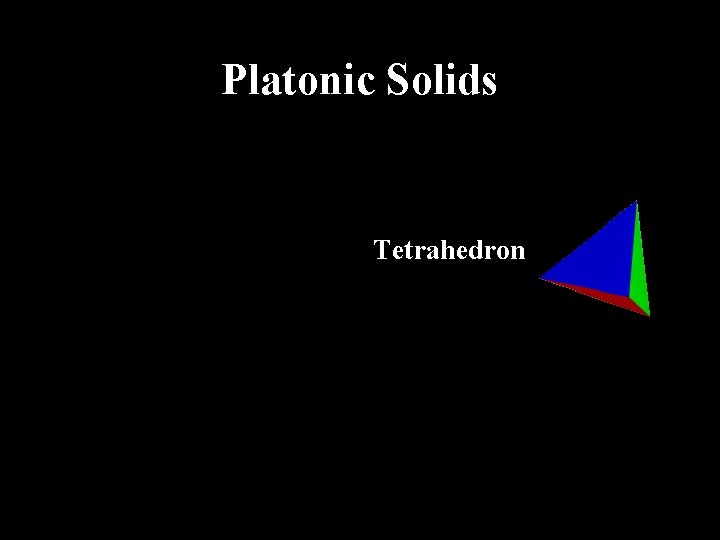
Platonic Solids Tetrahedron
Number of Triangles About each Vertex 3 Number of Faces (F) 4 Number of Edges (E) Number of Vertices (V) Euler Formula V+F=E+2 6 4 4+4=6+2 4
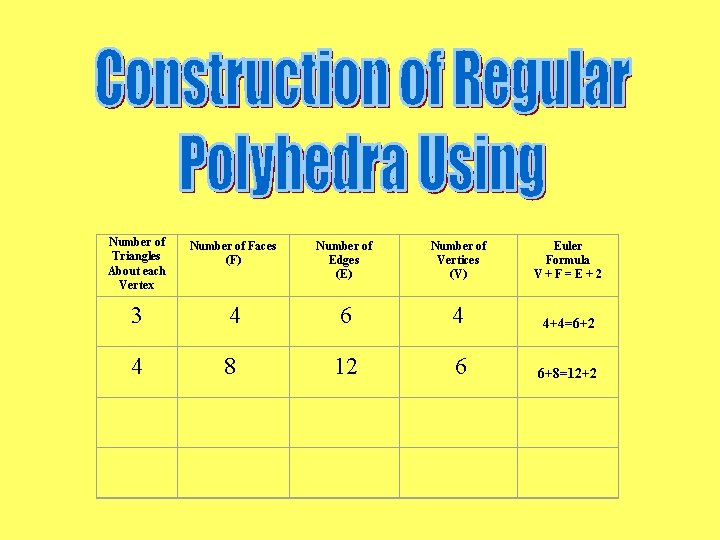
Number of Triangles About each Vertex Number of Faces (F) 3 4 8 Number of Edges (E) Number of Vertices (V) Euler Formula V+F=E+2 6 4 4+4=6+2 12 6 6+8=12+2 4
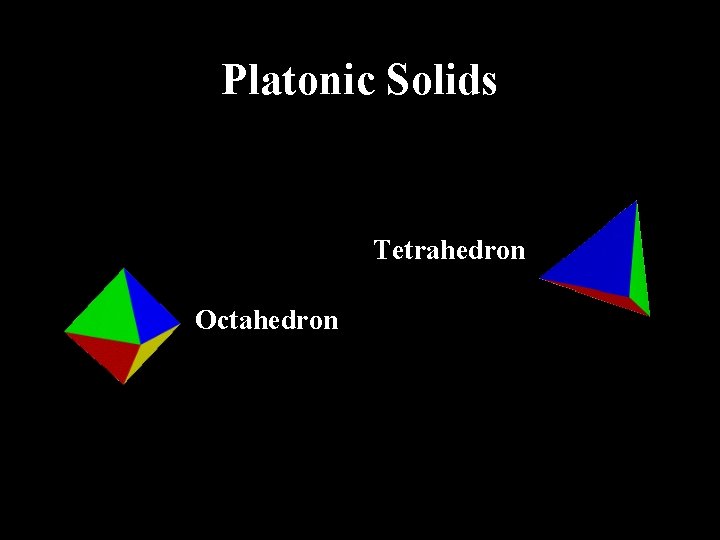
Platonic Solids Tetrahedron Octahedron
Number of Triangles About each Vertex Number of Faces (F) Number of Edges (E) Number of Vertices (V) Euler Formula V+F=E+2 6 4 4+4=6+2 12 6 6+8=12+2 3 4 4 8 5
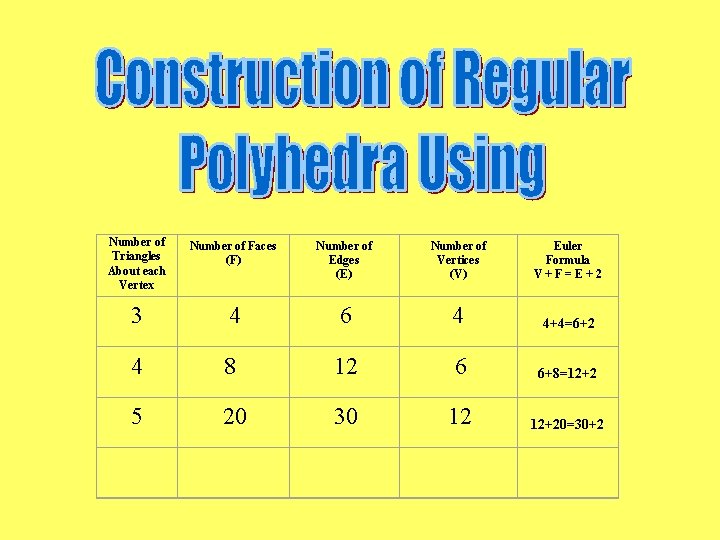
Number of Triangles About each Vertex Number of Faces (F) Number of Edges (E) Number of Vertices (V) Euler Formula V+F=E+2 6 4 4+4=6+2 12 6 3 4 8 20 5 4 30 6+8=12+2 12 12+20=30+2
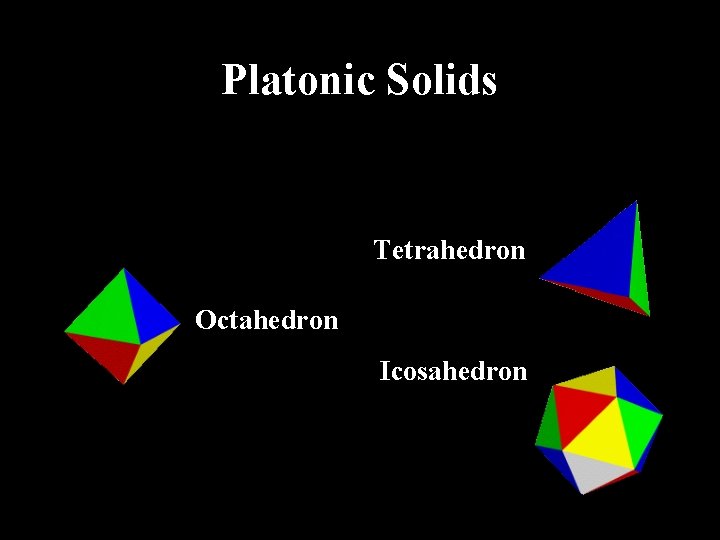
Platonic Solids Tetrahedron Octahedron Icosahedron
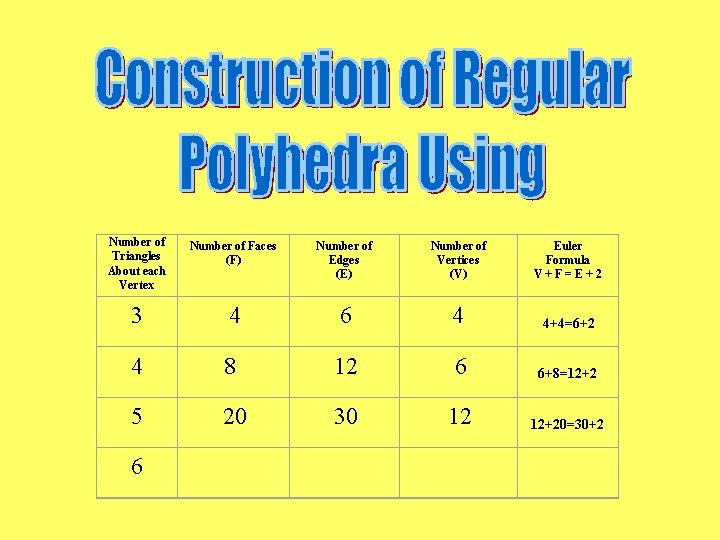
Number of Triangles About each Vertex Number of Faces (F) Number of Edges (E) Number of Vertices (V) Euler Formula V+F=E+2 6 4 4+4=6+2 12 6 3 4 8 20 5 6 4 30 6+8=12+2 12 12+20=30+2
Number of Triangles About each Vertex Number of Faces (F) Number of Edges (E) Number of Vertices (V) Euler Formula V+F=E+2 6 4 4+4=6+2 12 6 3 4 8 20 5 6 4 30 6+8=12+2 12 12+20=30+2
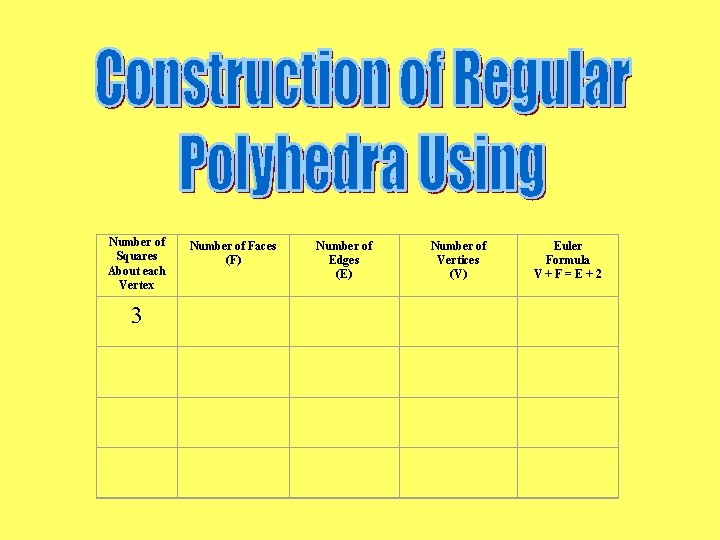
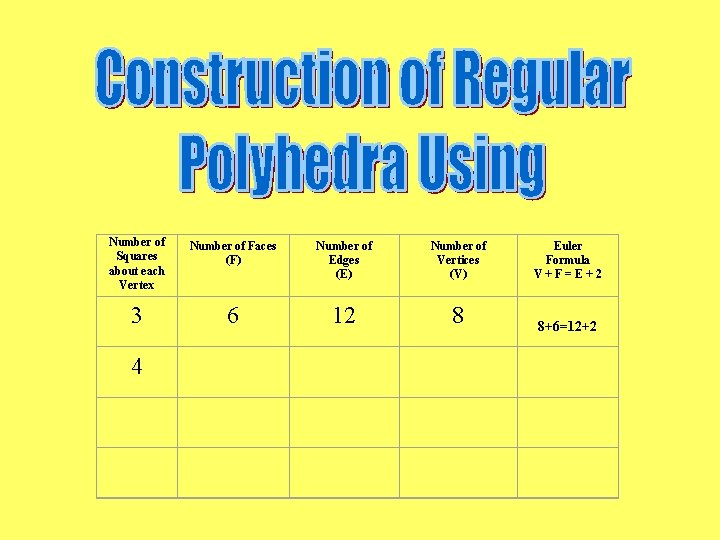
Number of Squares About each Vertex Number of Faces (F) 3 Number of Edges (E) Number of Vertices (V) Euler Formula V+F=E+2
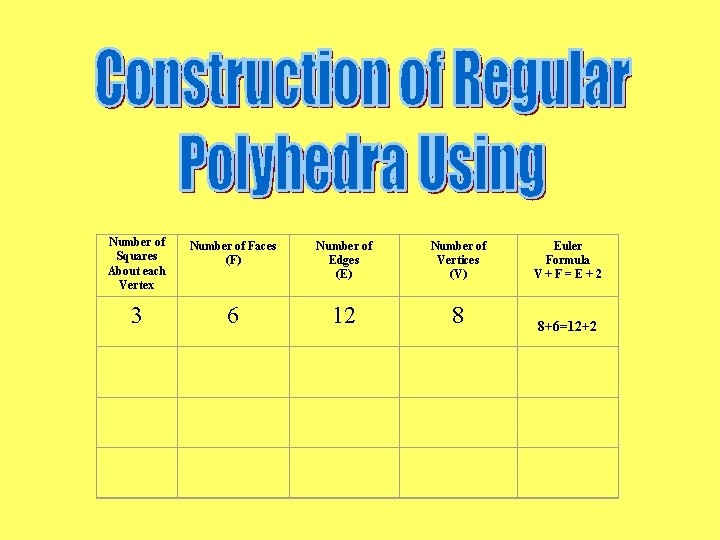
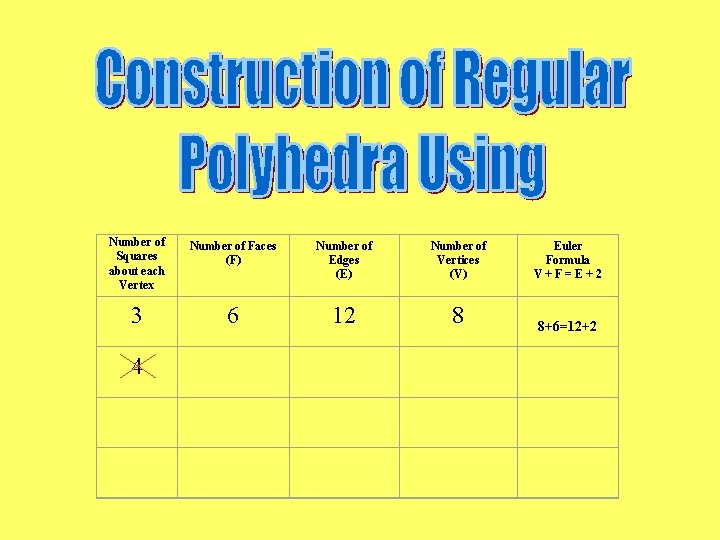
Number of Squares About each Vertex Number of Faces (F) Number of Edges (E) Number of Vertices (V) Euler Formula V+F=E+2 3 6 12 8 8+6=12+2
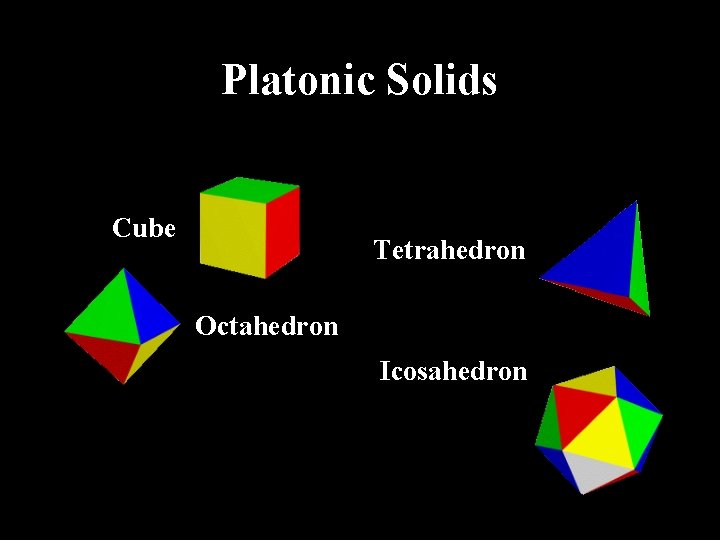
Platonic Solids Cube Tetrahedron Octahedron Icosahedron
Number of Squares about each Vertex Number of Faces (F) Number of Edges (E) Number of Vertices (V) Euler Formula V+F=E+2 3 6 12 8 8+6=12+2 4
Number of Squares about each Vertex Number of Faces (F) Number of Edges (E) Number of Vertices (V) Euler Formula V+F=E+2 3 6 12 8 8+6=12+2 4
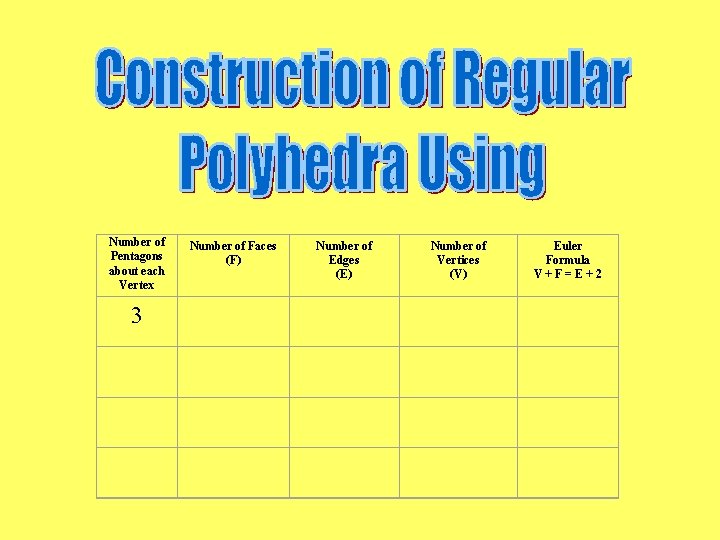
Number of Pentagons about each Vertex Number of Faces (F) Number of Edges (E) Number of Vertices (V) Euler Formula V+F=E+2 3
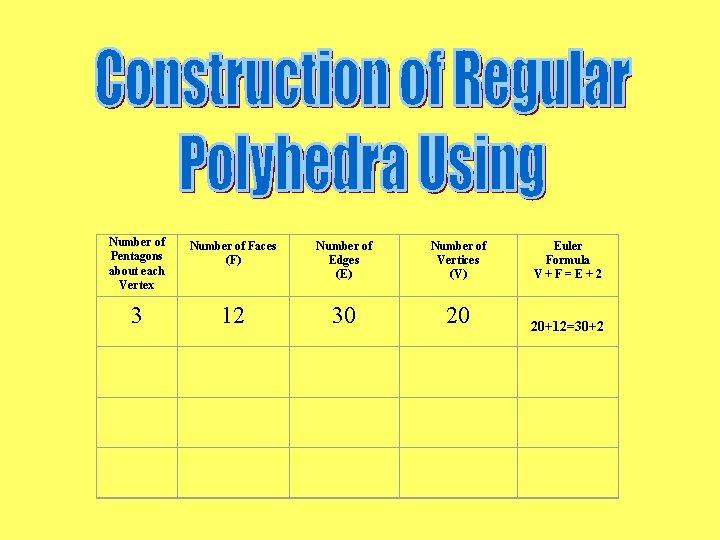
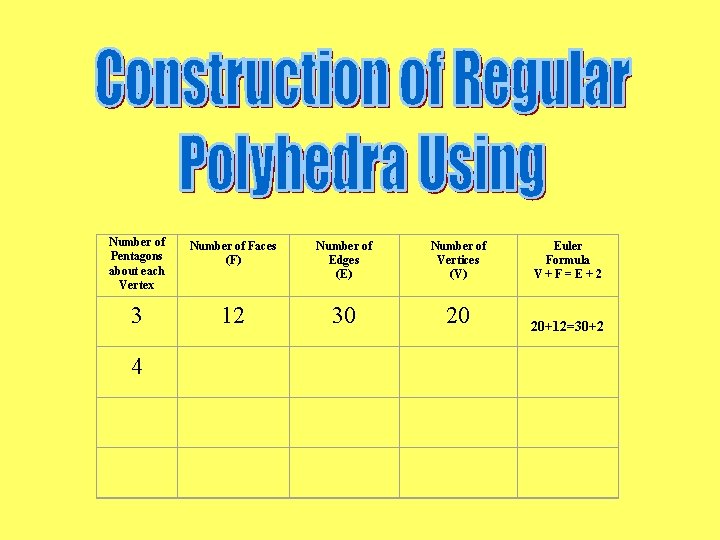
Number of Pentagons about each Vertex Number of Faces (F) Number of Edges (E) Number of Vertices (V) Euler Formula V+F=E+2 3 12 30 20 20+12=30+2
Platonic Solids Cube Tetrahedron Octahedron Dodecahedron Icosahedron
Number of Pentagons about each Vertex Number of Faces (F) Number of Edges (E) Number of Vertices (V) Euler Formula V+F=E+2 3 12 30 20 20+12=30+2 4
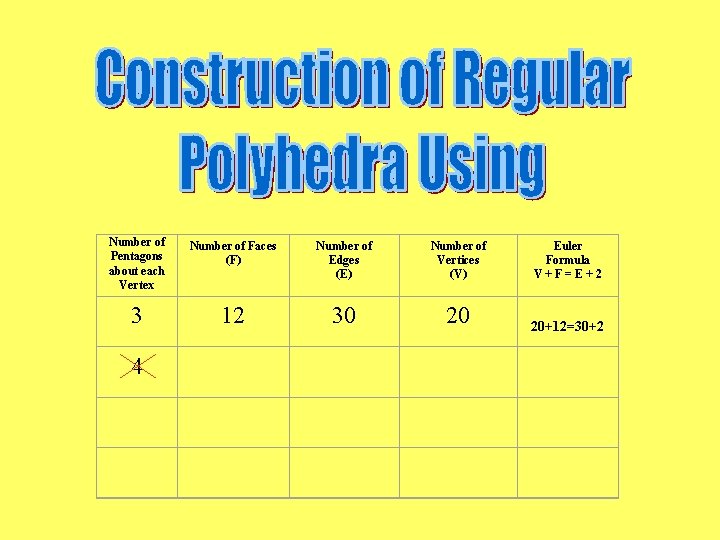
Number of Pentagons about each Vertex Number of Faces (F) Number of Edges (E) Number of Vertices (V) Euler Formula V+F=E+2 3 12 30 20 20+12=30+2 4
Number of Hexagons about each Vertex Number of Faces (F) Number of Edges (E) Number of Vertices (V) Euler Formula V+F=E+2 3
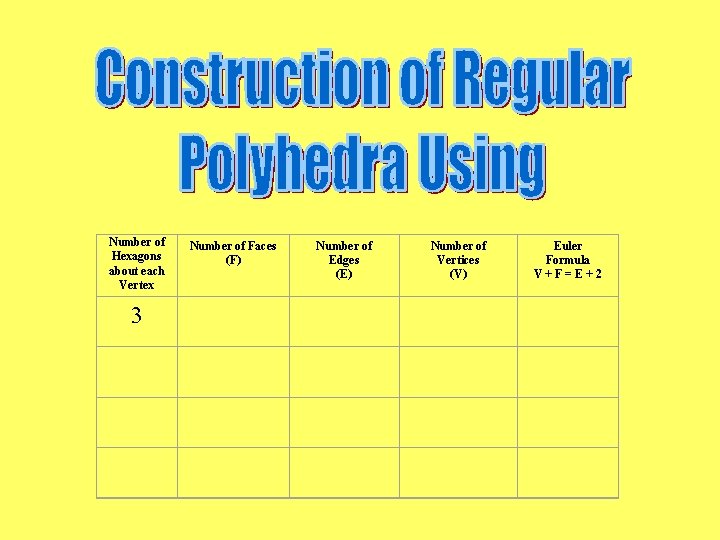
Number of Hexagons about each Vertex Number of Faces (F) Number of Edges (E) Number of Vertices (V) Euler Formula V+F=E+2 3
Platonic Solids ~There are only five platonic solids~ Cube Tetrahedron Octahedron Dodecahedron Icosahedron
We define the dual of a regular polyhedron to be another regular polyhedron, which is formed by connecting the centers of the faces of the original polyhedron
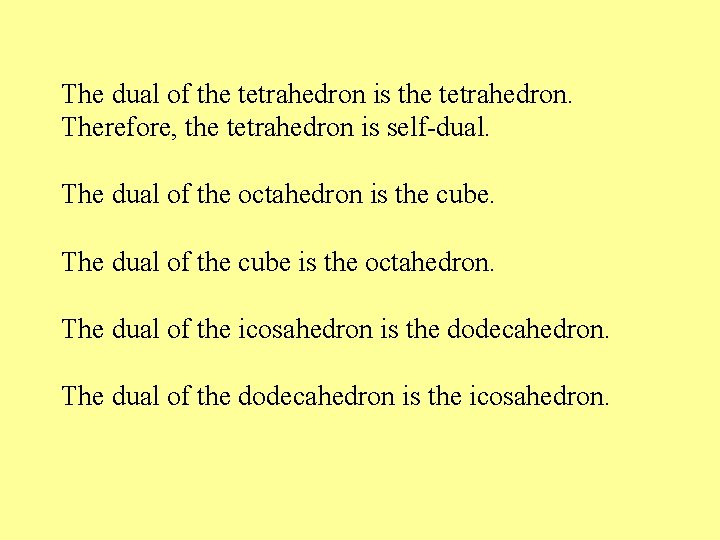
The dual of the tetrahedron is the tetrahedron. Therefore, the tetrahedron is self-dual. The dual of the octahedron is the cube. The dual of the cube is the octahedron. The dual of the icosahedron is the dodecahedron. The dual of the dodecahedron is the icosahedron.
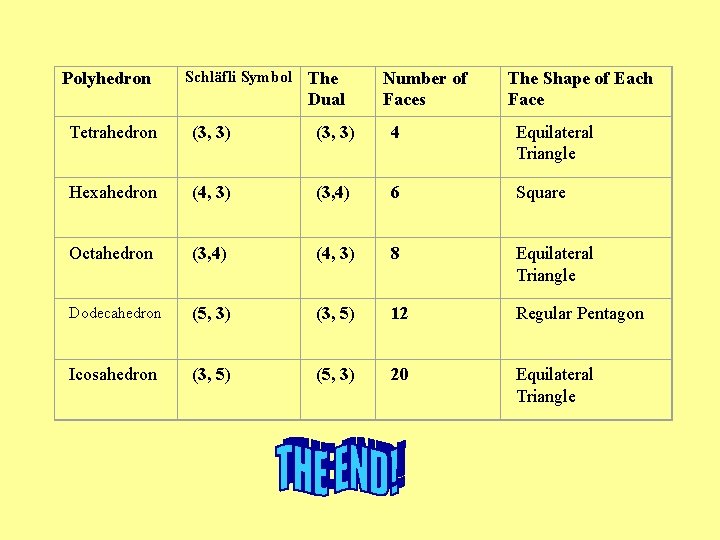
Polyhedron Schläfli Symbol The Dual Number of Faces The Shape of Each Face Tetrahedron (3, 3) 4 Equilateral Triangle Hexahedron (4, 3) (3, 4) 6 Square Octahedron (3, 4) (4, 3) 8 Equilateral Triangle Dodecahedron (5, 3) (3, 5) 12 Regular Pentagon Icosahedron (3, 5) (5, 3) 20 Equilateral Triangle