
A regimedependent balanced control variable based on potential
A regime-dependent balanced control variable based on potential vorticity Ross Bannister, Data Assimilation Research Centre, University of Reading Mike Cullen, Numerical Weather Prediction, Met Office Funding: NERC and Met Office ECMWF Workshop on Flow-dependent Aspects of Data Assimilation, 11 -13 th June 2007 ECMWF flow dependent workshop, June 2007. Slide 1 of 14.
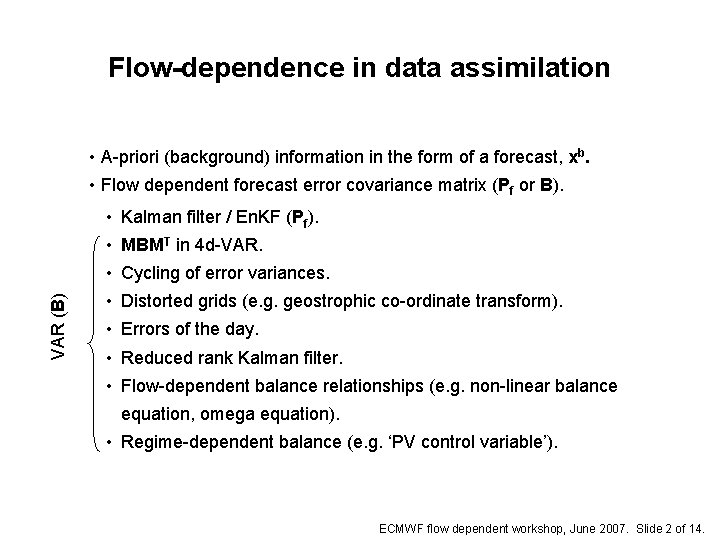
Flow-dependence in data assimilation • A-priori (background) information in the form of a forecast, xb. • Flow dependent forecast error covariance matrix (Pf or B). • Kalman filter / En. KF (Pf). • MBMT in 4 d-VAR. VAR (B) • Cycling of error variances. • Distorted grids (e. g. geostrophic co-ordinate transform). • Errors of the day. • Reduced rank Kalman filter. • Flow-dependent balance relationships (e. g. non-linear balance equation, omega equation). • Regime-dependent balance (e. g. ‘PV control variable’). ECMWF flow dependent workshop, June 2007. Slide 2 of 14.
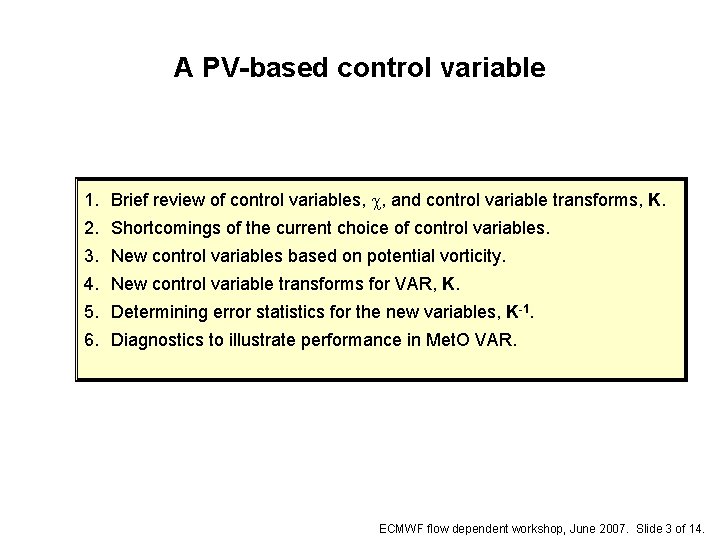
A PV-based control variable 1. Brief review of control variables, , and control variable transforms, K. 2. Shortcomings of the current choice of control variables. 3. New control variables based on potential vorticity. 4. New control variable transforms for VAR, K. 5. Determining error statistics for the new variables, K-1. 6. Diagnostics to illustrate performance in Met. O VAR. ECMWF flow dependent workshop, June 2007. Slide 3 of 14.
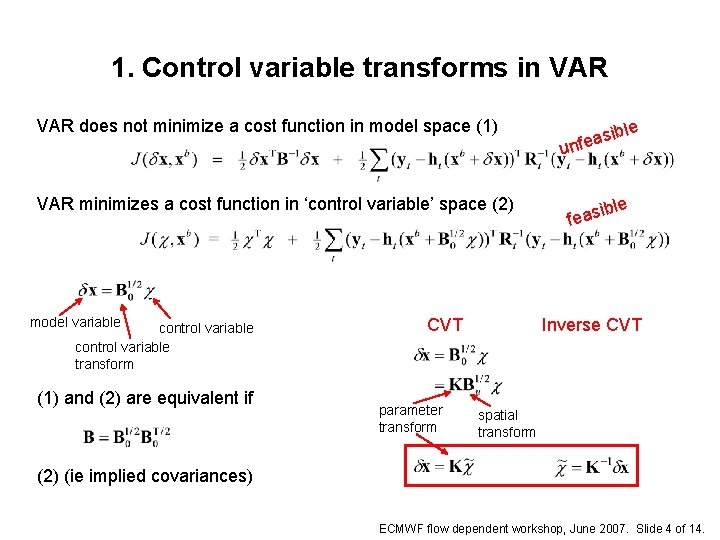
1. Control variable transforms in VAR does not minimize a cost function in model space (1) VAR minimizes a cost function in ‘control variable’ space (2) model variable control variable transform (1) and (2) are equivalent if CVT parameter transform le sib a e f un ib feas le Inverse CVT spatial transform (2) (ie implied covariances) ECMWF flow dependent workshop, June 2007. Slide 4 of 14.

1. Control variable transforms in VAR Example parameter transforms ECMWF (Derber & Bouttier 1999) Met Office (Lorenc et al. 2000) ‘parameter transform’, Up ~ are referred to as ‘balanced’ (proxy for PV). • The leading control parameters ( ~ or ) • Balance relations are built into the problem. ~ have no unbalanced components (there The fundamental assumption is that ~ and is no such thing as unbalanced rotational wind in these schemes). The balanced vorticity approximation (BVA). ECMWF flow dependent workshop, June 2007. Slide 5 of 14.
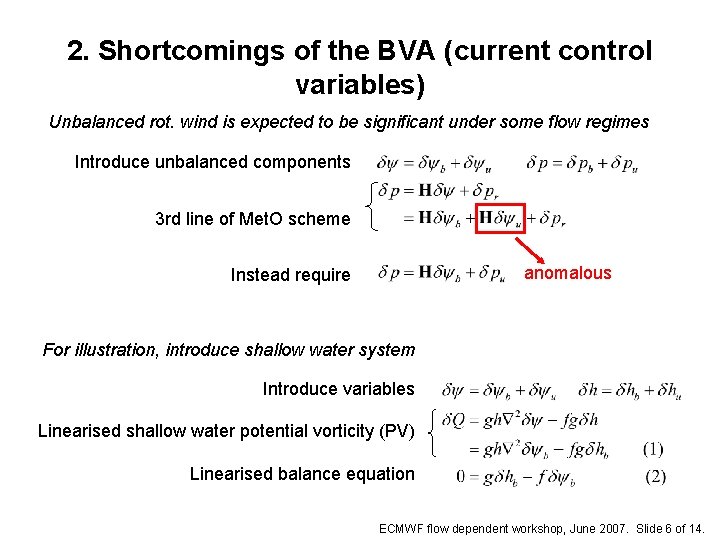
2. Shortcomings of the BVA (current control variables) Unbalanced rot. wind is expected to be significant under some flow regimes Introduce unbalanced components 3 rd line of Met. O scheme anomalous Instead require For illustration, introduce shallow water system Introduce variables Linearised shallow water potential vorticity (PV) Linearised balance equation ECMWF flow dependent workshop, June 2007. Slide 6 of 14.
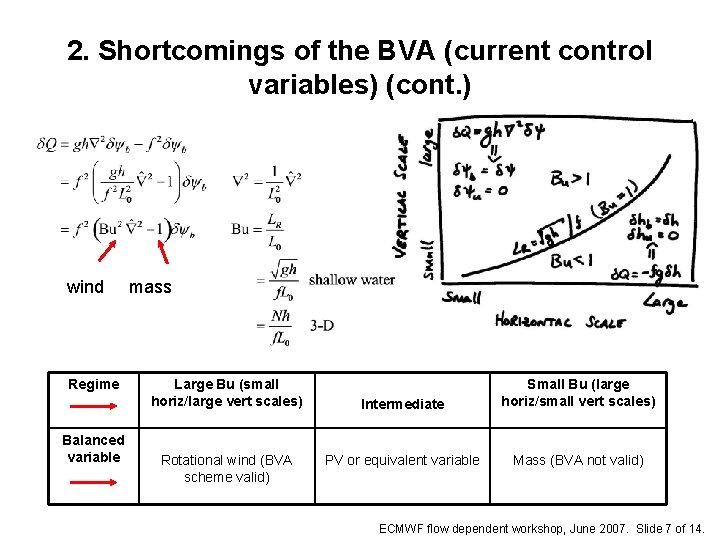
2. Shortcomings of the BVA (current control variables) (cont. ) wind Regime Balanced variable mass Large Bu (small horiz/large vert scales) Rotational wind (BVA scheme valid) Intermediate Small Bu (large horiz/small vert scales) PV or equivalent variable Mass (BVA not valid) ECMWF flow dependent workshop, June 2007. Slide 7 of 14.
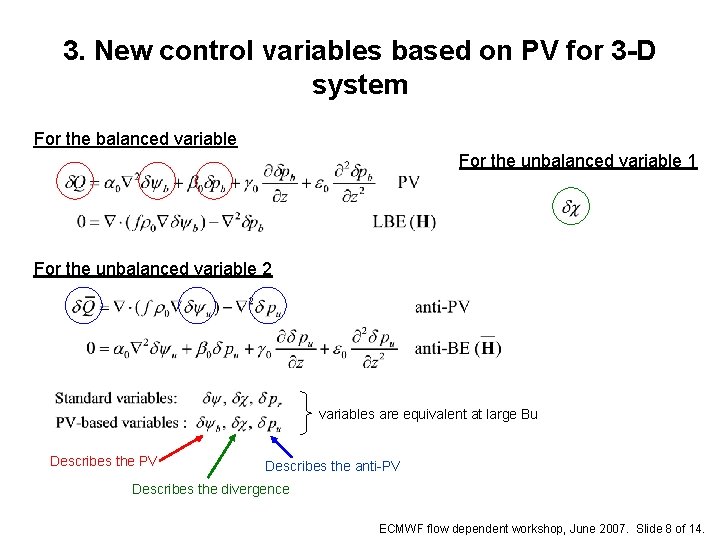
3. New control variables based on PV for 3 -D system For the balanced variable For the unbalanced variable 1 For the unbalanced variable 2 variables are equivalent at large Bu Describes the PV Describes the anti-PV Describes the divergence ECMWF flow dependent workshop, June 2007. Slide 8 of 14.
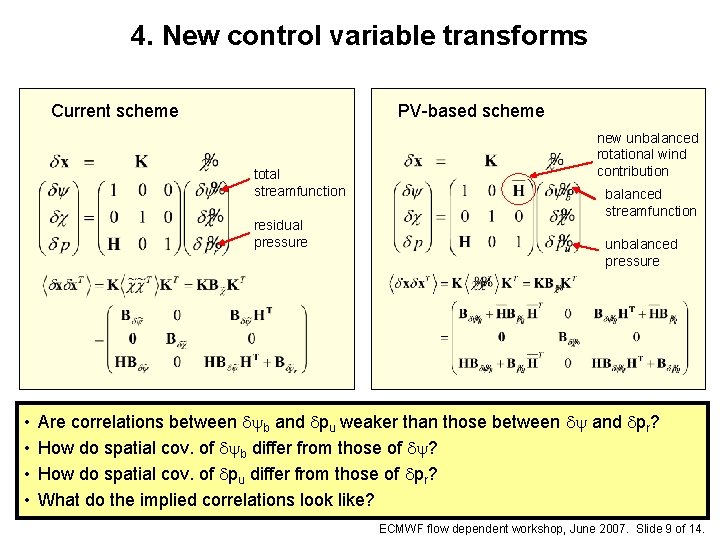
4. New control variable transforms Current scheme PV-based scheme total streamfunction residual pressure • • new unbalanced rotational wind contribution balanced streamfunction unbalanced pressure Are correlations between b and pu weaker than those between and pr? How do spatial cov. of b differ from those of ? How do spatial cov. of pu differ from those of pr? What do the implied correlations look like? ECMWF flow dependent workshop, June 2007. Slide 9 of 14.
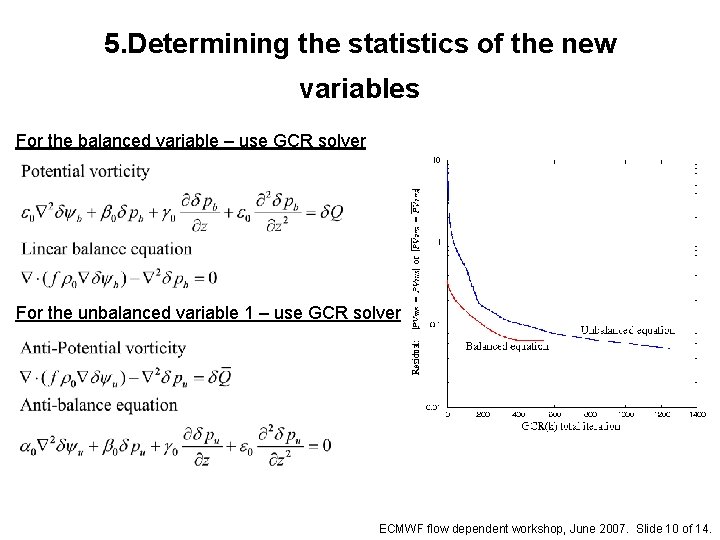
5. Determining the statistics of the new variables For the balanced variable – use GCR solver For the unbalanced variable 1 – use GCR solver ECMWF flow dependent workshop, June 2007. Slide 10 of 14.
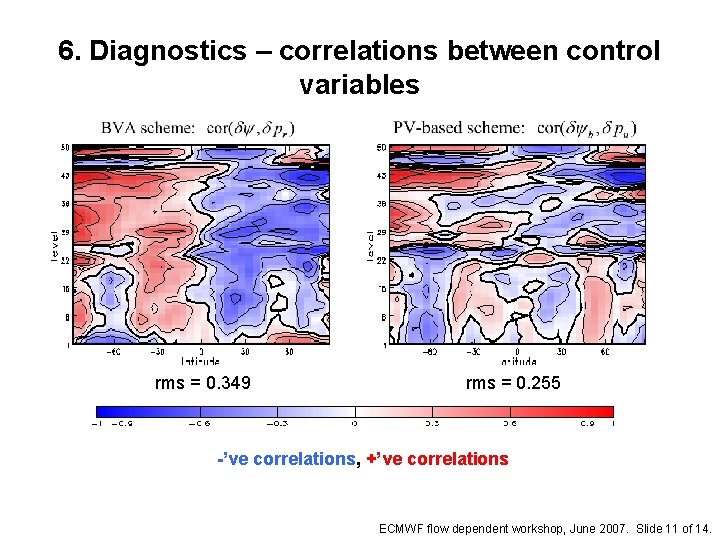
6. Diagnostics – correlations between control variables rms = 0. 349 rms = 0. 255 -’ve correlations, +’ve correlations ECMWF flow dependent workshop, June 2007. Slide 11 of 14.
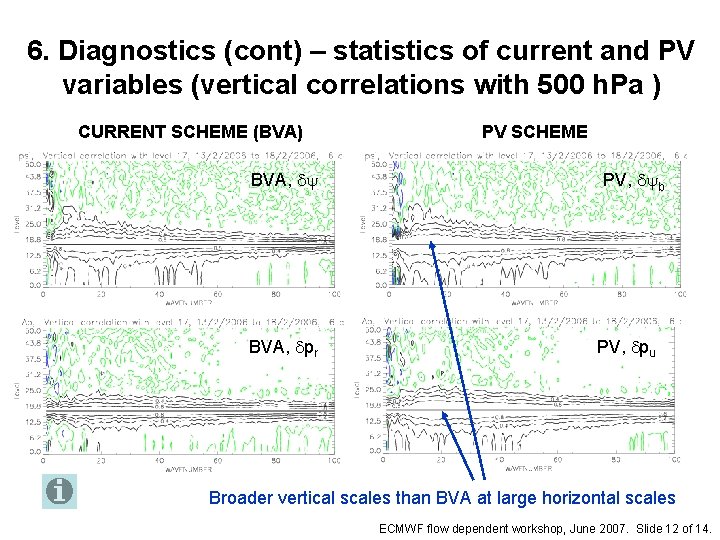
6. Diagnostics (cont) – statistics of current and PV variables (vertical correlations with 500 h. Pa ) CURRENT SCHEME (BVA) BVA, pr PV SCHEME PV, b PV, pu Broader vertical scales than BVA at large horizontal scales ECMWF flow dependent workshop, June 2007. Slide 12 of 14.
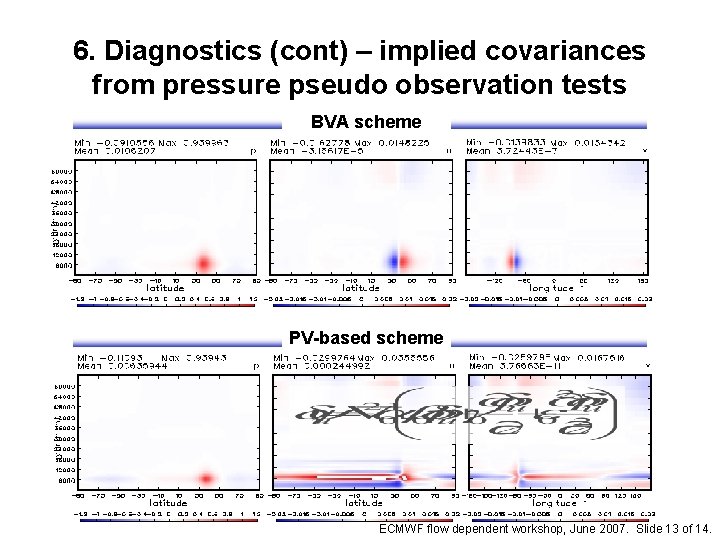
6. Diagnostics (cont) – implied covariances from pressure pseudo observation tests BVA scheme PV-based scheme ECMWF flow dependent workshop, June 2007. Slide 13 of 14.
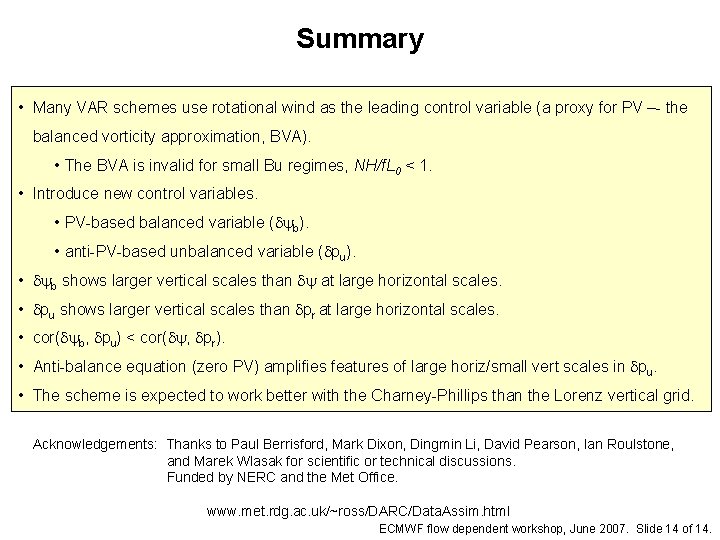
Summary • Many VAR schemes use rotational wind as the leading control variable (a proxy for PV –- the balanced vorticity approximation, BVA). • The BVA is invalid for small Bu regimes, NH/f. L 0 < 1. • Introduce new control variables. • PV-based balanced variable ( b). • anti-PV-based unbalanced variable ( pu). • b shows larger vertical scales than at large horizontal scales. • pu shows larger vertical scales than pr at large horizontal scales. • cor( b, pu) < cor( , pr). • Anti-balance equation (zero PV) amplifies features of large horiz/small vert scales in pu. • The scheme is expected to work better with the Charney-Phillips than the Lorenz vertical grid. Acknowledgements: Thanks to Paul Berrisford, Mark Dixon, Dingmin Li, David Pearson, Ian Roulstone, and Marek Wlasak for scientific or technical discussions. Funded by NERC and the Met Office. www. met. rdg. ac. uk/~ross/DARC/Data. Assim. html ECMWF flow dependent workshop, June 2007. Slide 14 of 14.
End ECMWF flow dependent workshop, June 2007. Slide 15 of 14.
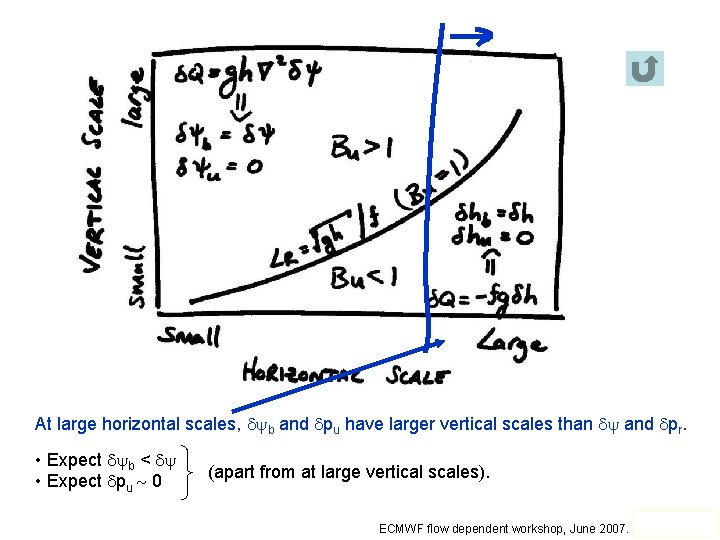
At large horizontal scales, b and pu have larger vertical scales than and pr. • Expect b < • Expect pu 0 (apart from at large vertical scales). ECMWF flow dependent workshop, June 2007. Slide 16 of 14.
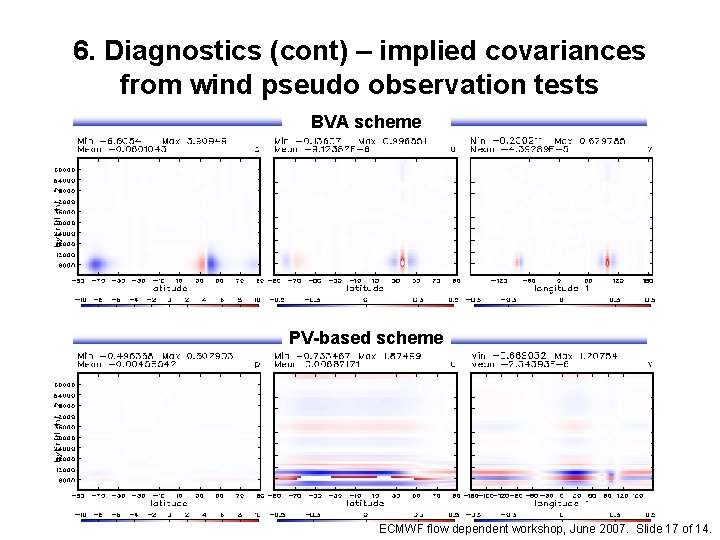
6. Diagnostics (cont) – implied covariances from wind pseudo observation tests BVA scheme PV-based scheme ECMWF flow dependent workshop, June 2007. Slide 17 of 14.
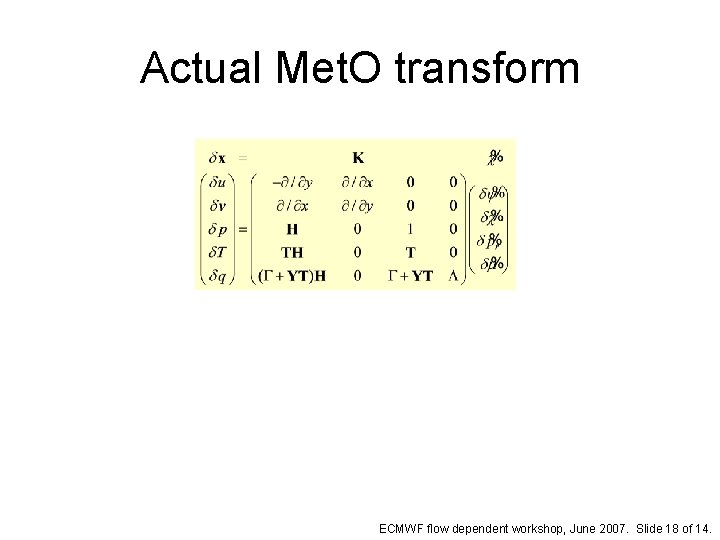
Actual Met. O transform ECMWF flow dependent workshop, June 2007. Slide 18 of 14.
- Slides: 18