
A recombination frequency of 28 between two Drosophila
A recombination frequency of 28% between two Drosophila melanogaster genes suggests which of the following regarding their relative chromosomal locations? A. They are linked together on the same chromosome. B. They are unlinked from each other on the same chromosome. C. They are located on two different chromosomes. D. Recombination frequency does not provide information with respect to chromosome location. © 2014 Pearson Education, Inc.
A recombination frequency of 28% between two Drosophila melanogaster genes suggests which of the following regarding their relative chromosomal locations? A. They are linked together on the same chromosome. B. They are unlinked from each other on the same chromosome. C. They are located on two different chromosomes. D. Recombination frequency does not provide information with respect to chromosome location. © 2014 Pearson Education, Inc.
A low mutation rate over time can be advantageous to plants and animals because _____. A. select mutations can allow organisms to adapt to constantly changing environmental conditions B. mutations will always occur in non-protein-coding regions C. most mutations cause loss-of-function for the protein encoded by that mutated gene D. most mutations do not cause loss-of-function for the protein encoded by that mutated gene © 2014 Pearson Education, Inc.
A low mutation rate over time can be advantageous to plants and animals because _____. A. mutations can allow organisms to adapt to constantly changing environmental conditions B. mutations will always occur in non-protein-coding regions C. most mutations cause loss-of-function for the protein encoded by that mutated gene D. most mutations do not cause loss-of-function for the protein encoded by that mutated gene © 2014 Pearson Education, Inc.
Consider a cross between the parental genotypes RRTT and rrtt in a pea plant. The F 1 offspring are doubly heterozygous (dihybrid). The recombinant gametes produced in this F 1 generation are _____. A. RT and rt B. Tt and Rr C. Rt and r. T D. RR and TT © 2014 Pearson Education, Inc.
Consider a cross between the parental genotypes RRTT and rrtt in a pea plant. The F 1 offspring are doubly heterozygous (dihybrid). The recombinant gametes produced in this F 1 generation are _____. A. RT and rt B. Tt and Rr C. Rt and r. T D. RR and TT © 2014 Pearson Education, Inc.
The principle of independent assortment holds true for two given genes only if _____. A. the genes are nearby on the same chromosome B. the recombination frequency between the genes is less than 50% C. the genes are linked D. the genes are on different chromosomes or very far apart on the same chromosome © 2014 Pearson Education, Inc.
The principle of independent assortment holds true for two given genes only if _____. A. the genes are nearby on the same chromosome B. the recombination frequency between the genes is less than 50% C. the genes are linked D. the genes are on different chromosomes or very far apart on the same chromosome © 2014 Pearson Education, Inc.
Recombinant gametes form in meiosis as a result of _____. A. crossing over between homologous chromosomes alone B. independent assortment of allele pairs alone C. both crossing over between homologous chromosomes and the independent assortment of allele pairs D. tight linkage between genes on the same chromosome © 2014 Pearson Education, Inc.
Recombinant gametes form in meiosis as a result of _____. A. crossing over between homologous chromosomes alone B. independent assortment of allele pairs alone C. both crossing over between homologous chromosomes and the independent assortment of allele pairs D. tight linkage between genes on the same chromosome © 2014 Pearson Education, Inc.
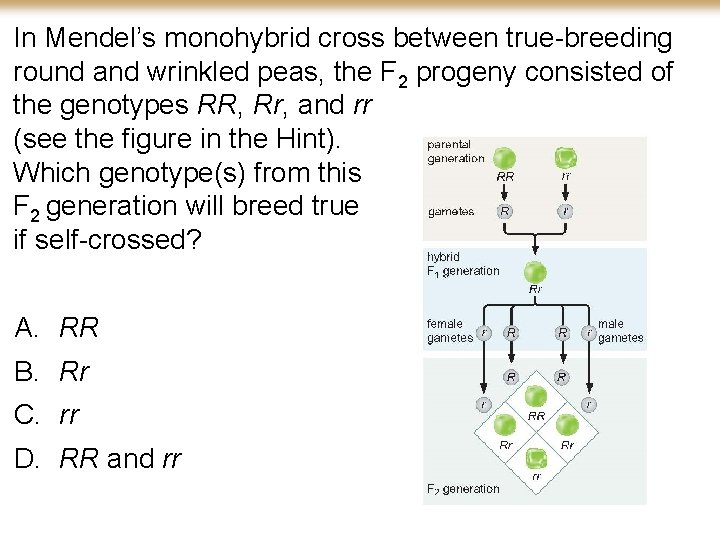
In Mendel’s monohybrid cross between true-breeding round and wrinkled peas, the F 2 progeny consisted of the genotypes RR, Rr, and rr (see the figure in the Hint). Which genotype(s) from this F 2 generation will breed true if self-crossed? A. RR B. Rr C. rr D. RR and rr © 2014 Pearson Education, Inc.
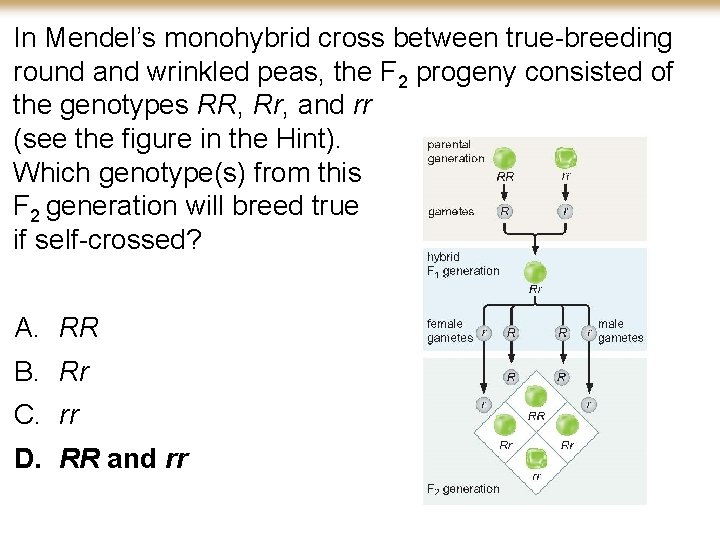
In Mendel’s monohybrid cross between true-breeding round and wrinkled peas, the F 2 progeny consisted of the genotypes RR, Rr, and rr (see the figure in the Hint). Which genotype(s) from this F 2 generation will breed true if self-crossed? A. RR B. Rr C. rr D. RR and rr © 2014 Pearson Education, Inc.
If you cross a white-eyed female (ww) to a red-eyed male (WY) Drosophila fly, you will see red-eyed females and white-eyed males in the F 1 generation. If you cross an F 1 red-eyed female to an F 1 white-eyed male, what is the approximate percentage of total progeny in the F 2 generation that are white-eyed males? A. 100% B. 50% C. 25% D. 0% © 2014 Pearson Education, Inc.
If you cross a white-eyed female (ww) to a red-eyed male (WY) Drosophila fly, you will see red-eyed females and white-eyed males in the F 1 generation. If you cross an F 1 red-eyed female to an F 1 white-eyed male, what is the approximate percentage of total progeny in the F 2 generation that are white-eyed males? A. 100% B. 50% C. 25% D. 0% © 2014 Pearson Education, Inc.
- Slides: 14