
A recipe for solving mechanics problems Mechanics problems
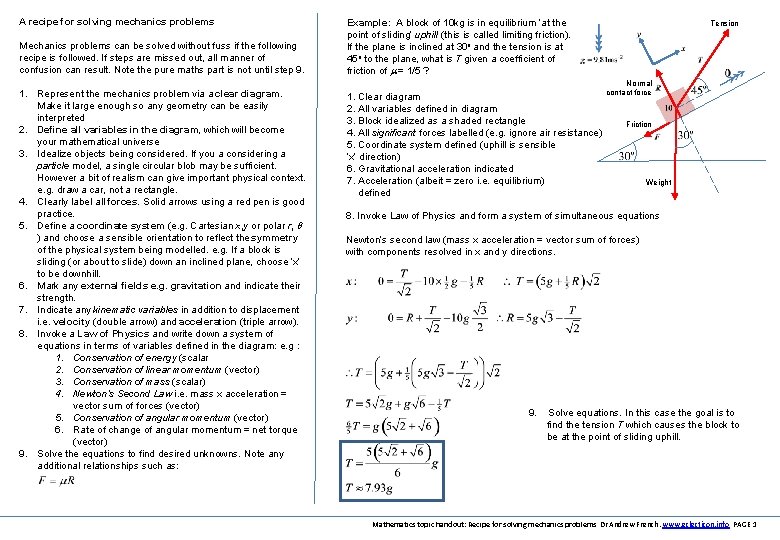
A recipe for solving mechanics problems Mechanics problems can be solved without fuss if the following recipe is followed. If steps are missed out, all manner of confusion can result. Note the pure maths part is not until step 9. 1. Represent the mechanics problem via a clear diagram. Make it large enough so any geometry can be easily interpreted 2. Define all variables in the diagram, which will become your mathematical universe 3. Idealize objects being considered. If you a considering a particle model, a single circular blob may be sufficient. However a bit of realism can give important physical context. e. g. draw a car, not a rectangle. 4. Clearly label all forces. Solid arrows using a red pen is good practice. 5. Define a coordinate system (e. g. Cartesian x, y or polar r, q ) and choose a sensible orientation to reflect the symmetry of the physical system being modelled. e. g. If a block is sliding (or about to slide) down an inclined plane, choose ‘x’ to be downhill. 6. Mark any external fields e. g. gravitation and indicate their strength. 7. Indicate any kinematic variables in addition to displacement i. e. velocity (double arrow) and acceleration (triple arrow). 8. Invoke a Law of Physics and write down a system of equations in terms of variables defined in the diagram: e. g : 1. Conservation of energy (scalar 2. Conservation of linear momentum (vector) 3. Conservation of mass (scalar) 4. Newton’s Second Law i. e. mass x acceleration = vector sum of forces (vector) 5. Conservation of angular momentum (vector) 6. Rate of change of angular momentum = net torque (vector) 9. Solve the equations to find desired unknowns. Note any additional relationships such as: Example: A block of 10 kg is in equilibrium ‘at the point of sliding’ uphill (this is called limiting friction). If the plane is inclined at 30 o and the tension is at 45 o to the plane, what is T given a coefficient of friction of m = 1/5 ? 1. Clear diagram 2. All variables defined in diagram 3. Block idealized as a shaded rectangle 4. All significant forces labelled (e. g. ignore air resistance) 5. Coordinate system defined (uphill is sensible ‘x’ direction) 6. Gravitational acceleration indicated 7. Acceleration (albeit = zero i. e. equilibrium) defined Tension Normal contact force Friction Weight 8. Invoke Law of Physics and form a system of simultaneous equations Newton’s second law (mass x acceleration = vector sum of forces) with components resolved in x and y directions. 9. Solve equations. In this case the goal is to find the tension T which causes the block to be at the point of sliding uphill. Mathematics topic handout: Recipe for solving mechanics problems Dr Andrew French. www. eclecticon. info PAGE 1
- Slides: 1