
A Range Verification Method for Proton Therapy using
- Slides: 1
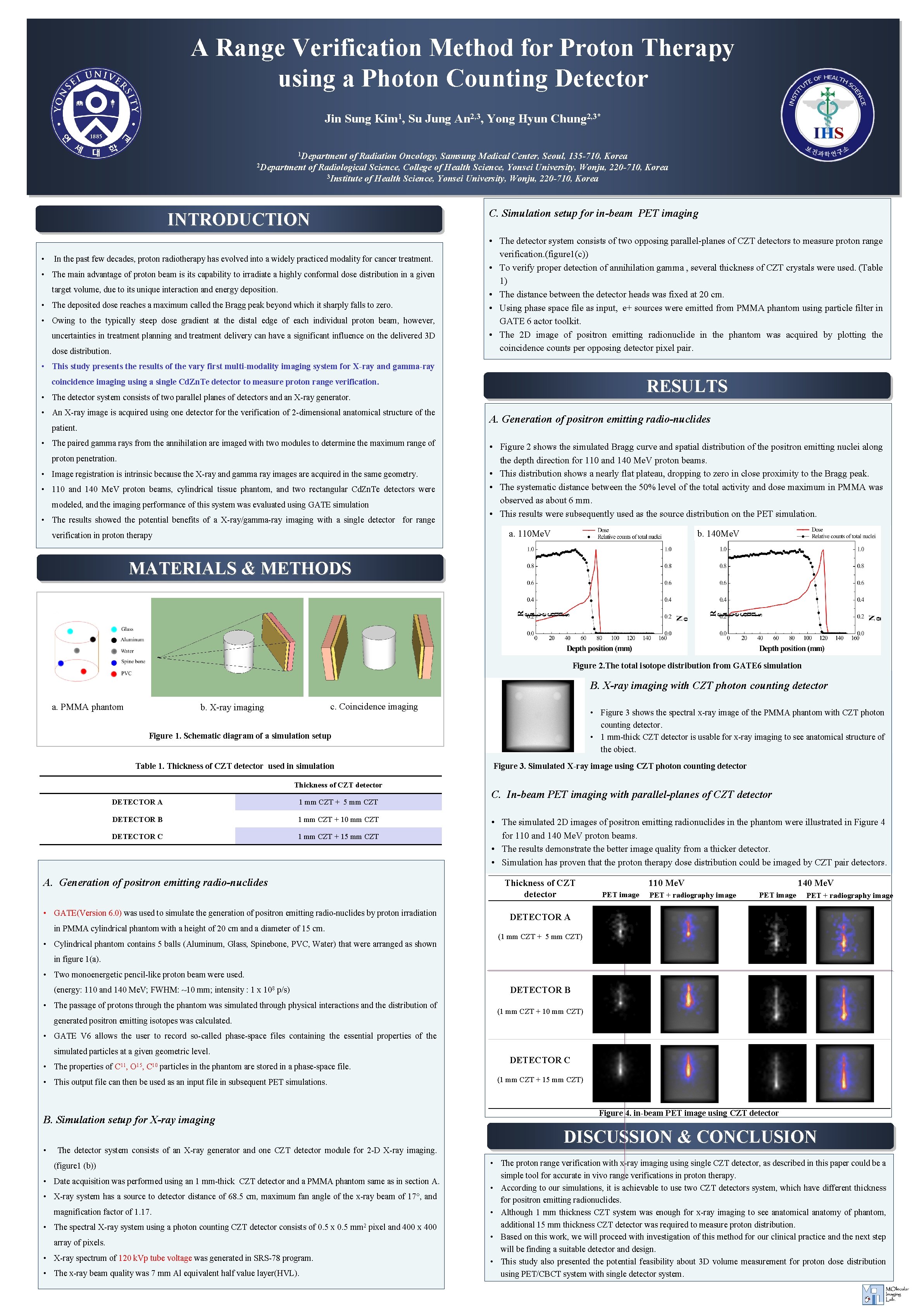
A Range Verification Method for Proton Therapy using a Photon Counting Detector Jin Sung Kim 1, Su Jung An 2, 3, Yong Hyun Chung 2, 3* 1 Department of Radiation Oncology, Samsung Medical Center, Seoul, 135 -710, Korea 2 Department of Radiological Science, College of Health Science, Yonsei University, Wonju, 220 -710, Korea 3 Institute of Health Science, Yonsei University, Wonju, 220 -710, Korea C. Simulation setup for in-beam PET imaging INTRODUCTION • In the past few decades, proton radiotherapy has evolved into a widely practiced modality for cancer treatment. • The main advantage of proton beam is its capability to irradiate a highly conformal dose distribution in a given target volume, due to its unique interaction and energy deposition. • The deposited dose reaches a maximum called the Bragg peak beyond which it sharply falls to zero. • Owing to the typically steep dose gradient at the distal edge of each individual proton beam, however, uncertainties in treatment planning and treatment delivery can have a significant influence on the delivered 3 D dose distribution. • The detector system consists of two opposing parallel-planes of CZT detectors to measure proton range verification. (figure 1(c)) • To verify proper detection of annihilation gamma , several thickness of CZT crystals were used. (Table 1) • The distance between the detector heads was fixed at 20 cm. • Using phase space file as input, e+ sources were emitted from PMMA phantom using particle filter in GATE 6 actor toolkit. • The 2 D image of positron emitting radionuclide in the phantom was acquired by plotting the coincidence counts per opposing detector pixel pair. • This study presents the results of the vary first multi-modality imaging system for X-ray and gamma-ray RESULTS coincidence imaging using a single Cd. Zn. Te detector to measure proton range verification. • The detector system consists of two parallel planes of detectors and an X-ray generator. • An X-ray image is acquired using one detector for the verification of 2 -dimensional anatomical structure of the patient. • The paired gamma rays from the annihilation are imaged with two modules to determine the maximum range of proton penetration. • Image registration is intrinsic because the X-ray and gamma ray images are acquired in the same geometry. • 110 and 140 Me. V proton beams, cylindrical tissue phantom, and two rectangular Cd. Zn. Te detectors were modeled, and the imaging performance of this system was evaluated using GATE simulation • The results showed the potential benefits of a X-ray/gamma-ray imaging with a single detector for range A. Generation of positron emitting radio-nuclides • Figure 2 shows the simulated Bragg curve and spatial distribution of the positron emitting nuclei along the depth direction for 110 and 140 Me. V proton beams. • This distribution shows a nearly flat plateau, dropping to zero in close proximity to the Bragg peak. • The systematic distance between the 50% level of the total activity and dose maximum in PMMA was observed as about 6 mm. • This results were subsequently used as the source distribution on the PET simulation. b. 140 Me. V a. 110 Me. V verification in proton therapy MATERIALS & METHODS Figure 2. The total isotope distribution from GATE 6 simulation B. X-ray imaging with CZT photon counting detector a. PMMA phantom c. Coincidence imaging b. X-ray imaging • Figure 3 shows the spectral x-ray image of the PMMA phantom with CZT photon counting detector. • 1 mm-thick CZT detector is usable for x-ray imaging to see anatomical structure of the object. Figure 1. Schematic diagram of a simulation setup Table 1. Thickness of CZT detector used in simulation Thickness of CZT detector DETECTOR A 1 mm CZT + 5 mm CZT DETECTOR B 1 mm CZT + 10 mm CZT DETECTOR C 1 mm CZT + 15 mm CZT A. Generation of positron emitting radio-nuclides • GATE(Version 6. 0) was used to simulate the generation of positron emitting radio-nuclides by proton irradiation in PMMA cylindrical phantom with a height of 20 cm and a diameter of 15 cm. • Cylindrical phantom contains 5 balls (Aluminum, Glass, Spinebone, PVC, Water) that were arranged as shown Figure 3. Simulated X-ray image using CZT photon counting detector C. In-beam PET imaging with parallel-planes of CZT detector • The simulated 2 D images of positron emitting radionuclides in the phantom were illustrated in Figure 4 for 110 and 140 Me. V proton beams. • The results demonstrate the better image quality from a thicker detector. • Simulation has proven that the proton therapy dose distribution could be imaged by CZT pair detectors. Thickness of CZT detector 110 Me. V PET image PET + radiography image 140 Me. V PET image PET + radiography image DETECTOR A (1 mm CZT + 5 mm CZT) in figure 1(a). • Two monoenergetic pencil-like proton beam were used. (energy: 110 and 140 Me. V; FWHM: ~10 mm; intensity : 1 x 10⁸ p/s) • The passage of protons through the phantom was simulated through physical interactions and the distribution of DETECTOR B (1 mm CZT + 10 mm CZT) generated positron emitting isotopes was calculated. • GATE V 6 allows the user to record so-called phase-space files containing the essential properties of the simulated particles at a given geometric level. • The properties of C 11, O 15, C 10 particles in the phantom are stored in a phase-space file. • This output file can then be used as an input file in subsequent PET simulations. B. Simulation setup for X-ray imaging • The detector system consists of an X-ray generator and one CZT detector module for 2 -D X-ray imaging. (figure 1 (b)) • Date acquisition was performed using an 1 mm-thick CZT detector and a PMMA phantom same as in section A. • X-ray system has a source to detector distance of 68. 5 cm, maximum fan angle of the x-ray beam of 17°, and magnification factor of 1. 17. • The spectral X-ray system using a photon counting CZT detector consists of 0. 5 x 0. 5 mm 2 pixel and 400 x 400 array of pixels. • X-ray spectrum of 120 k. Vp tube voltage was generated in SRS-78 program. • The x-ray beam quality was 7 mm Al equivalent half value layer(HVL). DETECTOR C (1 mm CZT + 15 mm CZT) Figure 4. in-beam PET image using CZT detector DISCUSSION & CONCLUSION • The proton range verification with x-ray imaging usingle CZT detector, as described in this paper could be a simple tool for accurate in vivo range verifications in proton therapy. • According to our simulations, it is achievable to use two CZT detectors system, which have different thickness for positron emitting radionuclides. • Although 1 mm thickness CZT system was enough for x-ray imaging to see anatomical anatomy of phantom, additional 15 mm thickness CZT detector was required to measure proton distribution. • Based on this work, we will proceed with investigation of this method for our clinical practice and the next step will be finding a suitable detector and design. • This study also presented the potential feasibility about 3 D volume measurement for proton dose distribution using PET/CBCT system with single detector system.