
A Randomized Phase 3 Trial of Blinatumomab Vs
A Randomized Phase 3 Trial of Blinatumomab Vs. Chemotherapy As Post-Reinduction Therapy in High and Intermediate Risk (HR/IR) First Relapse of B-ALL in Children and AYAs Demonstrates Superior Efficacy and Tolerability of Blinatumomab A Report from Children’s Oncology Group Study AALL 1331 Patrick A. Brown, Lingyun Ji, Xinxin Xu, Meenakshi Devidas, Laura Hogan, Michael J. Borowitz, Elizabeth A. Raetz, Gerhard Zugmaier, Elad Sharon, Lia Gore, James A. Whitlock, Michael A. Pulsipher, Stephen P. Hunger, Mignon L. Loh
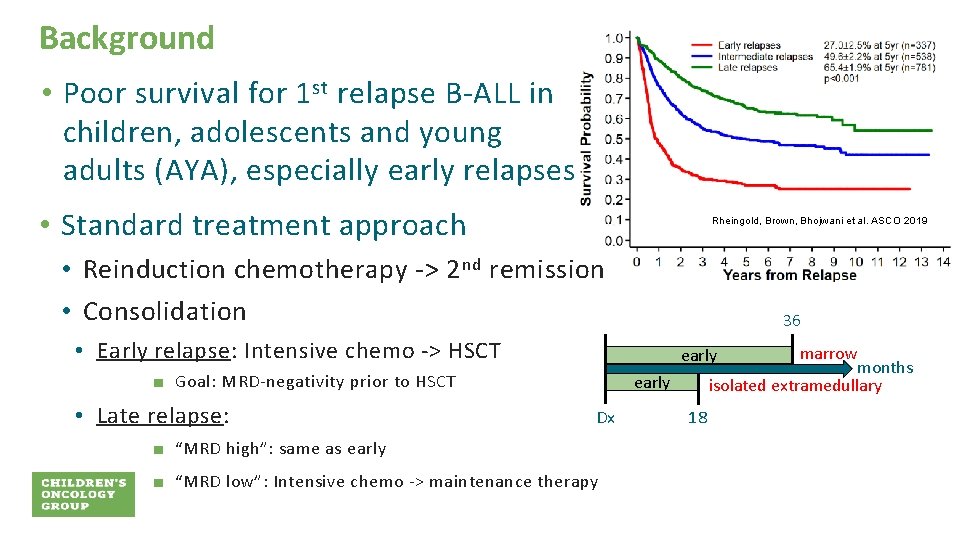
Background • Poor survival for 1 st relapse B-ALL in children, adolescents and young adults (AYA), especially early relapses • Standard treatment approach Rheingold, Brown, Bhojwani et al. ASCO 2019 • Reinduction chemotherapy -> 2 nd remission • Consolidation 36 • Early relapse: Intensive chemo -> HSCT ■ Goal: MRD-negativity prior to HSCT • Late relapse: marrow months isolated extramedullary early Dx ■ “MRD high”: same as early ■ “MRD low”: Intensive chemo -> maintenance therapy 18

Blinatumomab (CD 19 Bi. TE) • In multiply relapsed/refractory setting (pediatrics) • CR 35 -40% • MRD-negative CR 20 -25% von Stackelberg et al. JCO. 2016; 34: 4381 -4389 • In MRD+ setting (adults) • 80% MRD clearance • 60% subsequent DFS (bridge to HSCT) Gokbuget et al. Blood. 2018; 131: 1522 -1531 Adapted from Brown P. Blood. 2018; 131: 1497– 1498 Objective of COG AALL 1331: To determine if substituting blinatumomab for intensive consolidation chemotherapy improves survival in 1 st relapse of childhood/AYA B-ALL
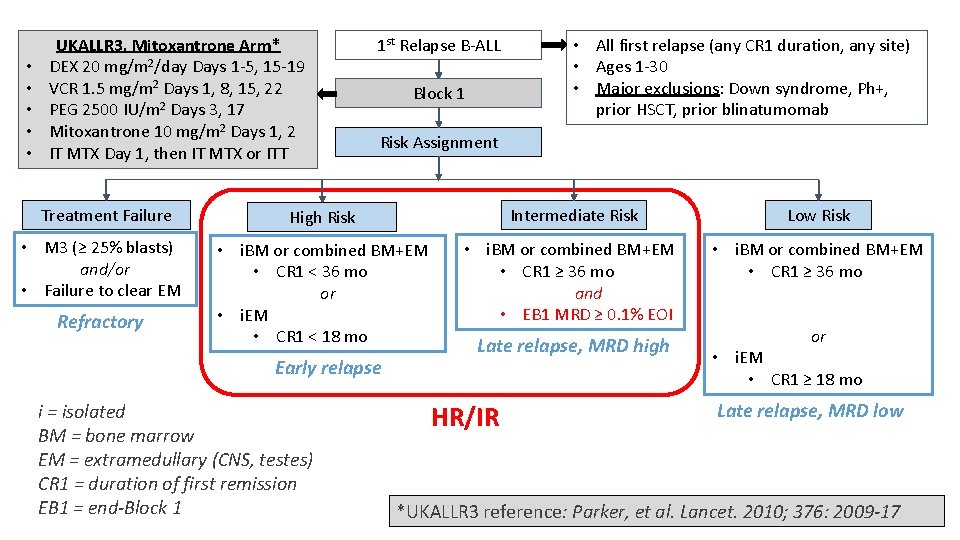
• • • UKALLR 3, Mitoxantrone Arm* DEX 20 mg/m 2/day Days 1 -5, 15 -19 VCR 1. 5 mg/m 2 Days 1, 8, 15, 22 PEG 2500 IU/m 2 Days 3, 17 Mitoxantrone 10 mg/m 2 Days 1, 2 IT MTX Day 1, then IT MTX or ITT 1 st Relapse B-ALL Block 1 • All first relapse (any CR 1 duration, any site) • Ages 1 -30 • Major exclusions: Down syndrome, Ph+, prior HSCT, prior blinatumomab Risk Assignment Treatment Failure High Risk Intermediate Risk Low Risk • M 3 (≥ 25% blasts) and/or • Failure to clear EM • i. BM or combined BM+EM • CR 1 < 36 mo or • i. EM • CR 1 < 18 mo • i. BM or combined BM+EM • CR 1 ≥ 36 mo and • EB 1 MRD ≥ 0. 1% EOI • i. BM or combined BM+EM • CR 1 ≥ 36 mo and • EB 1 MRD <0. 1% EOI or • i. EM • CR 1 ≥ 18 mo Refractory Early relapse i = isolated BM = bone marrow EM = extramedullary (CNS, testes) CR 1 = duration of first remission EB 1 = end-Block 1 Late relapse, MRD high HR/IR Late relapse, MRD low *UKALLR 3 reference: Parker, et al. Lancet. 2010; 376: 2009 -17
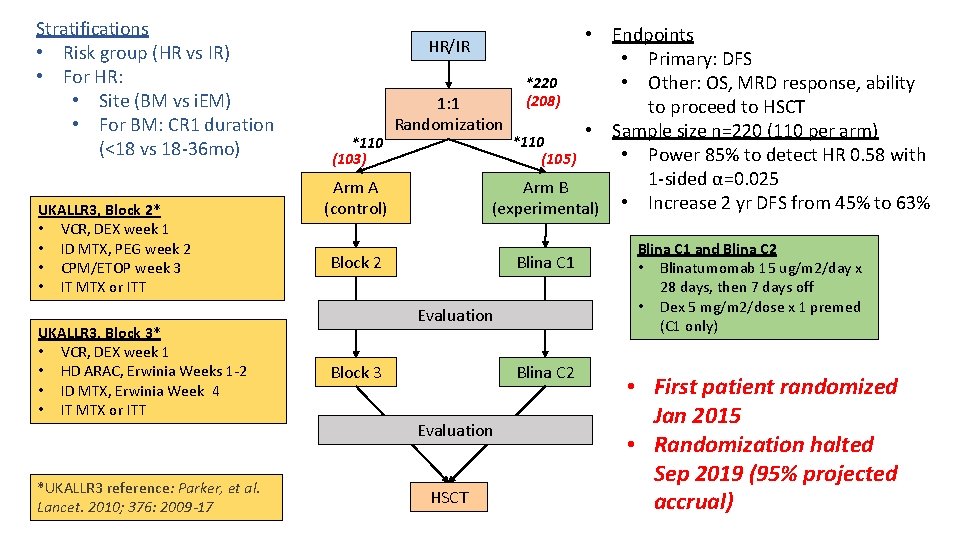
Stratifications • Risk group (HR vs IR) • For HR: • Site (BM vs i. EM) • For BM: CR 1 duration (<18 vs 18 -36 mo) UKALLR 3, Block 2* • VCR, DEX week 1 • ID MTX, PEG week 2 • CPM/ETOP week 3 • IT MTX or ITT UKALLR 3, Block 3* • VCR, DEX week 1 • HD ARAC, Erwinia Weeks 1 -2 • ID MTX, Erwinia Week 4 • IT MTX or ITT *UKALLR 3 reference: Parker, et al. Lancet. 2010; 376: 2009 -17 • Endpoints • Primary: DFS *220 • Other: OS, MRD response, ability (208) 1: 1 to proceed to HSCT Randomization • Sample size n=220 (110 per arm) *110 • Power 85% to detect HR 0. 58 with (103) (105) 1 -sided α=0. 025 Arm A Arm B (control) (experimental) • Increase 2 yr DFS from 45% to 63% HR/IR Block 2 Blina C 1 Evaluation Block 3 Blina C 2 Evaluation HSCT Blina C 1 and Blina C 2 • Blinatumomab 15 ug/m 2/day x 28 days, then 7 days off • Dex 5 mg/m 2/dose x 1 premed (C 1 only) • First patient randomized Jan 2015 • Randomization halted Sep 2019 (95% projected accrual)
Early closure recommended by DSMC • Scheduled review by DSMC Sep 2019 using data cut-off 6/30/2019 (~60% of projected events) • Despite the monitoring threshold for DFS not being crossed, the DSMC recommended: • Permanent closure of accrual to HR/IR randomization • Immediate cross-over to experimental Arm B for patients still receiving therapy • DSMC recommendation based on: • The difference in DFS and OS between arms • The profound difference in adverse events between arms • The highly significant difference in MRD clearance rates between arms
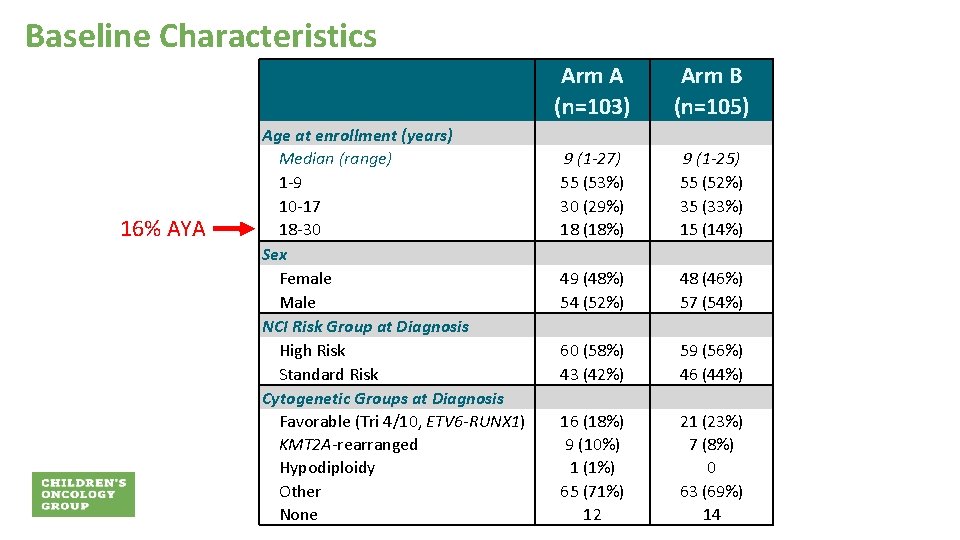
Baseline Characteristics 16% AYA Age at enrollment (years) Median (range) 1 -9 10 -17 18 -30 Sex Female Male NCI Risk Group at Diagnosis High Risk Standard Risk Cytogenetic Groups at Diagnosis Favorable (Tri 4/10, ETV 6 -RUNX 1) KMT 2 A-rearranged Hypodiploidy Other None Arm A (n=103) Arm B (n=105) 9 (1 -27) 55 (53%) 30 (29%) 18 (18%) 9 (1 -25) 55 (52%) 35 (33%) 15 (14%) 49 (48%) 54 (52%) 48 (46%) 57 (54%) 60 (58%) 43 (42%) 59 (56%) 46 (44%) 16 (18%) 9 (10%) 1 (1%) 65 (71%) 12 21 (23%) 7 (8%) 0 63 (69%) 14
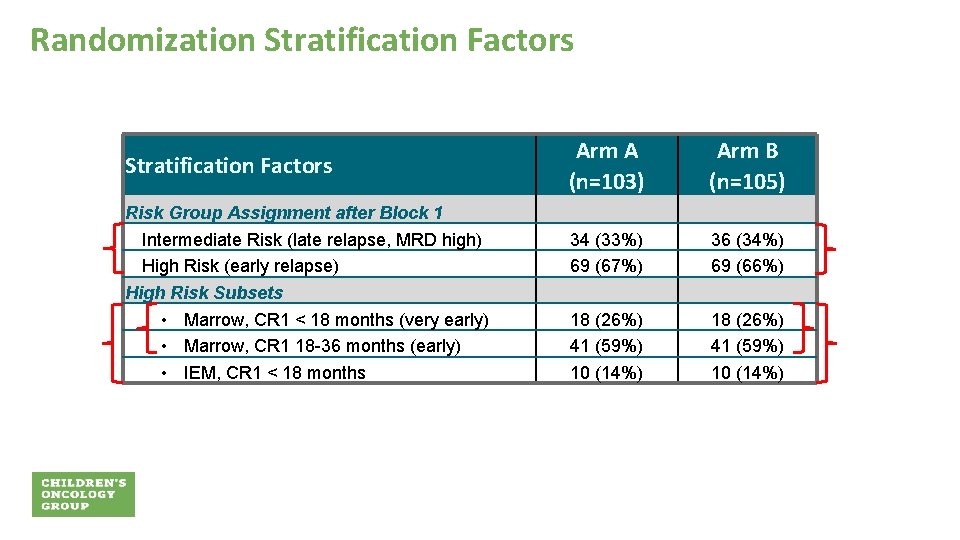
Randomization Stratification Factors Risk Group Assignment after Block 1 Intermediate Risk (late relapse, MRD high) High Risk (early relapse) High Risk Subsets • Marrow, CR 1 < 18 months (very early) • Marrow, CR 1 18 -36 months (early) • IEM, CR 1 < 18 months Arm A (n=103) Arm B (n=105) 34 (33%) 69 (67%) 36 (34%) 69 (66%) 18 (26%) 41 (59%) 10 (14%)
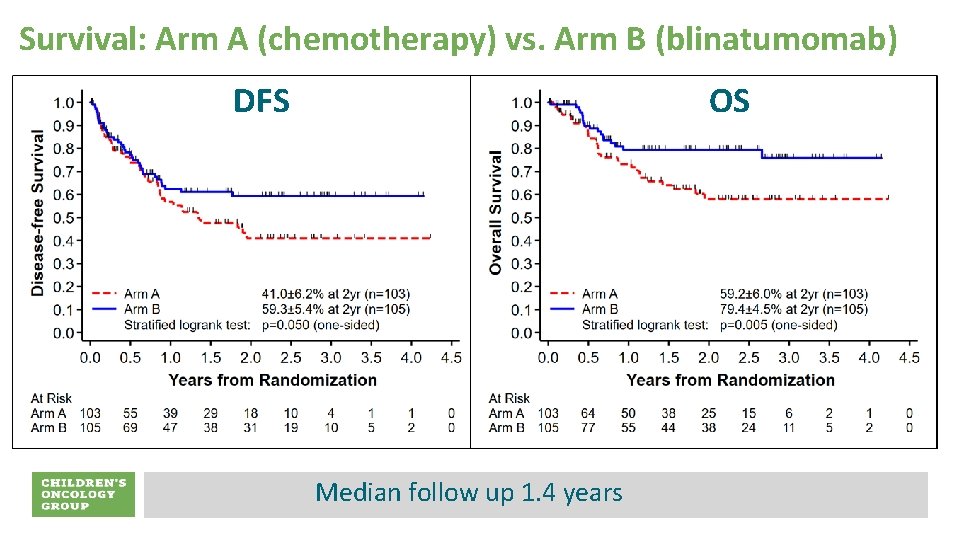
Survival: Arm A (chemotherapy) vs. Arm B (blinatumomab) DFS OS Median follow up 1. 4 years
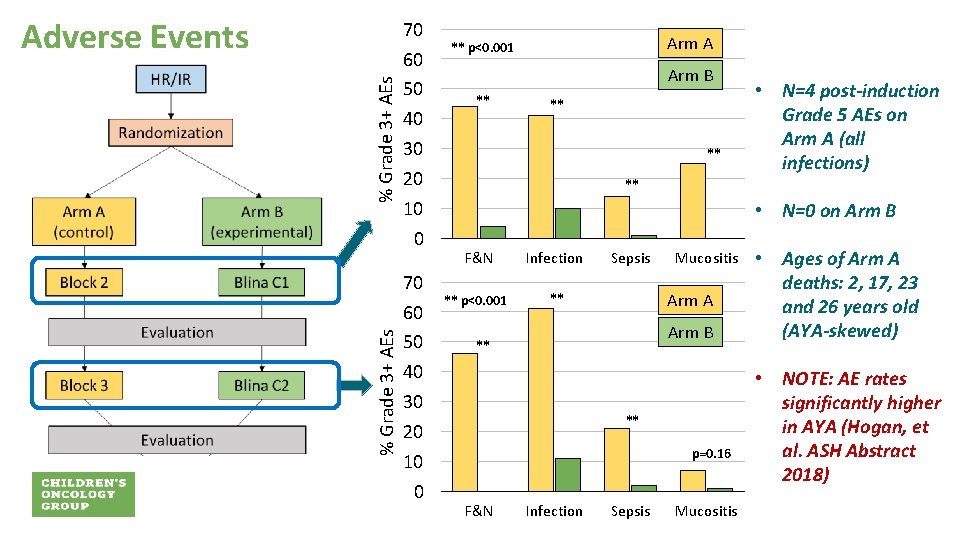
% Grade 3+ AEs Adverse Events 70 60 50 40 30 20 10 0 Arm A ** p<0. 001 Arm B ** ** ** • N=4 post-induction Grade 5 AEs on Arm A (all infections) ** • N=0 on Arm B F&N Infection ** p<0. 001 ** Sepsis Mucositis Arm A Arm B ** ** p=0. 16 F&N Infection Sepsis Mucositis • Ages of Arm A deaths: 2, 17, 23 and 26 years old (AYA-skewed) • NOTE: AE rates significantly higher in AYA (Hogan, et al. ASH Abstract 2018)
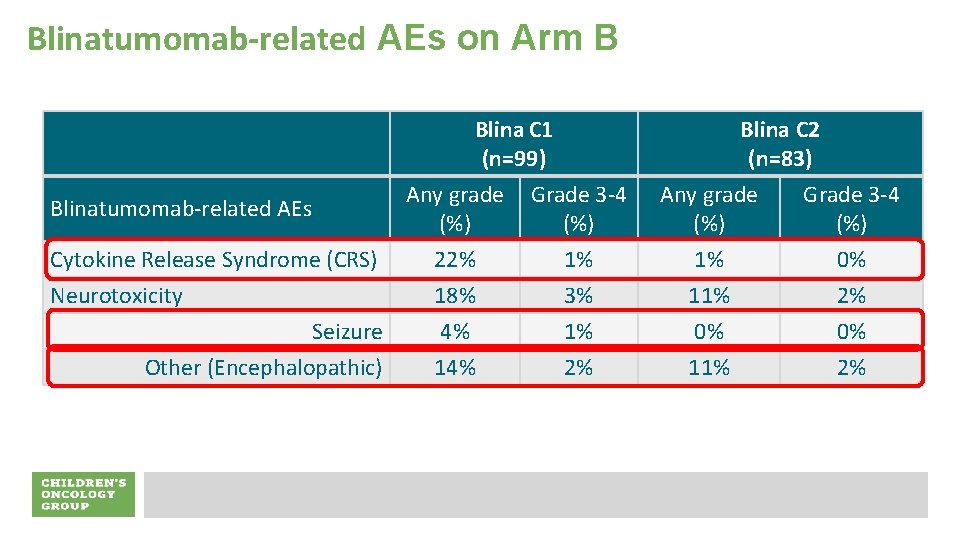
Blinatumomab-related AEs on Arm B Blinatumomab-related AEs Cytokine Release Syndrome (CRS) Neurotoxicity Seizure Other (Encephalopathic) Blina C 1 (n=99) Any grade Grade 3 -4 (%) 22% 18% 4% 1% 3% 1% 2% Blina C 2 (n=83) Any grade Grade 3 -4 (%) 1% 11% 0% 2%
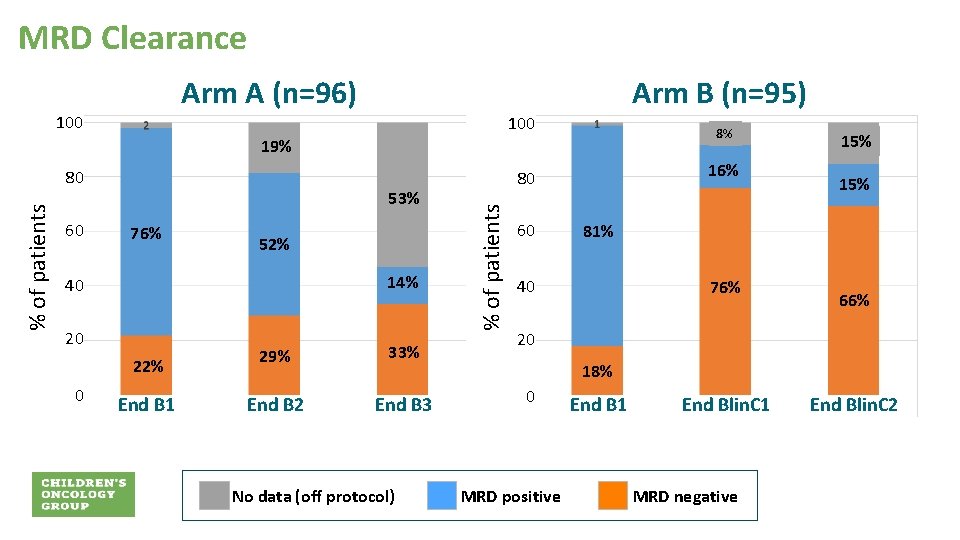
MRD Clearance Arm A (n=96) Arm B (n=95) 100 8% 19% 60 53% 76% 52% 14% 40 20 22% 0 End B 1 29% 33% End B 2 End B 3 No data (off protocol) 16% 80 % of patients 80 60 15% 81% 40 76% 66% 20 18% 0 MRD positive End B 1 End Blin. C 1 MRD negative End Blin. C 2
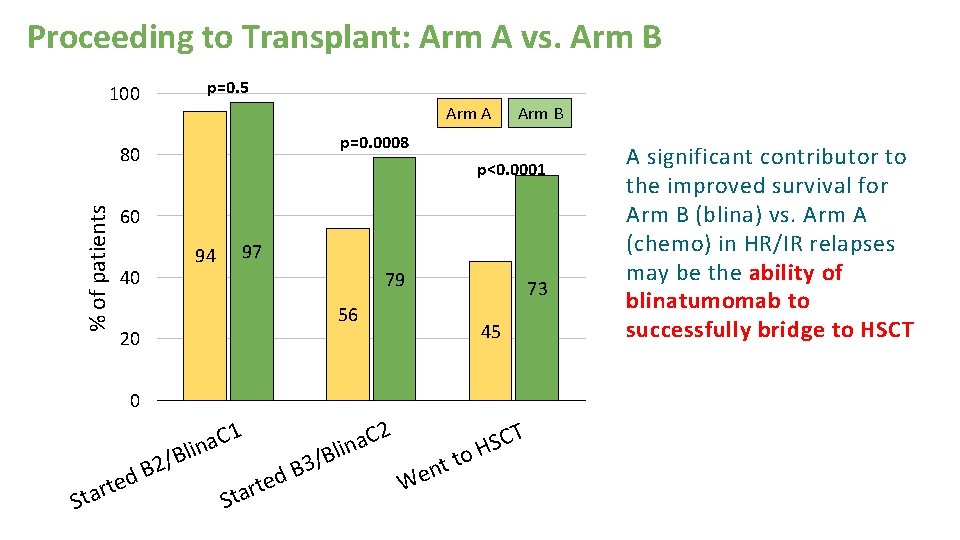
Proceeding to Transplant: Arm A vs. Arm B p=0. 5 100 Arm A p=0. 0008 80 % of patients Arm B p<0. 0001 60 94 40 97 79 73 56 45 20 0 S d e t r ta B B 2/ 1 C a lin d e t r Sta B 3/ 2 C a Blin W o t t en T C S H A significant contributor to the improved survival for Arm B (blina) vs. Arm A (chemo) in HR/IR relapses may be the ability of blinatumomab to successfully bridge to HSCT
Conclusions • For children and AYA patients with HR/IR first relapse of B-ALL, blinatumomab is superior to standard chemotherapy as post-reinduction consolidation prior to HSCT, resulting in: • Fewer and less severe toxicities • Higher rates of MRD response • Greater likelihood of proceeding to HSCT • Improved disease-free and overall survival • Blinatumomab constitutes a new standard of care in this setting • Future: Optimizing immunotherapy in relapsed ALL • Combination of blinatumomab and checkpoint inhibitors • Immunotherapy to replace or augment reinduction chemotherapy • CAR T-cells to replace or augment HSCT
- Slides: 14