
A quick history of Network Operating Systems Glenford
- Slides: 17
A quick history of Network Operating Systems Glenford Mapp Middlesex University
What is an Operating System • A piece of software which controls access to and the use of computing hardware • Application/user programs must use the operating system to get things done • Examples of well known OSs – Windows, OS 2, Unix, Linux
1945 -1951 • No operating system • Users booked time on the machine and programmed it manually • Wasted a lot of time • Main use as an advanced calculator for solving equations: e. g. ; missile trajectories
1952 -1957 • FORTRAN – high level language invented – Allowed larger number of engineering and scientific problems to be solved • Invention of compilers • Routines controlled the movement of data in and out of the computer and allowed a human to control the system via a console. – The first operating system – Batch mode operation
1958 -1965 • Multiprogramming – While the processor was waiting on I/O for your program, another user’s program could be executed • New concepts in memory allocation and protection, virtual memory, storage systems • Better electronics: Integrated Circuit Boards • Timesharing systems CTSS; Multics proposed as a computing “utility”.
1966 -1970 • Multics failed in overall goal but produced a lot of seminal ideas • Ken Thompson and Dennis Ritchie developed UNIX • ARPAnet – first packet switching network announced
1970 -1975 • Mini-computers got really popular – PDP 11 introduced • • • The Alto (Xerox PARC) Ethernet invented (Xerox PARC) Microprocessor invented (Intel) CP/M invented – led to DOS TCP/IP formally specified
1975 -1981 • The Altair – first programmable microprocessor system one could buy – Gates and Allen wrote BASIC interpreter • Apple launched first commercial PC • TCP/IP became the preferred US military protocol.
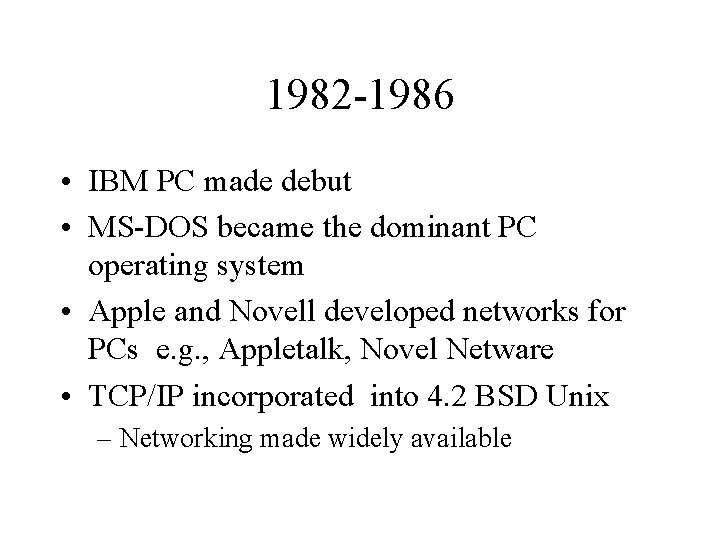
1982 -1986 • IBM PC made debut • MS-DOS became the dominant PC operating system • Apple and Novell developed networks for PCs e. g. , Appletalk, Novel Netware • TCP/IP incorporated into 4. 2 BSD Unix – Networking made widely available
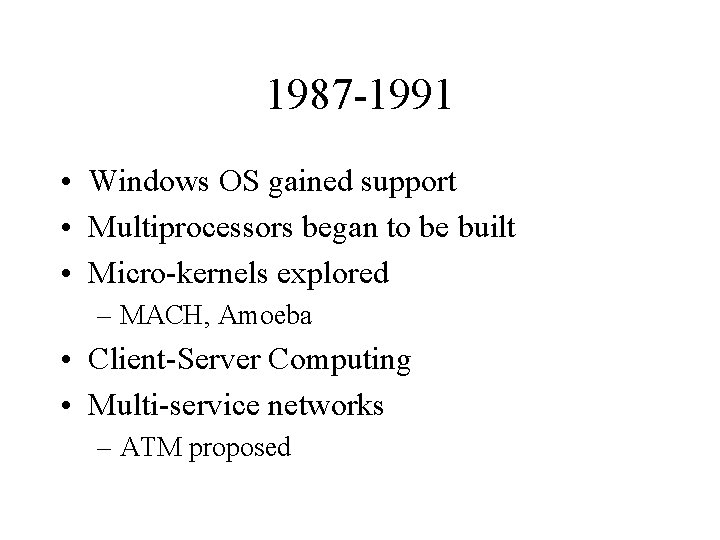
1987 -1991 • Windows OS gained support • Multiprocessors began to be built • Micro-kernels explored – MACH, Amoeba • Client-Server Computing • Multi-service networks – ATM proposed
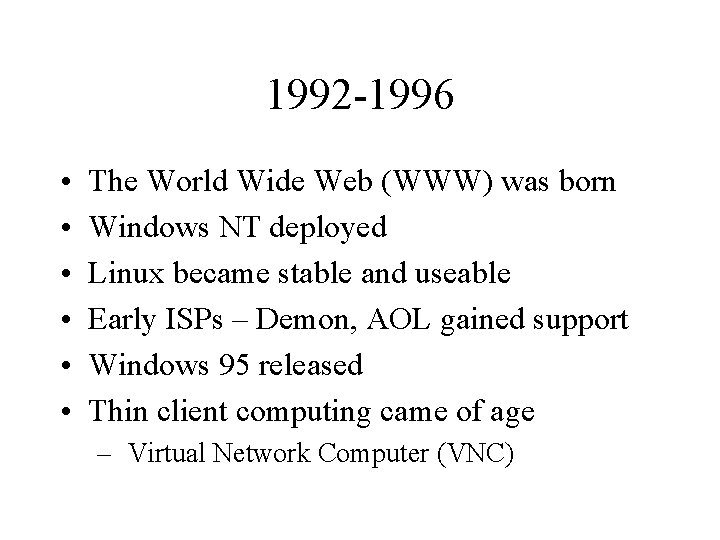
1992 -1996 • • • The World Wide Web (WWW) was born Windows NT deployed Linux became stable and useable Early ISPs – Demon, AOL gained support Windows 95 released Thin client computing came of age – Virtual Network Computer (VNC)
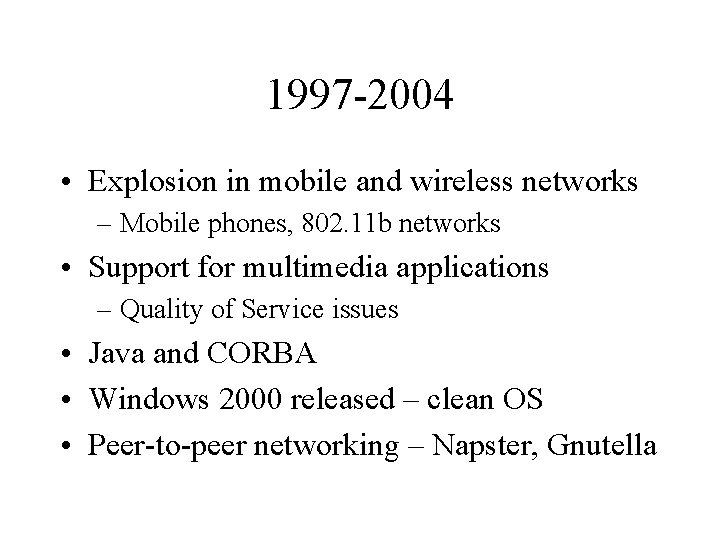
1997 -2004 • Explosion in mobile and wireless networks – Mobile phones, 802. 11 b networks • Support for multimedia applications – Quality of Service issues • Java and CORBA • Windows 2000 released – clean OS • Peer-to-peer networking – Napster, Gnutella
2005 - 2009 • Blade Servers Technology • Deployment of hardware platforms – Dual and Quad Core processors common – Energy is now a big issue • Deployment of Wireless Technology – Wi. Max, 802. 11 n, Ultrawideband • Cheaper platforms – The rise of netbooks – ASUS Eee PC, etc (under £ 200. 00)
2009 - Present • The rise of the Mobile Platform – Apple’s i. Phone – Google’s Android Platform • Net. OS/Browser platforms – Chrome, Google Wave • Mobile Architectures for heterogeneous networks • Ambient Networks, Y-Comm
Mega Trends (Big Wave) • Moore’s law – silicon density doubles every 18 months (dual and quad processors) • Cost of computing, memory and networking continue to fall • One -> many computers • Processor-centric -> network-centric • Wired->wireless environments
Mega Trends (Small Wave) • Integrated Processors – Death of NICs and I/O buses • Embedded Networking Support for very small devices • The rise and rise of Ethernet technology – From LAN to WAN, 802. 11 a/b/g -> 802. 11 n • Heterogeneous Networking • Devices connected to many networks at the same time
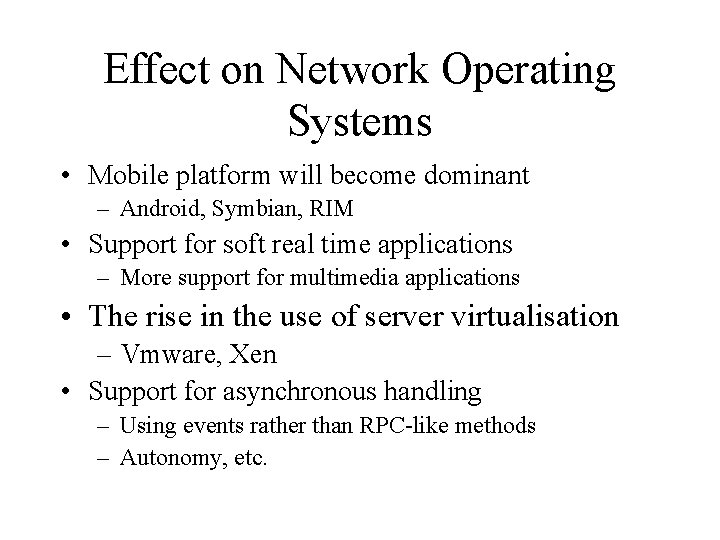
Effect on Network Operating Systems • Mobile platform will become dominant – Android, Symbian, RIM • Support for soft real time applications – More support for multimedia applications • The rise in the use of server virtualisation – Vmware, Xen • Support for asynchronous handling – Using events rather than RPC-like methods – Autonomy, etc.