
A quick guide to Six Sigma Objectives Gain

A quick guide to Six Sigma
Objectives • Gain a high-level understanding of Six Sigma • Learn the basic vocabulary of Six Sigma • Understand the roles and responsibilities of Six Sigma practitioners • Identify some of the benefits of Six Sigma as a business improvement methodology

Agenda • • Introduction Methodology Roles and Responsibilities Why Six Sigma
What Six Sigma Means “Past definitions of quality focused on conformance to standards, as companies strived to create products and services that fell within certain specification limits. ” -Mikel Harry and Richard Schroeder
What Six Sigma Does “. . . this Six Sigma journey will change the paradigm from fixing products so they are perfect to fixing processes so that they produce nothing but perfection, or close to it. ” - Jack Welch
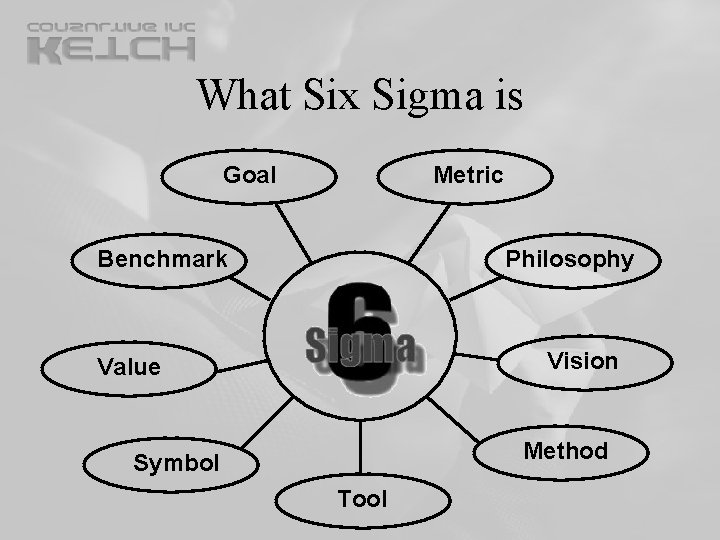
What Six Sigma is Goal Metric Benchmark Philosophy Vision Value Method Symbol Tool
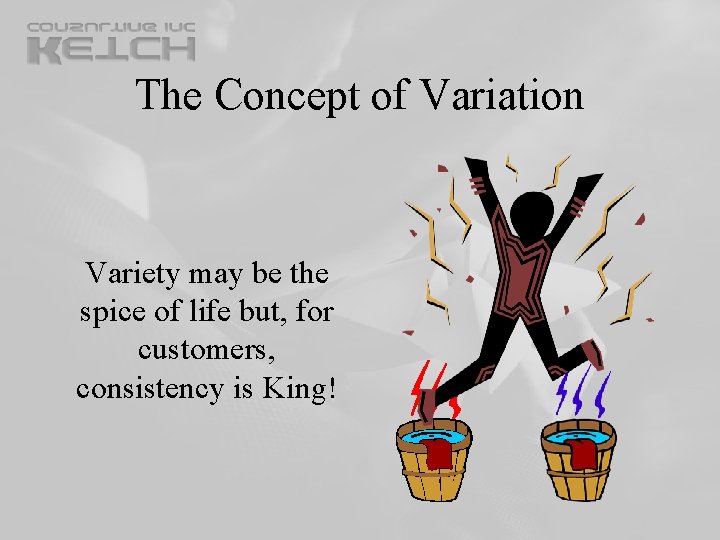
The Concept of Variation Variety may be the spice of life but, for customers, consistency is King!
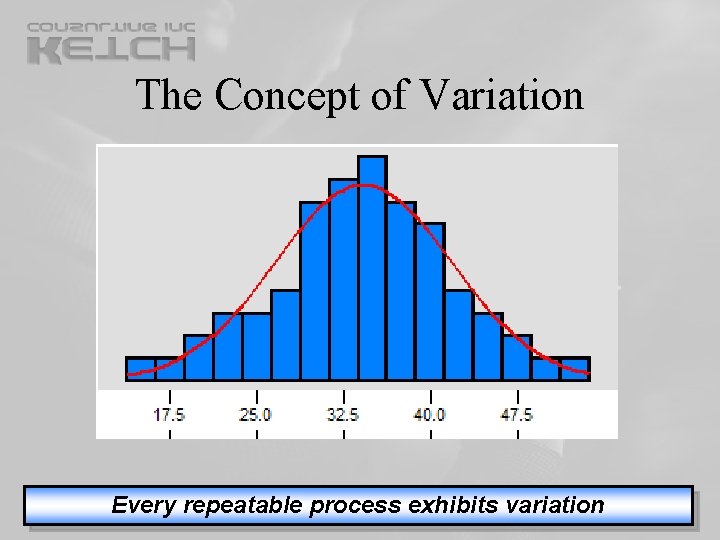
The Concept of Variation Every repeatable process exhibits variation
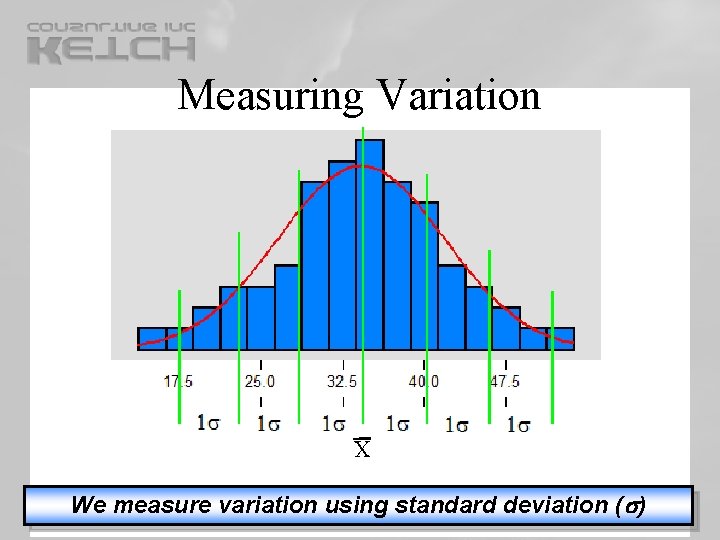
Measuring Variation X We measure variation using standard deviation (s)
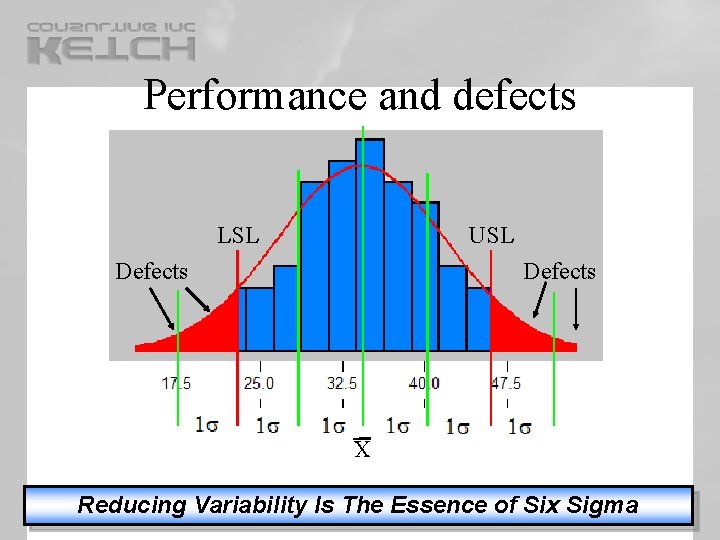
Performance and defects LSL USL Defects X Reducing Variability Is The Essence of Six Sigma
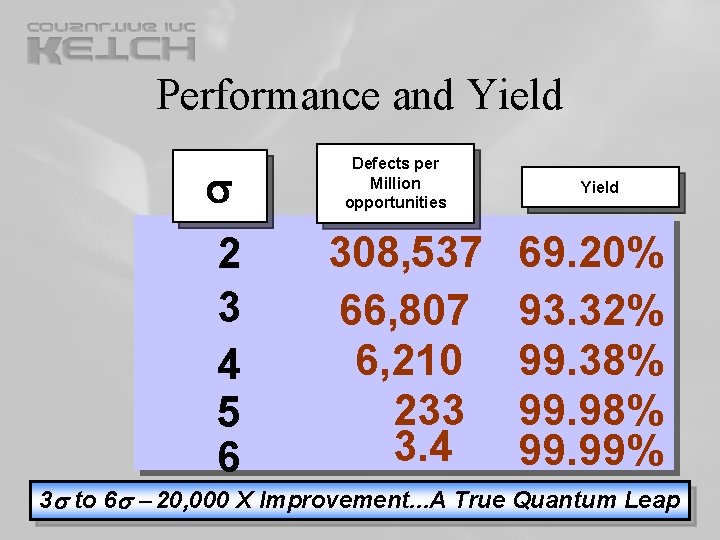
Performance and Yield s 2 3 4 5 6 Defects per Million opportunities 308, 537 66, 807 6, 210 233 3. 4 Yield 69. 20% 93. 32% 99. 38% 99. 99% 3 s to 6 s - 20, 000 X Improvement. . . A True Quantum Leap
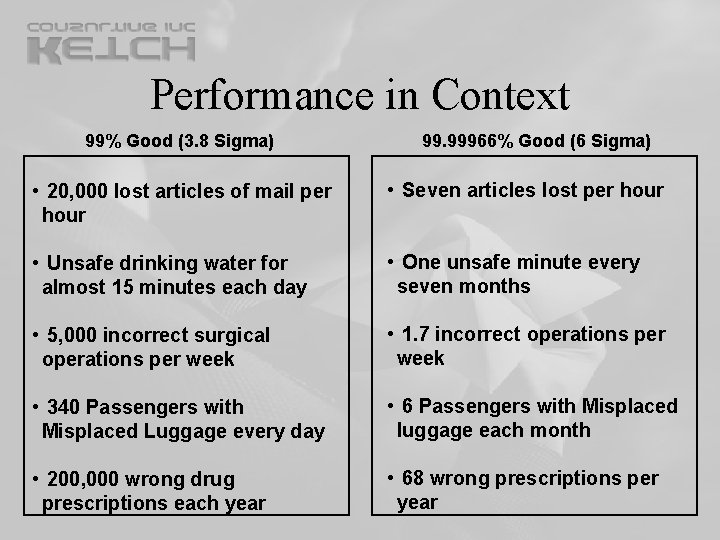
Performance in Context 99% Good (3. 8 Sigma) 99. 99966% Good (6 Sigma) • 20, 000 lost articles of mail per hour • Seven articles lost per hour • Unsafe drinking water for almost 15 minutes each day • One unsafe minute every seven months • 5, 000 incorrect surgical operations per week • 1. 7 incorrect operations per week • 340 Passengers with Misplaced Luggage every day • 6 Passengers with Misplaced luggage each month • 200, 000 wrong drug prescriptions each year • 68 wrong prescriptions per year
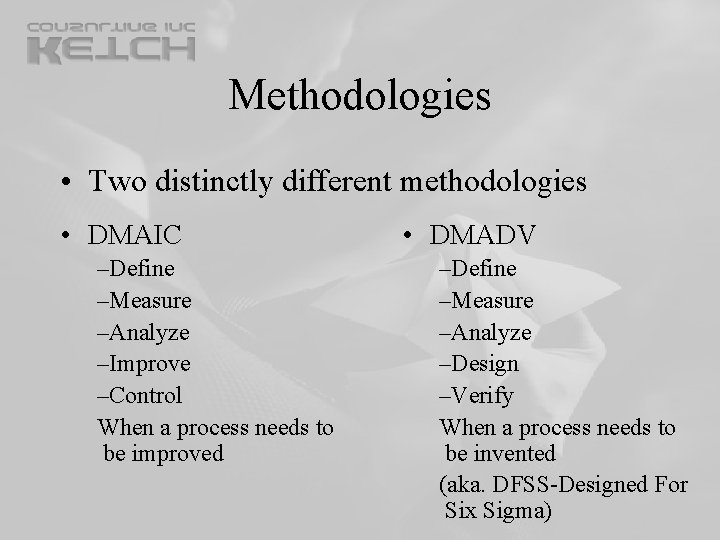
Methodologies • Two distinctly different methodologies • DMAIC –Define –Measure –Analyze –Improve –Control When a process needs to be improved • DMADV –Define –Measure –Analyze –Design –Verify When a process needs to be invented (aka. DFSS-Designed For Six Sigma)
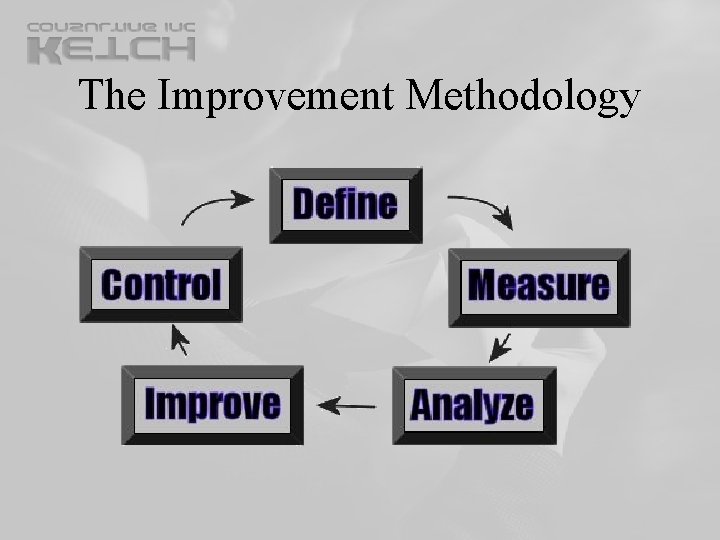
The Improvement Methodology
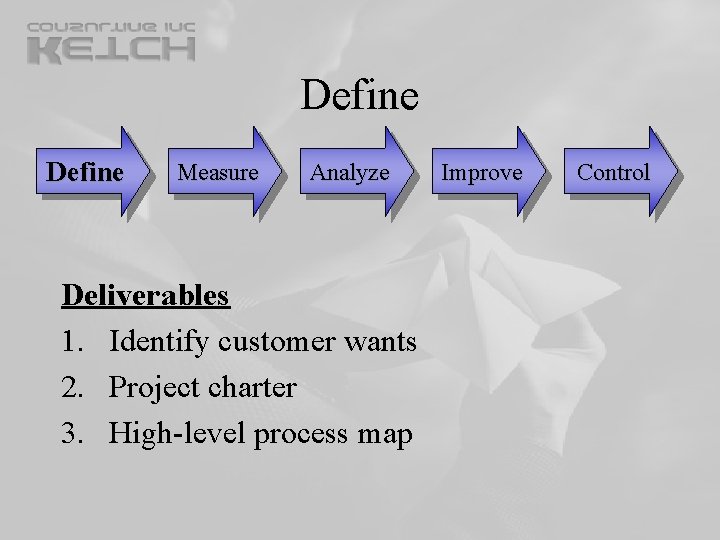
Define Measure Analyze Deliverables 1. Identify customer wants 2. Project charter 3. High-level process map Improve Control
Identify Customer Wants Define • Who are your customers? – Internal vs. external customers • Collect VOC-Voice Of Customer data – – Interviews Surveys Complaints Focus groups • Define CTQs-Critical To Quality measures – How does the customer judge your product or service?
Define • • • Project Charter Project scope Business case Cost benefit Roles & responsibilities Milestones Deliverables
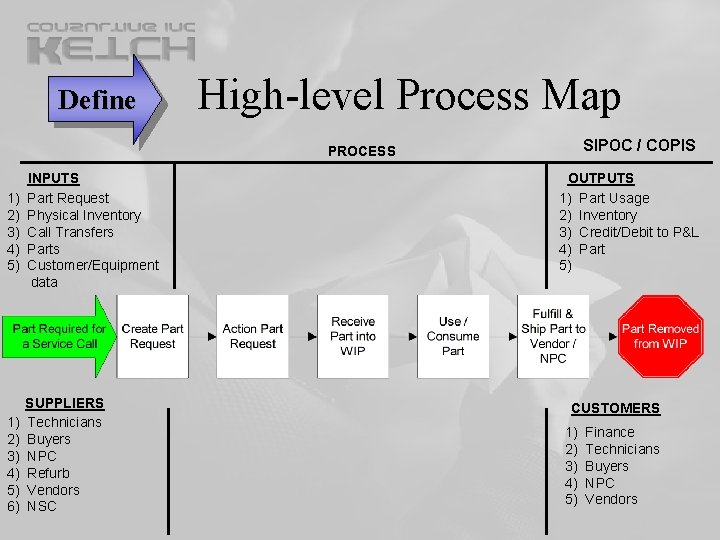
High-level Process Map Define SIPOC / COPIS PROCESS 1) 2) 3) 4) 5) 6) INPUTS Part Request Physical Inventory Call Transfers Parts Customer/Equipment data SUPPLIERS Technicians Buyers NPC Refurb Vendors NSC OUTPUTS 1) Part Usage 2) Inventory 3) Credit/Debit to P&L 4) Part 5) CUSTOMERS 1) 2) 3) 4) 5) Finance Technicians Buyers NPC Vendors
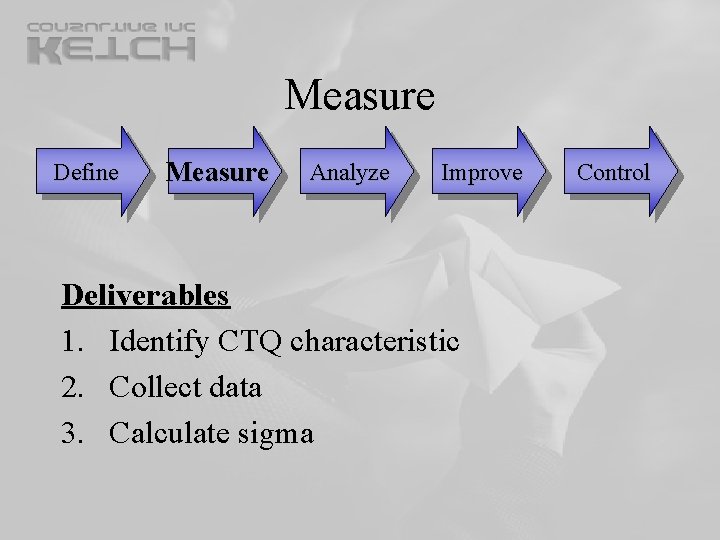
Measure Define Measure Analyze Improve Deliverables 1. Identify CTQ characteristic 2. Collect data 3. Calculate sigma Control
Identify CTQ Characteristic Measure • Getting down to the thing that the project will target using tools like: – Detailed process mapping – QFD-Quality Functional Deployment – Cause & effect analysis – FMEA-Failure Modes & Effects Analysis
Measure Collect Data • Create a data collection plan • Perform a MSA – Measurement Systems Analysis • Gage R & R • Attribute R & R • Test re-test study • Collect data
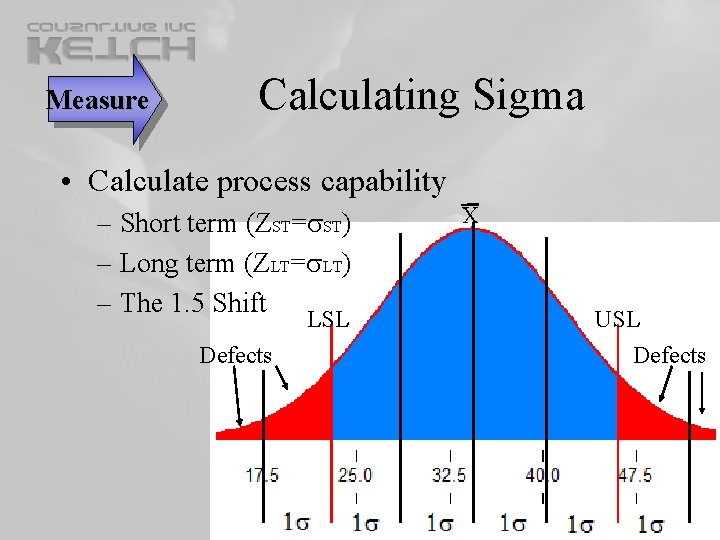
Measure Calculating Sigma • Calculate process capability LSL Defects X – Short term (ZST=s. ST) – Long term (ZLT=s. LT) – The 1. 5 Shift USL Defects
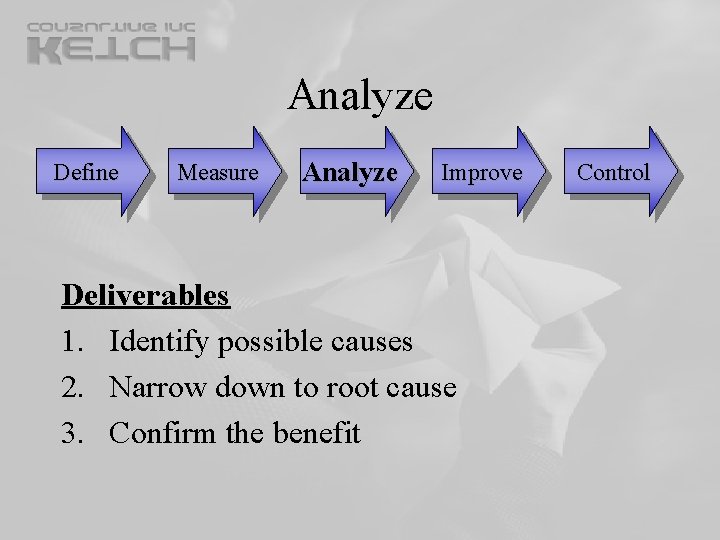
Analyze Define Measure Analyze Improve Deliverables 1. Identify possible causes 2. Narrow down to root cause 3. Confirm the benefit Control
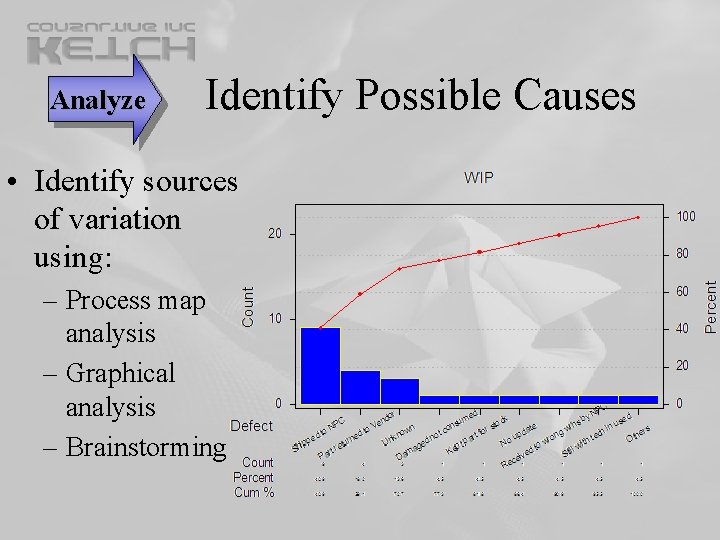
Identify Possible Causes Analyze • Identify sources of variation using: – Process map analysis – Graphical analysis – Brainstorming
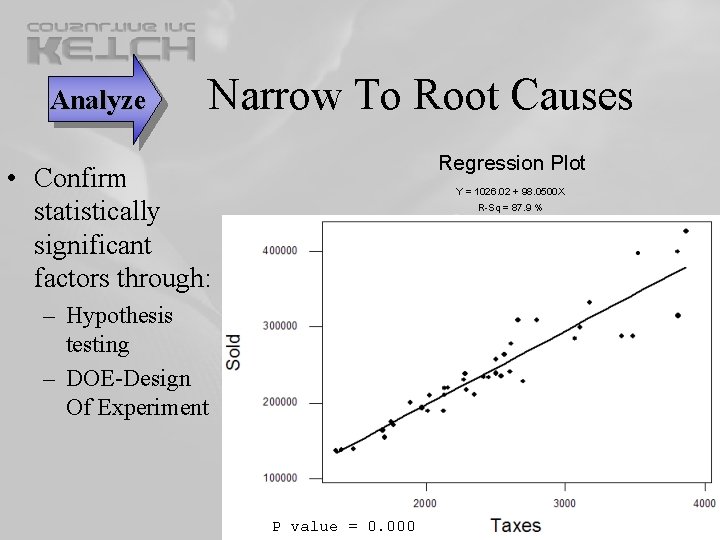
Narrow To Root Causes Analyze Regression Plot • Confirm statistically significant factors through: Y = 1026. 02 + 98. 0500 X R-Sq = 87. 9 % – Hypothesis testing – DOE-Design Of Experiment P value = 0. 000
Analyze Confirm The Benefit • Ensure that the effort needed to rectify the issues identified are financially feasible – Basic ROI-Return On Investment or cost benefit analysis
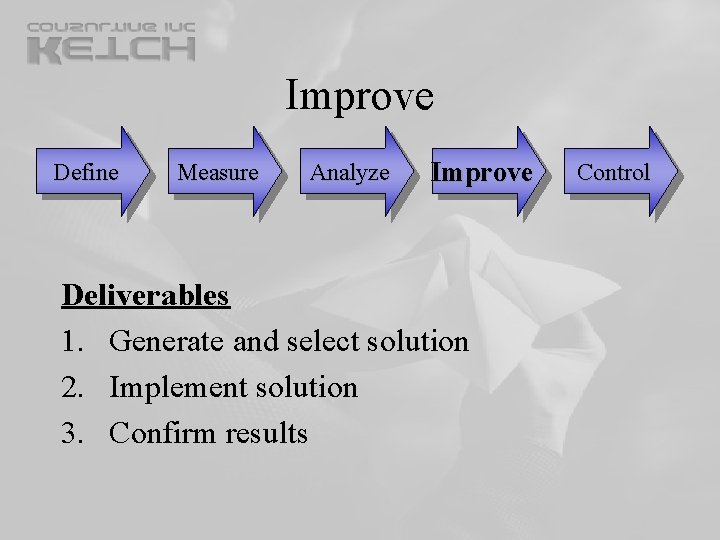
Improve Define Measure Analyze Improve Deliverables 1. Generate and select solution 2. Implement solution 3. Confirm results Control
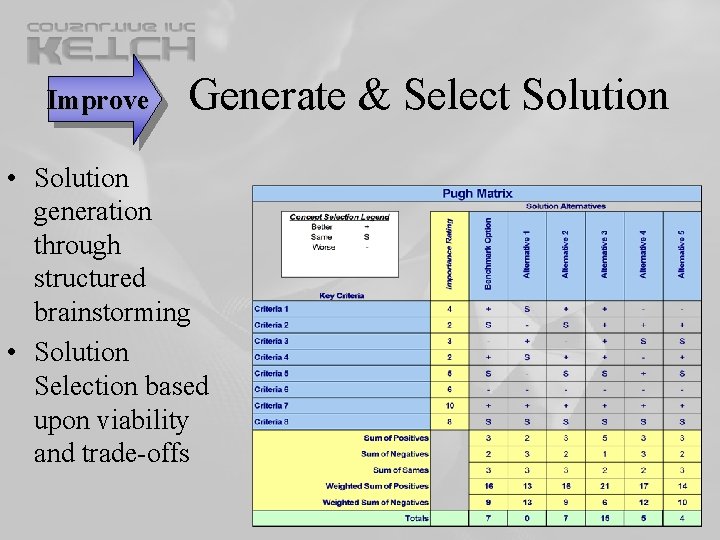
Generate & Select Solution Improve • Solution generation through structured brainstorming • Solution Selection based upon viability and trade-offs
Improve Implement Solution • Comprehensive pilot planning – Detailed process maps – SOP-Standard Operating Procedures – Monitoring plans – Contingency planning – Risk management plan
Improve Confirm Results • Ensure that an improvement has been made and is consistent with expectations – Learn and adapt – Re-assess measurement systems – Adjust improvements as required – Re-calculate sigma – Confirm improvement is statistically significant
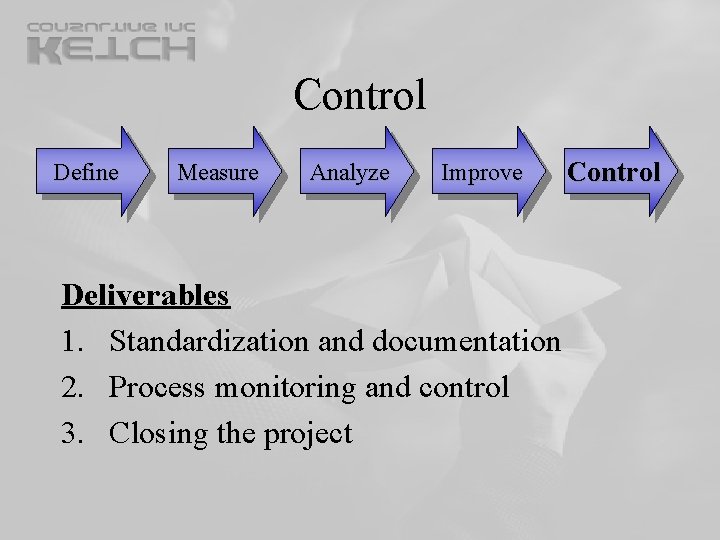
Control Define Measure Analyze Improve Deliverables 1. Standardization and documentation 2. Process monitoring and control 3. Closing the project Control
Control Standardize and Document • Rollout confirmed solution across business with updated information from pilot – Detailed process maps – SOP-Standard Operating Procedures – Monitoring plans – Contingency planning – Risk management plan
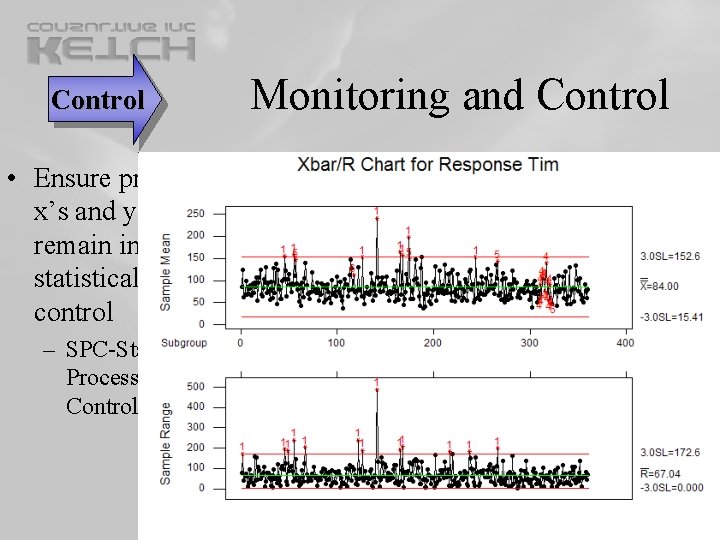
Control • Ensure project x’s and y’s remain in statistical control – SPC-Statistical Process Control Monitoring and Control
Control Close the Project • Complete project documentation • Complete project sign -off • Handoff documentation to process owner • Celebrate!
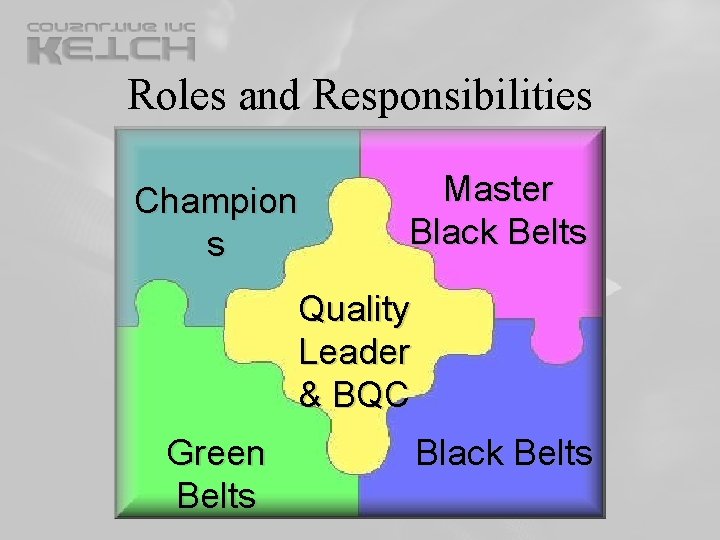
Roles and Responsibilities Champion s Master Black Belts Quality Leader & BQC Green Belts Black Belts
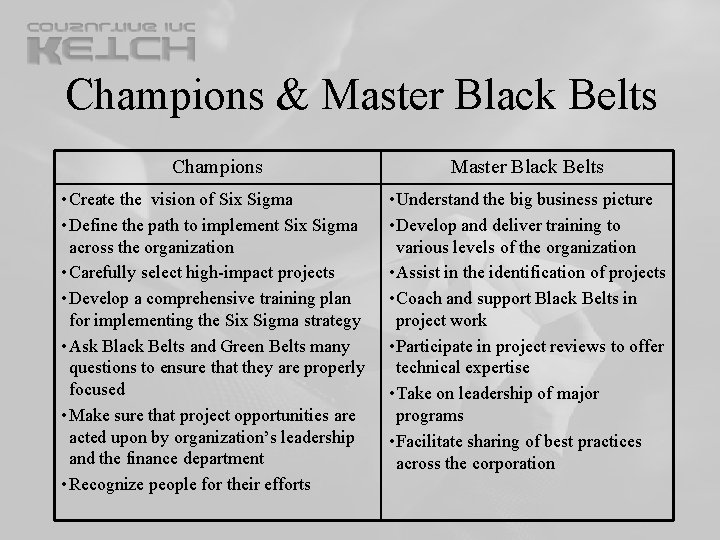
Champions & Master Black Belts Champions Master Black Belts • Create the vision of Six Sigma • Define the path to implement Six Sigma across the organization • Carefully select high-impact projects • Develop a comprehensive training plan for implementing the Six Sigma strategy • Ask Black Belts and Green Belts many questions to ensure that they are properly focused • Make sure that project opportunities are acted upon by organization’s leadership and the finance department • Recognize people for their efforts • Understand the big business picture • Develop and deliver training to various levels of the organization • Assist in the identification of projects • Coach and support Black Belts in project work • Participate in project reviews to offer technical expertise • Take on leadership of major programs • Facilitate sharing of best practices across the corporation
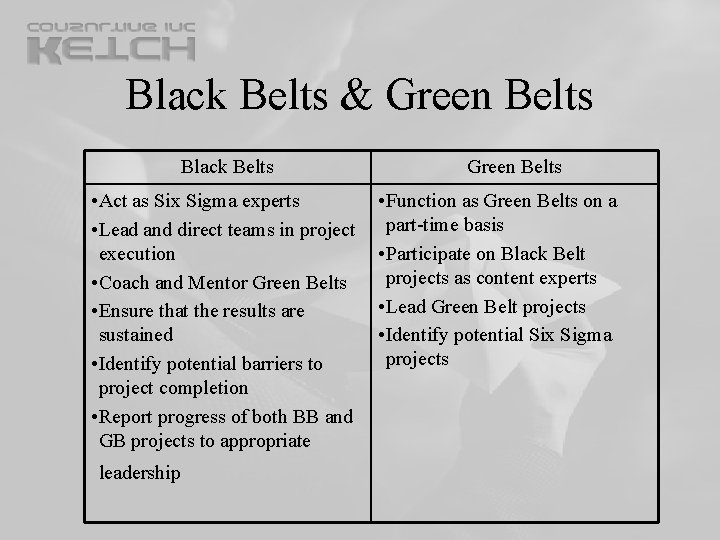
Black Belts & Green Belts Black Belts • Act as Six Sigma experts • Lead and direct teams in project execution • Coach and Mentor Green Belts • Ensure that the results are sustained • Identify potential barriers to project completion • Report progress of both BB and GB projects to appropriate leadership Green Belts • Function as Green Belts on a part-time basis • Participate on Black Belt projects as content experts • Lead Green Belt projects • Identify potential Six Sigma projects

Return on Investment • In 2000 GE’s gross annual benefit was $6. 6 billion. • CEO Larry Bossidy brought Allied. Signal back from the verge of bankruptcy. Cumulative benefits $2 billion in direct savings • Raytheon improved its cost of doing business by more than $1 billion annually in 2001. • Average financial benefit per project $120, 000 • Motorola claims a Six Sigma ROI of between 10: 1 & 50: 1
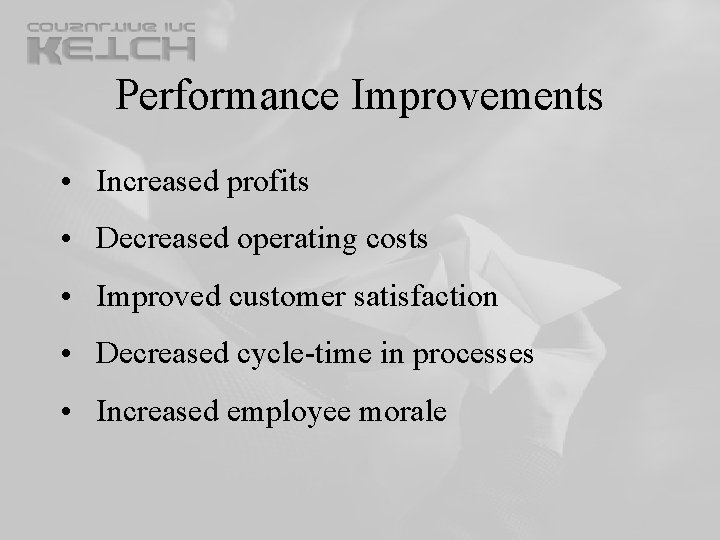
Performance Improvements • Increased profits • Decreased operating costs • Improved customer satisfaction • Decreased cycle-time in processes • Increased employee morale
How To Implement Six Sigma • Factors for success – Leadership – Communication – Rewards & recognition – Training – Launching the initiative – Implementation – Sustaining the effort and return

Information Sources Six Sigma Software
Questions and Answers Ketch Consulting 1 -888 -2 -6 -SIGMA www. ketch. ca
- Slides: 42