
A Quenched model Origin of the Red Sequence

- Slides: 11
A Quenched model Origin of the Red Sequence Justin Harker Sandy Faber Ricardo Schiavon EGS Meeting 17 Dec 2005
What are the ages of Red Sequence Galaxies? Early type galaxies have fairly uniformly red colors consistent with old populations Monolithic collapse: predicts a red sequence formed at a single epoch
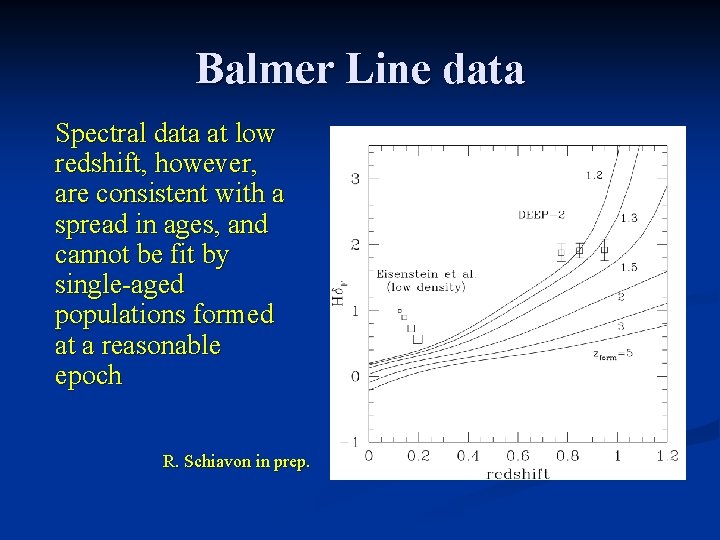
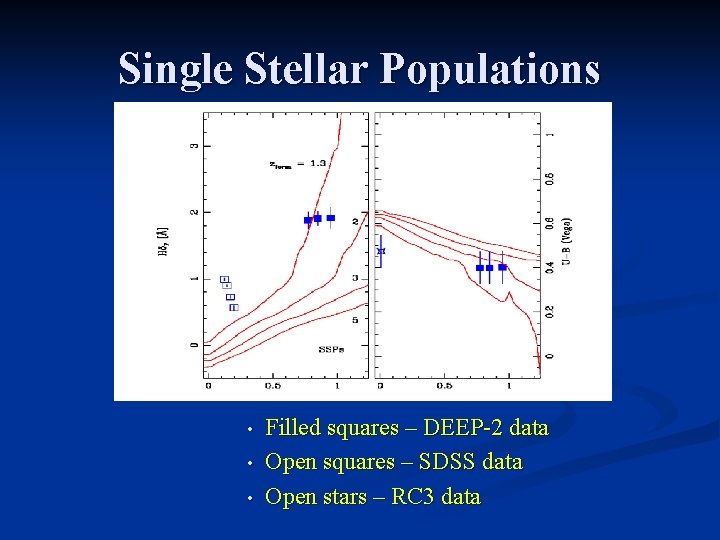
Balmer Line data Spectral data at low redshift, however, are consistent with a spread in ages, and cannot be fit by single-aged populations formed at a reasonable epoch R. Schiavon in prep.
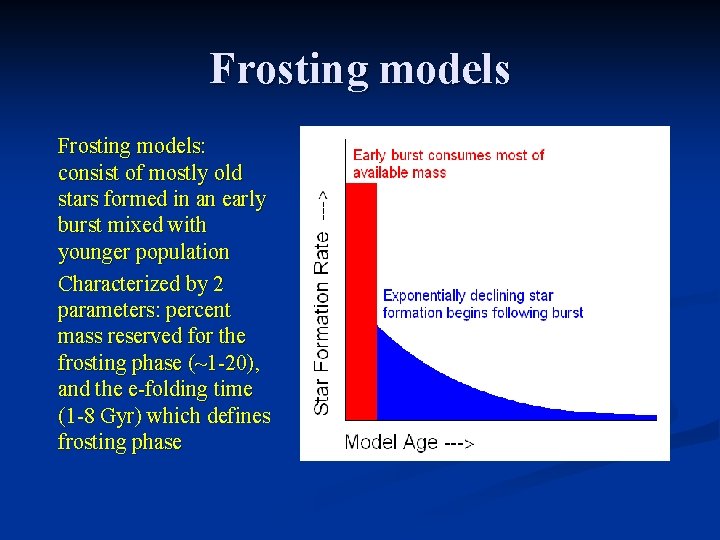
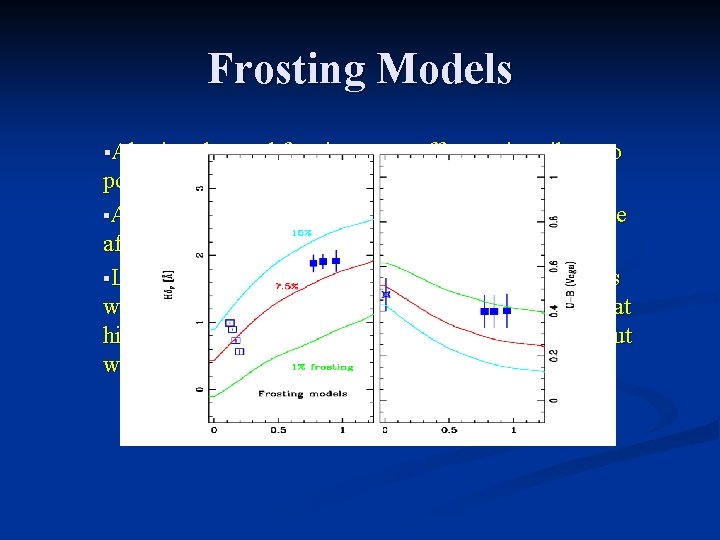
Frosting models: consist of mostly old stars formed in an early burst mixed with younger population Characterized by 2 parameters: percent mass reserved for the frosting phase (~1 -20), and the e-folding time (1 -8 Gyr) which defines frosting phase
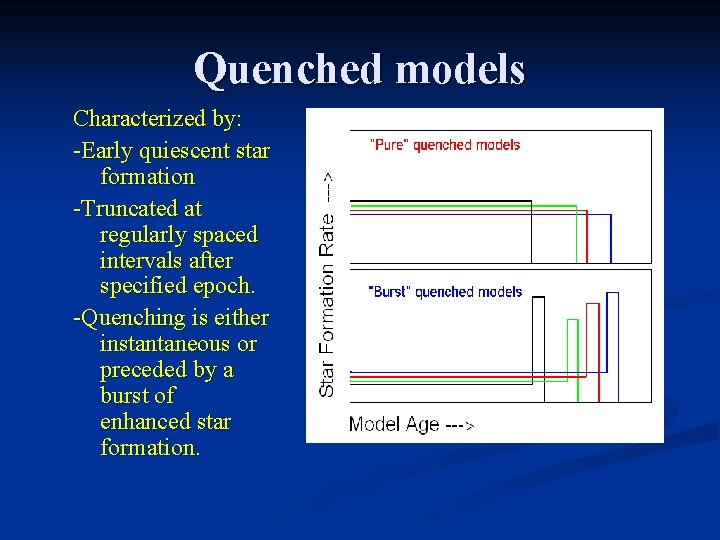
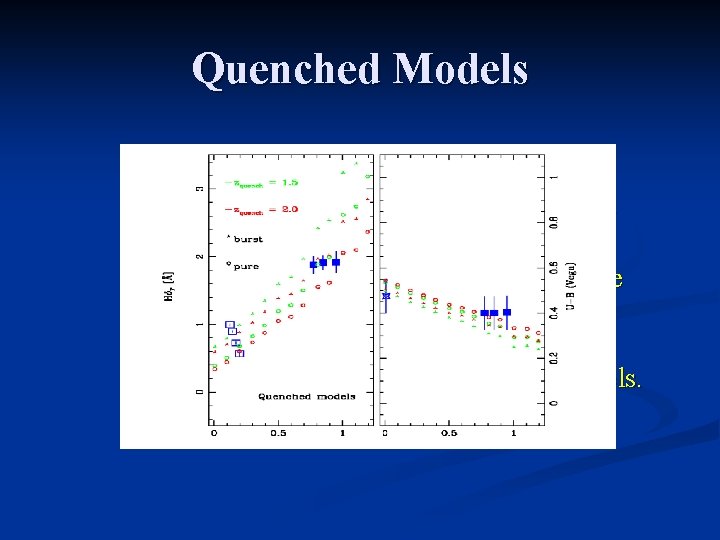
Quenched models Characterized by: -Early quiescent star formation -Truncated at regularly spaced intervals after specified epoch. -Quenching is either instantaneous or preceded by a burst of enhanced star formation.
Selection of Quenched Models We examine quenching epochs of z=1. 5, 2. 0 To compute line strengths and colors of the composite population, we take averaged HδF, U-B of quenched models that pass a color cut at a given epoch.
Single Stellar Populations • • • Filled squares – DEEP-2 data Open squares – SDSS data Open stars – RC 3 data
Frosting Models §Altering the total frosting mass affects primarily zero point in color, line strength §Altering the e-folding timescale for the frosting phase affects primarily slope of fit §Line strength fit is reasonable for 7. 5% frosting mass with an exponent of 4 Gyr, but colors are rather blue at high redshift, and you cannot improve color fit without worsening line strength fit.
Quenched Models The averaged quenched model is a good fit to U-B color under all conditions (thanks in part to the color cut) Both pure and burst models are a reasonable fit to data for a quenching epoch of z=2, z=1. 5 produces fairly high Balmer line strengths at high redshift for the burst models.
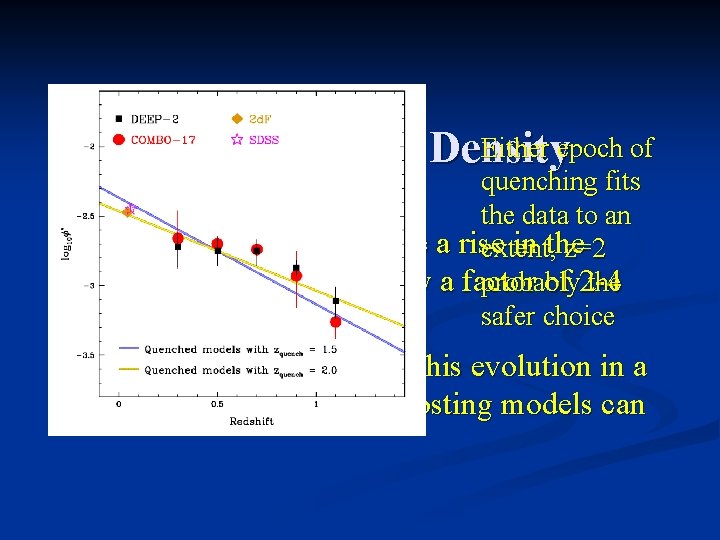
Either epoch of RSG Number Density quenching fits the data to an DEEP-2, COMBO 17 observe a rise in the extent, z=2 probably the number density of RSGs by a factor of 2 -4 safer choice after z=1 Quenched models also trace this evolution in a way neither SSPs or our frosting models can
Conclusions Balmer line strength data are inconsistent with a monolithic collapse red sequence n Frosting models cannot simultaneously fit color and line strength data n Quenched models are able to match the data accurately, and are suitable for testing against number density evolution, which they also match. n