
A Quantum Gas Microscope for Detecting Single Atoms
- Slides: 1
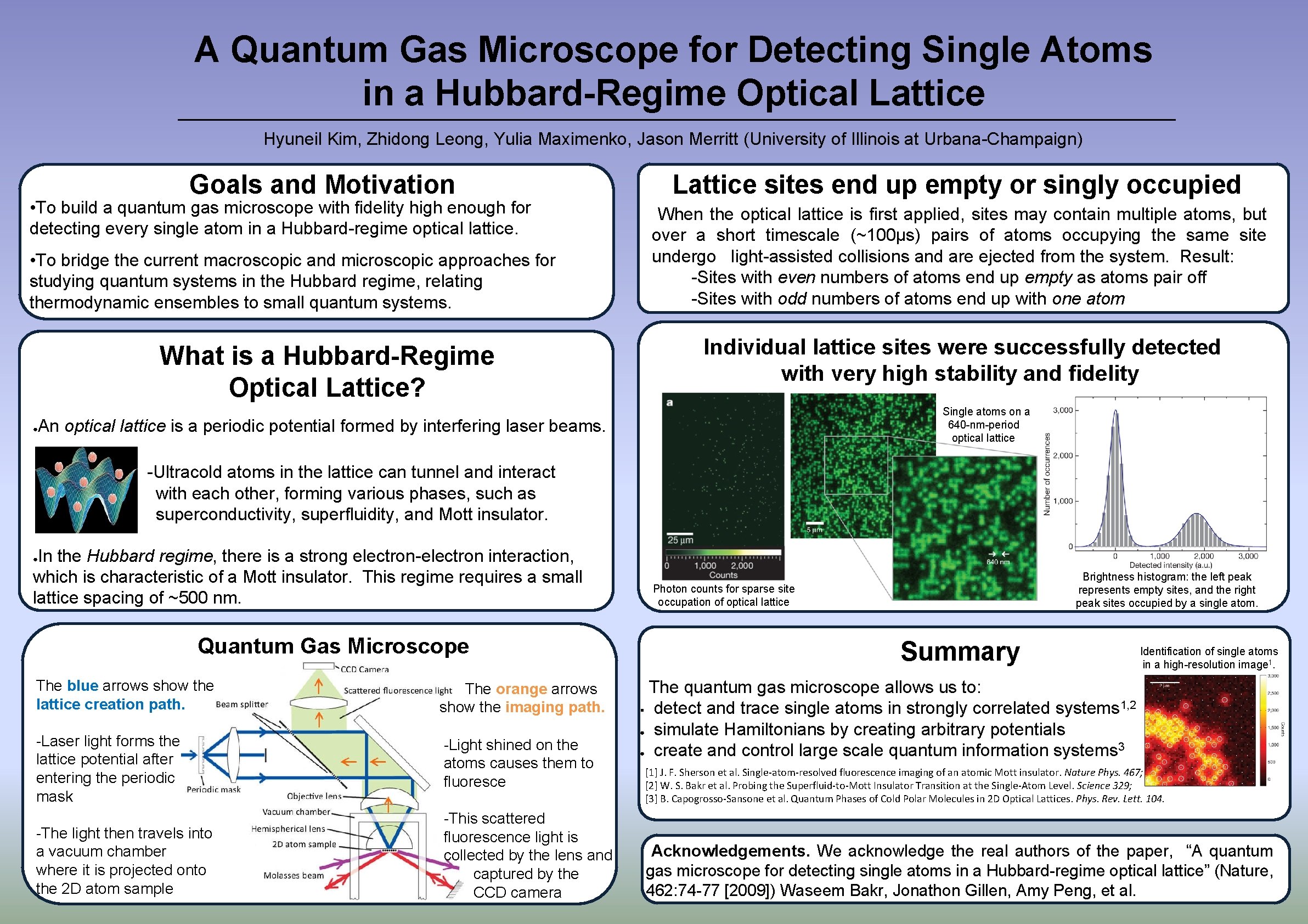
A Quantum Gas Microscope for Detecting Single Atoms in a Hubbard-Regime Optical Lattice Hyuneil Kim, Zhidong Leong, Yulia Maximenko, Jason Merritt (University of Illinois at Urbana-Champaign) Goals and Motivation • To build a quantum gas microscope with fidelity high enough for detecting every single atom in a Hubbard-regime optical lattice. • To bridge the current macroscopic and microscopic approaches for studying quantum systems in the Hubbard regime, relating thermodynamic ensembles to small quantum systems. What is a Hubbard-Regime Optical Lattice? ● Lattice sites end up empty or singly occupied When the optical lattice is first applied, sites may contain multiple atoms, but over a short timescale (~100µs) pairs of atoms occupying the same site undergo light-assisted collisions and are ejected from the system. Result: -Sites with even numbers of atoms end up empty as atoms pair off -Sites with odd numbers of atoms end up with one atom Individual lattice sites were successfully detected with very high stability and fidelity Single atoms on a 640 -nm-period optical lattice An optical lattice is a periodic potential formed by interfering laser beams. -Ultracold atoms in the lattice can tunnel and interact with each other, forming various phases, such as superconductivity, superfluidity, and Mott insulator. In the Hubbard regime, there is a strong electron-electron interaction, which is characteristic of a Mott insulator. This regime requires a small lattice spacing of ~500 nm. ● Quantum Gas Microscope The blue arrows show the lattice creation path. The orange arrows show the imaging path. -Laser light forms the lattice potential after entering the periodic mask -Light shined on the atoms causes them to fluoresce -The light then travels into a vacuum chamber where it is projected onto the 2 D atom sample -This scattered fluorescence light is collected by the lens and captured by the CCD camera Brightness histogram: the left peak represents empty sites, and the right peak sites occupied by a single atom. Photon counts for sparse site occupation of optical lattice Summary Identification of single atoms in a high-resolution image 1. The quantum gas microscope allows us to: 1, 2 § detect and trace single atoms in strongly correlated systems ● simulate Hamiltonians by creating arbitrary potentials 3 ● create and control large scale quantum information systems [1] J. F. Sherson et al. Single-atom-resolved fluorescence imaging of an atomic Mott insulator. Nature Phys. 467; [2] W. S. Bakr et al. Probing the Superfluid-to-Mott Insulator Transition at the Single-Atom Level. Science 329; [3] B. Capogrosso-Sansone et al. Quantum Phases of Cold Polar Molecules in 2 D Optical Lattices. Phys. Rev. Lett. 104. Acknowledgements. We acknowledge the real authors of the paper, “A quantum gas microscope for detecting single atoms in a Hubbard-regime optical lattice” (Nature, 462: 74 -77 [2009]) Waseem Bakr, Jonathon Gillen, Amy Peng, et al.