
A Qualitative Examination of Families Experiences of Tube
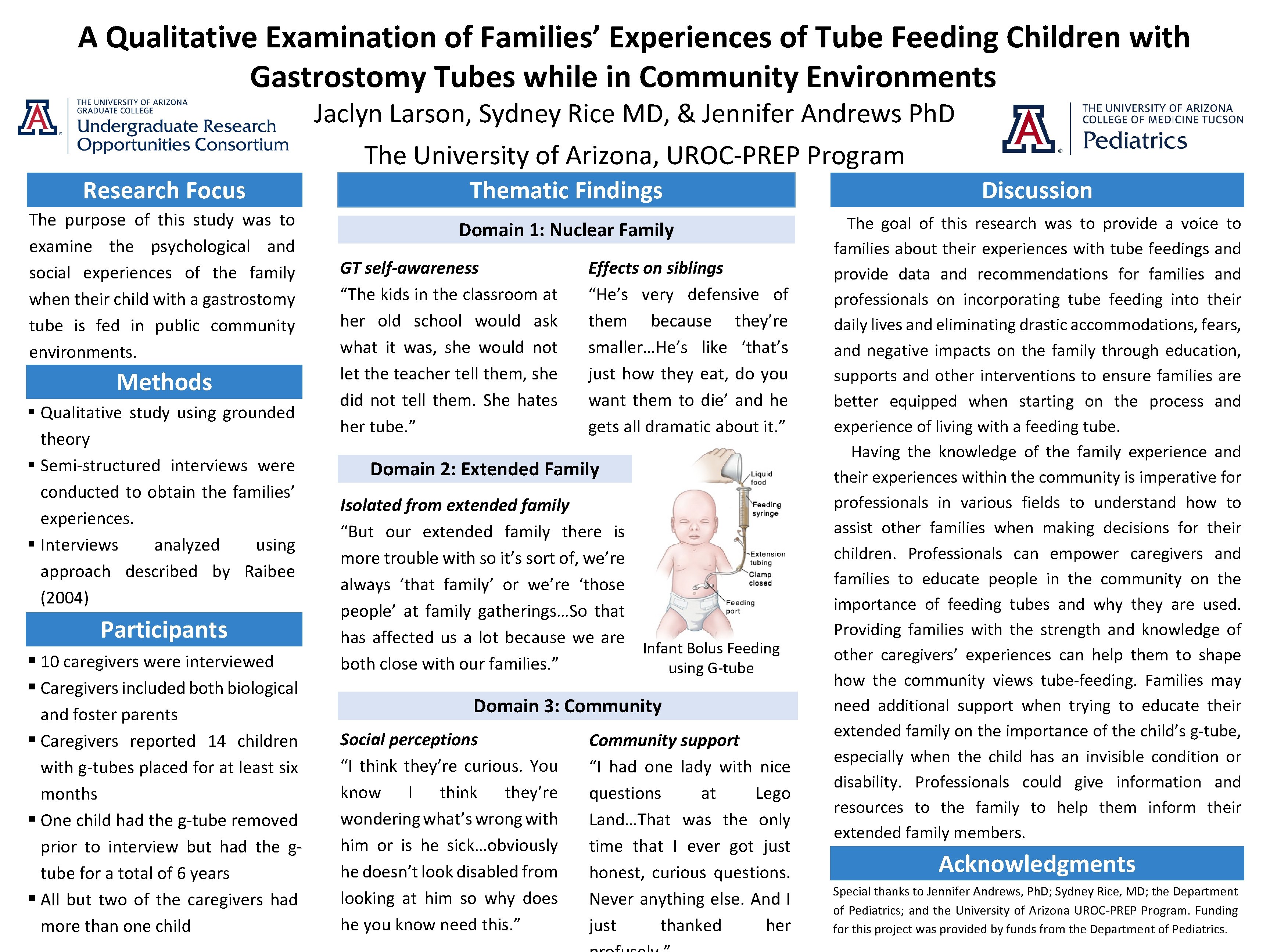
A Qualitative Examination of Families’ Experiences of Tube Feeding Children with Gastrostomy Tubes while in Community Environments Jaclyn Larson, Sydney Rice MD, & Jennifer Andrews Ph. D The University of Arizona, UROC-PREP Program Research Focus The purpose of this study was to examine the psychological and social experiences of the family when their child with a gastrostomy tube is fed in public community environments. Methods § Qualitative study using grounded theory § Semi-structured interviews were conducted to obtain the families’ experiences. § Interviews analyzed using approach described by Raibee (2004) Participants § 10 caregivers were interviewed § Caregivers included both biological and foster parents § Caregivers reported 14 children with g-tubes placed for at least six months § One child had the g-tube removed prior to interview but had the gtube for a total of 6 years § All but two of the caregivers had more than one child Thematic Findings Discussion Domain 1: Nuclear Family The goal of this research was to provide a voice to families about their experiences with tube feedings and provide data and recommendations for families and professionals on incorporating tube feeding into their daily lives and eliminating drastic accommodations, fears, and negative impacts on the family through education, supports and other interventions to ensure families are better equipped when starting on the process and experience of living with a feeding tube. Having the knowledge of the family experience and their experiences within the community is imperative for professionals in various fields to understand how to assist other families when making decisions for their children. Professionals can empower caregivers and families to educate people in the community on the importance of feeding tubes and why they are used. Providing families with the strength and knowledge of other caregivers’ experiences can help them to shape how the community views tube-feeding. Families may need additional support when trying to educate their extended family on the importance of the child’s g-tube, especially when the child has an invisible condition or disability. Professionals could give information and resources to the family to help them inform their extended family members. GT self-awareness “The kids in the classroom at her old school would ask what it was, she would not let the teacher tell them, she did not tell them. She hates her tube. ” Effects on siblings “He’s very defensive of them because they’re smaller…He’s like ‘that’s just how they eat, do you want them to die’ and he gets all dramatic about it. ” Domain 2: Extended Family Isolated from extended family “But our extended family there is more trouble with so it’s sort of, we’re always ‘that family’ or we’re ‘those people’ at family gatherings…So that has affected us a lot because we are Infant Bolus Feeding both close with our families. ” using G-tube Domain 3: Community Social perceptions “I think they’re curious. You know I think they’re wondering what’s wrong with him or is he sick…obviously he doesn’t look disabled from looking at him so why does he you know need this. ” Community support “I had one lady with nice questions at Lego Land…That was the only time that I ever got just honest, curious questions. Never anything else. And I just thanked her Acknowledgments Special thanks to Jennifer Andrews, Ph. D; Sydney Rice, MD; the Department of Pediatrics; and the University of Arizona UROC-PREP Program. Funding for this project was provided by funds from the Department of Pediatrics.
- Slides: 1