
A Qualitative Approach Towards Reliability Estimation of OO
A Qualitative Approach Towards Reliability Estimation of OO System Design Aiman Rasheed 220306 Research paper presentation as partial fulfillment of ICS-519, Software Metrics
Outline • • Introduction Reliability Models Approaches Problem with Traditional Reliability Models • Proposed Approach • Conclusion • Future Directions
Introduction • What is Reliability? “Reliability of software is the probability over a given period of time that the system will correctly deliver services as expected by the user”

Introduction • Why we need Reliability? – Estimate or predict effort/cost of development processes – Estimate or predict the quality of the software

Reliability Models • • • Reliability Growth Model Time/ Structure Based Model Error Seeding Model Markov Model Bayesian Network Model
Approaches • Blind approach • Autopsy approach
Problems with Traditional Models • Reliability Growth Models – Huge history of defect data is required – Assumption of representative test coverage – Assumption that fault removal is successful i. e. absence of ripple effect
Problems with Traditional Models • Reliability Growth Models – Assumption of independence of successive software failures during successive software runs – Increasing the reliability level increases the length of the test series required until it becomes infeasible
Problems with Traditional Models • Time /Structure based Model – Test path space is very large – We don’t know the paths to be executed because of dynamic nature of applications.
Problems with Traditional Models • Error Seeding Model – Number of counts do not matter much as compared to the severity of faults – Defect data is needed
Proposed Approach • • Design level reliability estimation Qualitative approach Higher granularity reliability level Incremental approach
Proposed Approach • Breaking the System Design into Smaller Components – Efficient software engineering paradigm. – System restoring involves only the specific component. – Easy to maintain and – Helps in overall system reliability estimation.
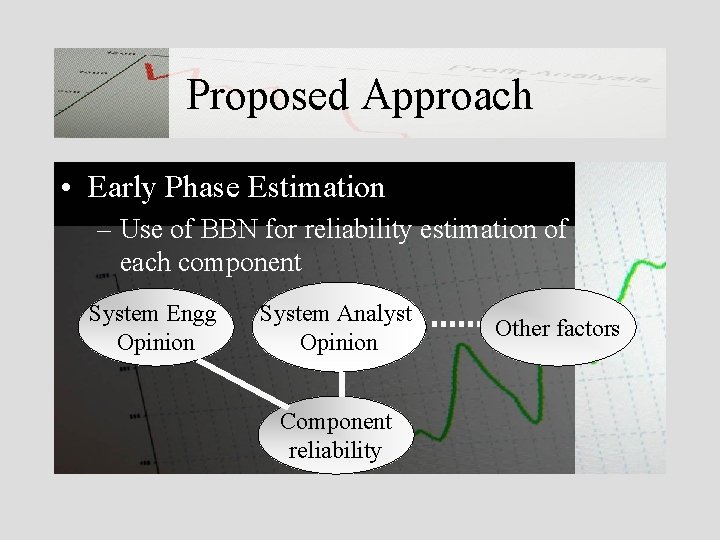
Proposed Approach • Early Phase Estimation – Use of BBN for reliability estimation of each component System Engg Opinion System Analyst Opinion Component reliability Other factors

Proposed Approach • Early Phase Estimation – For construction of BBN, we can use • DIT • NOC

Proposed Approach • Rank Assignment to Error Prone Classes, Using Heuristics: Key-Class – Distance = f(coupling, size-complexity, ) • Where is angle from x-axis

Proposed Approach • Redesigning of Higher Order Ranked Classes – First to see the component with high failure probability – Secondly, redesign the class that has the highest rank

Proposed Approach • Non-probabilistic Confidential Level Design Analysis Through Coupling – Drawing out factors that affect Reliability – Drawing out factors that affect coupling – Analyzing the overlapping factors
Conclusion • Achievement of highly reliable system by attaining high design level reliability. • Precise reliability achievement by addressing high ranked classes • Independent of defect data in the beginning. • Incremental approach.

Future Directions • Kind of coupling is not specified for calculating the distance. Different kinds of coupling can be tested for better estimation. • Empirical validation can be done.
- Slides: 19