
A Pyroelectric Crystal Particle Accelerator Amanda Gehring RoseHulman
- Slides: 1
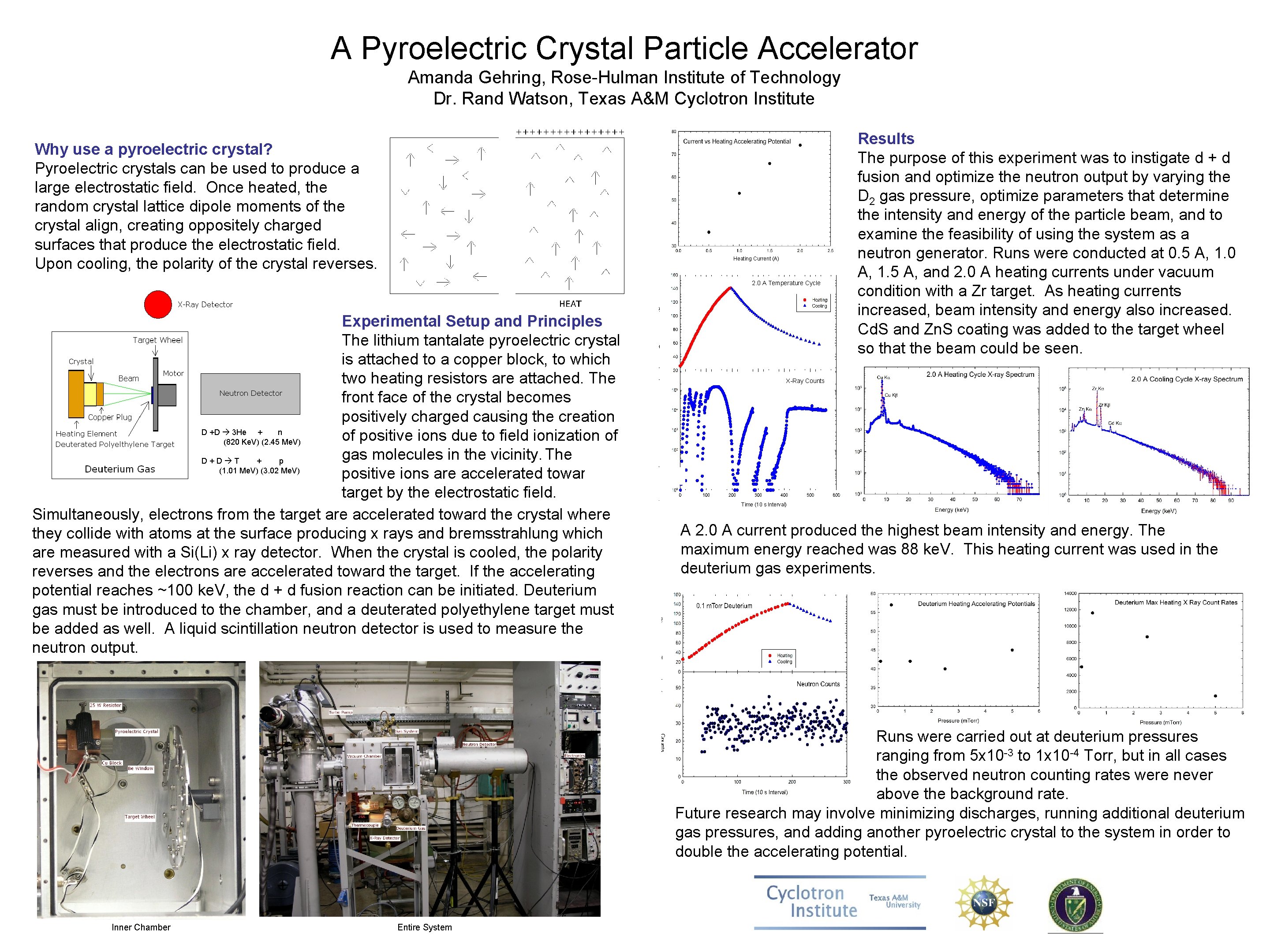
A Pyroelectric Crystal Particle Accelerator Amanda Gehring, Rose-Hulman Institute of Technology Dr. Rand Watson, Texas A&M Cyclotron Institute Why use a pyroelectric crystal? Pyroelectric crystals can be used to produce a large electrostatic field. Once heated, the random crystal lattice dipole moments of the crystal align, creating oppositely charged surfaces that produce the electrostatic field. Upon cooling, the polarity of the crystal reverses. Heating Current (A) 2. 0 A Temperature Cycle Experimental Setup and Principles The lithium tantalate pyroelectric crystal is attached to a copper block, to which two heating resistors are attached. The front face of the crystal becomes positively charged causing the creation D +D 3 He + n of positive ions due to field ionization of (820 Ke. V) (2. 45 Me. V) gas molecules in the vicinity. The D+D T + p (1. 01 Me. V) (3. 02 Me. V) positive ions are accelerated toward the target by the electrostatic field. Simultaneously, electrons from the target are accelerated toward the crystal where they collide with atoms at the surface producing x rays and bremsstrahlung which are measured with a Si(Li) x ray detector. When the crystal is cooled, the polarity reverses and the electrons are accelerated toward the target. If the accelerating potential reaches ~100 ke. V, the d + d fusion reaction can be initiated. Deuterium gas must be introduced to the chamber, and a deuterated polyethylene target must be added as well. A liquid scintillation neutron detector is used to measure the neutron output. Results The purpose of this experiment was to instigate d + d fusion and optimize the neutron output by varying the D 2 gas pressure, optimize parameters that determine the intensity and energy of the particle beam, and to examine the feasibility of using the system as a neutron generator. Runs were conducted at 0. 5 A, 1. 0 A, 1. 5 A, and 2. 0 A heating currents under vacuum condition with a Zr target. As heating currents increased, beam intensity and energy also increased. Cd. S and Zn. S coating was added to the target wheel so that the beam could be seen. X-Ray Counts Time (10 s Interval) A 2. 0 A current produced the highest beam intensity and energy. The maximum energy reached was 88 ke. V. This heating current was used in the deuterium gas experiments. Runs were carried out at deuterium pressures ranging from 5 x 10 -3 to 1 x 10 -4 Torr, but in all cases the observed neutron counting rates were never above the background rate. Future research may involve minimizing discharges, running additional deuterium gas pressures, and adding another pyroelectric crystal to the system in order to double the accelerating potential. Inner Chamber Entire System