
A Public Health Response to Asthma A call
A Public Health Response to Asthma A call to action for organizations and people with an interest in asthma management to work as partners in reducing the burden of asthma within our nation’s communities.
A Public Health Response to Asthma: Surveillance Over time… v. How much asthma does the population have? v. How severe is asthma across the population? v. How well controlled is asthma in the population? v. What is the cost of asthma?
A Public Health Response to Asthma: Uses of Surveillance Data v Basis for planning and targeting intervention activities v Evaluating intervention activities
A Public Health Response to Asthma Education programs can be targeted to: v. People with asthma v. Parents of children with asthma v. Medical care providers v. School staff v. Public

A Public Health Response to Asthma: Coalition Successful asthma campaigns need the cooperation of committed partners.
A Public Health Response to Asthma: Advocacy Asthma needs to be addressed comprehensively by multiple government and non-government agencies.
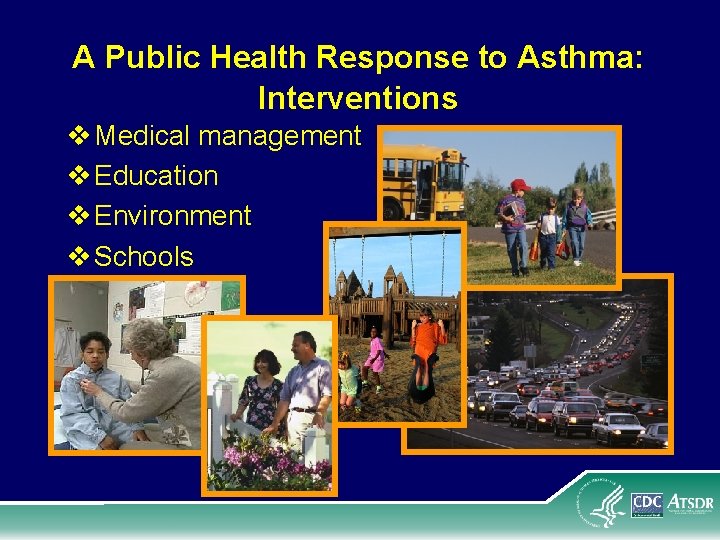
A Public Health Response to Asthma: Interventions v Medical management v Education v Environment v Schools
A Public Health Response to Asthma: Medical Management Interventions Ensure people with asthma know about their disease and are empowered to demand appropriate management
A Public Health Response to Asthma: Environmental Interventions v Help people create and maintain healthy home, school, and work environments. v Environmental interventions may consist of: v Assessments to identify asthma triggers v Education on how to remove asthma triggers v Remediation to remove asthma triggers
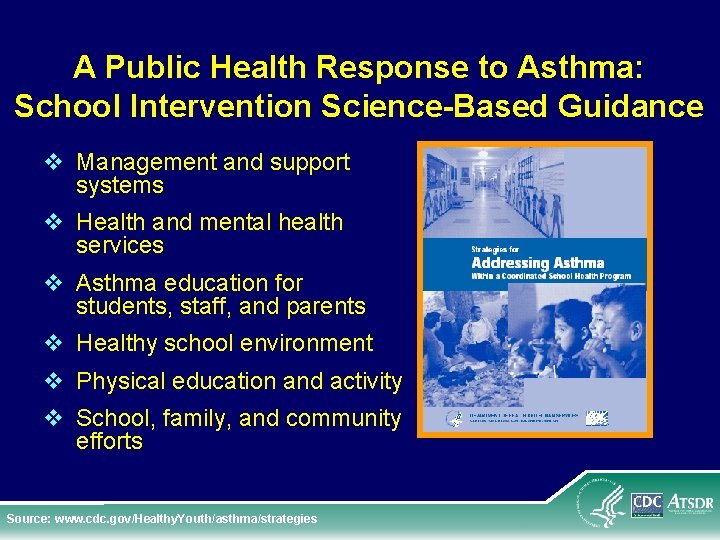
A Public Health Response to Asthma: School Intervention Science-Based Guidance v Management and support systems v Health and mental health services v Asthma education for students, staff, and parents v Healthy school environment v Physical education and activity v School, family, and community efforts Source: www. cdc. gov/Healthy. Youth/asthma/strategies
Key Aspects v Require team effort v Coordinate health, including mental and physical health, education, environment, family, and community efforts v Assess needs of school and prioritize (every action step is not feasible to every school or district) v Focus on students with frequent asthma symptoms, health room visits, and absenteeism
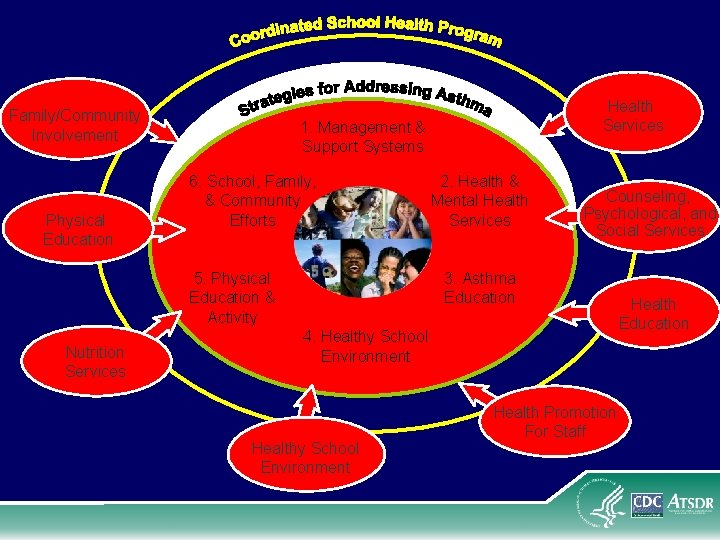
Family/Community Involvement Physical Education 1. Management & Support Systems 6. School, Family, & Community Efforts 5. Physical Education & Activity Nutrition Services Health Services 2. Health & Mental Health Services Counseling, Psychological, and Social Services 3. Asthma Education 4. Healthy School Environment Health Promotion For Staff Health Education
A Public Health Response to Asthma: School v A leading chronic disease cause of school absence v Common disease addressed by school nurses v Affects teachers, administrators, nurses, coaches, students, bus drivers, after school program staff, maintenance personnel
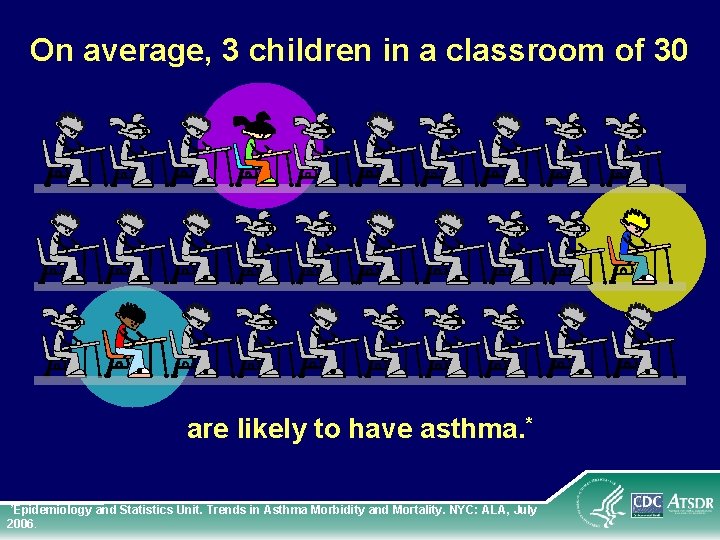
On average, 3 children in a classroom of 30 are likely to have asthma. * *Epidemiology 2006. and Statistics Unit. Trends in Asthma Morbidity and Mortality. NYC: ALA, July
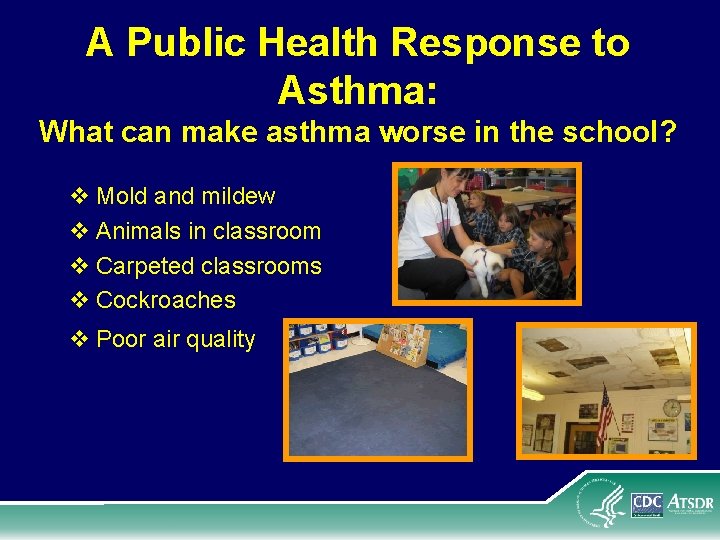
A Public Health Response to Asthma: What can make asthma worse in the school? v Mold and mildew v Animals in classroom v Carpeted classrooms v Cockroaches v Poor air quality
Asthma-Friendly School DVD and Toolkit Objectives v. Personal stories to relate to viewer v. Aspects of an asthma-friendly school v. Six strategies for addressing asthma in a coordinated school health program v. Potential impact of asthmafriendly schools
A Public Health Response to Asthma: School Actions v Establish policies and procedures to support children with asthma. v Keep students’ asthma action plans at the school. v Make medications available v During school hours v Before physical activity and sports v During before- and after-school programs v On field trips or when away from campus v Train school staff to recognize signs of an asthma attack and to use appropriate medications.
A Public Health Response to Asthma: Evaluation The systematic investigation of the structure, activities, or outcomes of asthma control programs. v Are we doing the right thing? v Are we doing things right?
Benefits of Program Evaluations help asthma programs v Manage resources and services effectively v Understand reasons for current performance v Build capacity v Plan and implement new activities v Demonstrate the value of their efforts v Ensure accountability
Using Evaluation to Improve Programs v Highlight effective program components v. Recognize achievements v. Replicate successes v Assess and prioritize needs v Target program improvements v Advocate for the program
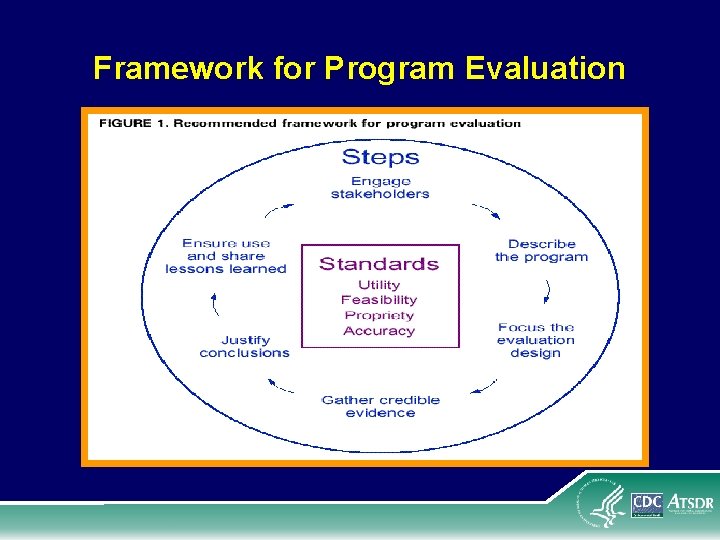
Framework for Program Evaluation
A Public Health Response to Asthma: Summary v Asthma is a complex disease that is not yet preventable or curable. v Asthma can be managed with medication, environmental changes, and behavior modifications. v By working together, we can ensure that people with asthma enjoy a high quality of life.
Resources v National Asthma Education and Prevention Program v http: //www. nhlbi. nih. gov/about/naepp/ v Asthma and Allergy Foundation of America v http: //www. aafa. org v American Lung Association v http: //www. lungusa. org v American Academy of Allergy, Asthma, and Immunology v http: //www. aaaai. org v Allergy and Asthma Network/Mothers of Asthmatics, Inc. v http: //www. aanma. org
Resources v American College of Allergy, Asthma, and Immunology v http: //www. acaai. org v American College of Chest Physicians v http: //www. chestnet. org v American Thoracic Society v http: //www. thoracic. org v The Centers for Disease Control and Prevention v http: //www. cdc. gov/asthma
- Slides: 24