
A prototype Global Carbon Cycle Data Assimilation System
A prototype Global Carbon Cycle Data Assimilation System (CCDAS) Wolfgang Knorr 1, Marko Scholze 2, Peter Rayner 3, Thomas Kaminski 4, Ralf Giering 4 1 2 3 4 Fast. Opt CAMELS
Overview • Top-down vs. bottom-up • Gradient method and optimisation • Results: Optimal fluxes • Uncertainties in parameters + results • Uncertainties in fluxes + results • Possible assimilation of flux data • Conclusions and Outlook Fast. Opt CAMELS
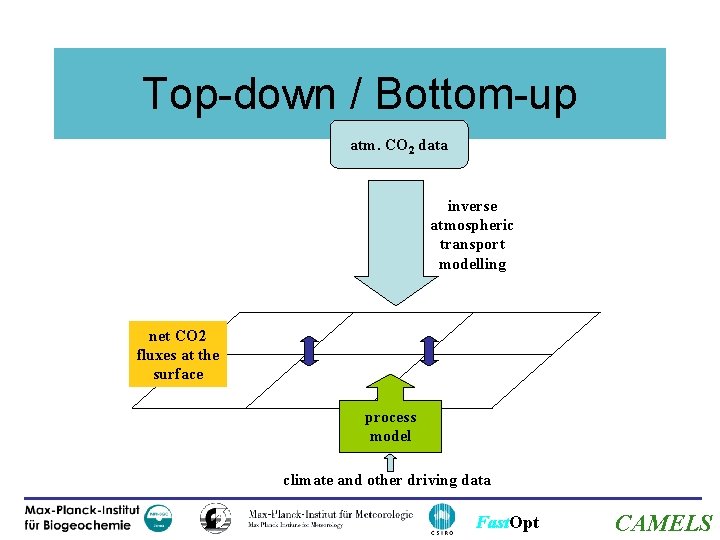
Top-down / Bottom-up atm. CO 2 data inverse atmospheric transport modelling net CO 2 fluxes at the surface process model climate and other driving data Fast. Opt CAMELS
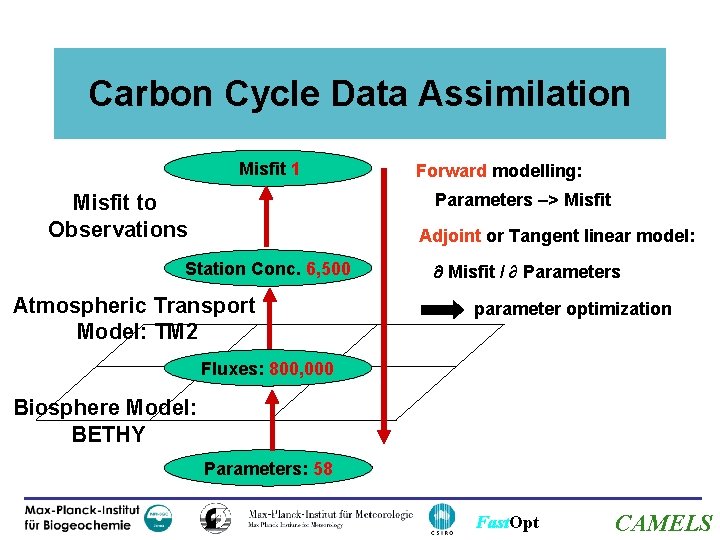
Carbon Cycle Data Assimilation Misfit 1 Forward modelling: Parameters –> Misfit to Observations Adjoint or Tangent linear model: Station Conc. 6, 500 Atmospheric Transport Model: TM 2 Misfit / ∂ Parameters parameter optimization Fluxes: 800, 000 Biosphere Model: BETHY Parameters: 58 Fast. Opt CAMELS
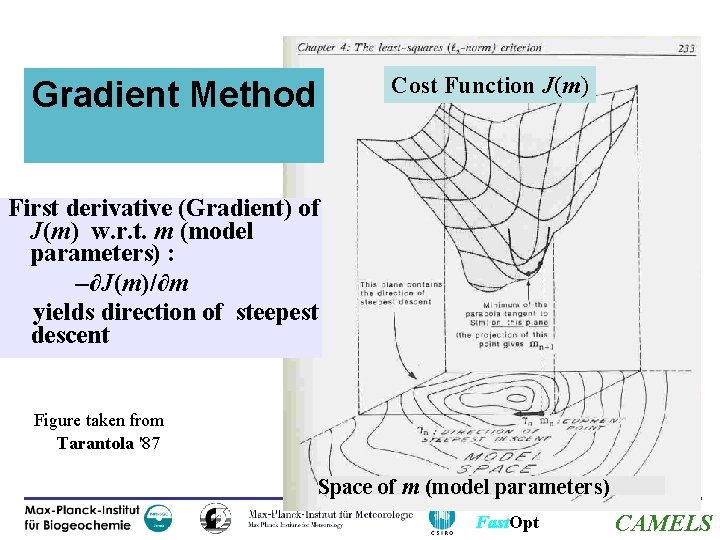
Cost Function J(m) Gradient Method First derivative (Gradient) of J(m) w. r. t. m (model parameters) : –∂J(m)/∂m yields direction of steepest descent Figure taken from Tarantola '87 Space of m (model parameters) Fast. Opt CAMELS
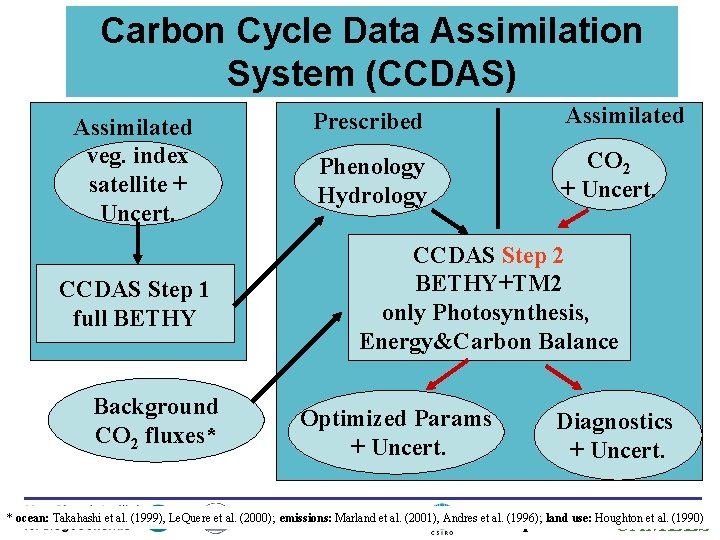
Carbon Cycle Data Assimilation System (CCDAS) Assimilated veg. index satellite + Uncert. CCDAS Step 1 full BETHY Background CO 2 fluxes* Prescribed Assimilated Phenology Hydrology CO 2 + Uncert. CCDAS Step 2 BETHY+TM 2 only Photosynthesis, Energy&Carbon Balance Optimized Params + Uncert. Diagnostics + Uncert. * * ocean: Takahashi et al. (1999), Le. Quere et al. (2000); emissions: Marland et al. (2001), Andres et al. (1996); land use: Houghton et al. (1990) Fast. Opt CAMELS
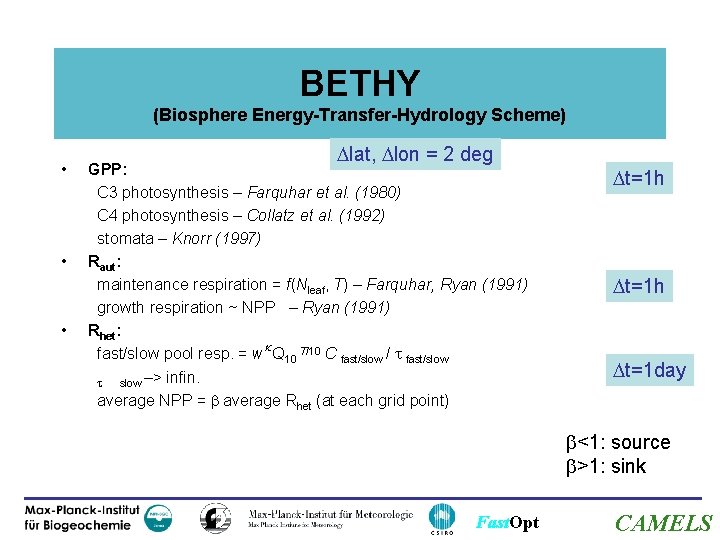
BETHY (Biosphere Energy-Transfer-Hydrology Scheme) • • • lat, lon = 2 deg GPP: C 3 photosynthesis – Farquhar et al. (1980) C 4 photosynthesis – Collatz et al. (1992) stomata – Knorr (1997) Raut: maintenance respiration = f(Nleaf, T) – Farquhar, Ryan (1991) growth respiration ~ NPP – Ryan (1991) Rhet: fast/slow pool resp. = wk Q 10 T/10 C fast/slow / t fast/slow –> infin. t average NPP = b average Rhet (at each grid point) t=1 h t=1 day b<1: source b>1: sink Fast. Opt CAMELS
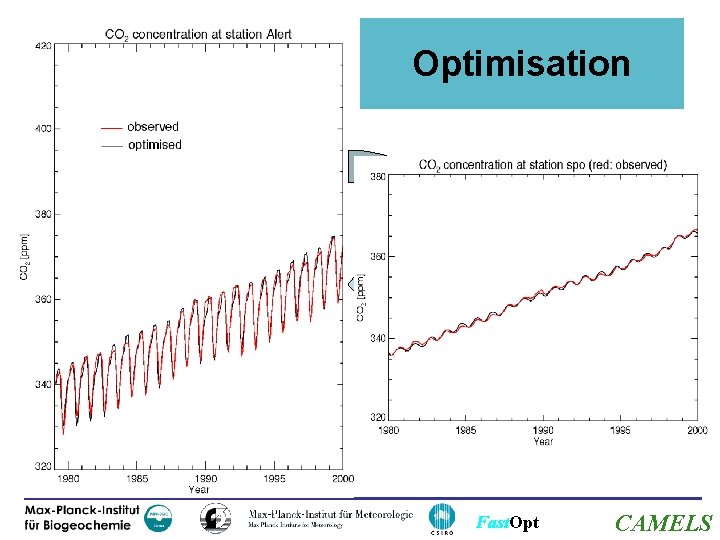
Optimisation Fast. Opt CAMELS
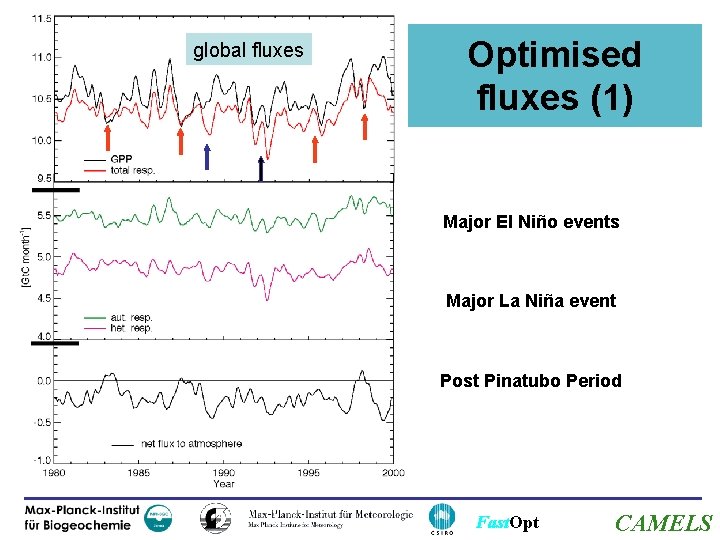
global fluxes Optimised fluxes (1) Major El Niño events Major La Niña event Post Pinatubo Period Fast. Opt CAMELS
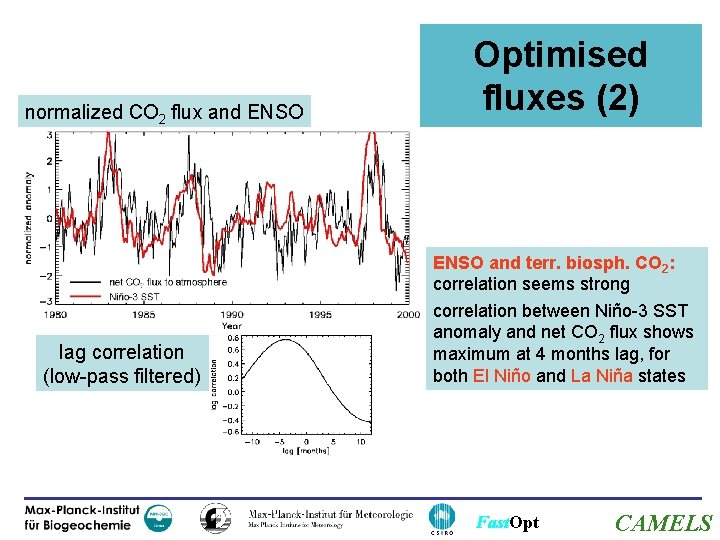
normalized CO 2 flux and ENSO lag correlation (low-pass filtered) Optimised fluxes (2) ENSO and terr. biosph. CO 2: correlation seems strong correlation between Niño-3 SST anomaly and net CO 2 flux shows maximum at 4 months lag, for both El Niño and La Niña states Fast. Opt CAMELS
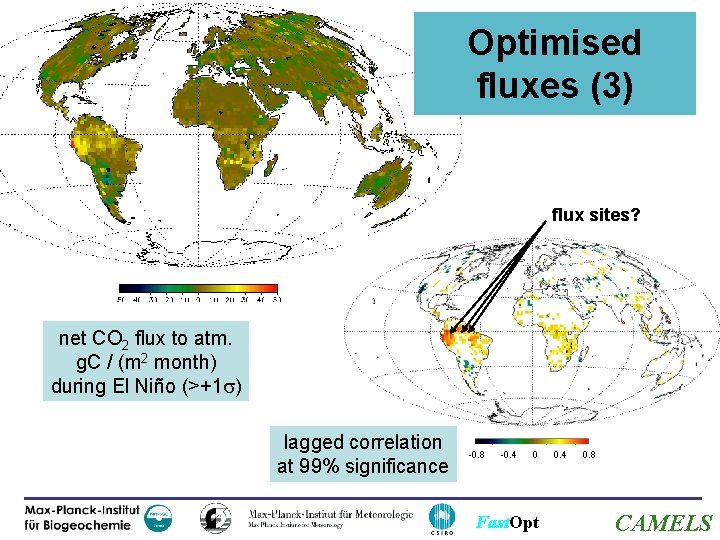
Optimised fluxes (3) flux sites? net CO 2 flux to atm. g. C / (m 2 month) during El Niño (>+1 s) lagged correlation at 99% significance -0. 8 -0. 4 0 Fast. Opt 0. 4 0. 8 CAMELS
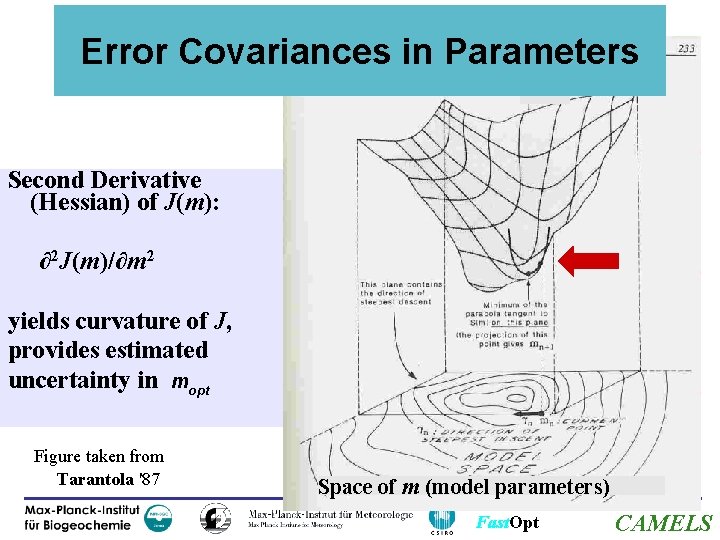
Error Covariances in Parameters J(x) Second Derivative (Hessian) of J(m): ∂2 J(m)/∂m 2 yields curvature of J, provides estimated uncertainty in mopt Figure taken from Tarantola '87 Space of m (model parameters) Fast. Opt CAMELS
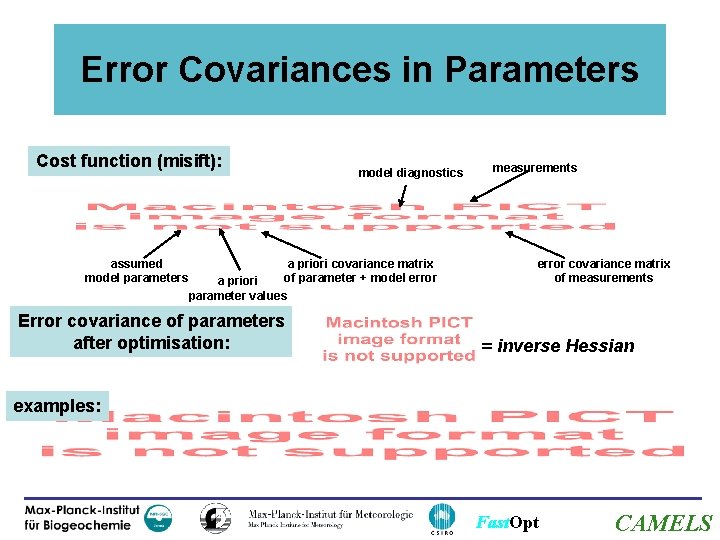
Error Covariances in Parameters Cost function (misift): assumed model parameters model diagnostics a priori covariance matrix of parameter + model error a priori parameter values Error covariance of parameters after optimisation: measurements error covariance matrix of measurements = inverse Hessian examples: Fast. Opt CAMELS
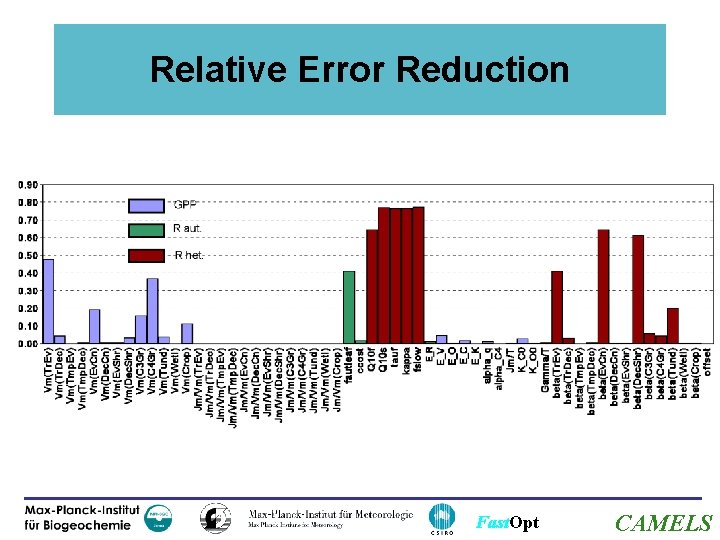
Relative Error Reduction Fast. Opt CAMELS
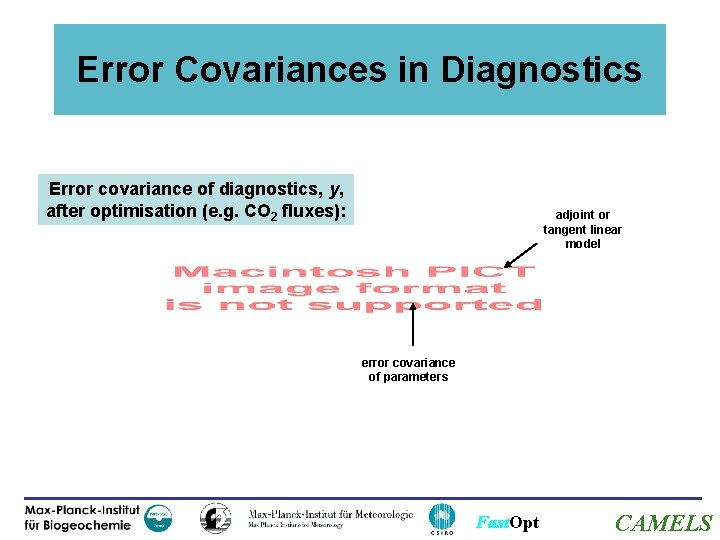
Error Covariances in Diagnostics Error covariance of diagnostics, y, after optimisation (e. g. CO 2 fluxes): adjoint or tangent linear model error covariance of parameters Fast. Opt CAMELS
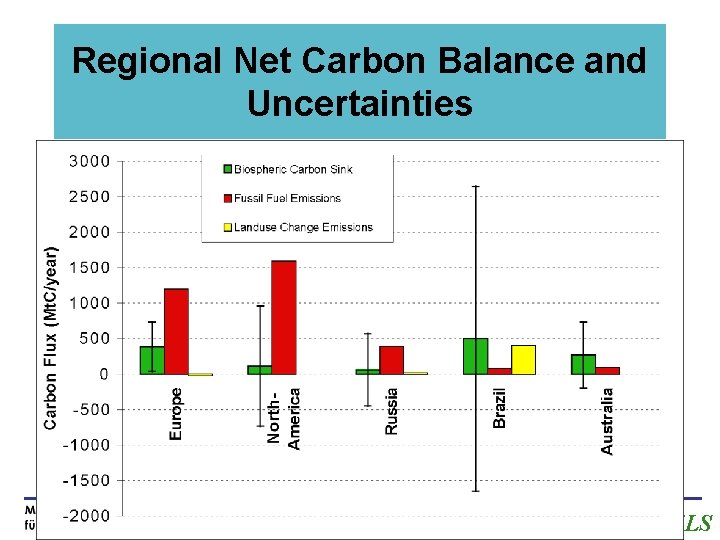
Regional Net Carbon Balance and Uncertainties Fast. Opt CAMELS
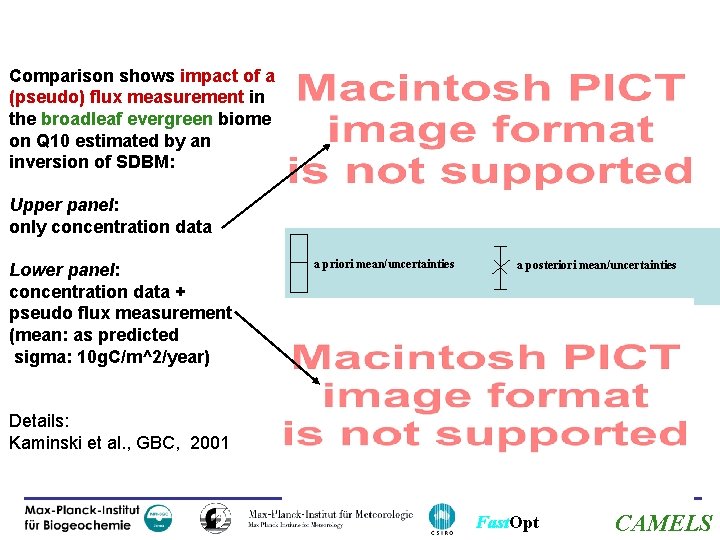
Comparison shows impact of a (pseudo) flux measurement in the broadleaf evergreen biome on Q 10 estimated by an inversion of SDBM: Upper panel: only concentration data Lower panel: concentration data + pseudo flux measurement (mean: as predicted sigma: 10 g. C/m^2/year) a priori mean/uncertainties a posteriori mean/uncertainties Details: Kaminski et al. , GBC, 2001 Fast. Opt CAMELS
Conclusions • CCDAS with 58 parameters can already fit 20 years of CO 2 concentration data • Sizeable reduction of uncertainty for ~13 parameters • terr. biosphere response to climate fluctuations dominated by ENSO • System can test model with uncertain parameters, and deliver a posteriori uncertainties on parameters, fluxes Fast. Opt CAMELS
Outlook • explore more parameter configurations • include fire as a process with uncertainties • need more constraints, e. g. eddy fluxes –> reduce uncertainties • however: needs to solve scaling problem (satellites? ) • approach can be regionalized easily • extend approach to ocean carbon cycle • projection of uncertainties into future Fast. Opt CAMELS
- Slides: 19