
A Prospective Comparative Study Between Endoscopic Cyclophotocoagulation and
A Prospective, Comparative Study Between Endoscopic Cyclophotocoagulation and the Ahmed Drainage Implant in Refractory Glaucoma Francisco E. Lima, MD Goiânia, Brazil CBCO Centro Brasileiro de Cirurgia de Olhos 12/31/2021 UFG Universidade Federal de Goiás
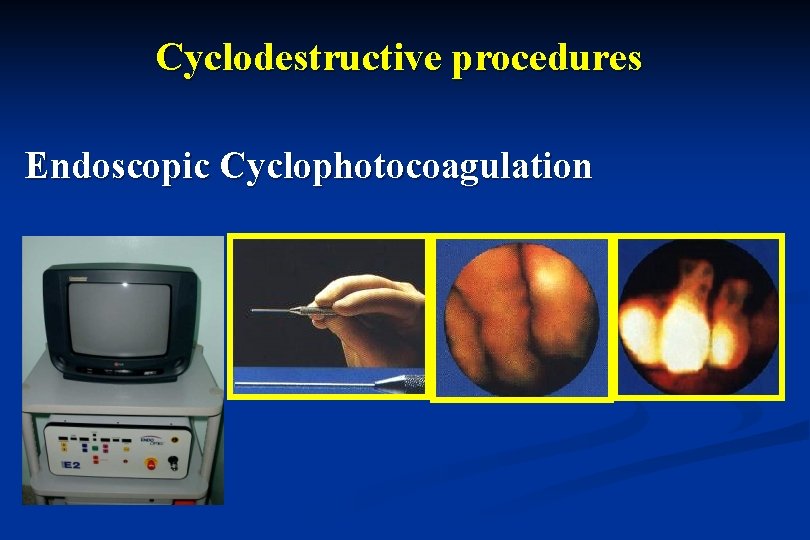
Cyclodestructive procedures Endoscopic Cyclophotocoagulation
Purpose To compare endoscopic cyclophotocoagulation (ECP) and the Ahmed drainage implant in the treatment of refractory glaucoma.
Methods One hundred-eight eyes of 180 patients with refractory glaucoma were prospectively assigned to either ECP or Ahmed tube shunt implantation. All procedures were performed by a single surgeon (F. E. L. )
Methods Eyes that were included had a history of at least one trabeculectomy with antimetabolite, an intraocular pressure (IOP) equal to or above 35 mm. Hg on maximum tolerated medical therapy, and a visual acuity better than 20/200.
Methods Exclusion criteria included eyes that had previous glaucoma drainage device implantation or a cyclodestructive procedure. Success was defined as an IOP more than 6 mm. Hg and less than 21 mm. Hg, with or without topical anti-hypertensive therapy.
Methods The procedure was performed by a limbal or pars plana incision, with laser power ranging from 0. 5 W to 0. 9 W, continuous mode to produce both whitening and shrinkage of the ciliary processes. ECP was done to 210º of the ciliary body, corresponding to 2 to 9 hours in the right eye and from 3 to 10 hours in the left eye, including the anterior third of the pars plana.
Results The mean follow-up was 39. 21 9. 36 months and 41. 24 8. 24 months, for the Ahmed and ECP groups, respectively (p = 0. 3). The preoperative IOP, 36. 27 5. 33 mm. Hg (Ahmed) and 35. 15 6. 57 mm. Hg (ECP) (p = 0. 5), and the mean post-operative IOP, at 36 months followup, 15. 36 5. 51 mm. Hg (Ahmed) and 16. 12 6. 32 mm. Hg (ECP) (p = 0. 6), were significantly different from baseline in both groups (p<0. 001).
Results Kaplan-Meier survival curve analysis showed a probability of success at 36 months of 75. 93% and 72. 22% for the Ahmed and ECP groups respectively (p = 0. 6). Complications included choroidal detachment (Ahmed 15%, ECP 2%), shallow anterior chamber (Ahmed 16%, ECP 0. 0%) and hyphema (Ahmed 12%, ECP 13%).
Conclusions There was no difference in the success rate between the Ahmed Glaucoma Valve and ECP in refractory glaucoma. The eyes that underwent Ahmed tube shunt implantation had more complications than those treated with ECP.
- Slides: 10