
A proposal for the recognition of handwritten Sign
- Slides: 28
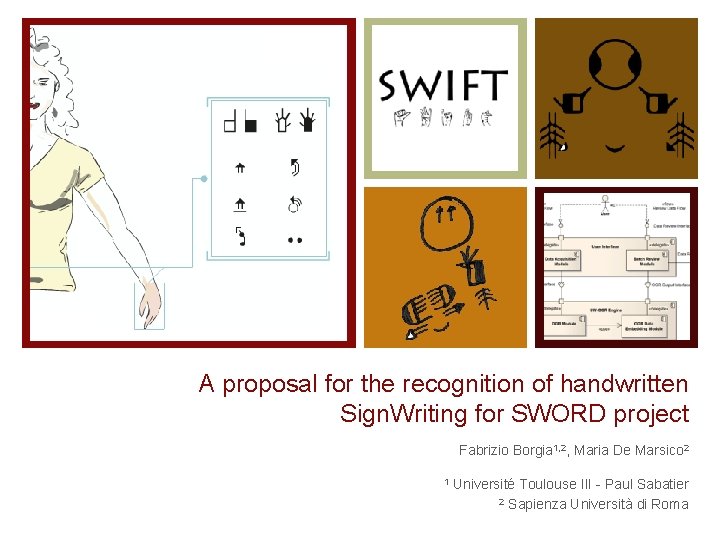
A proposal for the recognition of handwritten Sign. Writing for SWORD project Fabrizio Borgia 1, 2, Maria De Marsico 2 1 Université Toulouse III - Paul Sabatier 2 Sapienza Università di Roma
+ Outline n Introduction n The SWORD project n A new generation of Sign. Writing editors n SW-OGR - Concept n SW-OGR - Challenges n SW-OGR - Design n SW-OGR – In action n Conclusions and Future A proposal for the recognition of handwritten Sign. Writing for SWORD project
+ Introduction n A pencil and a piece of paper are the only required items to produce signs using Sign. Writing n Since the early years the need to produce a digital version of the system was evident n The informatization of the system, started in 1986 with the Sign. Writer computer program, allowed Sign. Writing to achieve a wider diffusion through: n Newspaper n Books n Websites n Other digital resources A proposal for the recognition of handwritten Sign. Writing for SWORD project
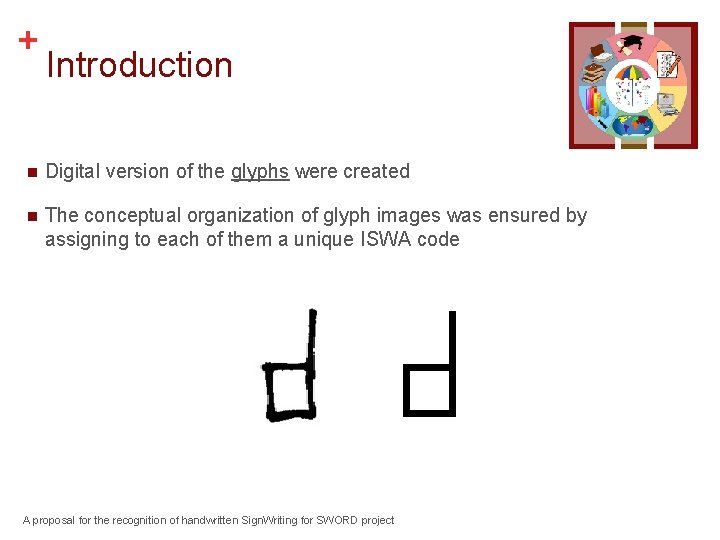
+ Introduction n Digital version of the glyphs were created n The conceptual organization of glyph images was ensured by assigning to each of them a unique ISWA code A proposal for the recognition of handwritten Sign. Writing for SWORD project
+ Introduction n Sign. Writing digital editors are the tools that enable the creation of digital resources written in Sign. Writing n In other words, they are critical for the informatization of Sign. Writing and therefore the “digital transcription” of SLs n Many applications have been produced by different teams, delivered in different ways, ranging from desktop to web applications A proposal for the recognition of handwritten Sign. Writing for SWORD project
+ Introduction n Most Sign. Writing digital editors basically provide the same functionalities n Despite differences in design and implementation existing from one editor to another, such functionalities are: n Search for (or type) glyphs which belong to the ISWA n Insert the chosen glyphs onto an area which is designated for the composition of the sign n Manage the glyphs on the sign composition area n Save the sign in one (or more) formats n See Sign. Maker and SWift A proposal for the recognition of handwritten Sign. Writing for SWORD project
+ Introduction Despite their increasing capabilities, Sign. Writing digital editors are still far from the simplicity of the handwriting approach. A proposal for the recognition of handwritten Sign. Writing for SWORD project
+ Introduction n Any Sign. Writing digital editor developed so far relies heavily on “Windows, Icons, Menus, Pointer” (WIMP) interfaces n They require a navigation/selection process in a huge amount of digital images that, though facilitated, may become long and cumbersome n Sign. Writing users are more fast and comfortable when using handwriting, rather than when dealing with the complex interaction style of a Sign. Writing digital editor n Writing is easier than understanding and using a User Interface A proposal for the recognition of handwritten Sign. Writing for SWORD project
+ The SWORD project Sign. Writing Oriented Resources for the Deaf (SWORD) n A project towards the full Sign. Writing-based integration of deaf people in the digital society n The project aims at producing digital artifacts (applications, websites, etc. ) featuring deaf-oriented accessibility via written Sign Language n A Sign. Writing digital editor, namely SWift, was produced within SWORD A proposal for the recognition of handwritten Sign. Writing for SWORD project
+ A new generation of Sign. Writing editors SWift still carries most intrinsic shortcomings of its peers, including the strict dependency on WIMP interfaces. A proposal for the recognition of handwritten Sign. Writing for SWORD project
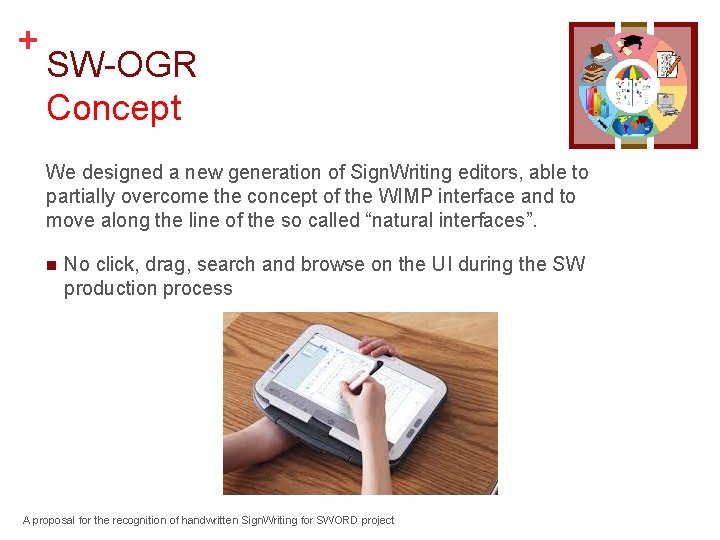
+ SW-OGR Concept We designed a new generation of Sign. Writing editors, able to partially overcome the concept of the WIMP interface and to move along the line of the so called “natural interfaces”. n No click, drag, search and browse on the UI during the SW production process A proposal for the recognition of handwritten Sign. Writing for SWORD project
+ SW-OGR Concept n Introducing a SW-OGR engine within an existing SW editor, such as SWift: n n The user will handwrite glyphs rather than searching them among thousands others Each handwritten symbol will be processed and replaced with its standard ISWA version by SW-OGR n We n n maintain the advantages of a digital editor Multiple save options: PNG, XML and remove save Each sign is saved in a database with the list of its component glyphs: support for linguistic analysis A proposal for the recognition of handwritten Sign. Writing for SWORD project
+ SW-OGR Challenges n WIMP is currently the most common interface style, it cannot be totally left behind n n The interaction with most application is still firmly grounded on it Nevertheless, our aim is to limit its use, or to dismiss it whenever possible, during the SW production process A proposal for the recognition of handwritten Sign. Writing for SWORD project
+ SW-OGR Challenges n Very high number of glyphs (tens of thousands) n Multilinear/two-dimensional arrangement n No rigid rules for composition n Complex segmentation, particularly when handwritten n OCR-like pattern-recognition approach not feasible n Large amount of patterns to recognize, and consequently very long machine training A proposal for the recognition of handwritten Sign. Writing for SWORD project
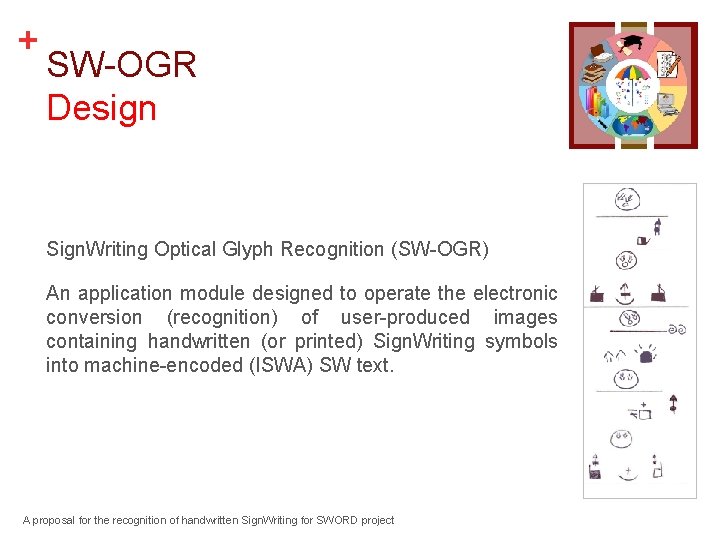
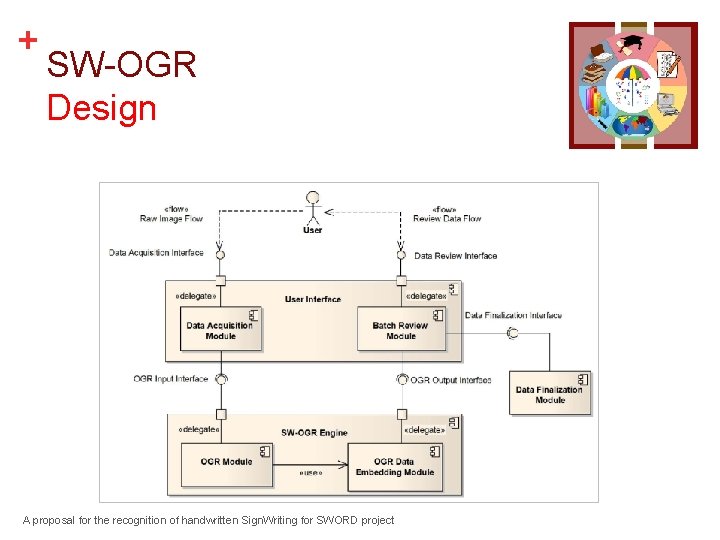
+ SW-OGR Design Sign. Writing Optical Glyph Recognition (SW-OGR) An application module designed to operate the electronic conversion (recognition) of user-produced images containing handwritten (or printed) Sign. Writing symbols into machine-encoded (ISWA) SW text. A proposal for the recognition of handwritten Sign. Writing for SWORD project
+ SW-OGR Design n The SW-OGR approach is based on: n Geometric features of the glyphs n Topologic information about the glyphs n Contextual information about the organization of the ISWA A proposal for the recognition of handwritten Sign. Writing for SWORD project
+ SW-OGR Design A proposal for the recognition of handwritten Sign. Writing for SWORD project
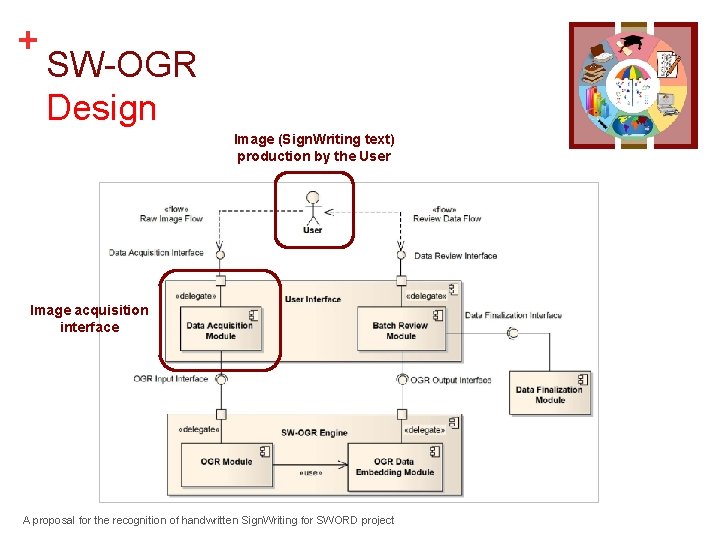
+ SW-OGR Design Image (Sign. Writing text) production by the User Image acquisition interface A proposal for the recognition of handwritten Sign. Writing for SWORD project
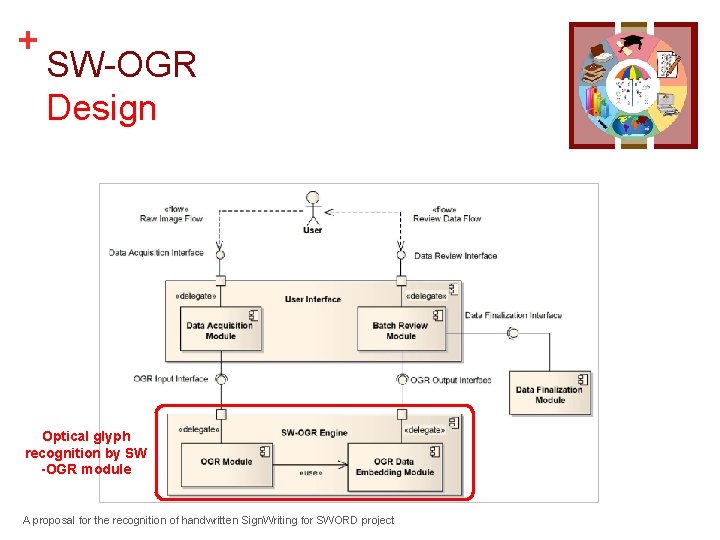
+ SW-OGR Design Optical glyph recognition by SW -OGR module A proposal for the recognition of handwritten Sign. Writing for SWORD project
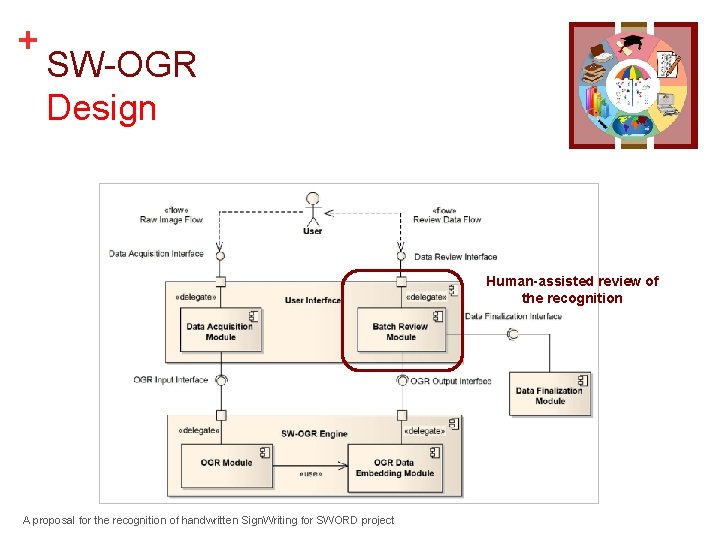
+ SW-OGR Design Human-assisted review of the recognition A proposal for the recognition of handwritten Sign. Writing for SWORD project
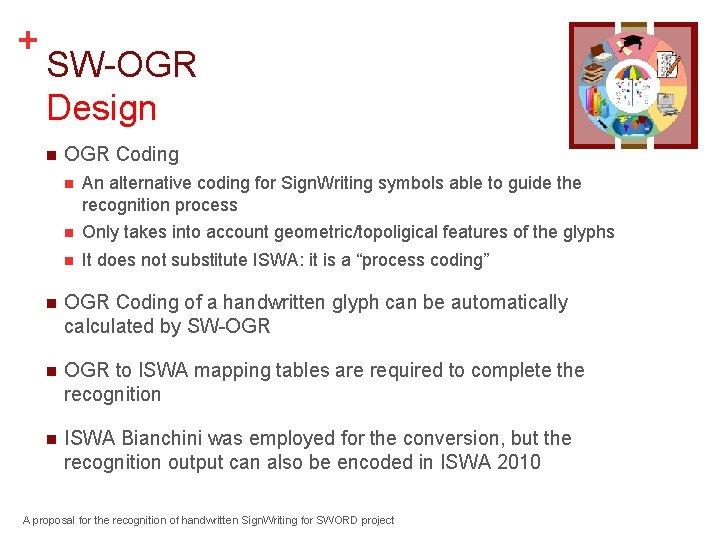
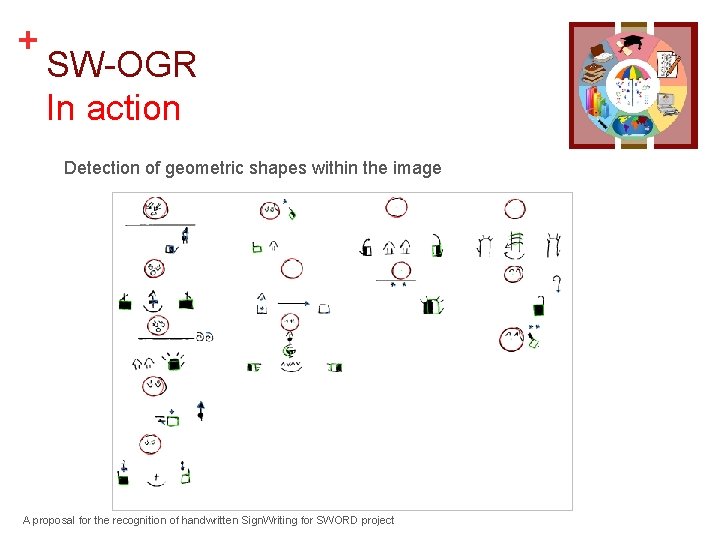
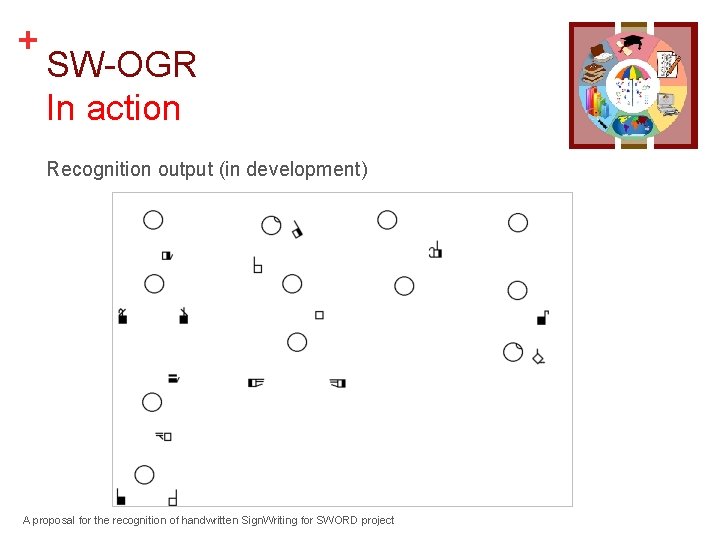
+ SW-OGR Design n The recognition by SW-OGR is composed by different analyses of the image (Sign. Writing text): Image pre-processing and binarization n Noise reduction, thresholding 2. Detection of geometric shapes within the image n Circles, rectangles, trapeziuses, etc. . . 3. Category inference on geometric shapes n Topological and contextual information 4. Glyph recognition n OGR coding to ISWA coding conversion 1. A proposal for the recognition of handwritten Sign. Writing for SWORD project
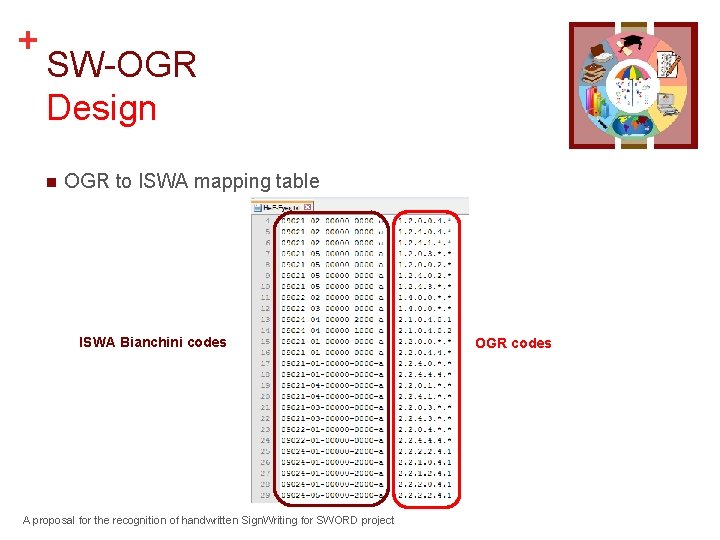
+ SW-OGR Design n OGR Coding n An alternative coding for Sign. Writing symbols able to guide the recognition process n Only takes into account geometric/topoligical features of the glyphs n It does not substitute ISWA: it is a “process coding” n OGR Coding of a handwritten glyph can be automatically calculated by SW-OGR n OGR to ISWA mapping tables are required to complete the recognition n ISWA Bianchini was employed for the conversion, but the recognition output can also be encoded in ISWA 2010 A proposal for the recognition of handwritten Sign. Writing for SWORD project
+ SW-OGR Design n OGR to ISWA mapping table ISWA Bianchini codes A proposal for the recognition of handwritten Sign. Writing for SWORD project OGR codes
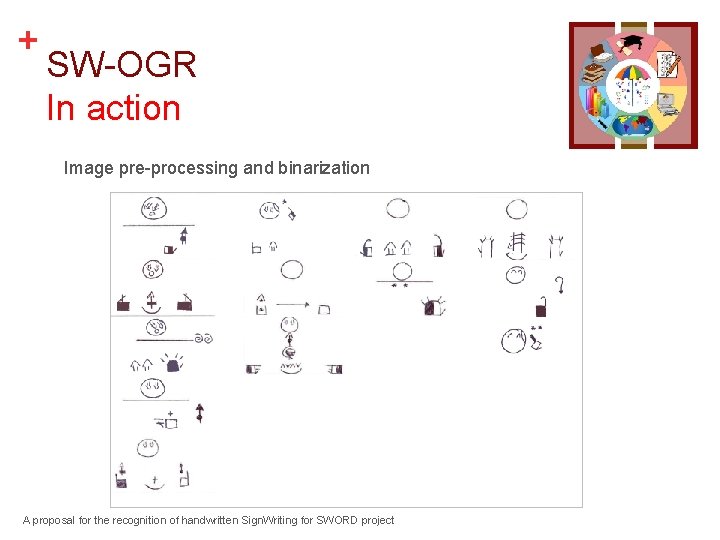
+ SW-OGR In action Image pre-processing and binarization A proposal for the recognition of handwritten Sign. Writing for SWORD project
+ SW-OGR In action Detection of geometric shapes within the image A proposal for the recognition of handwritten Sign. Writing for SWORD project
+ SW-OGR In action Recognition output (in development) A proposal for the recognition of handwritten Sign. Writing for SWORD project
+ Conclusions and Future “IT. . . COULD. . . WORK!” (Dr. Frederick Frankenstein) A proposal for the recognition of handwritten Sign. Writing for SWORD project
+ Conclusions and Future n Sign. Writing Optical Glyph Recognition is possible n SW-OGR makes digital handwriting of Sign. Writing texts real n Overcoming WIMP interface in digital editors will make the sign composition process real n SW-OGR needs to be expanded adding support for more and more ISWA categories and groups n Real-time text recognition and batch corpora digitalization n Next step: transcription from videos A proposal for the recognition of handwritten Sign. Writing for SWORD project