
A Programmable Single Chip Digital Signal Processing Engine

A Programmable Single Chip Digital Signal Processing Engine • MAPLD 2005 • Paul Chiang, Math. Star Inc. • Pius Ng, Apache Design Solutions
Presentation Outline • • Chiang Space born signal processing tasks FPOA architecture highlights programmability and expandability System partition on FPOA device Spatial processing 5 x 5 filter solution Temporal processing – motion estimation Internal bus and I/O throughput Resource utilization and future expansion 2 MAPLD 2005/206
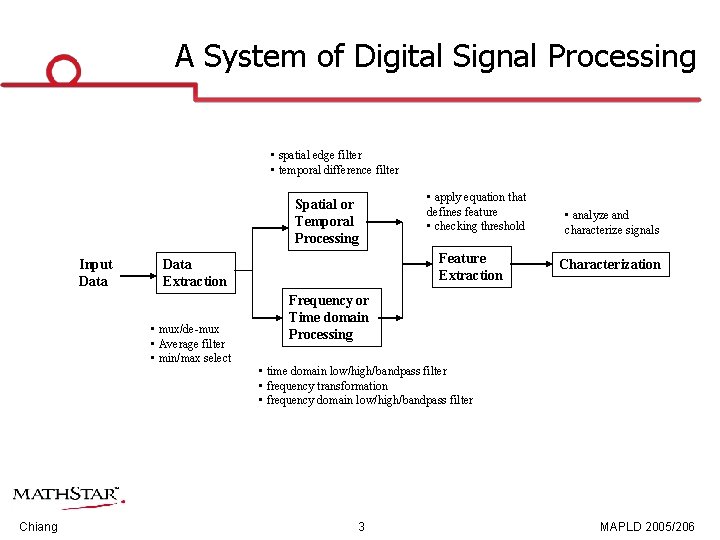
A System of Digital Signal Processing • spatial edge filter • temporal difference filter Spatial or Temporal Processing Input Data Chiang Feature Extraction Data Extraction • mux/de-mux • Average filter • min/max select • apply equation that defines feature • checking threshold • analyze and characterize signals Characterization Frequency or Time domain Processing • time domain low/high/bandpass filter • frequency transformation • frequency domain low/high/bandpass filter 3 MAPLD 2005/206
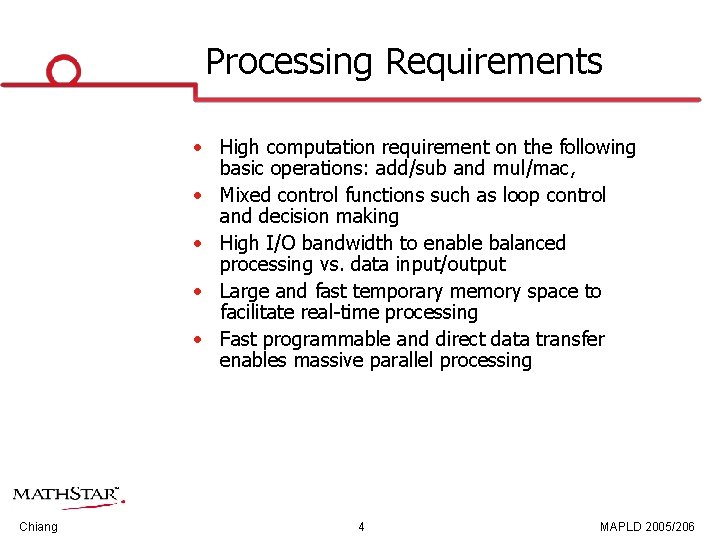
Processing Requirements • High computation requirement on the following basic operations: add/sub and mul/mac, • Mixed control functions such as loop control and decision making • High I/O bandwidth to enable balanced processing vs. data input/output • Large and fast temporary memory space to facilitate real time processing • Fast programmable and direct data transfer enables massive parallel processing Chiang 4 MAPLD 2005/206
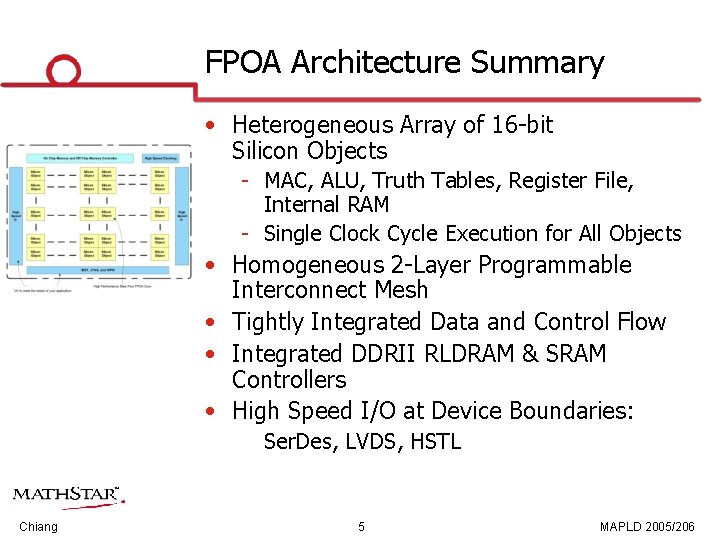
FPOA Architecture Summary • Heterogeneous Array of 16 bit Silicon Objects MAC, ALU, Truth Tables, Register File, Internal RAM Single Clock Cycle Execution for All Objects • Homogeneous 2 Layer Programmable Interconnect Mesh • Tightly Integrated Data and Control Flow • Integrated DDRII RLDRAM & SRAM Controllers • High Speed I/O at Device Boundaries: Ser. Des, LVDS, HSTL Chiang 5 MAPLD 2005/206
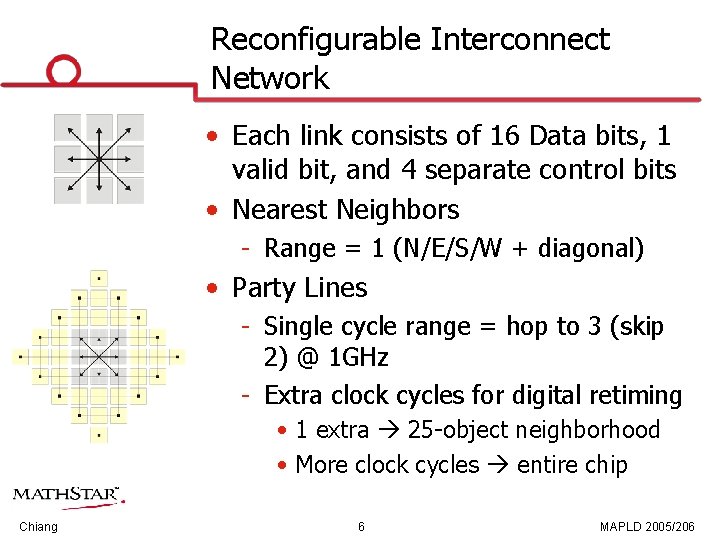
Reconfigurable Interconnect Network • Each link consists of 16 Data bits, 1 valid bit, and 4 separate control bits • Nearest Neighbors Range = 1 (N/E/S/W + diagonal) • Party Lines Single cycle range = hop to 3 (skip 2) @ 1 GHz Extra clock cycles for digital retiming • 1 extra 25 object neighborhood • More clock cycles entire chip Chiang 6 MAPLD 2005/206
FPOA Solution • Four GPIO ports with 44 bit I/O at 100 MHz, that is, 17. 6 Giga bits per second • Two 250 MHz DDR 32 bit external memory with 32 Giga bits per second bandwidth • 400 Silicon Objects running at 1 GHz ALU: add/sub, and combinational logic MAC: mul/mac Register File (RF): fast distributed data storage Internal RAM (IRAM): intermediate data storage • Party lines and muxes to support flexible internal bus as well as dedicated connections Chiang 7 MAPLD 2005/206
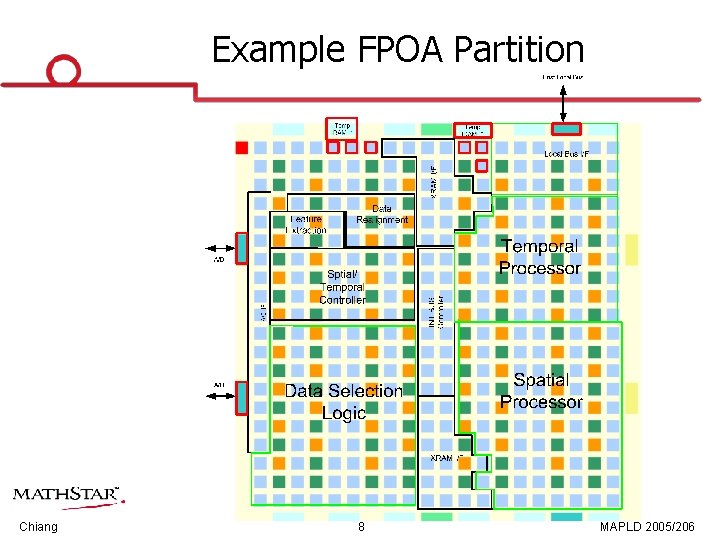
Example FPOA Partition Chiang 8 MAPLD 2005/206
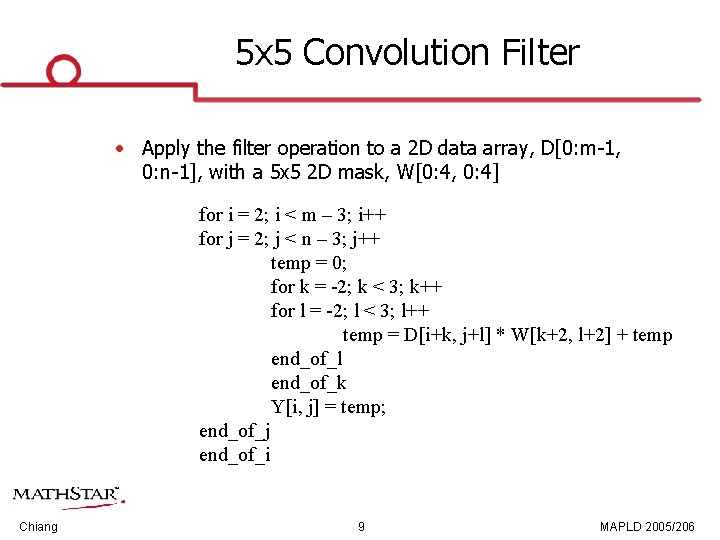
5 x 5 Convolution Filter • Apply the filter operation to a 2 D data array, D[0: m 1, 0: n 1], with a 5 x 5 2 D mask, W[0: 4, 0: 4] for i = 2; i < m – 3; i++ for j = 2; j < n – 3; j++ temp = 0; for k = -2; k < 3; k++ for l = -2; l < 3; l++ temp = D[i+k, j+l] * W[k+2, l+2] + temp end_of_l end_of_k Y[i, j] = temp; end_of_j end_of_i Chiang 9 MAPLD 2005/206
Computation Requirements • Assuming an m by n 2 D data array and a 5 x 5 mask, there are 25 Multiply and Add (MAC) operations for each filtered sample • The whole convolution filter operation requires 25 * M * N MAC operations • With a standard 720 x 480 image data and 30 frames per second, the convolution filter operation requires 259 MMAC per second Chiang 10 MAPLD 2005/206
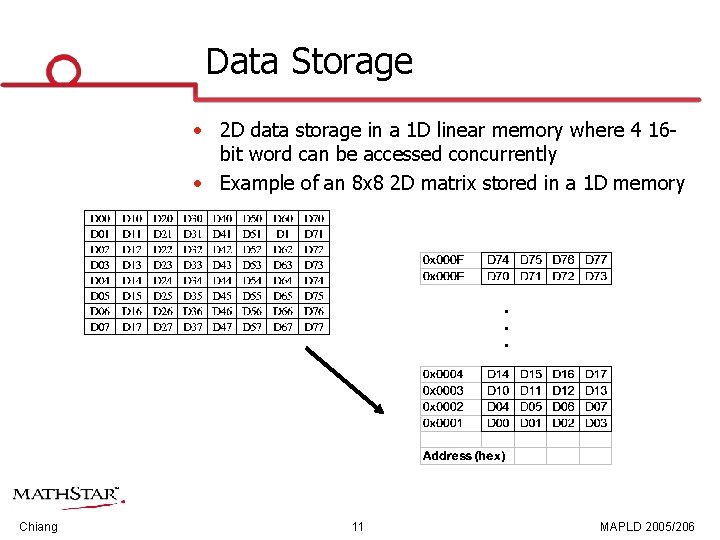
Data Storage • 2 D data storage in a 1 D linear memory where 4 16 bit word can be accessed concurrently • Example of an 8 x 8 2 D matrix stored in a 1 D memory • • • Chiang 11 MAPLD 2005/206
Data Access Analysis • Samples are stored in the external memory with slower access speed • Maximize data bandwidth by accessing 4 words at a time • Use Register Files to store weights and sample data so that they can be repeatedly used without going out to external memory • Perform calculation on 4 pixels concurrently and rotate coefficients and samples in a way to form convolution operation Chiang 12 MAPLD 2005/206
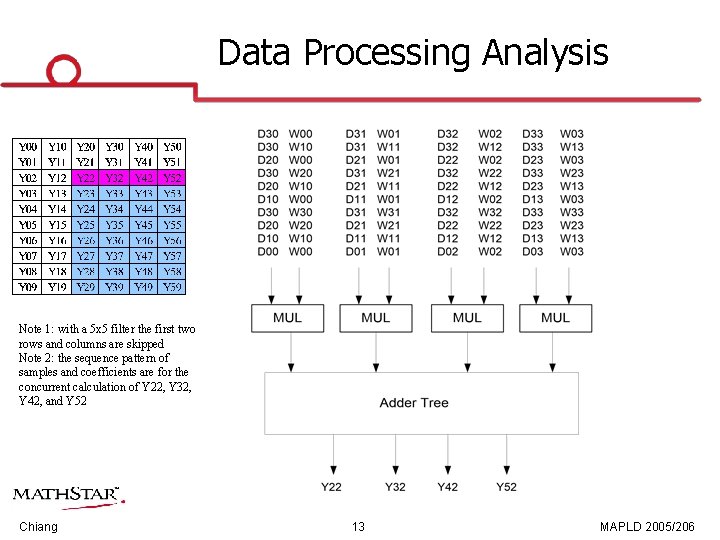
Data Processing Analysis Note 1: with a 5 x 5 filter the first two rows and columns are skipped Note 2: the sequence pattern of samples and coefficients are for the concurrent calculation of Y 22, Y 32, Y 42, and Y 52 Chiang 13 MAPLD 2005/206
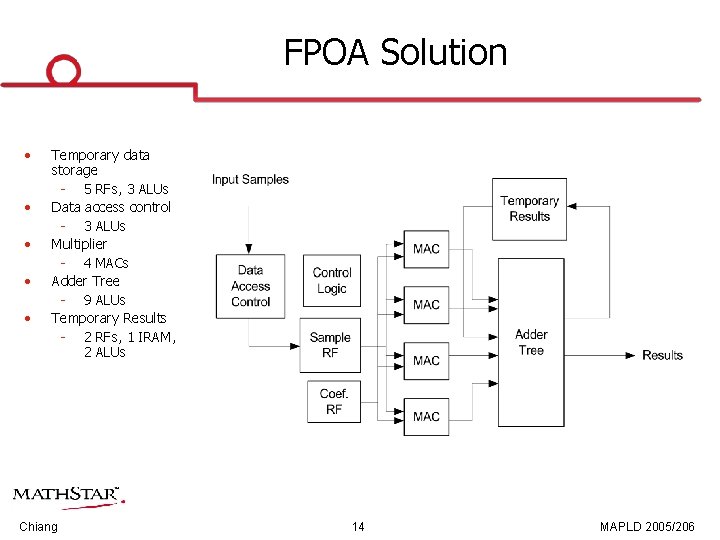
FPOA Solution • • • Temporary data storage 5 RFs, 3 ALUs Data access control 3 ALUs Multiplier 4 MACs Adder Tree 9 ALUs Temporary Results 2 RFs, 1 IRAM, 2 ALUs Chiang 14 MAPLD 2005/206
5 x 5 Convolution Filter Performance • FPOA Resources ALU: 17 RF: 7 MAC: 4 IRAM: 1 Total: 28 SOs + 1 IRAM • Data throughput 20 results every 125 cycles Chiang 15 MAPLD 2005/206
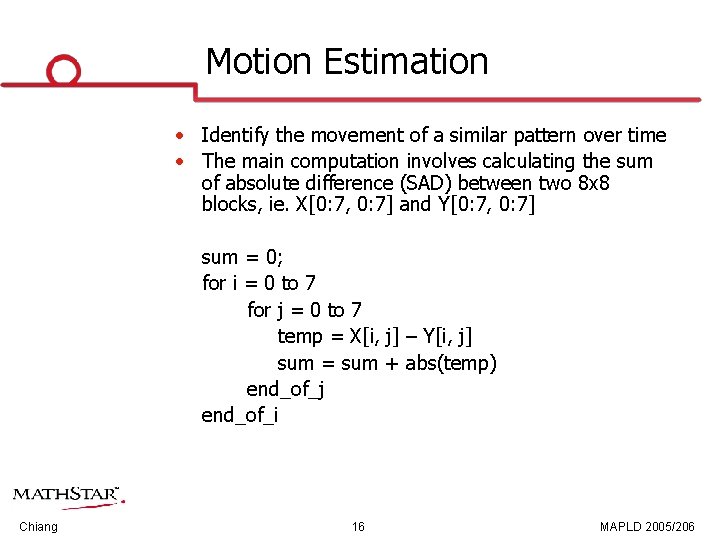
Motion Estimation • Identify the movement of a similar pattern over time • The main computation involves calculating the sum of absolute difference (SAD) between two 8 x 8 blocks, ie. X[0: 7, 0: 7] and Y[0: 7, 0: 7] sum = 0; for i = 0 to 7 for j = 0 to 7 temp = X[i, j] – Y[i, j] sum = sum + abs(temp) end_of_j end_of_i Chiang 16 MAPLD 2005/206
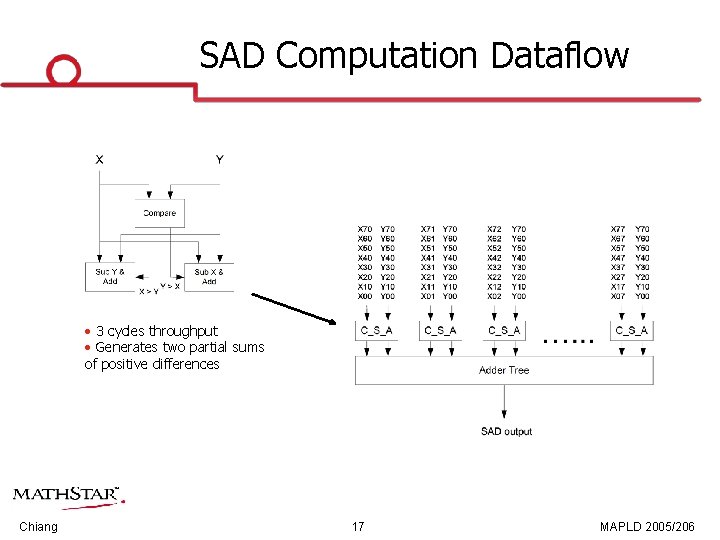
SAD Computation Dataflow • 3 cycles throughput • Generates two partial sums of positive differences Chiang 17 MAPLD 2005/206
SAD Performance • FPOA Resources ALU: 35 RF: 1 Total: 36 SOs • Data throughput 24 cycles per 8 x 8 block Chiang 18 MAPLD 2005/206
Internal System Bus • Link all processing modules and the external host to the external memory for data accesses to the external system memory • Host controlled round robin access from module to module • User defined package format to utilize the 16 bit party line and minimize the access overhead Chiang 19 MAPLD 2005/206
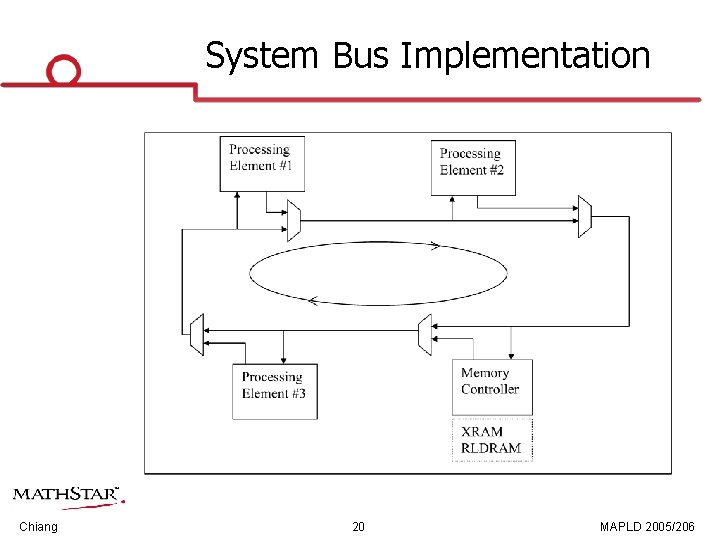
System Bus Implementation Chiang 20 MAPLD 2005/206
System Bus Performance • FPOA Resources ALU: 20 • Cycles XRAM read: 4 cycles XRAM write: 4 cycles Module switch: 10 cycles Chiang 21 MAPLD 2005/206
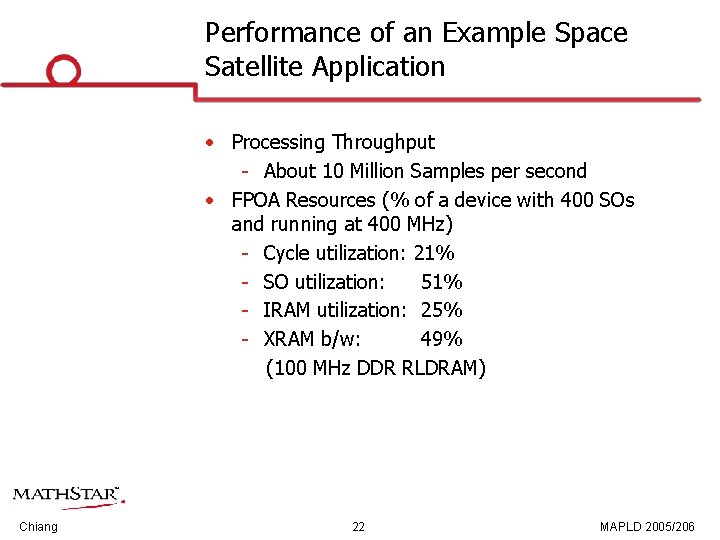
Performance of an Example Space Satellite Application • Processing Throughput About 10 Million Samples per second • FPOA Resources (% of a device with 400 SOs and running at 400 MHz) Cycle utilization: 21% SO utilization: 51% IRAM utilization: 25% XRAM b/w: 49% (100 MHz DDR RLDRAM) Chiang 22 MAPLD 2005/206
- Slides: 22