
A Problem Solving Approach to Mathematics for Elementary
A Problem Solving Approach to Mathematics for Elementary School Teachers Thirteenth Edition Chapter 8 Algebraic Thinking Copyright © 2020, 2016, 2012 Pearson Education, Inc. All Rights Reserved Slide - 1
Section 8 -3 Functions Students will be able to understand explain • The concept of a function including domain and range. • Different representations of functions. • Derivation of the formulas for the sum of n terms of arithmetic and geometric sequences. Copyright © 2020, 2016, 2012 Pearson Education, Inc. All Rights Reserved Slide - 2
Functions as Rules One can think of a function as a “rule” whereby when one value is given, the function, or “rule, ” specifies a resulting value. Copyright © 2020, 2016, 2012 Pearson Education, Inc. All Rights Reserved Slide - 3
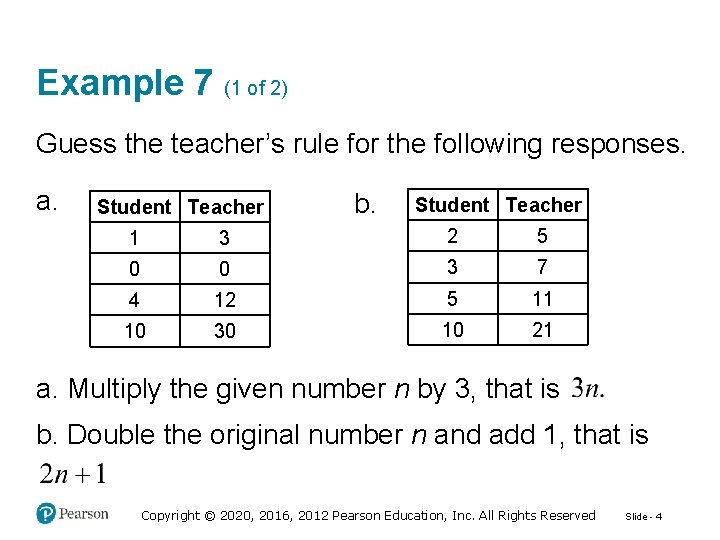
Example 7 (1 of 2) Guess the teacher’s rule for the following responses. a. Student Teacher b. Student Teacher 1 3 2 5 0 0 3 7 4 12 5 11 10 30 10 21 a. Multiply the given number n by 3, that is b. Double the original number n and add 1, that is Copyright © 2020, 2016, 2012 Pearson Education, Inc. All Rights Reserved Slide - 4
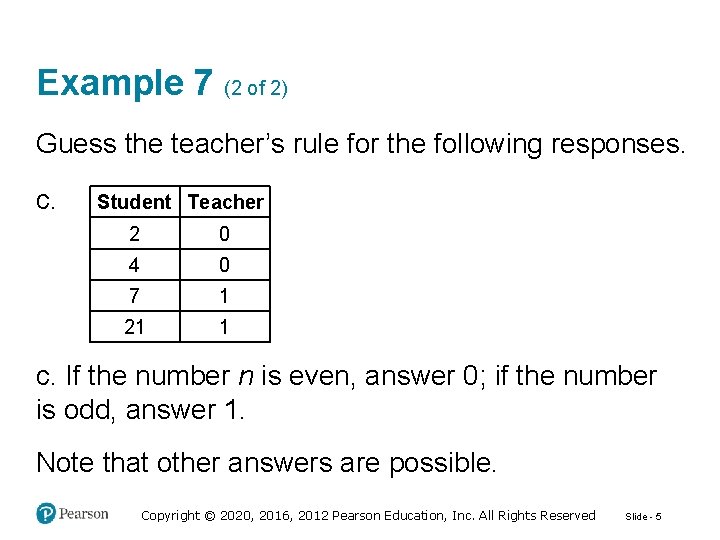
Example 7 (2 of 2) Guess the teacher’s rule for the following responses. c. Student Teacher 2 0 4 0 7 1 21 1 c. If the number n is even, answer 0; if the number is odd, answer 1. Note that other answers are possible. Copyright © 2020, 2016, 2012 Pearson Education, Inc. All Rights Reserved Slide - 5
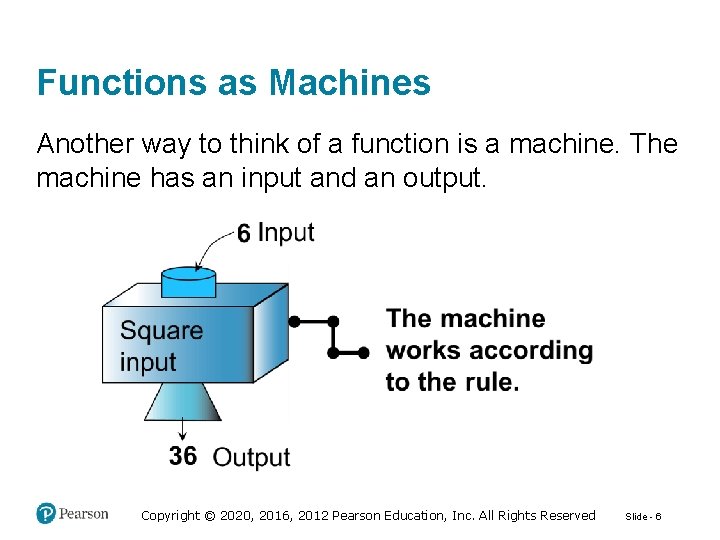
Functions as Machines Another way to think of a function is a machine. The machine has an input and an output. Copyright © 2020, 2016, 2012 Pearson Education, Inc. All Rights Reserved Slide - 6
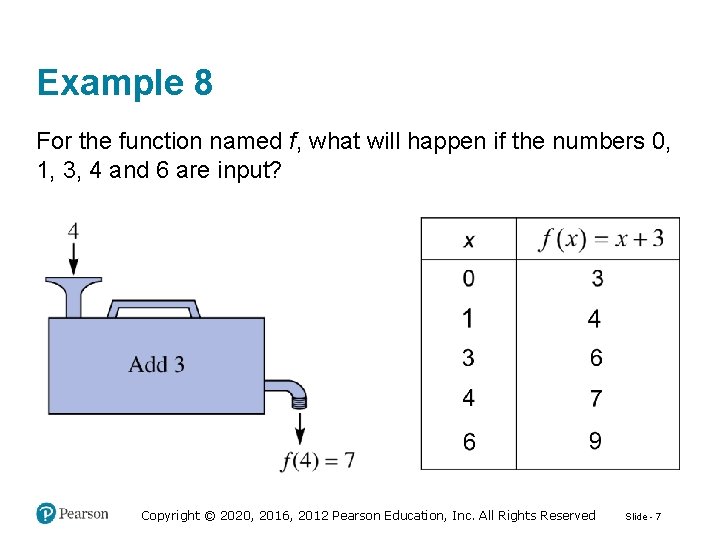
Example 8 For the function named f, what will happen if the numbers 0, 1, 3, 4 and 6 are input? Copyright © 2020, 2016, 2012 Pearson Education, Inc. All Rights Reserved Slide - 7
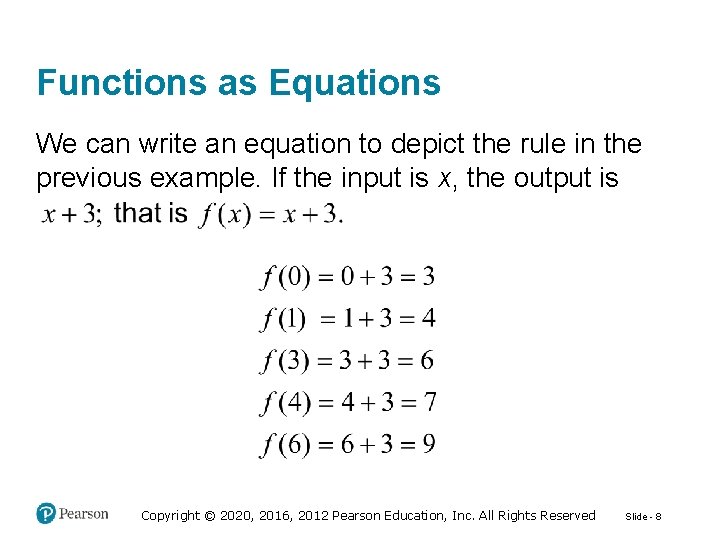
Functions as Equations We can write an equation to depict the rule in the previous example. If the input is x, the output is Copyright © 2020, 2016, 2012 Pearson Education, Inc. All Rights Reserved Slide - 8
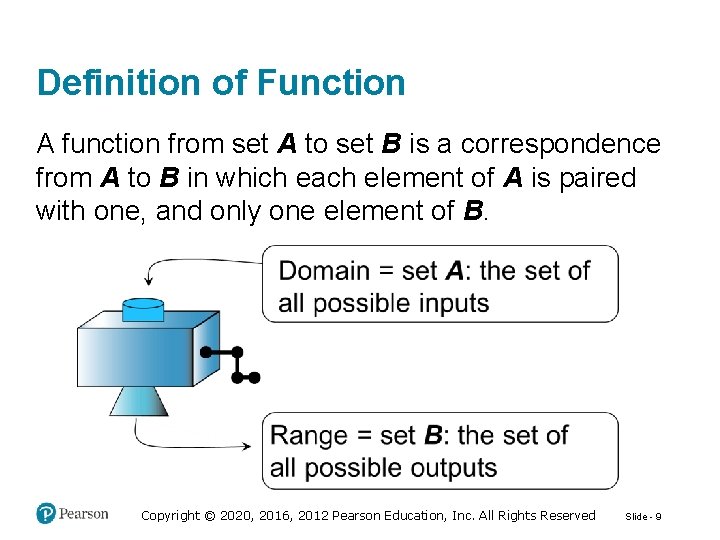
Definition of Function A function from set A to set B is a correspondence from A to B in which each element of A is paired with one, and only one element of B. Copyright © 2020, 2016, 2012 Pearson Education, Inc. All Rights Reserved Slide - 9
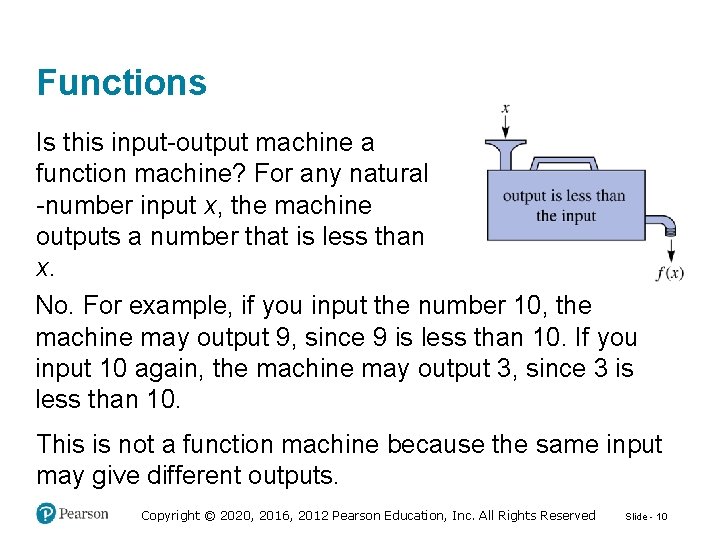
Functions Is this input-output machine a function machine? For any natural -number input x, the machine outputs a number that is less than x. No. For example, if you input the number 10, the machine may output 9, since 9 is less than 10. If you input 10 again, the machine may output 3, since 3 is less than 10. This is not a function machine because the same input may give different outputs. Copyright © 2020, 2016, 2012 Pearson Education, Inc. All Rights Reserved Slide - 10
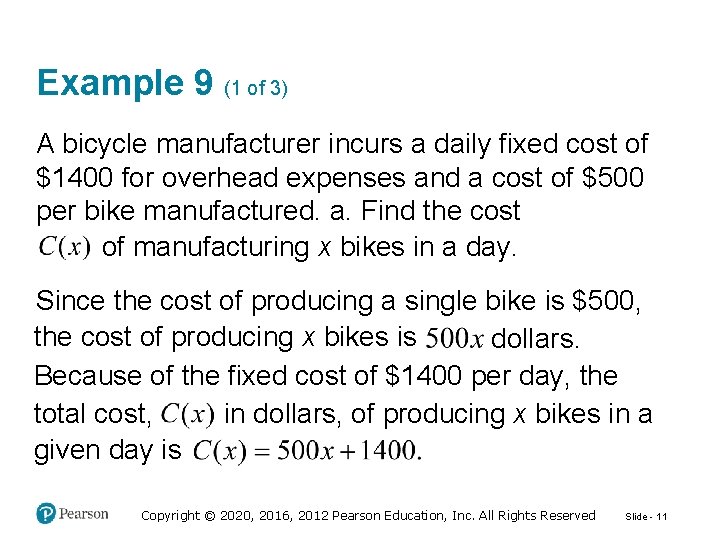
Example 9 (1 of 3) A bicycle manufacturer incurs a daily fixed cost of $1400 for overhead expenses and a cost of $500 per bike manufactured. a. Find the cost of manufacturing x bikes in a day. Since the cost of producing a single bike is $500, the cost of producing x bikes is dollars. Because of the fixed cost of $1400 per day, the total cost, in dollars, of producing x bikes in a given day is Copyright © 2020, 2016, 2012 Pearson Education, Inc. All Rights Reserved Slide - 11
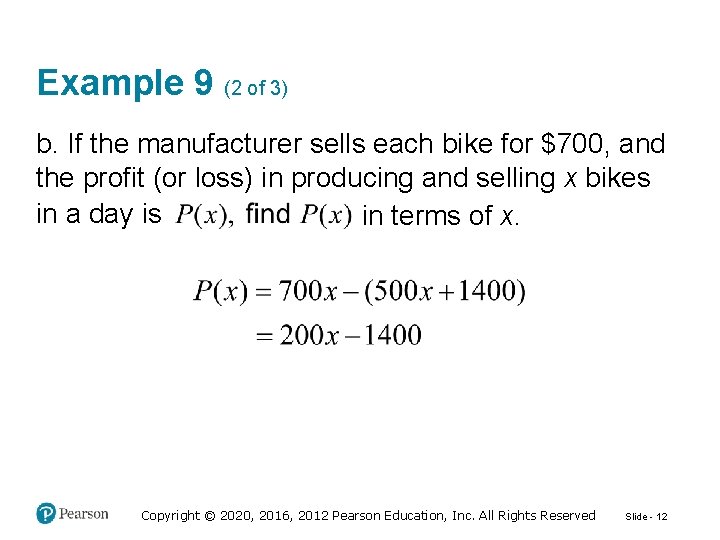
Example 9 (2 of 3) b. If the manufacturer sells each bike for $700, and the profit (or loss) in producing and selling x bikes in a day is in terms of x. Copyright © 2020, 2016, 2012 Pearson Education, Inc. All Rights Reserved Slide - 12
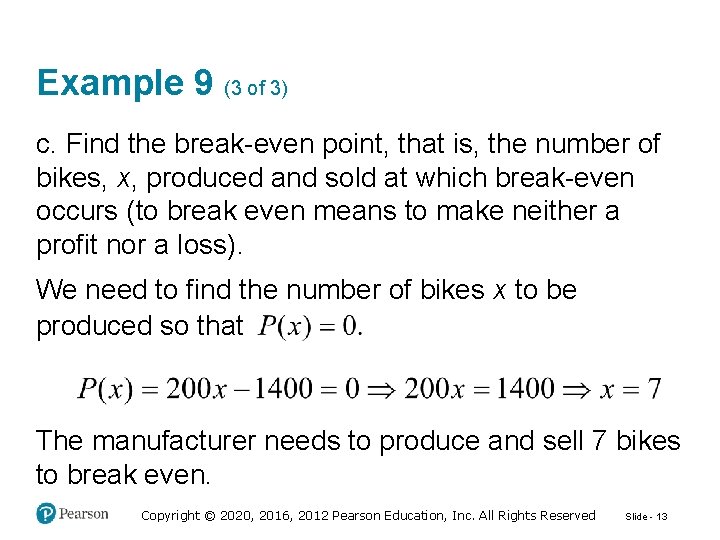
Example 9 (3 of 3) c. Find the break-even point, that is, the number of bikes, x, produced and sold at which break-even occurs (to break even means to make neither a profit nor a loss). We need to find the number of bikes x to be produced so that The manufacturer needs to produce and sell 7 bikes to break even. Copyright © 2020, 2016, 2012 Pearson Education, Inc. All Rights Reserved Slide - 13
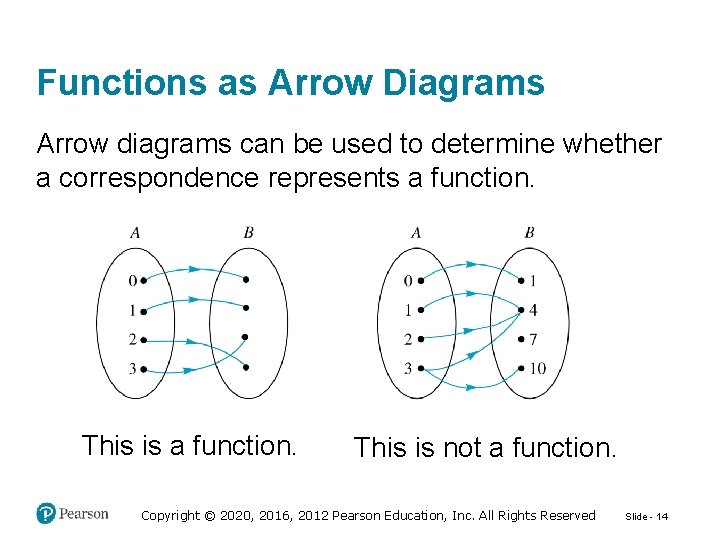
Functions as Arrow Diagrams Arrow diagrams can be used to determine whether a correspondence represents a function. This is not a function. Copyright © 2020, 2016, 2012 Pearson Education, Inc. All Rights Reserved Slide - 14
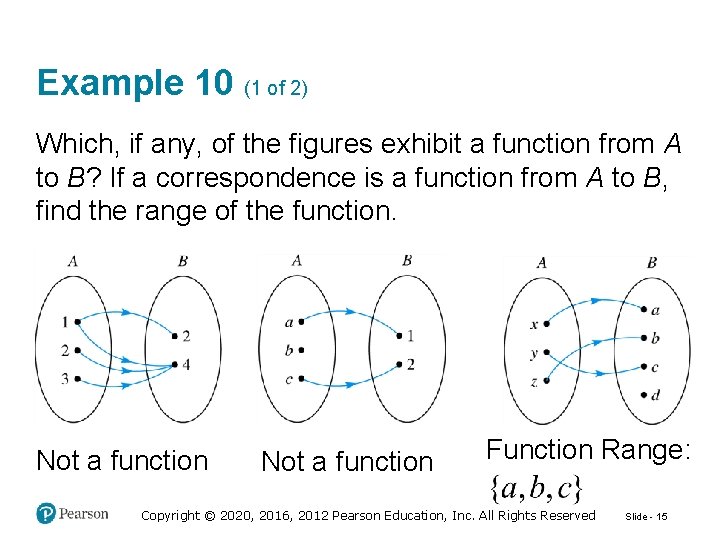
Example 10 (1 of 2) Which, if any, of the figures exhibit a function from A to B? If a correspondence is a function from A to B, find the range of the function. Not a function Function Range: Copyright © 2020, 2016, 2012 Pearson Education, Inc. All Rights Reserved Slide - 15
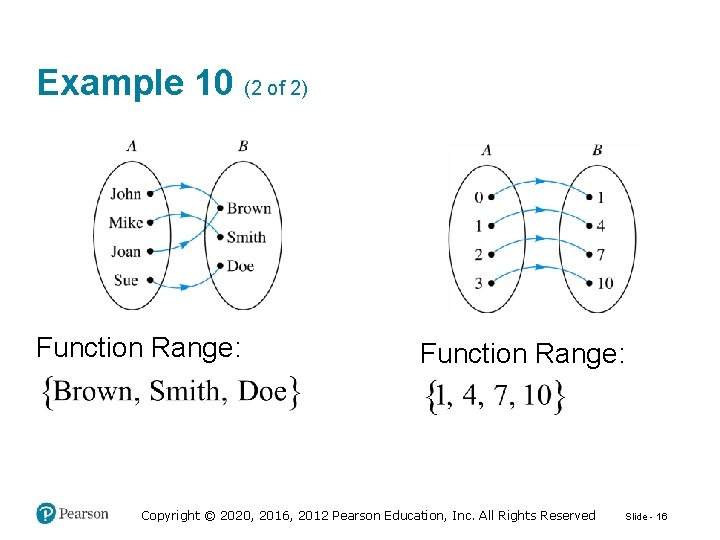
Example 10 (2 of 2) Function Range: Copyright © 2020, 2016, 2012 Pearson Education, Inc. All Rights Reserved Slide - 16
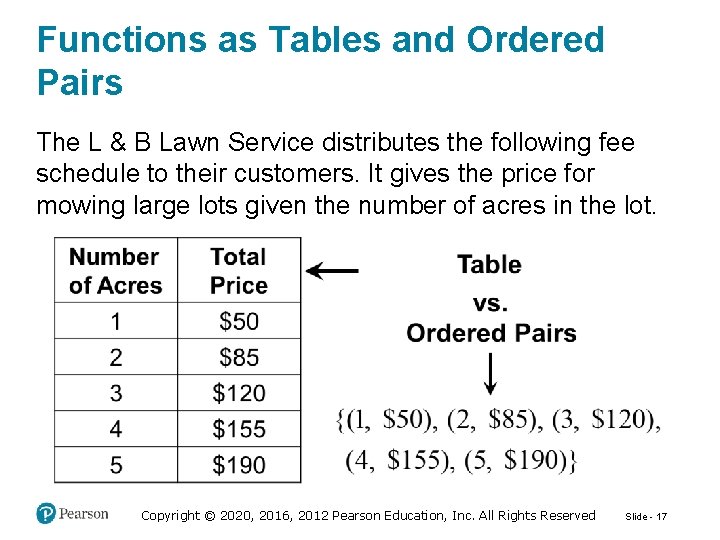
Functions as Tables and Ordered Pairs The L & B Lawn Service distributes the following fee schedule to their customers. It gives the price for mowing large lots given the number of acres in the lot. Copyright © 2020, 2016, 2012 Pearson Education, Inc. All Rights Reserved Slide - 17
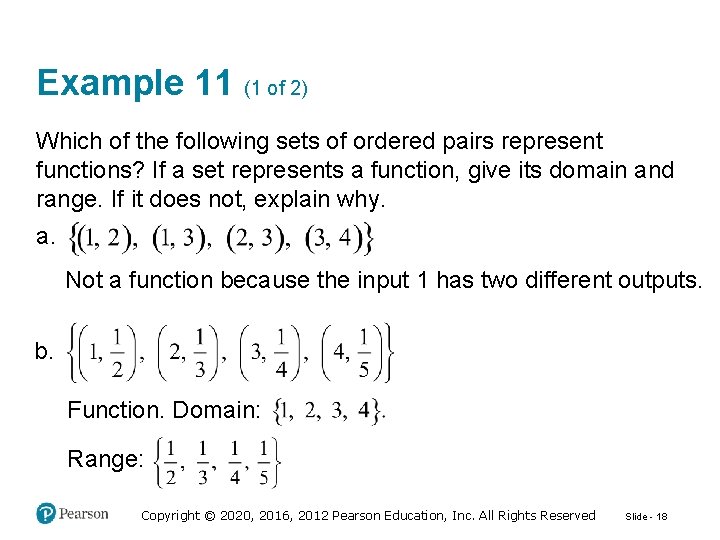
Example 11 (1 of 2) Which of the following sets of ordered pairs represent functions? If a set represents a function, give its domain and range. If it does not, explain why. a. Not a function because the input 1 has two different outputs. b. Function. Domain: Range: Copyright © 2020, 2016, 2012 Pearson Education, Inc. All Rights Reserved Slide - 18
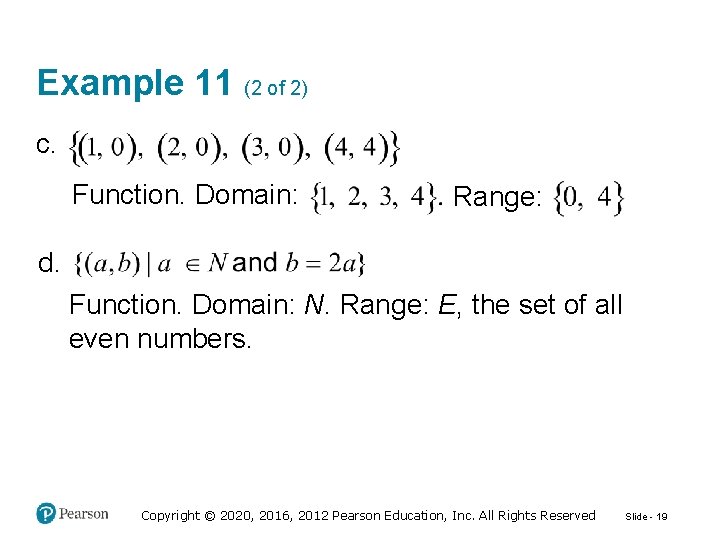
Example 11 (2 of 2) c. Function. Domain: Range: d. Function. Domain: N. Range: E, the set of all even numbers. Copyright © 2020, 2016, 2012 Pearson Education, Inc. All Rights Reserved Slide - 19
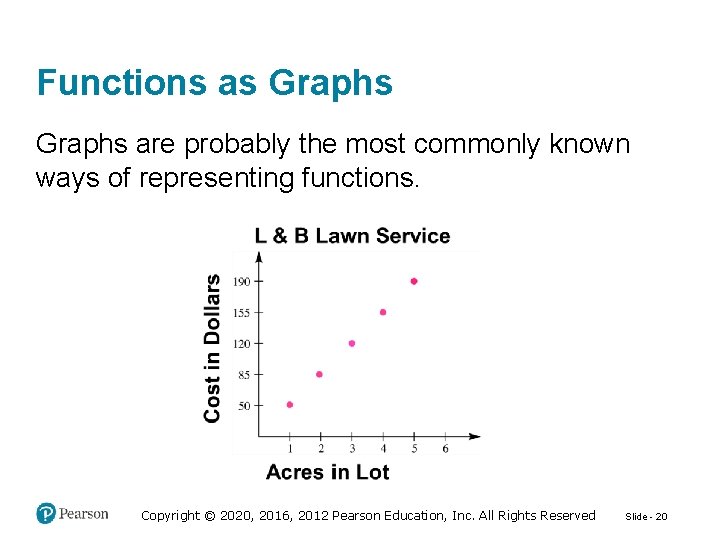
Functions as Graphs are probably the most commonly known ways of representing functions. Copyright © 2020, 2016, 2012 Pearson Education, Inc. All Rights Reserved Slide - 20
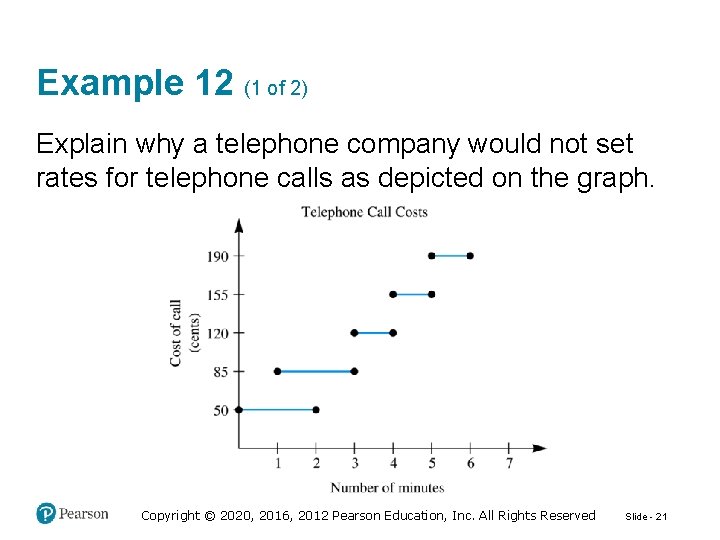
Example 12 (1 of 2) Explain why a telephone company would not set rates for telephone calls as depicted on the graph. Copyright © 2020, 2016, 2012 Pearson Education, Inc. All Rights Reserved Slide - 21
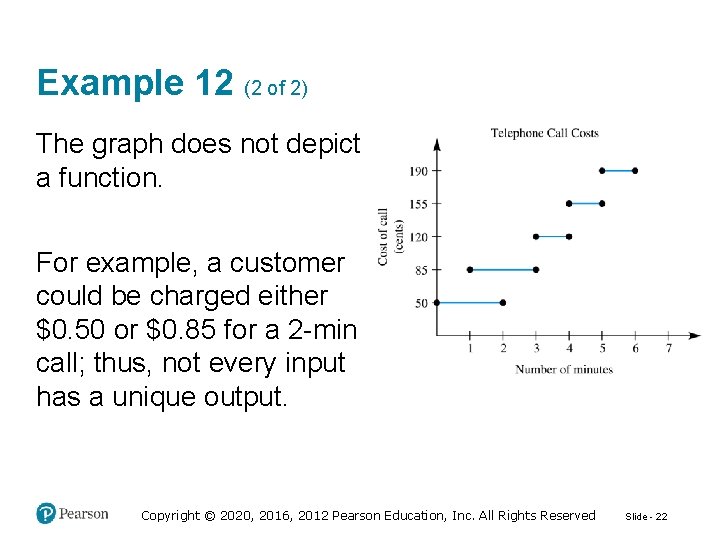
Example 12 (2 of 2) The graph does not depict a function. For example, a customer could be charged either $0. 50 or $0. 85 for a 2 -min call; thus, not every input has a unique output. Copyright © 2020, 2016, 2012 Pearson Education, Inc. All Rights Reserved Slide - 22
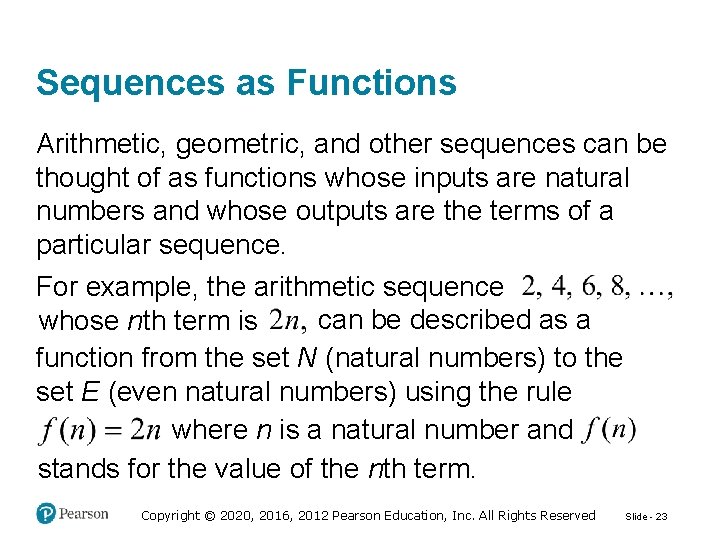
Sequences as Functions Arithmetic, geometric, and other sequences can be thought of as functions whose inputs are natural numbers and whose outputs are the terms of a particular sequence. For example, the arithmetic sequence can be described as a whose nth term is function from the set N (natural numbers) to the set E (even natural numbers) using the rule where n is a natural number and stands for the value of the nth term. Copyright © 2020, 2016, 2012 Pearson Education, Inc. All Rights Reserved Slide - 23
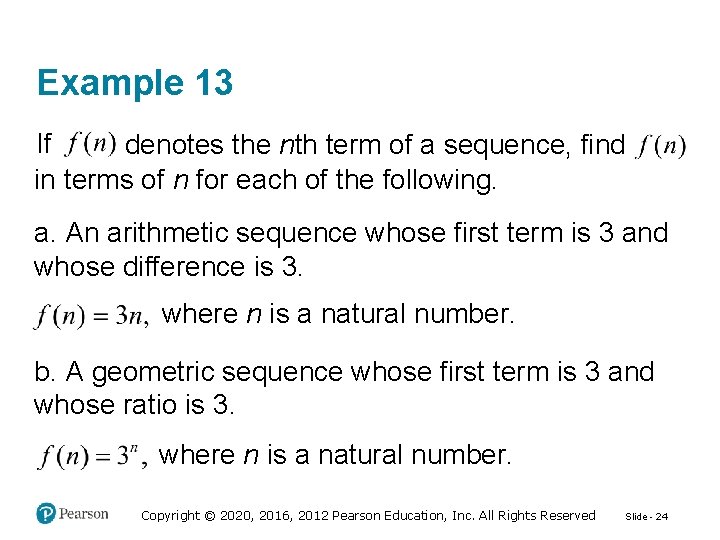
Example 13 If denotes the nth term of a sequence, find in terms of n for each of the following. a. An arithmetic sequence whose first term is 3 and whose difference is 3. where n is a natural number. b. A geometric sequence whose first term is 3 and whose ratio is 3. where n is a natural number. Copyright © 2020, 2016, 2012 Pearson Education, Inc. All Rights Reserved Slide - 24
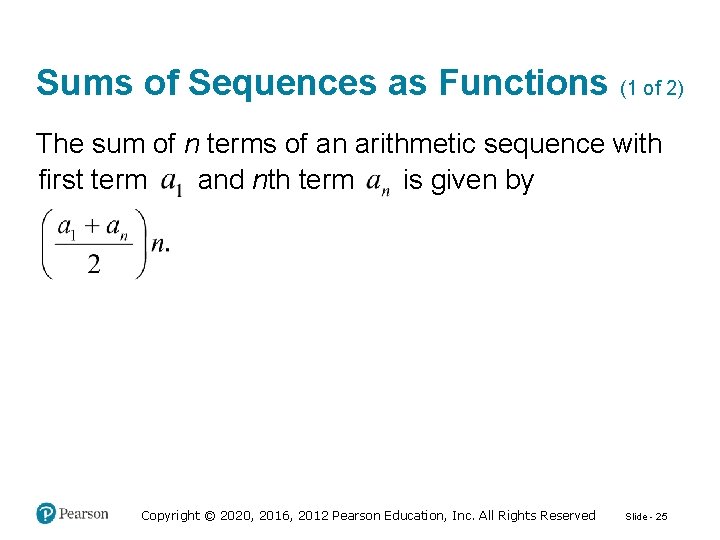
Sums of Sequences as Functions (1 of 2) The sum of n terms of an arithmetic sequence with and nth term is given by first term Copyright © 2020, 2016, 2012 Pearson Education, Inc. All Rights Reserved Slide - 25
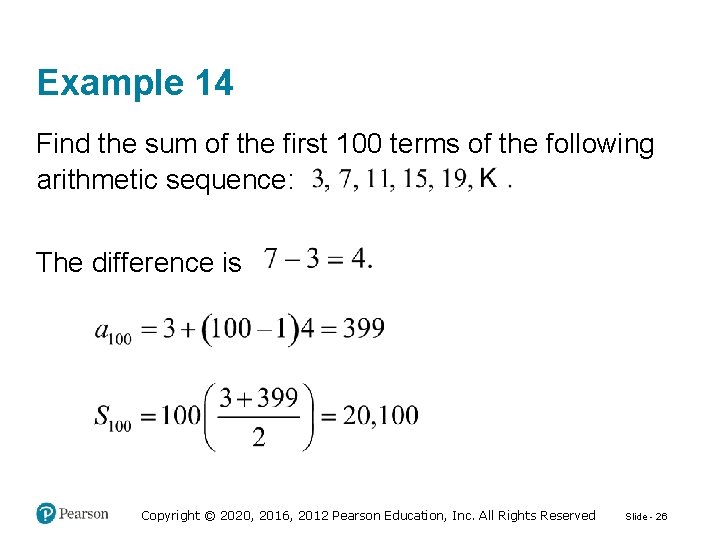
Example 14 Find the sum of the first 100 terms of the following arithmetic sequence: The difference is Copyright © 2020, 2016, 2012 Pearson Education, Inc. All Rights Reserved Slide - 26
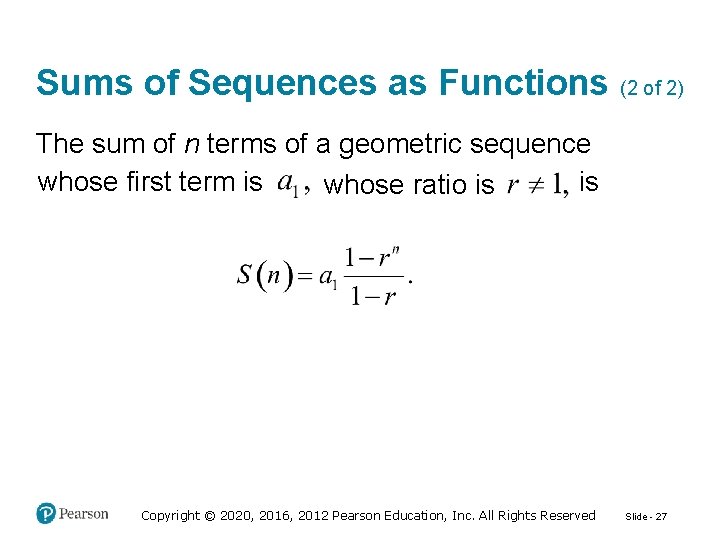
Sums of Sequences as Functions (2 of 2) The sum of n terms of a geometric sequence whose first term is is whose ratio is Copyright © 2020, 2016, 2012 Pearson Education, Inc. All Rights Reserved Slide - 27
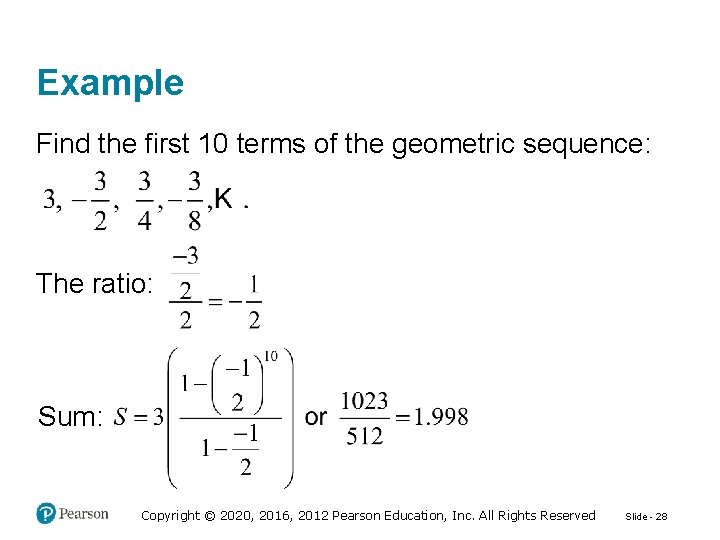
Example Find the first 10 terms of the geometric sequence: The ratio: Sum: Copyright © 2020, 2016, 2012 Pearson Education, Inc. All Rights Reserved Slide - 28
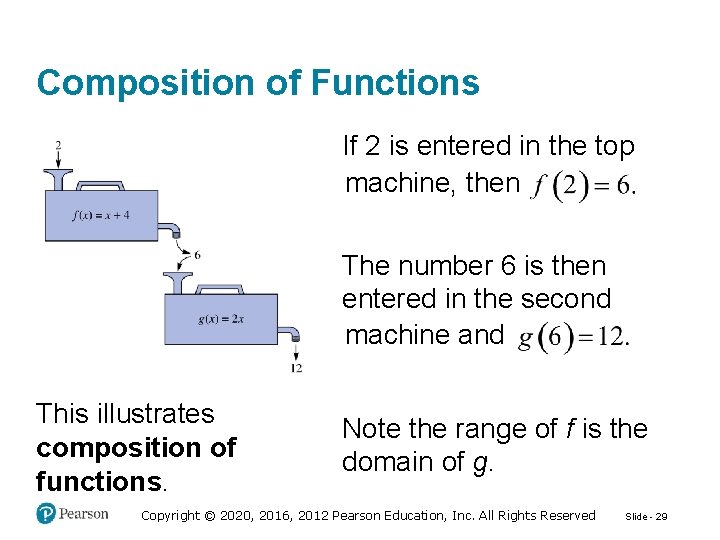
Composition of Functions If 2 is entered in the top machine, then The number 6 is then entered in the second machine and This illustrates composition of functions. Note the range of f is the domain of g. Copyright © 2020, 2016, 2012 Pearson Education, Inc. All Rights Reserved Slide - 29
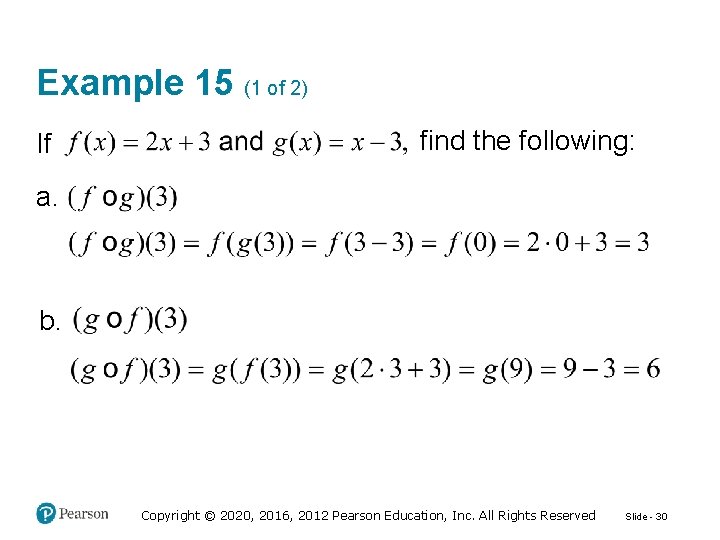
Example 15 (1 of 2) If find the following: a. b. Copyright © 2020, 2016, 2012 Pearson Education, Inc. All Rights Reserved Slide - 30
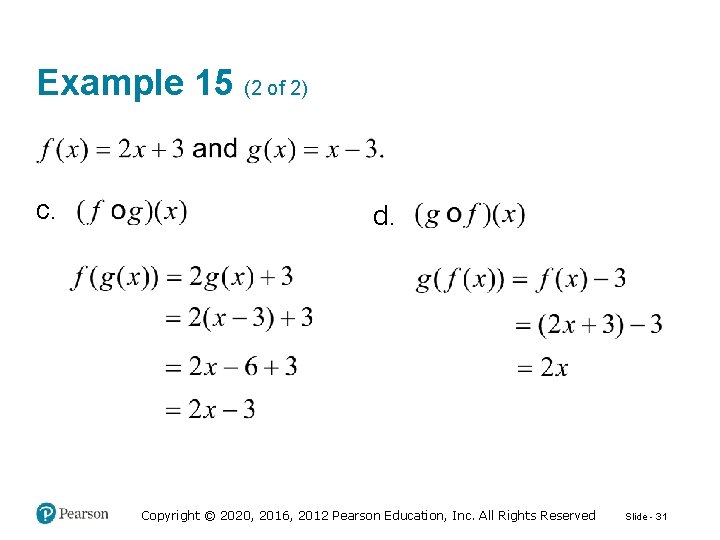
Example 15 (2 of 2) c. d. Copyright © 2020, 2016, 2012 Pearson Education, Inc. All Rights Reserved Slide - 31
- Slides: 31