
A Primer on Metadata Standards From Dublin Core
A Primer on Metadata Standards From Dublin Core to IEEE LOM Rory Mc. Greal Julia Innes Toni Roberts Tele. Education NB 1
How did standards develop? Tele. Campus 2
What is METADATA? I never met a metadata I ever really liked. (Dorman, 1999) Like any early inception of any standard, just understanding the landscape is difficult. (Luh, 1999) Tele. Campus 3
What is METADATA? data about data Metadata standards are agreed-on criteria for describing data to support interoperability Example: Tele. Campus January 31, 2001 31 janvier 2001 -01 -31 -2000 31012000 4
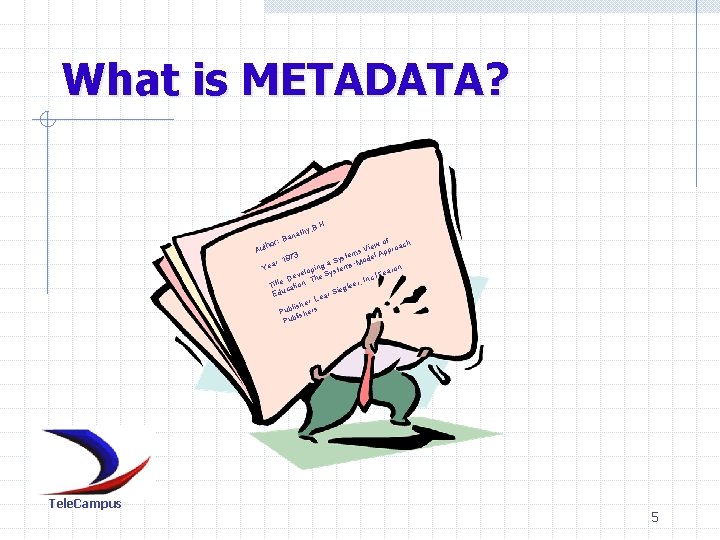
What is METADATA? . B. H , athy Ban f : ch wo hor Vie pproa Aut s m A 3 l e t 7 e 9 ys Mod r: 1 a. S n Yea ing stems p o aro l y e S v. /Fe e e c h D n I : T r, Title cation: glee Sie r Edu a Le er: lish Pub lishers Pub Tele. Campus 5
What is METADATA? Objective: Factual information – e. g. author, subject, cost, code Subjective Attributes: opinions e. g. evaluation of a module varied & variable information Tele. Campus 6
Learning objects any entities, digital or non-digital, which can be used or referenced in technology-supported learning. Mo dul ar Tele. Campus 7
Learning objects Adaptable Affordable Assessable Scorm Accessible Discoverable Scorm Durable Interchangeable Scorm Interoperable Manageable Scorm Re-usable Reliable Adapted from Parmentier, 1999 Tele. Campus 8
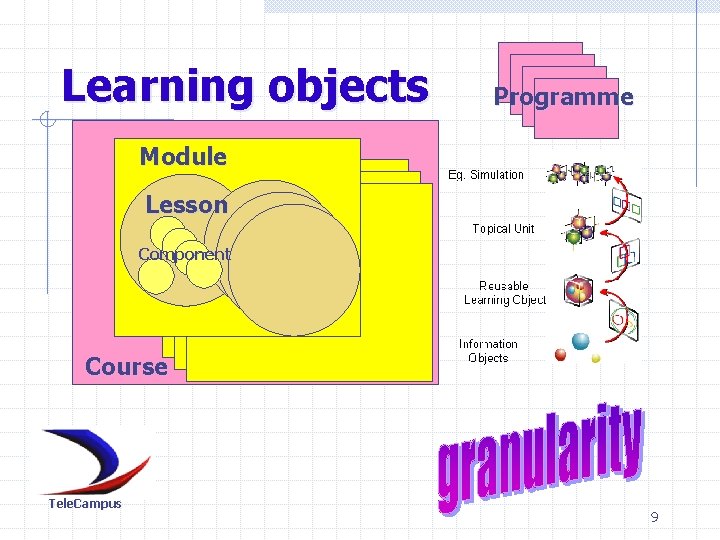
Learning objects Programme Module Lesson Component Course Tele. Campus 9
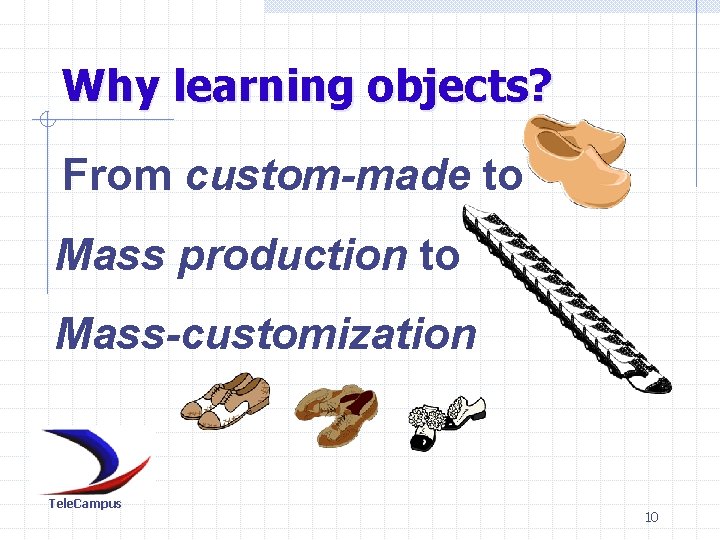
Why learning objects? From custom-made to Mass production to Mass-customization Tele. Campus 10
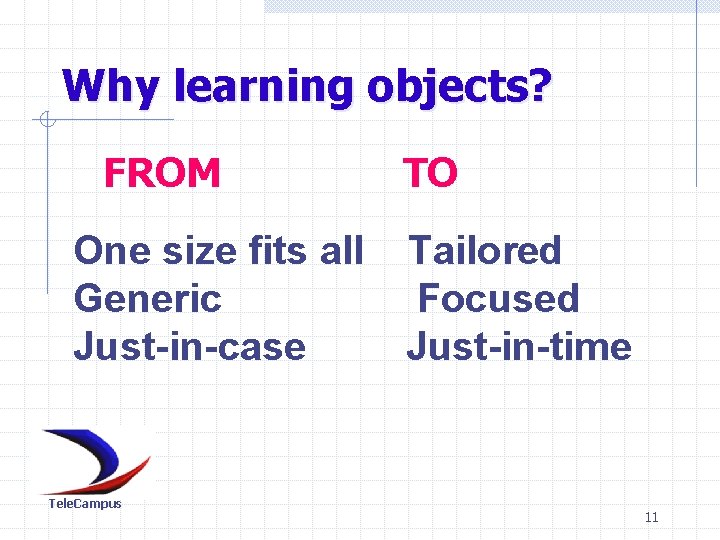
Why learning objects? FROM One size fits all Generic Just-in-case Tele. Campus TO Tailored Focused Just-in-time 11
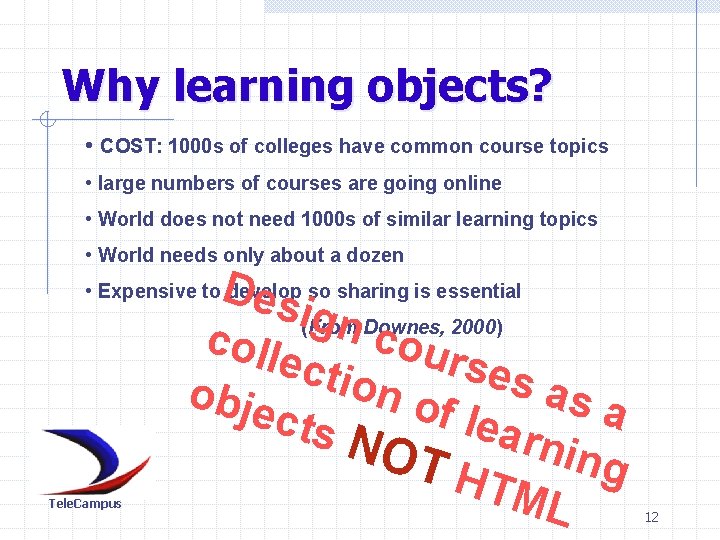
Why learning objects? • COST: 1000 s of colleges have common course topics • large numbers of courses are going online • World does not need 1000 s of similar learning topics • World needs only about a dozen Des i(From g Downes, 2000) n cou coll rses ecti on o obje a s a f cts l e NOT arning HTM L • Expensive to develop so sharing is essential Tele. Campus 12
Who inputs METADATA? Two Camps: • Internal referenced - Users input their own metadata • External referenced – Professionals input metadata • number of electronic objects is growing rapidly • metadata required is too much for third-party indexers Tele. Campus 13

METADATA characteristics 1. a data dictionary of commonly defined elements; 2. a method for manipulating and communicating elements electronically; 3. rules for identifying and extracting content; 4. an official standards body; 5. tools for creating, transmitting, and storing. Ahronheim (1998) Tele. Campus 14
METADATA conditions • • Mandatory fields (small subset) Optional fields Extensible International interoperability Adapted from Griffin and Wason (1997) Tele. Campus 15
METADATA challenges Too much concern with FIELDS NOT enough with TERMS • Fields need a common terminology • Described by a content expert BUT • TERMS must fit into a universe of knowledge AND • Not be only useful to content experts • Cross-searching requires compatible vocabularies Tele. Campus 16
What is RDF? (Resource Description Framework) An infrastructure enabling the encoding, exchange, and reuse of structured metadata (Bearman et al. , 1999) RDF is syntax independent, and can be expressed in both XML and HTML. -- World Wide Web Consortium Tele. Campus http: //www. w 3. org/TR/REC-rdf-syntax/ 17
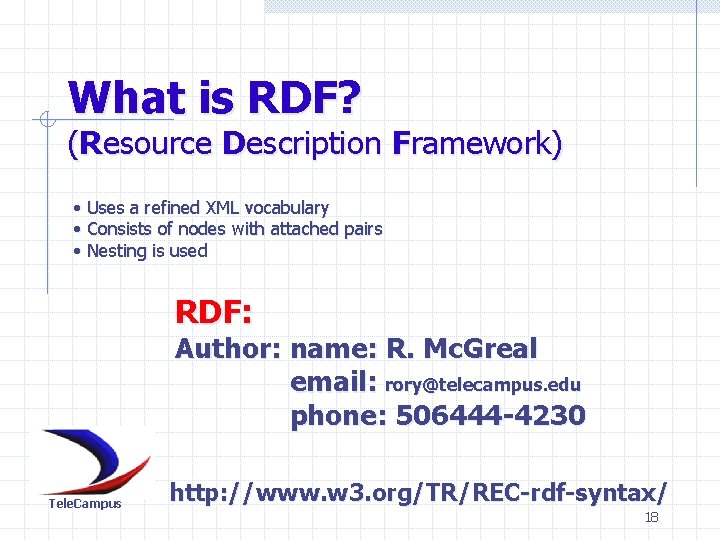
What is RDF? (Resource Description Framework) • Uses a refined XML vocabulary • Consists of nodes with attached pairs • Nesting is used RDF: Author: name: R. Mc. Greal email: rory@telecampus. edu phone: 506444 -4230 Tele. Campus http: //www. w 3. org/TR/REC-rdf-syntax/ 18
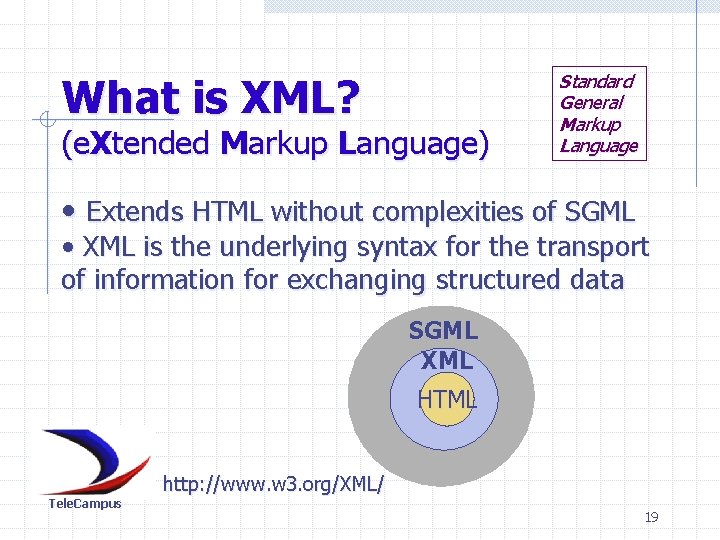
What is XML? (e. Xtended Markup Language) Standard General Markup Language • Extends HTML without complexities of SGML • XML is the underlying syntax for the transport of information for exchanging structured data SGML XML HTML Tele. Campus http: //www. w 3. org/XML/ 19
What is XML? • any level of complexity • functions without the server • vendor independent • user extensible • validation & human readability Warning: possible Pandora's box of incompatible metatags Tele. Campus 20
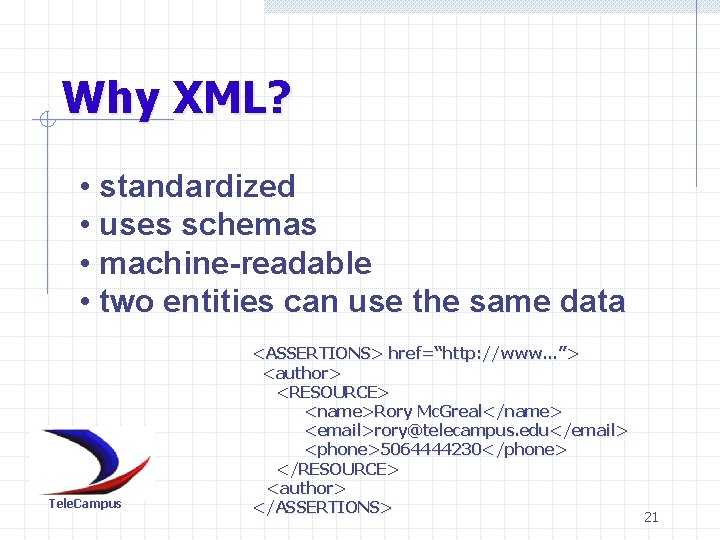
Why XML? • standardized • uses schemas • machine-readable • two entities can use the same data Tele. Campus <ASSERTIONS> href=“http: //www…”> <author> <RESOURCE> <name>Rory Mc. Greal</name> <email>rory@telecampus. edu</email> <phone>5064444230</phone> </RESOURCE> <author> </ASSERTIONS> 21
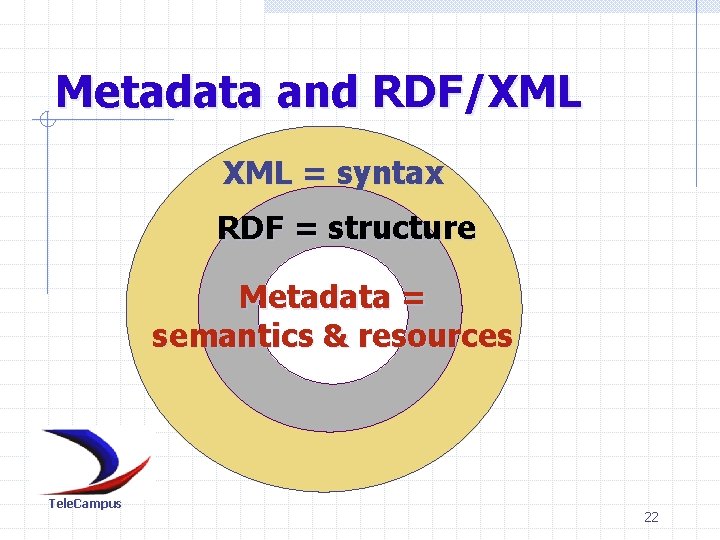
Metadata and RDF/XML = syntax RDF = structure Metadata = semantics & resources Tele. Campus 22
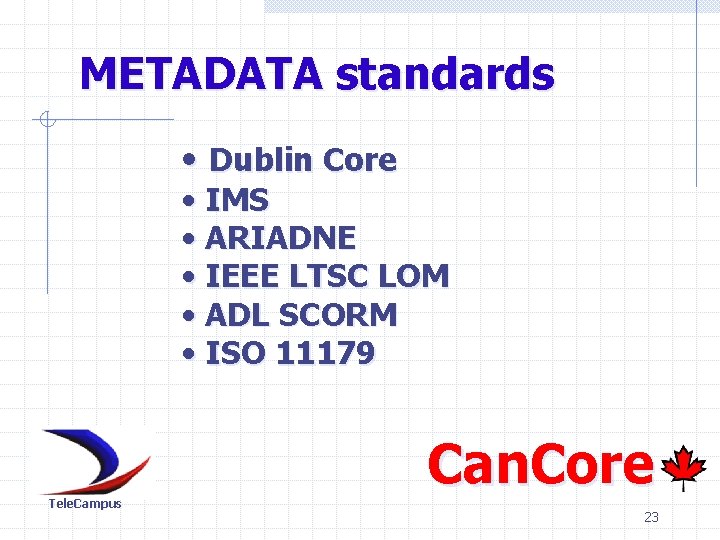
METADATA standards • Dublin Core • IMS • ARIADNE • IEEE LTSC LOM • ADL SCORM • ISO 11179 Tele. Campus Can. Core 23
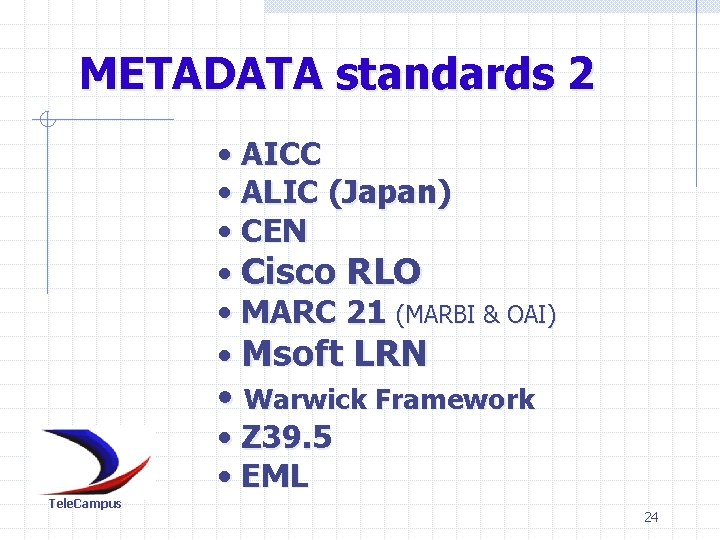
METADATA standards 2 • AICC • ALIC (Japan) • CEN • Cisco RLO • MARC 21 (MARBI & OAI) • Msoft LRN • Warwick Framework • Z 39. 5 • EML Tele. Campus 24
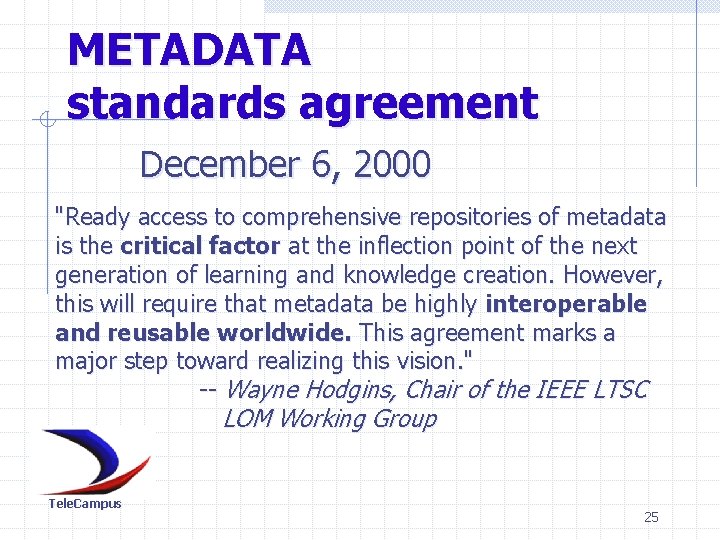
METADATA standards agreement December 6, 2000 "Ready access to comprehensive repositories of metadata is the critical factor at the inflection point of the next generation of learning and knowledge creation. However, this will require that metadata be highly interoperable and reusable worldwide. This agreement marks a major step toward realizing this vision. " -- Wayne Hodgins, Chair of the IEEE LTSC LOM Working Group Tele. Campus 25
Dublin Core. . . the HTML of Web metadata (Bearman et al. , 1999) . . . lingua franca for metadata, . . . at a basic level (Milstead & Feldman, 1999). . . the most broadly based consensus on resource description on the Web" (Weibel, 1999) http: //purl. oclc. org/dc/ Tele. Campus 26
Dublin Core • coexists with other metadata sets • all elements are optional • all elements are syntax-independent • tagged in HTML, raw XML, or RDF/XML Tele. Campus 27
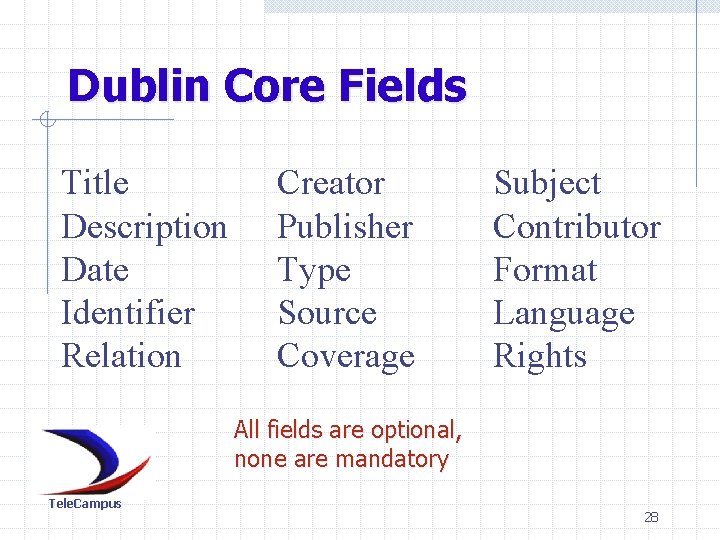
Dublin Core Fields Title Description Date Identifier Relation Creator Publisher Type Source Coverage Subject Contributor Format Language Rights All fields are optional, none are mandatory Tele. Campus 28
IMS Educause: Instructional Management System? ? MANDATE 1. catalyst for development of instructional software 2. creation of an online management infrastructure for learning 3. facilitation of collaborative learning activities 4. certification Partners: ARIADNE (Europe), NIST LOM, Members: Apple, Cisco, ETS, IBM, Indust. Canada, Tele. Campus Microsoft, Oracle, Sun, US Defense, etc. 29
IMS Metadata Schema NOT just a metadata schema • incorporates & extends Dublin Core • mandatory fields • simple controlled vocabulary • sets dictionary values • reference schemas • domain-specific taxonomies • RDF/XML http: //imsproject. com Tele. Campus 30
ARIADNE Alliance of Remote Instructional Authoring and Distribution Networks for Europe • fosters the sharing and reuse of electronic pedagogical material, by universities and corporations. • a Europe-wide repository for pedagogical documents (Knowledge Pool System) • co-author of IMS Metadata structure http: //ariadne. unil. ch/ Tele. Campus 31
IEEE LTSC LOM P 1484. 12 Institute for Electrical and Electronics Engineers Learning Technologies Standards Committee Learning Object Management Protocol MANDATE • To enable learners or instructors to search, evaluate, acquire, and use Learning Objects • focus on the minimal set of properties needed http: //ltsc. ieee. org/index. html Tele. Campus 32
ADL SCORM Advanced Distributed Learning Network Sharable Courseware Object Reference Model • a set of interrelated technical specifications built upon the work of the AICC, IMS and IEEE to create one unified content model • It incorporates XML • supported by US Dept. of Defense Roger St-Pierre Grandfather Tele. Campus http: //www. adlnet. org/Scorm/ 33
CLEO Lab Customized Learning Experiences Online • one-year research collaboration between corporations • ADL SCORM • focused, applied research on technical and pedagogical issues Cisco Systems, Click 2 Learn, IBM Mindspan Solutions, Microsoft and NETg Tele. Campus http: //www. cleolab. org/ 34
ISO/IEC JTC 1 SC 36 International Standards Organization Information Technology for Learning, Education, & Training • standardization in IT for learning • support individuals, groups, or organizations • enable interoperability & reusability of resources & tools External Liaisons: • IEEE/LTSC (Learning Technology Standards Committee) • CEN/ISSS/LTWS (Learning Technology Workshop) http: //jtc 1 sc 36. org/#terms_of_reference Tele. Campus 35
AICC Aviation Industry CBT (Computer-Based Training) Committee Provides guidelines for interoperability for systems to share data online http: //aicc. org/ AICC Guidelines & Recommendations (AGR) Tele. Campus 36
ALIC Advanced Learning Infrastructure Committee (Japan) • works with other international standards bodies for metadata • facilitates interoperability http: //www. alic. gr. jp/ Tele. Campus 37
CEN/ISSS EUROPEAN COMMITTEE FOR STANDARDIZATION Information Society Standardization System • formal and informal standardization • full standards to best-practice agreements • employs an open, transparent consensus mechanism • direct industry participation & consumer interests • not pushing a particular solution or technology • a wide constituency of interested parties • flexible methods of working and flexible deliverables http: //www. cenorm. be/isss/ Tele. Campus 38
Cisco Systems RLO/RIO Re-usable Learning Objects/ Re-usable Information Objects • 7 (+ or – 2) chunked reusable information objects • forms a complete lesson • incorporates metadata http: //www. cisco. com/warp/public/779/ ibs/solutions/learning/whitepapers/ Tele. Campus 39
Microsoft LRN Learning Resource INterchange • Implementation IMS content packaging specification v 1. 0 • more than a metadata implementation that incorporates IMS metadata http: //www. microsoft. com/elearn/support. asp LRN Toolkit v. 2. 0 Tele. Campus 40
OAI Open Archives Initiative • develops and promotes interoperability standards that aim to facilitate the efficient dissemination of content as a means of increasing the availability of scholarly communication • Digital Library Federation and the Coalition for Networked Information Tele. Campus http: //www. openarchives. org/ 41
Warwick Framework • a higher-level context for the Dublin Core • nests components (packages) in containers • facilitates interoperability • permits selective access & manipulation of data WARNING: It can create complexity that is not needed. (Lagoze, 1996) Tele. Campus http: //www. dlib. org/dlib/july 96/lagoze/07 lagoze. html 42
Learning Object Repositories • GEM • JA-SIG • MERLOT Tele. Campus 43
EML Educational Modeling Language • Notational system codifying units of study (e. g. courses, components, programmes) • Describes roles, relations, interactions & activities • Expressed in XML • Supports IMS, SCORM, – more comprehensive Tele. Campus 44
GEM Gateway to Educational Materials • The Gateway, a an example repository or catalog • set of metadata standards and technical mechanisms • "one-stop, any-stop" access to uncatalogued educational materials • consortium of 200 + orgs. & individuals • a project of the U. S. Dept. of Education, ERIC http: //www. geminfo. org/ http: //www. thegateway. org/ Tele. Campus 45
JA-SIG Java in Administration Special Interest Group • like Merlot: a collection interactive online learning materials • an example of a learning object repository • does not adhere to universal metadata standards http: //www. mis 2. udel. edu/ja-sig/ Tele. Campus 46
Merlot Multimedia Educational Resource for Learning and Online Teaching California State University system’s Distributed Learning and Teaching Initiative & Multimedia Repository Initiative • a collection of high quality interactive online learning materials & people • an example of a learning object repository • does not adhere to universal metadata standards http: //www. merlot. org Tele. Campus 47
Tele. Campus Online Course Directory • A metadata repository • Conforms to international metadata standards. • Houses only the metadata • Does NOT house actual lessons, modules, or courses • Links to the institutions that own the courses • +45 000 online courses • + 30 countries, +12 languages • +3 500 free courses http: //telecampus. edu Tele. Campus 48
Can. Core Canadian Core Fields and Vocabulary • a metadata protocol • an interpretation and simplification of the 86 elements of the IMS Model • FULL compatibility with IEEE LOM http: //www. careo. org/cancore http: //teleeducation. nb. ca/Can. Core Tele. Campus 49
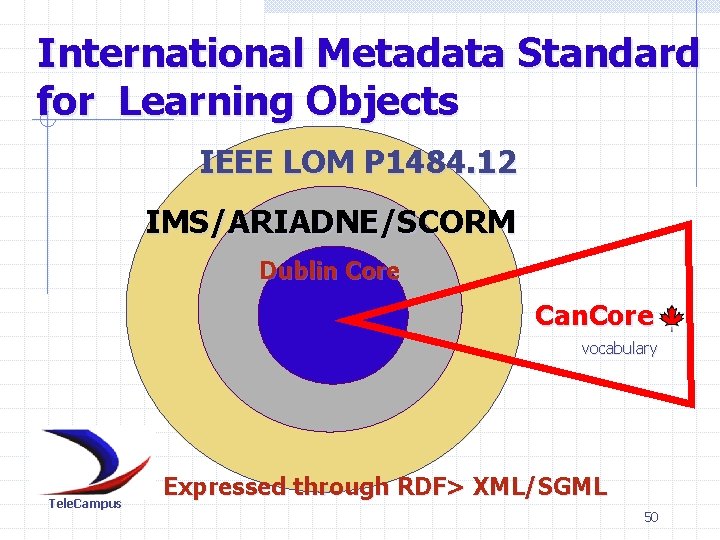
International Metadata Standard for Learning Objects IEEE LOM P 1484. 12 IMS/ARIADNE/SCORM Dublin Core Can. Core vocabulary Tele. Campus Expressed through RDF> XML/SGML 50
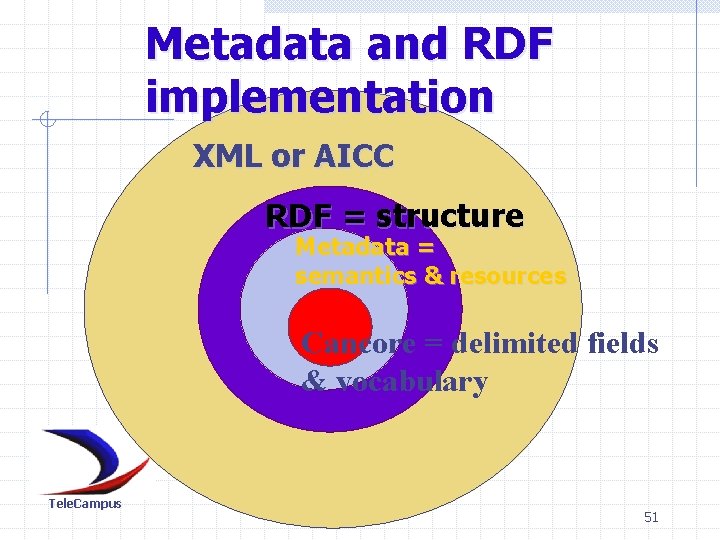
Metadata and RDF implementation XML or AICC RDF = structure Metadata = semantics & resources Cancore = delimited fields & vocabulary Tele. Campus 51
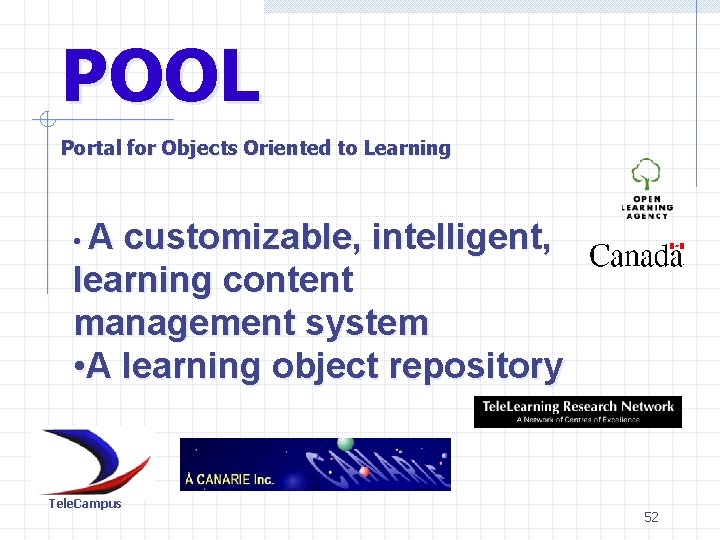
POOL Portal for Objects Oriented to Learning • A customizable, intelligent, learning content management system • A learning object repository Tele. Campus 52
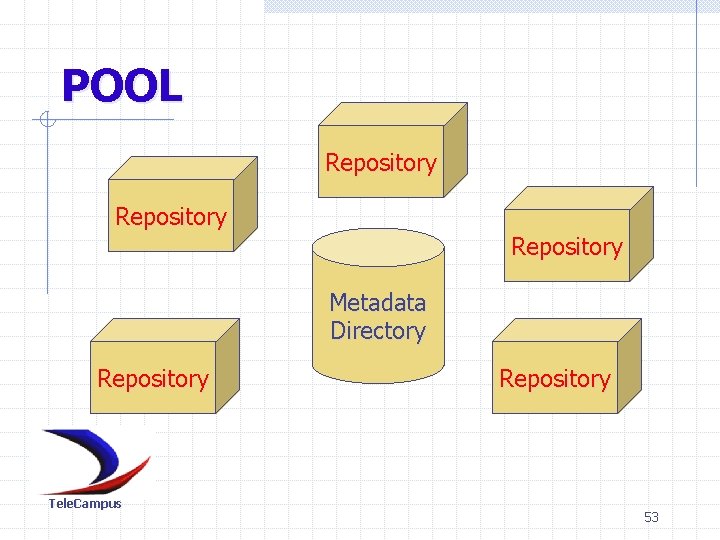
POOL Repository Metadata Directory Repository Tele. Campus Repository 53
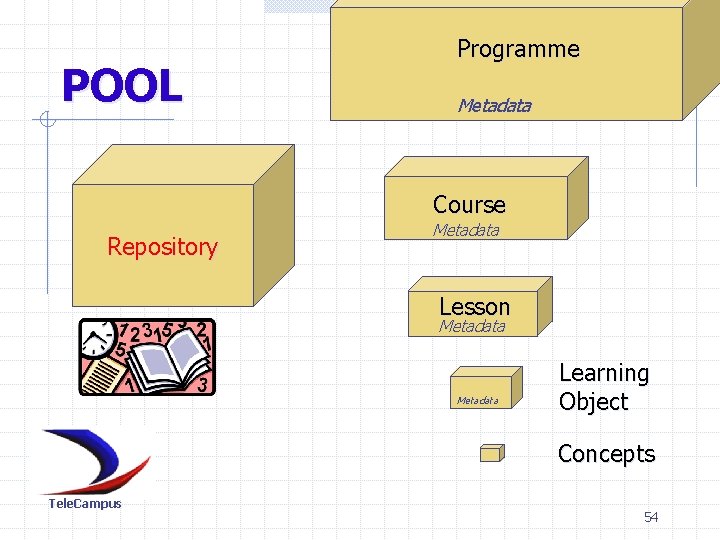
POOL Programme Metadata Course Repository Metadata Lesson Metadata Learning Object Concepts Concept Tele. Campus 54
POOL Tele. Campus 55
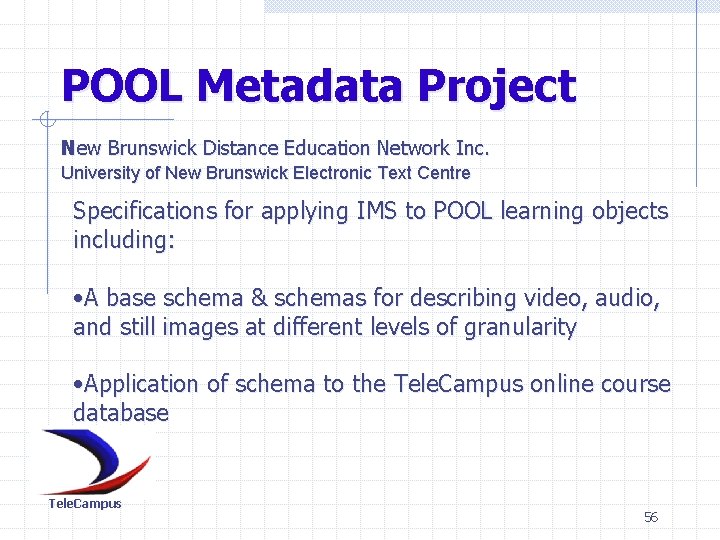
POOL Metadata Project New Brunswick Distance Education Network Inc. University of New Brunswick Electronic Text Centre Specifications for applying IMS to POOL learning objects including: • A base schema & schemas for describing video, audio, and still images at different levels of granularity • Application of schema to the Tele. Campus online course database Tele. Campus 56
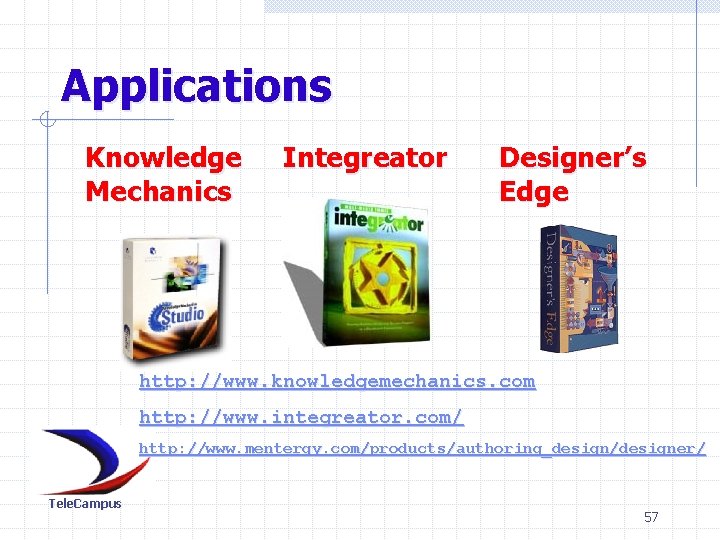
Applications Knowledge Mechanics Integreator Designer’s Edge http: //www. knowledgemechanics. com http: //www. integreator. com/ http: //www. mentergy. com/products/authoring_design/designer/ Tele. Campus 57
MARC 21 Machine-Readable Bibliographic Information Committee (MARBI) MAchine-Readable Cataloging record • library standards for the representation and communication of bibliographic and related information in machine-readable form • three elements: the record structure, the content designation, and the data content of the record Tele. Campus http: //lcweb. loc. gov/marc/ 58
Z 39. 50 • an information retrieval protocol that supports communication among different information systems • works with MARC records • used by librarians http: //www. loc. gov/z 3950/agency/ Tele. Campus 59
Tele. Campus 60
What is RSS? RDF Site Summary • a generalised format for online resources • expresses all vocabularies with one model and syntax • schema can work in XML Warning: RDF does not solve interoperability problems with legacy metadata AND a variety of RDF description schemas are possible Tele. Campus http: //groups. yahoo. com/group/rss-dev/files/namespace. html 61
- Slides: 61