
A PRESENTATION TO THE SENATE COMMITTEE ON COMMUNICATION




- Slides: 30
A PRESENTATION TO THE SENATE COMMITTEE ON COMMUNICATION ON THE ACTIVITES OF NIGERIAN COMMUNICATIONS COMMISSION EXECUTIVE VICE CHAIRMAN/CHIEF EXECUTIVE OFFICER NIGERIAN COMMUNICATIONS COMMISSION PROF. UMAR GARBA DANBATTA (FNSE) DATE: DECEMBER 2015
PRESENTATION OUTLINE q Nigerian Communications Commission q Universal Service Provision fund q Challenges q Legislative intervention q Conclusion NIGERIAN COMMUNICATIONS COMMISSION © 2015 2
vncc
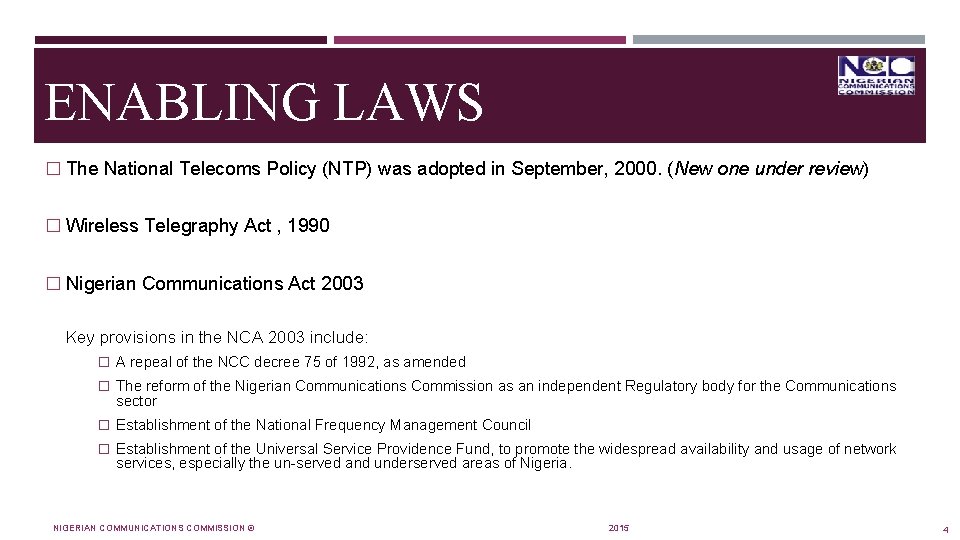
ENABLING LAWS � The National Telecoms Policy (NTP) was adopted in September, 2000. (New one under review) � Wireless Telegraphy Act , 1990 � Nigerian Communications Act 2003 Key provisions in the NCA 2003 include: � A repeal of the NCC decree 75 of 1992, as amended � The reform of the Nigerian Communications Commission as an independent Regulatory body for the Communications sector � Establishment of the National Frequency Management Council � Establishment of the Universal Service Providence Fund, to promote the widespread availability and usage of network services, especially the un-served and underserved areas of Nigeria. NIGERIAN COMMUNICATIONS COMMISSION © 2015 4
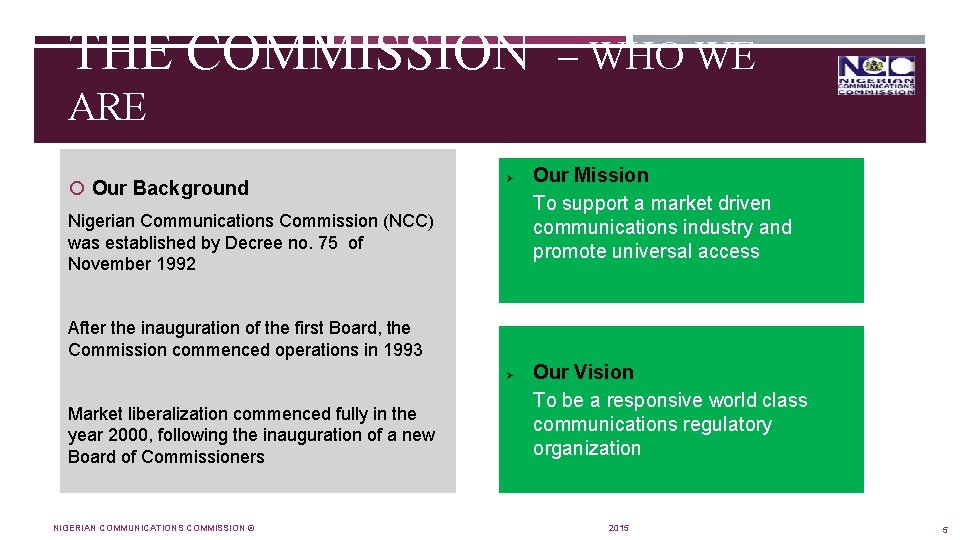
THE COMMISSION – WHO WE ARE Our Background Ø Nigerian Communications Commission (NCC) was established by Decree no. 75 of November 1992 Our Mission To support a market driven communications industry and promote universal access After the inauguration of the first Board, the Commission commenced operations in 1993 Ø Market liberalization commenced fully in the year 2000, following the inauguration of a new Board of Commissioners NIGERIAN COMMUNICATIONS COMMISSION © Our Vision To be a responsive world class communications regulatory organization 2015 5
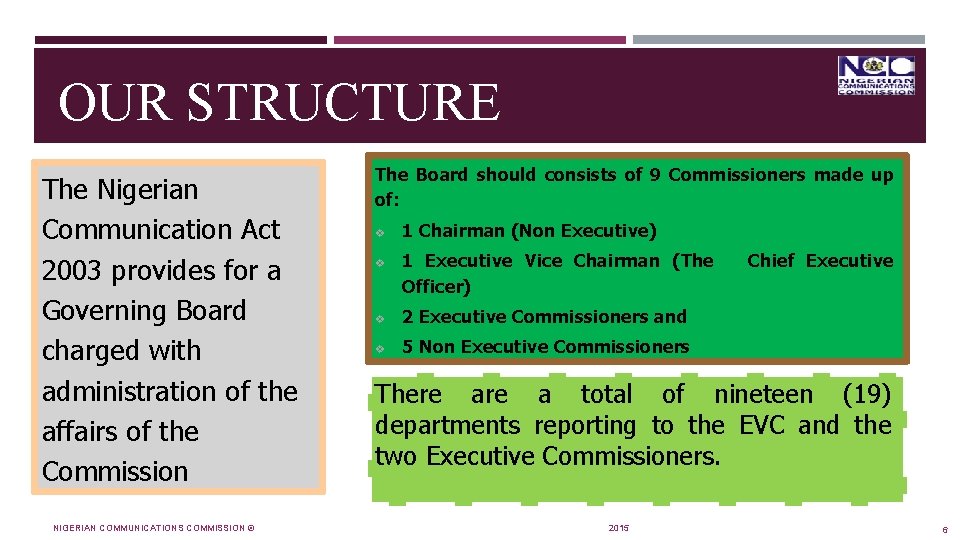
OUR STRUCTURE The Nigerian Communication Act 2003 provides for a Governing Board charged with administration of the affairs of the Commission NIGERIAN COMMUNICATIONS COMMISSION © The Board should consists of 9 Commissioners made up of: v v 1 Chairman (Non Executive) 1 Executive Vice Chairman (The Officer) v 2 Executive Commissioners and v 5 Non Executive Commissioners Chief Executive There a total of nineteen (19) departments reporting to the EVC and the two Executive Commissioners. 2015 6
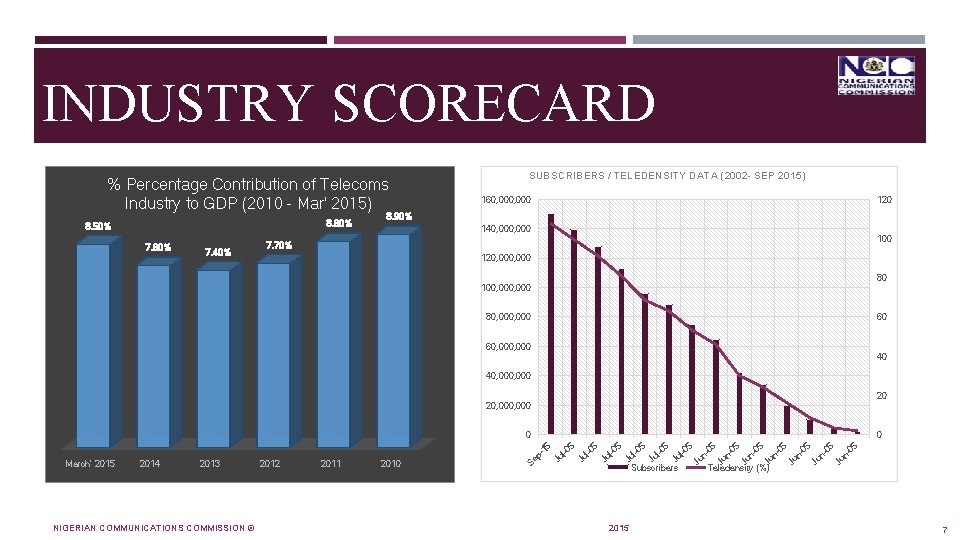
INDUSTRY SCORECARD % Percentage Contribution of Telecoms Industry to GDP (2010 - Mar' 2015) 8. 60% 8. 50% 7. 60% 7. 40% SUBSCRIBERS / TELEDENSITY DATA (2002 - SEP 2015) 160, 000 120 8. 90% 140, 000 100 7. 70% 120, 000 80 100, 000 80, 000 60 60, 000 40 40, 000 20 20, 000 NIGERIAN COMMUNICATIONS COMMISSION © 2015 05 n- 05 Ju n- 05 Teledensity (%) Ju n- 05 n- Ju Subscribers Ju l-0 5 l-0 5 Ju 2010 Ju 2011 Ju 2012 Ju 2013 p- 2014 Se March' 2015 l-0 5 0 15 0 7
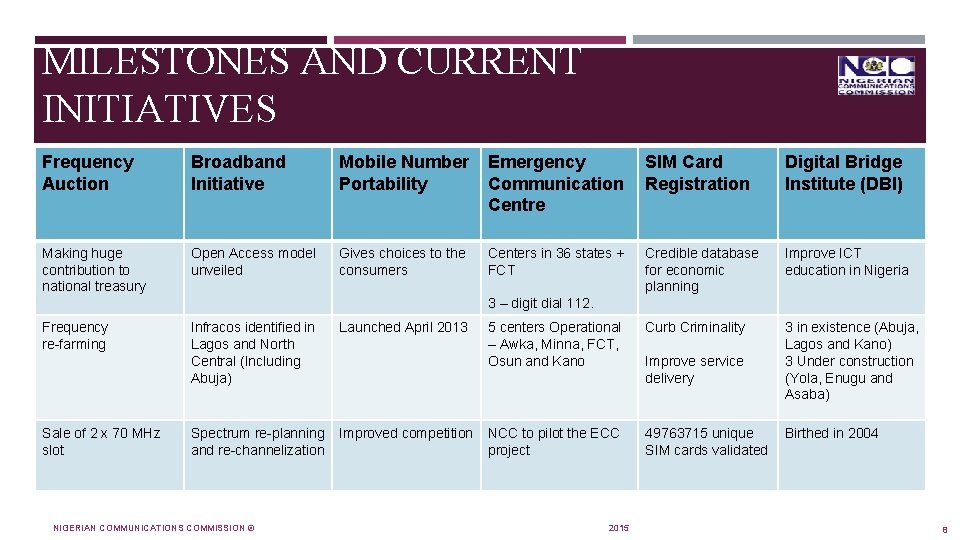
MILESTONES AND CURRENT INITIATIVES Frequency Auction Broadband Initiative Mobile Number Portability Emergency Communication Centre SIM Card Registration Digital Bridge Institute (DBI) Making huge contribution to national treasury Open Access model unveiled Gives choices to the consumers Centers in 36 states + FCT Credible database for economic planning Improve ICT education in Nigeria 5 centers Operational – Awka, Minna, FCT, Osun and Kano Curb Criminality 3 in existence (Abuja, Lagos and Kano) 3 Under construction (Yola, Enugu and Asaba) NCC to pilot the ECC project 49763715 unique SIM cards validated 3 – digit dial 112. Frequency re-farming Sale of 2 x 70 MHz slot Infracos identified in Lagos and North Central (Including Abuja) Launched April 2013 Spectrum re-planning and re-channelization Improved competition NIGERIAN COMMUNICATIONS COMMISSION © 2015 Improve service delivery Birthed in 2004 8
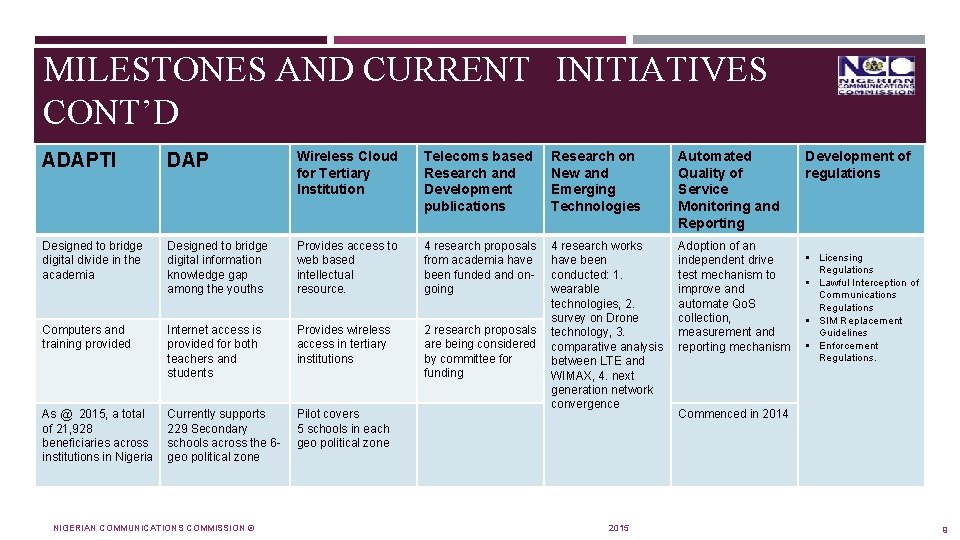
MILESTONES AND CURRENT INITIATIVES CONT’D ADAPTI DAP Wireless Cloud for Tertiary Institution Telecoms based Research and Development publications Research on New and Emerging Technologies Automated Quality of Service Monitoring and Reporting Designed to bridge digital divide in the academia Designed to bridge digital information knowledge gap among the youths Provides access to web based intellectual resource. 4 research proposals from academia have been funded and ongoing Computers and training provided Internet access is provided for both teachers and students Provides wireless access in tertiary institutions 2 research proposals are being considered by committee for funding Adoption of an independent drive test mechanism to improve and automate Qo. S collection, measurement and reporting mechanism As @ 2015, a total of 21, 928 beneficiaries across institutions in Nigeria Currently supports 229 Secondary schools across the 6 geo political zone Pilot covers 5 schools in each geo political zone 4 research works have been conducted: 1. wearable technologies, 2. survey on Drone technology, 3. comparative analysis between LTE and WIMAX, 4. next generation network convergence NIGERIAN COMMUNICATIONS COMMISSION © 2015 Development of regulations § Licensing Regulations § Lawful Interception of Communications Regulations § SIM Replacement Guidelines § Enforcement Regulations. Commenced in 2014 9
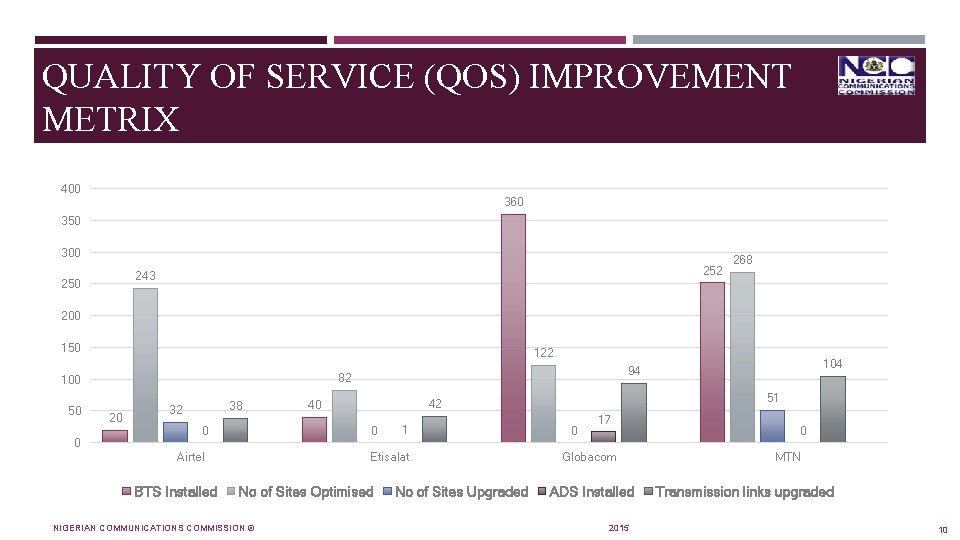
QUALITY OF SERVICE (QOS) IMPROVEMENT METRIX 400 360 350 300 252 243 250 268 200 150 122 50 0 20 38 32 0 BTS Installed 1 Etisalat No of Sites Optimised NIGERIAN COMMUNICATIONS COMMISSION © 51 42 40 0 Airtel 104 94 82 100 No of Sites Upgraded 0 17 Globacom ADS Installed 2015 0 MTN Transmission links upgraded 10
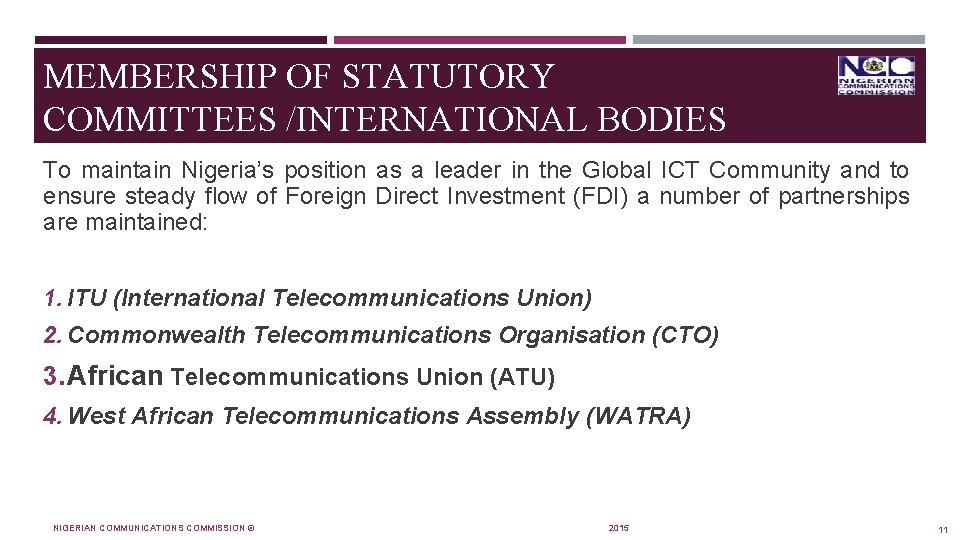
MEMBERSHIP OF STATUTORY COMMITTEES /INTERNATIONAL BODIES To maintain Nigeria’s position as a leader in the Global ICT Community and to ensure steady flow of Foreign Direct Investment (FDI) a number of partnerships are maintained: 1. ITU (International Telecommunications Union) 2. Commonwealth Telecommunications Organisation (CTO) 3. African Telecommunications Union (ATU) 4. West African Telecommunications Assembly (WATRA) NIGERIAN COMMUNICATIONS COMMISSION © 2015 11
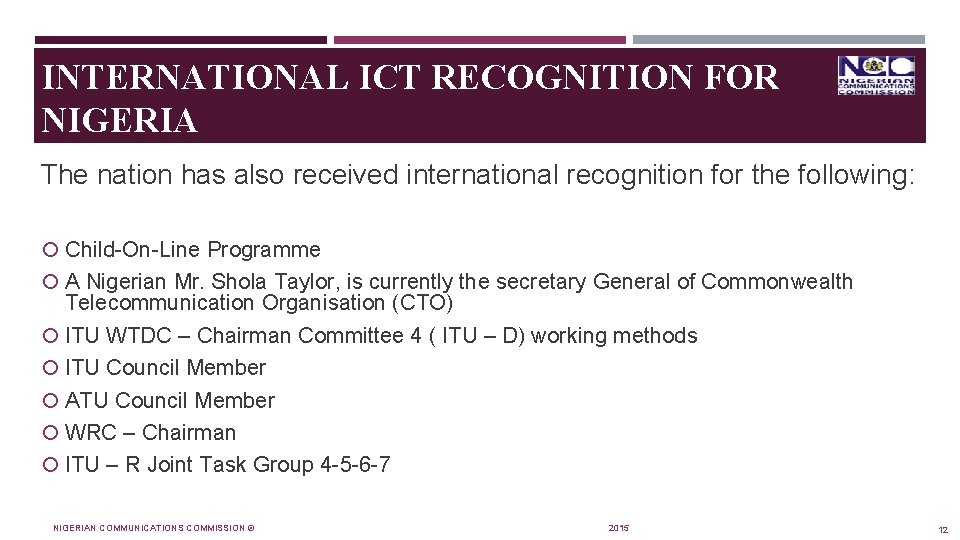
INTERNATIONAL ICT RECOGNITION FOR NIGERIA The nation has also received international recognition for the following: Child-On-Line Programme A Nigerian Mr. Shola Taylor, is currently the secretary General of Commonwealth Telecommunication Organisation (CTO) ITU WTDC – Chairman Committee 4 ( ITU – D) working methods ITU Council Member ATU Council Member WRC – Chairman ITU – R Joint Task Group 4 -5 -6 -7 NIGERIAN COMMUNICATIONS COMMISSION © 2015 12
v. USPF
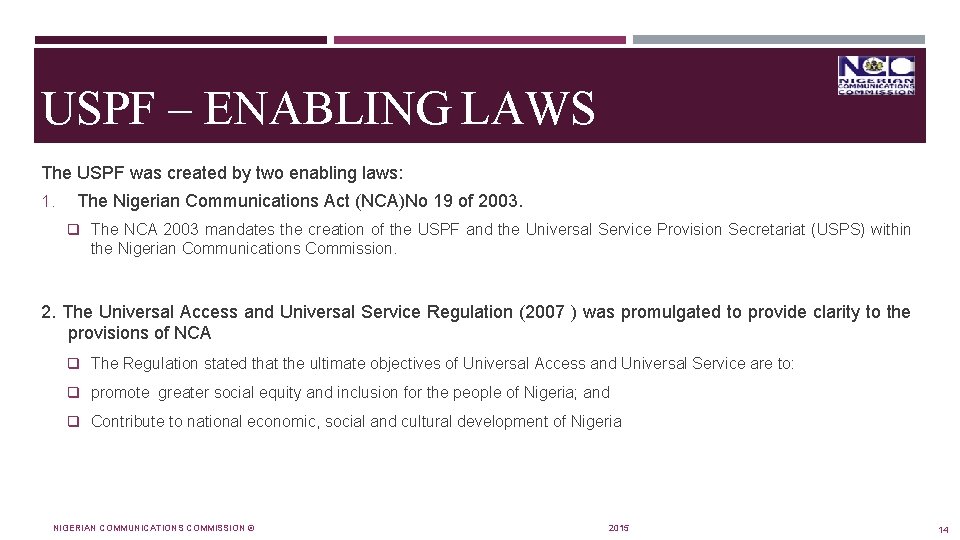
USPF – ENABLING LAWS The USPF was created by two enabling laws: 1. The Nigerian Communications Act (NCA)No 19 of 2003. q The NCA 2003 mandates the creation of the USPF and the Universal Service Provision Secretariat (USPS) within the Nigerian Communications Commission. 2. The Universal Access and Universal Service Regulation (2007 ) was promulgated to provide clarity to the provisions of NCA q The Regulation stated that the ultimate objectives of Universal Access and Universal Service are to: q promote greater social equity and inclusion for the people of Nigeria; and q Contribute to national economic, social and cultural development of Nigeria NIGERIAN COMMUNICATIONS COMMISSION © 2015 14
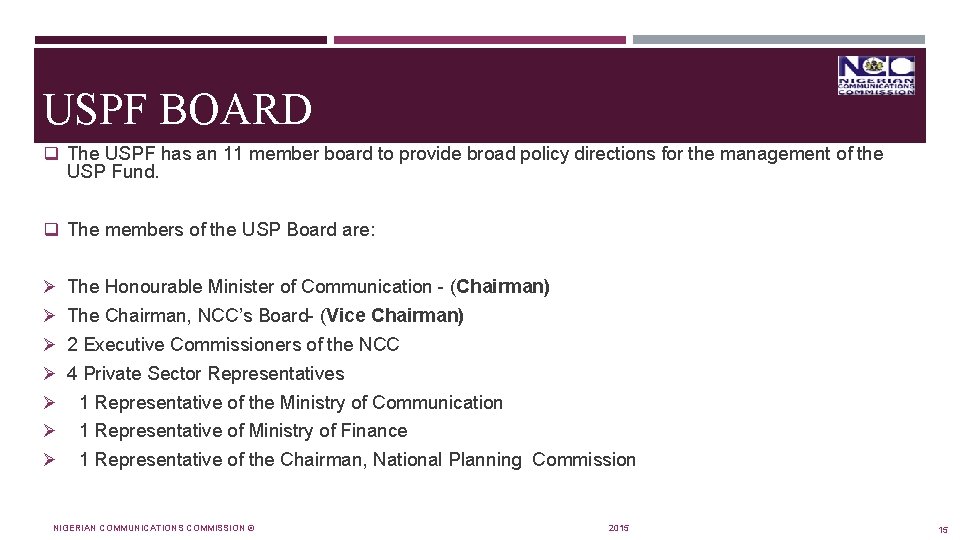
USPF BOARD q The USPF has an 11 member board to provide broad policy directions for the management of the USP Fund. q The members of the USP Board are: Ø The Honourable Minister of Communication - (Chairman) Ø The Chairman, NCC’s Board- (Vice Chairman) Ø 2 Executive Commissioners of the NCC Ø 4 Private Sector Representatives Ø 1 Representative of the Ministry of Communication Ø 1 Representative of Ministry of Finance Ø 1 Representative of the Chairman, National Planning Commission NIGERIAN COMMUNICATIONS COMMISSION © 2015 15
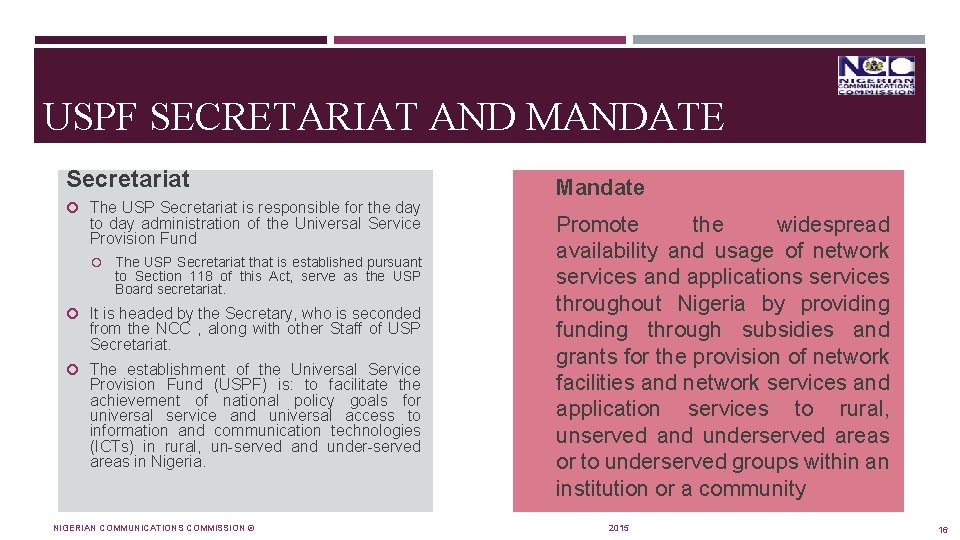
USPF SECRETARIAT AND MANDATE Secretariat The USP Secretariat is responsible for the day to day administration of the Universal Service Provision Fund The USP Secretariat that is established pursuant to Section 118 of this Act, serve as the USP Board secretariat. It is headed by the Secretary, who is seconded from the NCC , along with other Staff of USP Secretariat. The establishment of the Universal Service Provision Fund (USPF) is: to facilitate the achievement of national policy goals for universal service and universal access to information and communication technologies (ICTs) in rural, un-served and under-served areas in Nigeria. NIGERIAN COMMUNICATIONS COMMISSION © Mandate Promote the widespread availability and usage of network services and applications services throughout Nigeria by providing funding through subsidies and grants for the provision of network facilities and network services and application services to rural, unserved and underserved areas or to underserved groups within an institution or a community 2015 16
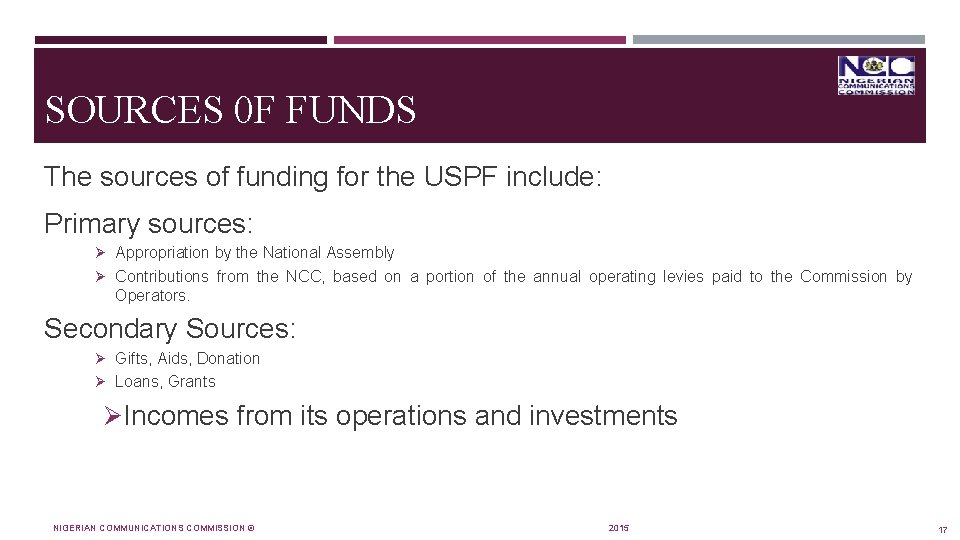
SOURCES 0 F FUNDS The sources of funding for the USPF include: Primary sources: Ø Appropriation by the National Assembly Ø Contributions from the NCC, based on a portion of the annual operating levies paid to the Commission by Operators. Secondary Sources: Ø Gifts, Aids, Donation Ø Loans, Grants ØIncomes from its operations and investments NIGERIAN COMMUNICATIONS COMMISSION © 2015 17
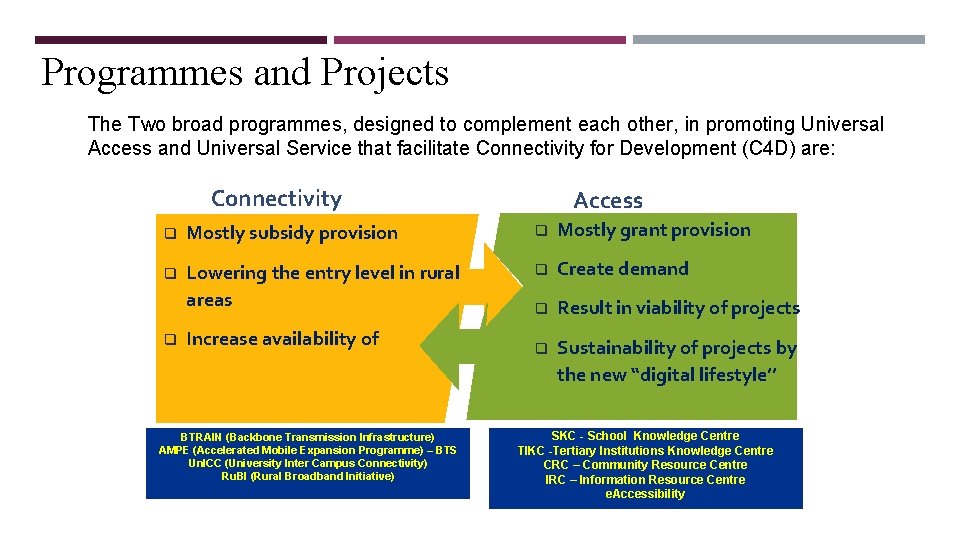
Programmes and Projects The Two broad programmes, designed to complement each other, in promoting Universal Access and Universal Service that facilitate Connectivity for Development (C 4 D) are: Connectivity Access q Mostly subsidy provision q Mostly grant provision q Lowering the entry level in rural areas q Create demand q Result in viability of projects q Sustainability of projects by the new “digital lifestyle’’ q Increase availability of services BTRAIN (Backbone Transmission Infrastructure) AMPE (Accelerated Mobile Expansion Programme) – BTS Un. ICC (University Inter Campus Connectivity) Ru. BI (Rural Broadband Initiative) SKC - School Knowledge Centre TIKC -Tertiary Institutions Knowledge Centre CRC – Community Resource Centre IRC – Information Resource Centre e. Accessibility
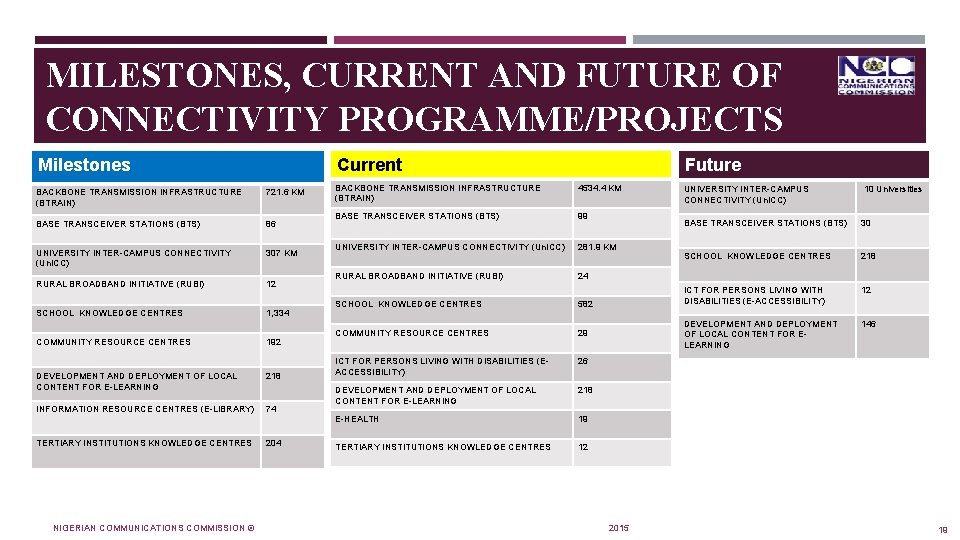
MILESTONES, CURRENT AND FUTURE OF CONNECTIVITY PROGRAMME/PROJECTS Milestones BACKBONE TRANSMISSION INFRASTRUCTURE (BTRAIN) 721. 6 KM BASE TRANSCEIVER STATIONS (BTS) 86 UNIVERSITY INTER-CAMPUS CONNECTIVITY (Un. ICC) 307 KM RURAL BROADBAND INITIATIVE (RUBI) 12 SCHOOL KNOWLEDGE CENTRES 1, 334 COMMUNITY RESOURCE CENTRES 192 DEVELOPMENT AND DEPLOYMENT OF LOCAL CONTENT FOR E-LEARNING 218 INFORMATION RESOURCE CENTRES (E-LIBRARY) 74 TERTIARY INSTITUTIONS KNOWLEDGE CENTRES 204 NIGERIAN COMMUNICATIONS COMMISSION © Future Current BACKBONE TRANSMISSION INFRASTRUCTURE (BTRAIN) 4534. 4 KM BASE TRANSCEIVER STATIONS (BTS) 99 UNIVERSITY INTER-CAMPUS CONNECTIVITY (Un. ICC) 281. 9 KM RURAL BROADBAND INITIATIVE (RUBI) 24 SCHOOL KNOWLEDGE CENTRES 582 COMMUNITY RESOURCE CENTRES 29 ICT FOR PERSONS LIVING WITH DISABILITIES (EACCESSIBILITY) 26 DEVELOPMENT AND DEPLOYMENT OF LOCAL CONTENT FOR E-LEARNING 218 E-HEALTH 19 TERTIARY INSTITUTIONS KNOWLEDGE CENTRES 12 2015 UNIVERSITY INTER-CAMPUS CONNECTIVITY (Un. ICC) 10 Universities BASE TRANSCEIVER STATIONS (BTS) 30 SCHOOL KNOWLEDGE CENTRES 218 ICT FOR PERSONS LIVING WITH DISABILITIES (E-ACCESSIBILITY) 12 DEVELOPMENT AND DEPLOYMENT OF LOCAL CONTENT FOR ELEARNING 146 19
v. CHALLENGE
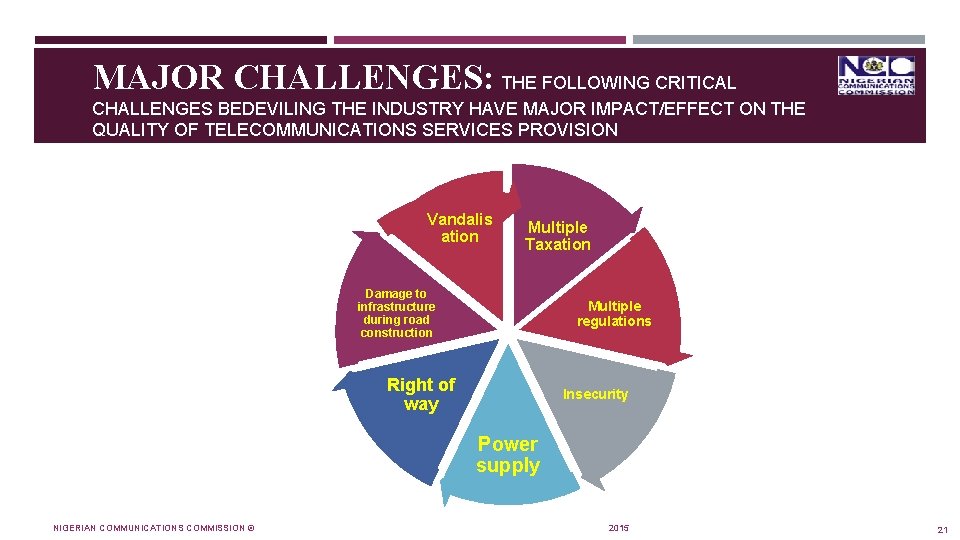
MAJOR CHALLENGES: THE FOLLOWING CRITICAL CHALLENGES BEDEVILING THE INDUSTRY HAVE MAJOR IMPACT/EFFECT ON THE QUALITY OF TELECOMMUNICATIONS SERVICES PROVISION Vandalis ation Multiple Taxation Damage to infrastructure during road construction Multiple regulations Right of way Insecurity Power supply NIGERIAN COMMUNICATIONS COMMISSION © 2015 21
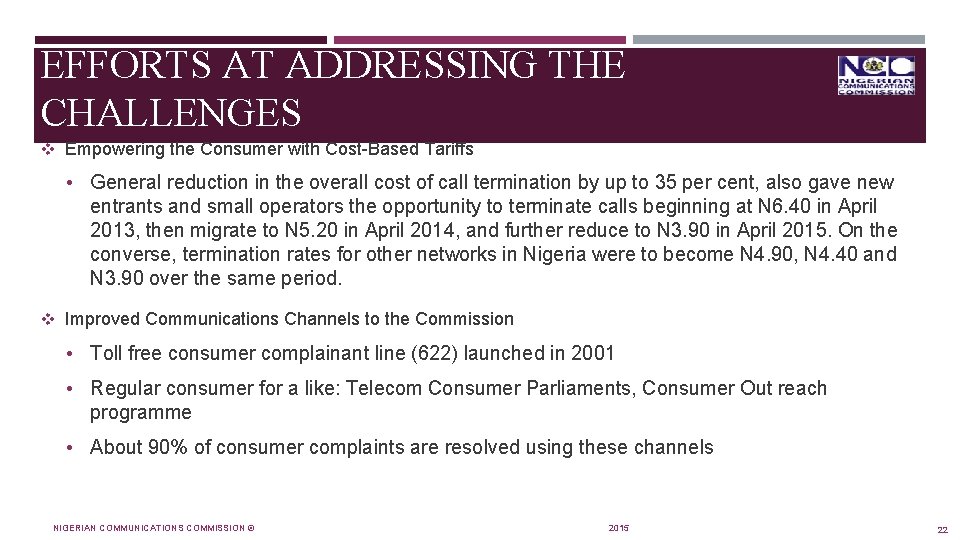
EFFORTS AT ADDRESSING THE CHALLENGES v Empowering the Consumer with Cost-Based Tariffs • General reduction in the overall cost of call termination by up to 35 per cent, also gave new entrants and small operators the opportunity to terminate calls beginning at N 6. 40 in April 2013, then migrate to N 5. 20 in April 2014, and further reduce to N 3. 90 in April 2015. On the converse, termination rates for other networks in Nigeria were to become N 4. 90, N 4. 40 and N 3. 90 over the same period. v Improved Communications Channels to the Commission • Toll free consumer complainant line (622) launched in 2001 • Regular consumer for a like: Telecom Consumer Parliaments, Consumer Out reach programme • About 90% of consumer complaints are resolved using these channels NIGERIAN COMMUNICATIONS COMMISSION © 2015 22
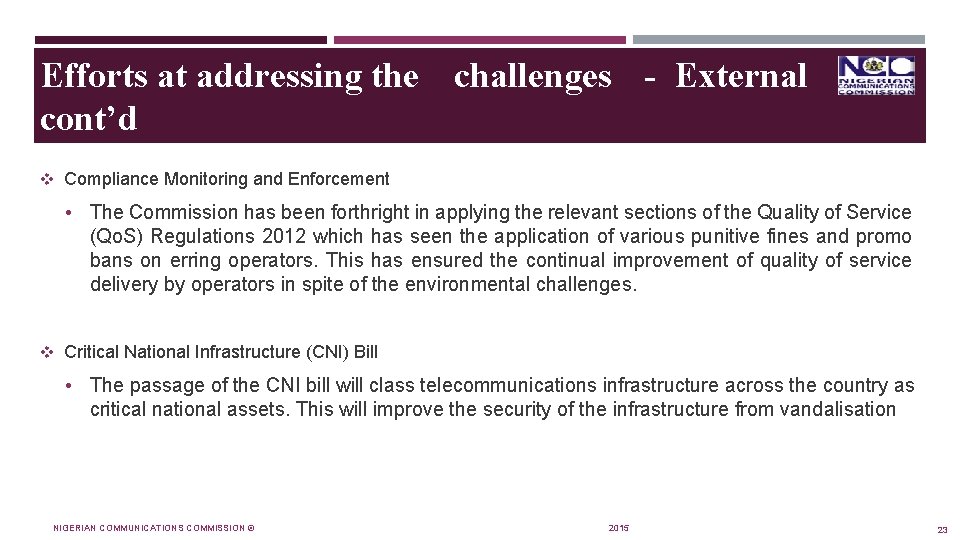
Efforts at addressing the challenges - External cont’d v Compliance Monitoring and Enforcement • The Commission has been forthright in applying the relevant sections of the Quality of Service (Qo. S) Regulations 2012 which has seen the application of various punitive fines and promo bans on erring operators. This has ensured the continual improvement of quality of service delivery by operators in spite of the environmental challenges. v Critical National Infrastructure (CNI) Bill • The passage of the CNI bill will class telecommunications infrastructure across the country as critical national assets. This will improve the security of the infrastructure from vandalisation NIGERIAN COMMUNICATIONS COMMISSION © 2015 23
EFFORTS AT ADDRESSING THE CHALLENGES - CONT’D v Harmonisation of Right of Way (Ro. W) Charges • The current high Ro. W charges across different states of the federation have negatively impacted the required expansion and rollout of fibre optic across the country. Harmonization of Ro. W will increase investment and expansion of critical transmission infrastructure. v Electrical Power Supply • The improvement of power to the sites of telecommunications services providers will have the triple effect of reducing operating costs and improving quality of service delivery v Capacity Building • Proper training and re-training of telecommunications personnel will enable the continuous supply of skilled hands in the industry NIGERIAN COMMUNICATIONS COMMISSION © 2015 24
v Legislative intervention
AREAS OF LEGISLATIVE INTERVENTION ICT Infrastructure as Critical National Infrastructure Considering the important role that telecommunications plays in the development of the economy of every country the commission in 2011 commenced the process of developing a bill that aims to designate telecoms equipment as critical national infrastructure. This is with the view of protecting such equipments from being vandalised and destroyed. However, the bill has not been passed into law. The Commission would appreciate prompt passage of the bill into law. Freedom of Information Act, 2011 The Freedom of Information Act 2011, is a landmark legislation which was passed with a view to increase transparency in the Government/ Public offices. However the Commission has encountered a lot of abuse of this Act by members of the public. A review of the Act for the purpose of providing a penalty for frivolous requests might be needful at the moment. Furthermore the seven (7) days’ timeline given within which a public institution is expected to respond to a request is unrealistic, hence, this should be revisited. NIGERIAN COMMUNICATIONS COMMISSION © 2015 26
AREAS OF LEGISLATIVE INTERVENTION Multiple Regulation and Taxation The Commission needs the Committee’s intervention to streamline the various taxes paid by the operators. Also to guard against regulatory overlaps when Bills are being passed into law. Data Protection and Competition Law The Country needs Data Protection as well as Competition Laws due to the proliferation of data gathering by different agencies and the need for an overall competition law for all sectors of the economy. Budget approval delays Delay in the approval of budget which lead to delay in implementation of project NIGERIAN COMMUNICATIONS COMMISSION © 2015 27
v conclusion
CONCLUSION The next frontier for communications in Nigeria is broadband. Access to broadband, Adequate broadband Sustainable broadband. In the years to come, telecoms contribution to GDP would experience significant increase Cyber security and child – on line safety have become increasing important to nation states. The NCC will build on the successes so far achieved and continue to strive towards safeguarding the future of children in the mobile space Efforts would be geared toward the maximizing the use of spectrum in the converged space Stakeholder engagements and relationships will be re-enforced at all levels NIGERIAN COMMUNICATIONS COMMISSION © 2015 29
v. Thank you v v www. ncc. gov. ng www. uspf. gov. ng