
A Presentation On Fluorescent Lamps PREPARED BY DEEPAK
A Presentation On Fluorescent Lamps PREPARED BY DEEPAK SOMANI Assistant Professor Utilization of Electrical Power Department Of Electrical engineering
A fluorescent lamp is a low weight mercury vapour lamp that uses fluorescence to deliver visible light. An electric current in the gas energizes mercury vapor which delivers ultraviolet radiation through discharge process and the ultraviolet radiation causes the phosphor coating of the lamp inner wall to radiate visible light.
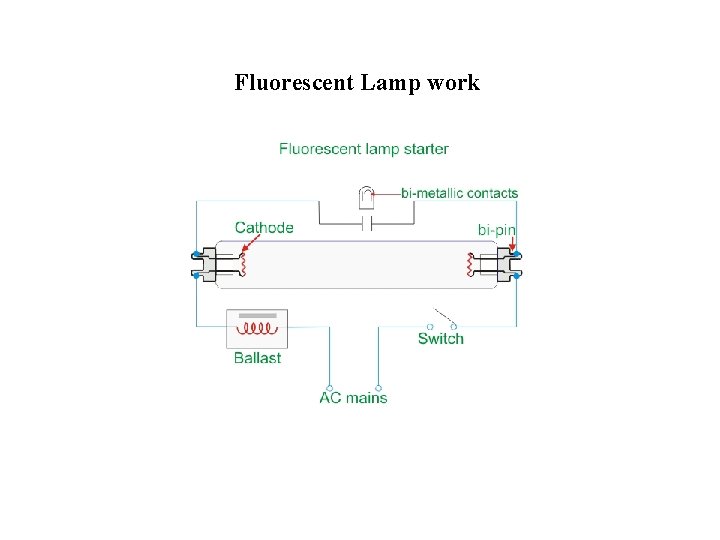
Fluorescent Lamp work
Here we connect one ballast, and one switch and the supply is series as shown. Then we connect the fluorescent tube and a starter across it. When we switch ON the supply, full voltage comes across the lamp and as well as across the starter through the ballast. But at that instant, no discharge happens, i. e. , no lumen output from the lamp. • that Three groups of light sensing cone cells At full voltage first the glow discharge is established in the starter. This is because the electrodes gap in the neon bulb of starter is much lesser than that of the • We perceive different colors when two or more type of fluorescent lamp. cone cells respond at once Then gas inside the starter gets ionized due to this full voltage and heats the bimetallic strip. That causes to bend the bimetallic strip to connect to the fixed contact. Now, current starts flowing through the starter. Although the ionization potential of the neon is more than that of the argon but still due to small electrode gap, a high voltage gradient appears in the neon bulb and hence glow discharge gets started first in the starter. As soon as the current starts flowing through the touched contacts of the neon bulb of the starter, the voltage across the neon bulb gets reduced since the current, causes a voltage drop across the inductor (ballast). At reduced or no voltage across the neon bulb of the starter, there will be no more gas discharge taking place and hence the bimetallic strip gets cool and breaks away from the fixed contact. At the time of breaking of the contacts in the neon bulb of the starter, the current gets interrupted, and hence at that moment, a large voltage surge comes across the inductor(ballast).
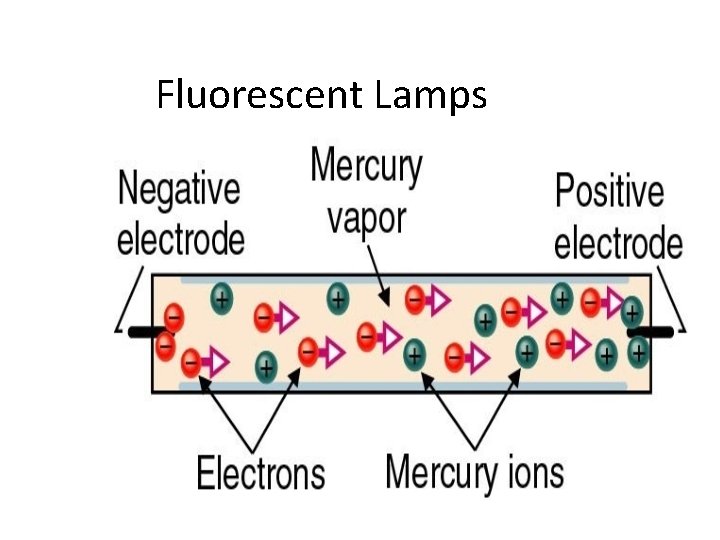
Fluorescent Lamps • • • Glass tube, low pressure gas, electrodes Inject free charges via temperature or high voltage Forms a plasma—a gas of charged particles Electric field produces current flow in plasma Collisions cause – electronic excitation in gas atoms – some ionization of gas atoms • Excited atoms emit light through fluorescence
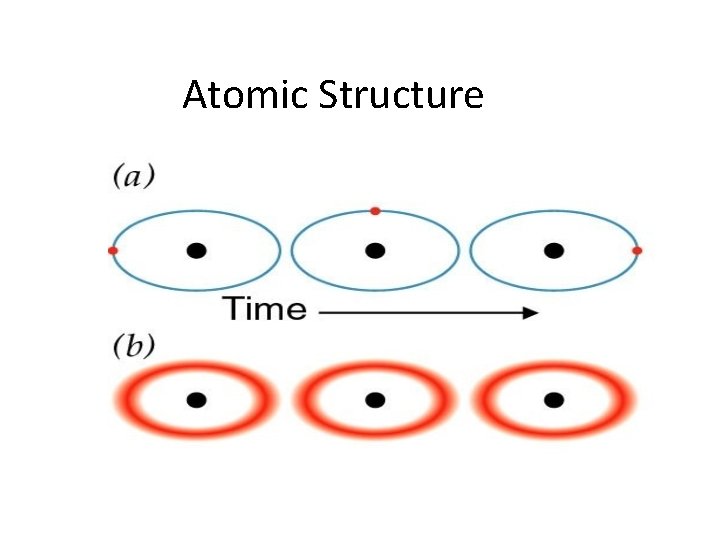
Atomic Structure • Electrons travel as waves • Electron in an orbital doesn’t emit light • Electron emits light when changing orbitals
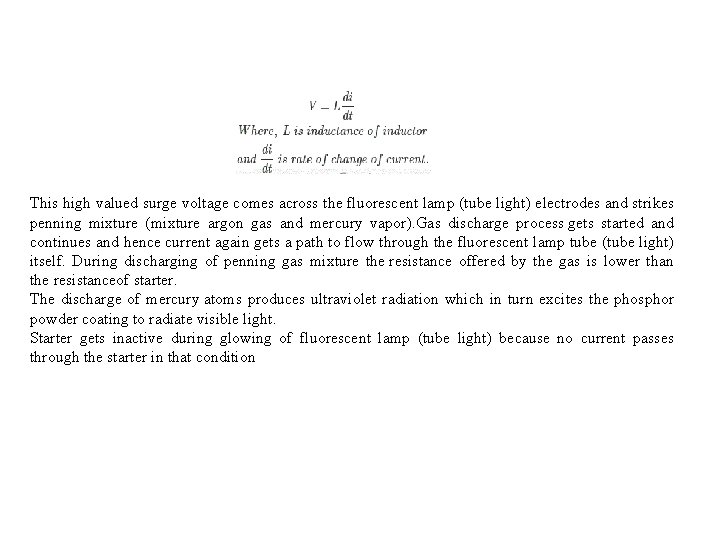
• Light This high valued surge voltage comes across the fluorescent lamp (tube light) electrodes and strikes – travels as a wave (a diffuse structure) penning mixture (mixture argon gas and mercury vapor). Gas discharge process gets started and continues and hence current again gets a path to flow through the fluorescent lamp tube (tube light) – is emitted or absorbed as a particle (a photon) itself. During discharging of penning gas mixture the resistance offered by the gas is lower than the resistanceof starter. The discharge of mercury atoms produces ultraviolet radiation which in turn excites the phosphor powder coating to radiate visible light. Starter gets inactive during glowing of fluorescent lamp (tube light) because no current passes through the starter in that condition • • Photon energy = Planck constant · frequency An atom’s orbitals have specific energy differences Energy differences establish photon energies An atom emits a specific spectrum of photons
Sodium vapor Lamp An electron boun. THE LOW-PRESSURE SODIUM LAMP The LPS lamp was the first sodium lamp to be developed. It is known by its signature monochromatic yellow color. It is mostly used in Europe since it did not appeal in other markets due to its poor CRI or color rendering. It is among the most efficient lamps in the world because it uses all the current it gets to create light at the most sensitive color (frequency) to the human eye. An incandescent lamp in contrast creates light at all frequencies from Infrared (non-visible) to UV at the other end of the spectrum. The energy used to make non-visible light is a waste of energy since it does not help do the principle job of an electric light. The LPS lamp is also called a SOX lamp (SO for sodium) Advantages: - Very efficient lamp - Powerful lamp for use of large areas - Despite a warm up time of 5 -10 minutes it restarts immediately if there is a brownout - Lumen output does not drop with age (such as in LEDs or incandescents) Disadvantages: - Worst color rendering of any lamp - Sodium is a hazardous material which can combust when exposed to air (such as if the bulb is broken in the trash) Statistics: CRI -44 Color Temperature: 1800 100 -190 lumens per watt Bulb life: 18, 000 hrs
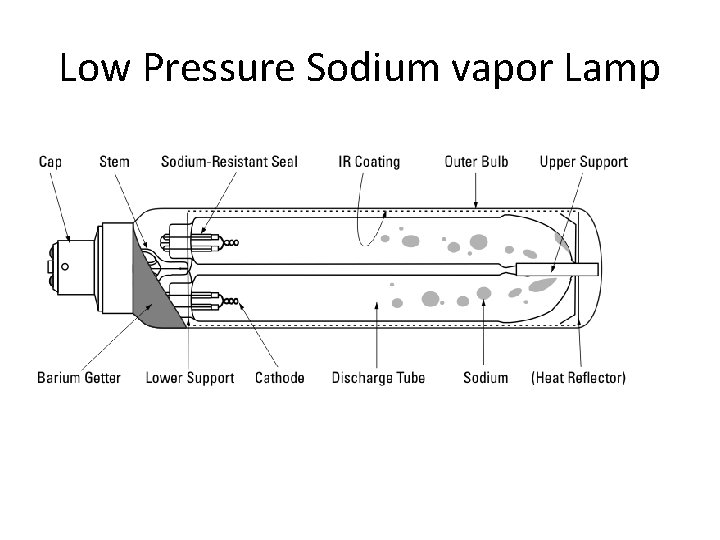
Low Pressure Sodium vapor Lamp

Thank You
- Slides: 10