
A Presentation on Automobile Chassis Chassis What is
A Presentation on Automobile Chassis
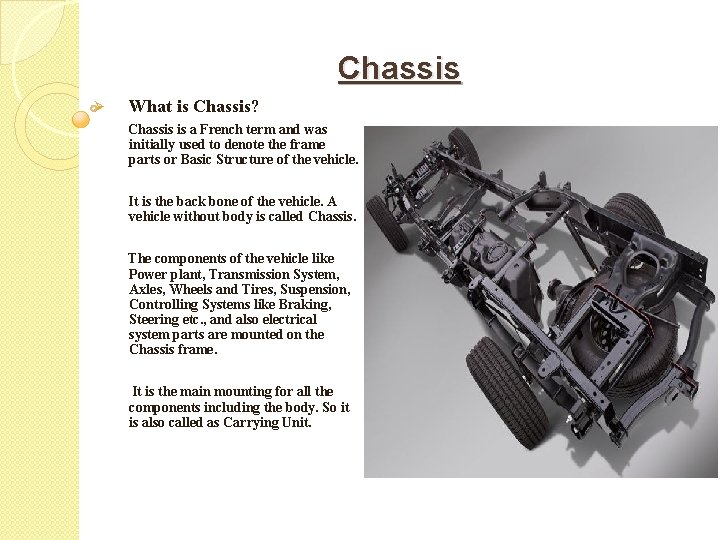
Chassis Ø What is Chassis? Chassis is a French term and was initially used to denote the frame parts or Basic Structure of the vehicle. It is the back bone of the vehicle. A vehicle without body is called Chassis. The components of the vehicle like Power plant, Transmission System, Axles, Wheels and Tires, Suspension, Controlling Systems like Braking, Steering etc. , and also electrical system parts are mounted on the Chassis frame. It is the main mounting for all the components including the body. So it is also called as Carrying Unit.

Requirements and Duties of chassis Ø Support the weight of the vehicle and everything inside it including passengers and cargo. Provide the frame for the suspension, engine and drivetrain to be mounted. It must be strong to hold these components in place during various driving conditions. Handles or resists any torsional stress (such as bending or twisting of the body) that the vehicle may be subjected to as it drives. It allows the vehicle to pull objects as these heavy objects must be directly or indirectly attached to the chassis.
Types of Chassis ØLadder Frame ØX-Bracing ØSpace Frame ØBackbone ØMonocoque

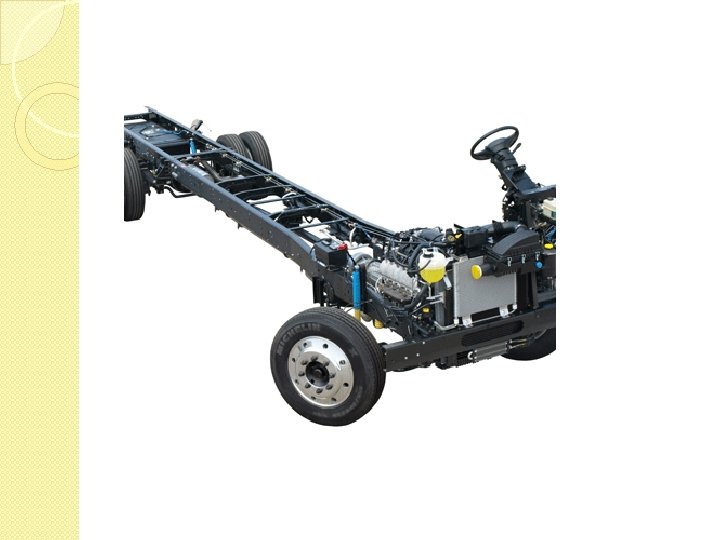
Types of Chassis Ø Ladder Frame / Body-onframe is an automobile construction method. Mounting a separate body to a rigid frame that supports the drivetrain was the original method of building automobiles and its use continues to this day. Steel ladder frames are common Frame is made of two members (usually C cannels) that run along the length of vehicle are mainly load bearing. Cross members are provided to prevent torsional deflection and maintain geometry. Poor strength to weight ratio. Used for heavy cargo carriers. C channels with heighted web rather than wide flange is preferred

Ladder Frame Chassis The ladder frame is the simplest and oldest of all designs. It consists of two symmetrical beams, rails, or channels running the length of the vehicle, and several transverse crossmembers connecting them. This design offers good beam resistance because of its continuous rails from front to rear. poor resistance to torsion
X-Bracing Chassis X bracing is done to increase torsional stiffness of main frame. There are 4 crossmembers plus an "X" member for maximum torsional stiffness. We even box in the "X" for extra strength! This chassis is somewhat heavier than most ladder designs, but it is also by far the stiffest.
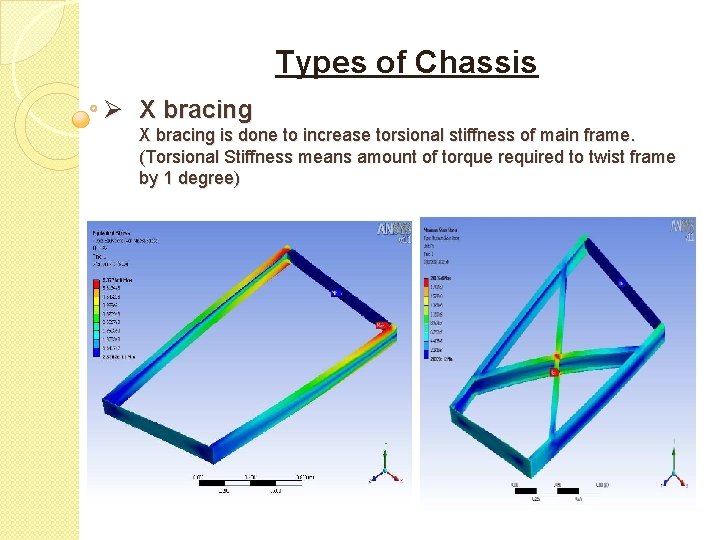
Types of Chassis Ø X bracing is done to increase torsional stiffness of main frame. (Torsional Stiffness means amount of torque required to twist frame by 1 degree)

Space Frame
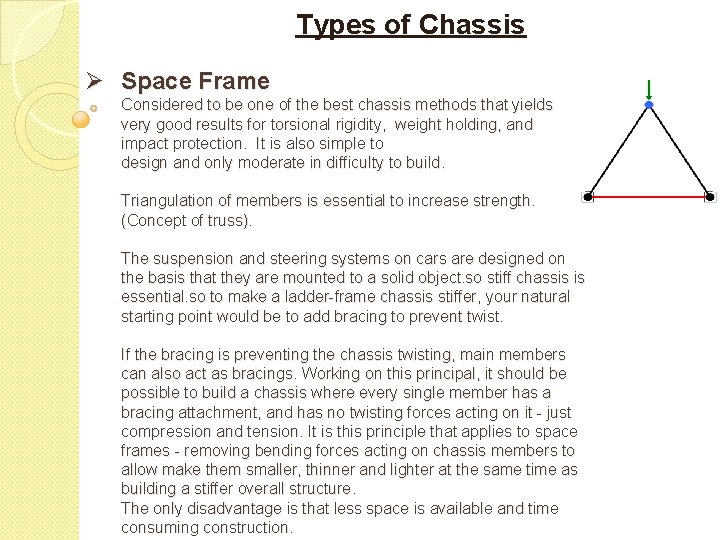
Types of Chassis Ø Space Frame Considered to be one of the best chassis methods that yields very good results for torsional rigidity, weight holding, and impact protection. It is also simple to design and only moderate in difficulty to build. Triangulation of members is essential to increase strength. (Concept of truss). The suspension and steering systems on cars are designed on the basis that they are mounted to a solid object. so stiff chassis is essential. so to make a ladder-frame chassis stiffer, your natural starting point would be to add bracing to prevent twist. If the bracing is preventing the chassis twisting, main members can also act as bracings. Working on this principal, it should be possible to build a chassis where every single member has a bracing attachment, and has no twisting forces acting on it - just compression and tension. It is this principle that applies to space frames - removing bending forces acting on chassis members to allow make them smaller, thinner and lighter at the same time as building a stiffer overall structure. The only disadvantage is that less space is available and time consuming construction.
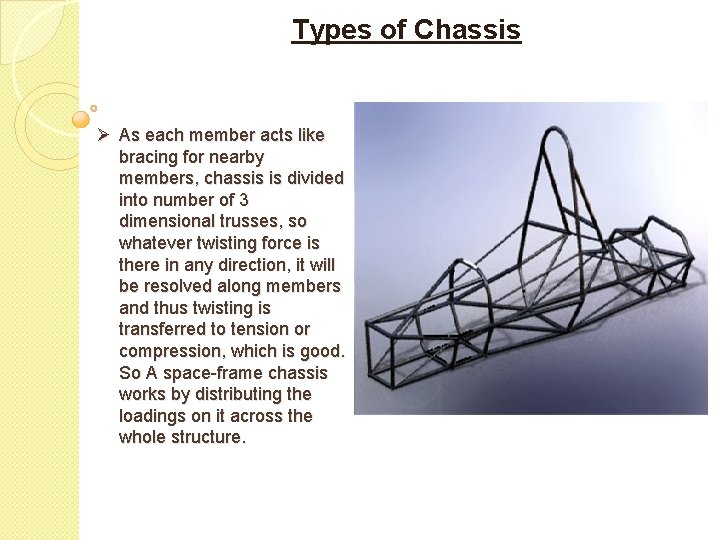
Types of Chassis Ø As each member acts like bracing for nearby members, chassis is divided into number of 3 dimensional trusses, so whatever twisting force is there in any direction, it will be resolved along members and thus twisting is transferred to tension or compression, which is good. So A space-frame chassis works by distributing the loadings on it across the whole structure.
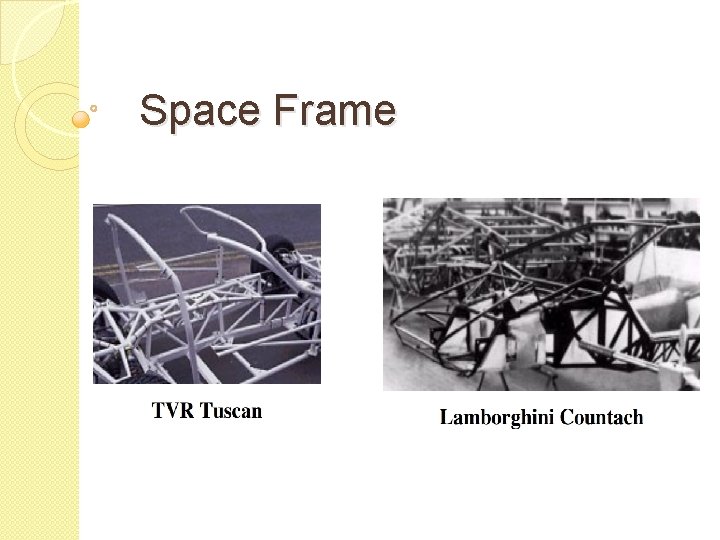
As ladder chassis is not strong enough, motor racing engineers developed a 3 dimensional design - Space Frame-. One of the earliest examples was the postwar Maserati Tipo 61 "Birdcage" racing car. Space frame chassis employs dozens of circular-section tubes (some may use squaresection tubes for easier connection to the body panels, though circular section provides the maximum strength), position in different directions to provide mechanical strength against forces from anywhere. These tubes are welded together and forms a very complex structure, as you can see in the above pictures.
A space-frame chassis lies somewhere between the ladder chassis and the monocoque, it is constructed from an arrangement of small, simple members which make up a larger frame. A space-frame is analogous to a truss style bridge which is made up of small (generally straight) members in a triangular pattern which are always in pure compression or tension. By having members in pure compression or tension (ie. they do not experience bending forces) they do not have to be oversized to support bending loads. So given the same force, a lighter car will accelerate quicker. This applies in all transient conditions including braking and cornering. If a car accelerates quicker, then it reaches a higher speed quicker and therefore it is faster, which is the purpose of a race car. So wherever possible everything in a race car
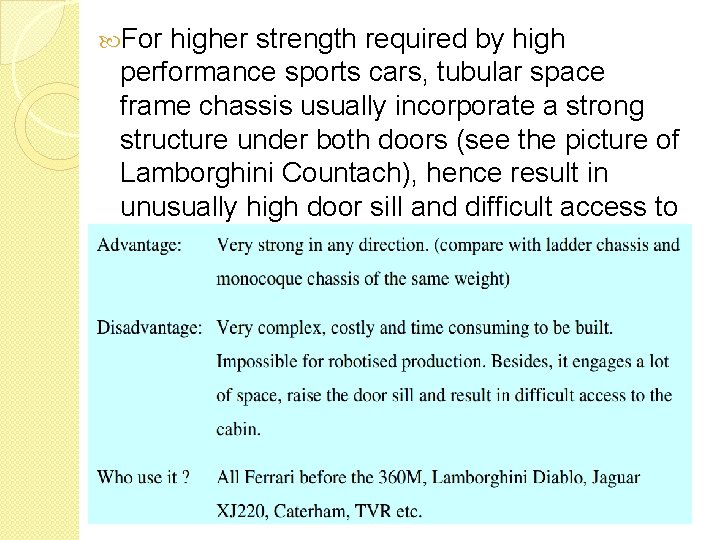
For higher strength required by high performance sports cars, tubular space frame chassis usually incorporate a strong structure under both doors (see the picture of Lamborghini Countach), hence result in unusually high door sill and difficult access to the cabin.
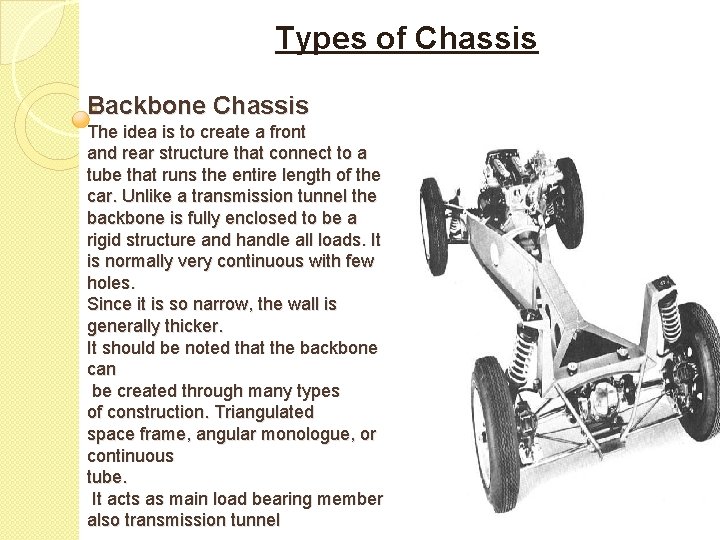
Types of Chassis Backbone Chassis The idea is to create a front and rear structure that connect to a tube that runs the entire length of the car. Unlike a transmission tunnel the backbone is fully enclosed to be a rigid structure and handle all loads. It is normally very continuous with few holes. Since it is so narrow, the wall is generally thicker. It should be noted that the backbone can be created through many types of construction. Triangulated space frame, angular monologue, or continuous tube. It acts as main load bearing member also transmission tunnel
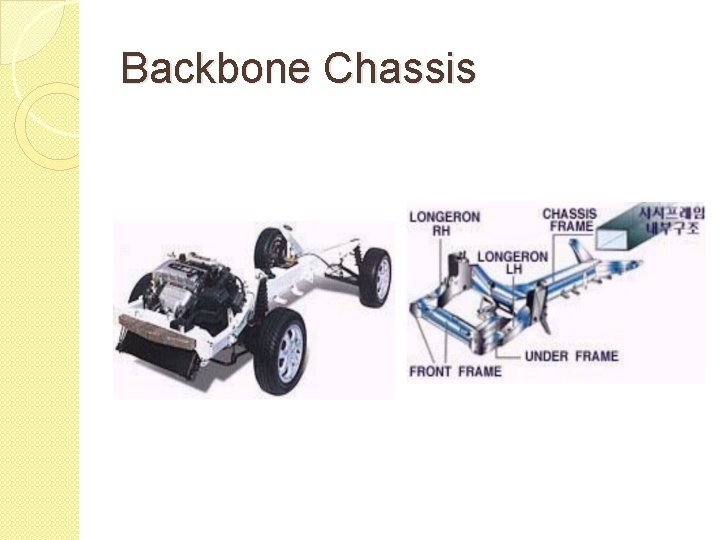
Backbone Chassis
Backbone chassis is very simple: A strong tubular backbone (usually in rectangular section) connects the front and rear axle and provides nearly all the mechnical strength. Inside which there is space for the drive shaft in case of front-engine, rear -wheel drive layout like the Elan. The whole drivetrain, engine and suspensions are connected to both ends of the backbone. The body is built on the backbone, usually made of glass-fibre.
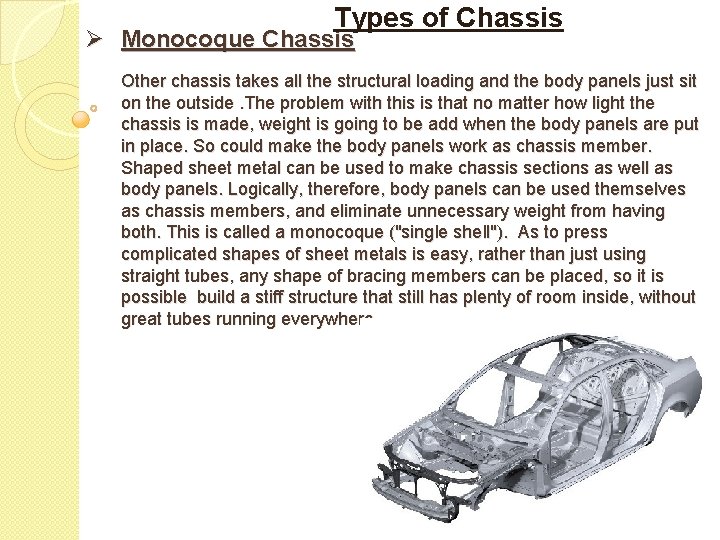
Types of Chassis Ø Monocoque Chassis Other chassis takes all the structural loading and the body panels just sit on the outside. The problem with this is that no matter how light the chassis is made, weight is going to be add when the body panels are put in place. So could make the body panels work as chassis member. Shaped sheet metal can be used to make chassis sections as well as body panels. Logically, therefore, body panels can be used themselves as chassis members, and eliminate unnecessary weight from having both. This is called a monocoque ("single shell"). As to press complicated shapes of sheet metals is easy, rather than just using straight tubes, any shape of bracing members can be placed, so it is possible build a stiff structure that still has plenty of room inside, without great tubes running everywhere.
Monocoque Chassis Today, 99% cars produced in this planet are made of steel monocoque chassis, thanks to its low production cost and suitability to robotised production.
Monocoque is a one-piece structure which defines the overall shape of the car. While ladder, tubular space frame and backbone chassis provides only the stress members and need to build the body around them, monoque chassis is already incorporated with the body in a single piece, as you can see in the bottom picture showing a Volvo V 70. In fact, the "one-piece" chassis is actually made by welding several pieces together. The floorpan, which is the largest piece, and other pieces are pressmade by big stamping machines. They are spot welded together by robot arms (some even use laser welding) in a stream production line. The whole process just takes minutes. After that, some accessories like doors, bonnet, boot lid, side panels and roof are added.
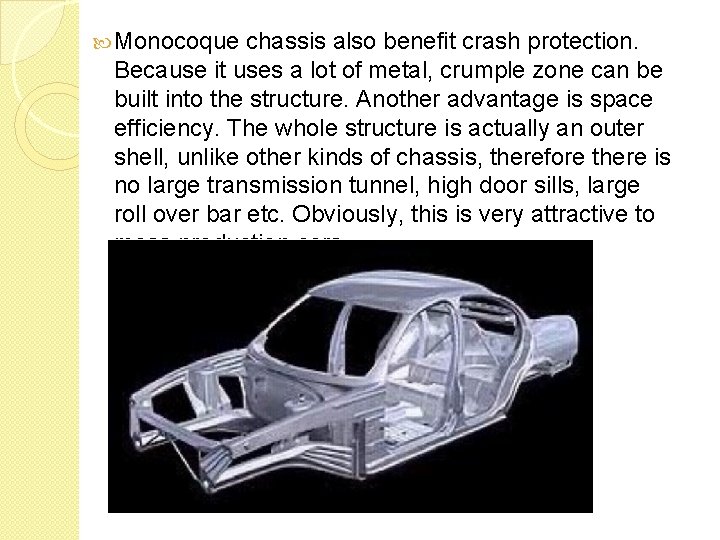
Monocoque chassis also benefit crash protection. Because it uses a lot of metal, crumple zone can be built into the structure. Another advantage is space efficiency. The whole structure is actually an outer shell, unlike other kinds of chassis, therefore there is no large transmission tunnel, high door sills, large roll over bar etc. Obviously, this is very attractive to mass production cars.
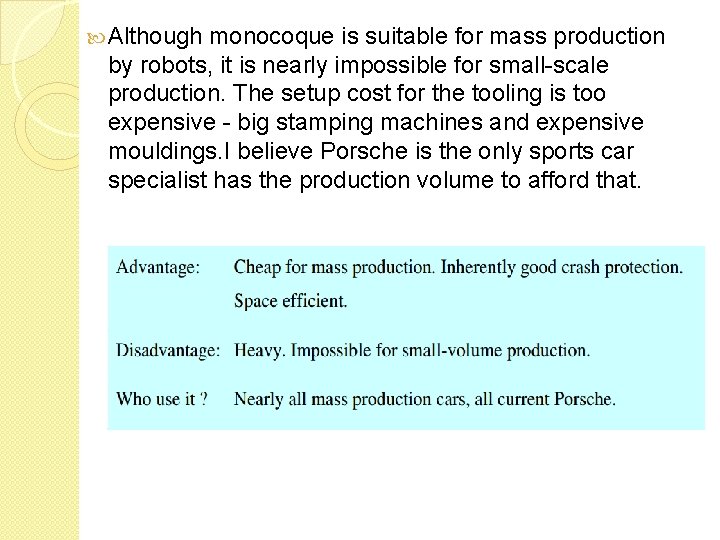
Although monocoque is suitable for mass production by robots, it is nearly impossible for small-scale production. The setup cost for the tooling is too expensive - big stamping machines and expensive mouldings. I believe Porsche is the only sports car specialist has the production volume to afford that.

Any questions?

- Slides: 27