
A Presentation from Coram BAAF Making Good Fostering
A Presentation from Coram. BAAF Making Good Fostering Assessments Workshop Day 2 © Coram. BAAF Adoption & Fostering Academy 2016 Coram Academy Ltd, 41 Brunswick Square, London WC 1 N 1 AZ. www. corambaaf. org. uk Registered as a company limited by guarantee in England Wales no. 9697712, part of the Coram Group, Charity no. 3122718.
Relationships Try sitting in a different seat. You might change your view and develop a new one (and maybe a new relationship!) 2 Coram. BAAF Adoption & Fostering Academy 2017
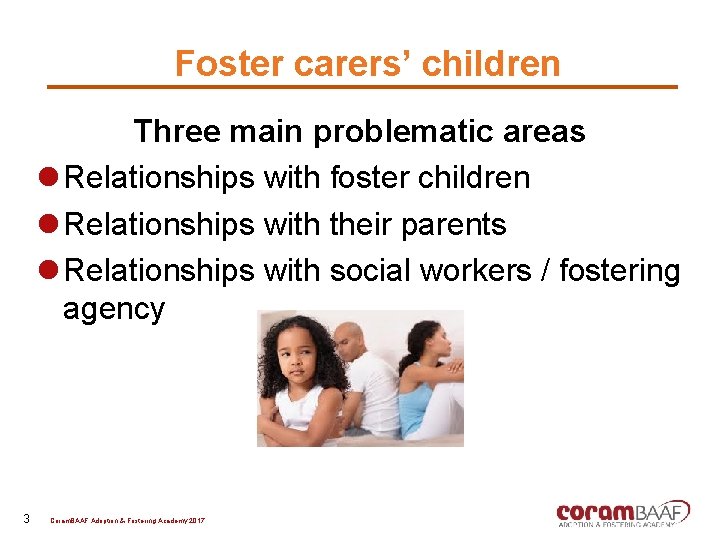
Foster carers’ children Three main problematic areas l Relationships with foster children l Relationships with their parents l Relationships with social workers / fostering agency 3 Coram. BAAF Adoption & Fostering Academy 2017
Relationships with foster children l Aggression – most had experienced violent outbursts, threats, destruction of valued possessions and physical acts of violence l Age and sex differences – there were fewer conflicts with children who were younger and who were of a different sex to carers’ own children. l Loss – they felt this deeply but didn’t have time to mourn properly. 4 Coram. BAAF Adoption & Fostering Academy 2017
Loss of role 5 l Children repeatedly have to adjust their role in the family as foster children come and go; l Children’s relationships with other family members will change as well as forging a new relationship with the foster child. l In 2 studies fostering link workers had to reassure birth children that they wouldn’t be removed from their families as foster children were. Coram. BAAF Adoption & Fostering Academy 2017
Loss of parental attention l Carers’ children sometimes felt that too much of their parents’ time was spent on foster children l They understood this but still felt jealous and resentful l Children felt guilty for being jealous. 6 Coram. BAAF Adoption & Fostering Academy 2017
Children’s responses: l Cutting themselves off, looking for support from outside the home l Silence l Early maturation – 1. To be role models 2. To help with care 3. To take care of themselves 7 Coram. BAAF Adoption & Fostering Academy 2017
Involving adopted/ birth children in assessments. – To establish a relationship with the child and give the child a voice; – To ascertain the child’s understanding, wishes and feelings about adoption; – To assess their relationship with their parents and siblings; – To assess their needs, strengths and vulnerabilities; – To help prepare the child for the impact of adoption; – To help the child understand the needs and behaviour of children who may be placed. – To help the child feel safe; – To gather evidence of the applicant’s parenting capacity and style. 8 Coram. BAAF Adoption & Fostering Academy 2017
Some issues and tools to consider l Sibling assessment without one of the siblings present. l Assessment of a child – an opportunity for direct work. Use direct work tools – scenarios (what happens in your family if a child comes in and changes the tv channel without asking); role play; life story work; outline ten things that the foster child would need to know about your family, school report on your parents. l Some children may find confrontational behaviour towards their parents difficult to tolerate. 9 Coram. BAAF Adoption & Fostering Academy 2017
Towards a direct work tool l. Consider the following: – – How does the child express emotions; How does s/he seek comfort; How do they interact with other children; How do they respond to the difficult behaviour of other children or young people; – How do they handle conflict; – How have they managed significant transitions in the past; 10 Coram. BAAF Adoption & Fostering Academy 2017
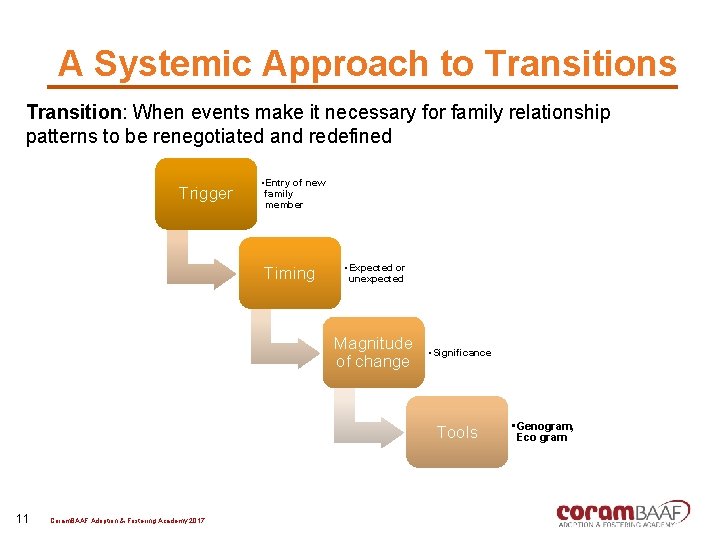
A Systemic Approach to Transitions Transition: When events make it necessary for family relationship patterns to be renegotiated and redefined Trigger • Entry of new family member Timing • Expected or unexpected Magnitude of change • Significance Tools 11 Coram. BAAF Adoption & Fostering Academy 2017 • Genogram, Eco gram
Systemic Assessments l How do you currently include children of the household within an assessment? l Share suggestions for increasing the participation of birth children? l If you have concerns, what are they and what could be done differently to obtain a benefit? 12 Coram. BAAF Adoption & Fostering Academy 2017
Recommendations from research l Maintain identity as a family l Communicate with children l Fostering link workers should spend time with children of the fostering household and provide training for them l Agencies need to recognise the important role played by carers' children l Agencies should facilitate support groups for carers’ children. 13 Coram. BAAF Adoption & Fostering Academy 2017
Relationships: Introductions Exercise Please introduce yourself as one of the following would introduce you if asked to say three things they would want to say about you. Think carefully; l Your mother l Your partner l Your best friend 14 Coram. BAAF Adoption & Fostering Academy 2017
Relationships l What do Relationships provide? l What is a “healthy” relationship? l Do particular relationships pose challenges for you? 15 Coram. BAAF Adoption & Fostering Academy 2017
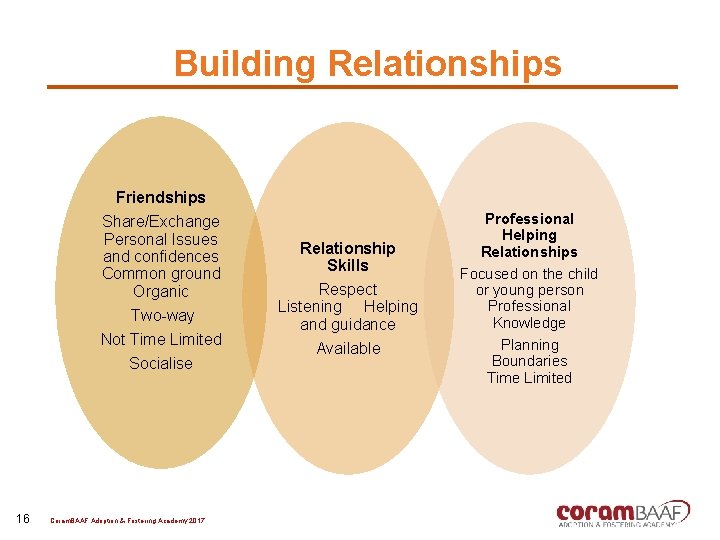
Building Relationships Friendships Share/Exchange Personal Issues and confidences Common ground Organic Two-way Not Time Limited Socialise 16 Coram. BAAF Adoption & Fostering Academy 2017 Relationship Skills Respect Listening Helping and guidance Available Professional Helping Relationships Focused on the child or young person Professional Knowledge Planning Boundaries Time Limited
BREAK 17 Coram. BAAF Adoption & Fostering Academy 2017
Key Relationship Difficulties l Transition to parenthood l The challenges of raising children l Finance l Health and well-being l The influences of in-laws, family and friends l Infidelity. l The unequal balance of control l Poor communication 18 Coram. BAAF Adoption & Fostering Academy 2017 Relationship Difficulties and Help seeking Behaviour. DFE 2010
What makes Assessing Adult Relationships Difficult? l They take place over a much wider space and time l They are much more private than infant-mother interactions. l More of what goes on in adult relationships is in their minds. l They don’t have to be interacting at all to be thinking about their partner and about things that they have done in the past or might want to do in the future. l Their relationship is invisible to an observer. 19 Coram. BAAF Adoption & Fostering Academy 2017
Exercise – Characteristics of Prospective Foster Carers Open discussion: l What characteristics do we look for in Prospective Foster Carers? l Why are these characteristics important? 20 Coram. BAAF Adoption & Fostering Academy 2017
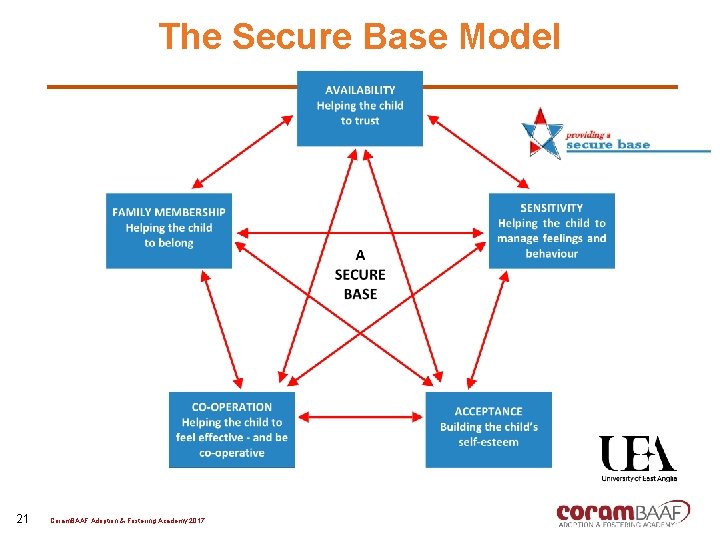
The Secure Base Model 21 Coram. BAAF Adoption & Fostering Academy 2017
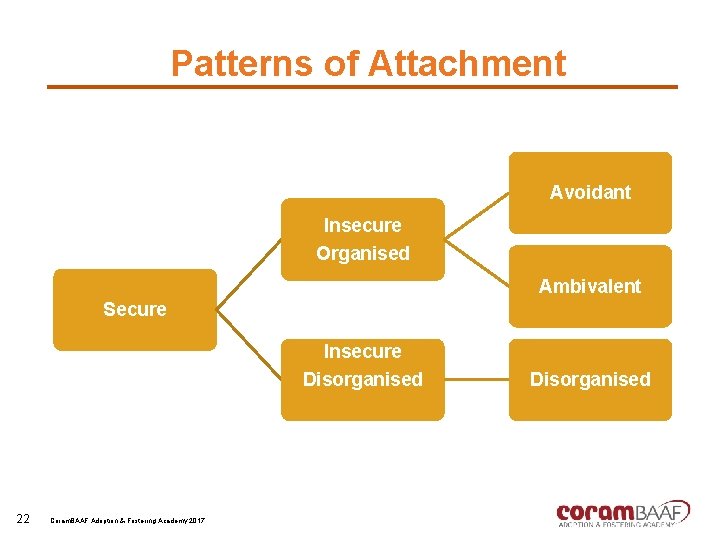
Patterns of Attachment Avoidant Insecure Organised Ambivalent Secure Insecure Disorganised 22 Coram. BAAF Adoption & Fostering Academy 2017 Disorganised
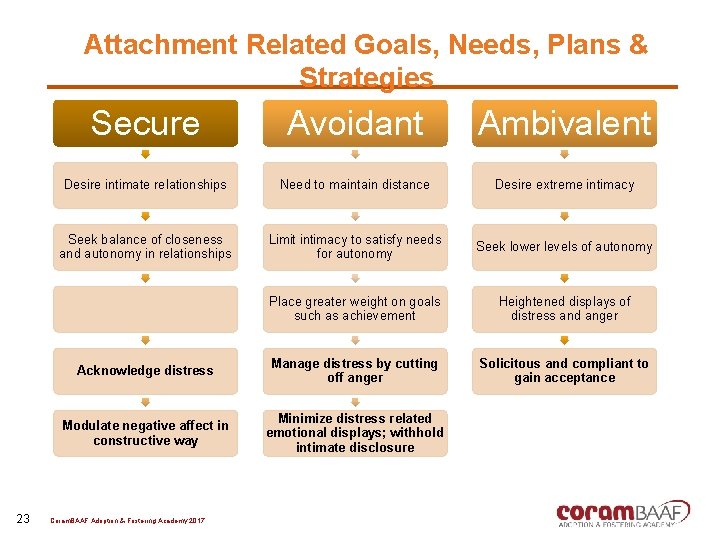
Attachment Related Goals, Needs, Plans & Strategies 23 Secure Avoidant Ambivalent Desire intimate relationships Need to maintain distance Desire extreme intimacy Seek balance of closeness and autonomy in relationships Limit intimacy to satisfy needs for autonomy Seek lower levels of autonomy Place greater weight on goals such as achievement Heightened displays of distress and anger Acknowledge distress Manage distress by cutting off anger Solicitous and compliant to gain acceptance Modulate negative affect in constructive way Minimize distress related emotional displays; withhold intimate disclosure Coram. BAAF Adoption & Fostering Academy 2017
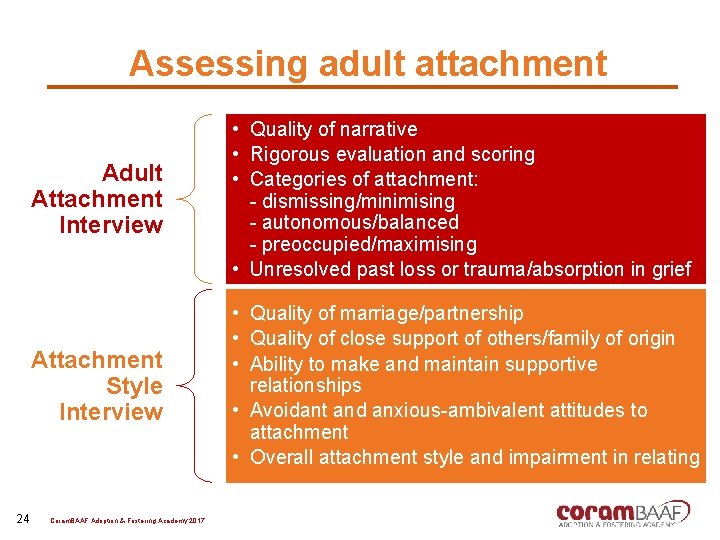
Assessing adult attachment 24 Adult Attachment Interview • Quality of narrative • Rigorous evaluation and scoring • Categories of attachment: - dismissing/minimising - autonomous/balanced - preoccupied/maximising • Unresolved past loss or trauma/absorption in grief Attachment Style Interview • Quality of marriage/partnership • Quality of close support of others/family of origin • Ability to make and maintain supportive relationships • Avoidant and anxious-ambivalent attitudes to attachment • Overall attachment style and impairment in relating Coram. BAAF Adoption & Fostering Academy 2017
Adult attachment interview (AAI): types of questions asked l Five adjectives which describe your early relationship with your mother or father l Can you remember times when you were emotionally upset, physically hurt, separated or rejected, or suffered abuse or loss? l Why do you think your parents behaved in the way that they did? l Has your childhood influenced the kind of person that you are today? 25 Coram. BAAF Adoption & Fostering Academy 2017
Your own attachment style Exercise: l Individually: write down five words to describe the relationship you had with your main carer when you were a young child. l In pairs: share examples of specific incidents to evidence one or two of the words that you have written down. 26 Coram. BAAF Adoption & Fostering Academy 2017
Attachment Style Interview (ASI) l l l Can only be carried out by fully trained practitioners Four-day training, including pilot interview Semi-structured interview, taped and rated Looks at the previous year (not right back into past) Addresses quality of relationships and degree in which interviewee is able to confide in close other l Assesses carer’s ability to access support when under stress l Style of relating to other adults, in terms of self-reliance, desire for company, ease in accessing help. l May potentially help match carer’s attachment style to child’s attachment style 27 Coram. BAAF Adoption & Fostering Academy 2017
ASI interviews Exercise: l Read the two sides of the ASI interview in your workbooks l How do you rate Mrs Brown’s ability to confide? l How do you rate her partner’s active emotional support? l Were there any surprises for you as you rated this? 28 Coram. BAAF Adoption & Fostering Academy 2017
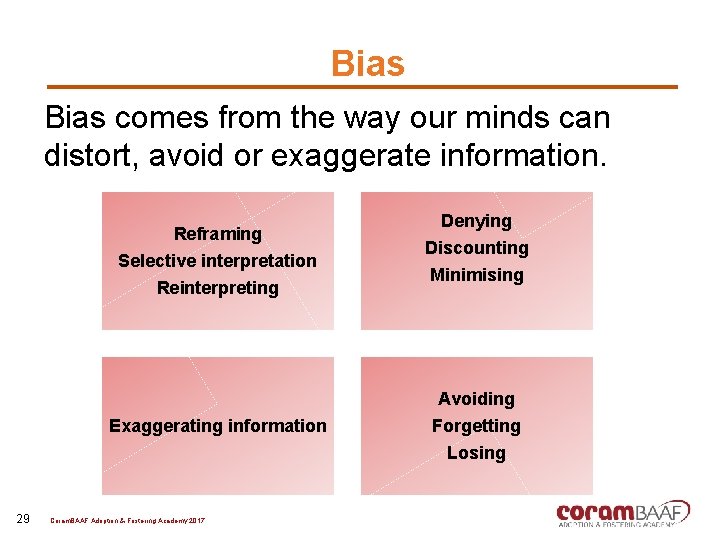
Bias comes from the way our minds can distort, avoid or exaggerate information. Reframing Selective interpretation Reinterpreting Denying Discounting Minimising Avoiding Exaggerating information 29 Coram. BAAF Adoption & Fostering Academy 2017 Forgetting Losing
Five types of discrepancy l Informational: contradictory information from different sources l Interpretative: different conclusions drawn from different professionals l Interactive: declared intentions are contradicted by actions l Incongruence: manner or ‘talk’ is inconsistent, contradictory or incoherent l Instinctual: worker’s gut feeling tells them something is wrong 30 Coram. BAAF Adoption & Fostering Academy 2017
Discrepancy matrix l Developed by Wonnacott & Morrison (2009) for practitioners to explore discrepancies within evidence from different sources l Visual tool used to plot four different types of information: ambiguous, missing, assumption-led and firm ground l Encourages practitioners to reflect critically on how they make decision and what informs their decision-making l Information which is missing, assumption-led or ambiguous can be checked or verified and either become ‘firm ground’ or be discarded 31 Coram. BAAF Adoption & Fostering Academy 2017
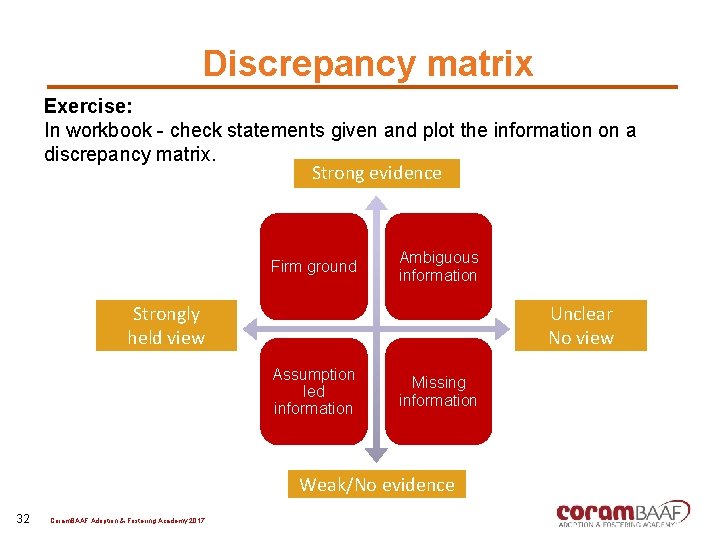
Discrepancy matrix Exercise: In workbook - check statements given and plot the information on a discrepancy matrix. Strong evidence Firm ground Ambiguous information Strongly held view Unclear No view Assumption led information Missing information Weak/No evidence 32 Coram. BAAF Adoption & Fostering Academy 2017
LUNCH 33 Coram. BAAF Adoption & Fostering Academy 2017
Assessment Tools l Genogram l Eco-gram l Timelines l Circular Questions 34 Coram. BAAF Adoption & Fostering Academy 2017
Key concept of systems thinking l One change within system will have knock on effects on all other members of the system, including the child ih the family l Alliances within family – identify common purpose l Coalition; 2 or more uniting against another member – triangular relationships when 2 marginalise third 35 Coram. BAAF Adoption & Fostering Academy 2017
Genogram exercise l Work in pairs. l One of you to complete a Genogram for yourself. l The other to try out some of the questions from the handout. 36 Coram. BAAF Adoption & Fostering Academy 2017
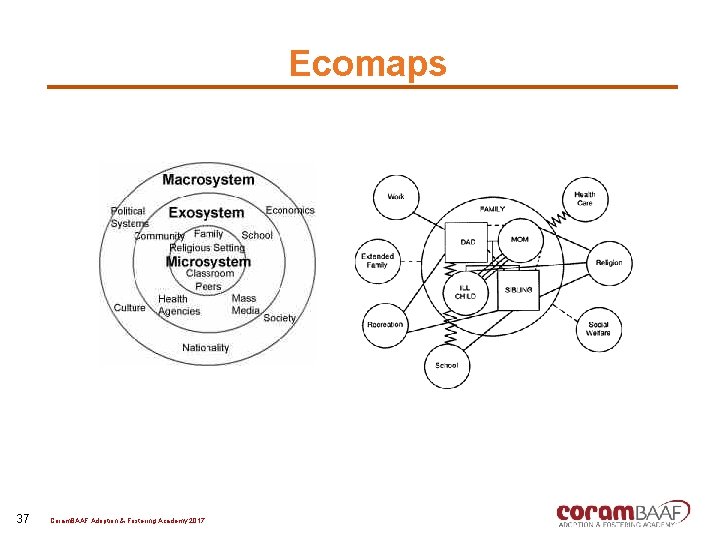
Ecomaps 37 Coram. BAAF Adoption & Fostering Academy 2017
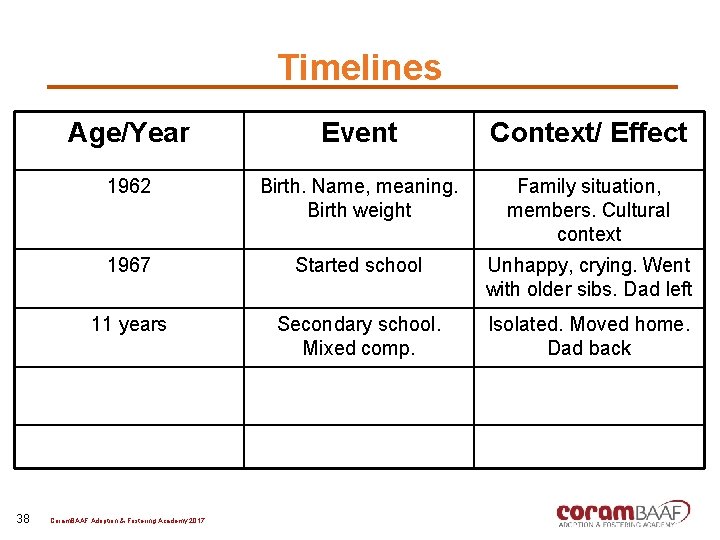
Timelines 38 Age/Year Event Context/ Effect 1962 Birth. Name, meaning. Birth weight Family situation, members. Cultural context 1967 Started school Unhappy, crying. Went with older sibs. Dad left 11 years Secondary school. Mixed comp. Isolated. Moved home. Dad back Coram. BAAF Adoption & Fostering Academy 2017
Exercise: Timelines l In Pairs one persons to be questioned about their early history in order to begin completing a time line l Beginning with birth try to be curious about experience and context up to 5 years of age l Time allowing, move onto the period 5 -10 years 39 Coram. BAAF Adoption & Fostering Academy 2017
Last Chance! 40 Coram. BAAF Adoption & Fostering Academy 2017
A robust analytical assessment report l Is clear about the purpose and potential outcomes of the assessment l Is based on a clear theoretical framework l Is clear about context and value base l Is collaborative with, and promotes accessibility for, applicants l Is based on the multiple sources of good information from different sources 41 Coram. BAAF Adoption & Fostering Academy 2017
A robust analytical assessment report Contd. l Values the expertise and understanding applicants bring to their situation l Is clear about missing information l Identifies themes and patterns, strengths and limitations l Demonstrates the elements of critical reflection and critical thinking l Identifies an effective and robust support and professional development plan SIGNIFICANT IMPORTANCE OF SUPERVISION THROUGHOUT 42 Coram. BAAF Adoption & Fostering Academy 2017
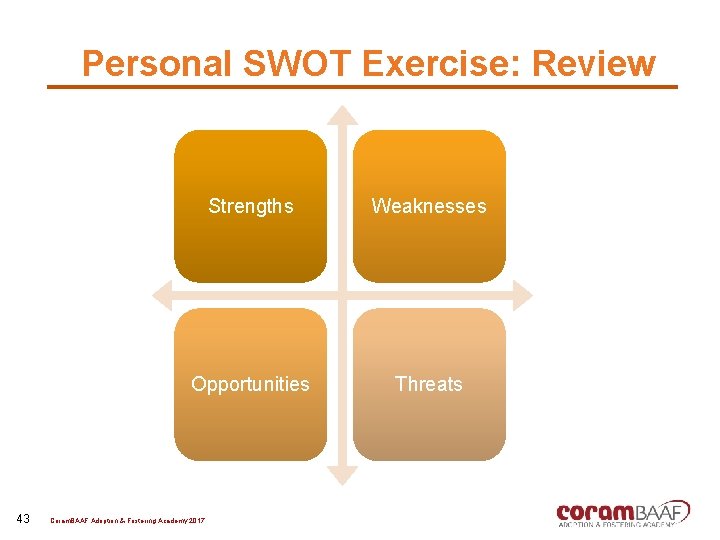
Personal SWOT Exercise: Review 43 Strengths Weaknesses Opportunities Threats Coram. BAAF Adoption & Fostering Academy 2017
Case Application Consider Individuals you are working with and application of learning from today. What might you do differently? 44 Coram. BAAF Adoption & Fostering Academy 2017
- Slides: 44