
A Presentation from Coram BAAF Making Good Fostering
A Presentation from Coram. BAAF Making Good Fostering Assessments Workshop Day 1 © Coram. BAAF Adoption & Fostering Academy 2017 Coram Academy Ltd, 41 Brunswick Square, London WC 1 N 1 AZ. www. corambaaf. org. uk Registered as a company limited by guarantee in England Wales no. 9697712, part of the Coram Group, Charity no. 3122718.
Inclusive Training We aim to ensure that all their training addresses issues of diversity throughout each training course. Participants share this responsibility. 2 © Coram. BAAF Adoption & Fostering Academy 2017 • Think about: class, culture, disability, ethnicity, family structure, age, gender, language, “race”, religion and sexuality. • Challenge unhelpful assumptions and stereotypes (respectfully). • Question whether the topic could be viewed from a different angle. • Be proactive about these issues during the training.
Working Agreement Environment Learning 3 © Coram. BAAF Adoption & Fostering Academy 2017 • • Trust Safe Caring and gentle Assumptions • Responsibility • Respect • Confidentiality
Housekeeping l Fire exits l Please switch off mobile phones l Breaks l Lunch l Participation 4 © Coram. BAAF Adoption & Fostering Academy 2017
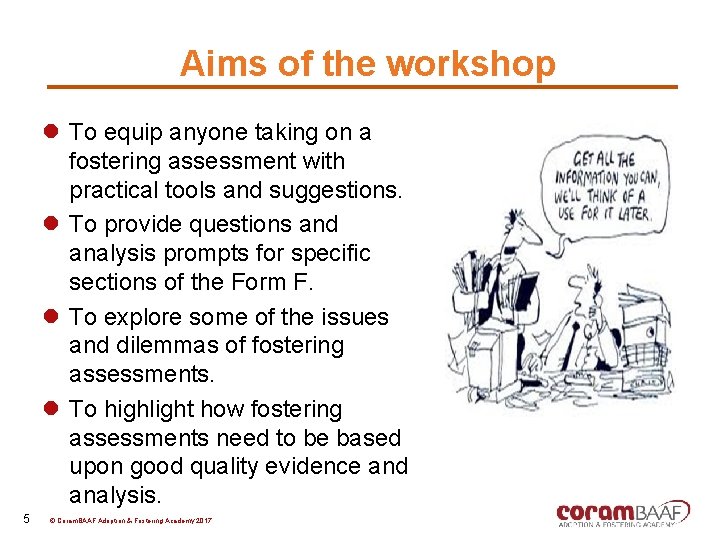
Aims of the workshop l To equip anyone taking on a fostering assessment with practical tools and suggestions. l To provide questions and analysis prompts for specific sections of the Form F. l To explore some of the issues and dilemmas of fostering assessments. l To highlight how fostering assessments need to be based upon good quality evidence and analysis. 5 © Coram. BAAF Adoption & Fostering Academy 2017

Outline of workshop l l l l 6 2 stage fostering process BAAF Form F (May 2014) Gathering information Assessment issues Assessment tools Involving birth children Safer caring © Coram. BAAF Adoption & Fostering Academy 2017 l Diversity considerations in assessments l Attachment l Resilience l Secure Base Model l Analysis
Welcome and introductions l Name l Role l Form F experience 7 © Coram. BAAF Adoption & Fostering Academy 2017
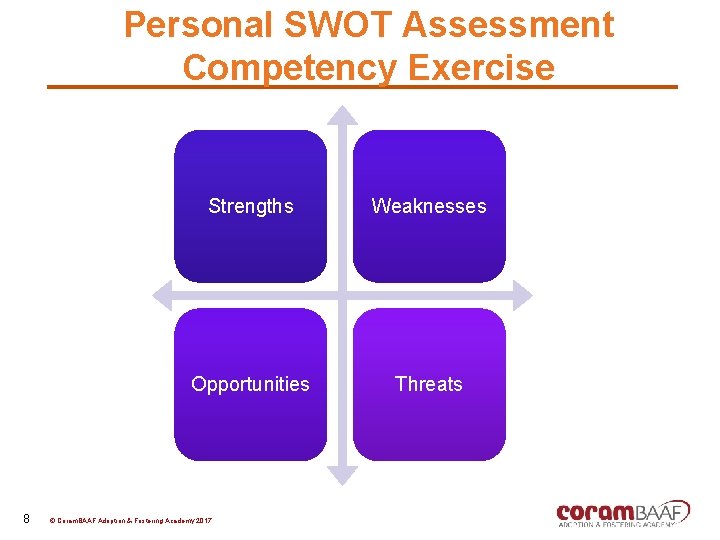
Personal SWOT Assessment Competency Exercise 8 Strengths Weaknesses Opportunities Threats © Coram. BAAF Adoption & Fostering Academy 2017
Statutory framework overview l Children Act 1989 l Fostering Services Regulations/Statutory Guidance, 2002, amended in 2011 l Statutory Guidance updated in 2015 (Assessment & Approval of Foster Carers & Delegation of Authority l Care Planning, Placement and Case Review Regulations 2015 l National Minimum Fostering Standards - 2011 9 © Coram. BAAF Adoption & Fostering Academy 2017
Exercise First thoughts! – 2 Stage Process l How familiar are you with the 2 stage process? l How is this process working in your agency/ for you individually? 10 © Coram. BAAF Adoption & Fostering Academy 2017

Building up the picture – 2 stage fostering process Stage 1 Stage 2 Ambition: A fair, transparent, safe and timely process for the assessment and approval of foster carers (Df. E) 11 © Coram. BAAF Adoption & Fostering Academy 2017
Stage 1 of the assessment l Regulation 26(1 A) requires the fostering service to obtain information specified in Part 1 of Schedule 3 l If an applicant has been a foster carer in the previous 12 months, and a written reference from their previous fostering service is obtained, there is no requirement to also interview personal referees, however fostering services can choose to do so l Where an applicant has been approved previously, or is currently approved, as a foster carer, regulation 26(1 A) gives powers to request access to records (provided that the applicant consents). 12 © Coram. BAAF Adoption & Fostering Academy 2017
Stage 1 of the assessment Contd. l Records complied by another fostering service, can be used to inform the new assessment, i. e. if previous partners have been interviewed in the past to verify facts, and the current assessing worker is satisfied with the records in respect of these interviews, it should not be necessary to repeat the interviews if no further information is required. l The assessing worker should, however, satisfy themselves as to the quality and continuing relevance of the information before using it to inform the current assessment. 13 © Coram. BAAF Adoption & Fostering Academy 2017
Stage 1 of the assessment – completion or termination l Regulation 26 (1 B) and (1 C) provide that at any point during stage 1 of the assessment process, if the fostering service’s decision maker decides that the applicant is not suitable to foster, they must write to the applicant informing them of this decision and give full reasons for it. l At the latest, the decision about whether or not the applicant has successfully completed stage 1 must be reached, and the applicant informed, within 10 working days of all stage 1 information (regulation 26 (1 A)) being received. l No right of recourse to IRM at this stage but applicants can follow fostering services complaints procedure if they wish. 14 © Coram. BAAF Adoption & Fostering Academy 2017
Stage 2 of the assessment l Regulation 26(2) requires the fostering service to obtain information about the applicant set out in Part 2 of Schedule 3 l Information must take into account the suitability of the applicants to become a foster carer, suitability of their household, and recommendations regarding any terms of approval. 15 © Coram. BAAF Adoption & Fostering Academy 2017
Stage 2 of the assessment Contd. A stage 2 assessment that has been started must be competed, unless: l The assessment is terminated following a brief report; l The applicant withdraws from the process; l The applicant is deemed unsuitable as a result of stage 1 of the assessment (where stages 1 and 2 have been carried out in parallel); or l It becomes apparent that the applicant or an adult member of their household has been convicted of, or cautioned for, a specified offence (defined in regulation 26(6)). 16 © Coram. BAAF Adoption & Fostering Academy 2017
Stage 2 of the assessment – incomplete assessments and ‘brief report’ l Regulation 26(3) provides that if, before the assessment is complete, information comes to light indicating that the applicant is unlikely to be suitable to foster, a ‘brief report’ can be complied setting out details of the assessment done and the reasons for considering the applicants unsuitable. l The applicants must be: - notified that the brief report is to be sent to the Panel; - provided with a copy of the brief report; and - given 10 working days from the date of the notification to send their observations to the fostering service provider. 17 © Coram. BAAF Adoption & Fostering Academy 2017
Stage 2 of the assessment – incomplete assessments and ‘brief report’ Contd. l The brief report should then be presented to the fostering Panel for consideration, along with any observations submitted by the applicant and any other relevant information. l The decision maker’s determination about whether to terminate the assessment following a brief report must take account of the recommendations of the Panel. 18 © Coram. BAAF Adoption & Fostering Academy 2017
BAAF Form F (May 2017) 19 © Coram. BAAF Adoption & Fostering Academy 2017
Break 20 © Coram. BAAF Adoption & Fostering Academy 2017
Assessment Components l Produce a diagram, list, mind map etc. of what an assessment consists of using only words and phrases beginning with… A 21 © Coram. BAAF Adoption & Fostering Academy 2017
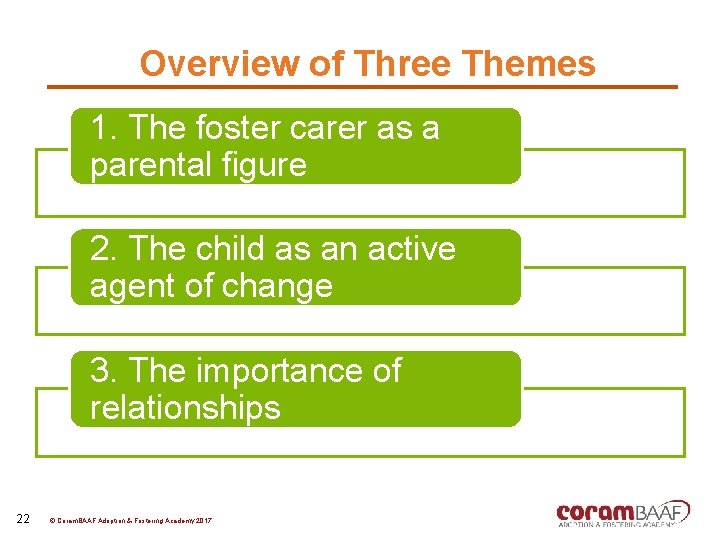
Overview of Three Themes 1. The foster carer as a parental figure 2. The child as an active agent of change 3. The importance of relationships 22 © Coram. BAAF Adoption & Fostering Academy 2017
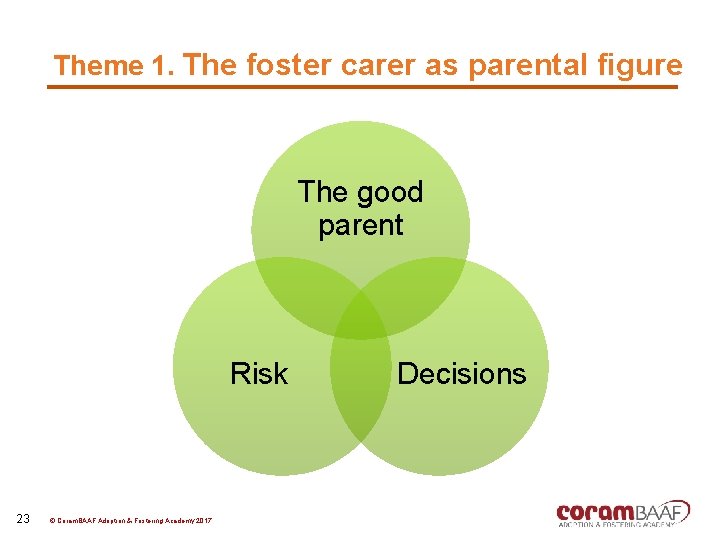
Theme 1. The foster carer as parental figure The good parent Risk 23 © Coram. BAAF Adoption & Fostering Academy 2017 Decisions
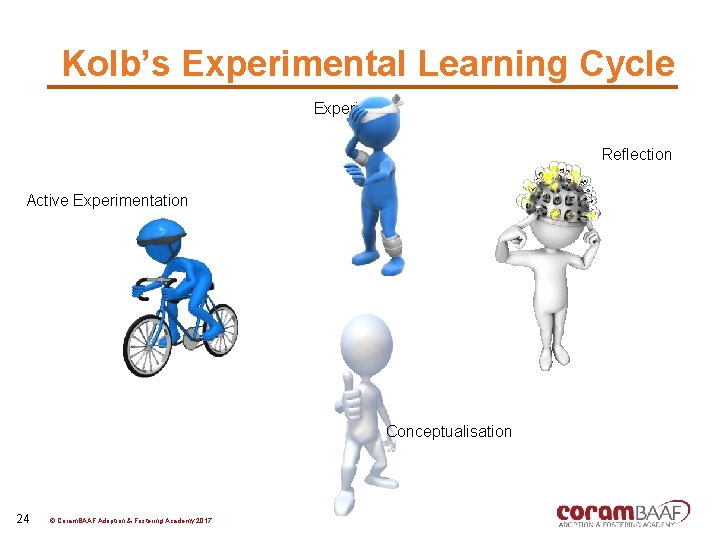
Kolb’s Experimental Learning Cycle Experience Reflection Active Experimentation Conceptualisation 24 © Coram. BAAF Adoption & Fostering Academy 2017
Exercise first thoughts! – Kolb’s cycle l Why might assessors and applicants get ‘stuck’ in different stages of Kolb’s cycle? l What implications might this have? l How can we apply this knowledge to assessments? 25 © Coram. BAAF Adoption & Fostering Academy 2017
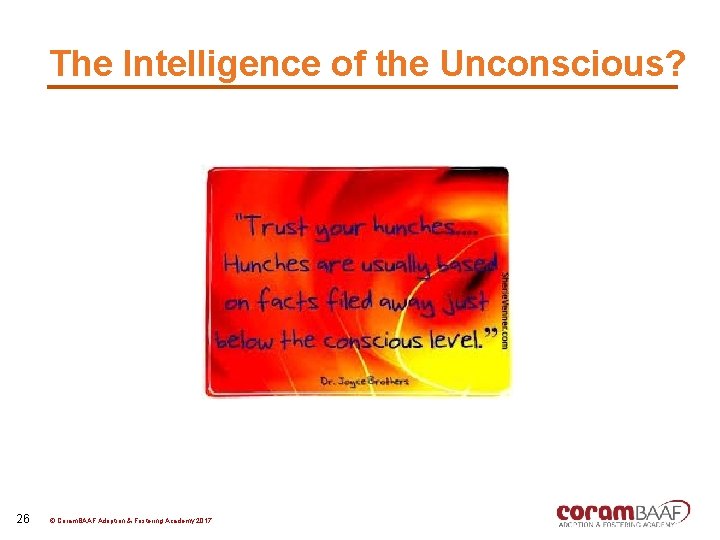
The Intelligence of the Unconscious? 26 © Coram. BAAF Adoption & Fostering Academy 2017
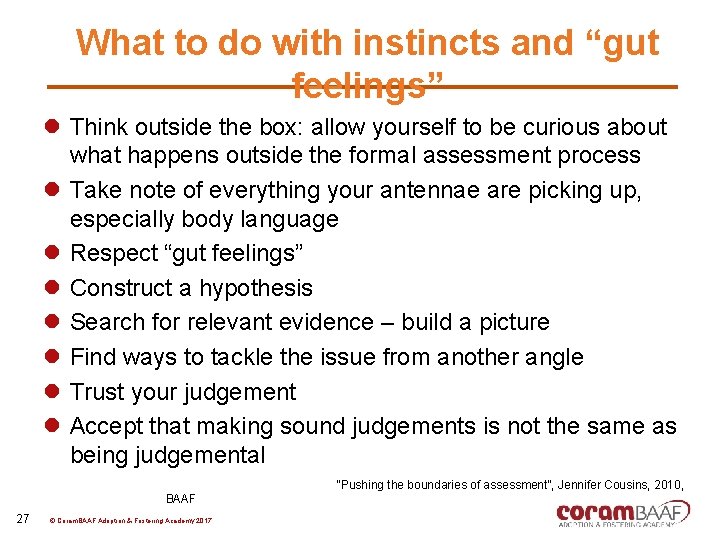
What to do with instincts and “gut feelings” l Think outside the box: allow yourself to be curious about what happens outside the formal assessment process l Take note of everything your antennae are picking up, especially body language l Respect “gut feelings” l Construct a hypothesis l Search for relevant evidence – build a picture l Find ways to tackle the issue from another angle l Trust your judgement l Accept that making sound judgements is not the same as being judgemental “Pushing the boundaries of assessment”, Jennifer Cousins, 2010, BAAF 27 © Coram. BAAF Adoption & Fostering Academy 2017
Exercise: Evidencing Gut Feelings l In groups, think of prospective foster carers that you are currently assessing. l What are your instincts or “gut feelings” about them? l How could you gather evidence to support or refute your instincts or “gut feelings”? 28 © Coram. BAAF Adoption & Fostering Academy 2017
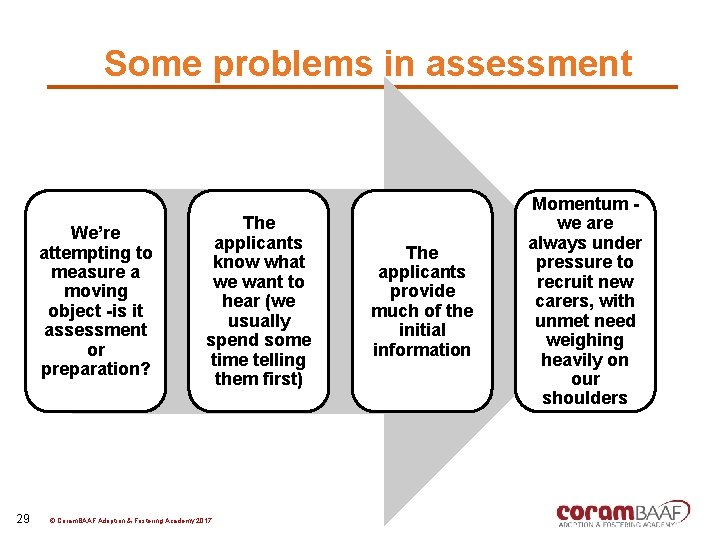
Some problems in assessment We’re attempting to measure a moving object -is it assessment or preparation? 29 The applicants know what we want to hear (we usually spend some time telling them first) © Coram. BAAF Adoption & Fostering Academy 2017 The applicants provide much of the initial information Momentum we are always under pressure to recruit new carers, with unmet need weighing heavily on our shoulders
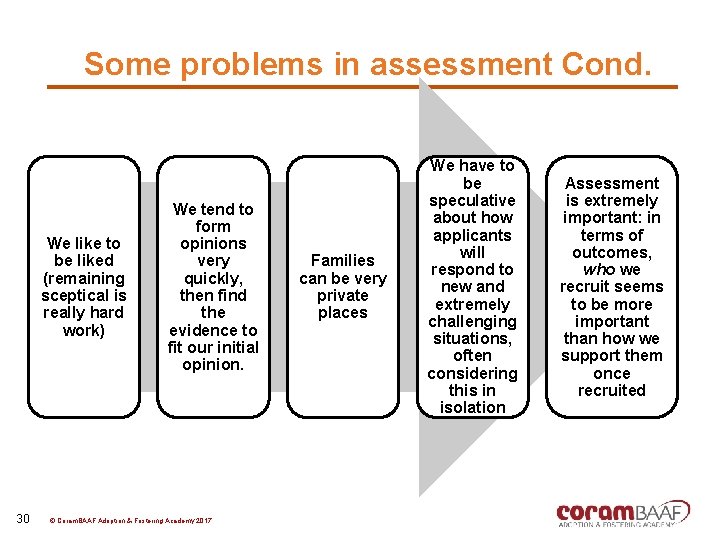
Some problems in assessment Cond. We like to be liked (remaining sceptical is really hard work) 30 We tend to form opinions very quickly, then find the evidence to fit our initial opinion. © Coram. BAAF Adoption & Fostering Academy 2017 Families can be very private places We have to be speculative about how applicants will respond to new and extremely challenging situations, often considering this in isolation Assessment is extremely important: in terms of outcomes, who we recruit seems to be more important than how we support them once recruited
Exercise – Distortions in assessment l How might assessors overcome potential issues in assessments? 31 © Coram. BAAF Adoption & Fostering Academy 2017
Impact of self on assessments l Reflexivity – A circular process of thought and action, with our thoughts and beliefs interacting with and affecting service users and their responses and experiences in turn affecting our thoughts and belief systems. l Need to be critically aware of the impact of ourselves and our belief systems on the assessment including ‘categories’ associated with ourselves such as gender, race and professional status; our agency culture; and dominant theories, practices and assumptions within our occupation. (Holland, 2004) 32 © Coram. BAAF Adoption & Fostering Academy 2017
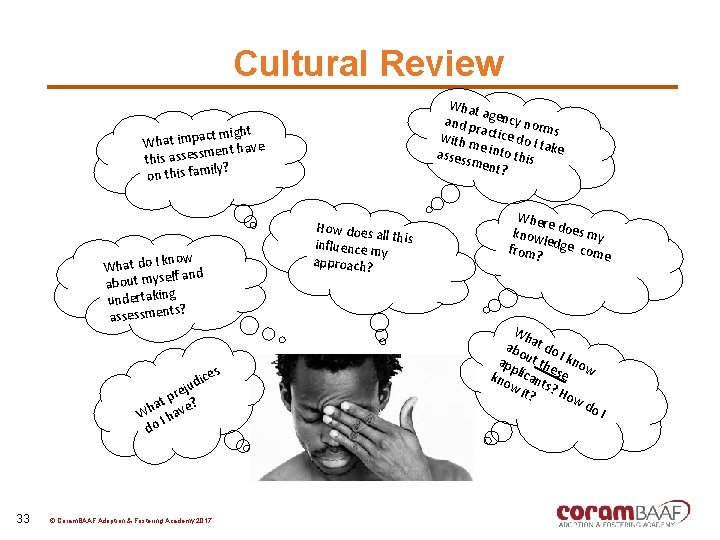
Cultural Review What a and p gency nor m ra with m ctice do I s ta asses e into this ke smen t? ct might What impa ment have s s a is h t ily? on this fam How does a ll this influence m y approach? now What do I k nd elf a about mys g undertakin ts? assessmen es dic u j pre ? t a e Wh I hav do 33 © Coram. BAAF Adoption & Fostering Academy 2017 Wher e know does my le from? dge come Wh abo at do app ut th I know e kno licant se s wi t? ? How do I
Cultural Review: Questions to consider l How do people with strong religious convictions OR no convictions make you feel? l How do gay & lesbian relationships make you feel? l What thoughts, assumptions come up for you when you think about “religious” couples or gay & lesbian partnerships? l Is gender an issue (Gay or Lesbian); race, disability, age? l What thoughts, assumptions come up for you when you think about religion/ gay & lesbian parenting partnerships? l How would these feelings impact on your ability to assess? l How do these relate to your actual experiences of assessing these applicants? 34 © Coram. BAAF Adoption & Fostering Academy 2017
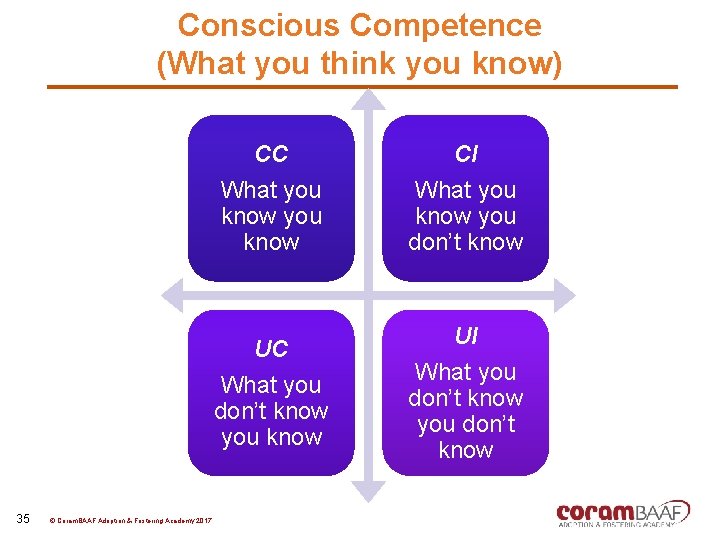
Conscious Competence (What you think you know) CC CI What you know you don’t know UC What you don’t know you know 35 © Coram. BAAF Adoption & Fostering Academy 2017 UI What you don’t know
Reflective Practice © Coram. BAAF Adoption & Fostering Academy 2017 36
Characteristics of a Reflective Practitioner l Assumption analysis : challenging our own beliefs and values l Contextual awareness : recognition of social construction of beliefs and practice l Imaginative speculation: ability to imagine a different way l Reflective Skepticism: Challenging or suspending existing knowledge and beliefs (Brookfield 1998) 37 © Coram. BAAF Adoption & Fostering Academy 2017
ANALYSIS l Analytic induction and deduction – Seeking information to test potential ways of understanding – Seeking information that might throw doubt on understanding l Reflexivity and reflective practice – Being critically aware of the impact of self and belief systems on the assessment – Checking out with others; sharing emerging thinking with the applicant 38 © Coram. BAAF Adoption & Fostering Academy 2017
ANALYSIS l Building hypotheses – Making propositions, explanations, ways of understanding – Seeking information, evidence to confirm or disconfirm them l Reaching conclusions – Unlikely to reach a definite, correct conclusion – Should be able to reach a conclusion “that is least likely to be wrong” (Sheppard et al, 2001) 39 © Coram. BAAF Adoption & Fostering Academy 2017
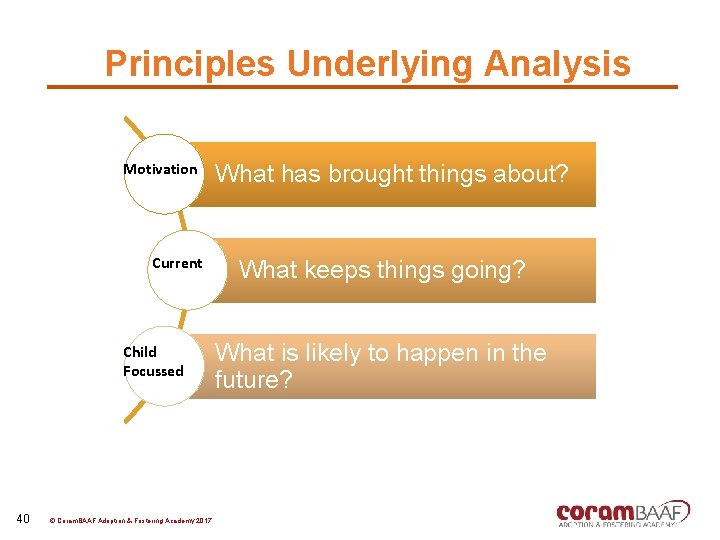
Principles Underlying Analysis Motivation Current Child Focussed 40 © Coram. BAAF Adoption & Fostering Academy 2017 What has brought things about? What keeps things going? What is likely to happen in the future?
Good practice in analysis l Acknowledge what you don’t know about the situation – describe gaps and limitations l Put the information you have got in context – child development, race and culture, recent events l Consult widely l Consider language l Summarise 41 © Coram. BAAF Adoption & Fostering Academy 2017
Analysis l What do you understand the word analysis to mean? l Why do you think we struggle with analysis? l How do you go about analysis? What does it involve? l At what stage of the assessment do you analyse? l How does analysis contribute to planning and decision making? 42 © Coram. BAAF Adoption & Fostering Academy 2017
Analytical thinking By contrast, Munro calls analytical thinking: “… a conscious and controlled process using formal reasoning and explicit data and rules to deliberate and compute a conclusion”. Analytical thinking a ‘step by step, conscious, logically defensible process’ (Hammond, 1996). Breaking decisions down into elements, which are then carefully considered in relation to each other. 43 © Coram. BAAF Adoption & Fostering Academy 2017
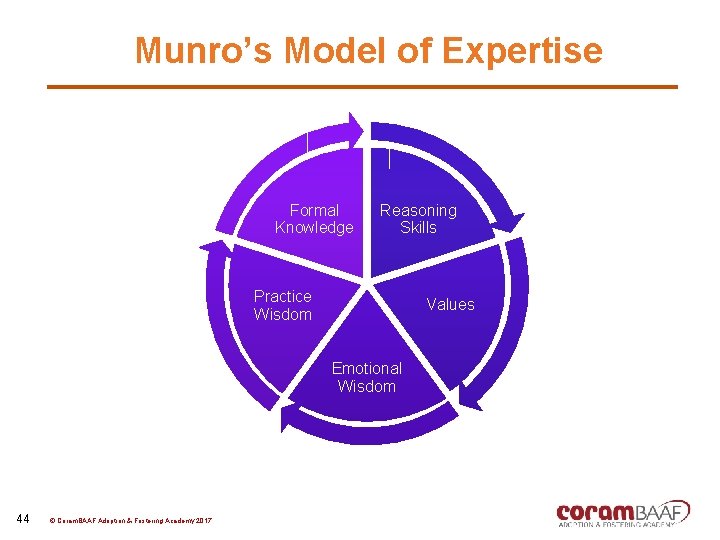
Munro’s Model of Expertise Formal Knowledge Reasoning Skills Practice Wisdom Values Emotional Wisdom 44 © Coram. BAAF Adoption & Fostering Academy 2017
Learning from Serious case reviews Wakefield report 2007 l Inadequate psycho-social assessment of them as individuals and of their relationship with each other Brighton and Hove 2001 l Lack of evidence l No chronology l Information not sought from ex-partners l Referees were friends only of one partner 45 © Coram. BAAF Adoption & Fostering Academy 2017
Learning from the IRM Main concerns leading to IRM l Inability to work with FSP l Risk factors l Allegations of abuse l Understanding of needs of LAC 46 © Coram. BAAF Adoption & Fostering Academy 2017
Lunch 47 © Coram. BAAF Adoption & Fostering Academy 2017
Hypothesis l A supposition, an assumption; made as a starting point for further investigation or research from known facts 48 © Coram. BAAF Adoption & Fostering Academy 2017
Developing hypotheses - pitfalls l Natural human tendency to be ‘verificationists’ – form explanations and seek to confirm l Fail to check more widely or reappraise original judgements in light of new evidence l ‘Unconflicted adherence’ relevant in safeguarding – new risk discounted and current strategy maintained (Hollows, 2003) Any views/experiences? 49 © Coram. BAAF Adoption & Fostering Academy 2017
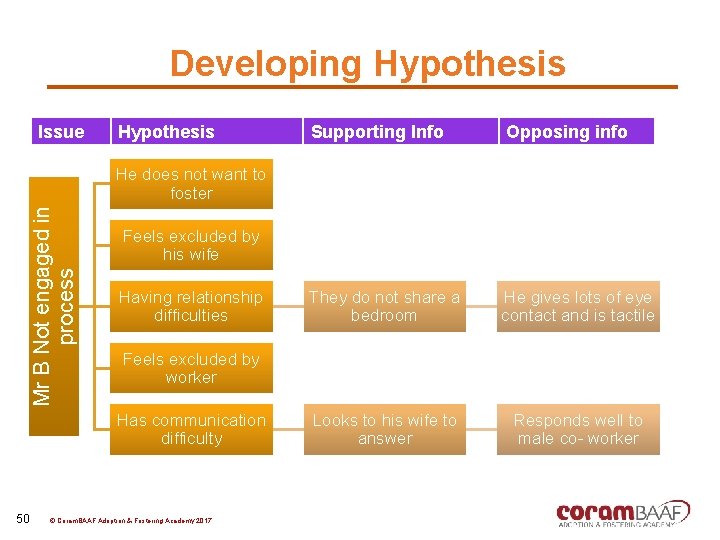
Developing Hypothesis Issue Hypothesis Supporting Info Opposing info They do not share a bedroom He gives lots of eye contact and is tactile Looks to his wife to answer Responds well to male co- worker Mr B Not engaged in process He does not want to foster Feels excluded by his wife Having relationship difficulties Feels excluded by worker Has communication difficulty 50 © Coram. BAAF Adoption & Fostering Academy 2017
Exercise – Hypothesising (2) l Consider an assessment “Issue” – Who is it an issue for – Develop hypotheses with supporting and opposing information • • • 51 What different hypotheses exist about this situation What are they based n What methods will you use to test Have any new hypothesis emerged What further action needs to be taken to test What conclusions can be drawn © Coram. BAAF Adoption & Fostering Academy 2017
Break 52 © Coram. BAAF Adoption & Fostering Academy 2017
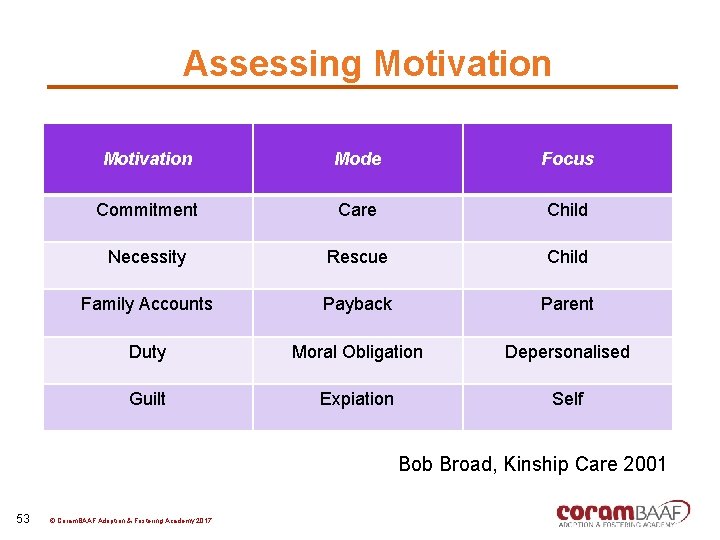
Assessing Motivation Mode Focus Commitment Care Child Necessity Rescue Child Family Accounts Payback Parent Duty Moral Obligation Depersonalised Guilt Expiation Self Bob Broad, Kinship Care 2001 53 © Coram. BAAF Adoption & Fostering Academy 2017
Assessing Motivation l Think of other motivations for fostering and apply the grid in terms of Mode and Focus l What are the possible strengths or difficulties of each motivation? 54 © Coram. BAAF Adoption & Fostering Academy 2017
Circular Questions 1 l Developed from Systemic Family Therapy l Questions are based on Circular Causality rather than linear, ie, A affects B, who affects C who in turn affects A l They elicit patterns that connect individuals l They can help to ‘map’ an individual’s relational world l Enables the Assessor/Questioner to retain an objective (helicopter) view 55 © Coram. BAAF Adoption & Fostering Academy 2017
Examples l Mary – when would John think that you get most upset? l How do you think John knows that you’re upset? l What would John say about how you learned to trust him? l In what situation would John say that you felt it was most difficult for you to trust people? 56 © Coram. BAAF Adoption & Fostering Academy 2017
Examples 57 l John – how does Mary show when she is upset? l What did Mary find the most difficult thing in learning to trust you/show you her feelings? l If your/Mary’s mother was alive, what would she say about you wanting to change your lifestyle and adopt a child? l What would she say about how you coped with change as a child? © Coram. BAAF Adoption & Fostering Academy 2017
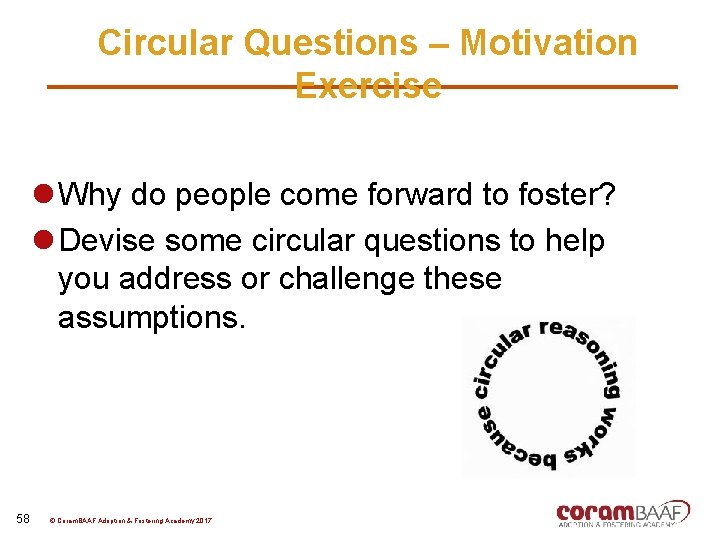
Circular Questions – Motivation Exercise l Why do people come forward to foster? l Devise some circular questions to help you address or challenge these assumptions. 58 © Coram. BAAF Adoption & Fostering Academy 2017
Tomorrow l Birth Children l Building Relationships l Assessing Adult Relationships: Attachment l Assessment Tools © Coram. BAAF Adoption & Fostering Academy 2017
- Slides: 59