
A PRESENTATION BY WG CDR ARVIND KUMAR BEARINGS
A PRESENTATION BY WG CDR ARVIND KUMAR
BEARINGS, FAILURES CAUSES & REMEDIES
Ø CONCEPT Ø CONSTRUCTION Ø BEARING MATERIALS Ø TYPES OF LOADS & BEARINGS Ø BEARING CLEARANCES Ø WHY BEARING FAILS! Ø FAILURES, CAUSES & REMEDIES : FEW EXAMPLES Ø PATH PATTERN INTERPRETATION Ø OTHER IMPORTANT POINTS Ø TV-2 STATISTICS Ø PRACTICAL DEMONSTRATION
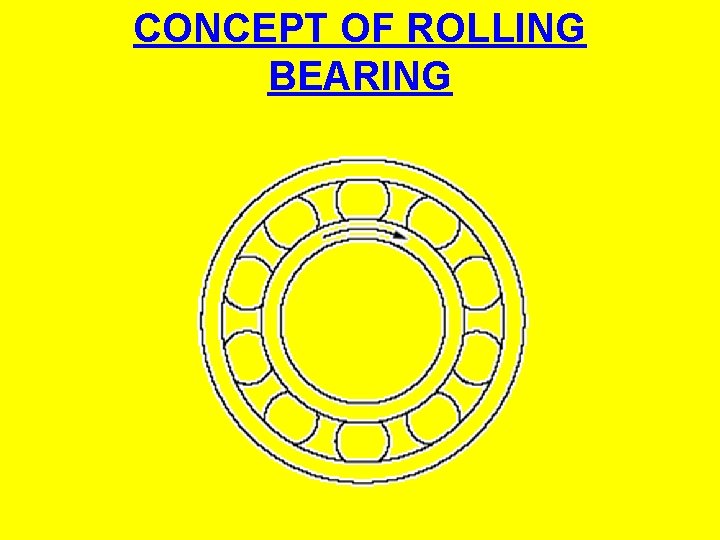
CONCEPT OF ROLLING BEARING
• Things roll better than they slide. Hence the invention of WHEEL. • Rolling friction is far lesser (>100 times less) than sliding friction. • Microscopic contacts get peeled off and not sheared off in rolling.

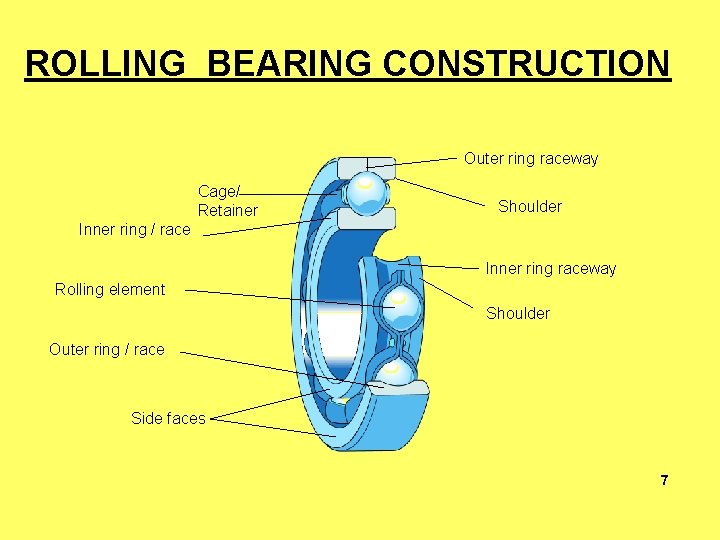
ROLLING BEARING CONSTRUCTION Outer ring raceway Cage/ Retainer Shoulder Inner ring / race Inner ring raceway Rolling element Shoulder Outer ring / race Side faces 7
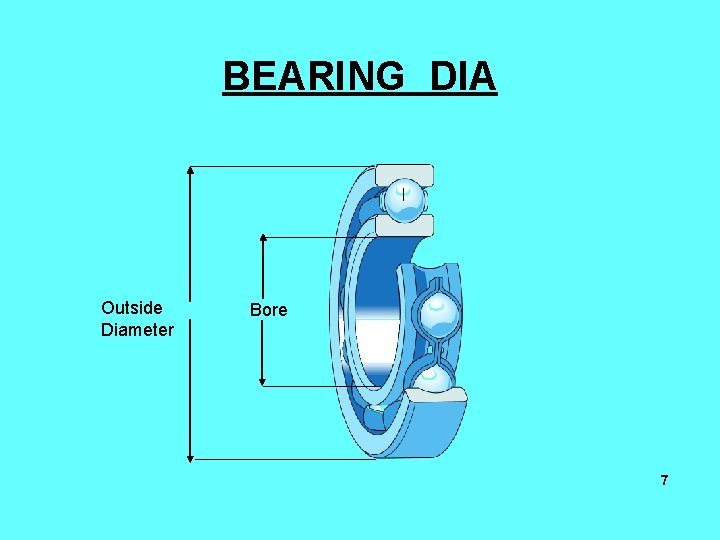
BEARING DIA Outside Diameter Bore 7
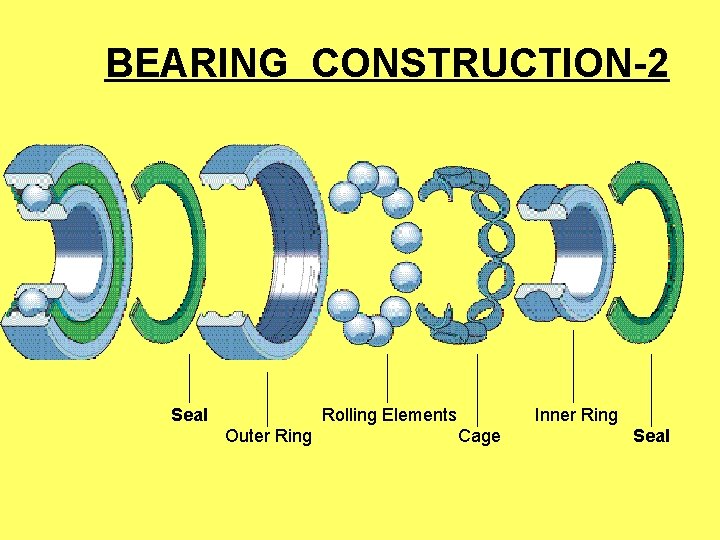
BEARING CONSTRUCTION-2 Seal Rolling Elements Outer Ring Inner Ring Cage Seal
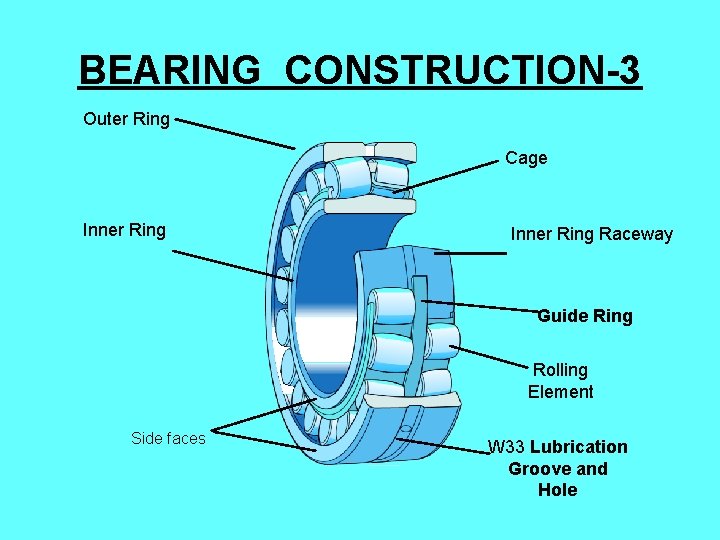
BEARING CONSTRUCTION-3 Outer Ring Cage Inner Ring Raceway Guide Ring Rolling Element Side faces W 33 Lubrication Groove and Hole
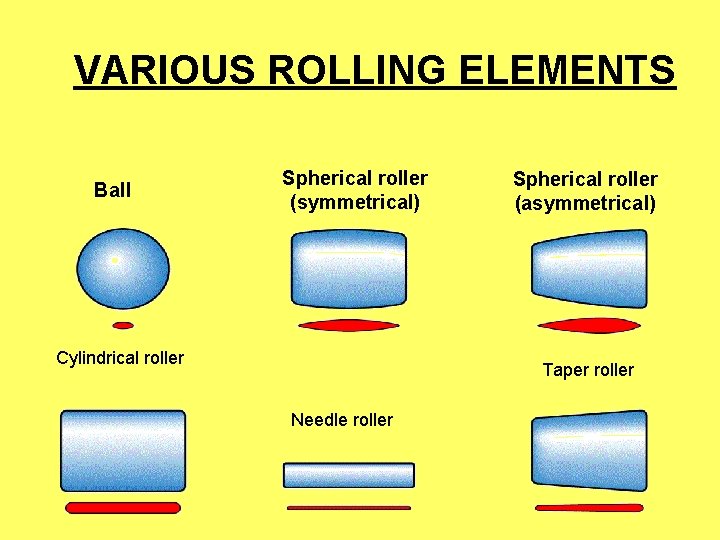
VARIOUS ROLLING ELEMENTS Ball Spherical roller (symmetrical) Cylindrical roller Spherical roller (asymmetrical) Taper roller Needle roller
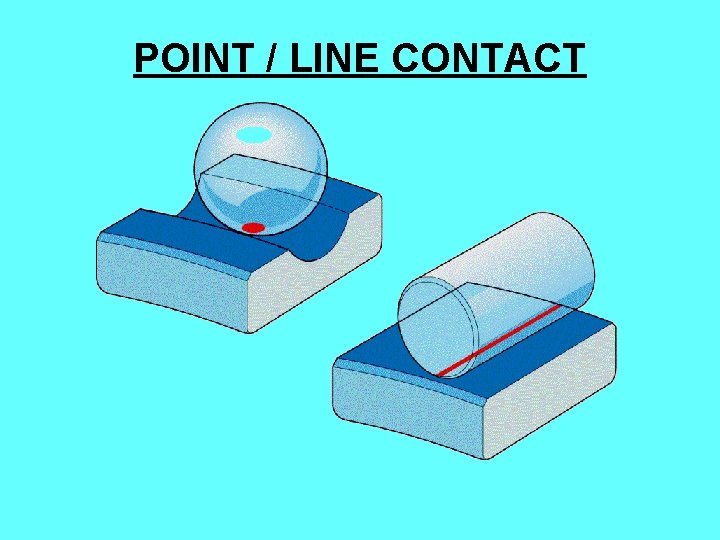
POINT / LINE CONTACT
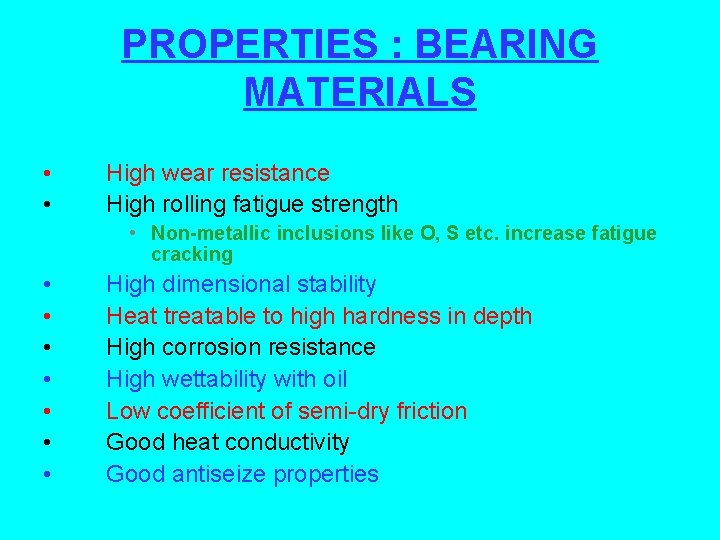
PROPERTIES : BEARING MATERIALS • • High wear resistance High rolling fatigue strength • Non-metallic inclusions like O, S etc. increase fatigue cracking • • High dimensional stability Heat treatable to high hardness in depth High corrosion resistance High wettability with oil Low coefficient of semi-dry friction Good heat conductivity Good antiseize properties
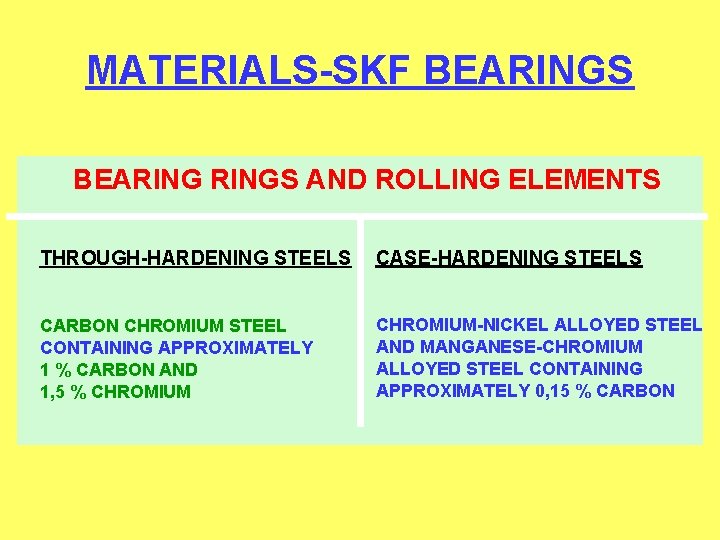
MATERIALS-SKF BEARINGS BEARINGS AND ROLLING ELEMENTS THROUGH-HARDENING STEELS CASE-HARDENING STEELS CARBON CHROMIUM STEEL CONTAINING APPROXIMATELY 1 % CARBON AND 1, 5 % CHROMIUM-NICKEL ALLOYED STEEL AND MANGANESE-CHROMIUM ALLOYED STEEL CONTAINING APPROXIMATELY 0, 15 % CARBON
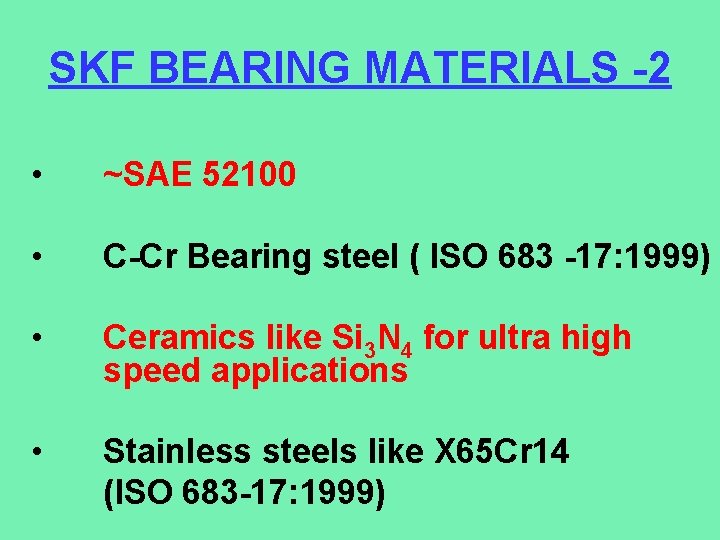
SKF BEARING MATERIALS -2 • ~SAE 52100 • C-Cr Bearing steel ( ISO 683 -17: 1999) • Ceramics like Si 3 N 4 for ultra high speed applications • Stainless steels like X 65 Cr 14 (ISO 683 -17: 1999)
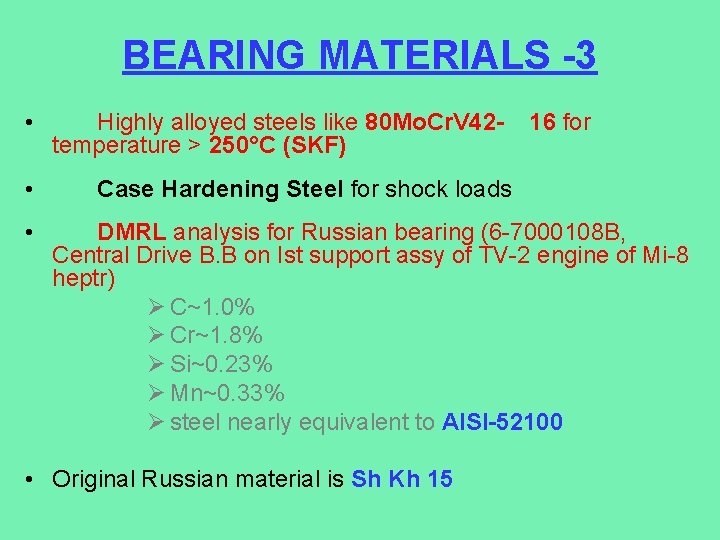
BEARING MATERIALS -3 • • • Highly alloyed steels like 80 Mo. Cr. V 42 temperature > 250°C (SKF) 16 for Case Hardening Steel for shock loads DMRL analysis for Russian bearing (6 -7000108 B, Central Drive B. B on Ist support assy of TV-2 engine of Mi-8 heptr) Ø C~1. 0% Ø Cr~1. 8% Ø Si~0. 23% Ø Mn~0. 33% Ø steel nearly equivalent to AISI-52100 • Original Russian material is Sh Kh 15
SPECIAL FEATURES • Hard Surfaces Ø Ø HRC 58 -65 for C-Cr bearing steel (SKF) DMRL analysis of Russian Bearing - HV/5 Kg : 930 (HRC : 68) • • • Perfectly round and incredibly smooth Very high surface finish : CLA ~ 0. 5 microns Addition of Si to improve heat resistance dimensional stability) at 150 -200°C
§ Radial loads § Axial Loads § Combined loads
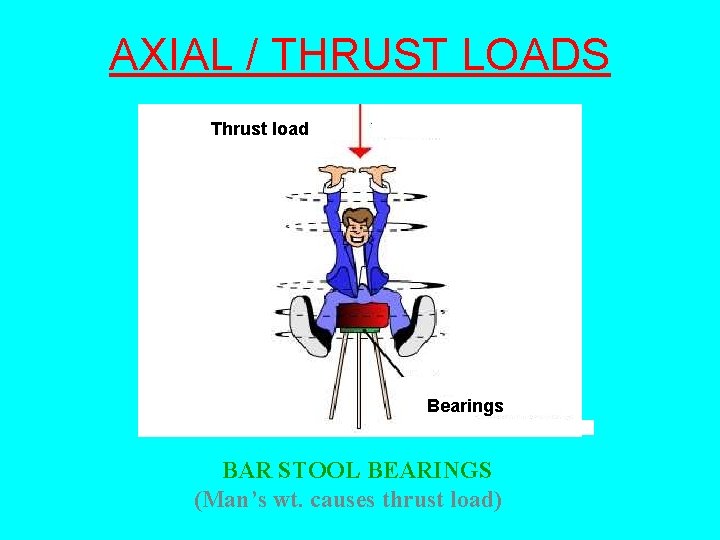
AXIAL / THRUST LOADS Thrust load Bearings BAR STOOL BEARINGS (Man’s wt. causes thrust load)
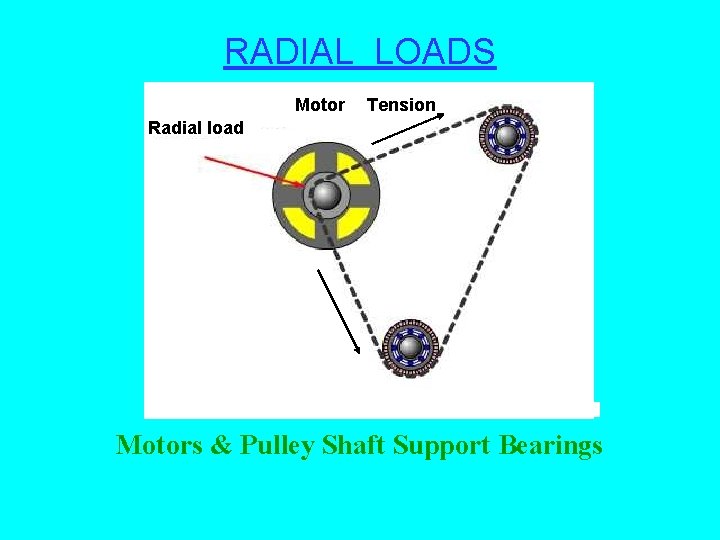
RADIAL LOADS Motor Tension Radial load Motors & Pulley Shaft Support Bearings
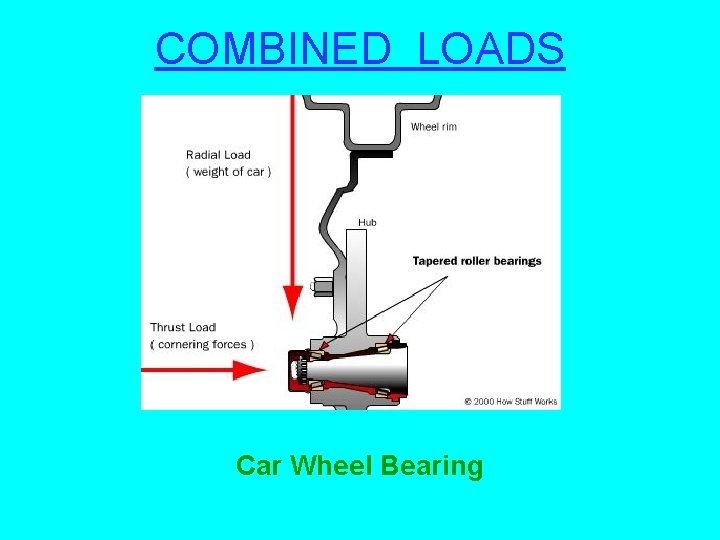
COMBINED LOADS Car Wheel Bearing
Ø Ø CYLINDRICAL ROLLER BRG : Radial load only (Heavy) BALL BRG : Both axial & radial TAPERED ROLLER BRG : Radial load & Axial load in one direction also Axial load is also called as Thrust load
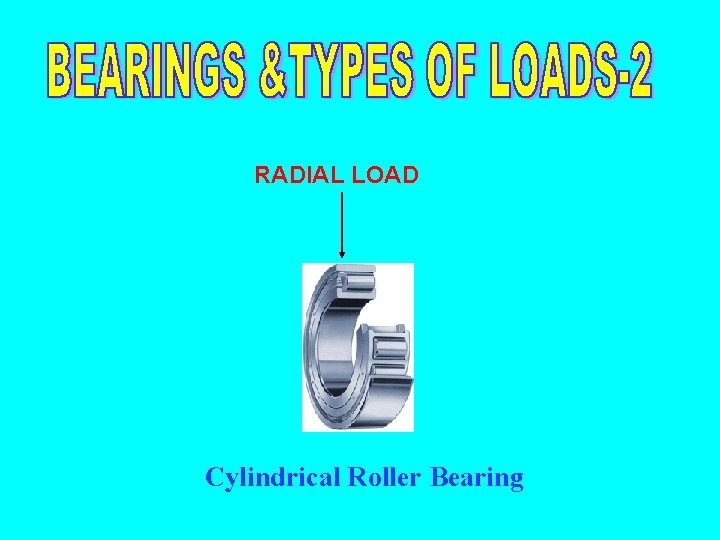
RADIAL LOAD Cylindrical Roller Bearing
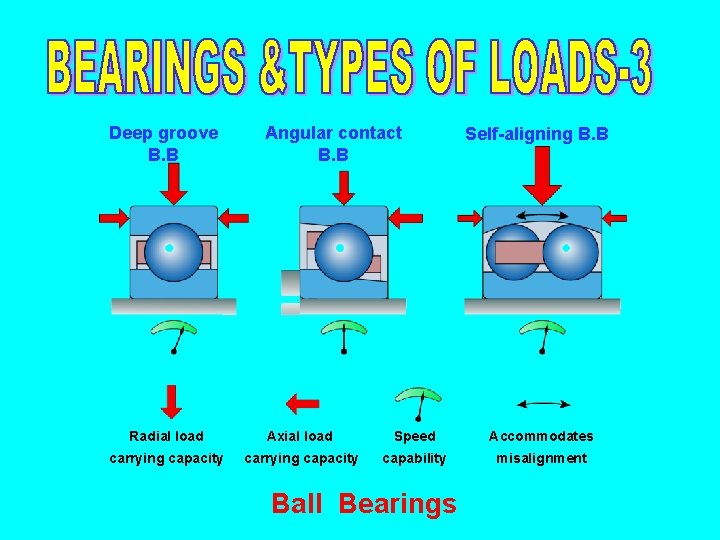
Deep groove B. B Angular contact B. B Self-aligning B. B Radial load Axial load Speed Accommodates carrying capacity capability misalignment Ball Bearings
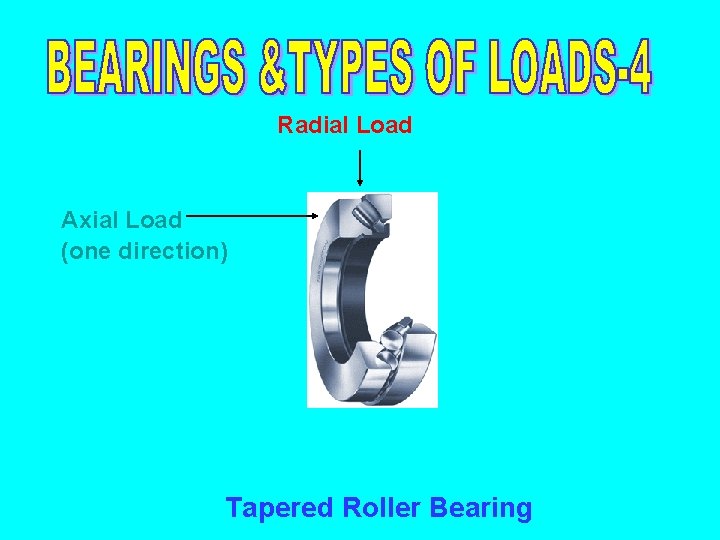
Radial Load Axial Load (one direction) Tapered Roller Bearing
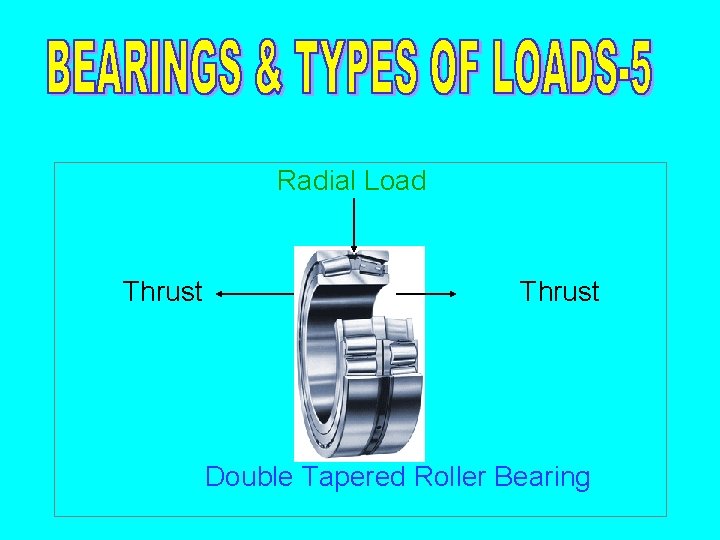
Radial Load Thrust Double Tapered Roller Bearing

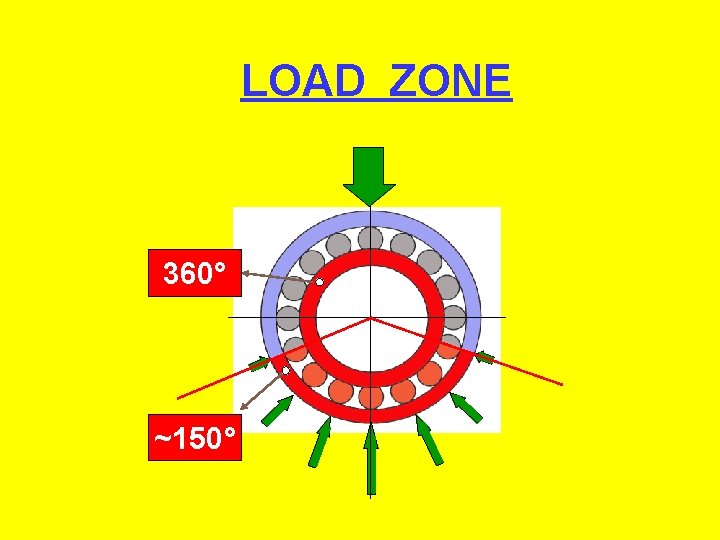
LOAD ZONE 360° ~150°
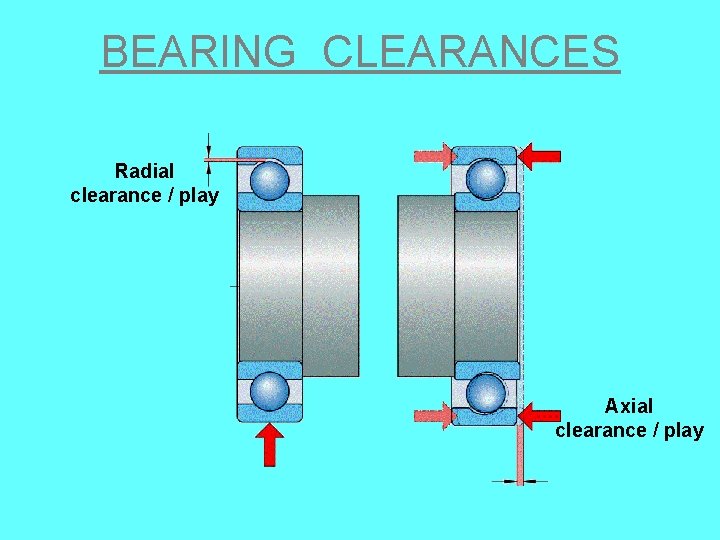
BEARING CLEARANCES Radial clearance / play Axial clearance / play
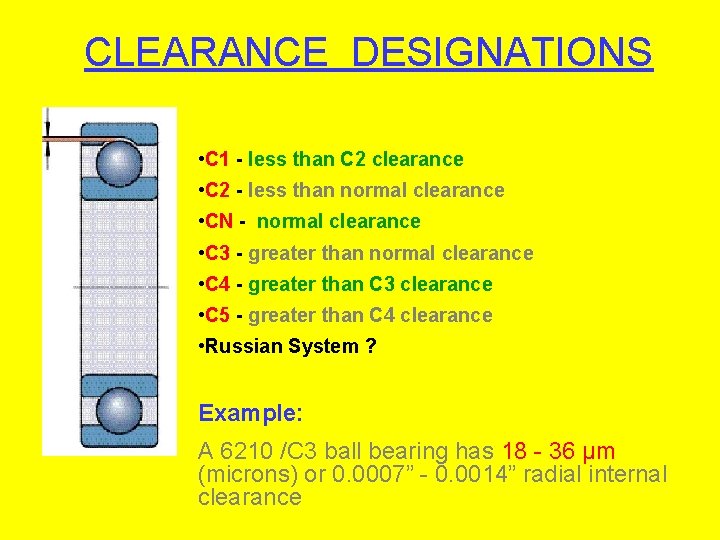
CLEARANCE DESIGNATIONS • C 1 - less than C 2 clearance • C 2 - less than normal clearance • CN - normal clearance • C 3 - greater than normal clearance • C 4 - greater than C 3 clearance • C 5 - greater than C 4 clearance • Russian System ? Example: A 6210 /C 3 ball bearing has 18 - 36 µm (microns) or 0. 0007” - 0. 0014” radial internal clearance
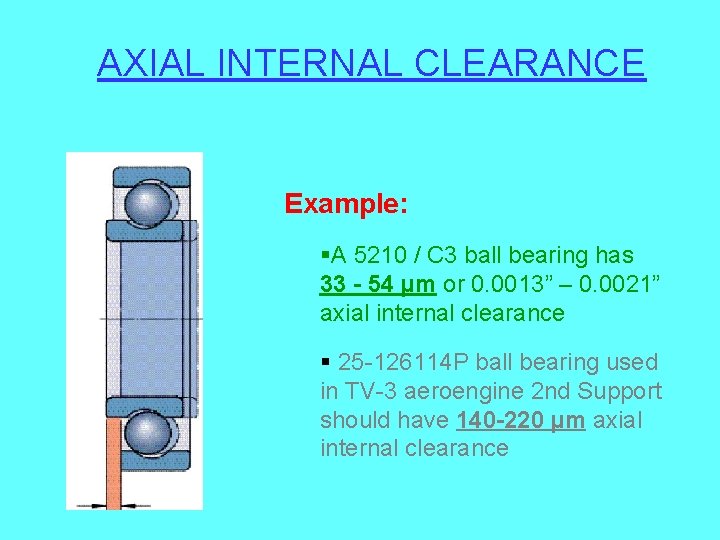
AXIAL INTERNAL CLEARANCE Example: §A 5210 / C 3 ball bearing has 33 - 54 µm or 0. 0013” – 0. 0021” axial internal clearance § 25 -126114 P ball bearing used in TV-3 aeroengine 2 nd Support should have 140 -220 µm axial internal clearance
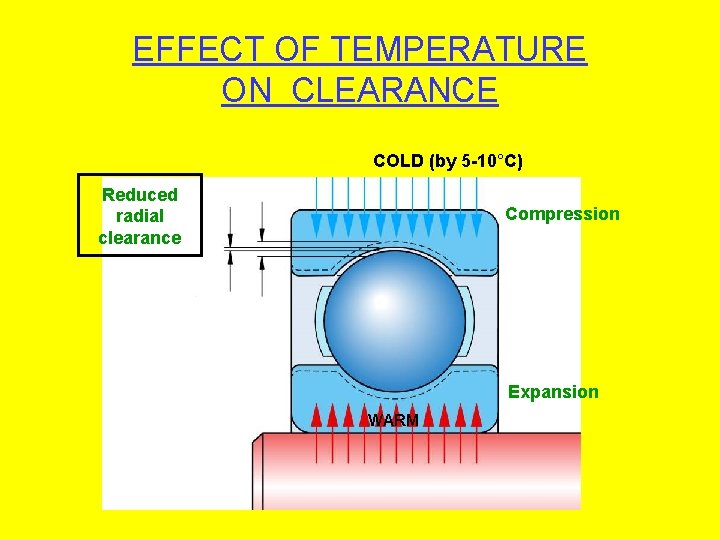
EFFECT OF TEMPERATURE ON CLEARANCE COLD (by 5 -10°C) Reduced radial clearance Compression Expansion WARM
EFFECT OF FIT ON CLEARANCE • INTERFERENCE FIT between shaft and bearing (inner race) reduces radial clearance by approx 80% of the fit. • Because the inner ring expands and the outer ring contracts.
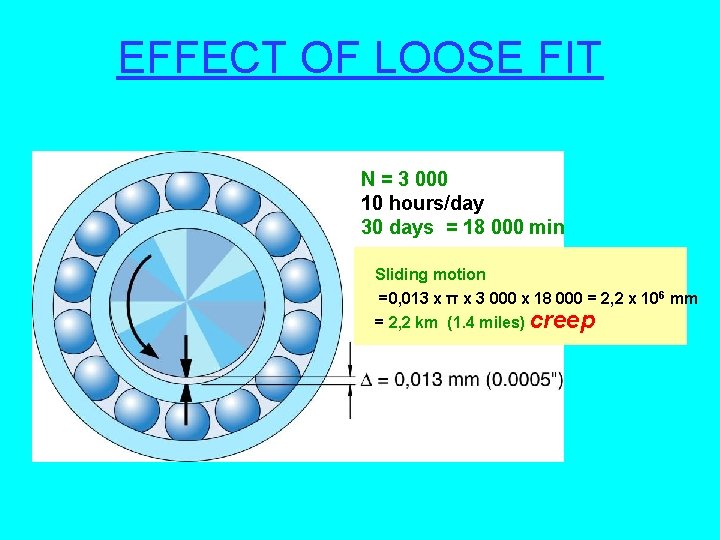
EFFECT OF LOOSE FIT N = 3 000 10 hours/day 30 days = 18 000 min Sliding motion =0, 013 x π x 3 000 x 18 000 = 2, 2 x 106 mm = 2, 2 km (1. 4 miles) creep
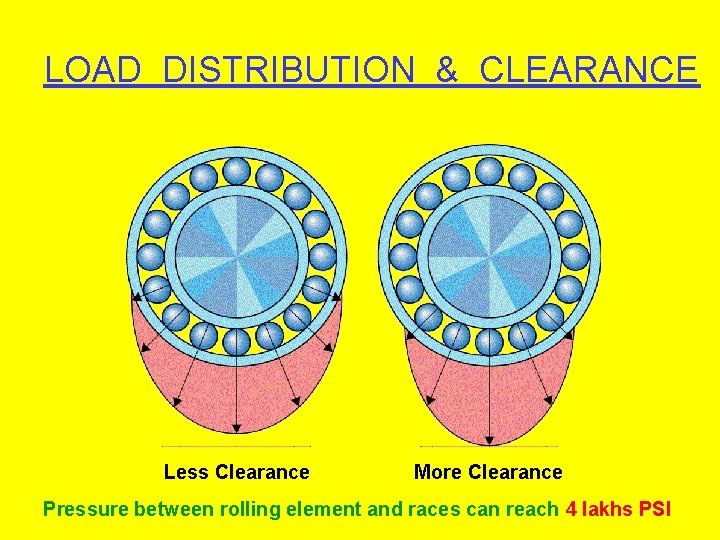
LOAD DISTRIBUTION & CLEARANCE Less Clearance More Clearance Pressure between rolling element and races can reach 4 lakhs PSI
EXCESSIVE CLEARANCE • • • Loading area reduces & stress increases Bearing rigidity reduces Alignment of rolling elements decreases Vibration increases at high speeds Noise increases Running and locating accuracy reduces
PRELOAD • Small amount of loading before running of brg Ø Causes negative clearance Ø Elastic deformation & compressive stress at contact area Ø Bearing rigidity improves Ø Vibration at high speeds reduces Ø Noise reduces Ø Alignment of rolling elements improves (Thrust brgs) Ø Running and locating accuracy improves
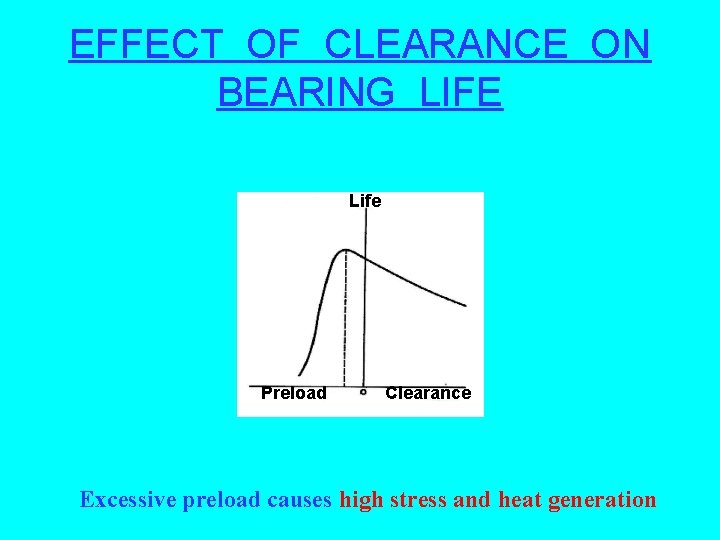
EFFECT OF CLEARANCE ON BEARING LIFE Life Preload Clearance Excessive preload causes high stress and heat generation
BEARING LIFE • Repeated compressive stresses (rolling fatigue) cause flaking of material of raceways and rolling elements and hence failure. • Basic Rating Life L 10 (90% reliability) of the bearing is the total number of revolutions in millions which 90% of the bearings out of the lot reach before or at which the first signs of flaking occur under identical operating conditions.
BEARING LIFE-2 • L 10 = (C / P)n C = Design Load {Basic dynamic rating load (constant radial or axial load when brg is rotating) in N that will give bearing life of 106 revs in accordance with ISO 281: 1990} P = Actual equivalent dynamic load in N n = 3 for ball bearings 3. 33 for roller bearings
BEARING LIFE-3 • If actual load is half of the rated load, life of a ball bearing will increase by 8 times. (Min. Load*) • If actual load increases by 25% above the rated load, the life of a ball bearing gets nearly halved. • Actual service life may be reduced even further below the calculated value because of factors like contamination, misalignment, improper installation or lubrication etc. • Effect of overload is more severe on roller brg.
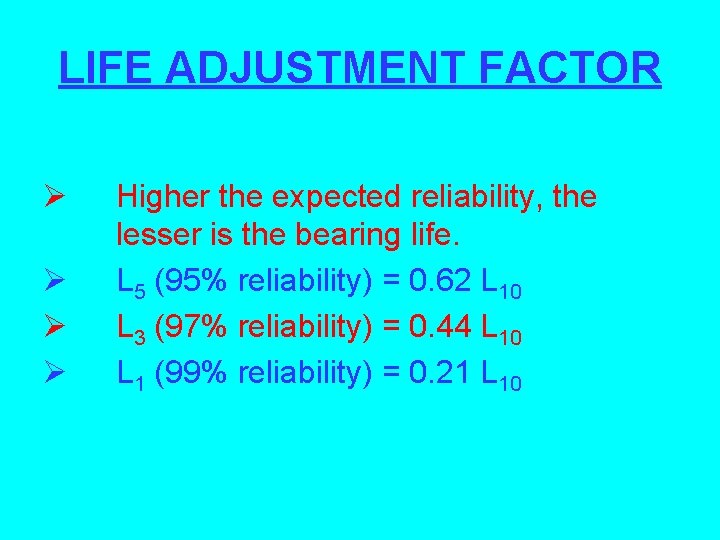
LIFE ADJUSTMENT FACTOR Ø Ø Higher the expected reliability, the lesser is the bearing life. L 5 (95% reliability) = 0. 62 L 10 L 3 (97% reliability) = 0. 44 L 10 L 1 (99% reliability) = 0. 21 L 10
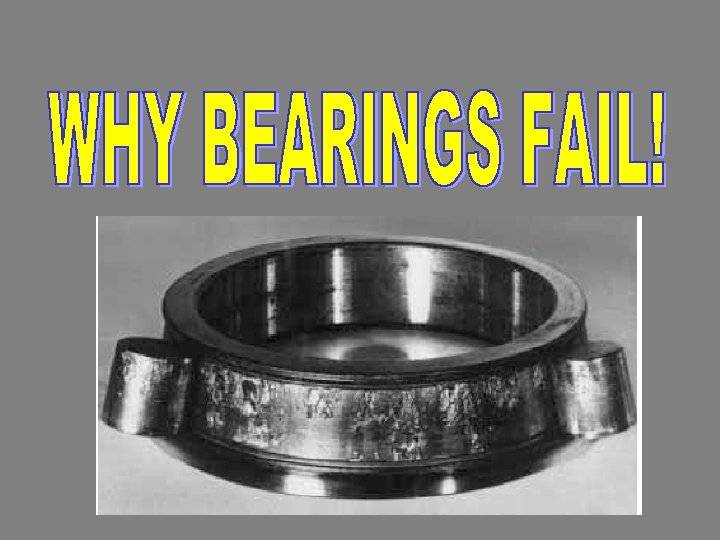
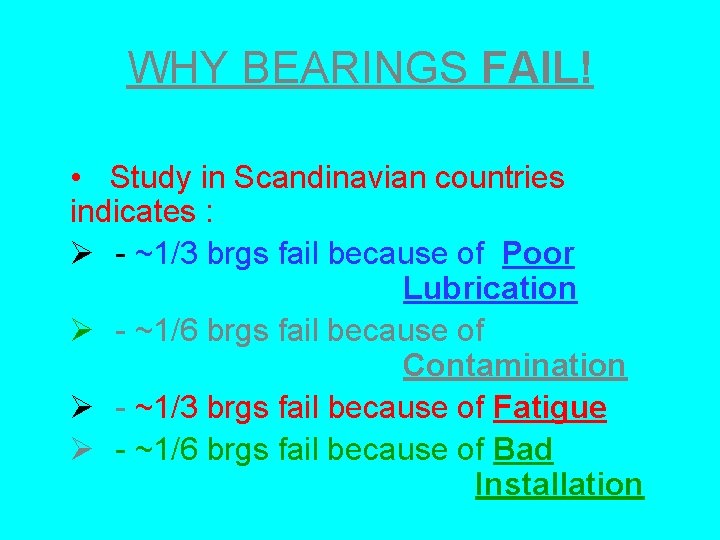
WHY BEARINGS FAIL! • Study in Scandinavian countries indicates : Ø - ~1/3 brgs fail because of Poor Lubrication Ø - ~1/6 brgs fail because of Contamination Ø - ~1/3 brgs fail because of Fatigue Ø - ~1/6 brgs fail because of Bad Installation
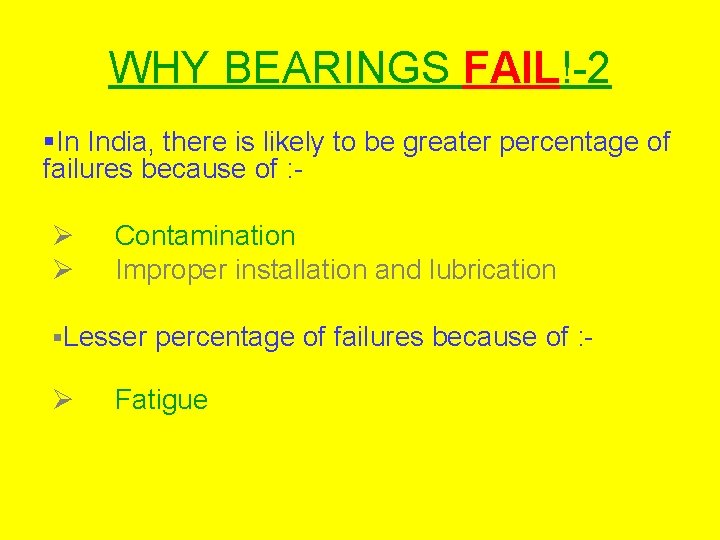
WHY BEARINGS FAIL!-2 §In India, there is likely to be greater percentage of failures because of : Ø Ø Contamination Improper installation and lubrication §Lesser percentage of failures because of : - Ø Fatigue
FAILURE MODE CLASSIFICATION-1 • As per ISO 15243: 2004, there are 15 main failure modes classified as: Ø Fatigue (Repeated compressive stresses) -Subsurface -Surface initiated (metal to metal contact) Ø Wear -Abrasive -Adhesive
FAILURE MODE CLASSIFICATION-2 Ø Corrosion - Moisture, - Fretting - False Brinelling Ø Electrical Erosion -Excess voltage - Current leakage
FAILURE MODE CLASSIFICATION-3 • Plastic Deformation - Overload - Indentation from debris - Indentation by handling • Fracture - Forced - Fatigue - Thermal Cracking
SYMPTOMS OF BEARING FAILURE - Overheating - Noise - Vibration - Obstruction of movement (RDT reduces) - Shaft jammed - Others ?
FAILURES, CAUSES & REMEDIES – FEW EXAMPLES
CORROSION
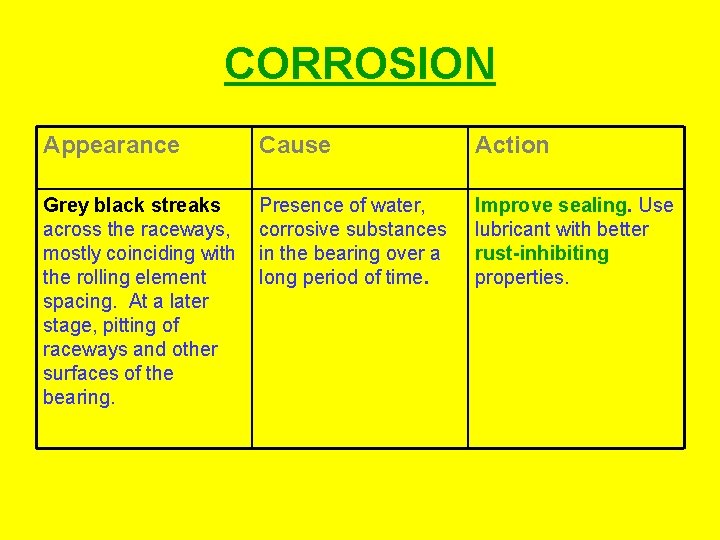
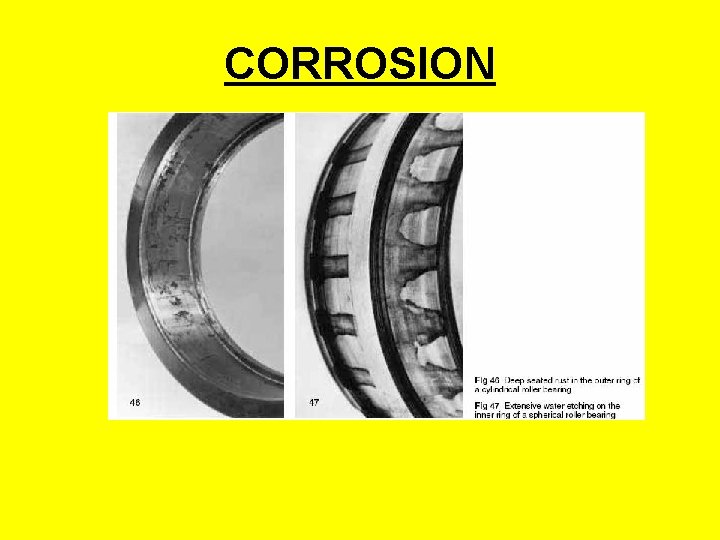
CORROSION Appearance Cause Action Grey black streaks across the raceways, mostly coinciding with the rolling element spacing. At a later stage, pitting of raceways and other surfaces of the bearing. Presence of water, corrosive substances in the bearing over a long period of time. Improve sealing. Use lubricant with better rust-inhibiting properties.
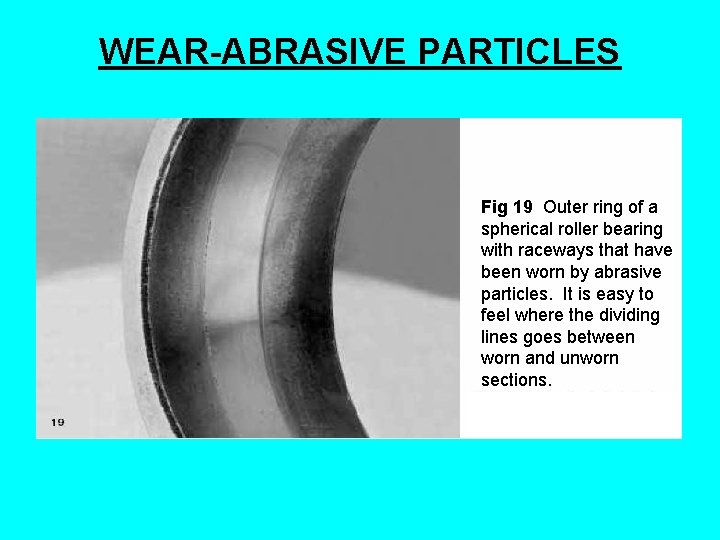
WEAR-ABRASIVE PARTICLES Fig 19 Outer ring of a spherical roller bearing with raceways that have been worn by abrasive particles. It is easy to feel where the dividing lines goes between worn and unworn sections.
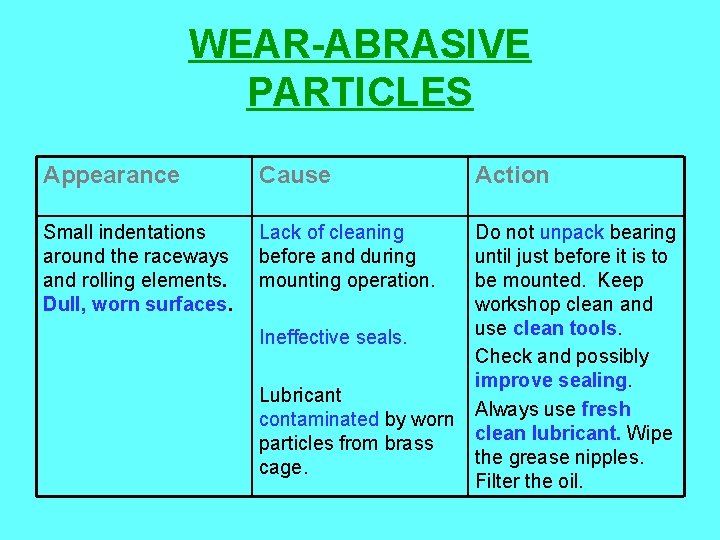
WEAR-ABRASIVE PARTICLES Appearance Cause Action Small indentations around the raceways and rolling elements. Dull, worn surfaces. Lack of cleaning before and during mounting operation. Do not unpack bearing until just before it is to be mounted. Keep workshop clean and use clean tools. Check and possibly improve sealing. Always use fresh clean lubricant. Wipe the grease nipples. Filter the oil. Ineffective seals. Lubricant contaminated by worn particles from brass cage.
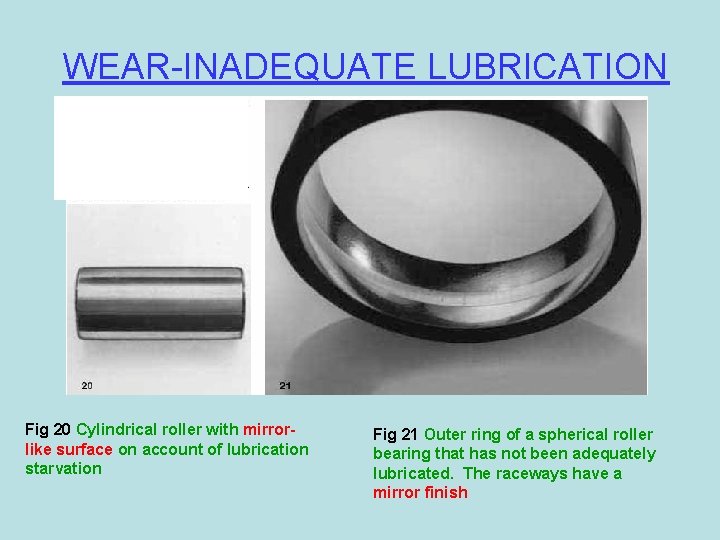
WEAR-INADEQUATE LUBRICATION Fig 20 Cylindrical roller with mirrorlike surface on account of lubrication starvation Fig 21 Outer ring of a spherical roller bearing that has not been adequately lubricated. The raceways have a mirror finish
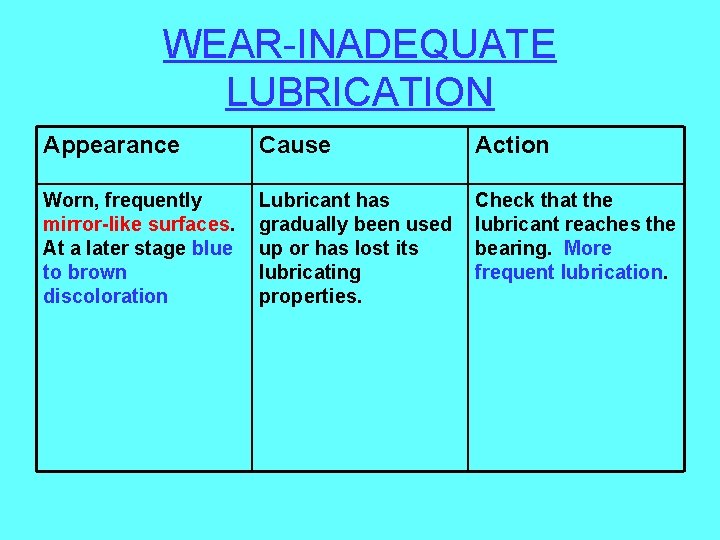
WEAR-INADEQUATE LUBRICATION Appearance Cause Action Worn, frequently mirror-like surfaces. At a later stage blue to brown discoloration Lubricant has gradually been used up or has lost its lubricating properties. Check that the lubricant reaches the bearing. More frequent lubrication.
WEAR DUE TO VIBRATION
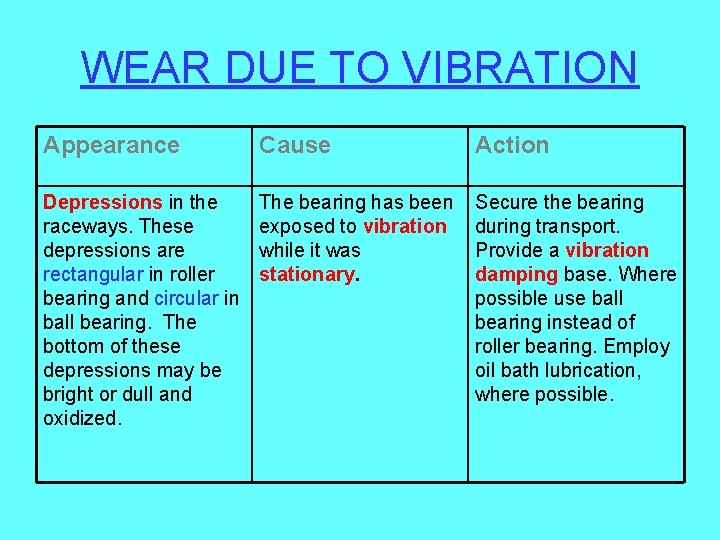
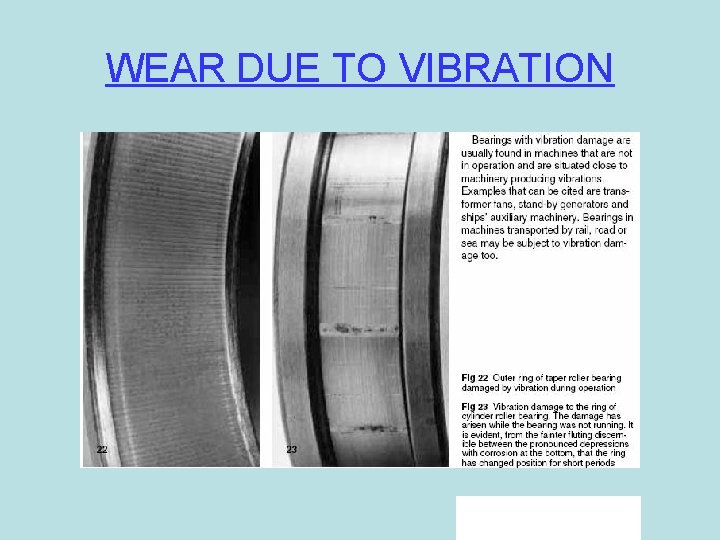
WEAR DUE TO VIBRATION Appearance Cause Action Depressions in the raceways. These depressions are rectangular in roller bearing and circular in ball bearing. The bottom of these depressions may be bright or dull and oxidized. The bearing has been exposed to vibration while it was stationary. Secure the bearing during transport. Provide a vibration damping base. Where possible use ball bearing instead of roller bearing. Employ oil bath lubrication, where possible.
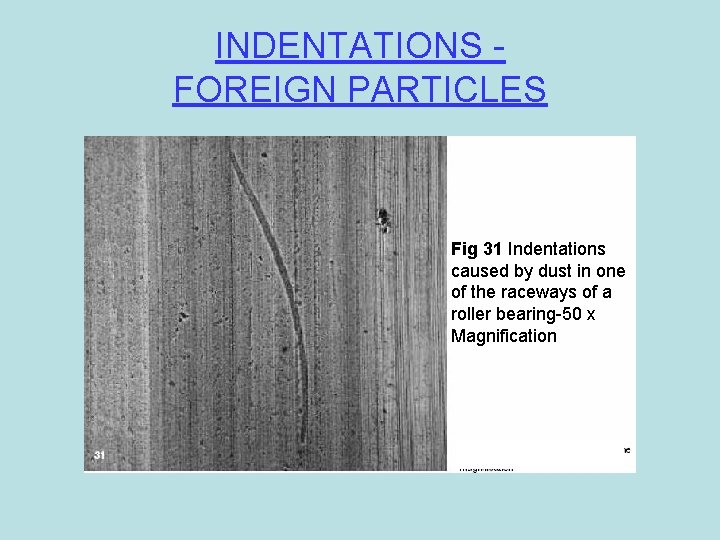
INDENTATIONS FOREIGN PARTICLES Fig 31 Indentations caused by dust in one of the raceways of a roller bearing-50 x Magnification
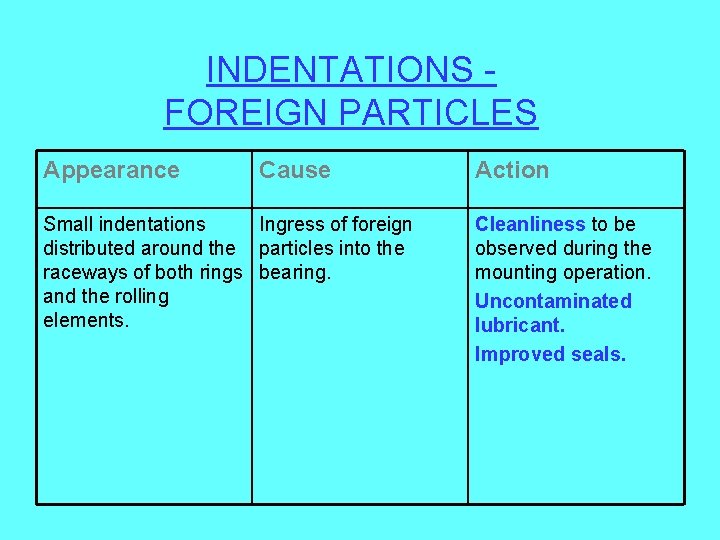
INDENTATIONS FOREIGN PARTICLES Appearance Cause Small indentations Ingress of foreign distributed around the particles into the raceways of both rings bearing. and the rolling elements. Action Cleanliness to be observed during the mounting operation. Uncontaminated lubricant. Improved seals.
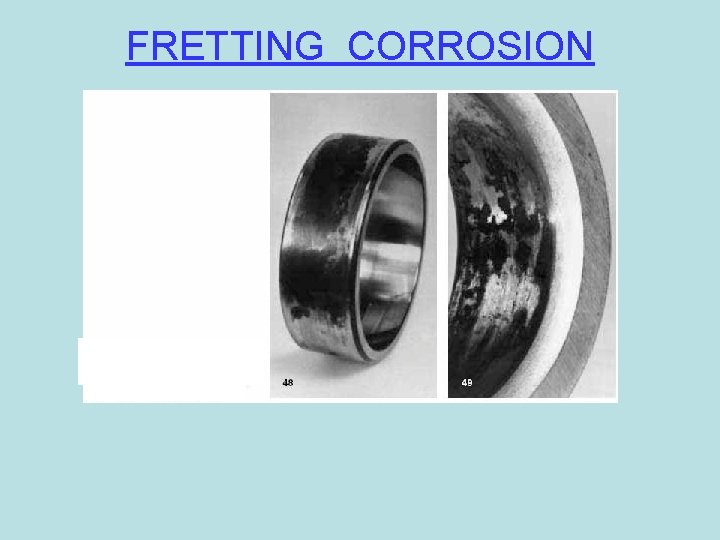
FRETTING CORROSION
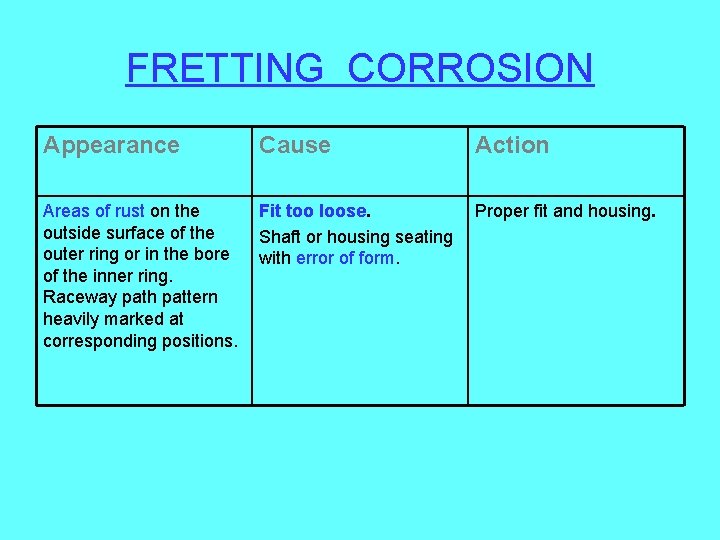
FRETTING CORROSION Appearance Cause Action Areas of rust on the outside surface of the outer ring or in the bore of the inner ring. Raceway path pattern heavily marked at corresponding positions. Fit too loose. Shaft or housing seating with error of form. Proper fit and housing.
SMEARING
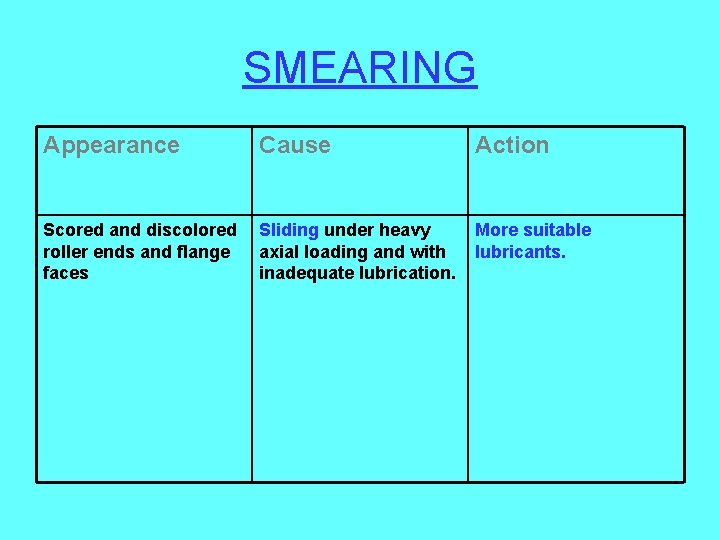
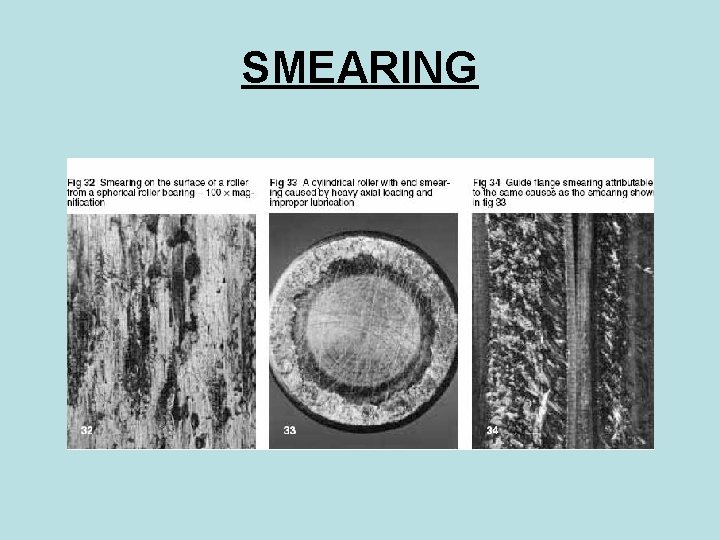
SMEARING Appearance Cause Scored and discolored Sliding under heavy roller ends and flange axial loading and with faces inadequate lubrication. Action More suitable lubricants.
ELECTRIC CURRENT EROSION
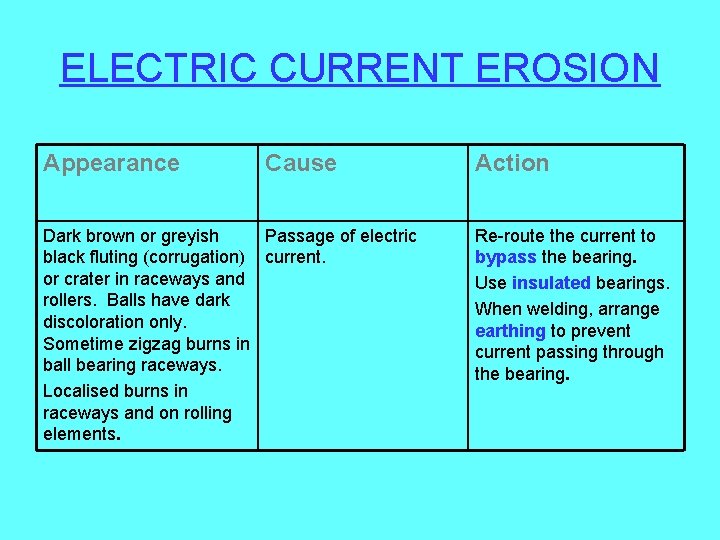
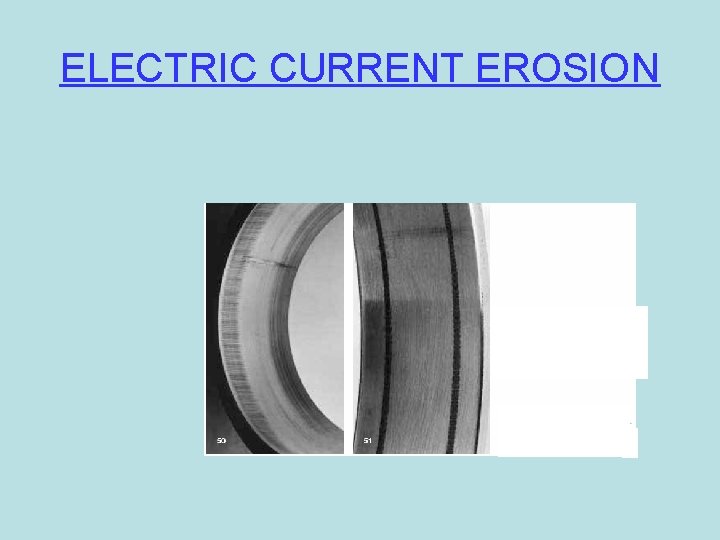
ELECTRIC CURRENT EROSION Appearance Cause Dark brown or greyish Passage of electric black fluting (corrugation) current. or crater in raceways and rollers. Balls have dark discoloration only. Sometime zigzag burns in ball bearing raceways. Localised burns in raceways and on rolling elements. Action Re-route the current to bypass the bearing. Use insulated bearings. When welding, arrange earthing to prevent current passing through the bearing.
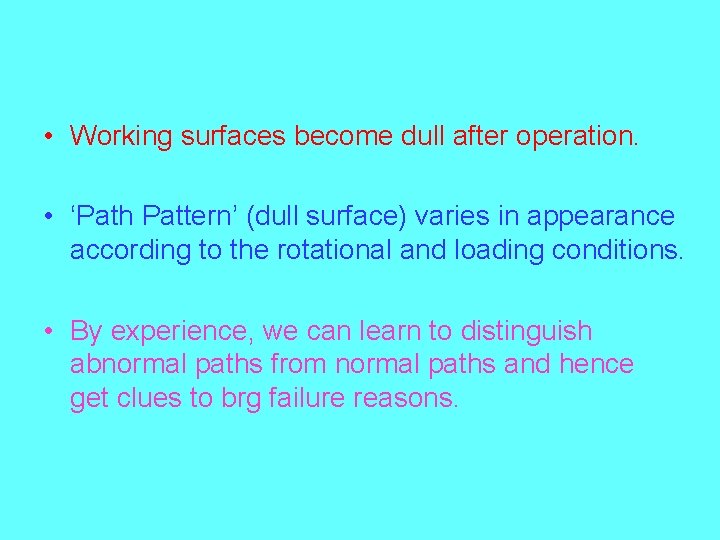
• Working surfaces become dull after operation. • ‘Path Pattern’ (dull surface) varies in appearance according to the rotational and loading conditions. • By experience, we can learn to distinguish abnormal paths from normal paths and hence get clues to brg failure reasons.
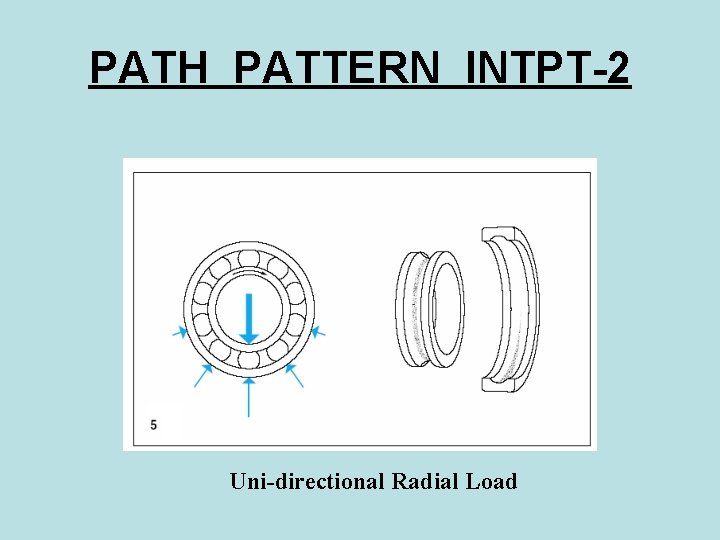
PATH PATTERN INTPT-2 Uni-directional Radial Load
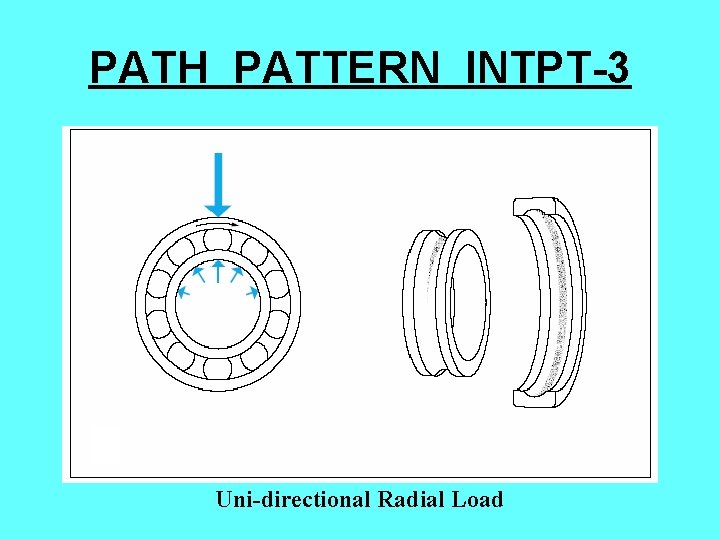
PATH PATTERN INTPT-3 Uni-directional Radial Load
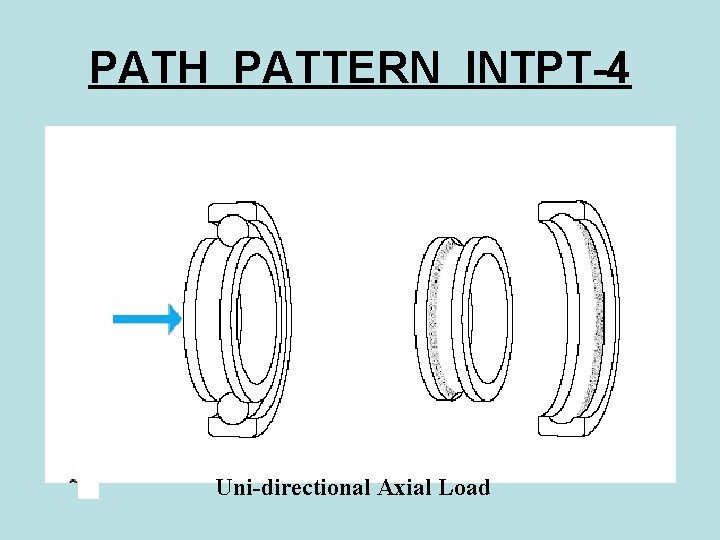
PATH PATTERN INTPT-4 Uni-directional Axial Load
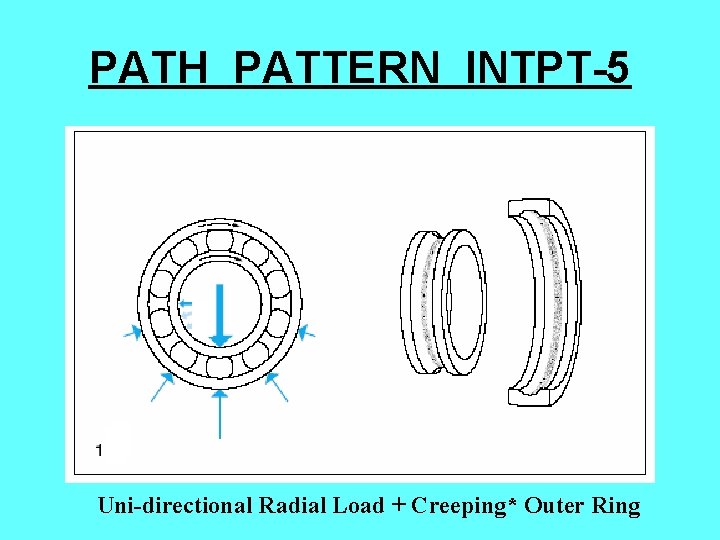
PATH PATTERN INTPT-5 Uni-directional Radial Load + Creeping* Outer Ring
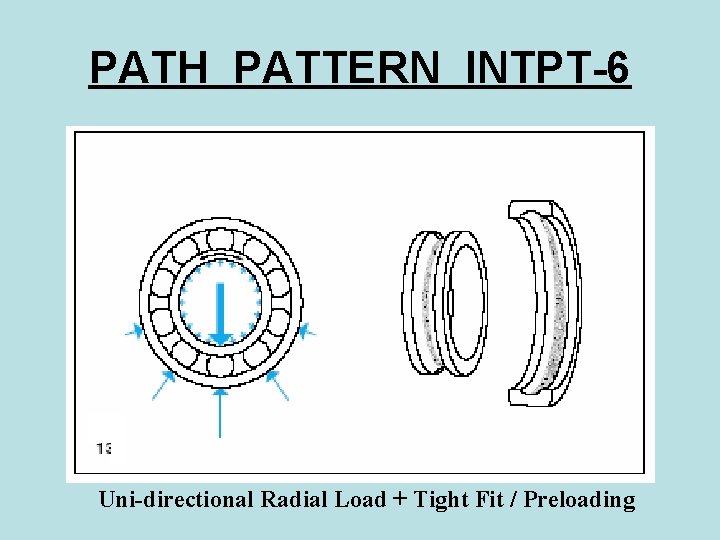
PATH PATTERN INTPT-6 Uni-directional Radial Load + Tight Fit / Preloading
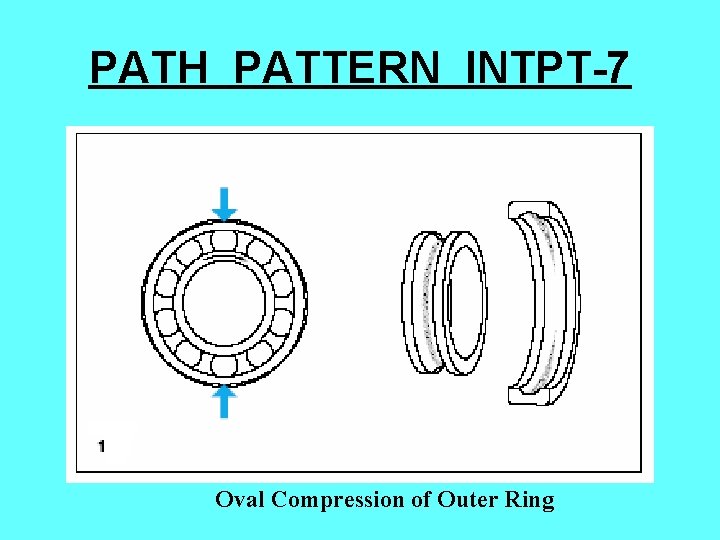
PATH PATTERN INTPT-7 Oval Compression of Outer Ring
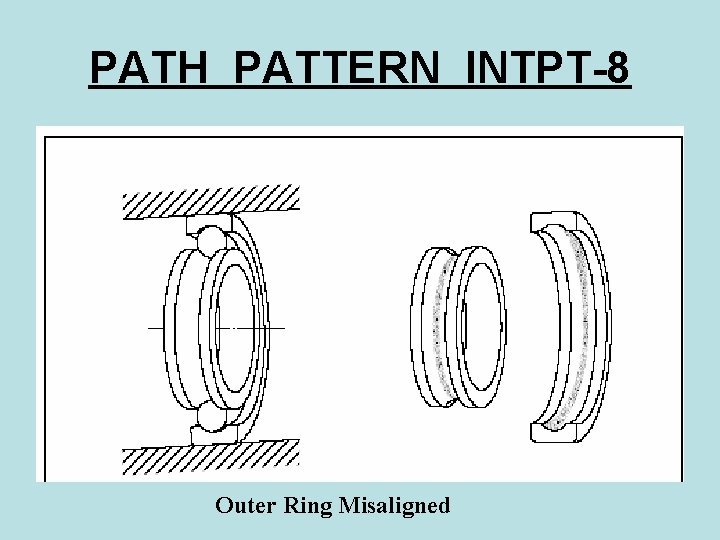
PATH PATTERN INTPT-8 Outer Ring Misaligned
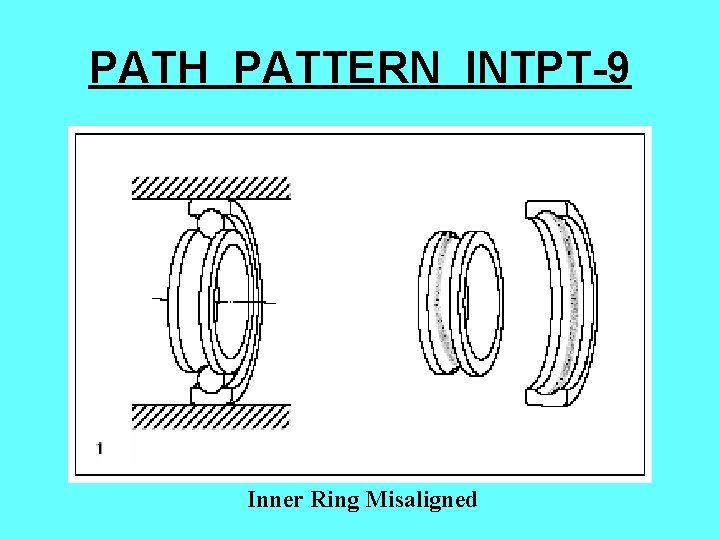
PATH PATTERN INTPT-9 Inner Ring Misaligned
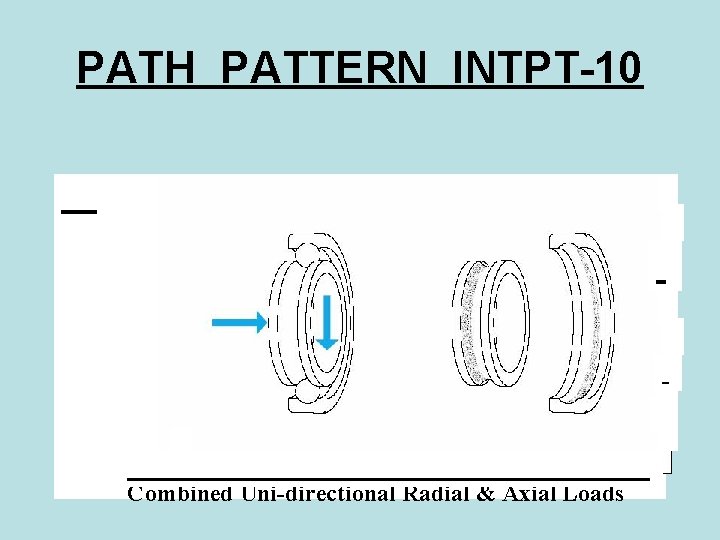
PATH PATTERN INTPT-10 Combined Uni-directional Radial & Axial Loads

![LUBRICATION MODES 2020 -12 -01 ©SKF Slide 80 [Code]](http://slidetodoc.com/presentation_image_h/c9975f79873cf1583a1ec3b732424dc8/image-80.jpg "LUBRICATION MODES 2020 -12 -01 ©SKF Slide 80 [Code]")
LUBRICATION MODES 2020 -12 -01 ©SKF Slide 80 [Code]
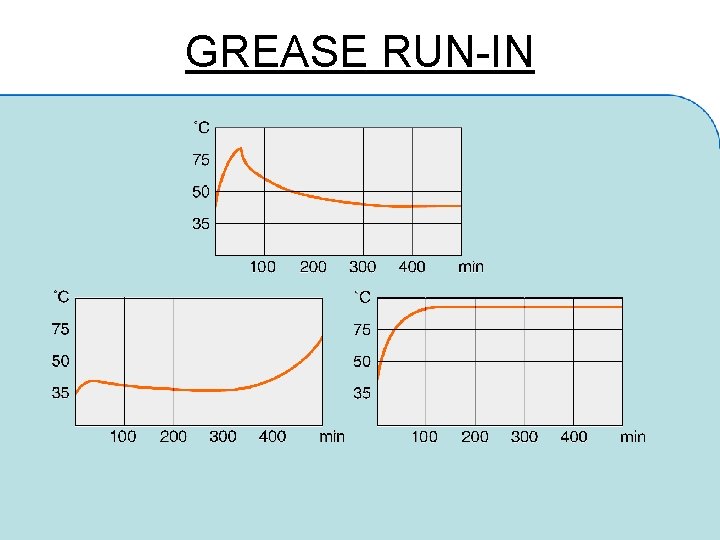
GREASE RUN-IN
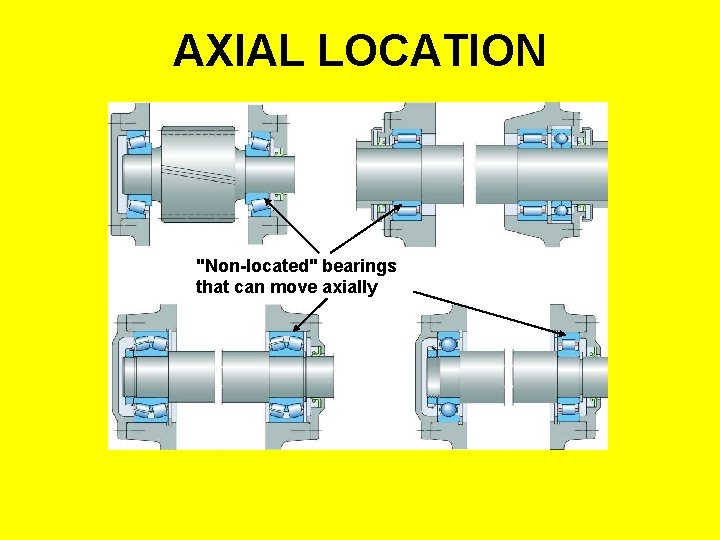
AXIAL LOCATION "Non-located" bearings that can move axially
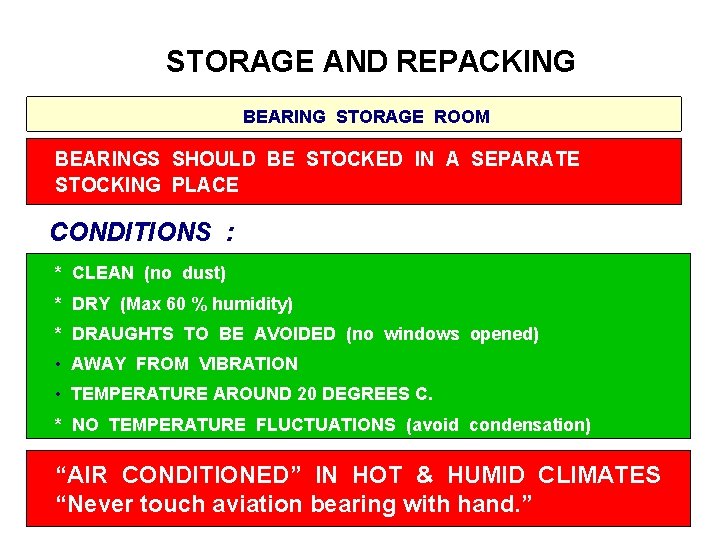
STORAGE AND REPACKING BEARING STORAGE ROOM BEARINGS SHOULD BE STOCKED IN A SEPARATE STOCKING PLACE CONDITIONS : * CLEAN (no dust) * DRY (Max 60 % humidity) * DRAUGHTS TO BE AVOIDED (no windows opened) • AWAY FROM VIBRATION • TEMPERATURE AROUND 20 DEGREES C. * NO TEMPERATURE FLUCTUATIONS (avoid condensation) “AIR CONDITIONED” IN HOT & HUMID CLIMATES “Never touch aviation bearing with hand. ”
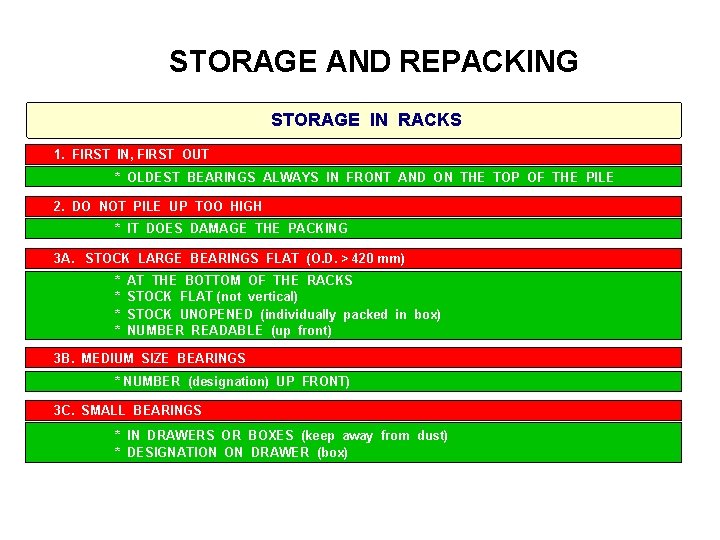
STORAGE AND REPACKING STORAGE IN RACKS 1. FIRST IN, FIRST OUT * OLDEST BEARINGS ALWAYS IN FRONT AND ON THE TOP OF THE PILE 2. DO NOT PILE UP TOO HIGH * IT DOES DAMAGE THE PACKING 3 A. STOCK LARGE BEARINGS FLAT (O. D. > 420 mm) * AT THE BOTTOM OF THE RACKS * STOCK FLAT (not vertical) * STOCK UNOPENED (individually packed in box) * NUMBER READABLE (up front) 3 B. MEDIUM SIZE BEARINGS * NUMBER (designation) UP FRONT) 3 C. SMALL BEARINGS * IN DRAWERS OR BOXES (keep away from dust) * DESIGNATION ON DRAWER (box)
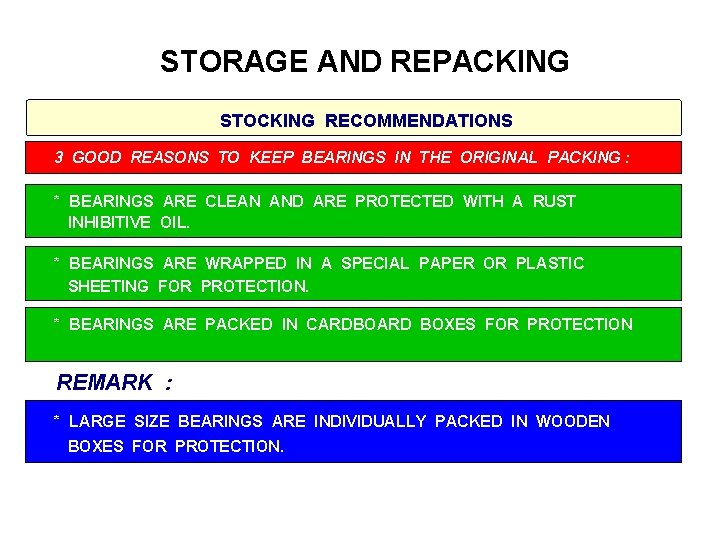
STORAGE AND REPACKING STOCKING RECOMMENDATIONS 3 GOOD REASONS TO KEEP BEARINGS IN THE ORIGINAL PACKING : * BEARINGS ARE CLEAN AND ARE PROTECTED WITH A RUST INHIBITIVE OIL. * BEARINGS ARE WRAPPED IN A SPECIAL PAPER OR PLASTIC SHEETING FOR PROTECTION. * BEARINGS ARE PACKED IN CARDBOARD BOXES FOR PROTECTION REMARK : * LARGE SIZE BEARINGS ARE INDIVIDUALLY PACKED IN WOODEN BOXES FOR PROTECTION.
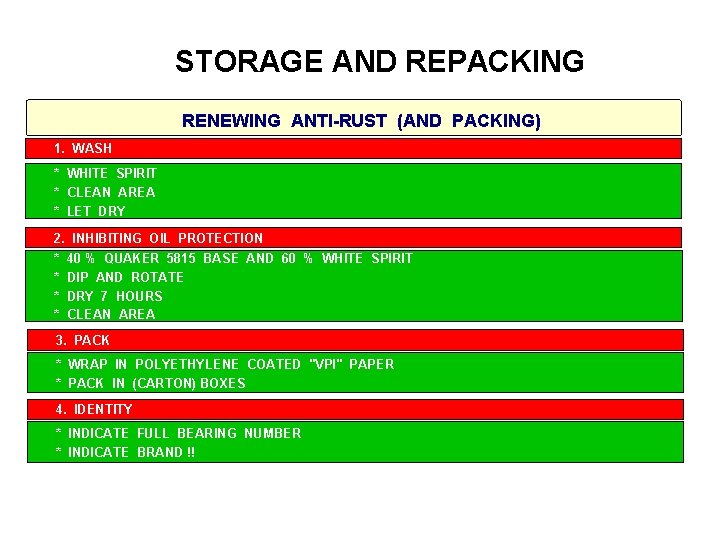
STORAGE AND REPACKING RENEWING ANTI-RUST (AND PACKING) 1. WASH * WHITE SPIRIT * CLEAN AREA * LET DRY 2. INHIBITING OIL PROTECTION * 40 % QUAKER 5815 BASE AND 60 % WHITE SPIRIT * DIP AND ROTATE * DRY 7 HOURS * CLEAN AREA 3. PACK * WRAP IN POLYETHYLENE COATED "VPI" PAPER * PACK IN (CARTON) BOXES 4. IDENTITY * INDICATE FULL BEARING NUMBER * INDICATE BRAND !!



- Slides: 90