
A Presentation by Executive Director Banking Supervision Group
A Presentation by: Executive Director Banking Supervision Group 1

OUTLINE § § Financial Stability - Definition Global Financial Crisis and Regulatory Reforms Central Banks and Financial Stability Framework at SBP Ø Financial Stability Mandate Ø Legal & Supervisory Framework Ø Financial Stability Structure Ø Financial Stability-Key initiatives Ø Way Forward 2

FINANCIAL STABILITY-DEFINITION § No universally accepted definition § Financial stability is a situation in which the financial system is satisfactorily performing its three functions: Ø The financial System is efficiently and smoothly facilitating the intertemporal allocation of resources from savers to investors and allocation of economic resources in general; Ø Forward looking financial risks are being assessed/priced reasonably accurately and are also being relatively well managed; Ø The financial system can comfortably, if not smoothly, absorb financial and real economic surprises and the shocks. Source: Schinai, Garry J. 2006, Safeguarding Financial Stability: Theory and Practice (IMF) 3

FINANCIAL STABILITY-DEFINITION A stable financial system is capable of efficiently allocating resources, assessing and managing financial risks, maintaining employment levels close to the economy’s natural rate, and eliminating relative price movements of real or financial assets that will affect monetary stability or employment levels Source: World Bank Financial stability is defined as a situation in which the function of efficient financial intermediation and payment services continues without disruptions despite internal and external shocks, and financial risks are monitored and managed so well that the possibility of systemic crisis is minimized. Source: State Bank of Pakistan: Financial Stability Review 4
GLOBAL FINANCIAL CRISIS AND REGULATORY REFORMS Key Causes § § § Macro-financial Imbalances Excessive Risk-taking Capital Inadequacy Failing in Supervision Highly Complex Group Structures Impact of GFC § Loss of Output, hampered or slow economic growth § Increase in Public Debt 5
GLOBAL FINANCIAL CRISIS AND REGULATORY REFORMS International Bodies involved in Promoting Global Financial Stability Board (FSB); Basel Committee on Banking Supervision (BCBS); International Association of Insurance Supervisors; International Association of Deposit Insurers (IADI); International Organization of Securities Commissions(IOSCO); § Committee on Payments and Market Infrastructures(CPMI); § Islamic Financial Services Board (IFSB); § Others (including International Monetary Fund, World Bank, etc. ). § § § 6
GLOBAL FINANCIAL CRISIS AND REGULATORY REFORMS Post crisis focus of reforms § Building Resilient Financial Institutions LE Framework, etc. ); (Basel-III, LCR, NSFR, § Addressing Systemically Important Financial Institutions (Too Big to Fail); § Effective Resolution Regime and Policies BCBS Weak Banks Guidance); (FSB Key Attributes, § Enhancing Effectiveness of Supervision (Basel CPs); § Transforming Shadow Banking (FSB Monitoring Framework; develop policies to regulate shadow banking); § Cross Border Cooperation cooperation); (FSB Principles for cross-border § Making Derivatives Market Safer (OTC derivatives reporting to TRs; clearing through CCPs); 7

GLOBAL FINANCIAL CRISIS AND REGULATORY REFORMS Major Regulatory Reforms § Pre-crisis: One main regulatory metric (RW CAR); § Post-crisis : Multiple complementary metrics: Ø Ø Ø Ø RW CAR with Macro-Prudential overlay Leverage Ratio Large Exposure Regime Liquidity Coverage Ratio(LCR) Net Stable Funding Ratio(NSFR) Stress Testing Others 8
GLOBAL FINANCIAL CRISIS AND REGULATORY REFORMS Future direction of Reforms § § § § § Finalization of Basel-III; RWs under Standardized Approach for Credit Risk; Standardized Approach for Operational Risk; Leverage Ratio Surcharge for G-SIBs; Shift in focus from standards (regulations) to supervision; Treatment of sovereign exposures Fintech; Cyber Security Risk; Expected loss provisioning and new accounting standards; 9
GLOBAL FINANCIAL CRISIS AND REGULATORY REFORMS Implementation Monitoring of Reforms § FSB monitors implementation of financial reforms and report periodically to the G 20: Ø Reporting on FSB members’ commitments and progress in implementing international financial standards; Ø Conducting peer reviews of FSB members; and Ø Encouraging global adherence to prudential regulatory and supervisory standards. § Basel Committee’s Regulatory Consistency Assessment Programme (RCAP); § IMF & World Bank Assessments (Financial Sector Assessment Programs-FSAP). 10
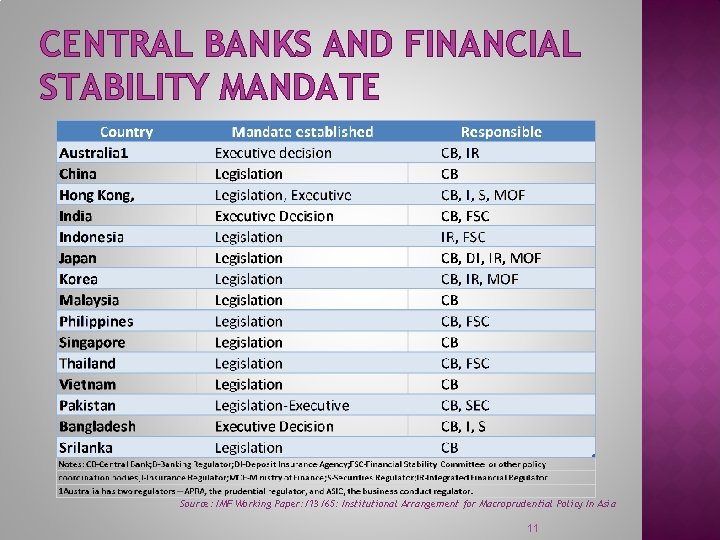
CENTRAL BANKS AND FINANCIAL STABILITY MANDATE Source: IMF Working Paper: /13/65: Institutional Arrangement for Macroprudential Policy In Asia 11
FINANCIAL STABILITY FRAMEWORK AT STATE BANK OF PAKISTAN 12
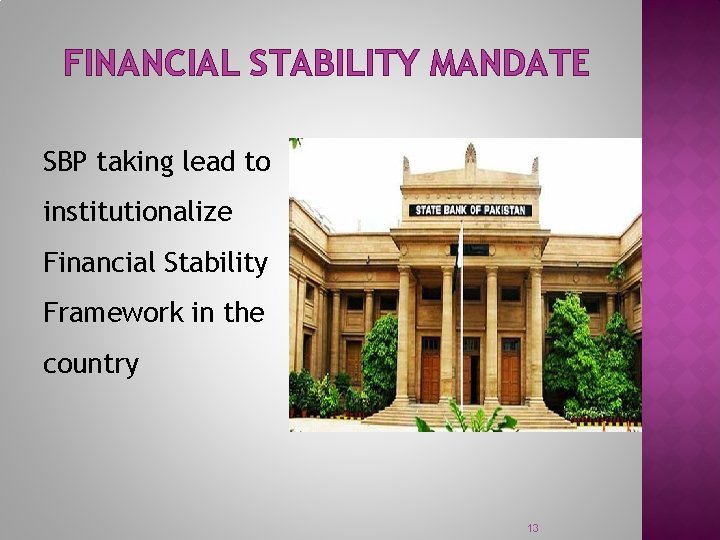
FINANCIAL STABILITY MANDATE SBP taking lead to institutionalize Financial Stability Framework in the country 13
FINANCIAL STABILITY MANDATE SBP Vision and Mission Statement Vision: To be an independent and credible central bank that achieve monetary and financial stability and inclusive financial sector development for the long term benefit of the people of Pakistan Mission: To promote monetary and financial stability and foster a sound and dynamic financial system, so as to achieve sustained and equitable economic growth and prosperity in Pakistan 14
FINANCIAL STABILITY MANDATE SBP Strategic Plan “Vision 2020” foucs on following six strategic imperatives: SG-1 : Enhance the effectiveness of monetary policy; SG-2 : Strengthen the financial system stability regime; SG-3 : Improve the efficiency, effectiveness and fairness of the banking system; SG-4 : Increase financial inclusion; SG-5 : Develop modern and robust payments systems; and SG-6 : Strengthen SBP’s organizational efficiency and effectiveness; 15

FINANCIAL STABILITY MANDATE SBP Strategic Plan “Vision 2020” § Key activities under SG-2 (Strengthening the financial system stability regime): Ø Design and implement a comprehensive financial system stability framework consistent with international standards; Ø Improve crisis management framework; Ø Implement Deposit Insurance Scheme; Ø Pursue necessary laws and regulations to implement the financial system stability framework; Ø Establish a National Financial Stability Council; Ø Review lender of last resort facility; 16
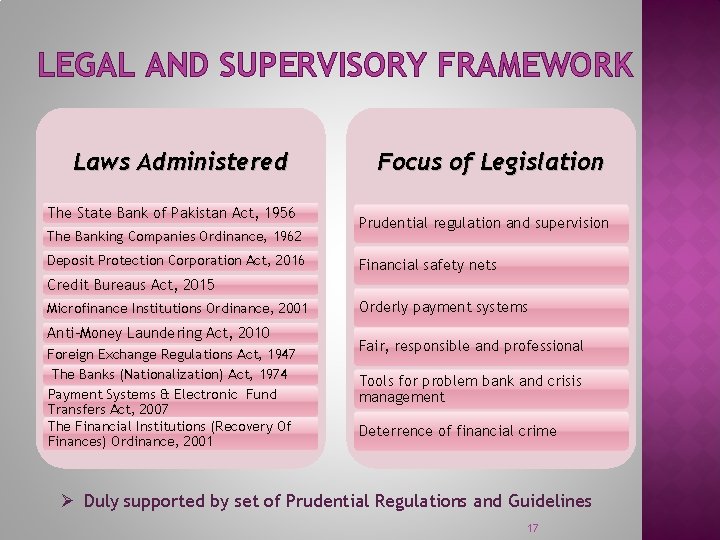
LEGAL AND SUPERVISORY FRAMEWORK Laws Administered The State Bank of Pakistan Act, 1956 The Banking Companies Ordinance, 1962 Deposit Protection Corporation Act, 2016 Focus of Legislation Prudential regulation and supervision Financial safety nets Credit Bureaus Act, 2015 Microfinance Institutions Ordinance, 2001 Anti-Money Laundering Act, 2010 Foreign Exchange Regulations Act, 1947 The Banks (Nationalization) Act, 1974 Payment Systems & Electronic Fund Transfers Act, 2007 The Financial Institutions (Recovery Of Finances) Ordinance, 2001 Orderly payment systems Fair, responsible and professional Tools for problem bank and crisis management Deterrence of financial crime Ø Duly supported by set of Prudential Regulations and Guidelines 17

LEGAL AND SUPERVISORY FRAMEWORK Supervisory Framework § Pakistan is compliant with most BCP on Supervisory approach, techniques and reporting; Ø SBP uses CAMELS system for supervision of banks, that is being used by a number of other regulatory bodies in various jurisdictions Ø Key Elements of Supervisory Framework Ø Ø On-site Inspection Off-site Surveillance Ø Outcomes of Supervisory Assessment Ø Enforcement Actions Ø Problem Bank Management / Bank Resolution 18

LEGAL AND SUPERVISORY FRAMEWORK Supporting Micro and Macro Surveillance Framework Macrosurveillance • • • Financial Surveillance/ Macro- analysis • Financial Institutions • Financial markets • Financial Market Infrastructure • Stress Testing Systemic Risk Assessment • D-SIBs • Large Exposures • Financial Conglomerates Supervisory Practices Assessment Micro-Surveillance • • Banking Supervision On-site inspection Off-site Supervision and Enforcement Coverage: • Banks • Islamic Banks • Foreign Banks • Microfinance banks • Development Finance Institutions • Exchange Companies • Regulation Bank Resolution arrangements Banking Conduct and Consumer Protection Banking Policy and Regulations Payments Systems 19
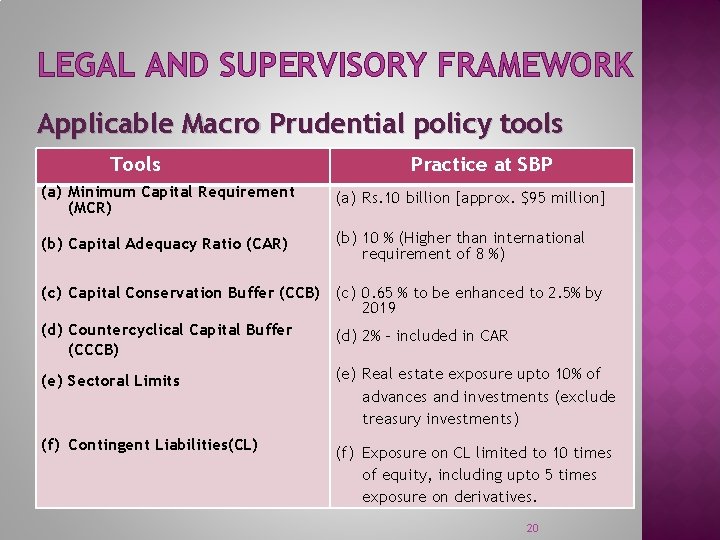
LEGAL AND SUPERVISORY FRAMEWORK Applicable Macro Prudential policy tools Tools Practice at SBP (a) Minimum Capital Requirement (MCR) (a) Rs. 10 billion [approx. $95 million] (b) Capital Adequacy Ratio (CAR) (b) 10 % (Higher than international requirement of 8 %) (c) Capital Conservation Buffer (CCB) (c) 0. 65 % to be enhanced to 2. 5% by 2019 (d) Countercyclical Capital Buffer (d) 2% - included in CAR (CCCB) (e) Sectoral Limits (e) Real estate exposure upto 10% of advances and investments (exclude treasury investments) (f) Contingent Liabilities(CL) (f) Exposure on CL limited to 10 times of equity, including upto 5 times exposure on derivatives. 20
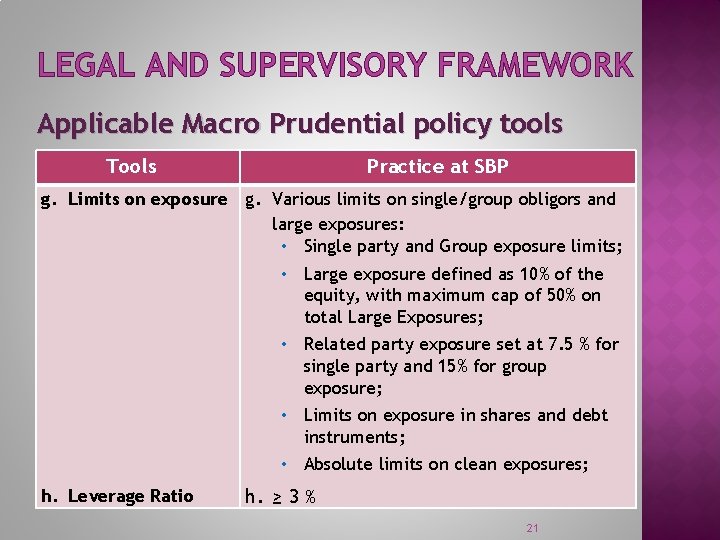
LEGAL AND SUPERVISORY FRAMEWORK Applicable Macro Prudential policy tools Tools Practice at SBP g. Limits on exposure g. Various limits on single/group obligors and large exposures: • Single party and Group exposure limits; • Large exposure defined as 10% of the equity, with maximum cap of 50% on total Large Exposures; • Related party exposure set at 7. 5 % for single party and 15% for group exposure; • Limits on exposure in shares and debt instruments; • Absolute limits on clean exposures; h. Leverage Ratio h. ≥ 3 % 21
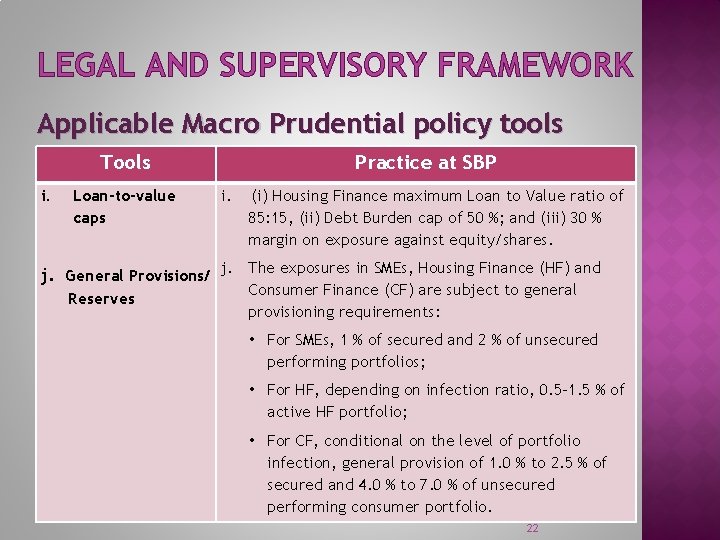
LEGAL AND SUPERVISORY FRAMEWORK Applicable Macro Prudential policy tools Tools i. Loan-to-value caps Practice at SBP i. (i) Housing Finance maximum Loan to Value ratio of 85: 15, (ii) Debt Burden cap of 50 %; and (iii) 30 % margin on exposure against equity/shares. j. General Provisions/ j. The exposures in SMEs, Housing Finance (HF) and Reserves Consumer Finance (CF) are subject to general provisioning requirements: • For SMEs, 1 % of secured and 2 % of unsecured performing portfolios; • For HF, depending on infection ratio, 0. 5 -1. 5 % of active HF portfolio; • For CF, conditional on the level of portfolio infection, general provision of 1. 0 % to 2. 5 % of secured and 4. 0 % to 7. 0 % of unsecured performing consumer portfolio. 22
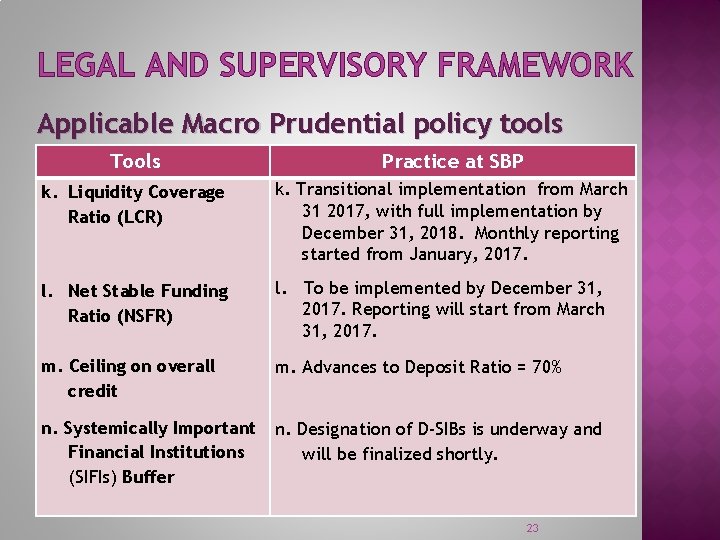
LEGAL AND SUPERVISORY FRAMEWORK Applicable Macro Prudential policy tools Tools Practice at SBP k. Liquidity Coverage Ratio (LCR) k. Transitional implementation from March 31 2017, with full implementation by December 31, 2018. Monthly reporting started from January, 2017. l. Net Stable Funding Ratio (NSFR) l. To be implemented by December 31, 2017. Reporting will start from March 31, 2017. m. Ceiling on overall credit m. Advances to Deposit Ratio = 70% n. Systemically Important Financial Institutions (SIFIs) Buffer n. Designation of D-SIBs is underway and will be finalized shortly. 23
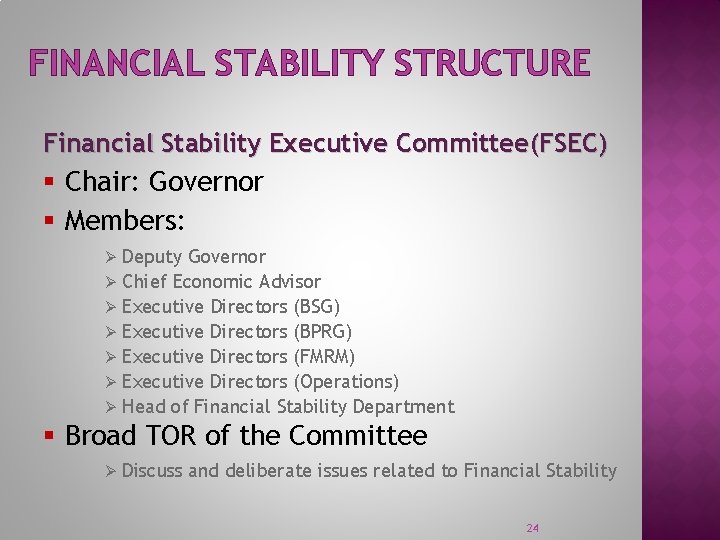
FINANCIAL STABILITY STRUCTURE Financial Stability Executive Committee(FSEC) § Chair: Governor § Members: Deputy Governor Ø Chief Economic Advisor Ø Executive Directors (BSG) Ø Executive Directors (BPRG) Ø Executive Directors (FMRM) Ø Executive Directors (Operations) Ø Head of Financial Stability Department Ø § Broad TOR of the Committee Ø Discuss and deliberate issues related to Financial Stability 24

FINANCIAL STABILITY STRUCTURE Establishment of National Financial Stability Council § SBP working in coordination with other regulators for establishment of the council § Mandate would be to strengthen Financial System Stability § Scope: Financial System covering, financial institutions, financial markets and financial infrastructure § The Council will deliberate upon issues related to systemic risk, and suggest possible arrangements for crisis preparedness and issuing a coordinated response 25
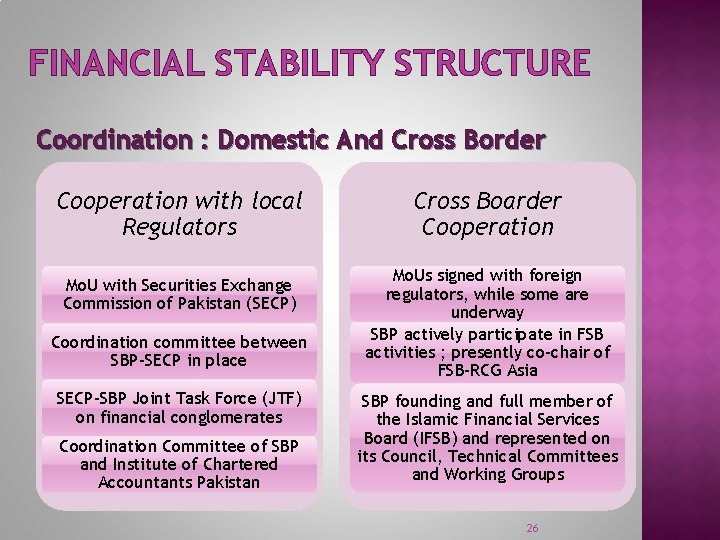
FINANCIAL STABILITY STRUCTURE Coordination : Domestic And Cross Border Cooperation with local Regulators Mo. U with Securities Exchange Commission of Pakistan (SECP) Coordination committee between SBP-SECP in place SECP-SBP Joint Task Force (JTF) on financial conglomerates Coordination Committee of SBP and Institute of Chartered Accountants Pakistan Cross Boarder Cooperation Mo. Us signed with foreign regulators, while some are underway SBP actively participate in FSB activities ; presently co-chair of FSB-RCG Asia SBP founding and full member of the Islamic Financial Services Board (IFSB) and represented on its Council, Technical Committees and Working Groups 26
FINANCIAL STABILITY- KEY INITIATIVES Building Resilient Financial Institutions § SBP implemented Basel III: ØHigher capital requirements (2% above Basel standard) under Basel III; ØIntroduced Leverage ratio; ØImplemented Liquidity Coverage Ratio (LCR) and Net Stable Funding Ratio(NSFR). 27
FINANCIAL STABILITY- KEY INITIATIVES Domestic Systemically Important Banks § No G-SIFIs in Pakistan; though some banks are systemically important, the failure of which may significantly impact the financial sector. § SBP is presently working on designing a framework for Domestic Systemically Important Banks (D-SIBs), in line with international standards and practices. 28
FINANCIAL STABILITY- KEY INITIATIVES Consolidated Supervision § SBP working to institute an effective framework for consolidated supervision to supervise banking groups in line with the Basel Core Principles § Developed a basic mechanism for ongoing supervision of banking groups § Dedicated joint task force (JTF) with Securities & Exchange Commission of Pakistan (SECP) (securities, insurance and NBFI supervisor) for coordination and cooperation on matters related to financial conglomerates. § Envisaging certain amendments in the banking law 29
FINANCIAL STABILITY- KEY INITIATIVES Monitoring of Large Exposures § Under the Prudential Regulations, SBP has introduced limits on single/group obligor exposure and defined large exposures; § SBP is also working to align the large exposure framework as per the BCBS standard “Supervisory framework for measuring and controlling large exposure” issued in April 2014. 30
FINANCIAL STABILITY- KEY INITIATIVES Financial Stability Assessments § Annual Report on State of Economy § Annual Financial Stability Review § Quarterly reports on State of Economy, Performance of Banking System, Payment Systems, Islamic Banking etc. § Quarterly Financial Soundness Indicators-Core and encouraged both § Stress Testing-Sensitivity and Scenario Analysis § Regular Studies on Financial Sector Issues 31
FINANCIAL STABILITY- KEY INITIATIVES Assessment of International standards and best practices § FSB Key Attributes of Effective Resolution Regime; § Basel Core Principles for Effective Banking Supervision; § Effective Elements of Macro prudential Policy Framework; § Comments on Consultative Documents issued by BIS and FSB and assessment of various standards for possible application in Pakistan; 32
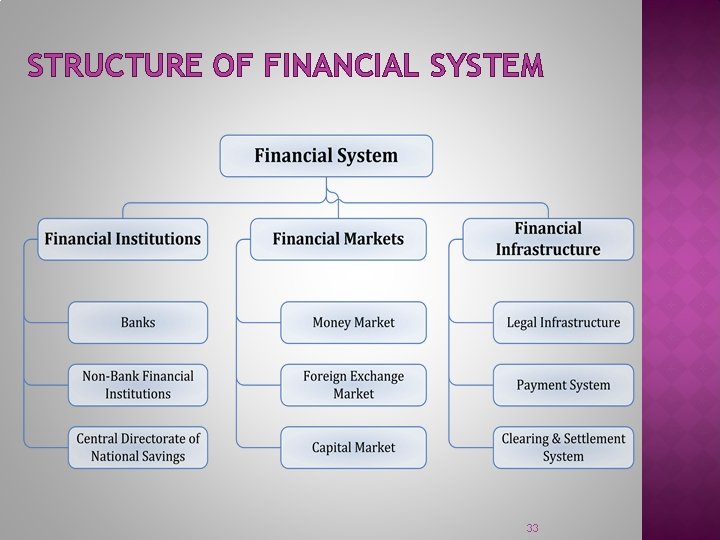
STRUCTURE OF FINANCIAL SYSTEM 33
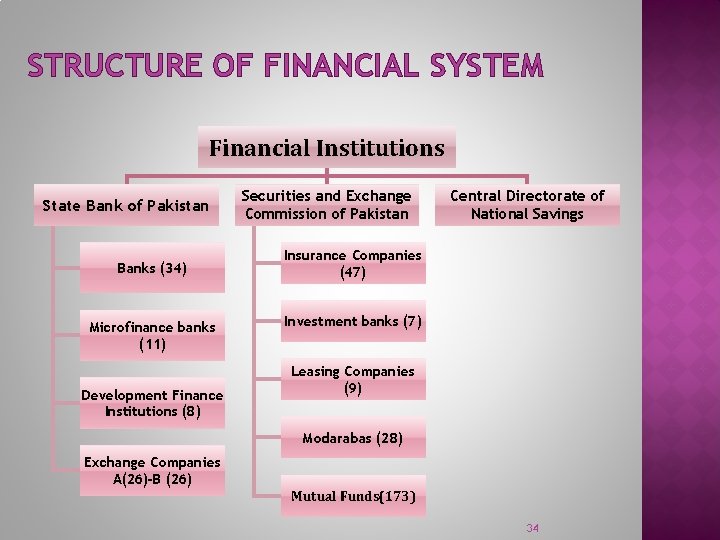
STRUCTURE OF FINANCIAL SYSTEM Financial Institutions State Bank of Pakistan Banks (34) Microfinance banks (11) Development Finance Institutions (8) Securities and Exchange Commission of Pakistan Central Directorate of National Savings Insurance Companies (47) Investment banks (7) Leasing Companies (9) Modarabas (28) Exchange Companies A(26)-B (26) Mutual Funds(173) 34
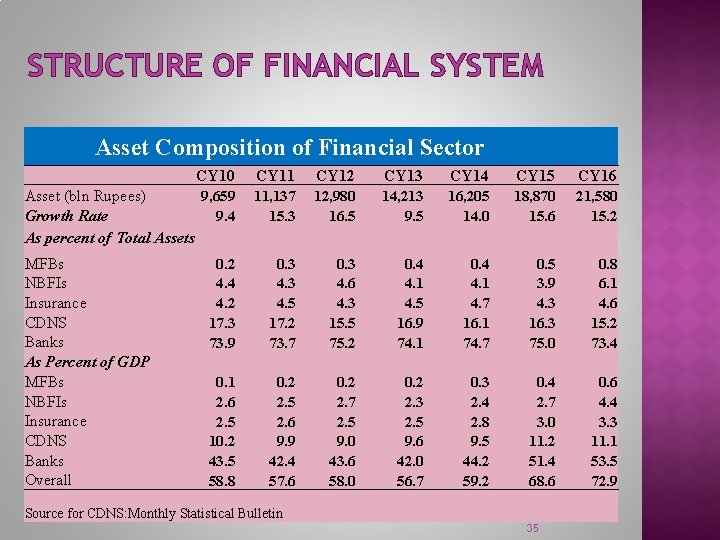
STRUCTURE OF FINANCIAL SYSTEM Asset Composition of Financial Sector CY 10 CY 11 CY 12 CY 13 CY 14 CY 15 CY 16 Asset (bln Rupees) 9, 659 Growth Rate 9. 4 As percent of Total Assets 11, 137 15. 3 12, 980 16. 5 14, 213 9. 5 16, 205 14. 0 18, 870 15. 6 21, 580 15. 2 0. 2 4. 4 4. 2 17. 3 73. 9 0. 3 4. 5 17. 2 73. 7 0. 3 4. 6 4. 3 15. 5 75. 2 0. 4 4. 1 4. 5 16. 9 74. 1 0. 4 4. 1 4. 7 16. 1 74. 7 0. 5 3. 9 4. 3 16. 3 75. 0 0. 8 6. 1 4. 6 15. 2 73. 4 0. 1 2. 6 2. 5 10. 2 43. 5 58. 8 0. 2 2. 5 2. 6 9. 9 42. 4 57. 6 0. 2 2. 7 2. 5 9. 0 43. 6 58. 0 0. 2 2. 3 2. 5 9. 6 42. 0 56. 7 0. 3 2. 4 2. 8 9. 5 44. 2 59. 2 0. 4 2. 7 3. 0 11. 2 51. 4 68. 6 0. 6 4. 4 3. 3 11. 1 53. 5 72. 9 MFBs NBFIs Insurance CDNS Banks As Percent of GDP MFBs NBFIs Insurance CDNS Banks Overall Source for CDNS: Monthly Statistical Bulletin 35
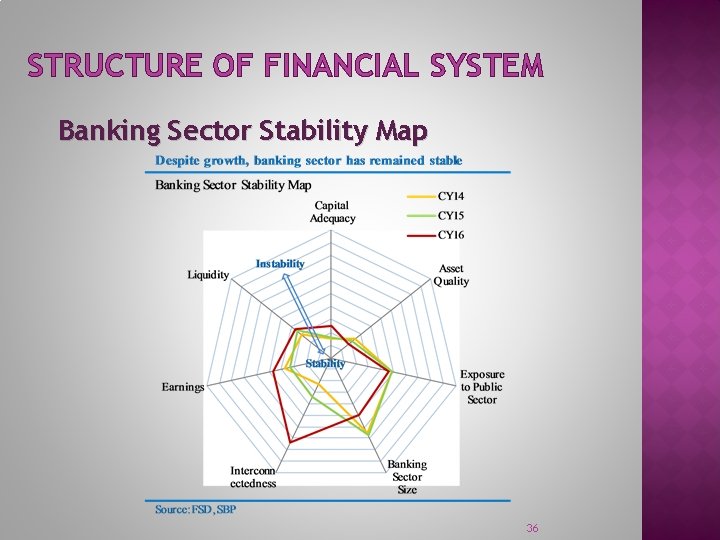
STRUCTURE OF FINANCIAL SYSTEM Banking Sector Stability Map 36
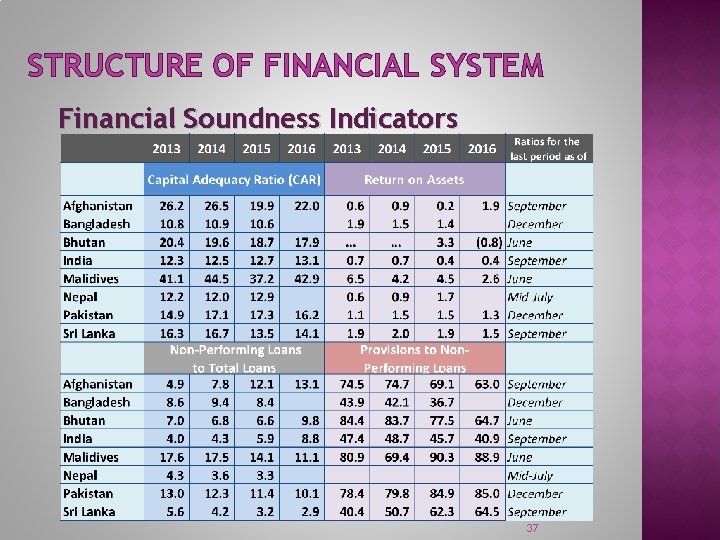
STRUCTURE OF FINANCIAL SYSTEM Financial Soundness Indicators 37
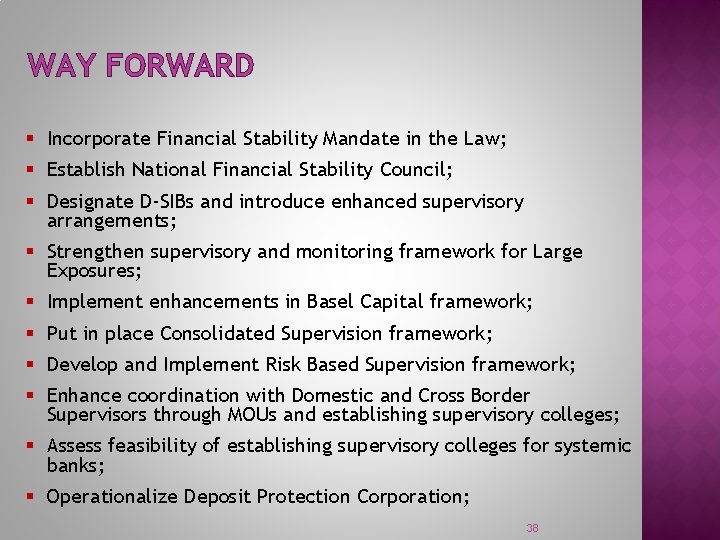
WAY FORWARD § Incorporate Financial Stability Mandate in the Law; § Establish National Financial Stability Council; § Designate D-SIBs and introduce enhanced supervisory arrangements; § Strengthen supervisory and monitoring framework for Large Exposures; § Implement enhancements in Basel Capital framework; § Put in place Consolidated Supervision framework; § Develop and Implement Risk Based Supervision framework; § Enhance coordination with Domestic and Cross Border Supervisors through MOUs and establishing supervisory colleges; § Assess feasibility of establishing supervisory colleges for systemic banks; § Operationalize Deposit Protection Corporation; 38

39
- Slides: 39