
A PRESCRIBING CURRICULUM FOR AUSTRALIAN MEDICAL STUDENTS Smith
A PRESCRIBING CURRICULUM FOR AUSTRALIAN MEDICAL STUDENTS Smith AJ, Hill SR, Tasioulas T, Cockayne NL. National Prescribing Service, Sydney & Clinical Pharmacology Unit, University of Newcastle, Australia
Background • The Australian National Prescribing Service (NPS) not-for-profit, independent organisation • Activities aim to improve the overall quality of use of medicines in Australia • Development of curriculum as a response to: – Documented sub-optimal prescribing by doctors – A perceived deficit in prescribing education for senior students in medical schools - despite good programs in pharmacology/clinical pharmacology
Objectives • To design, field-test, implement and evaluate the impact of a modular, problem-based webinteractive prescribing curriculum based on the WHO “Guide to Good Prescribing”
Methods (1) Design • Jointly sponsored by NPS and the Australasian Society for Clinical and Experimental Pharmacologists and Toxicologists (ASCEPT) • Collaboration with teachers from each of the Australian medical schools • Clinical conditions were selected from those that interns claimed were common and raised prescribing issues • The 12 written cases were converted to web-based interactive form by Knowledge South and the University of South Australia
Methods (2) Field-testing and implementation • The 12 modules were field-tested for ease of navigation and for content by medical students and staff • The curriculum could not be mandated and uptake was dependent on NPS advocacy and the influence of the teachers who had helped construct the program • The completed modules were made available to each of the 11 Australian medical schools in January, 2002
Methods (3) Evaluation • Measurement of ‘hits’ on the website by each medical school • Structured interviews with 15 teachers from 9 medical schools and online survey of 121 medical students from 5 medical schools • An assessment of students’ ability to select drugs for four common conditions: – before using the curriculum – after one year’s voluntary use – after a further one year’s compulsory use
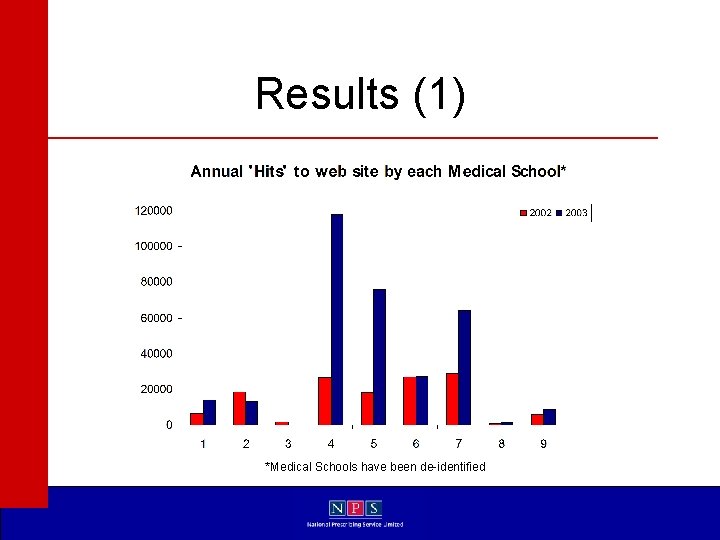
Results (1) *Medical Schools have been de-identified
Results (2) Qualitative feedback: In-depth interviews with teaching staff • All used it as a tool for individual self-directed learning tool – five with added case-discussions • Five schools made the curriculum assessable in final examinations • Issues/problems: – Technical aspects e. g. navigation and browser capability – “Need to engage more teaching staff within faculty” • Generally, “an excellent, practical resource”
Results (3) Qualitative feedback: student online survey • 97/107 (91%) therapeutic content appropriate to needs • 92/107 (86%) felt better able to prescribe after using the curriculum • 57 (54%) had developed their own personal formulary – a major goal of the program
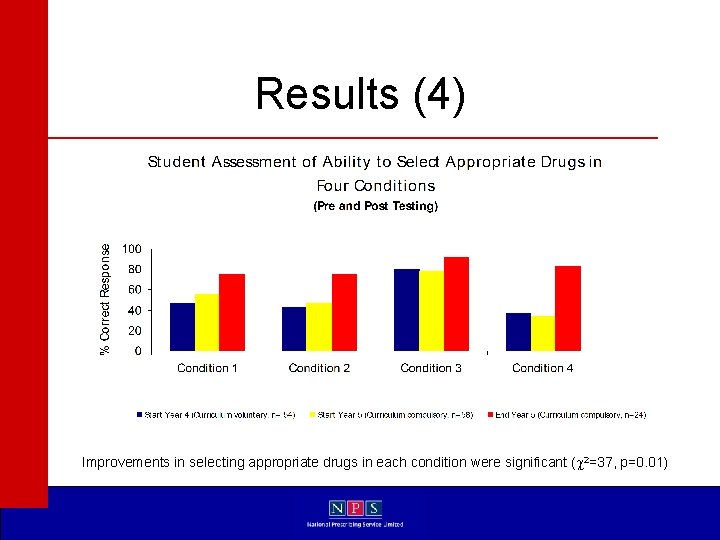
Results (4) Improvements in selecting appropriate drugs in each condition were significant ( 2=37, p=0. 01)
Conclusions • The program has proved very popular with students and staff • Uptake in the first two years has been better than predicted but the program needs more ‘marketing’ • The modules have now been revised and plans are in place for more thorough evaluation in 2004 • Website URL: http: //nps. unisa. edu. au
- Slides: 11