
A Precise Measurement of the EMC Effect in
- Slides: 15
A Precise Measurement of the EMC Effect in Light Nuclei Dave Gaskell Jefferson Lab PANIC October 24, 2005 • Motivation and existing data • JLab Experiment E 03 -103 • Preliminary Results
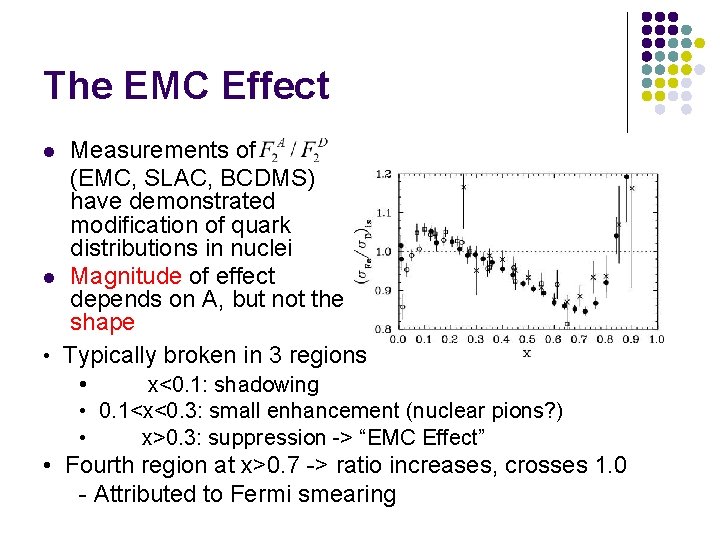
The EMC Effect Measurements of (EMC, SLAC, BCDMS) have demonstrated modification of quark distributions in nuclei l Magnitude of effect depends on A, but not the shape • Typically broken in 3 regions • x<0. 1: shadowing l • 0. 1<x<0. 3: small enhancement (nuclear pions? ) • x>0. 3: suppression -> “EMC Effect” • Fourth region at x>0. 7 -> ratio increases, crosses 1. 0 - Attributed to Fermi smearing
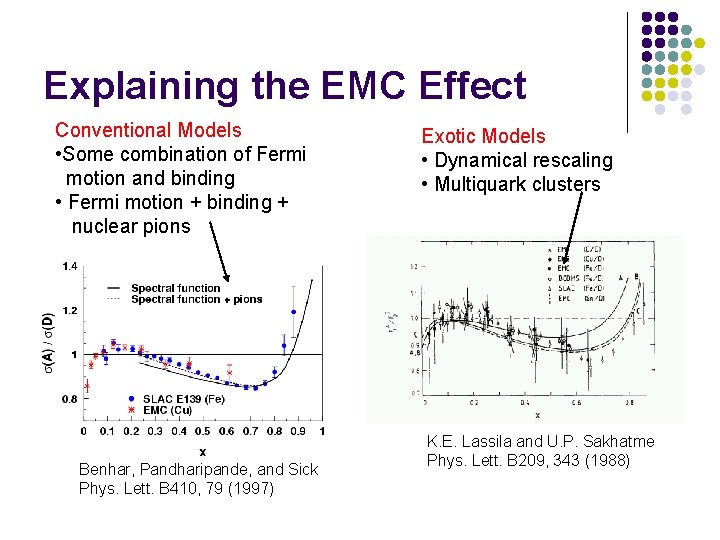
Explaining the EMC Effect Conventional Models • Some combination of Fermi motion and binding • Fermi motion + binding + nuclear pions Benhar, Pandharipande, and Sick Phys. Lett. B 410, 79 (1997) Exotic Models • Dynamical rescaling • Multiquark clusters K. E. Lassila and U. P. Sakhatme Phys. Lett. B 209, 343 (1988)
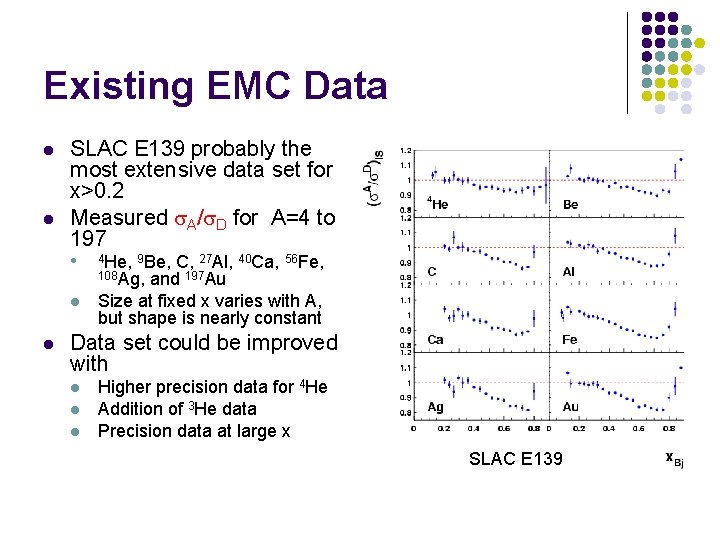
Existing EMC Data l l SLAC E 139 probably the most extensive data set for x>0. 2 Measured s. A/s. D for A=4 to 197 l l l 4 He, 9 Be, C, 27 Al, 40 Ca, 56 Fe, 108 Ag, and 197 Au Size at fixed x varies with A, but shape is nearly constant Data set could be improved with l l l Higher precision data for 4 He Addition of 3 He data Precision data at large x SLAC E 139
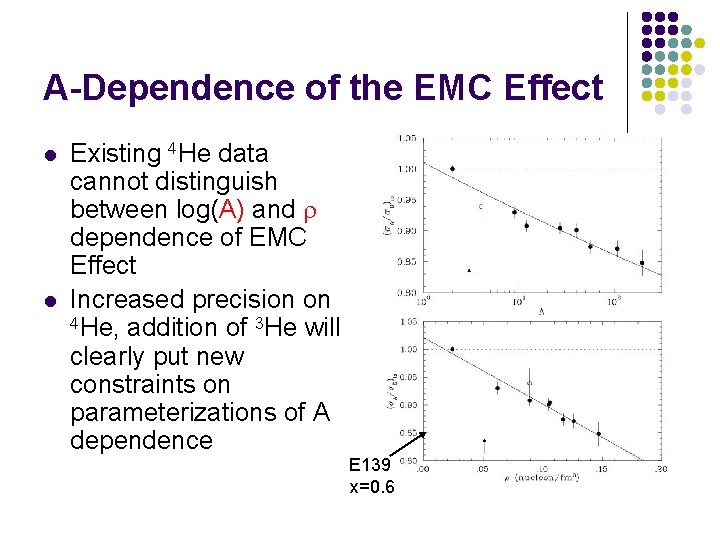
A-Dependence of the EMC Effect l l Existing 4 He data cannot distinguish between log(A) and r dependence of EMC Effect Increased precision on 4 He, addition of 3 He will clearly put new constraints on parameterizations of A dependence E 139 x=0. 6
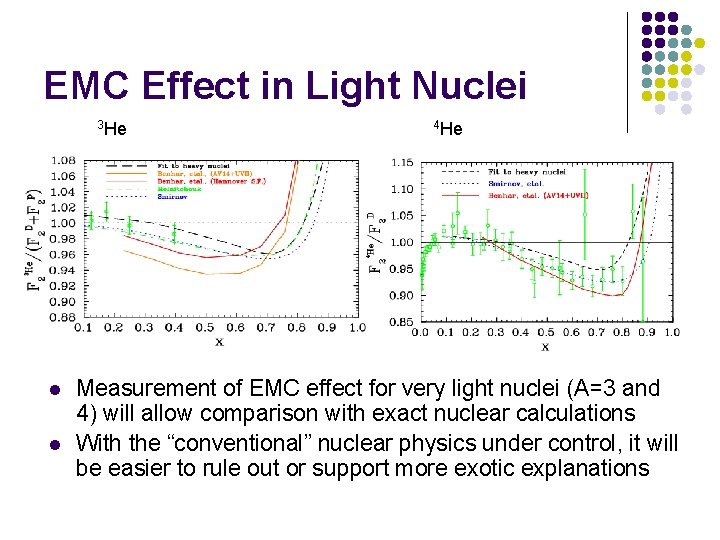
EMC Effect in Light Nuclei 3 He l l 4 He Measurement of EMC effect for very light nuclei (A=3 and 4) will allow comparison with exact nuclear calculations With the “conventional” nuclear physics under control, it will be easier to rule out or support more exotic explanations
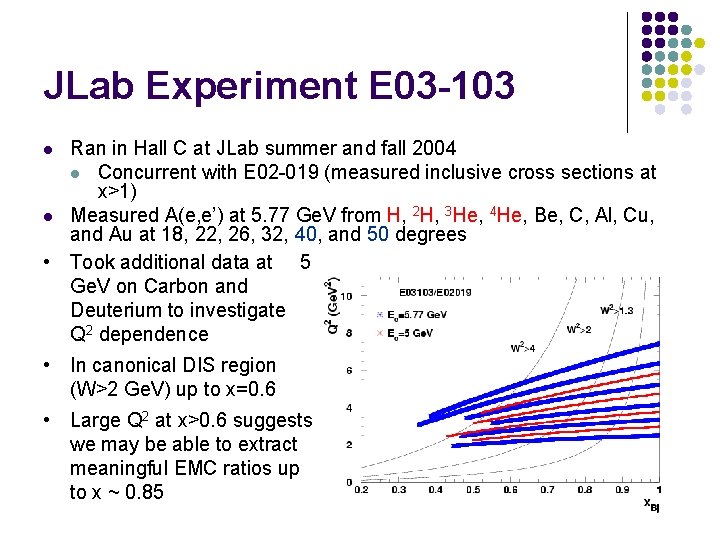
JLab Experiment E 03 -103 Ran in Hall C at JLab summer and fall 2004 l Concurrent with E 02 -019 (measured inclusive cross sections at x>1) l Measured A(e, e’) at 5. 77 Ge. V from H, 2 H, 3 He, 4 He, Be, C, Al, Cu, and Au at 18, 22, 26, 32, 40, and 50 degrees • Took additional data at 5 Ge. V on Carbon and Deuterium to investigate Q 2 dependence l • In canonical DIS region (W>2 Ge. V) up to x=0. 6 • Large Q 2 at x>0. 6 suggests we may be able to extract meaningful EMC ratios up to x ~ 0. 85
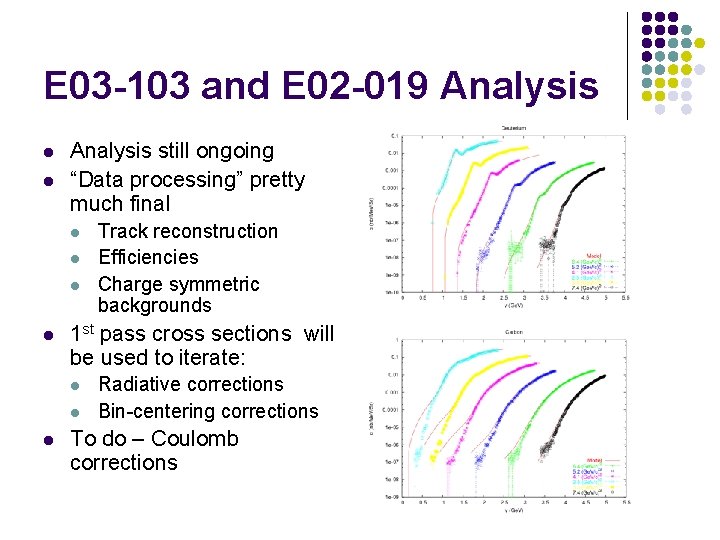
E 03 -103 and E 02 -019 Analysis l l Analysis still ongoing “Data processing” pretty much final l l 1 st pass cross sections will be used to iterate: l l l Track reconstruction Efficiencies Charge symmetric backgrounds Radiative corrections Bin-centering corrections To do – Coulomb corrections
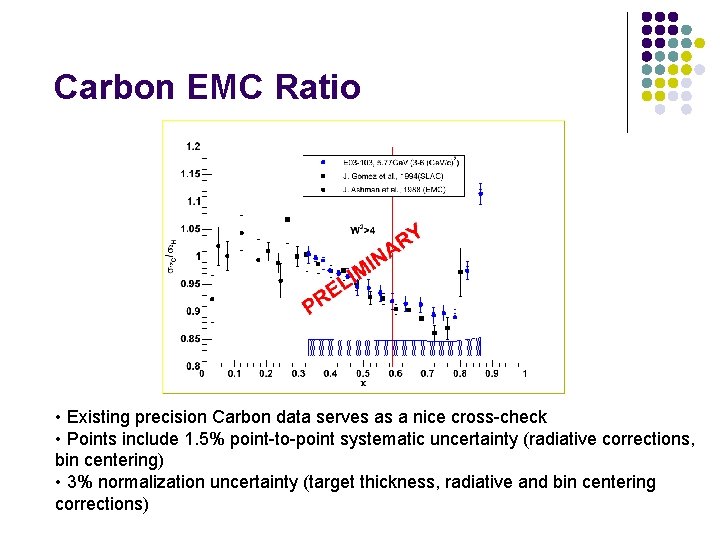
Carbon EMC Ratio • Existing precision Carbon data serves as a nice cross-check • Points include 1. 5% point-to-point systematic uncertainty (radiative corrections, bin centering) • 3% normalization uncertainty (target thickness, radiative and bin centering corrections)
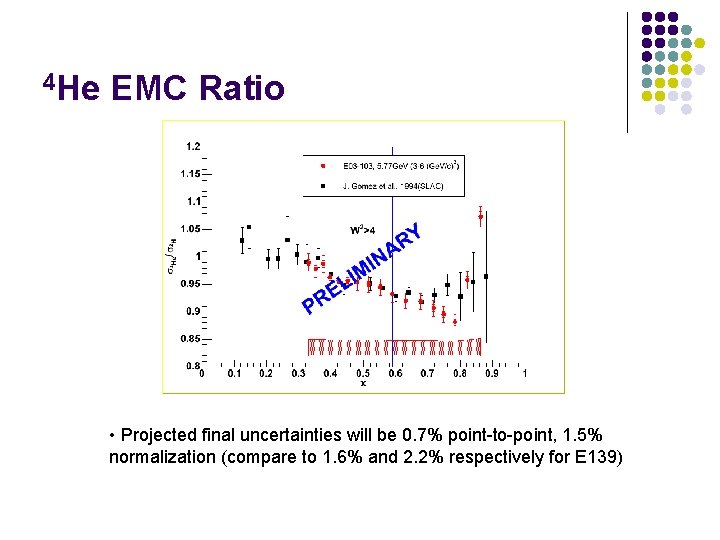
4 He EMC Ratio • Projected final uncertainties will be 0. 7% point-to-point, 1. 5% normalization (compare to 1. 6% and 2. 2% respectively for E 139)
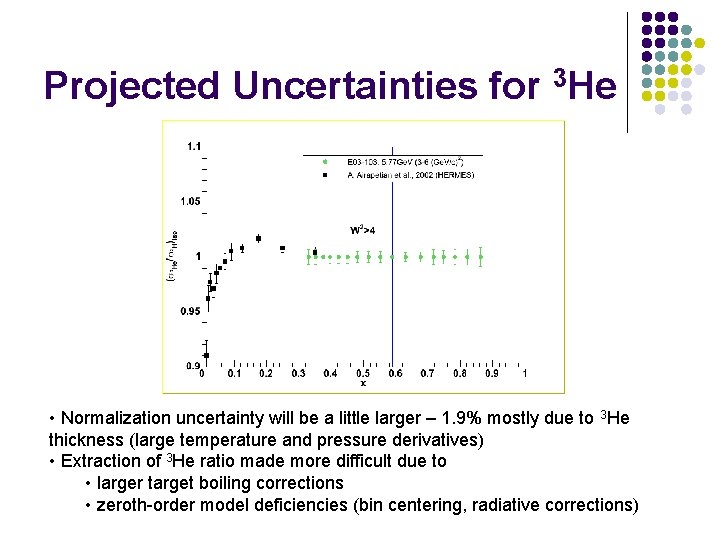
Projected Uncertainties for 3 He • Normalization uncertainty will be a little larger – 1. 9% mostly due to 3 He thickness (large temperature and pressure derivatives) • Extraction of 3 He ratio made more difficult due to • larger target boiling corrections • zeroth-order model deficiencies (bin centering, radiative corrections)
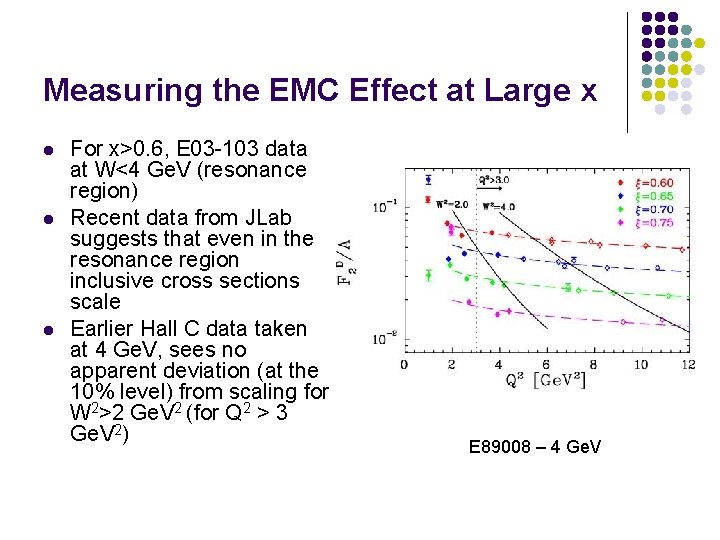
Measuring the EMC Effect at Large x l l l For x>0. 6, E 03 -103 data at W<4 Ge. V (resonance region) Recent data from JLab suggests that even in the resonance region inclusive cross sections scale Earlier Hall C data taken at 4 Ge. V, sees no apparent deviation (at the 10% level) from scaling for W 2>2 Ge. V 2 (for Q 2 > 3 Ge. V 2) E 89008 – 4 Ge. V
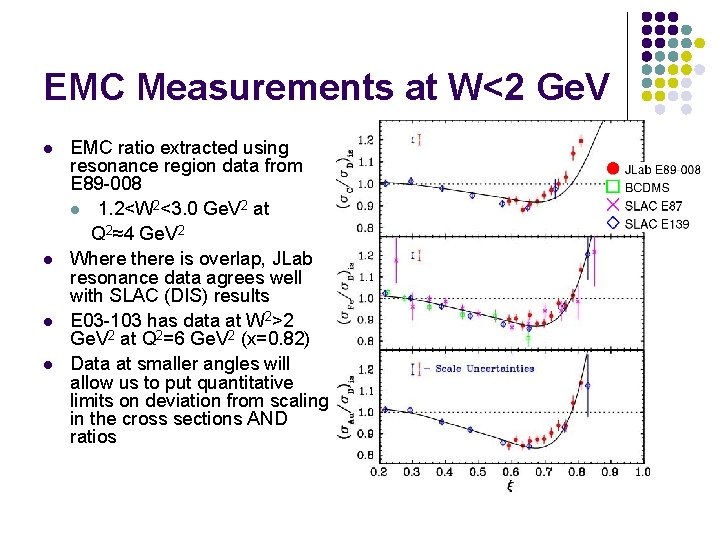
EMC Measurements at W<2 Ge. V l l EMC ratio extracted using resonance region data from E 89 -008 l 1. 2<W 2<3. 0 Ge. V 2 at Q 2≈4 Ge. V 2 Where there is overlap, JLab resonance data agrees well with SLAC (DIS) results E 03 -103 has data at W 2>2 Ge. V 2 at Q 2=6 Ge. V 2 (x=0. 82) Data at smaller angles will allow us to put quantitative limits on deviation from scaling in the cross sections AND ratios
Summary l l Study of the EMC effect in light nuclei will help us more cleanly separate “conventional nuclear physics” contributions to the cross section ratios from more exotic explanations JLab E 03 -103 will increase the precision of 4 He ratios, and be the first precise measurement for 3 He at x>0. 4 Observation of cross section scaling in deuterium for W 2>2 Ge. V 2 and agreement of “resonance region EMC ratio” with DIS results gives us confidence that we will be able to extract precise ratios up to x~0. 85 Stay tuned – final results soon
E 03 -103 Collaboration J. Arrington (spokesperson), L. El Fassi, K. Hafidi, R. Holt, D. H. Potterveld, P. E. Reimer, E. Schulte, X. Zheng Argonne National Laboratory, Argonne, IL B. Boillat, J. Jourdan, M. Kotulla, T. Mertens, D. Rohe, G. Testa, R. Trojer Basel University, Basel, Switzerland B. Filippone California Institute of Technology, Pasadena, CA C. Perdrisat College of William and Mary, Williamsburg, VA D. Dutta, H. Gao, X. Qian Duke University, Durham, NC W. Boeglin Florida International University, Miami, FL M. E. Christy, C. E. Keppel, S. Malace, E. Segbefia, L. Tang, V. Tvaskis, L. Yuan Hampton University, Hampton, VA G. Niculescu, I. Niculescu James Madison University, Harrisonburg, VA P. Bosted, A. Bruell, V. Dharmawardane, R. Ent, H. Fenker, D. Gaskell (spokesperson), M. K. Jones, A. F. Lung, D. G. Meekins, J. Roche, G. Smith, W. F. Vulcan, S. A. Wood Jefferson Laboratory, Newport News, VA B. Clasie, J. Seely Massachusetts Institute of Technology, Cambridge, MA J. Dunne Mississippi State University, Jackson, MS V. Punjabi Norfolk State University, Norfolk, VA A. K. Opper Ohio University, Athens, OH H. Nomura Tohoku University, Sendai, Japan M. Bukhari, A. Daniel, N. Kalantarians, Y. Okayasu, V. Rodriguez University of Houston, TX F. Benmokhtar, T. Horn University of Maryland, College Park, MD D. Day, N. Fomin, C. Hill, R. Lindgren, P. Mc. Kee, O. Rondon, K. Slifer, S. Tajima, F. Wesselmann, J. Wright University of Virginia, Charlottesville, VA R. Asaturyan, H. Mkrtchyan, T. Navasardyan, V. Tadevosyan Yerevan Physics Institute, Armenia S. Connell, M. Dalton, C. Gray University of the Witwatersrand, Johannesburg, South Africa