
A Practical Approach to International Monetary System Reform

- Slides: 34
A Practical Approach to International Monetary System Reform: Building Settlement Infrastructure for Local Currency Internationalization Changyong Rhee and Lea Sumulong Asian Development Bank 11 December 2012 Hong Kong, China The views expressed in this document are those of the author and do not necessarily reflect the views and policies of the Asian Development Bank, or its Board of Governors, or the governments they represent. 1
Outline 1. Introduction 2. The RMB trade settlement system 3. Expanding the regional currency settlement system: A practical approach to international monetary system reform 4. Relation with other initiatives 5. Conclusion 2
Introduction 3
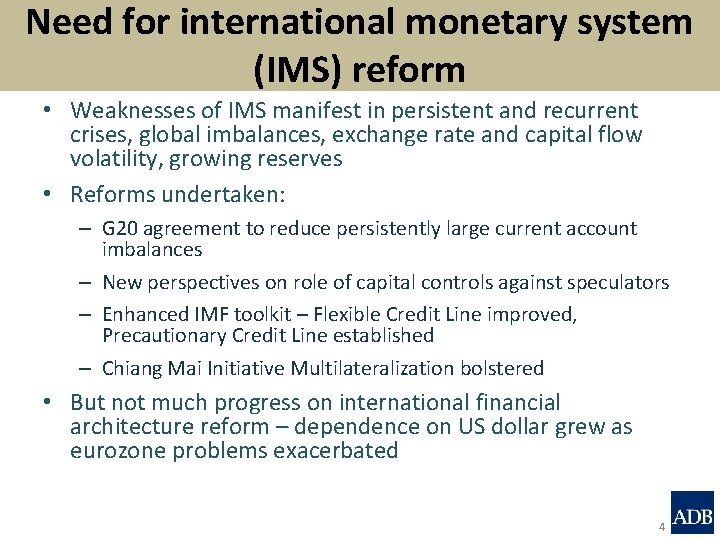
Need for international monetary system (IMS) reform • Weaknesses of IMS manifest in persistent and recurrent crises, global imbalances, exchange rate and capital flow volatility, growing reserves • Reforms undertaken: – G 20 agreement to reduce persistently large current account imbalances – New perspectives on role of capital controls against speculators – Enhanced IMF toolkit – Flexible Credit Line improved, Precautionary Credit Line established – Chiang Mai Initiative Multilateralization bolstered • But not much progress on international financial architecture reform – dependence on US dollar grew as eurozone problems exacerbated 4
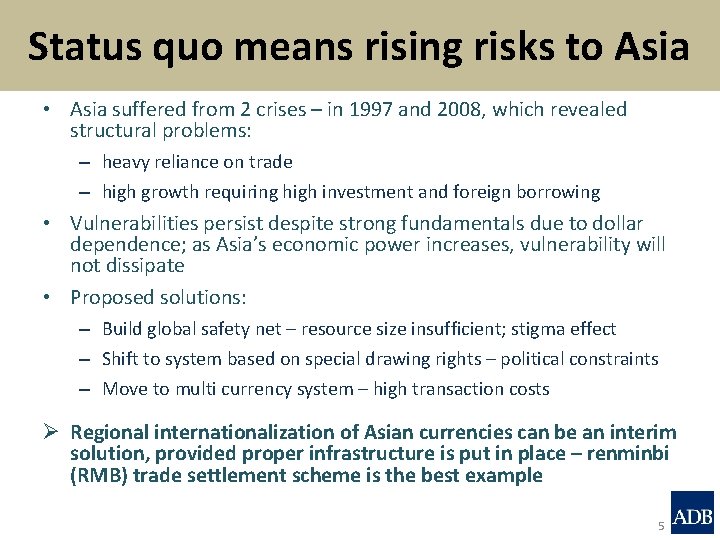
Status quo means rising risks to Asia • Asia suffered from 2 crises – in 1997 and 2008, which revealed structural problems: – heavy reliance on trade – high growth requiring high investment and foreign borrowing • Vulnerabilities persist despite strong fundamentals due to dollar dependence; as Asia’s economic power increases, vulnerability will not dissipate • Proposed solutions: – Build global safety net – resource size insufficient; stigma effect – Shift to system based on special drawing rights – political constraints – Move to multi currency system – high transaction costs Ø Regional internationalization of Asian currencies can be an interim solution, provided proper infrastructure is put in place – renminbi (RMB) trade settlement scheme is the best example 5
A chicken and egg issue • High bilateral transaction costs between non-US dollar currencies encouraged triangular transactions through the US dollar • But once infrastructure is built, transaction costs will go down • RMB trade settlement scheme promoted offshore RMB business due to existing infrastructure in Hong Kong, China • Proposal to expand bilateral into a regional trade settlement scheme as practical solution to IMS reform • Markets will then determine which regional currency will be internationalized 6
The RMB trade settlement system 7
Background • Objectives of RMB trade settlement scheme: – – – Promote RMB internationalization Reduce exchange rate risks Shrink trade transaction costs Improve funding efficiency of financial institutions Diminish need to hold US dollar as medium of exchange and store of value • Introduced in July 2009 and subsequently expanded several times • Initiated as a cross-border trade transaction settlement but contributed to the development of offshore RMB business and regional internationalization of RMB 8
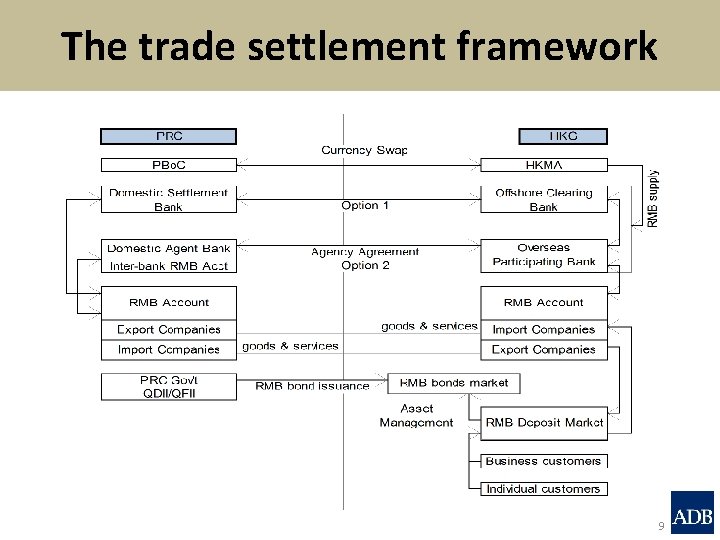
The trade settlement framework 9
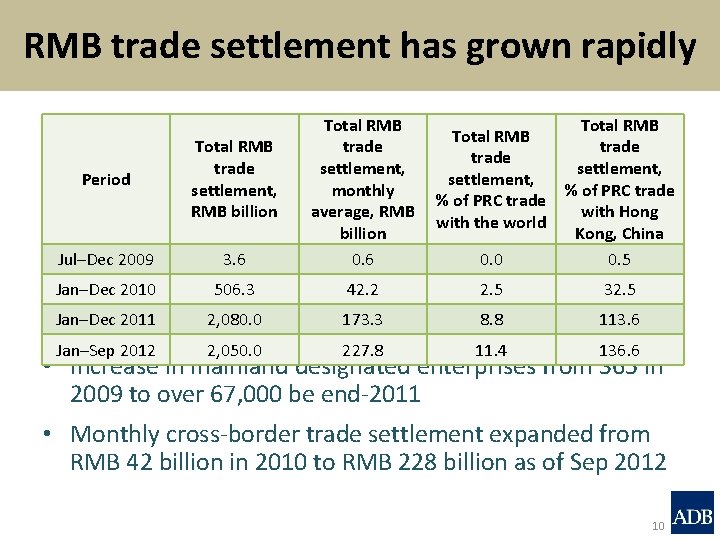
RMB trade settlement has grown rapidly Period Total RMB trade settlement, RMB billion Jul–Dec 2009 3. 6 Total RMB trade settlement, monthly average, RMB billion 0. 6 0. 0 Total RMB trade settlement, % of PRC trade with Hong Kong, China 0. 5 Jan–Dec 2010 506. 3 42. 2 2. 5 32. 5 Jan–Dec 2011 2, 080. 0 173. 3 8. 8 113. 6 Jan–Sep 2012 2, 050. 0 227. 8 11. 4 136. 6 Total RMB trade settlement, % of PRC trade with the world • Increase in mainland designated enterprises from 365 in 2009 to over 67, 000 be end-2011 • Monthly cross-border trade settlement expanded from RMB 42 billion in 2010 to RMB 228 billion as of Sep 2012 10
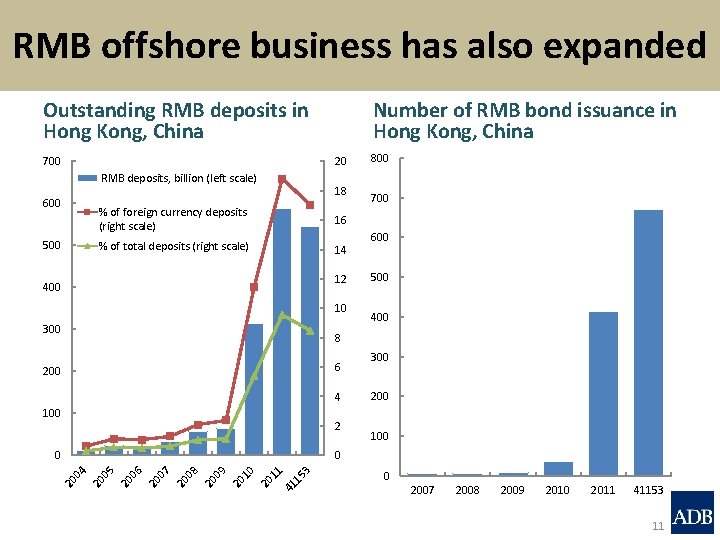
RMB offshore business has also expanded Outstanding RMB deposits in Hong Kong, China 700 Number of RMB bond issuance in Hong Kong, China 20 RMB deposits, billion (left scale) 600 500 18 % of foreign currency deposits (right scale) 16 % of total deposits (right scale) 14 12 400 10 300 800 700 600 500 400 8 6 200 4 100 2 200 100 3 15 41 11 20 10 20 09 20 08 20 07 20 06 20 20 20 05 0 04 0 300 0 2007 2008 2009 2010 2011 41153 11
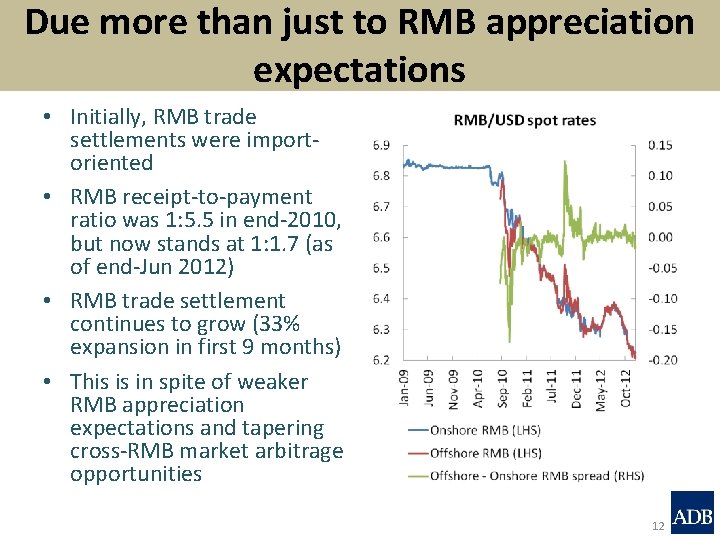
Due more than just to RMB appreciation expectations • Initially, RMB trade settlements were importoriented • RMB receipt-to-payment ratio was 1: 5. 5 in end-2010, but now stands at 1: 1. 7 (as of end-Jun 2012) • RMB trade settlement continues to grow (33% expansion in first 9 months) • This is in spite of weaker RMB appreciation expectations and tapering cross-RMB market arbitrage opportunities 12
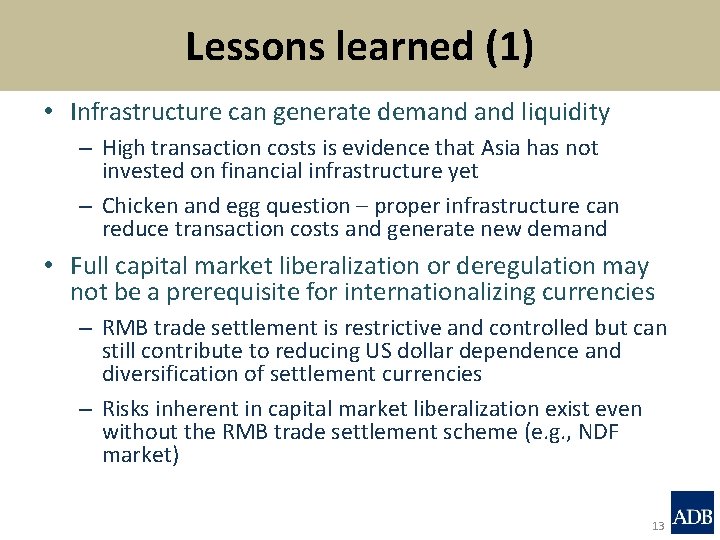
Lessons learned (1) • Infrastructure can generate demand liquidity – High transaction costs is evidence that Asia has not invested on financial infrastructure yet – Chicken and egg question – proper infrastructure can reduce transaction costs and generate new demand • Full capital market liberalization or deregulation may not be a prerequisite for internationalizing currencies – RMB trade settlement is restrictive and controlled but can still contribute to reducing US dollar dependence and diversification of settlement currencies – Risks inherent in capital market liberalization exist even without the RMB trade settlement scheme (e. g. , NDF market) 13
Lessons learned (2) • Better to have payments and securities settlement system together to secure sufficient business – Availability of other RMB investment opportunities (e. g. , “dim sum” bonds, RMB CDs, synthetic offshore bonds) encouraged holdings of RMB deposits – Success of RMB trade settlement scheme partly due to efficient securities trading and settlement system (e. g. , RTGS / CMU) in Hong Kong, China 14
Expanding and deepening the regional currency settlement system 15
Expansion of bilateral trade settlement system • Option 1: Expedite capital market liberalization and allow more repatriation of RMB in Hong Kong, China to PRC – But deregulation will complicate exchange rate and monetary policy management, and risk capital volatility – Important in long-run but process will take time • Option 2: Expansion of trade settlement scheme to neighboring economies – Gradual approach of expanding bilateral agreements with other regional economies – More politically feasible and practical – Huge potential for reducing US dollar usage if intra-Asian trade is settled in local currency (Intra-regional trade has risen from US$284. 9 billion in 1990 to US$4. 2 trillion in 2011) 16
Combining regional trade and government bond settlement system • Bilateral links between central banks • Similar legal arrangements as RMB trade settlement scheme (e. g. , guaranteed convertibility of local currency proceeds into US dollars), but with addition of government bond settlement • Adds dimension on custodians and central securities depositories for government bonds, which is excluded in trade transactions • Central banks to provide custodian services and be central securities depositories of government bonds directly or indirectly 17
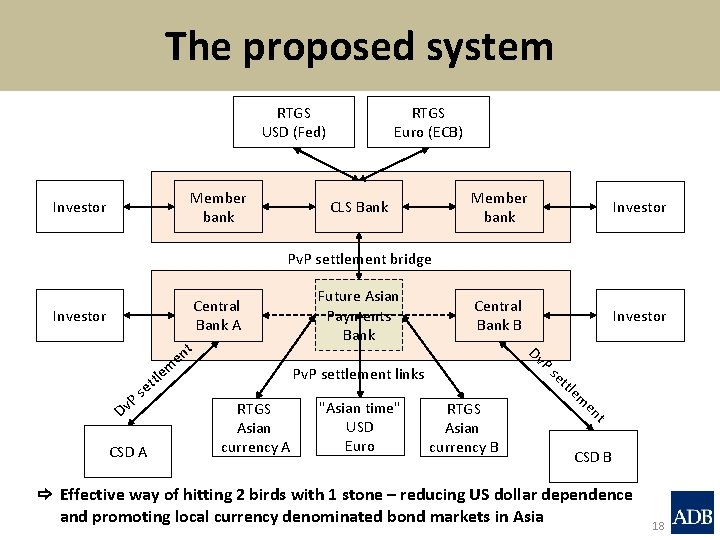
The proposed system RTGS USD (Fed) Member bank Investor RTGS Euro (ECB) CLS Bank Member bank Investor Central Bank B Investor Pv. P settlement bridge Investor P Dv t se CSD A m tle Central Bank A t en RTGS Asian currency A Future Asian Payments Bank Dv P Pv. P settlement links "Asian time" USD Euro RTGS Asian currency B se ttl em en t CSD B Effective way of hitting 2 birds with 1 stone – reducing US dollar dependence and promoting local currency denominated bond markets in Asia 18
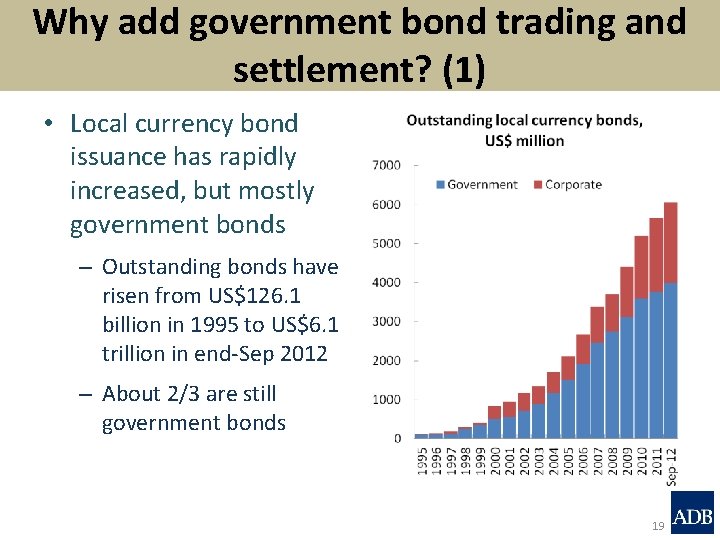
Why add government bond trading and settlement? (1) • Local currency bond issuance has rapidly increased, but mostly government bonds – Outstanding bonds have risen from US$126. 1 billion in 1995 to US$6. 1 trillion in end-Sep 2012 – About 2/3 are still government bonds 19
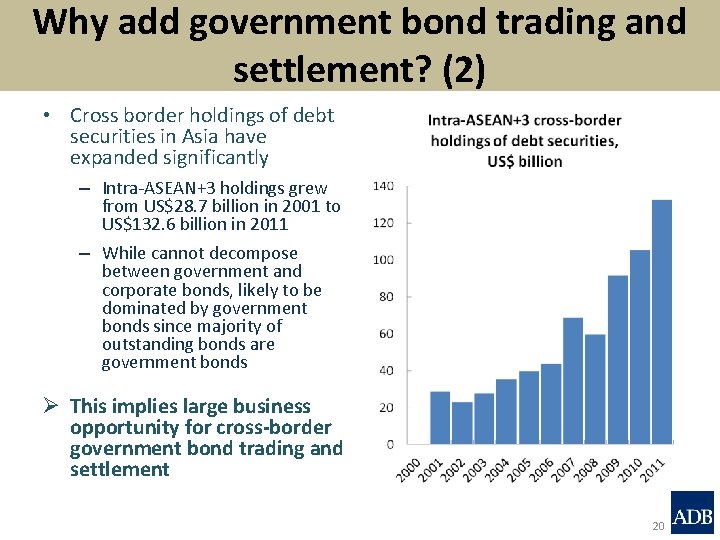
Why add government bond trading and settlement? (2) • Cross border holdings of debt securities in Asia have expanded significantly – Intra-ASEAN+3 holdings grew from US$28. 7 billion in 2001 to US$132. 6 billion in 2011 – While cannot decompose between government and corporate bonds, likely to be dominated by government bonds since majority of outstanding bonds are government bonds Ø This implies large business opportunity for cross-border government bond trading and settlement 20
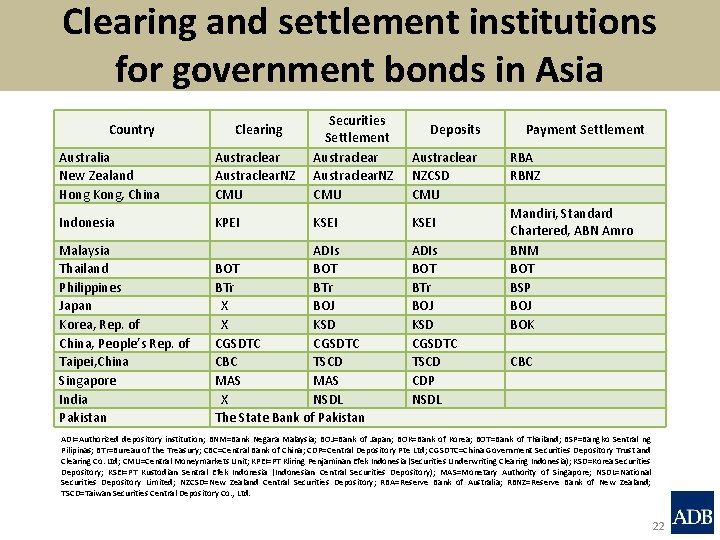
Why add government bond trading and settlement? (3) • Since central banks are already linked to central securities depositories (CSDs), or are CSDs themselves, marginal cost of adding government bond transactions to trade settlement scheme is low • System will allow real time gross settlement of Pv. P and Dv. P in local currency • Bilateral central bank links second best option, but a step toward the Asian payments bank or Regional Settlement Intermediary (RSI) 21
Clearing and settlement institutions for government bonds in Asia Australia New Zealand Hong Kong, China Austraclear. NZ CMU Securities Settlement Austraclear. NZ CMU Indonesia KPEI KSEI Malaysia Thailand Philippines Japan Korea, Rep. of China, People’s Rep. of Taipei, China Singapore India Pakistan ADIs BOT BTr X BOJ X KSD CGSDTC CBC TSCD MAS X NSDL The State Bank of Pakistan Country Clearing Deposits Austraclear NZCSD CMU KSEI ADIs BOT BTr BOJ KSD CGSDTC TSCD CDP NSDL Payment Settlement RBA RBNZ Mandiri, Standard Chartered, ABN Amro BNM BOT BSP BOJ BOK CBC ADI=Authorized depository institution; BNM=Bank Negara Malaysia; BOJ=Bank of Japan; BOK=Bank of Korea; BOT=Bank of Thailand; BSP=Bangko Sentral ng Pilipinas; BTr=Bureau of the Treasury; CBC=Central Bank of China; CDP=Central Depository Pte Ltd; CGSDTC=China Government Securities Depository Trust and Clearing Co. Ltd; CMU=Central Moneymarkets Unit; KPEI=PT Kliring Penjaminan Efek Indonesia (Securities Underwriting Clearing Indonesia); KSD=Korea Securities Depository; KSEI=PT Kustodian Sentral Efek Indonesia (Indonesian Central Securities Depository); MAS=Monetary Authority of Singapore; NSDL=National Securities Depository Limited; NZCSD=New Zealand Central Securities Depository; RBA=Reserve Bank of Australia; RBNZ=Reserve Bank of New Zealand; TSCD=Taiwan Securities Central Depository Co. , Ltd. 22
Proposed system will create financial market synergies • System could contribute to development of regional repo and derivatives markets by consolidating securities holdings • Government bonds deposited in CSDs can be used as collateral, effectively reducing risks in trade and non-trade related cross-border transactions 23
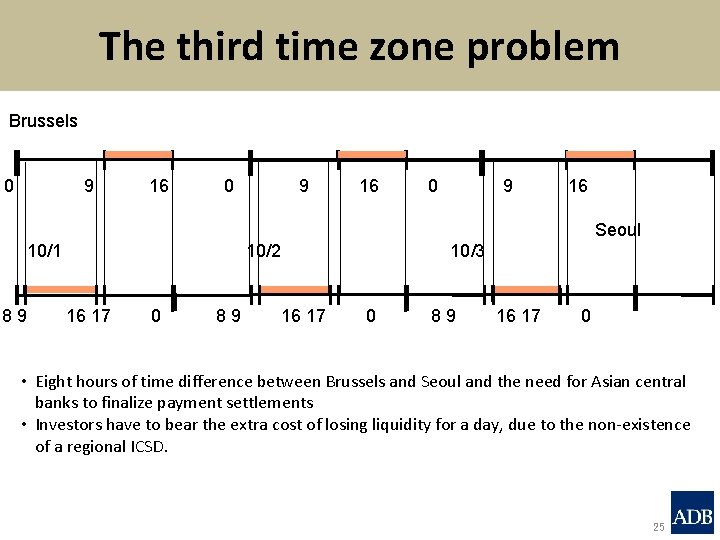
System can solve third time zone problem • Cross border bond settlement can unnecessarily aggravate foreign exchange risks – The duration of foreign exchange risk exposures in the transaction of Asian currencies which share a common time zone can be insignificant – But foreign exchange risk exposure can become unnecessarily magnified as the settlement of Asian currency denominated bonds are mostly carried out through ICSDs or GCs which do not share the same time zone – To alleviate Herstatt risk, bond settlement needs to be carried out in correspondence to the Asian time zone together with foreign exchange settlement • Proposal can solve third time zone problem – Allows government bond settlement in US dollar or euro in Asian time zone (RSI) – Permits government bond settlement in local currency 24
The third time zone problem Brussels 0 9 16 Seoul 10/1 89 10/2 16 17 0 89 10/3 16 17 0 89 16 17 0 • Eight hours of time difference between Brussels and Seoul and the need for Asian central banks to finalize payment settlements • Investors have to bear the extra cost of losing liquidity for a day, due to the non-existence of a regional ICSD. 25
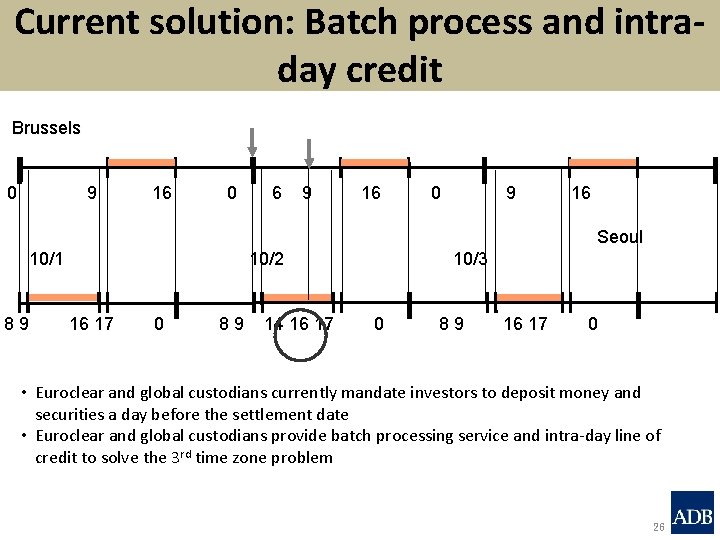
Current solution: Batch process and intraday credit Brussels 0 9 16 0 6 9 16 0 9 16 Seoul 10/1 89 10/2 16 17 0 89 14 16 17 10/3 0 89 16 17 0 • Euroclear and global custodians currently mandate investors to deposit money and securities a day before the settlement date • Euroclear and global custodians provide batch processing service and intra-day line of credit to solve the 3 rd time zone problem 26
Relation with other initiatives 27
Relationship with Asian Bond Markets Initiative (ABMI) • After the Asian financial crisis, regional economies strengthened their balance of payments by piling up foreign reserves • There were also discussions about regional bond market development to recycle savings and reduce foreign currency exposure • ABMI was thus established in 2002 to: (i) reduce risk of financial crisis by alleviating the double-mismatch problem in financing (i. e. , currency and maturity mismatches); and (ii) develop local currency bond markets • The current proposal is related to the objective of ABMI to build infrastructure to deepen and develop the region’s financial markets 28
Relationship with the regional settlement intermediary (RSI) • As part of ABMI, discussions underway to set up RSI for cross-border bond transactions • Studies on clearing and settlement infrastructure of ABMI – “Bond Market Settlements and Emerging Linkages among Selected ASEAN+3 Countries” § OTC securities trading in Asia generally use central bank operated settlement systems that are not linked to a clearing company or central counterparty § Links to ICSDs yield inefficiency costs and risks § Developing RSI, which is the first best option, will take time, but in interim focus on fundamental system improvements – “Minimizing Foreign Exchange Settlement Risk in ASEAN+3 Region” § Assessed settlement costs and risks in Asia in detail § Proposed to establish RSI and suggested possible architecture: Asia ICSD model; Pan-Asia CSD model; Asian Payments Bank model; CSD Linkage option Ø Current proposal, which is more practical, is an interim step to the Asian Payments Bank model 29
ASEAN+3 local currency trading system • ASEAN+3 pushing for more extensive crossborder local currency based trading – At 15 th ASEAN+3 Finance Ministers and Central Bank Governors’ Meeting in Manila on 3 May 2012, the caucus called for ABMI to: § Do further study on the use of local currencies for regional trade settlement § Put forward concrete policy recommendations – Shows political will to reduce heavy reliance on US dollar for trade settlement Ø Proposed scheme could be one option to achieve this end 30
Bilateral swaps and regional financial safety nets • Bilateral swap agreements to guard against liquidity crises – But not politically sustainable and not provided on regular basis – Need to expand intra-regional swap lines to strengthen regional insurance mechanism • Chiang Mai Initiative Multilaterization (CMIM) – Strengthened after the global financial crisis: (i) fund size doubled to US$240 billion; (ii) IMF de-linked portion increased to 30%; (iii) CMIM Precautionary Line introduced – But more needs to be done – mechanism for funds disbursement; surveillance and vulnerability assessment; address stigma effect Ø Existing regional financial safety nets can be complementary to the combined trade and government bond settlement system – CMIM funds may be used as credit guarantee for trade settlement transactions of countries with lower credit ratings to expedite bilateral linkages among Asian central banks 31
Conclusion 32
Key messages • Global financial crisis stimulated discussions on IMS reform • Regional internationalization of Asian currencies can contribute to this reform agenda • Extending the local currency trade settlement scheme and combining it with a government securities payment and settlement scheme can be practical solution • Let’s build infrastructure first to reduce transaction costs 33
Thank you Economics and Research Department Asian Development Bank 6 ADB Avenue, Mandaluyong City 1550 Philippines www. adb. org 34