
A Practical Approach to Accelerating the Clinical Development
- Slides: 30
A Practical Approach to Accelerating the Clinical Development Process Jerald S. Schindler, Dr. P. H. Assistant Vice President Global Biostatistics & Clinical Technology Wyeth Research FDA-Industry Workshop 10 -Mar-2003
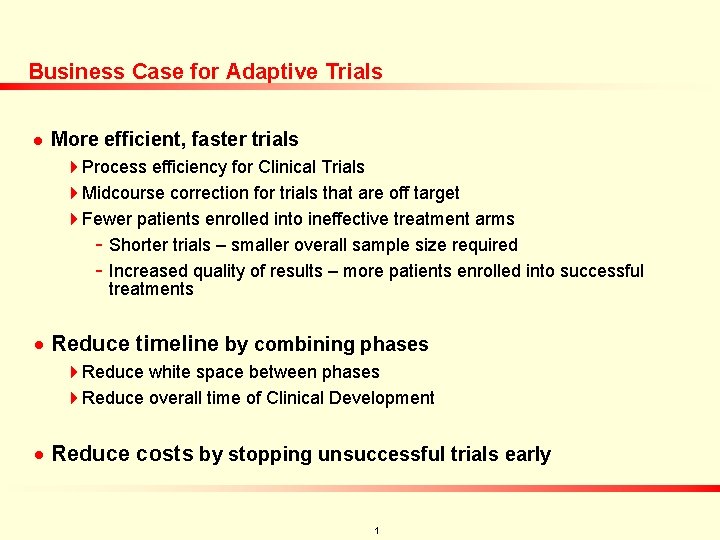
Business Case for Adaptive Trials n More efficient, faster trials 4 Process efficiency for Clinical Trials 4 Midcourse correction for trials that are off target 4 Fewer patients enrolled into ineffective treatment arms - Shorter trials – smaller overall sample size required - Increased quality of results – more patients enrolled into successful treatments n Reduce timeline by combining phases 4 Reduce white space between phases 4 Reduce overall time of Clinical Development n Reduce costs by stopping unsuccessful trials early 1
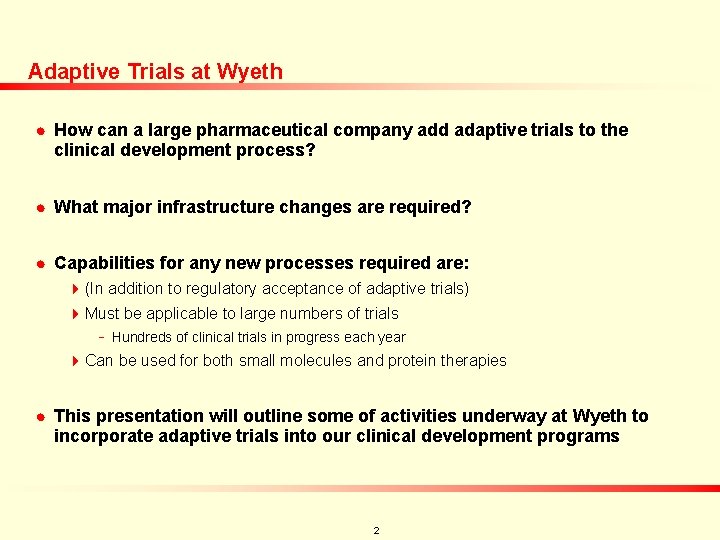
Adaptive Trials at Wyeth n How can a large pharmaceutical company add adaptive trials to the clinical development process? n What major infrastructure changes are required? n Capabilities for any new processes required are: 4 (In addition to regulatory acceptance of adaptive trials) 4 Must be applicable to large numbers of trials - Hundreds of clinical trials in progress each year 4 Can be used for both small molecules and protein therapies n This presentation will outline some of activities underway at Wyeth to incorporate adaptive trials into our clinical development programs 2
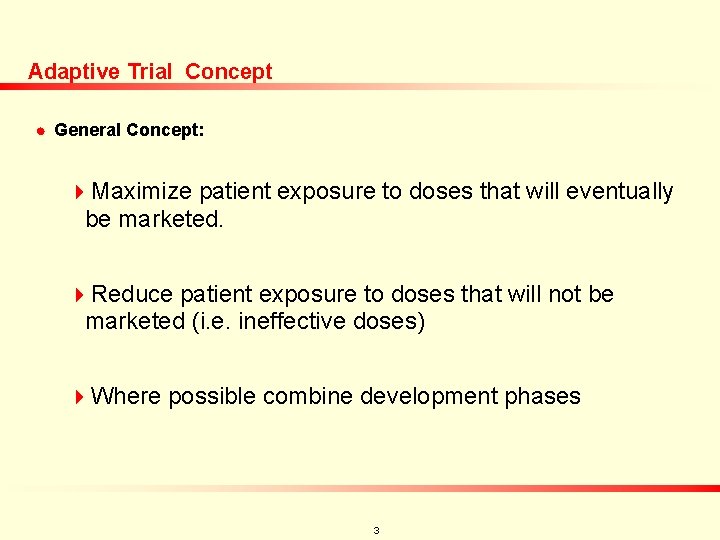
Adaptive Trial Concept n General Concept: 4 Maximize patient exposure to doses that will eventually be marketed. 4 Reduce patient exposure to doses that will not be marketed (i. e. ineffective doses) 4 Where possible combine development phases 3
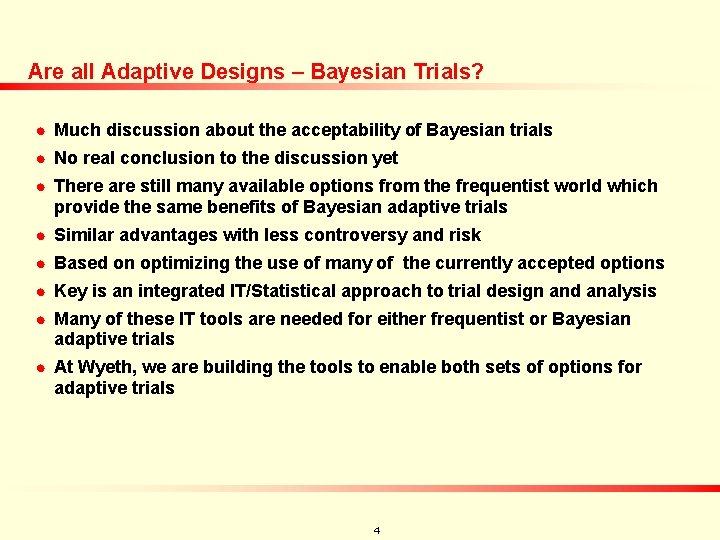
Are all Adaptive Designs – Bayesian Trials? n Much discussion about the acceptability of Bayesian trials n No real conclusion to the discussion yet n There are still many available options from the frequentist world which provide the same benefits of Bayesian adaptive trials n Similar advantages with less controversy and risk n Based on optimizing the use of many of the currently accepted options n Key is an integrated IT/Statistical approach to trial design and analysis n n Many of these IT tools are needed for either frequentist or Bayesian adaptive trials At Wyeth, we are building the tools to enable both sets of options for adaptive trials 4
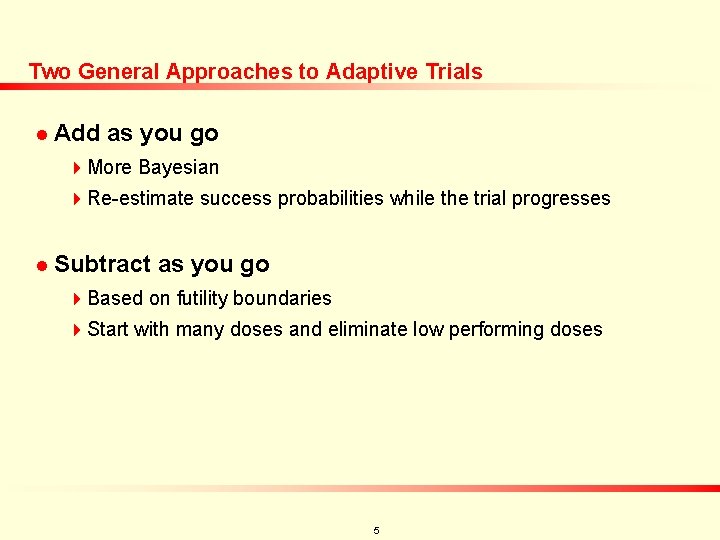
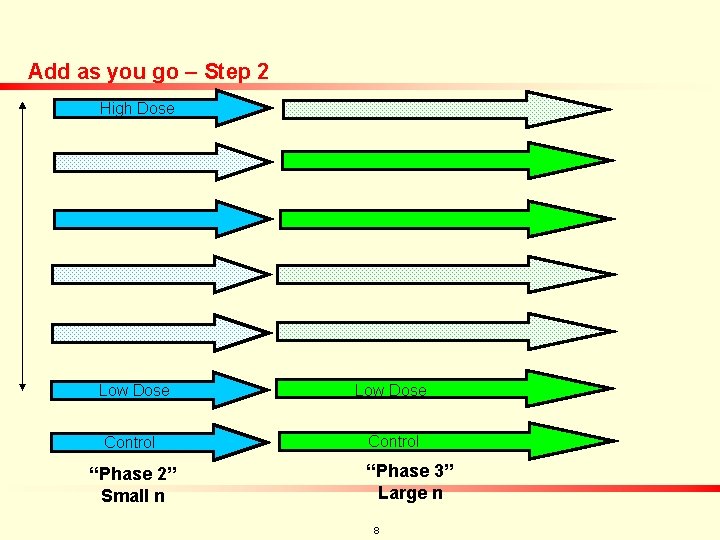
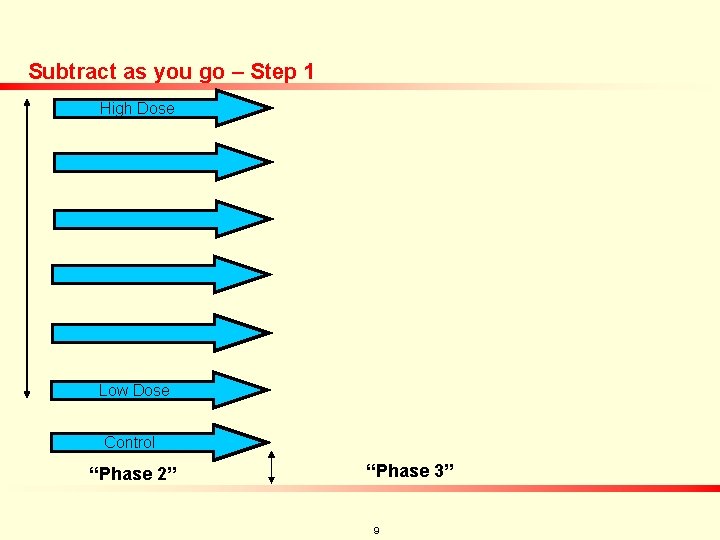
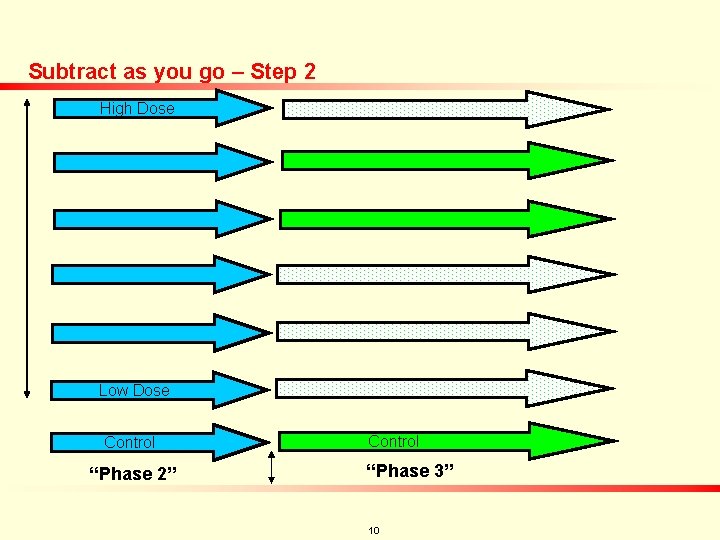
Two General Approaches to Adaptive Trials n Add as you go 4 More Bayesian 4 Re-estimate success probabilities while the trial progresses n Subtract as you go 4 Based on futility boundaries 4 Start with many doses and eliminate low performing doses 5
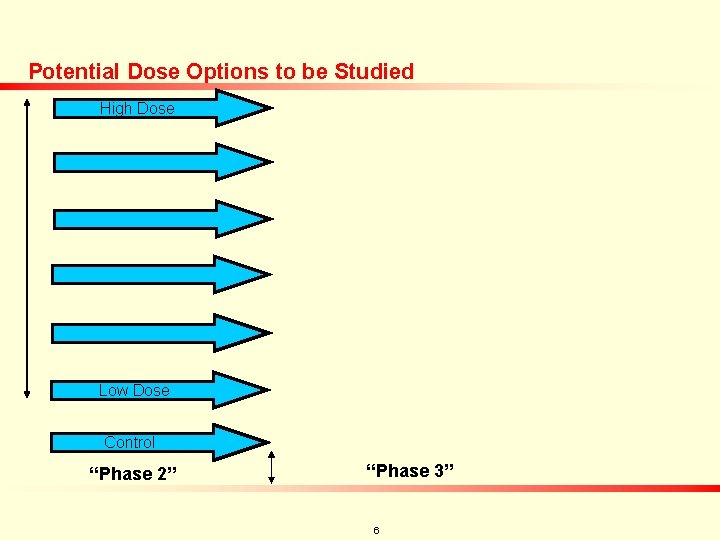
Potential Dose Options to be Studied High Dose Low Dose Control “Phase 2” “Phase 3” 6
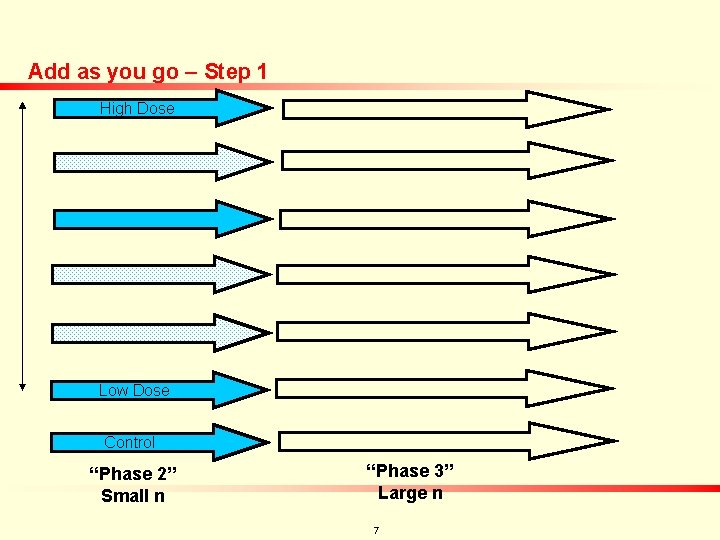
Add as you go – Step 1 High Dose Low Dose Control “Phase 2” Small n “Phase 3” Large n 7
Add as you go – Step 2 High Dose Low Dose Control “Phase 2” Small n “Phase 3” Large n 8
Subtract as you go – Step 1 High Dose Low Dose Control “Phase 2” “Phase 3” 9
Subtract as you go – Step 2 High Dose Low Dose Control “Phase 2” Control “Phase 3” 10
Practical Consideration: Drug Supply / Product Development n Many trials require pre-specified doses to be available 4 Tablet form rather than mix when given n Need to manufacture and package all dose options before trial begins Limits the total number different dose options available Since they are all available 4 Favors “subtract as you go” designs rather than “add as you go” 11
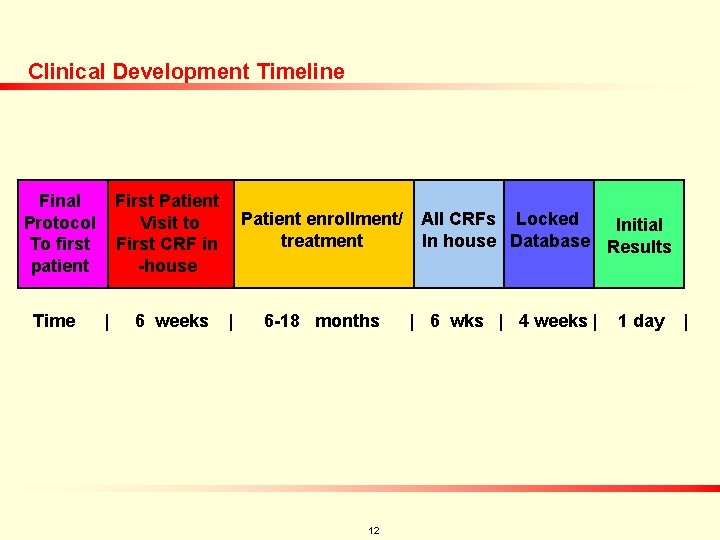
Clinical Development Timeline Final Protocol To first patient Time First Patient Visit to First CRF in -house | 6 weeks Patient enrollment/ treatment | 6 -18 months 12 All CRFs Locked Initial In house Database Results | 6 wks | 4 weeks | 1 day |
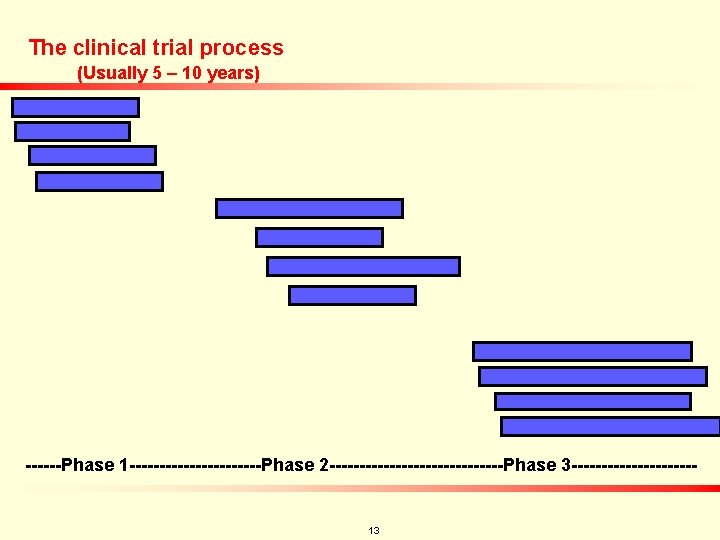
The clinical trial process (Usually 5 – 10 years) ------Phase 1 -----------Phase 2 ---------------Phase 3 ----------- 13
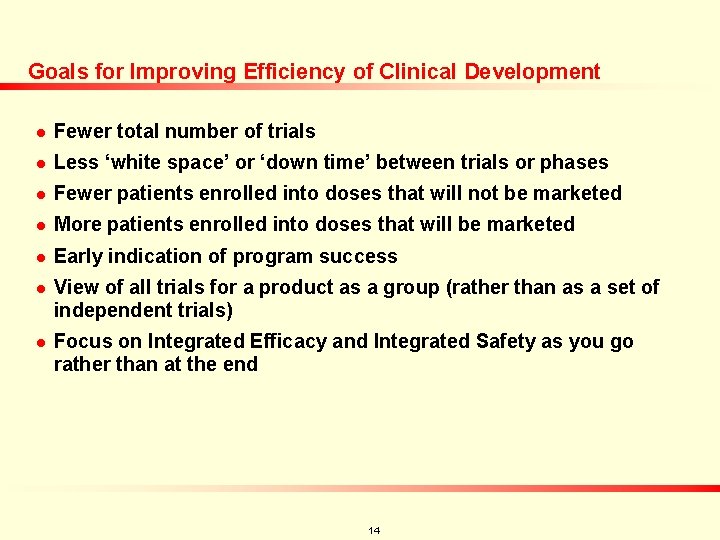
Goals for Improving Efficiency of Clinical Development n Fewer total number of trials n Less ‘white space’ or ‘down time’ between trials or phases n Fewer patients enrolled into doses that will not be marketed n More patients enrolled into doses that will be marketed n Early indication of program success n n View of all trials for a product as a group (rather than as a set of independent trials) Focus on Integrated Efficacy and Integrated Safety as you go rather than at the end 14
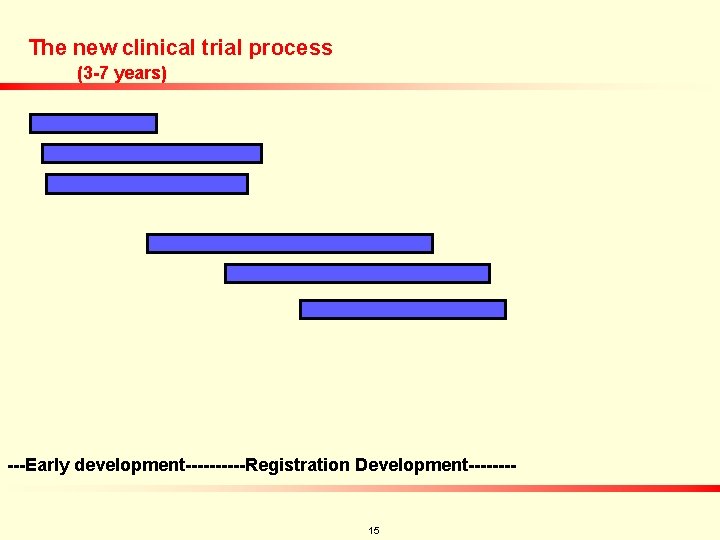
The new clinical trial process (3 -7 years) ---Early development-----Registration Development---- 15
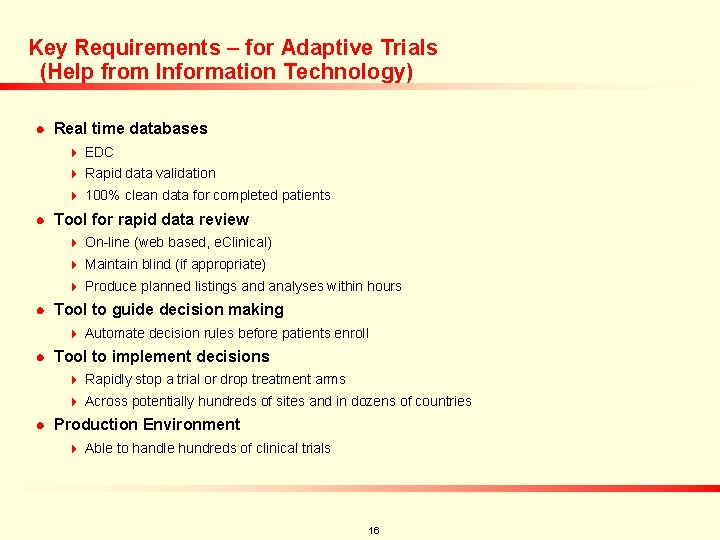
Key Requirements – for Adaptive Trials (Help from Information Technology) n Real time databases 4 EDC 4 Rapid data validation 4 100% clean data for completed patients n Tool for rapid data review 4 On-line (web based, e. Clinical) 4 Maintain blind (if appropriate) 4 Produce planned listings and analyses within hours n Tool to guide decision making 4 Automate decision rules before patients enroll n Tool to implement decisions 4 Rapidly stop a trial or drop treatment arms 4 Across potentially hundreds of sites and in dozens of countries n Production Environment 4 Able to handle hundreds of clinical trials 16
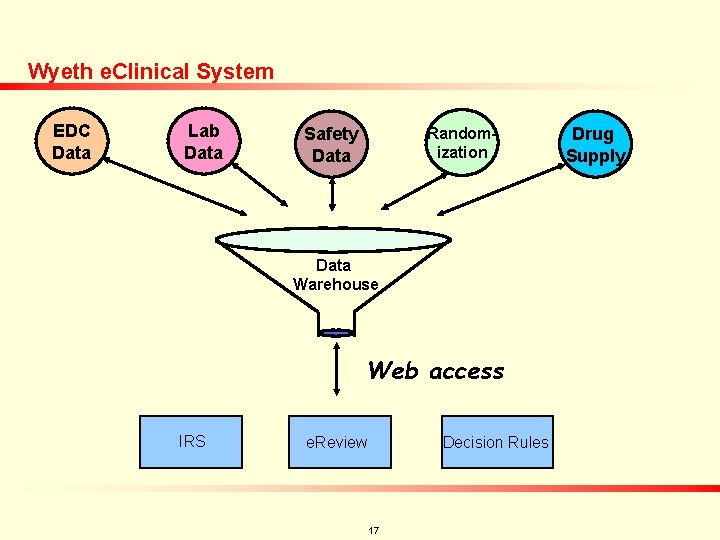
Wyeth e. Clinical System EDC Data Lab Data Safety Data Randomization Data Warehouse Web access IRS e. Review Decision Rules 17 Drug Supply
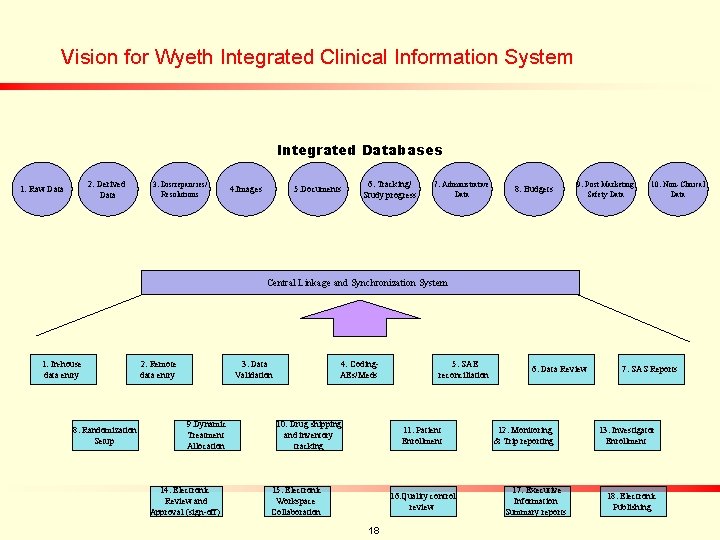
Vision for Wyeth Integrated Clinical Information System Integrated Databases 2. Derived Data 1. Raw Data 3. Discrepancies/ Resolutions 4. Images 5. Documents 6. Tracking/ Study progress 7. Administrative Data 8. Budgets 9. Post Marketing Safety Data 10. Non-Clinical Data Central Linkage and Synchronization System 1. In-house data entry 8. Randomization Setup 2. Remote data entry 3. Data Validation 9. Dynamic Treatment Allocation 14. Electronic Review and Approval (sign-off) 4. Coding. AEs/Meds 10. Drug shipping and inventory tracking 5. SAE reconciliation 11. Patient Enrollment 15. Electronic Workspace Collaboration 16. Quality control review 18 6. Data Review 12. Monitoring & Trip reporting 17. Executive Information Summary reports 7. SAS Reports 13. Investigator Enrollment 18. Electronic Publishing
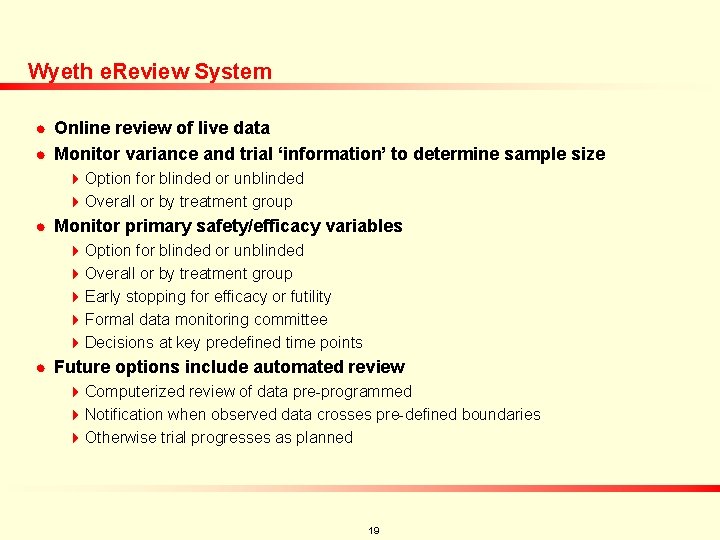
Wyeth e. Review System n n Online review of live data Monitor variance and trial ‘information’ to determine sample size 4 Option for blinded or unblinded 4 Overall or by treatment group n Monitor primary safety/efficacy variables 4 Option for blinded or unblinded 4 Overall or by treatment group 4 Early stopping for efficacy or futility 4 Formal data monitoring committee 4 Decisions at key predefined time points n Future options include automated review 4 Computerized review of data pre-programmed 4 Notification when observed data crosses pre-defined boundaries 4 Otherwise trial progresses as planned 19
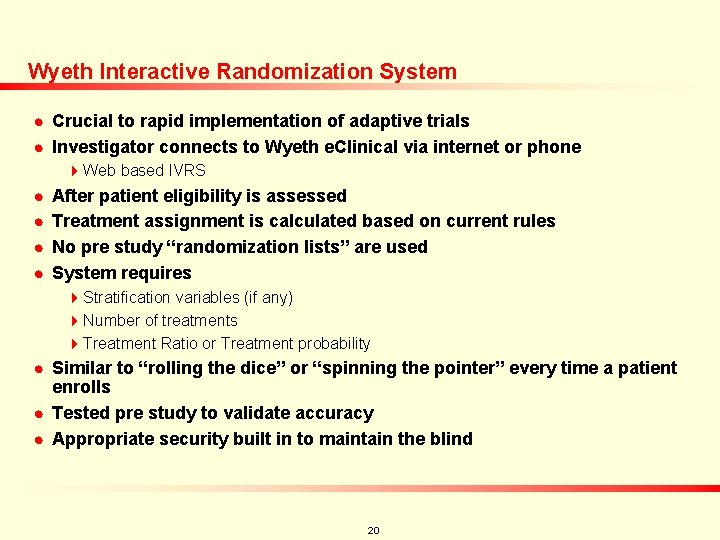
Wyeth Interactive Randomization System n n Crucial to rapid implementation of adaptive trials Investigator connects to Wyeth e. Clinical via internet or phone 4 Web based IVRS n n After patient eligibility is assessed Treatment assignment is calculated based on current rules No pre study “randomization lists” are used System requires 4 Stratification variables (if any) 4 Number of treatments 4 Treatment Ratio or Treatment probability n n n Similar to “rolling the dice” or “spinning the pointer” every time a patient enrolls Tested pre study to validate accuracy Appropriate security built in to maintain the blind 20
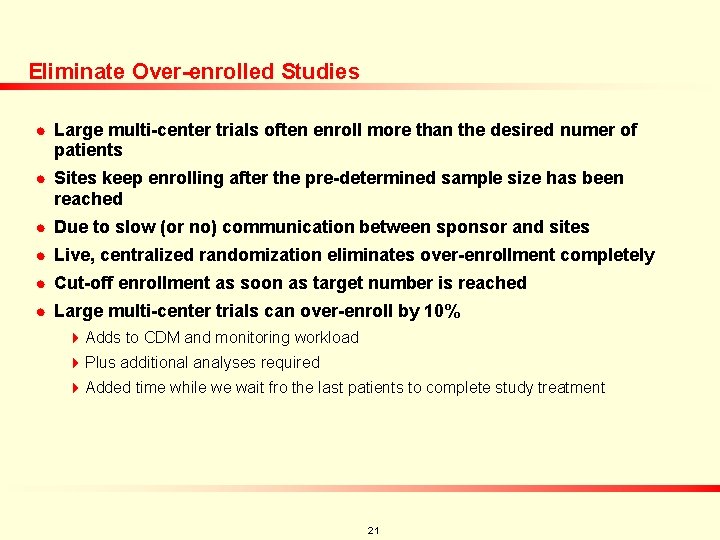
Eliminate Over-enrolled Studies n n Large multi-center trials often enroll more than the desired numer of patients Sites keep enrolling after the pre-determined sample size has been reached n Due to slow (or no) communication between sponsor and sites n Live, centralized randomization eliminates over-enrollment completely n Cut-off enrollment as soon as target number is reached n Large multi-center trials can over-enroll by 10% 4 Adds to CDM and monitoring workload 4 Plus additional analyses required 4 Added time while we wait fro the last patients to complete study treatment 21
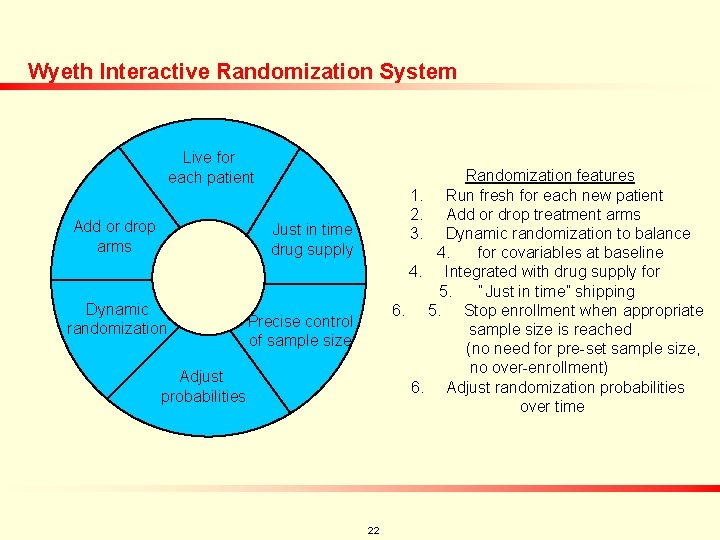
Wyeth Interactive Randomization System Live for each patient Add or drop arms Randomization features 1. Run fresh for each new patient 2. Add or drop treatment arms 3. Dynamic randomization to balance 4. for covariables at baseline 4. Integrated with drug supply for 5. “Just in time” shipping 6. 5. Stop enrollment when appropriate sample size is reached (no need for pre-set sample size, no over-enrollment) 6. Adjust randomization probabilities over time Just in time drug supply Dynamic randomization Precise control of sample size Adjust probabilities 22
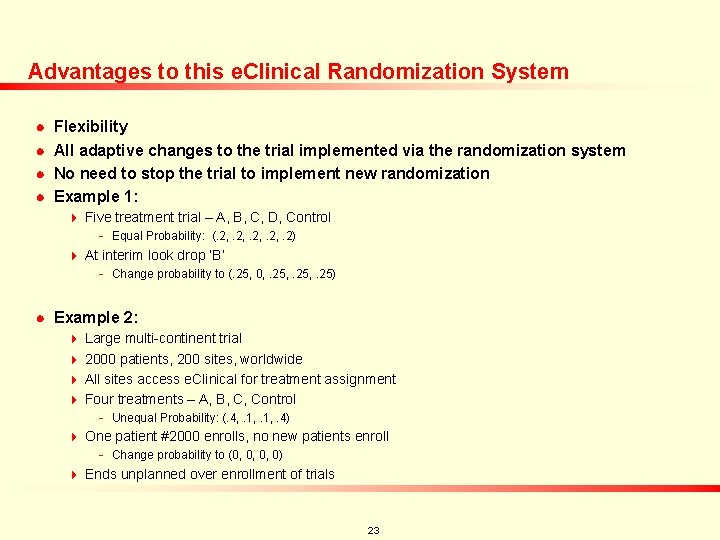
Advantages to this e. Clinical Randomization System n n Flexibility All adaptive changes to the trial implemented via the randomization system No need to stop the trial to implement new randomization Example 1: 4 Five treatment trial – A, B, C, D, Control - Equal Probability: (. 2, . 2) 4 At interim look drop ‘B’ - Change probability to (. 25, 0, . 25, . 25) n Example 2: 4 Large multi-continent trial 4 2000 patients, 200 sites, worldwide 4 All sites access e. Clinical for treatment assignment 4 Four treatments – A, B, C, Control - Unequal Probability: (. 4, . 1, . 4) 4 One patient #2000 enrolls, no new patients enroll - Change probability to (0, 0, 0, 0) 4 Ends unplanned over enrollment of trials 23
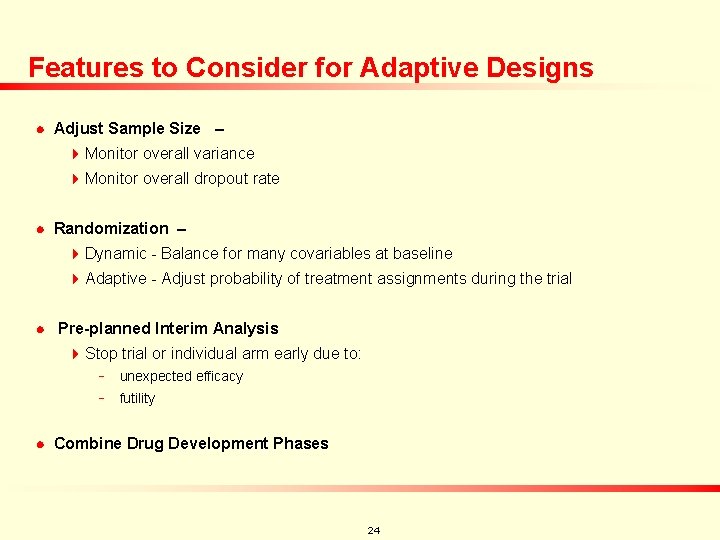
Features to Consider for Adaptive Designs n Adjust Sample Size – 4 Monitor overall variance 4 Monitor overall dropout rate n Randomization – 4 Dynamic - Balance for many covariables at baseline 4 Adaptive - Adjust probability of treatment assignments during the trial n Pre-planned Interim Analysis 4 Stop trial or individual arm early due to: - unexpected efficacy - futility n Combine Drug Development Phases 24
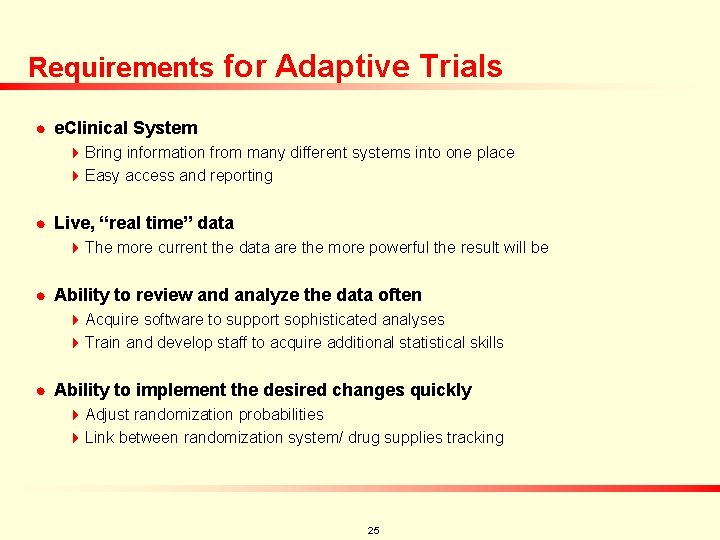
Requirements for Adaptive Trials n e. Clinical System 4 Bring information from many different systems into one place 4 Easy access and reporting n Live, “real time” data 4 The more current the data are the more powerful the result will be n Ability to review and analyze the data often 4 Acquire software to support sophisticated analyses 4 Train and develop staff to acquire additional statistical skills n Ability to implement the desired changes quickly 4 Adjust randomization probabilities 4 Link between randomization system/ drug supplies tracking 25
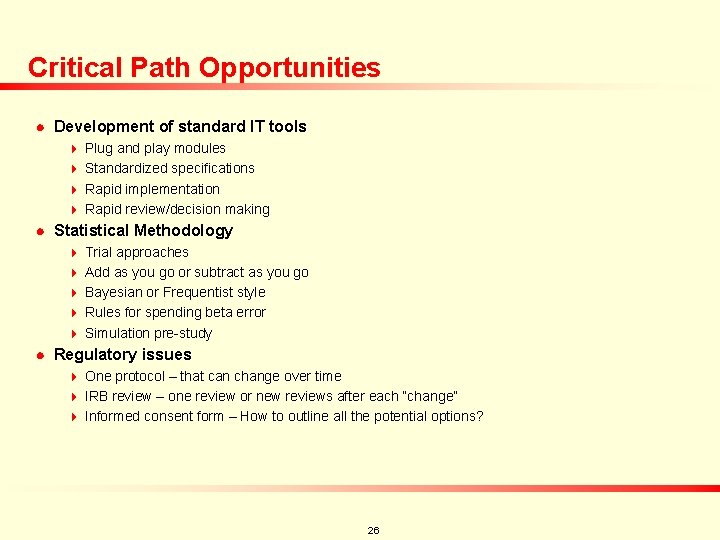
Critical Path Opportunities n Development of standard IT tools 4 Plug and play modules 4 Standardized specifications 4 Rapid implementation 4 Rapid review/decision making n Statistical Methodology 4 Trial approaches 4 Add as you go or subtract as you go 4 Bayesian or Frequentist style 4 Rules for spending beta error 4 Simulation pre-study n Regulatory issues 4 One protocol – that can change over time 4 IRB review – one review or new reviews after each “change” 4 Informed consent form – How to outline all the potential options? 26
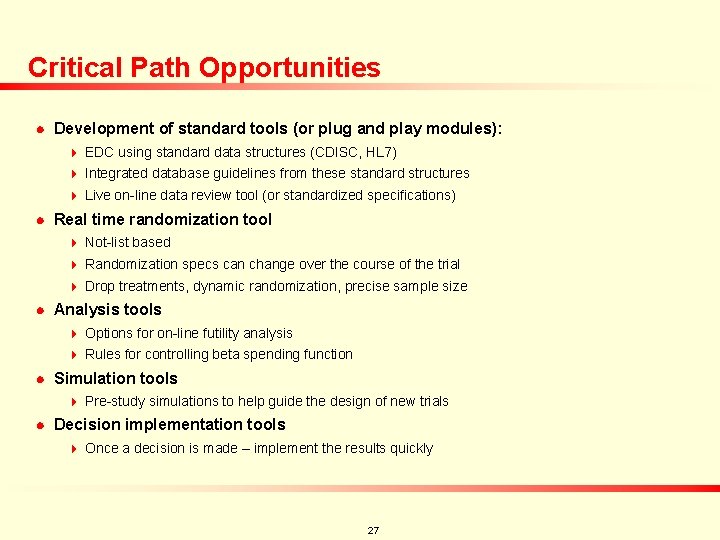
Critical Path Opportunities n Development of standard tools (or plug and play modules): 4 EDC using standard data structures (CDISC, HL 7) 4 Integrated database guidelines from these standard structures 4 Live on-line data review tool (or standardized specifications) n Real time randomization tool 4 Not-list based 4 Randomization specs can change over the course of the trial 4 Drop treatments, dynamic randomization, precise sample size n Analysis tools 4 Options for on-line futility analysis 4 Rules for controlling beta spending function n Simulation tools 4 Pre-study simulations to help guide the design of new trials n Decision implementation tools 4 Once a decision is made – implement the results quickly 27
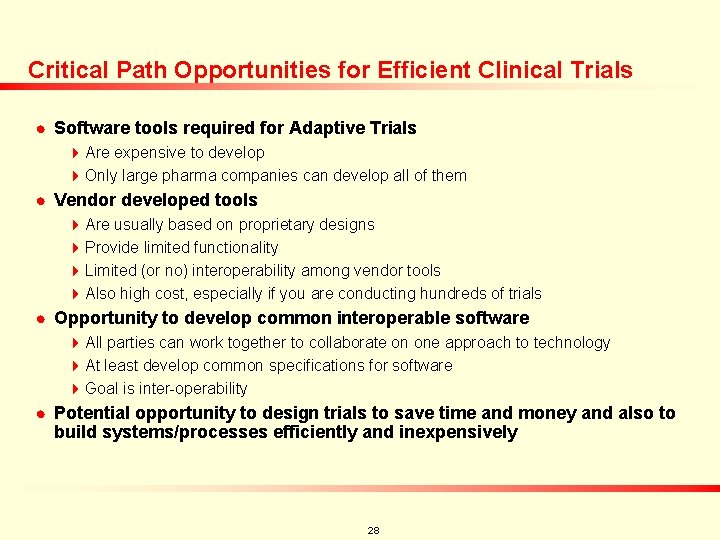
Critical Path Opportunities for Efficient Clinical Trials n Software tools required for Adaptive Trials 4 Are expensive to develop 4 Only large pharma companies can develop all of them n Vendor developed tools 4 Are usually based on proprietary designs 4 Provide limited functionality 4 Limited (or no) interoperability among vendor tools 4 Also high cost, especially if you are conducting hundreds of trials n Opportunity to develop common interoperable software 4 All parties can work together to collaborate on one approach to technology 4 At least develop common specifications for software 4 Goal is inter-operability n Potential opportunity to design trials to save time and money and also to build systems/processes efficiently and inexpensively 28
29