
A ppb measurement of the antiproton magnetic moment
A ppb measurement of the antiproton magnetic moment Christian Smorra RIKEN, Ulmer Fundamental Symmetries Laboratory on behalf of the BASE collaboration Low Energy Antiproton Physics Conference - LEAP 2018 – Paris 12. 03. 2018
Motivation: • Test of CPT invariance as fundamental symmetry in the Standard Model of particle physics • Probe for new interactions, e. g. Standard Model Extension or CPT-odd dimension-five interactions • The mechanism which generates the matter excess in the universe is not understood • Determination of a fundamental antiparticle property C. Smorra et al. , Nature 550, 371 (2017).
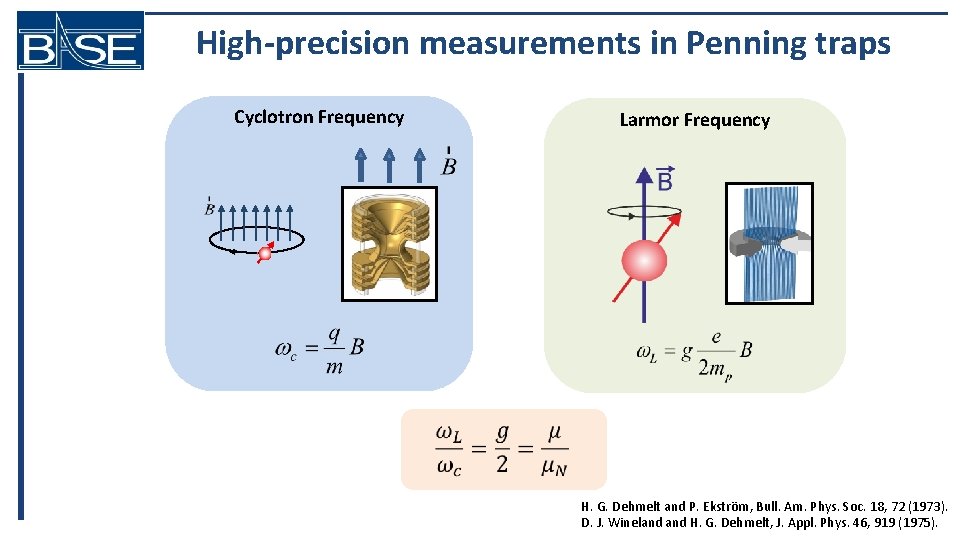
High-precision measurements in Penning traps Cyclotron Frequency Larmor Frequency H. G. Dehmelt and P. Ekström, Bull. Am. Phys. Soc. 18, 72 (1973). D. J. Wineland H. G. Dehmelt, J. Appl. Phys. 46, 919 (1975).
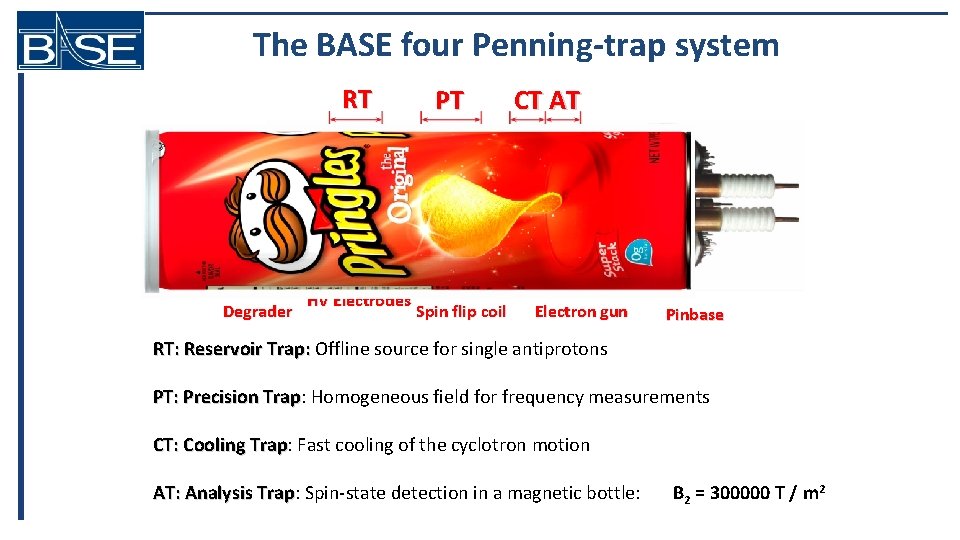
The BASE four Penning-trap system RT Degrader HV Electrodes PT Spin flip coil CT AT Electron gun Pinbase RT: Reservoir Trap: Offline source for single antiprotons PT: Precision Trap: Trap Homogeneous field for frequency measurements CT: Cooling Trap: Trap Fast cooling of the cyclotron motion AT: Analysis Trap: Trap Spin-state detection in a magnetic bottle: B 2 = 300000 T / m 2
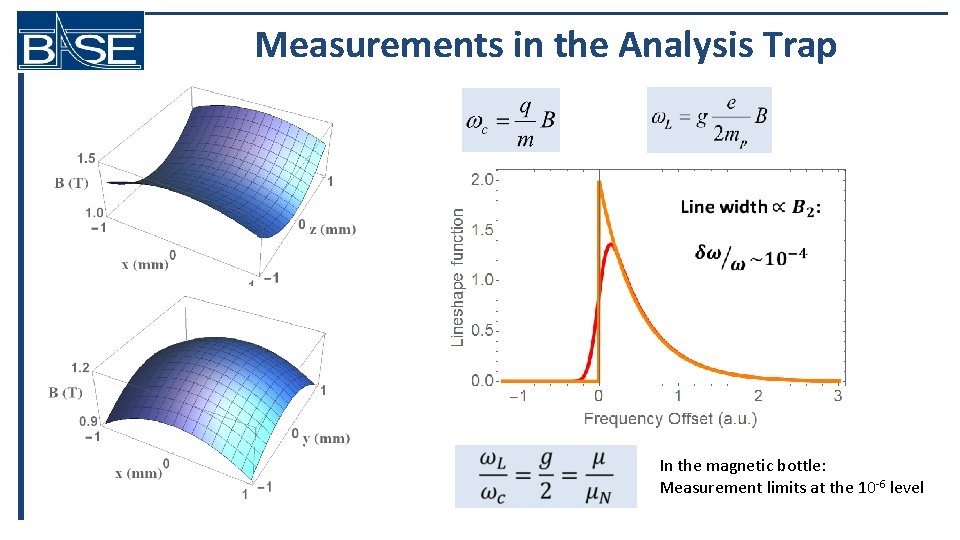
Measurements in the Analysis Trap In the magnetic bottle: Measurement limits at the 10 -6 level
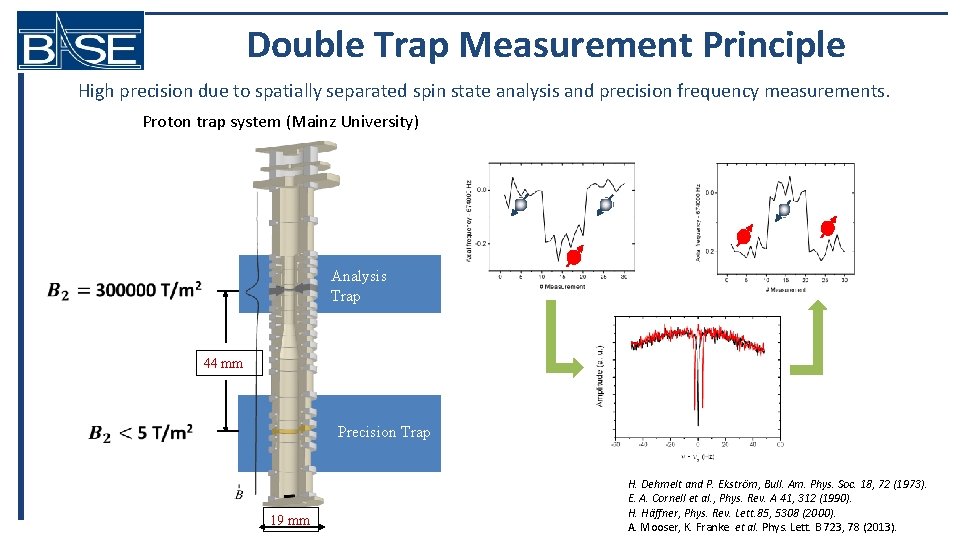
Double Trap Measurement Principle High precision due to spatially separated spin state analysis and precision frequency measurements. Proton trap system (Mainz University) Analysis Trap 44 mm Precision Trap 19 mm H. Dehmelt and P. Ekström, Bull. Am. Phys. Soc. 18, 72 (1973). E. A. Cornell et al. , Phys. Rev. A 41, 312 (1990). H. Häffner, Phys. Rev. Lett. 85, 5308 (2000). A. Mooser, K. Franke et al. Phys. Lett. B 723, 78 (2013).
REQUIREMENT SINGLE SPIN-FLIP DETECTION
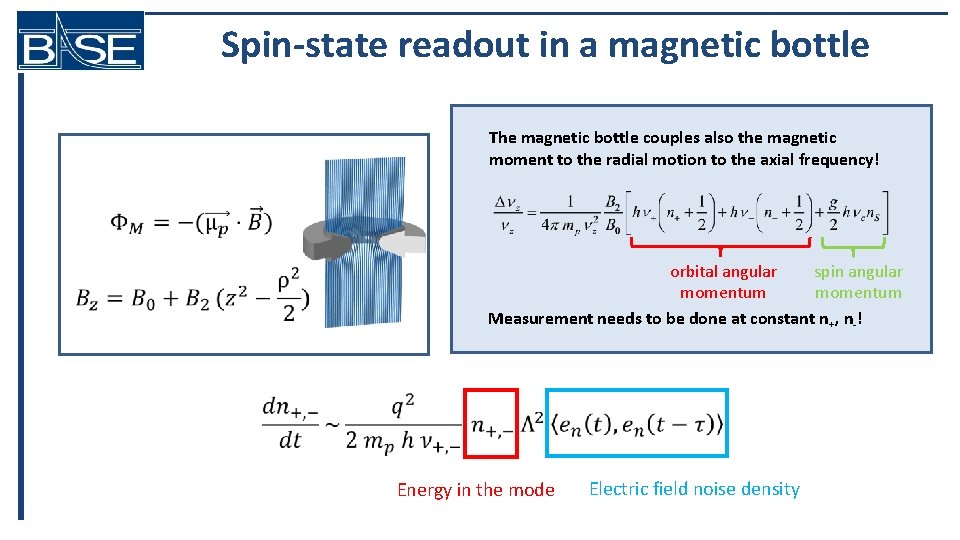
Spin-state readout in a magnetic bottle The magnetic bottle couples also the magnetic moment to the radial motion to the axial frequency! orbital angular spin angular momentum Measurement needs to be done at constant n+, n-! Energy in the mode Electric field noise density
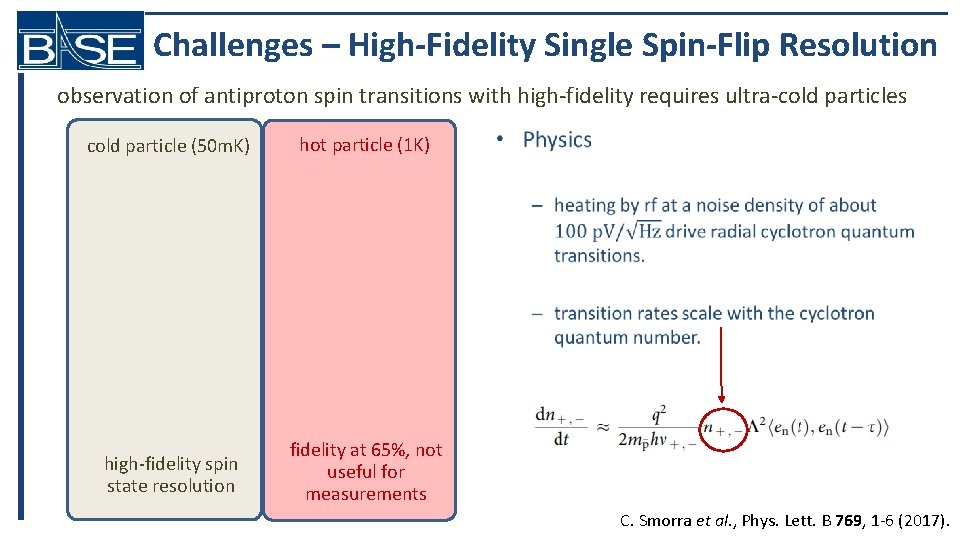
Challenges – High-Fidelity Single Spin-Flip Resolution observation of antiproton spin transitions with high-fidelity requires ultra-cold particles cold particle (50 m. K) hot particle (1 K) high-fidelity spin state resolution fidelity at 65%, not useful for measurements • C. Smorra et al. , Phys. Lett. B 769, 1 -6 (2017).
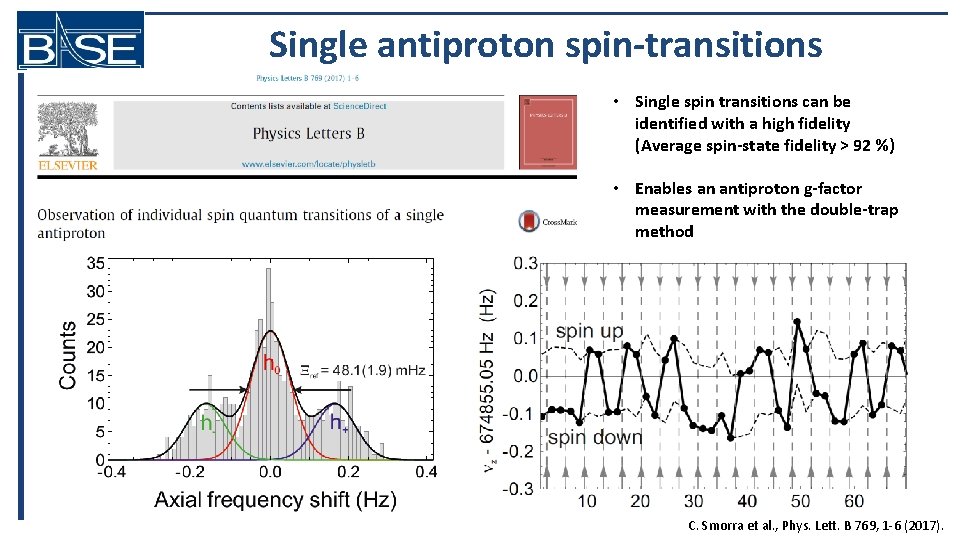
Single antiproton spin-transitions • Single spin transitions can be identified with a high fidelity (Average spin-state fidelity > 92 %) • Enables an antiproton g-factor measurement with the double-trap method C. Smorra et al. , Phys. Lett. B 769, 1 -6 (2017).
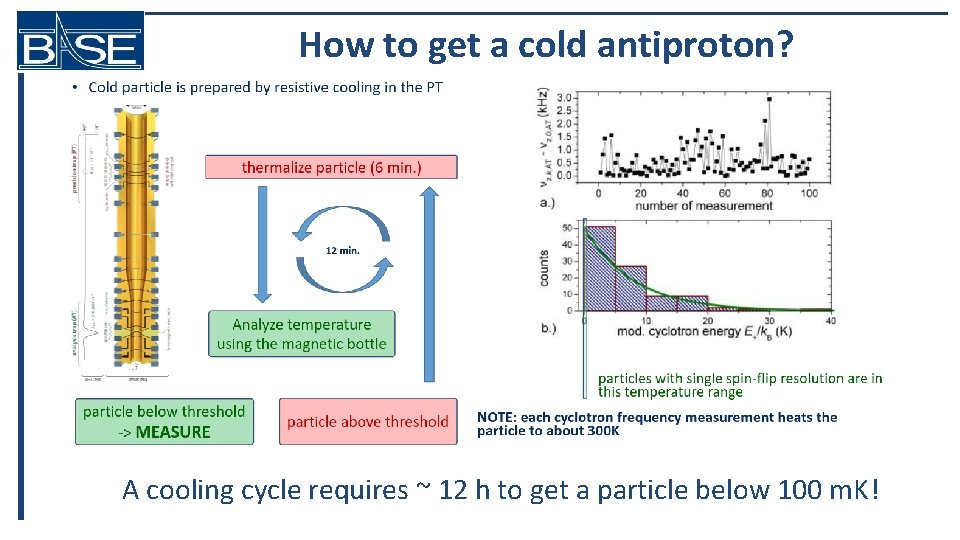
How to get a cold antiproton? A cooling cycle requires ~ 12 h to get a particle below 100 m. K!
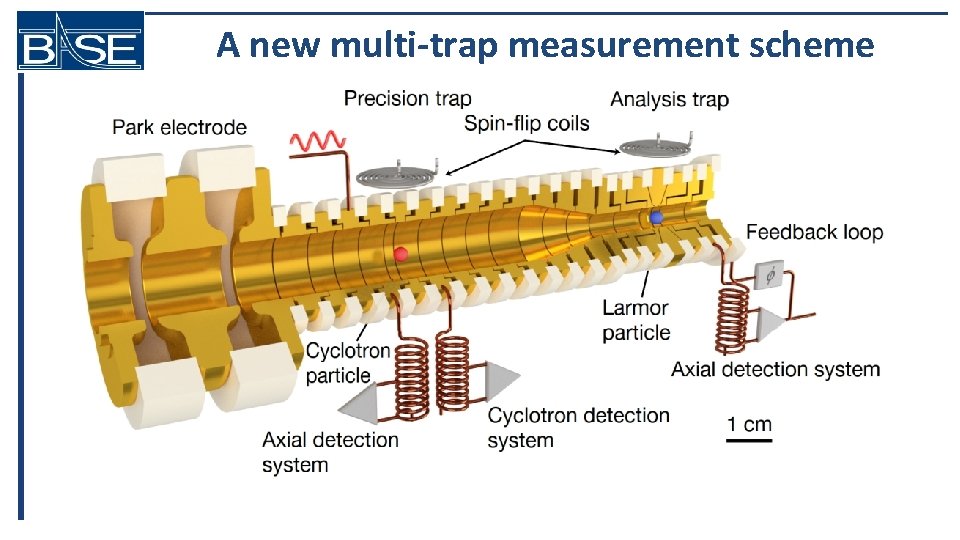
A new multi-trap measurement scheme
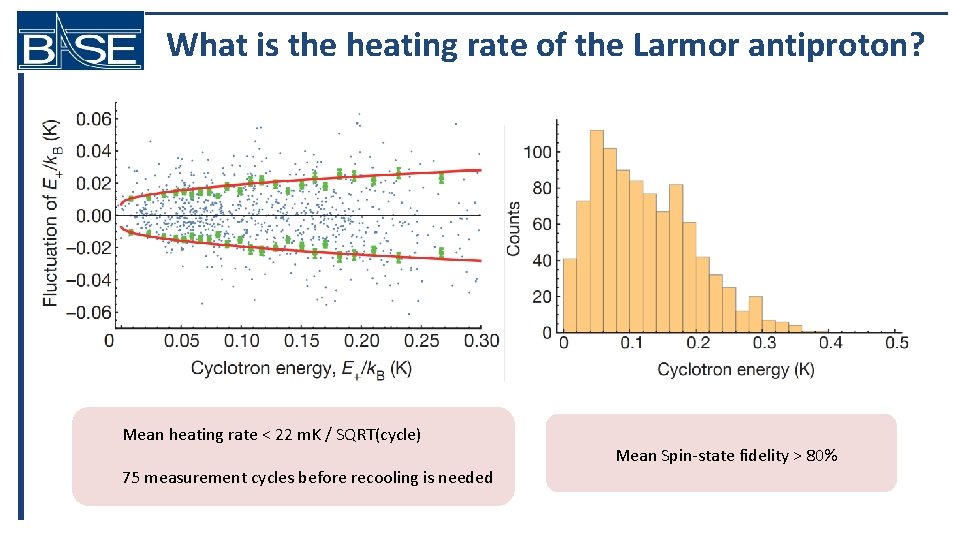
What is the heating rate of the Larmor antiproton? Mean heating rate < 22 m. K / SQRT(cycle) 75 measurement cycles before recooling is needed Mean Spin-state fidelity > 80%
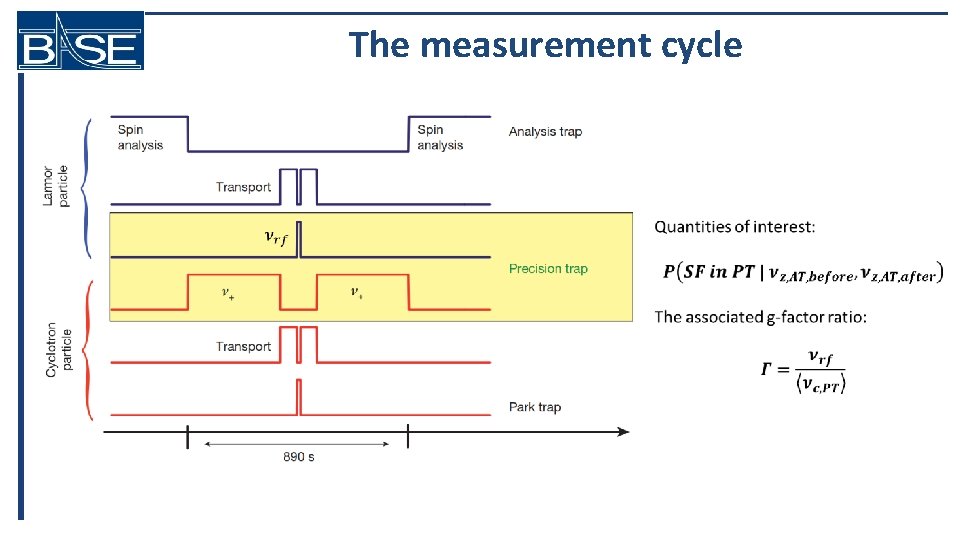
The measurement cycle
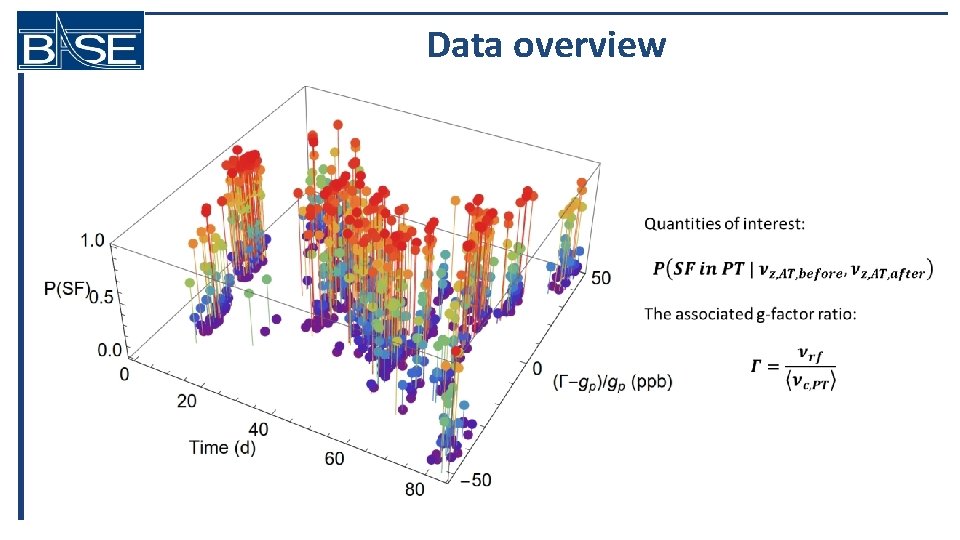
Data overview
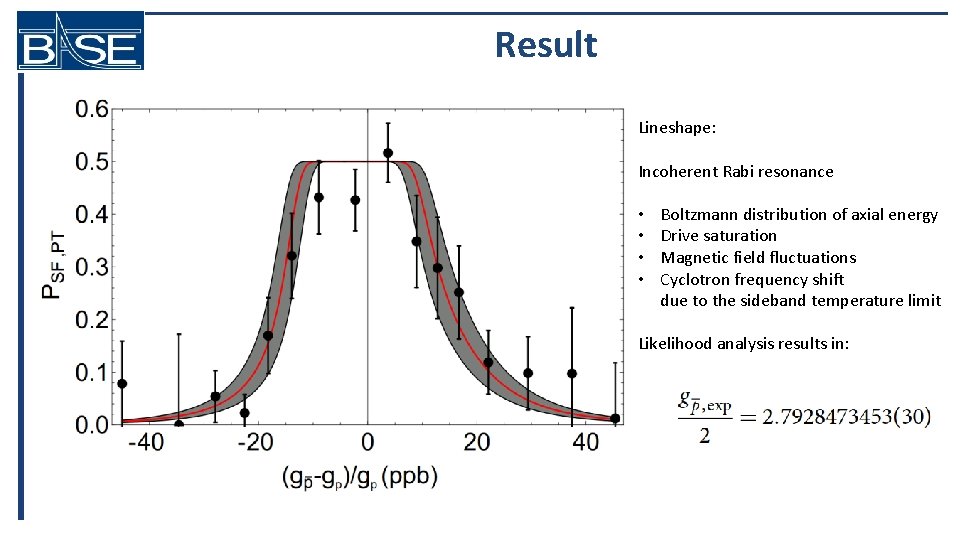
Result Lineshape: Incoherent Rabi resonance • • Boltzmann distribution of axial energy Drive saturation Magnetic field fluctuations Cyclotron frequency shift due to the sideband temperature limit Likelihood analysis results in:
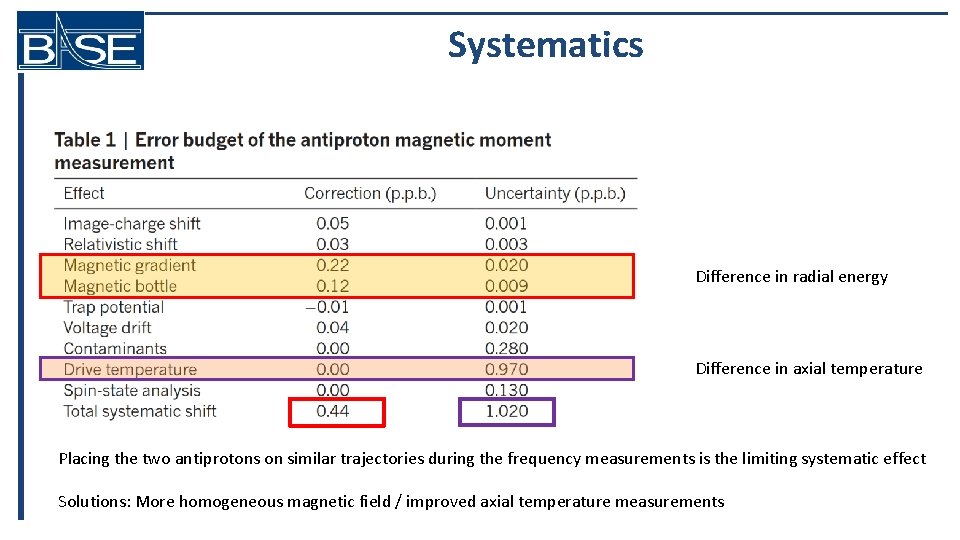
Systematics Difference in radial energy Difference in axial temperature Placing the two antiprotons on similar trajectories during the frequency measurements is the limiting systematic effect Solutions: More homogeneous magnetic field / improved axial temperature measurements
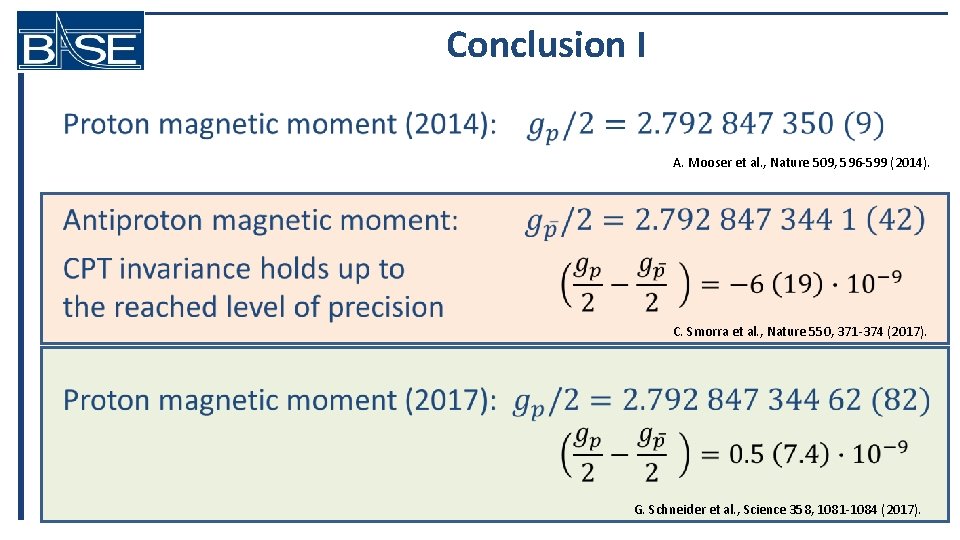
Conclusion I • A. Mooser et al. , Nature 509, 596 -599 (2014). C. Smorra et al. , Nature 550, 371 -374 (2017). G. Schneider et al. , Science 358, 1081 -1084 (2017).
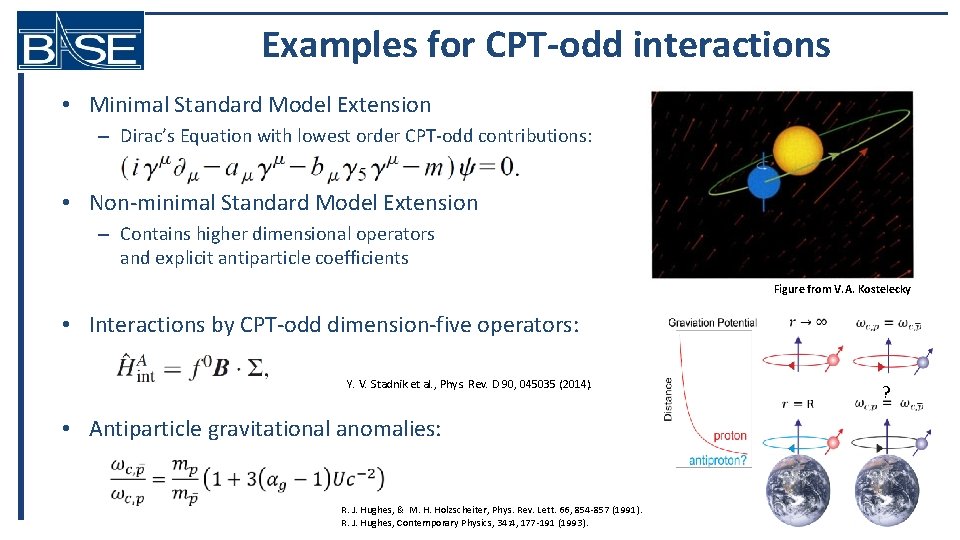
Examples for CPT-odd interactions • Minimal Standard Model Extension – Dirac’s Equation with lowest order CPT-odd contributions: • Non-minimal Standard Model Extension – Contains higher dimensional operators and explicit antiparticle coefficients Figure from V. A. Kostelecky • Interactions by CPT-odd dimension-five operators: Y. V. Stadnik et al. , Phys. Rev. D 90, 045035 (2014). • Antiparticle gravitational anomalies: R. J. Hughes, & M. H. Holzscheiter, Phys. Rev. Lett. 66, 854 -857 (1991). R. J. Hughes, Contemporary Physics, 34: 4, 177 -191 (1993). ?
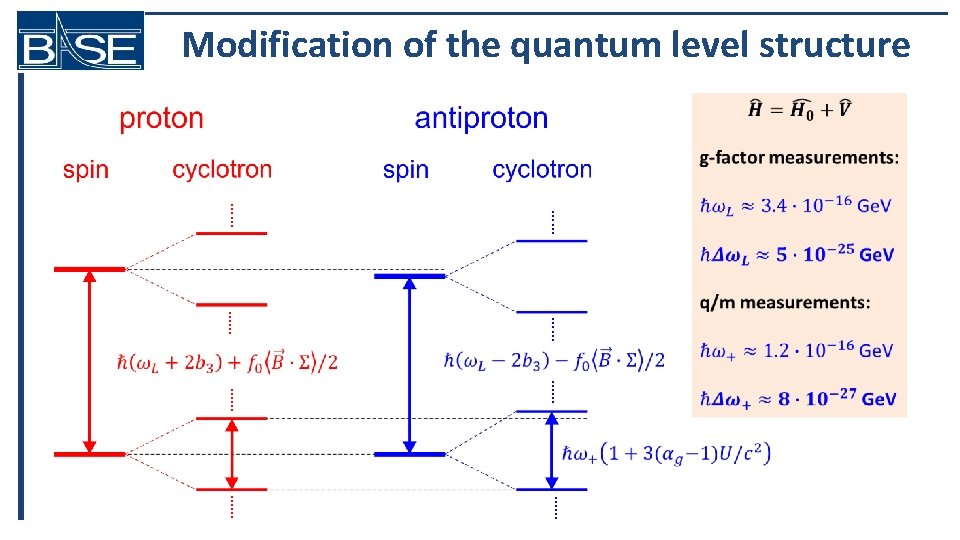
Modification of the quantum level structure …… ……
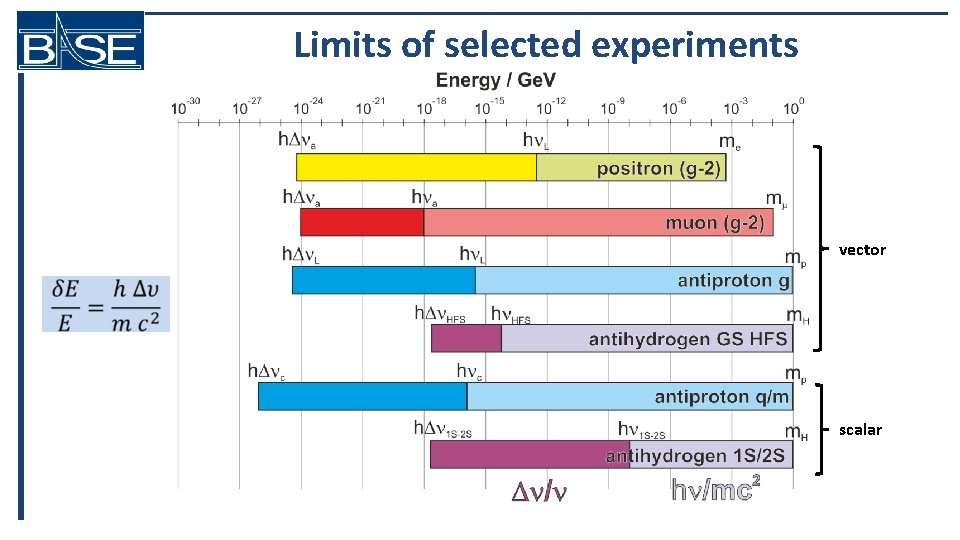
Limits of selected experiments vector scalar
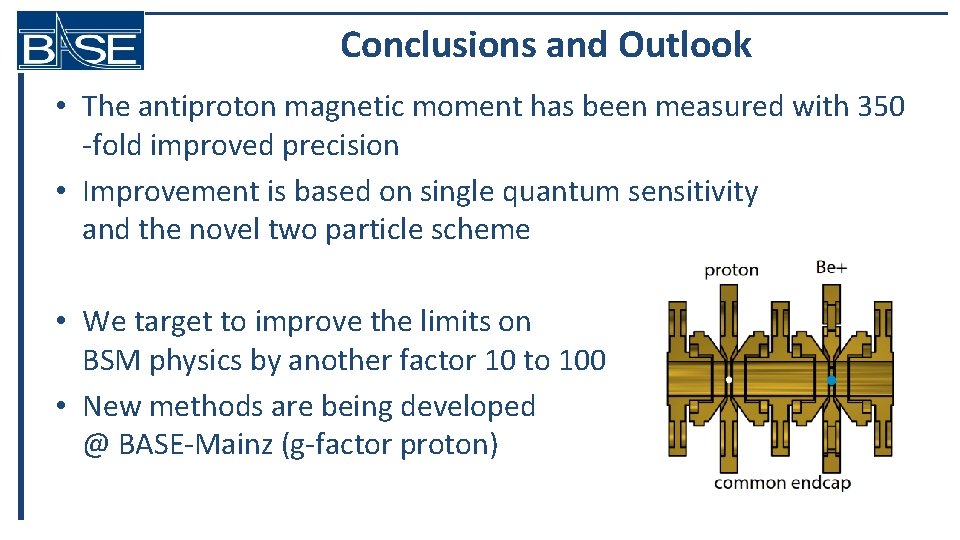
Conclusions and Outlook • The antiproton magnetic moment has been measured with 350 -fold improved precision • Improvement is based on single quantum sensitivity and the novel two particle scheme • We target to improve the limits on BSM physics by another factor 10 to 100 • New methods are being developed @ BASE-Mainz (g-factor proton)
Thank you for your attention! • Thanks to the BASE team • • S. Ulmer RIKEN C. Smorra CERN / RIKEN A. Mooser RIKEN S. Sellner RIKEN • • BASE@CERN: M. Borchert, J. Harrington, T. Higuchi, H. Nagahama, S. Sellner, T. Tanaka, S. Ulmer BASE@Mainz: M. Bohman, A. Mooser, G. Schneider, N. Schön, M. Wiesinger, J. Walz BASE@Hannover: C. Ospelkaus BASE collaborators: K. Blaum, Y. Matsuda, W. Quint, Y. Yamazaki • Thank you for the funding: H. Nagahma RIKEN / Tokyo M. Bohman MPI-K / RIKEN T. Higuchi RIKEN / Tokyo M. Borchert U - Hannover G. Schneider U - Mainz M. Wiesinger U - Mainz J. Harrington RIKEN & MPIK N. Schoen U - Mainz
- Slides: 23