
A Power Point lesson by Jim Soto Scene
A Power. Point lesson by Jim Soto Scene Blocking
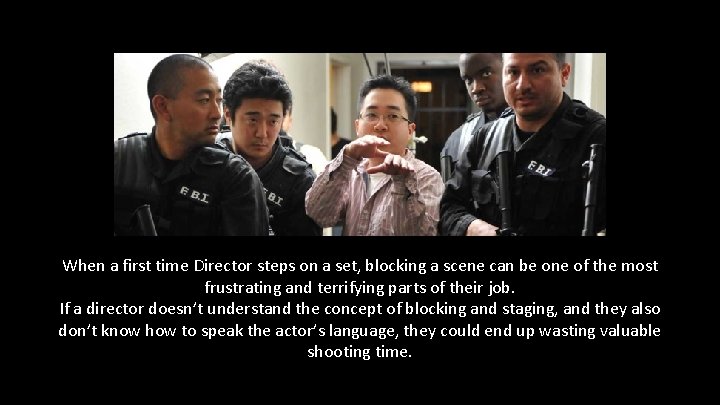
When a first time Director steps on a set, blocking a scene can be one of the most frustrating and terrifying parts of their job. If a director doesn’t understand the concept of blocking and staging, and they also don’t know how to speak the actor’s language, they could end up wasting valuable shooting time.

What is Blocking ? Blocking was originally a theatre term that refers to the positioning and movement of the actors in the stage. As a part of rehearsal, blocking is necessary for a smooth performance. In filmmaking, camera and lights are added to the equation. Blocking a film involves the precise movement of the actors in relation to camera and lights.
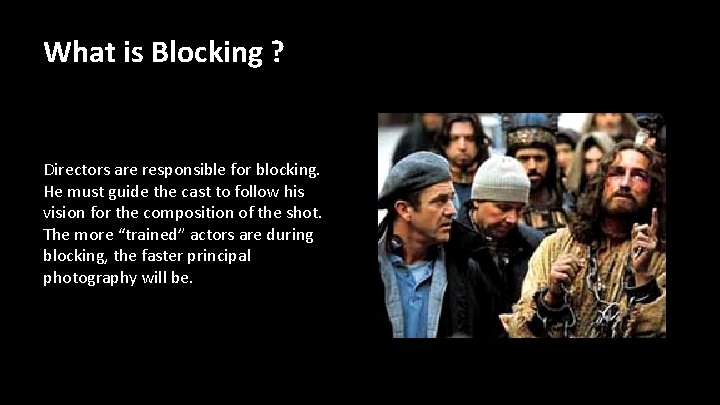
What is Blocking ? Directors are responsible for blocking. He must guide the cast to follow his vision for the composition of the shot. The more “trained” actors are during blocking, the faster principal photography will be.

Simply put, blocking a scene is “directing an actor’s moves in relation to the camera. ” You can also think of blocking as the choreography of a dance or a ballet: all the elements on the set (actors, extras, vehicles, crew, equipment) should move in perfect harmony with each other in front of the camera.

The 5 Stages of Blocking a Scene Every film shoot is divided into five parts: 1. Block – deciding where the actors will be on the set and the first camera position 2. Light – time for the DOP to light the set and position the camera for the first shot 3. Rehearse – camera rehearsal of the first set-up with the actors and crew 4. Adjustments – making lighting and other adjustments 5. Shoot – shooting the first scene (then repeat the process)

Blocking is the act of walking the actors through the scene before filming it to make sure the lighting is adequate and the camera is able to get the desired focus required. Blocking is for all departments to be sure that they are prepared for the scene to be shot. Taking a few extra minutes to block a scene can save time and money later.

Blocking could last days for a big scene, such as the scene in Jarhead where the soldiers met in a tent. Director Sam Mendes blocked that scene for 4 days before they shot it. Remember: Blocking a scene for film also should produce the BEST SHOT POSSIBLE. An effective scene is the result of the combination of several elements that together make up blocking. These include cinematographic details, the physical relationship (the chemistry) of the actors to each other, their energy (dynamics), and the clarity of what they are going.
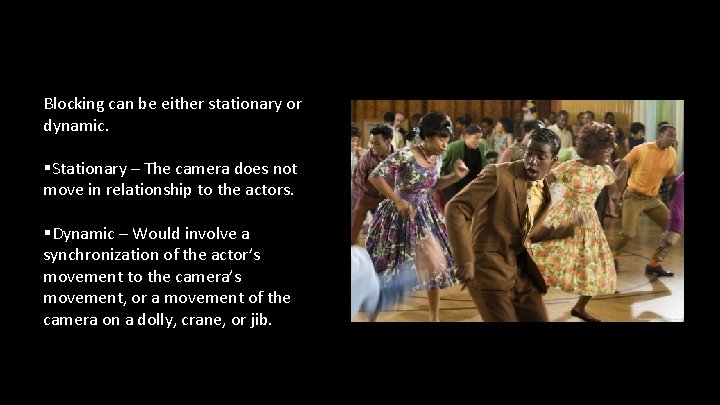
Blocking can be either stationary or dynamic. §Stationary – The camera does not move in relationship to the actors. §Dynamic – Would involve a synchronization of the actor’s movement to the camera’s movement, or a movement of the camera on a dolly, crane, or jib.
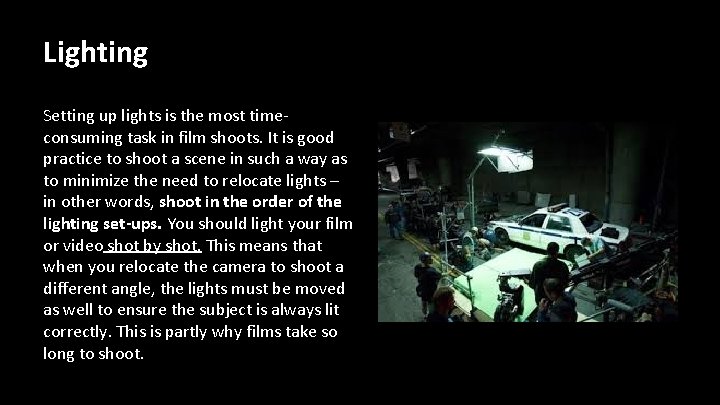
Lighting Setting up lights is the most timeconsuming task in film shoots. It is good practice to shoot a scene in such a way as to minimize the need to relocate lights – in other words, shoot in the order of the lighting set-ups. You should light your film or video shot by shot. This means that when you relocate the camera to shoot a different angle, the lights must be moved as well to ensure the subject is always lit correctly. This is partly why films take so long to shoot.
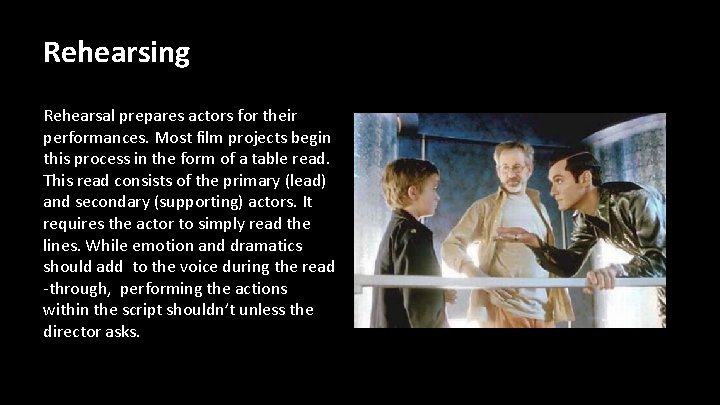
Rehearsing Rehearsal prepares actors for their performances. Most film projects begin this process in the form of a table read. This read consists of the primary (lead) and secondary (supporting) actors. It requires the actor to simply read the lines. While emotion and dramatics should add to the voice during the read -through, performing the actions within the script shouldn’t unless the director asks.
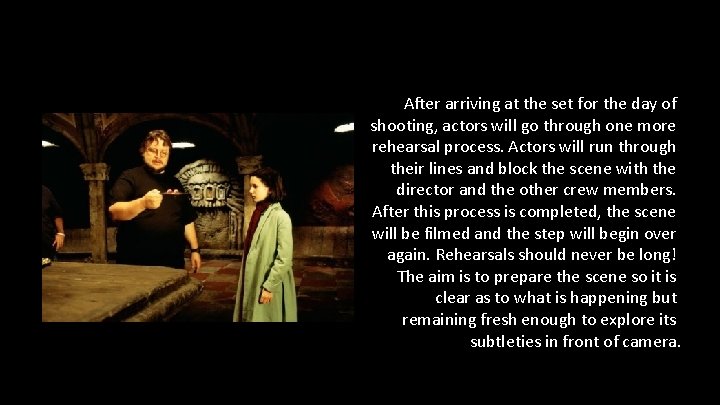
After arriving at the set for the day of shooting, actors will go through one more rehearsal process. Actors will run through their lines and block the scene with the director and the other crew members. After this process is completed, the scene will be filmed and the step will begin over again. Rehearsals should never be long! The aim is to prepare the scene so it is clear as to what is happening but remaining fresh enough to explore its subtleties in front of camera.
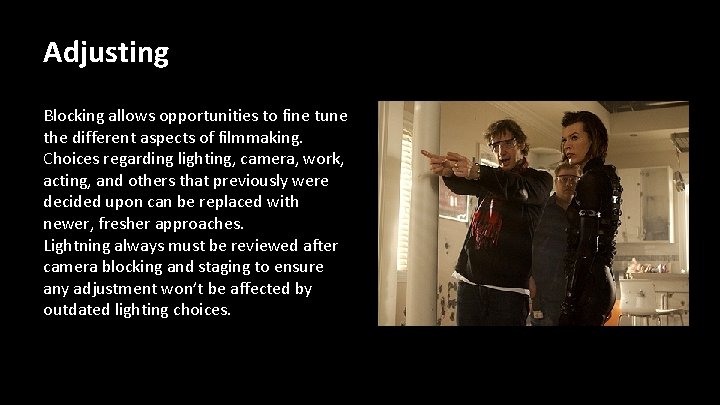
Adjusting Blocking allows opportunities to fine tune the different aspects of filmmaking. Choices regarding lighting, camera, work, acting, and others that previously were decided upon can be replaced with newer, fresher approaches. Lightning always must be reviewed after camera blocking and staging to ensure any adjustment won’t be affected by outdated lighting choices.
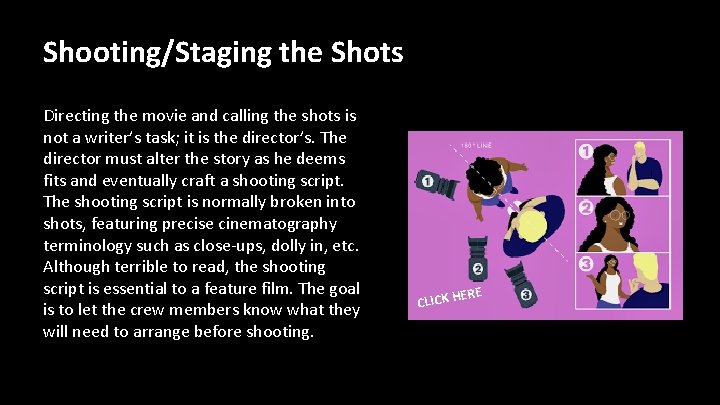
Shooting/Staging the Shots Directing the movie and calling the shots is not a writer’s task; it is the director’s. The director must alter the story as he deems fits and eventually craft a shooting script. The shooting script is normally broken into shots, featuring precise cinematography terminology such as close-ups, dolly in, etc. Although terrible to read, the shooting script is essential to a feature film. The goal is to let the crew members know what they will need to arrange before shooting. ERE CLICK H
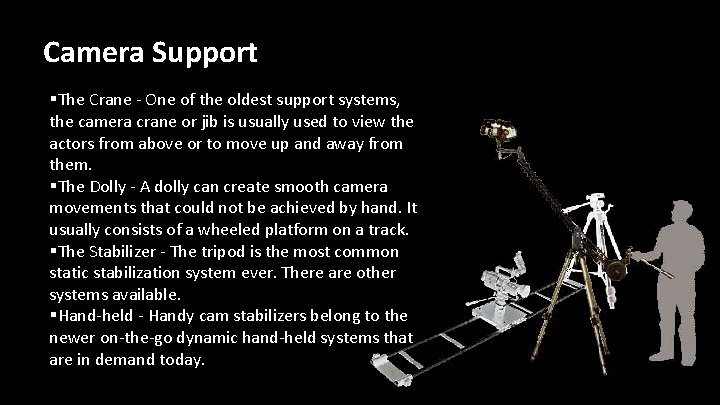
Camera Support §The Crane - One of the oldest support systems, the camera crane or jib is usually used to view the actors from above or to move up and away from them. §The Dolly - A dolly can create smooth camera movements that could not be achieved by hand. It usually consists of a wheeled platform on a track. §The Stabilizer - The tripod is the most common static stabilization system ever. There are other systems available. §Hand-held - Handy cam stabilizers belong to the newer on-the-go dynamic hand-held systems that are in demand today.
5 Important Tips When Blocking a Scene 1. Having a shot list will help you during the blocking process. The shot list is like a map: it gives you a path to your destination but you don’t always have to follow it 2. Let the actors show you what they want to do first, then, when you make a suggestion, it is based on something you have already seen 3. Where the camera is placed is determined primarily by what is important in the scene. 4. Blocking is like a puzzle: directors need to keep working at it until the whole scene works. 5. In Low budget films, speed is essential, story and block some scenes so that your action takes place in one direction (to avoid turning the camera around for reverses. ) Filmmaking Article
Reshoot 1. Why is blocking a scene so important? 2. What happens during the five stages of blocking? 3. Explain the difference between stationary blocking and dynamic blocking. 4. Why should scenes be shot in the order of the lighting set-ups? 5. Mention and explain four basic camera support systems.
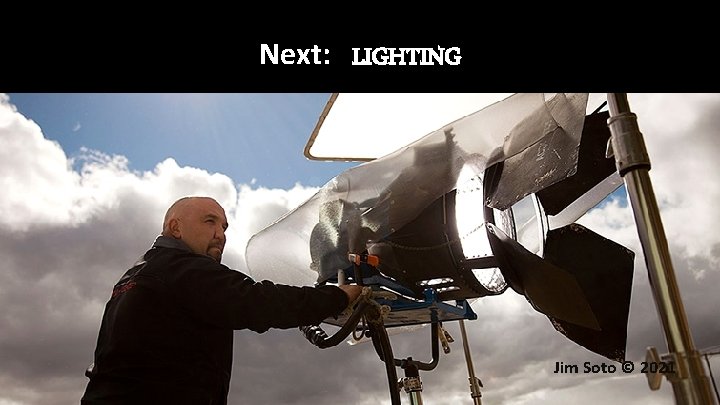
Next: LIGHTING Jim Soto © 2021
- Slides: 18