
A Portable Load Balancer for Kubernetes Cluster Kimitoshi

A Portable Load Balancer for Kubernetes Cluster Kimitoshi Takahashi∗ The Graduate University for Advanced Studies Chiyoda-ku, Tokyo, Japan ktaka@nii. ac. jp Kento Aida National Institute of Informatics, The Graduate University for Advanced Studies Chiyoda-ku, Tokyo, Japan aida@nii. ac. jp Tomoya Tanjo National Institute of Informatics Chiyoda-ku, Tokyo, Japan tanjo@nii. ac. jp Jingtao Sun National Institute of Informatics Chiyoda-ku, Tokyo, Japan sun@nii. ac. jp 2020 Mobile All-IP Networking Laboratory 1 National Chung Cheng University Dept. Computer Science & Information Engineering
National Chung Cheng University Dept. Computer Science & Information Engineering ABSTRACT Linux containers have become very popular these days due to their lightweight nature and portability. Numerous web services are now deployed as clusters of containers. Kubernetes is a popular container management system that enables users to deploy such web services easily, and hence, it facilitates web service migration to the other side of the world. 2
National Chung Cheng University Dept. Computer Science & Information Engineering However, since Kubernetes relies on external load balancers provided by cloud providers, it is difficult to use in environments where there are no supported load balancers. This is particularly true for on-premise data centers, or for all but the largest cloud providers. In this paper, we proposed a portable load balancer that was usable in any environment, and hence facilitated web services migration. We implemented a containerized software load balancer that is run by Kubernetes as a part of container cluster, using Linux kernel’s Internet Protocol Virtual Server(IPVS). 3
National Chung Cheng University Dept. Computer Science & Information Engineering Then we compared the performance of our proposed load balancer with existing iptables Destination Network Address Translation (DNAT) and the Nginx load balancers. During our experiments, we also clarified the importance of two network conditions to derive the best performance: the first was the choice of the overlay network operation mode, and the second was distributing packet processing to multiple cores. The results indicated that our proposed IPVS load balancer improved portability of web services without sacrificing the performance. 4
National Chung Cheng University Dept. Computer Science & Information Engineering 1 INTRODUCTION Recently, Linux containers have drawn significant amount of attention because they are lightweight, portable, and repeatable. Linux containers are generally more lightweight than virtual machine (VM) clusters, because the containers share the kernel with the host operating system (OS), even though they maintain separate execution environments. They are generally portable because the process execution environments are archived into tar files, so whenever one attempts to run a container, the exact same file systems are restored from the archives even when totally different data centers are used. This means that containers can provide repeatable and portable execution environments. 5
National Chung Cheng University Dept. Computer Science & Information Engineering For the same reasons, Linux containers are attractive for web services as well, and it is expected that web services consisting of container clusters would be capable of being migrated easily for variety of purposes. For example disaster recovery, cost performance improvemets, legal compliance, and shortening the geographical distance to customers are the main concerns for web service providers in e-commece, gaming, Financial technology(Fintech) and Internet of Things(Io. T) field 6
![National Chung Cheng University Dept. Computer Science & Information Engineering Kubernetes[3], which is one](http://slidetodoc.com/presentation_image_h2/e28febe84c9c8dc731c2d21dd21c295c/image-7.jpg "National Chung Cheng University Dept. Computer Science & Information Engineering Kubernetes[3], which is one")
National Chung Cheng University Dept. Computer Science & Information Engineering Kubernetes[3], which is one of the popular container cluster management systems, enables easy deployment of container clusters. Since Kubernetes hides the differences in the base environments, users can easily deploy a web service on different cloud providers or on on-premise data centers, without adjusting the container cluster configurations to the new environment. This allows a user to easily migrate a web service consisting of a container cluster even to the other side of the world. A user starts the container cluster in the new location, route the traffic there, then stop the old container cluster at his or her convenience. This is a typical web service migration scenario. 7
National Chung Cheng University Dept. Computer Science & Information Engineering However, this scenario only works when the user migrates a container cluster among major cloud providers including Google Cloud Platform (GCP), Amazon Web Services (AWS), and Microsoft Azure. The Kubernetes does not include a load balancer, and is heavily dependent on external load balancers that are set up on the fly by cloud providers through their application protocol interfaces (APIs). These external load balancers distribute incoming traffic to every server that hosts containers. The traffic is then distributed again to destination containers using iptables destination network address translation (DNAT)[17, 18] rules in a round-robin manner. 8
National Chung Cheng University Dept. Computer Science & Information Engineering The problem happens in the environment with a load balancer that is not supported by the Kubernetes, e. g. in an on-premise data center with a bare metal load balancer. In such environments, the user needs to manually configure the static route for inbound traffic in an ad-hoc manner. Since the Kubernetes fails to provide an uniform environment from a container cluster view point, migrating container clusters among the different environments will always be a burden 9
National Chung Cheng University Dept. Computer Science & Information Engineering In order to solve this problem by eliminating the dependency on external load balancer, herein we propose a containerized software load balancer that is run by Kubernetes as as a part of web services consisting of container cluster. It enables a user to easily deploy a web service on different environment without modification, because the load balancer is included in the web service itself. To accomplish this, we will containerize Linux kernel’s Internet Protocol Virtual Server (IPVS)[26] Layer 4 load balancer using an existing Kubernetes ingress[2] framework, as a proof of concept 10
National Chung Cheng University Dept. Computer Science & Information Engineering To prove that our approach will not significantly deteriorate the performance, we will also compare the performance of our proposed load balancer with those of iptables DNAT load balancer and the Nginx Layer 7 load balancing. The results indicated that the proposed load balancer could improve the portability of container clusters without performance degradation compared with the existing load balancer. The performance of the proposed load balancer may be affected by the network configurations of overlay network and distributed packet processing. We also evaluate how the network configurations affects the performance and discusses the best setting that derives the best performance 11
National Chung Cheng University Dept. Computer Science & Information Engineering The contributions of this paper are as follows: 1) We propose a portable software load balancer that is runnable on any cloud provider, or on on-premise data centers, as a part of a container cluster. 2) We discuss feasibility of the proposed load balancer by comparing its performance with other load balancers. 3) We also discuss usable overlay network configurations and clarify the importance of techniques that will draw the best performance from such load balancers. 12

National Chung Cheng University Dept. Computer Science & Information Engineering The rest of the paper is organized as follows. Section 2 highlights work that deals specifically with container cluster migration, software load balancer containerization, and load balancer related tools within the context of the container technology. Section 3 will explain existing architecture problems and propose our solutions. In Section 4, experimental conditions and the parameters that we considered to be important in our experiment will be described in detail. Then, we will show our experimental results and discuss the obtained performance characteristics in Section 5, which is followed by a summary of our work in Section 6. 13
National Chung Cheng University Dept. Computer Science & Information Engineering 2 RELATED WORK This section highlights related work, especially that dealing with container cluster migration, software load balancer containerization, and load balancer tools within the context of the container technology 14
National Chung Cheng University Dept. Computer Science & Information Engineering Container cluster migration: Kubernetes developers are trying to add federation[1] capability for handling situations where multiple Kubernetes clusters 1 are deployed on multiple cloud providers or on-premise data centers, and are managed via the Kubernetes federation API server (federationapiserver). However, how each Kubernetes cluster is run on different types of cloud providers and/or on-premise data centers, especially when the load balancers of such environments are not supported by Kubernetes, seems beyond the scope of that project. The main scope of this paper is to make Kubernetes usable in environments without supported load balancers by providing a containerized software load balancer. 15
National Chung Cheng University Dept. Computer Science & Information Engineering Software load balancer containerization: As far as load balancer containerization is concerned, the following related work has been identified: Nginxingress[14, 21] utilizes the ingress[2] capability of Kubernetes, to implement containerized Nginx proxy as a load balancer. Nginx itself is famous as a highperformance web server program that also has the functionality of a Layer-7 load balancer. Nginx is capable of handling Transport Layer Security(TLS) encryption, as well as Uniform Resource Identifier(URI) based switching. However, the flip side of Nginx is that it is much slower than Layer-4 switching. We compared the performance between Nginx as a load balancer and our proposed load balancer in this paper. 16
![National Chung Cheng University Dept. Computer Science & Information Engineering Meanwhile, the kube-keepalived-vip[22] project](http://slidetodoc.com/presentation_image_h2/e28febe84c9c8dc731c2d21dd21c295c/image-17.jpg "National Chung Cheng University Dept. Computer Science & Information Engineering Meanwhile, the kube-keepalived-vip[22] project")
National Chung Cheng University Dept. Computer Science & Information Engineering Meanwhile, the kube-keepalived-vip[22] project is trying to use Linux kernel’s IPVS[26] load balancer capabilities by containerizing the keepalived[5]. The kernel IPVS function is set up in the host OS’s net name spaces and is shared among multiple web services, as if it is part of the Kubernetes cluster infrastructure. Our approach differs in that the IPVS rules are set up in container’s net name spaces and function as a part of the web service container cluster itself. The load balancers are configurable one by one, and are movable with the cluster once the migration is needed. The kube-keepalived-vip’s approach lacks flexibility and portability whereas ours provide them. 17
National Chung Cheng University Dept. Computer Science & Information Engineering The swarm mode of the Docker[9, 10] also uses IPVS for internal load balancing, but it is also considered as part of Docker swarm infrastructure, and thus lacks the portability that our proposal aims to provide 18
National Chung Cheng University Dept. Computer Science & Information Engineering Load balancer tools in the container context: There are several other projects where efforts have been made to utilize IPVS in the context of container environment. For example, GORB[23] and clusterf[19] are daemons that setup IPVS rules in the kernel inside the Docker container. They utilize running container information stored in key-value storages like Core OS etcd[7] and Hashi. Corp’s Consul[12]. Although these were usable to implement a containerized load balancer in our proposal, we did not use them, since Kubernetes ingress framework already provided the methods to retrieve running container information through standard API. 19
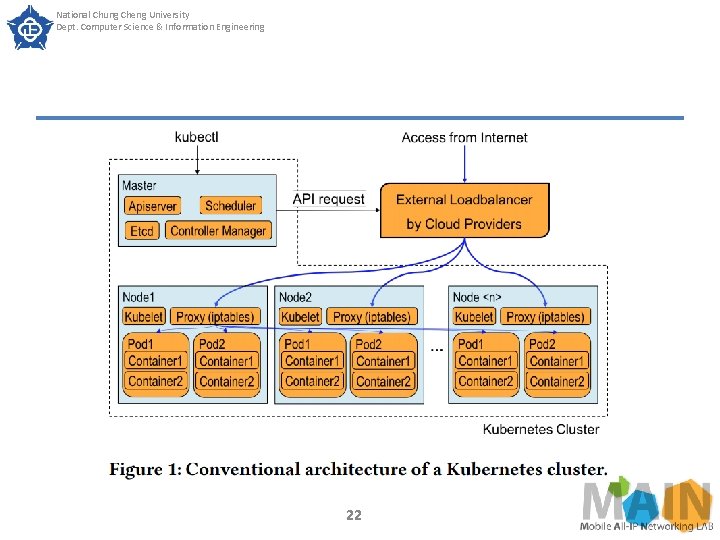
3 LOAD BALANCERS IN KUBERNETES CLUSTER National Chung Cheng University Dept. Computer Science & Information Engineering 3. 1 Conventional Architecture Problems commonly occur when the Kubernetes container management system is used outside of recommended cloud providers(such as GCP or AWS). Figure 1 shows an exemplified Kubernetes cluster. A Kubernetes cluster typically consists of a master and nodes. They can be physical servers or VMs. On the master, daemons that control the Kubernetes cluster are typically deployed. These daemons include, apiserver, scheduler, controller-manager and etcd. On the nodes, the kubelet daemon will run pods, depending the Pod. Spec information obtained from the apiserver on the master. 20
National Chung Cheng University Dept. Computer Science & Information Engineering A pod is a group of containers that share same net name space and cgroups, and is the basic execution unit in a Kubernetes cluster. 21
National Chung Cheng University Dept. Computer Science & Information Engineering 22
National Chung Cheng University Dept. Computer Science & Information Engineering When a service is created, the master will schedule where to run pods and kubelets on the nodes will launch them accordingly. At the same time, the masters will send out requests to cloud provider API endpoints, asking them to set up external load balancers. The proxy daemon on the nodes will also setup iptables DNAT[18] rules. The Internet traffic will then be evenly distributed by the external load balancer to nodes, after which it will be distributed again by the DNAT rules on the nodes to the designated pods. The returning packets will follow the exact same route as the incoming ones. 23
National Chung Cheng University Dept. Computer Science & Information Engineering This architecture has the followings problems: 1) Having external load balancers whose APIs are supported by the Kubernetes daemons is a prerequisite. There are numerous load balancers which is not supported by the Kubernetes. These include the bare metal load balancers for on-premise data centers. In such cases, a user could manually setup the routing table on the gateway so that the traffic would be routed to one of the nodes. Then the traffic would be distributed by the DNAT rules on the node to the designated pods. However, this approach would require complicated network configuration and significantly degrade the portability of container clusters 24
National Chung Cheng University Dept. Computer Science & Information Engineering 2) Distributing the traffic twice, first on the external load balancers and second on each node, complicates the administration of packet routing. Imagine a situation in which the DNAT table on one of the nodes malfunctions. In such a case, only occasional timeouts would be observed, which would make it very difficult to find out which node was malfunctioning. 25
National Chung Cheng University Dept. Computer Science & Information Engineering In short, 1) Kubernetes can be used only in limited environments where the external load balancers are supported, and 2) the routes incoming traffic follow are very complex. In order to address these problems, we propose a containerized software load balancer that is deployable in any environment even if there are no external load balancers. 26
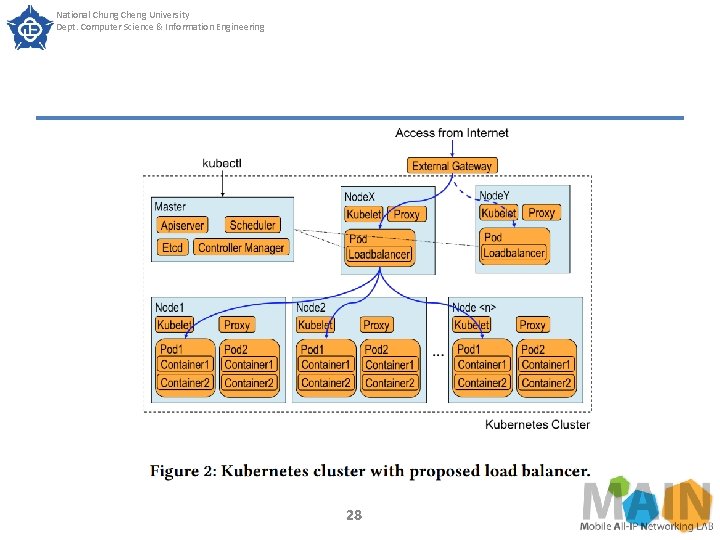
National Chung Cheng University Dept. Computer Science & Information Engineering 3. 2 Proposed architecture Figure 2 shows the proposed Kubernetes cluster architecture, which has the following characteristics: 1) Each load balancer itself is run as a pod by Kubernetes. 2) Load balancer configurations are dynamically updated based on information about running pods. The proposed load balancer can resolve the conventional architecture problems, as follows: Since the load balancer itself is containerized, load balancer can run in any environment including on-premise data centers, even without external load balancers that is supported by Kubernetes. The incoming traffic is directly distributed to designated pods by the load balancer. It makes the administration, e. g. finding malfunctions, 27 easier.
National Chung Cheng University Dept. Computer Science & Information Engineering 28
National Chung Cheng University Dept. Computer Science & Information Engineering We designed the proposed load balancer using three components, IPVS, keepalived, and a controller. These components are placed in a Docker container image. The IPVS is a Layer-4 load balancer capability, which is included in the Linux kernel 2. 6. 0 released in 2003 or later, to distribute incoming Transmission Control Protocol(TCP) traffic to real servers 2 [26]. For example, IPVS distributes incoming Hypertext Transfer Protocol(HTTP) traffic destined for a single destination IP address, to multiple HTTP servers(e. g. Apache HTTP or nginx) running on multiple nodes in order to improve the performance of web services. 29
National Chung Cheng University Dept. Computer Science & Information Engineering Keepalived is a management program that performs health checking for real servers and manage IPVS balancing rules in the kernel accordingly. It is often used together with IPVS to facilitate ease of use. Although keepalived also supports Virtual Router Redundancy Protocol(VRRP)[13], the authors leave that topic for future work 30
National Chung Cheng University Dept. Computer Science & Information Engineering The controller is a daemon that periodically monitors the pod information on the master, and performs various actions when such information changes. Kubernetes provides ingress controller framework as the Go Language(Golang) package to implement such controllers. We have implemented a controller program that will feed pod state changes to keepalived using this framework. These are the main ideas behind our proposal. In the following section, we will explain their implementation in detail. 31
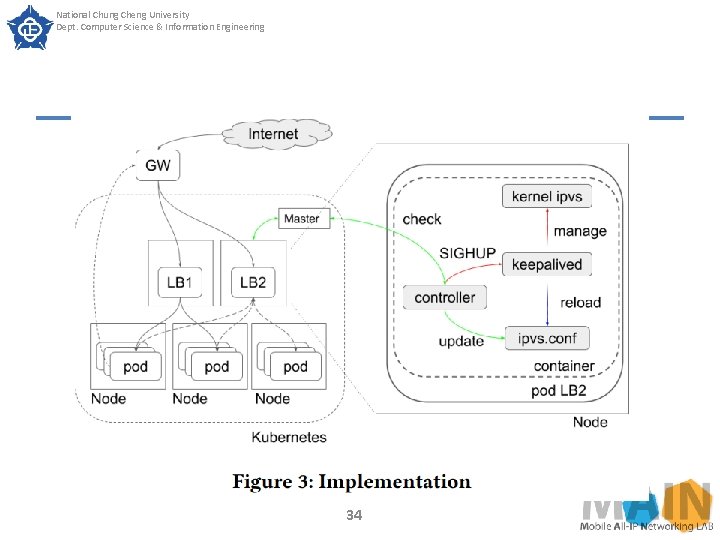
National Chung Cheng University Dept. Computer Science & Information Engineering 3. 3 Implementation The proposed load balancer needs to dynamically reconfigure the IPVS balancing rules whenever pods are created/deleted. Figure 3 is a schematic diagram to show the dynamic reconfiguration of the IPVS rules. The right part of the figure shows the enlarged view of one of the nodes where the load balancer pod(LB 2) is deployed. Two daemon programs, controller and keepalived, run in the container inside the LB 2 pod are illustrated. 32
National Chung Cheng University Dept. Computer Science & Information Engineering The keepalived manages Linux kernel’s IPVS rules depending on the ipvs. configuration file. It is also capable of health-checking the liveliness of real server, which is represented as a combination of the IP addresses and port numbers of the target pods. If the health check to a real server fails, keepalived will remove that real server from the IPVS rules. 33
National Chung Cheng University Dept. Computer Science & Information Engineering 34
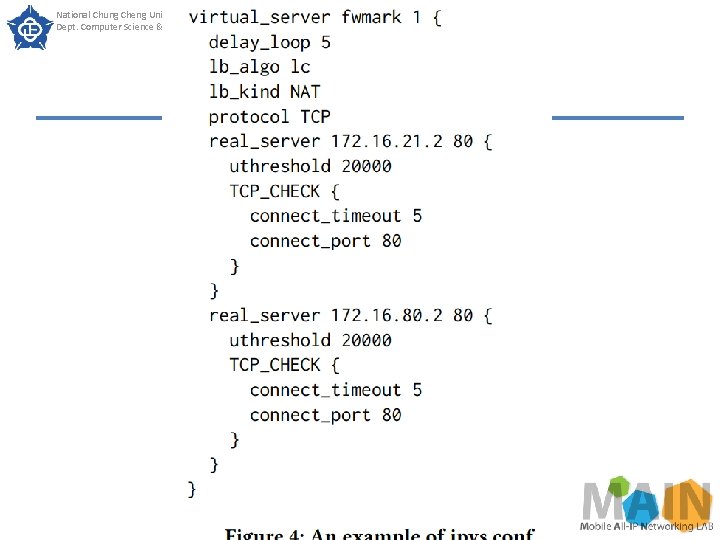
National Chung Cheng University Dept. Computer Science & Information Engineering The controller monitors information concerning the running pods of a service in the Kubernetes cluster by consulting the apiserver running on the master. Whenever pods are created or deleted, the controller will automatically regenerate an appropriate ipvs. conf and issue SIGHUP to keepalived. Then, keepalived will reload the ipvs. conf and modify the kernel’s IPVS rules accordingly. The actual controller[16] is implemented using the Kubernetes ingress controller[2] framework. By importing existing Golang package, “k 8 s. io/ingress /core/pkg/ingress”, we could simplify the implementation, e. g. 120 lines of code 35
National Chung Cheng University Dept. Computer Science & Information Engineering Configurations for capabilities were needed in the implementation: adding the CAP_SYS_MODULE capability to the container to allow the kernel to load required kernel modules inside a container, and adding CAP_NET_ADMIN capability to the container to allow keepalived to manipulate the kernel’s IPVS rules. For the former case, we also needed to mount the “/lib/module” of the node’s file system on the container’s file system. 36
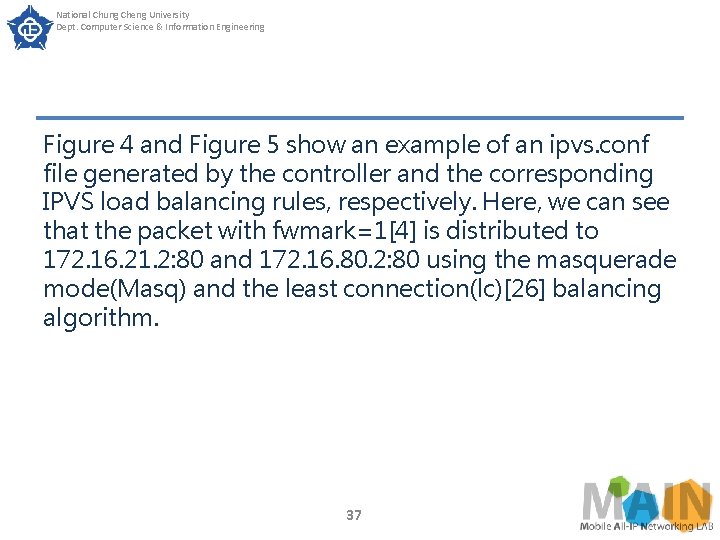
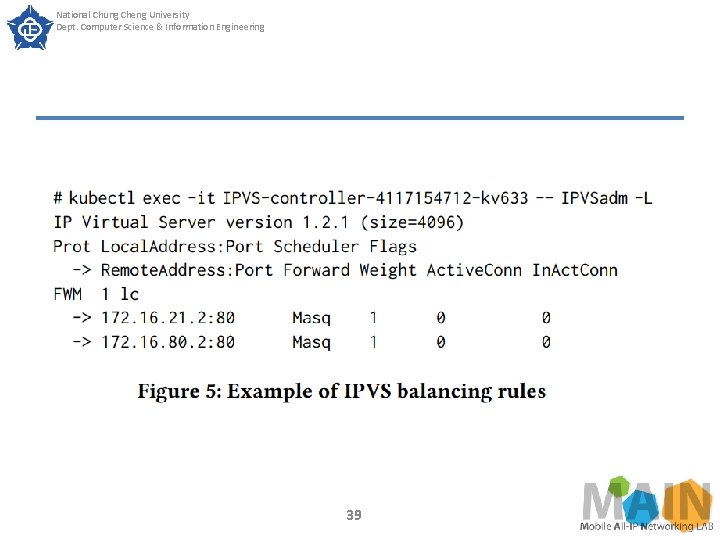
National Chung Cheng University Dept. Computer Science & Information Engineering Figure 4 and Figure 5 show an example of an ipvs. conf file generated by the controller and the corresponding IPVS load balancing rules, respectively. Here, we can see that the packet with fwmark=1[4] is distributed to 172. 16. 21. 2: 80 and 172. 16. 80. 2: 80 using the masquerade mode(Masq) and the least connection(lc)[26] balancing algorithm. 37
National Chung Cheng University Dept. Computer Science & Information Engineering 38
National Chung Cheng University Dept. Computer Science & Information Engineering 39

National Chung Cheng University Dept. Computer Science & Information Engineering 4 PERFORMANCE MEASUREMENT We will now discuss the feasibility of the proposed load balancer by comparing its performance with those of existing iptables DNAT and the Nginx based load balancers. We conducted the performance measurements using the benchmark program called wrk[11]. 40
National Chung Cheng University Dept. Computer Science & Information Engineering We also investigated the performance varying two network configurations: First one is an overlay network setting[17, 24] that is often used to build the Kubernetes cluster. Flannel[8] is one of popular overlay network technologies. We compared the performances of three backends settings[6], i. e. operating modes of flannel, to find the best setting. The other one is the setting for distributed packet processing. It is well known that distributing handling of interrupts from the network interface card(NIC) and the subsequent IP protocol processing, among multiple cores impact the network performance. In order to derive the best performance from load balancers, we also investigated how this 41 setting would affect their performance.
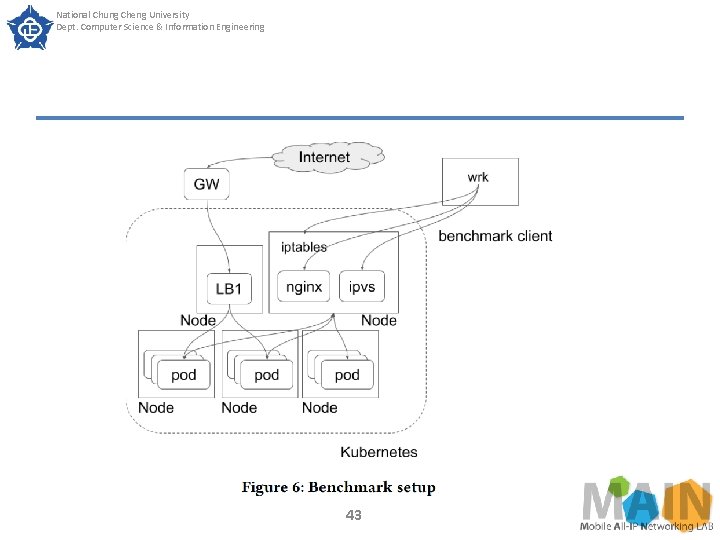
National Chung Cheng University Dept. Computer Science & Information Engineering 4. 1 Benchmark method We measured the performance of the load balancers using the wrk. Figure 6 illustrates a schematic diagram of our experimental setup. Multiple pods are deployed on multiple nodes in the Kubernetes cluster. In each pod, a Nginx web server that returns the IP address of the pod are running. We then set up the IPVS, iptables DNAT, and Nginx load balancers on one of the nodes(the top right node in the Figure 6). 42
National Chung Cheng University Dept. Computer Science & Information Engineering 43
National Chung Cheng University Dept. Computer Science & Information Engineering We measured the throughput, Request/sec, of the web service running on the Kubernetes cluster as follows: The HTTP GET requests are sent out by the wrk on the client machine toward the nodes, using destination IP addresses and port numbers that are chosen based on the type of the load balancer on which the measurement is performed. The load balancer on the node then distributes the requests to the pods. Each pod will return HTTP responses to the load balancer, after which the load balancer returns them to the client. Based on the number of responses received by wrk on the client, load balancer performance, in terms of Request/sec can be obtained 44
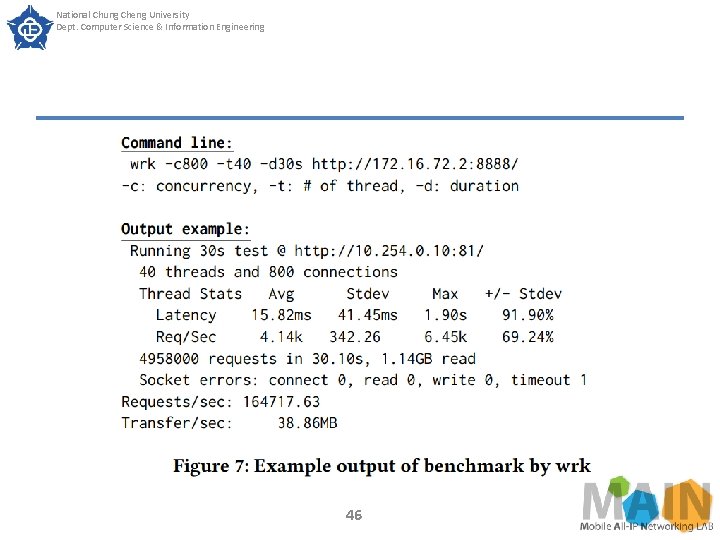
National Chung Cheng University Dept. Computer Science & Information Engineering Figure 7 shows an example of the command-line for wrk and the corresponding output. The command-line in Figure 7 will generate 40 wrk program threads and allow those threads to send out a total of 800 concurrent HTTP requests over the period of 30 seconds. The output example shows information including per thread statistics, error counts, Request/sec and Transfer/sec. 45
National Chung Cheng University Dept. Computer Science & Information Engineering 46
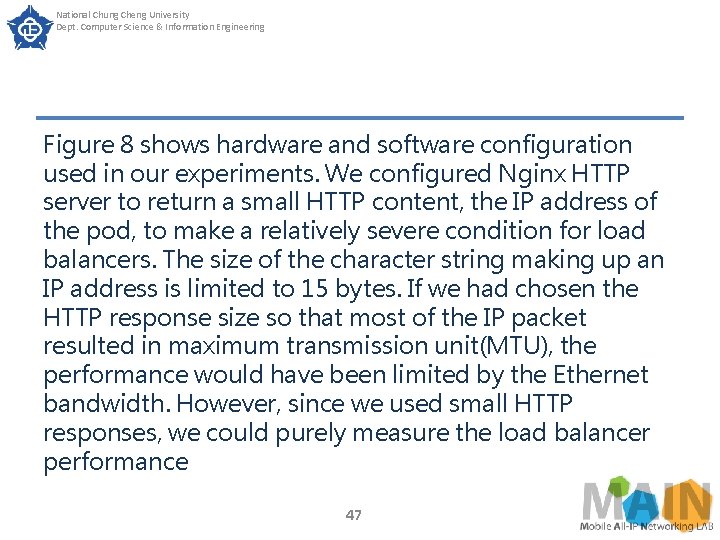
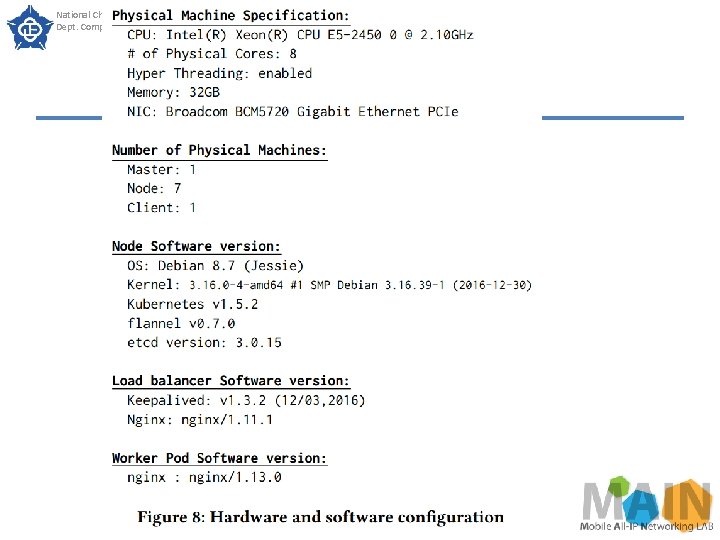
National Chung Cheng University Dept. Computer Science & Information Engineering Figure 8 shows hardware and software configuration used in our experiments. We configured Nginx HTTP server to return a small HTTP content, the IP address of the pod, to make a relatively severe condition for load balancers. The size of the character string making up an IP address is limited to 15 bytes. If we had chosen the HTTP response size so that most of the IP packet resulted in maximum transmission unit(MTU), the performance would have been limited by the Ethernet bandwidth. However, since we used small HTTP responses, we could purely measure the load balancer performance 47
National Chung Cheng University Dept. Computer Science & Information Engineering 48
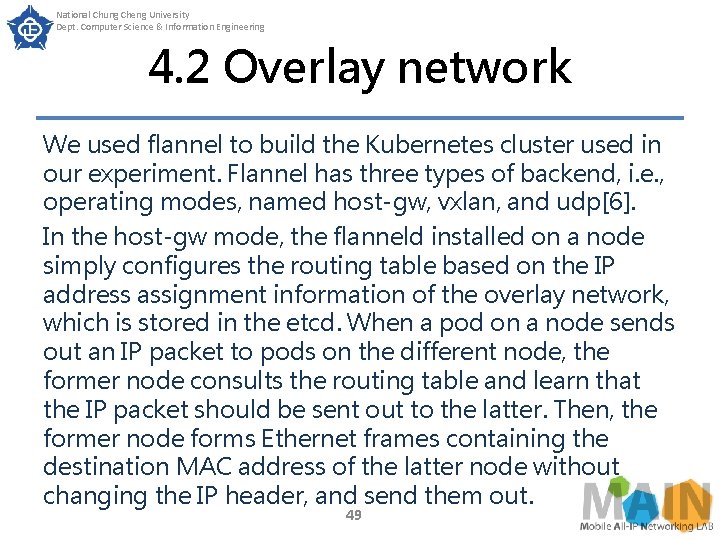
National Chung Cheng University Dept. Computer Science & Information Engineering 4. 2 Overlay network We used flannel to build the Kubernetes cluster used in our experiment. Flannel has three types of backend, i. e. , operating modes, named host-gw, vxlan, and udp[6]. In the host-gw mode, the flanneld installed on a node simply configures the routing table based on the IP address assignment information of the overlay network, which is stored in the etcd. When a pod on a node sends out an IP packet to pods on the different node, the former node consults the routing table and learn that the IP packet should be sent out to the latter. Then, the former node forms Ethernet frames containing the destination MAC address of the latter node without changing the IP header, and send them out. 49
National Chung Cheng University Dept. Computer Science & Information Engineering In the case of the vxlan mode, flanneld creates the Linux kernel’s vxlan device, flannel. 1. Flanneld will also configures the routing table appropriately based on the information stored in the etcd. When pods on different nodes need to communicate, the packet is routed to flannel. 1. The vxlan functionality of the Linux kernel identify the MAC address of flannel. 1 device on the destination node, then form an Ethernet frame toward the MAC address. The vxlan then encapsulates the Ethernet frame in a UDP/IP packet with a vxlan header, after which the IP packet is eventually sent out. 50
National Chung Cheng University Dept. Computer Science & Information Engineering In the case of udp mode, flanneld creates the tun device, flannel 0, and configures the routing table. The flannel 0 device is connected to the flanneld daemon itself. An IP packet routed to flannel 0 is encapsulated by flanneld, and eventually sent out to the appropriate node. The encapsulation is done for IP packets. 51
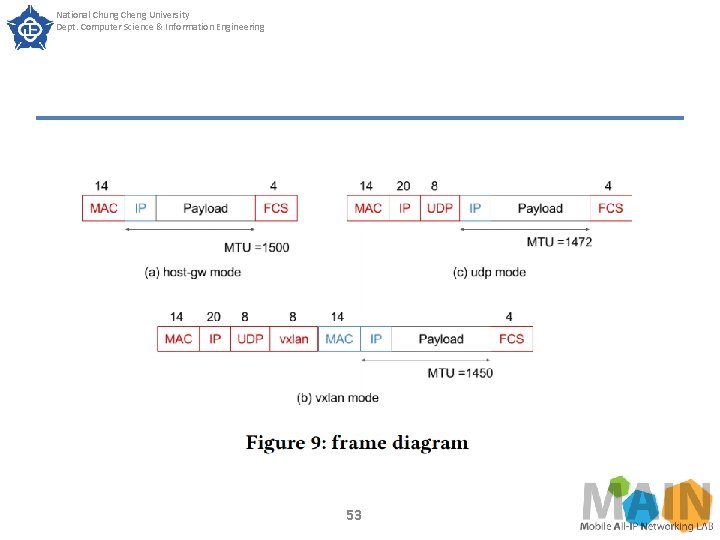
National Chung Cheng University Dept. Computer Science & Information Engineering Figure 9 shows the schematic diagrams of frame formats for three backends modes of the flannel overlay network. The MTU sizes in the backends, assuming the MTU size without encapsulation is 1500 bytes, are also presented. Since packets are not encapsulated in the host-gw mode, the MTU size remains 1500 bytes. An additional 50 bytes of header is used in the vxlan mode, thereby resulting in an MTU size of 1450 bytes. In the case of the udp mode, only 28 bytes of header are used for encapsulation, which results in an MTU size of 1472 bytes. 52
National Chung Cheng University Dept. Computer Science & Information Engineering 53
National Chung Cheng University Dept. Computer Science & Information Engineering Performance of the load balancers can be influenced by the overhead of encapsulation. Thus, the host-gw mode, where there is no overhead due to encapsulation, results in the best performance levels as shown in Section 5. However, the host-gw mode has a significant drawback that prohibit it to work correctly in cloud platforms. Since the host-gw mode simply sends out a packet without encapsulation, if there is a cloud gateway between nodes, the gateway cannot identify the proper destination, thus drop the packet. 54
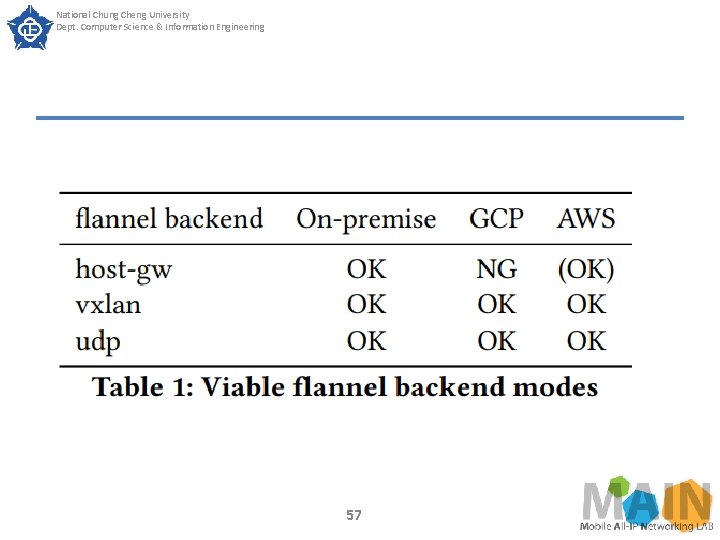
National Chung Cheng University Dept. Computer Science & Information Engineering We conducted an investigation to determine which of the flannel backend mode would be usable on AWS, GCP, and on-premise data centers. The results are summarized in Table 1. In the case of GCP, an IP address of /32 is assigned to every VM host and every communication between VMs goes through GCP’s gateway. As for AWS, the VMs within the same subnet communicate directly, while the VMs in different subnets communicate via the AWS’s gateway. 55
National Chung Cheng University Dept. Computer Science & Information Engineering Since the gateways do not have knowledge of the flannel overlay network, they drop the packets; thereby, they prohibit the use of the flannel host-gw mode in those cloud providers. In our experiment, we compared the performance of load balancers when different flannel backend modes were used 56
National Chung Cheng University Dept. Computer Science & Information Engineering 57
National Chung Cheng University Dept. Computer Science & Information Engineering 4. 3 Distributed packet handling Recently, the performance of CPUs are improved significantly due to the development of multi-core CPUs. One of the top of the line server processors from Intel now includes up to 28 cores in a single CPU. In order to enjoy the benefits of multi-core CPUs in communication performance, it is necessary to distribute the handling of interrupts from the NIC and the IP protocol processing to the available physical cores. Receive Side Scaling (RSS)[25] is a technology to distribute handling of the interrupt from NIC queues to multiple CPU cores. Subsequently, Receive Packet Steering (RPS)[25] distributes the IP protocol processing to multiple CPU cores by issuing inter core software interrupts 58
National Chung Cheng University Dept. Computer Science & Information Engineering Since load balancer performance levels could be affected by these technologies, we conducted an experiment to determine how load balancer performance level change depending on the RSS and RPS settings. The following shows how RSS and RPS are enabled and disabled in our experiment. The NIC used in our experiment is Broadcom BCM 5720, which has four rx-queues and one tx-queue. Figure 10 shows the interrupt request (IRQ) number assignments to those NIC queues. 59
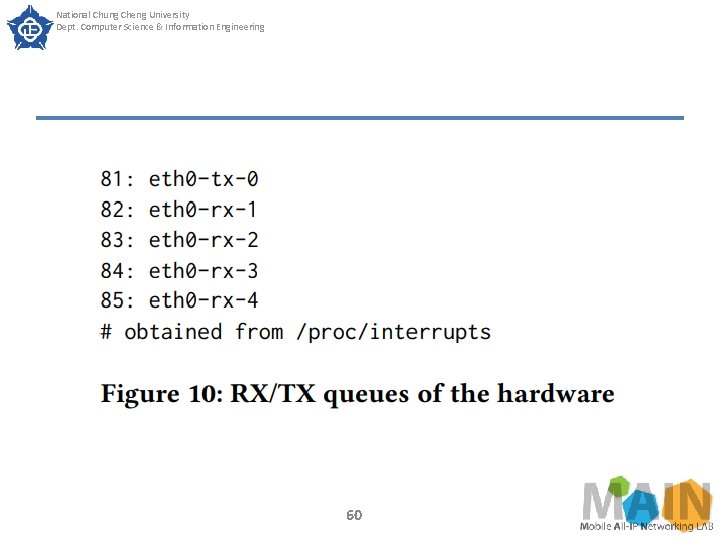
National Chung Cheng University Dept. Computer Science & Information Engineering 60
National Chung Cheng University Dept. Computer Science & Information Engineering When packets arrive, they are distributed to these rxqueues depending on the flow each packet belongs to. Each receive queue has a separate IRQ associated with it. The NIC triggers this to notify a CPU when new packets arrive on the given queue. Then, the notified CPU handles the interrupt, and performs the protocol processing. According to the [25], the CPU cores allowed to be notified is controlled by setting a hexadecimal value corresponding to the bit maps indicating the allowed CPU cores in “/proc/irq/$irq_number /smp_affinity”. 61
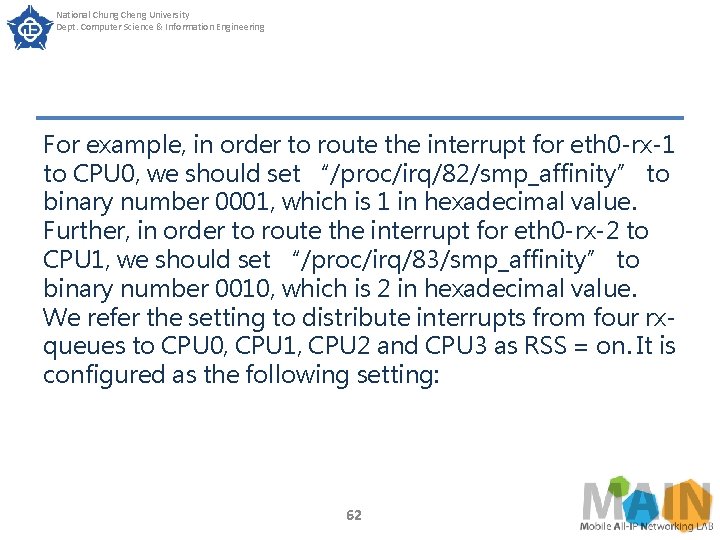
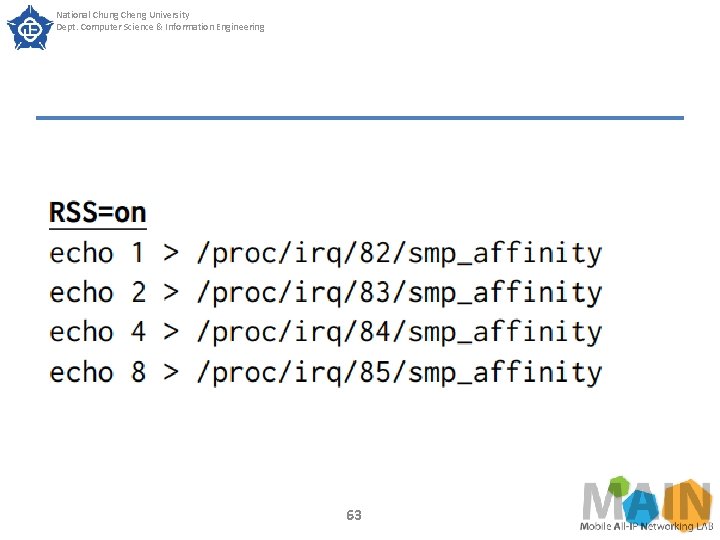
National Chung Cheng University Dept. Computer Science & Information Engineering For example, in order to route the interrupt for eth 0 -rx-1 to CPU 0, we should set “/proc/irq/82/smp_affinity” to binary number 0001, which is 1 in hexadecimal value. Further, in order to route the interrupt for eth 0 -rx-2 to CPU 1, we should set “/proc/irq/83/smp_affinity” to binary number 0010, which is 2 in hexadecimal value. We refer the setting to distribute interrupts from four rxqueues to CPU 0, CPU 1, CPU 2 and CPU 3 as RSS = on. It is configured as the following setting: 62
National Chung Cheng University Dept. Computer Science & Information Engineering 63
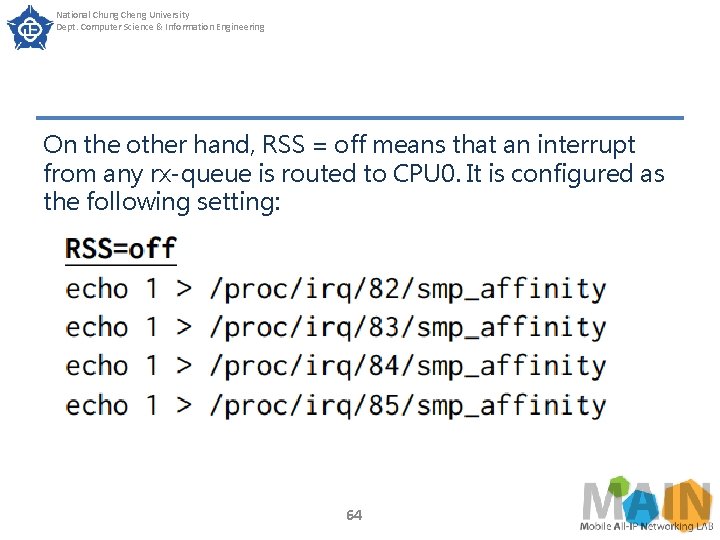
National Chung Cheng University Dept. Computer Science & Information Engineering On the other hand, RSS = off means that an interrupt from any rx-queue is routed to CPU 0. It is configured as the following setting: 64
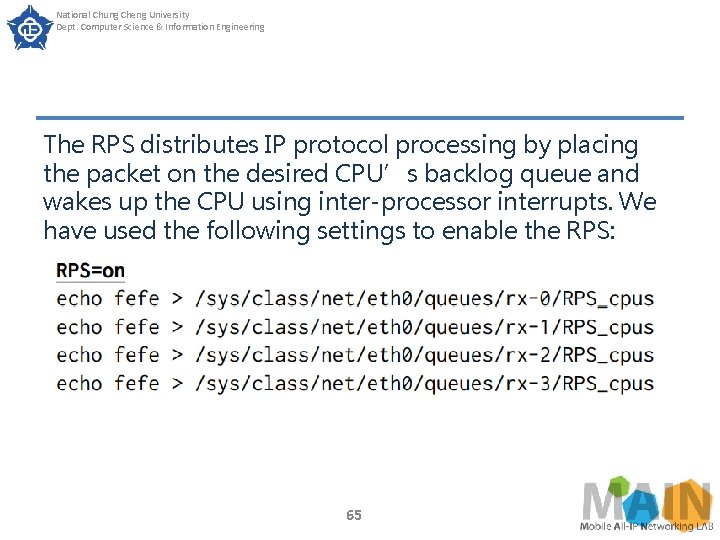
National Chung Cheng University Dept. Computer Science & Information Engineering The RPS distributes IP protocol processing by placing the packet on the desired CPU’s backlog queue and wakes up the CPU using inter-processor interrupts. We have used the following settings to enable the RPS: 65
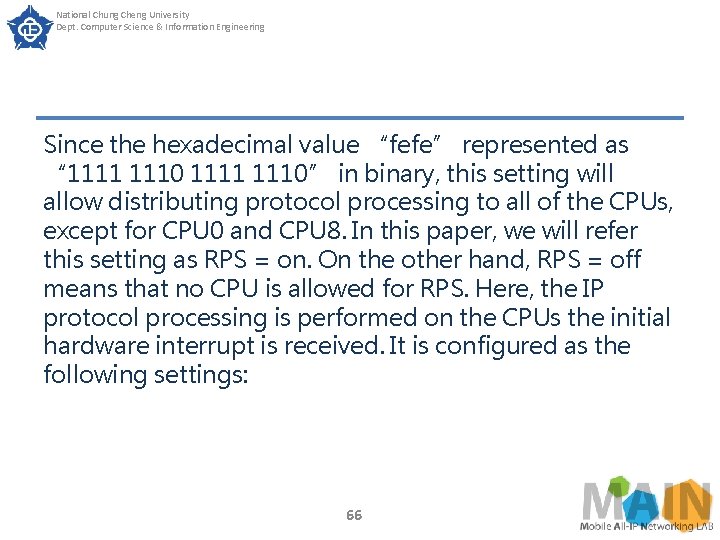
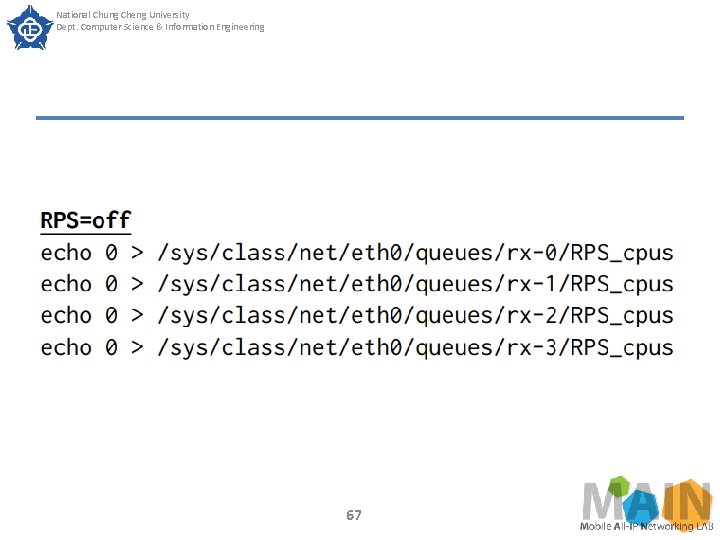
National Chung Cheng University Dept. Computer Science & Information Engineering Since the hexadecimal value “fefe” represented as “ 1111 1110” in binary, this setting will allow distributing protocol processing to all of the CPUs, except for CPU 0 and CPU 8. In this paper, we will refer this setting as RPS = on. On the other hand, RPS = off means that no CPU is allowed for RPS. Here, the IP protocol processing is performed on the CPUs the initial hardware interrupt is received. It is configured as the following settings: 66
National Chung Cheng University Dept. Computer Science & Information Engineering 67
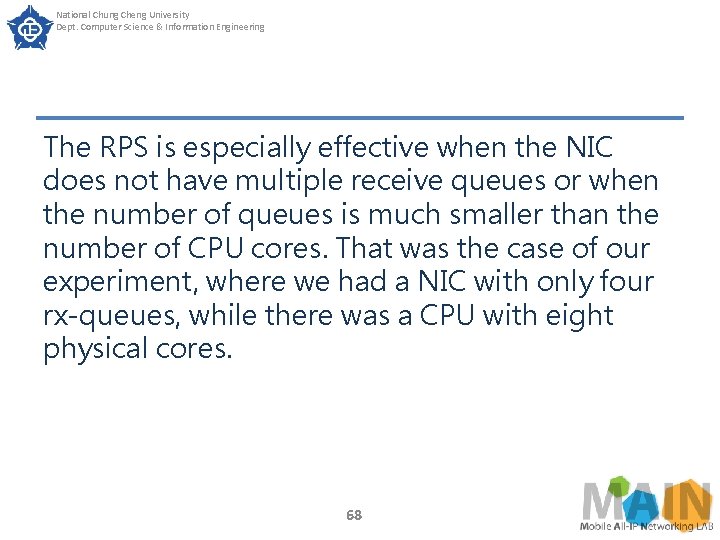
National Chung Cheng University Dept. Computer Science & Information Engineering The RPS is especially effective when the NIC does not have multiple receive queues or when the number of queues is much smaller than the number of CPU cores. That was the case of our experiment, where we had a NIC with only four rx-queues, while there was a CPU with eight physical cores. 68
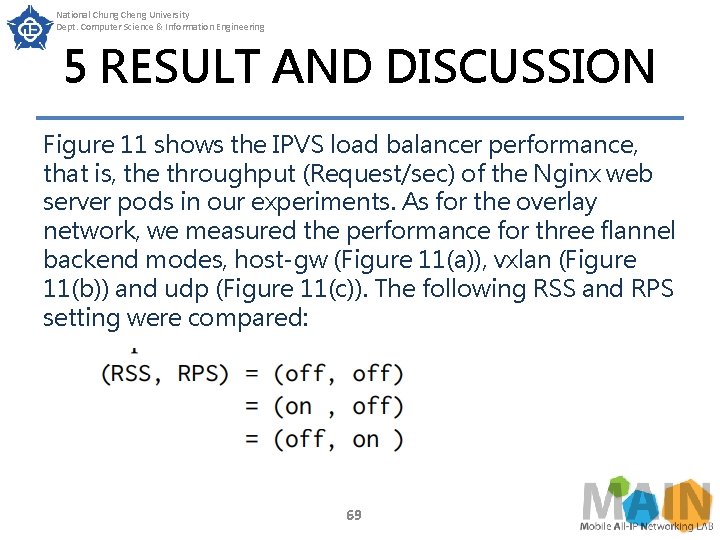
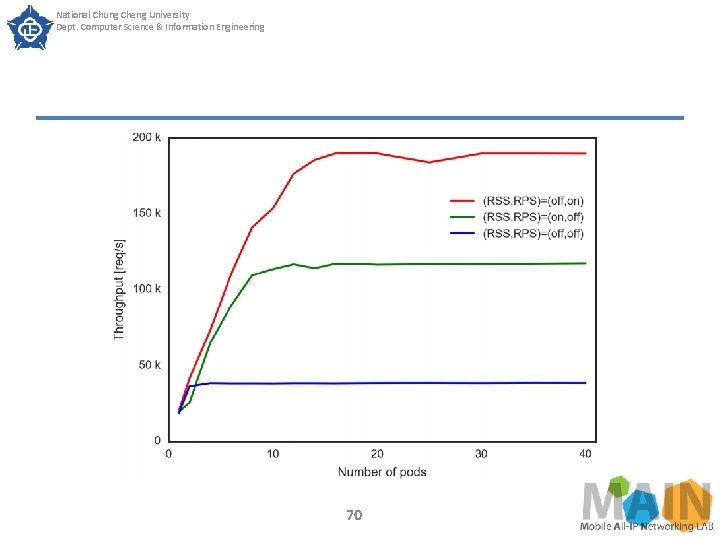
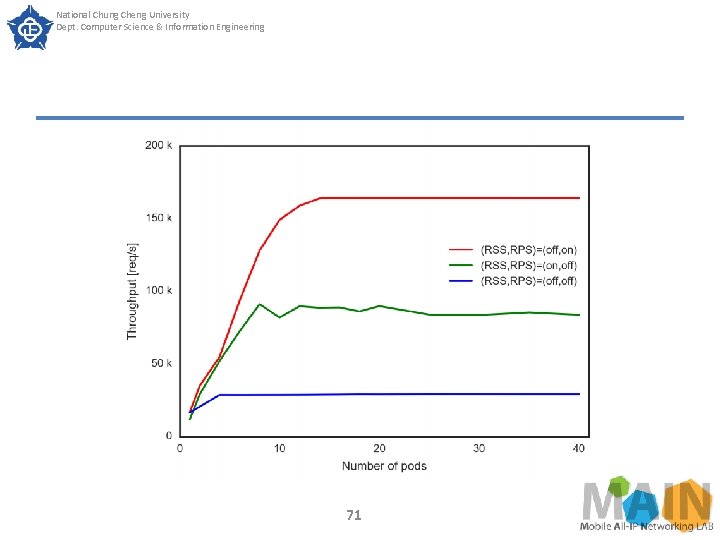
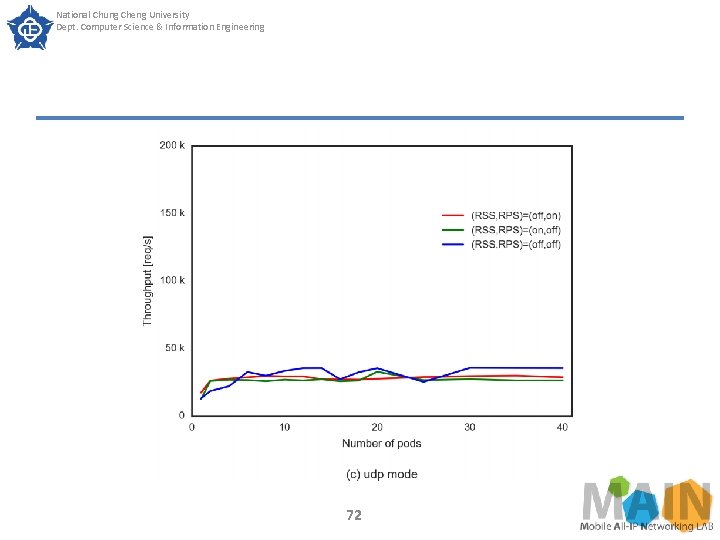
National Chung Cheng University Dept. Computer Science & Information Engineering 5 RESULT AND DISCUSSION Figure 11 shows the IPVS load balancer performance, that is, the throughput (Request/sec) of the Nginx web server pods in our experiments. As for the overlay network, we measured the performance for three flannel backend modes, host-gw (Figure 11(a)), vxlan (Figure 11(b)) and udp (Figure 11(c)). The following RSS and RPS setting were compared: 69
National Chung Cheng University Dept. Computer Science & Information Engineering 70
National Chung Cheng University Dept. Computer Science & Information Engineering 71
National Chung Cheng University Dept. Computer Science & Information Engineering 72
National Chung Cheng University Dept. Computer Science & Information Engineering Except for the udp cases, we can see the trend in which the throughput linearly increases as the pod number increases and then it eventually saturates. The saturated performance levels indicates the maximum performance of the IPVS load balancer. The maximum performance limits depend on the flannel backend mode type and the (RSS, RPS) settings. From the results in Figures 11(a, b), it can be seen that if we turn off distributed packet processing, i. e. , when “(RSS, RPS) = (off, off)”, performance degrades significantly. In this case, the performance bottleneck is primarily due to packet processing in a single core. 73
National Chung Cheng University Dept. Computer Science & Information Engineering If we compare the results for the cases when “(RSS, RPS) = (on, off)” and “(RSS, RPS) = (off, on)”, the latter is better than the former. This is understandable, since in the case of “RPS = on”, eight physical cores can be used whereas in the case of “RSS = on” only four cores can be used, on the hardware used in our experiment. The performance bottleneck of the case when “RSS = on” is considered to be due to the fact that the packet processing is only done on four CPU cores 74
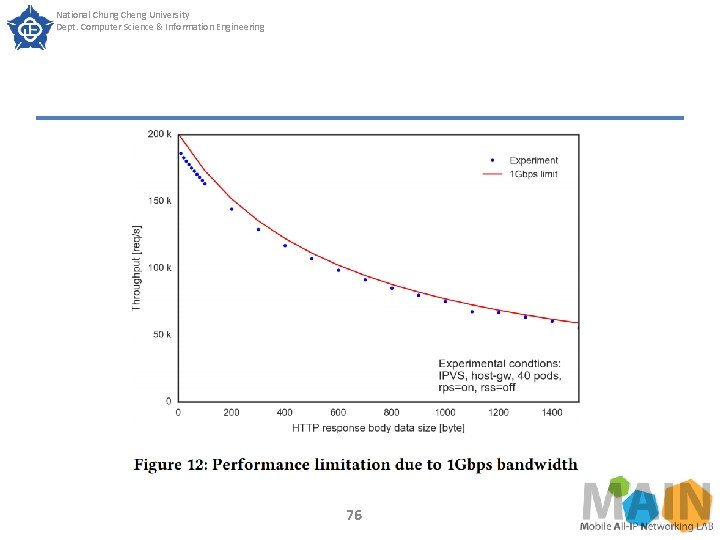
National Chung Cheng University Dept. Computer Science & Information Engineering At first, it was not clear what caused the performance limit for the case when “RPS = on”, however we now suspect this is due to 1 Gbps bandwidth limitation. A packet level analysis using tcpdump[15] revealed that 622. 72 byte of extra HTTP headers, TCP/IP headers and ethernet frames are needed for each request in the case of the wrk benchmack program. This results in the upper limitation of 196, 627 [req/s], where the date size of HTTP response body is 13 byte, or typical data size in our experiment. Figure 12 shows upper limitation of the performance level for 1 Gbps ethernet together with actual benchmark results and we can conclude that when “RPS = on”, IPVS performance is limited by 75 bandwidth.
National Chung Cheng University Dept. Computer Science & Information Engineering 76
National Chung Cheng University Dept. Computer Science & Information Engineering If we compare the performances among the flannel backend modes types, the host-gw mode where no encapsulation is conducted shows the highest performance level, followed by the vxlan mode where the Linux kernel encapsulate the Ethernet frame. The udp mode where flanneld itself encapsulate the IP packet shows significantly lower performances levels 77
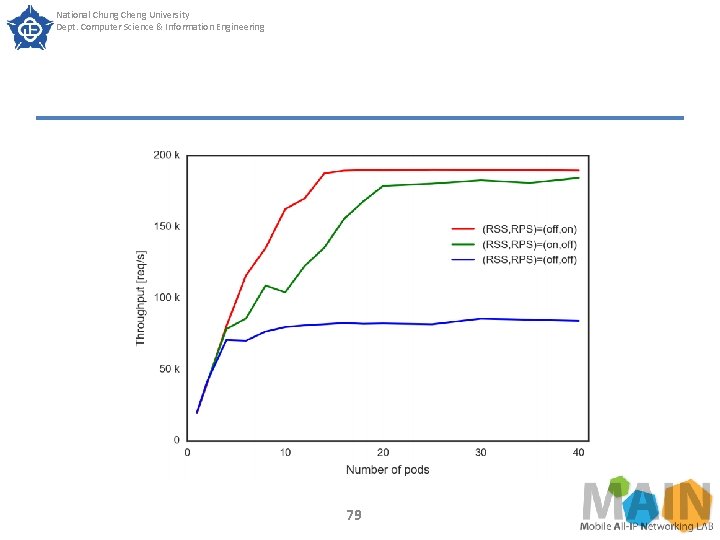
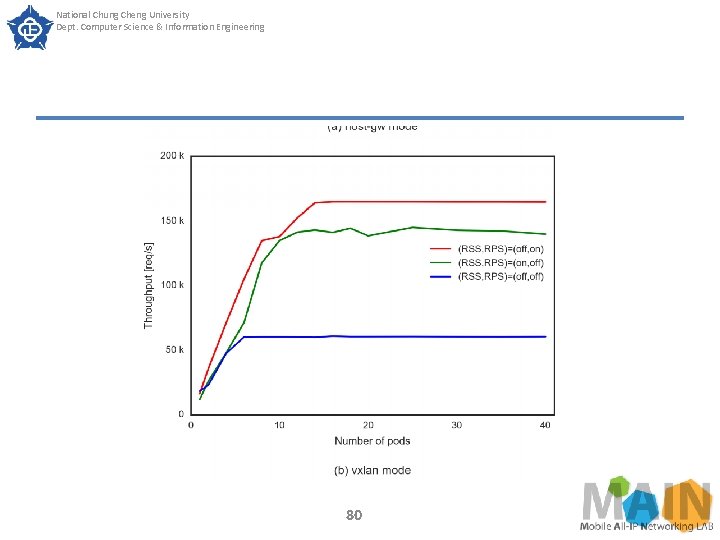
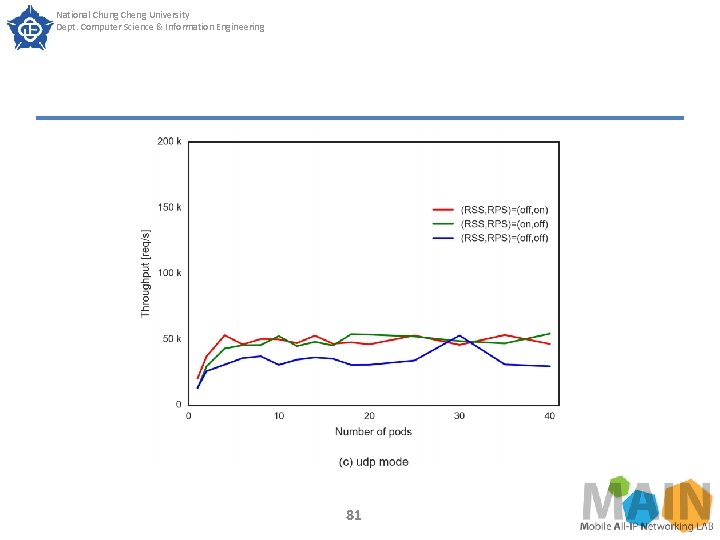
National Chung Cheng University Dept. Computer Science & Information Engineering Figure 13 shows the performance of the load balancer functionality of the iptables DNAT. As can be seen in the figure, the performance value increases as the number of the pod increases linearly, and then becomes saturated at some point, as was the case with the IPVS results. 78
National Chung Cheng University Dept. Computer Science & Information Engineering 79
National Chung Cheng University Dept. Computer Science & Information Engineering 80
National Chung Cheng University Dept. Computer Science & Information Engineering 81
National Chung Cheng University Dept. Computer Science & Information Engineering If we compare the results for different packet handling settings, the highest performance is obtained for the case when “(RSS, RPS) = (off on)”, followed by the case when “(RSS, RPS) = (on, off)”. The performance result for the case when “(RSS, RPS) = (off, off)” resulted in the poorest performance level, as was the case for the IPVS. As for the flannel backend modes, the host-gw shows the highest performance followed by the vxlan. The udp backend mode totally degrades the performance level. 82
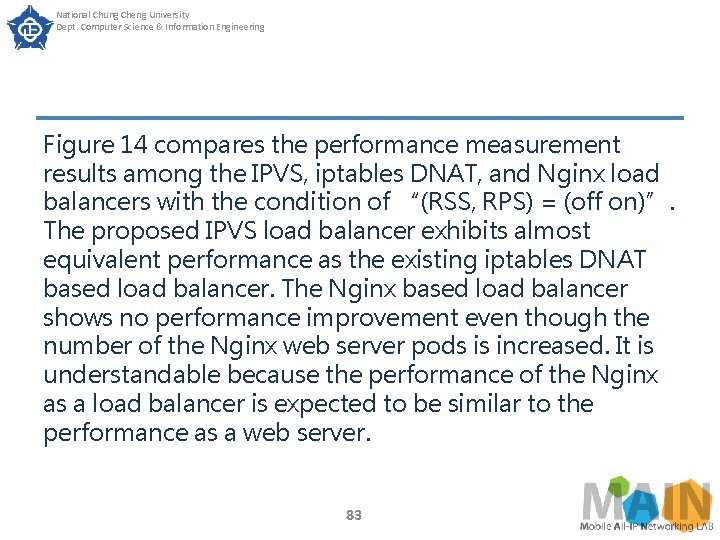
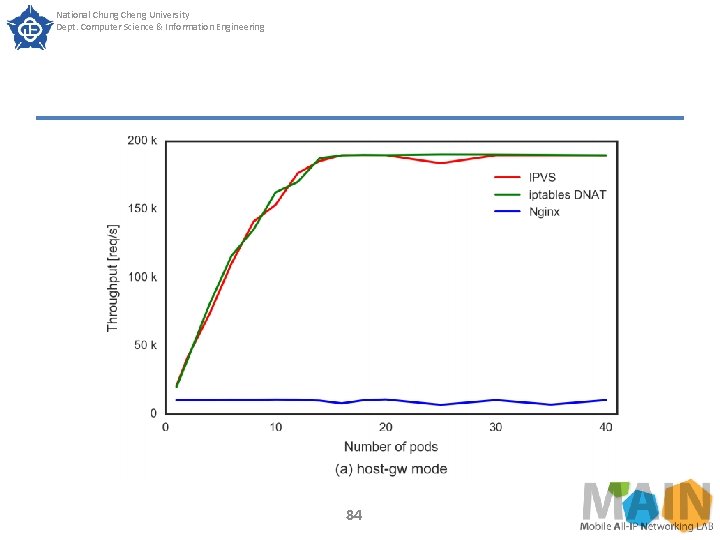
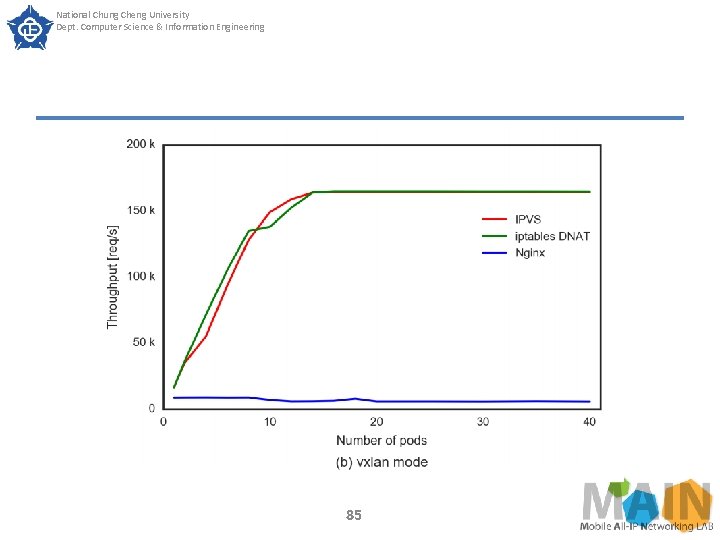
National Chung Cheng University Dept. Computer Science & Information Engineering Figure 14 compares the performance measurement results among the IPVS, iptables DNAT, and Nginx load balancers with the condition of “(RSS, RPS) = (off on)”. The proposed IPVS load balancer exhibits almost equivalent performance as the existing iptables DNAT based load balancer. The Nginx based load balancer shows no performance improvement even though the number of the Nginx web server pods is increased. It is understandable because the performance of the Nginx as a load balancer is expected to be similar to the performance as a web server. 83
National Chung Cheng University Dept. Computer Science & Information Engineering 84
National Chung Cheng University Dept. Computer Science & Information Engineering 85
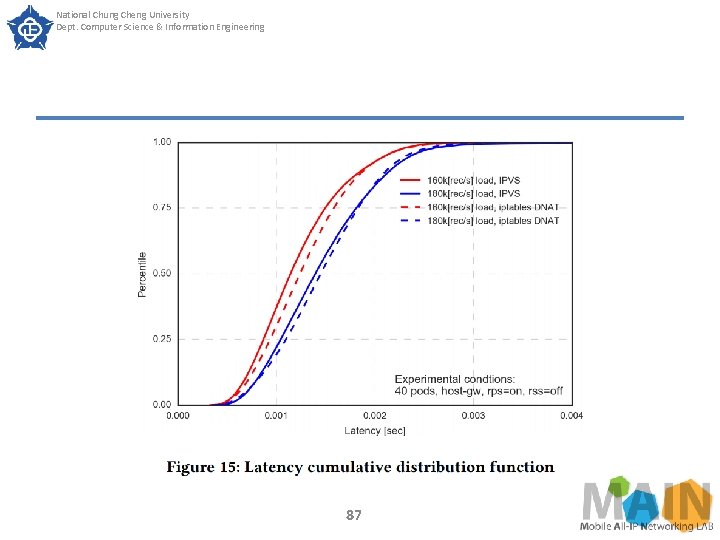
National Chung Cheng University Dept. Computer Science & Information Engineering Figure 15 compares Cumulative Distribution Function(CDF) of the load balancer latency at the constant load. The latencies are a little bit smaller for IPVS, however we consider the difference almost negligible. For example, the median value at 160 K[req/s] load for IPVS and iptables DNAT are, 1. 1 msec and 1. 2 msec, respectively. So, we can conclude our proposed load balancer showed no performance degradation while providing potability. 86
National Chung Cheng University Dept. Computer Science & Information Engineering 87
National Chung Cheng University Dept. Computer Science & Information Engineering 6 CONCLUSIONS In this paper, we proposed a portable load balancer for the Kubernetes cluster systems that is aimed at facilitating migration of container clusters for web services. We implemented a containerized software load balancer that is run by Kubernetes as a part of container cluster, using Linux kernel’s IPVS, as a proof of concept. In order to discuss the feasibility of the proposed load balancer, we built a Kubernetes cluster system and conducted performance measurements. 88
National Chung Cheng University Dept. Computer Science & Information Engineering Our experimental results indicate that the IPVS based load balancer in container improves the portability of the Kubernetes cluster system while it shows the similar performance levels as the existing iptables DNAT based load balancer. We also clarified that choosing the right operating modes of overlay networks is important for the performance of load balancers. For example, in the case of flannel, only the vxlan and udp backend operation modes could be used in the cloud environment, and the udp backend significantly degraded their performance. Furthermore, we also learned that the distribution of packet processing among multiple CPUs was very important to obtain the maximum performance levels 89 from load balancers.
National Chung Cheng University Dept. Computer Science & Information Engineering The limitations of this work that authors aware of include the followings: 1) We have not discussed the load balancer redundancy. Routing traffic to one of the load balancers while keeping redundancy in the container environment is a complex issue, because standard Layer 2 rendandacy protocols, e. g. VRRP or OSPF[20] that uses multicast, can not be used in many cases. Further more, providing uniform methods independent of various cloud environments and onpremise datacenter is much more difficult. 90
National Chung Cheng University Dept. Computer Science & Information Engineering 2) Experiments are conducted only in a 1 Gbps network environment. The experimental results indicate the performance of IPVS may be limited by the network bandwidth, 1 Gbps, in our experiments. Thus, experiments with the faster network setting, e. g. 10 Gigabit ethernet, are needed to investigate the feasibility of the proposed load balancer. 91
National Chung Cheng University Dept. Computer Science & Information Engineering 3) We have not yet compared the performance level of proposed load balance with those of cloud provider’s load balancers. It shoud be fair to compare the performance of proposed load balancer with those of the combination of the cloud load balancer and the iptables DNAT. The authors leave these issues for future work and they will be discussed elsewhere. 92
![National Chung Cheng University Dept. Computer Science & Information Engineering REFERENCES [1] The Kubernetes](http://slidetodoc.com/presentation_image_h2/e28febe84c9c8dc731c2d21dd21c295c/image-93.jpg "National Chung Cheng University Dept. Computer Science & Information Engineering REFERENCES [1] The Kubernetes")
National Chung Cheng University Dept. Computer Science & Information Engineering REFERENCES [1] The Kubernetes Authors. 2017. Federation. (2017). Retrieved July 14, 2017 from https: //kubernetes. io/docs/concepts/clusteradministration/federation/ [2] The Kubernetes Authors. 2017. Ingress Resources | Kubernetes. (2017). Retrieved July 14, 2017 from https: //kubernetes. io/docs/concepts/servicesnetworking/ ingress/ [3] The Kubernetes Authors. 2017. Kubernetes | Production-Grade Container Orchestration. (2017). Retrieved July 14, 2017 from https: //kubernetes. io/ [4] Bert Hubert, Gregory Maxwell, Remco van Mook, Martijn van Oosterhout, Paul B Schroeder, and Jasper Spaans. 2002. Linux Advanced Routing & Traffic Control HOWTO. (2002), 11. Netfilter & iproute – marking packets pages. http: //www. tldp. org/HOWTO/Adv-Routing. HOWTO/index. html [5] Alexandre Cassen. [n. d. ]. Keepalived for Linux. ([n. d. ]). Retrieved July 14, 2017 from http: //www. keepalived. org/ 93
![National Chung Cheng University Dept. Computer Science & Information Engineering [6] Inc Core. OS.](http://slidetodoc.com/presentation_image_h2/e28febe84c9c8dc731c2d21dd21c295c/image-94.jpg "National Chung Cheng University Dept. Computer Science & Information Engineering [6] Inc Core. OS.")
National Chung Cheng University Dept. Computer Science & Information Engineering [6] Inc Core. OS. [n. d. ]. Backend. ([n. d. ]). https: //github. com/coreos/flannel/blob/ master/Documentation/backends. md [7] Inc Core. OS. [n. d. ]. etcd | etcd Cluster by Core. OS. ([n. d. ]). https: //coreos. com/etcd [8] Inc Core. OS. [n. d. ]. flannel. ([n. d. ]). https: //github. com/coreos/flannel [9] Docker Inc. 2017. Use swarm mode routing mesh | Docker Documentation. (2017). https: //docs. docker. com/engine/swarm/ingress/ [10] Docker Core Engineering. 2016. Docker 1. 12: Now with Built-in Orchestration! - Docker Blog. (2016). Retrieved July 14, 2017 from https: //blog. docker. com/2016/ 06/docker-1 -12 -built-in-orchestration/ [11] Will Glozer. 2012. wrk - a HTTP benchmarking tool. (2012). Retrieved July 14, 2017 from https: //github. com/wg/wrk 94
![National Chung Cheng University Dept. Computer Science & Information Engineering [12] Hashi. Corp. [n.](http://slidetodoc.com/presentation_image_h2/e28febe84c9c8dc731c2d21dd21c295c/image-95.jpg "National Chung Cheng University Dept. Computer Science & Information Engineering [12] Hashi. Corp. [n.")
National Chung Cheng University Dept. Computer Science & Information Engineering [12] Hashi. Corp. [n. d. ]. Consul by Hashi. Corp. ([n. d. ]). https: //www. consul. io/ [13] Robert Hinden. 2004. Virtual router redundancy protocol (VRRP). (2004). [14] NGINX Inc. 2017. NGINX Ingress Controller. (2017). Retrieved July 14, 2017 from https: //github. com/nginxinc/kubernetes-ingress [15] Van Jacobson, Craig Leres, and S Mc. Canne. 1989. The tcpdump manual page. Lawrence Berkeley Laboratory, Berkeley, CA 143 (1989). [16] ktaka ccmp. 2017. ktaka-ccmp/ipvs-ingress: Initial Release. (July 2017). https: //doi. org/10. 5281/zenodo. 826894 [17] Victor Marmol, Rohit Jnagal, and Tim Hockin. 2015. Networking in Containers and Container Clusters. Netdev (2015). [18] Martin A. Brown. 2007. Guide to IP Layer Network Administration with Linux. (2007), 5. 5. Destination NAT with netfilter (DNAT) pages. http: //linuxip. net/ html/index. html 95
![National Chung Cheng University Dept. Computer Science & Information Engineering [19] Tero Marttila. 2016](http://slidetodoc.com/presentation_image_h2/e28febe84c9c8dc731c2d21dd21c295c/image-96.jpg "National Chung Cheng University Dept. Computer Science & Information Engineering [19] Tero Marttila. 2016")
National Chung Cheng University Dept. Computer Science & Information Engineering [19] Tero Marttila. 2016 -10 -27. Design and Implementation of the clusterf Load Balancer for Docker Clusters. Master’s Thesis, Aalto University. http: //urn. fi/URN: NBN: fi: aalto-201611025433 [20] John Moy. 1997. OSPF version 2. (1997). [21] Michael Pleshakov. 2016. NGINX and NGINX Plus Ingress Controllers for Kubernetes Load Balancing. (Dec. 2016). Retrieved July 14, 2017 from https: //www. nginx. com/blog/nginx-plus-ingress-controller-kubernetesload-balancing/ [22] Bowei Du Prashanth B, Mike Danese. 2016. kube-keepalived-vip. (2016). Retrieved July 14, 2017 from https: //github. com/kubernetes/contrib/tree/master/ keepalived-vip [23] Andrey Sibiryov. 2015. GORB Go Routing and Balancing. (2015). Retrieved July 14, 2017 from https: //github. com/kobolog/gorb 96
![National Chung Cheng University Dept. Computer Science & Information Engineering [24] Alan Sill. 2016.](http://slidetodoc.com/presentation_image_h2/e28febe84c9c8dc731c2d21dd21c295c/image-97.jpg "National Chung Cheng University Dept. Computer Science & Information Engineering [24] Alan Sill. 2016.")
National Chung Cheng University Dept. Computer Science & Information Engineering [24] Alan Sill. 2016. Standards Underlying Cloud Networking. IEEE Cloud Computing 3, 3 (2016), 76– 80. https: //doi. org/10. 1109/MCC. 2016. 55 [25] Tom Herbert and Willem de Bruijn. [n. d. ]. Scaling in the Linux Networking Stack. ([n. d. ]). https: //www. kernel. org/doc/Documentation/networking/scaling. txt [26] Wensong Zhang. 2000. Linux virtual server for scalable network services. Ottawa Linux Symposium (2000). 97
- Slides: 97