
A porous Calcium Phosphate based Bioceramic prepared by
A porous Calcium Phosphate based Bioceramic prepared by SHS method for guided bone regeneration Mariam Zoulgami 1, Laura Epure 1, J. J. Moore 2, L’Hocine Yahia 1 1. Biomedical Engineering Institute, Laboratory for the Inovation and Analysis of Bioperformance, École Polytechnique de Montréal, Canada 2. Center for Commercial Application of Combustion in space (CCACS), Colorado School of Mines, Colorado, USA Bioceramic and SHS Process
Biomedical applications n Orthopaedics n Maxillo-facial and cranial surgeries n Dentistry Bioceramic and SHS Process

Class of Bioceramics Bioinert ceramics Al 2 O 3 Zr. O 2 Ti. O 2 Si. C Si 3 N 4 etc… Surface bioactive ceramics HA Bioglass® A-W glass Ceramics HA/Bioglass Al 2 O 3/HA Al 2 O 3/Bioglass Si 3 N 4/Bioglass Si. C/Bioglass ect… Bioceramic and SHS Process Resorbable bioactive ceramics HA (low crystaline) -TCP OCP Tet. CP DCPD HA/TCP Aragonite Coral etc…
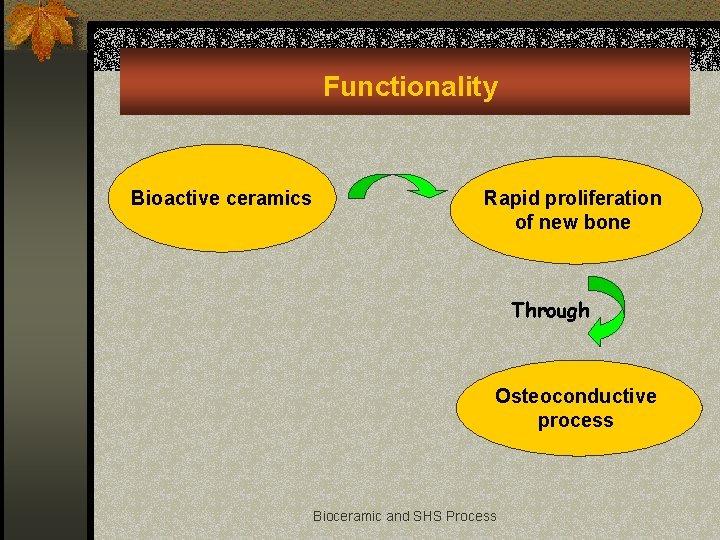
Functionality Bioactive ceramics Rapid proliferation of new bone Through Osteoconductive process Bioceramic and SHS Process

Ceramic powder methods Ceramic synthesis Solid-state Wet methods n. Micro-wave method n. Sol-gel method n. Ceramic process n Hydrothermal method n. Combustion Synthesis Bioceramic and SHS Process

Bioceramics process Conventionnel methods Powder synthetis Porogen Powder compaction Drying Sintering (1100 ~1400 °C) Bioceramic and SHS Process
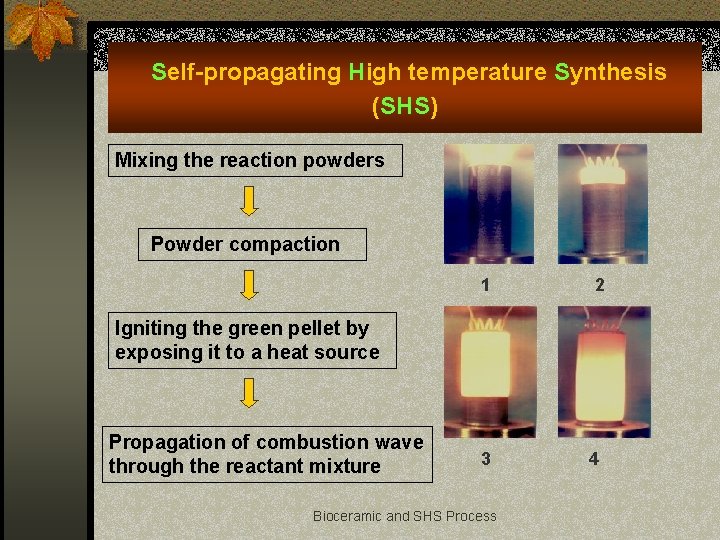
Self-propagating High temperature Synthesis (SHS) Mixing the reaction powders Powder compaction 1 2 Igniting the green pellet by exposing it to a heat source Propagation of combustion wave through the reactant mixture 3 Bioceramic and SHS Process 4
Advantages of the SHS technique § § § Materials with better control of porosity Personalized implants Functionally graded materials Fast reactions Economic and simple process Bioceramic and SHS Process
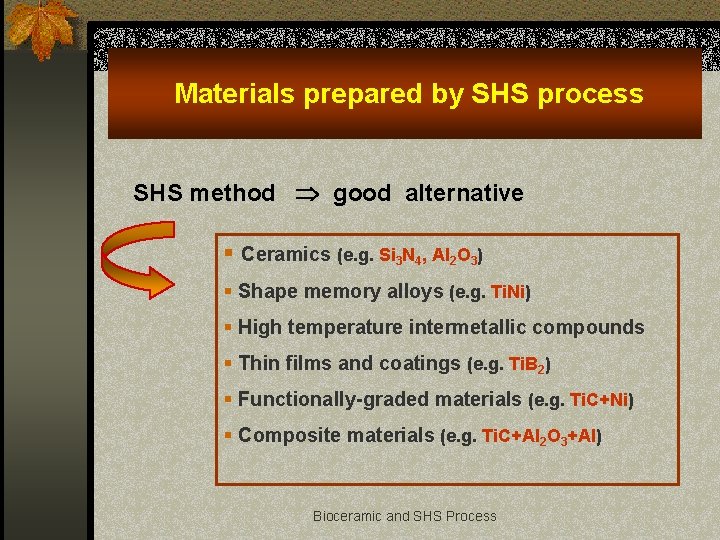
Materials prepared by SHS process good alternative SHS method § Ceramics (e. g. Si 3 N 4, Al 2 O 3) § Shape memory alloys (e. g. Ti. Ni) § High temperature intermetallic compounds § Thin films and coatings (e. g. Ti. B 2) § Functionally-graded materials (e. g. Ti. C+Ni) § Composite materials (e. g. Ti. C+Al 2 O 3+Al) Bioceramic and SHS Process
The main challenge of the implant technology Our objective To use the SHS technique for developpment of new generation of implant materials with : § Biological response § Optimum of biodegradability § Enhanced mechanical properties Bioceramic and SHS Process
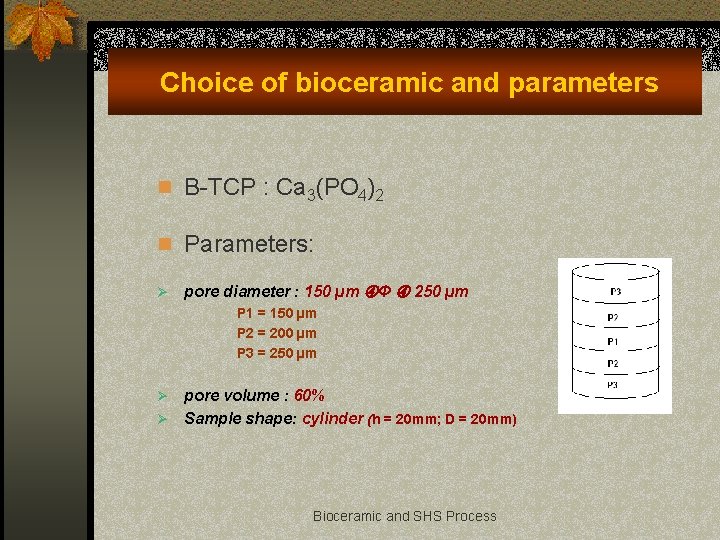
Choice of bioceramic and parameters n Β-TCP : Ca 3(PO 4)2 n Parameters: Ø pore diameter : 150 µm Φ 250 µm P 1 = 150 µm P 2 = 200 µm P 3 = 250 µm pore volume : 60% Ø Sample shape: cylinder (h = 20 mm; D = 20 mm) Ø Bioceramic and SHS Process
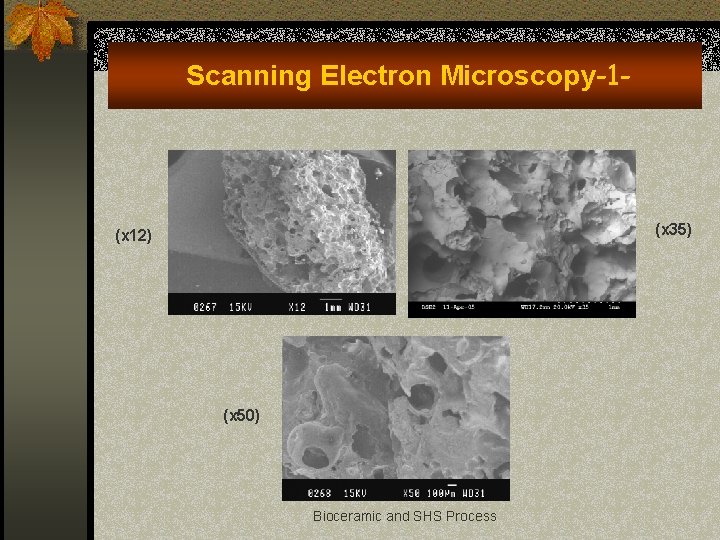
Scanning Electron Microscopy-1 - (x 35) (x 12) (x 50) Bioceramic and SHS Process
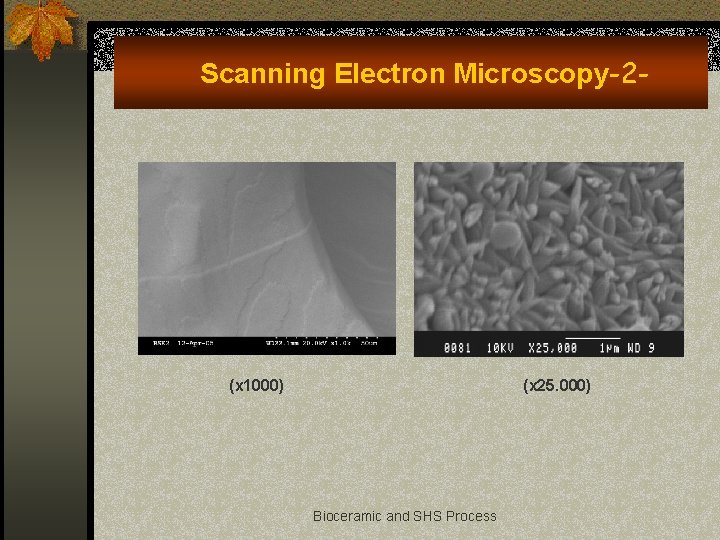
Scanning Electron Microscopy-2 - (x 1000) (x 25. 000) Bioceramic and SHS Process

Characterization - diffraction RX β -TCP α –TCP Ca 2 P 2 O 7 Bioceramic and SHS Process
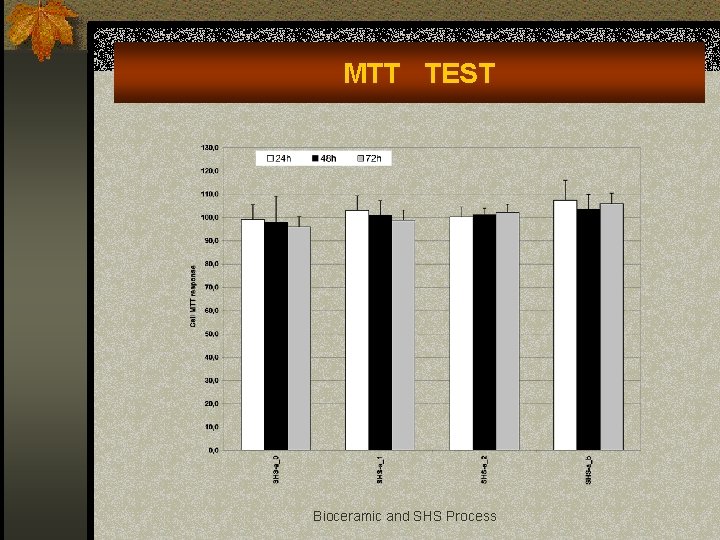
MTT TEST Bioceramic and SHS Process
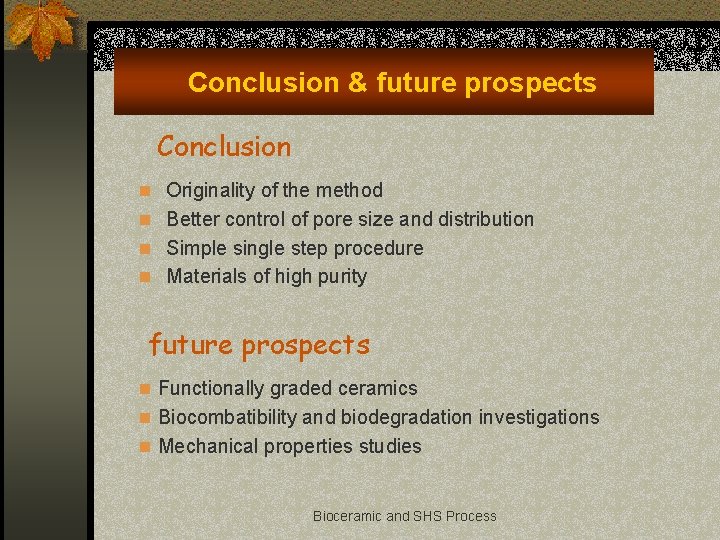
Conclusion & future prospects Conclusion n Originality of the method n Better control of pore size and distribution n Simple single step procedure n Materials of high purity future prospects n Functionally graded ceramics n Biocombatibility and biodegradation investigations n Mechanical properties studies Bioceramic and SHS Process

Thanks for the collaboration of & Bioceramic and SHS Process
- Slides: 17