
A POEM TO MY FOSTER DOG BY Diane
A POEM TO MY FOSTER DOG BY Diane Morgan I am the bridge, Between what was and what can be. I am the pathway to a new life. I am made of mush, Because my heart melted when I saw you, Matted and sore, limping, depressed Lonely, unwanted, afraid to love. For one little time you are mine. I will feed you with my own hand. I will love you with my whole heart. I will make you whole. I am made of steel. Because when the time comes, When you are well, and sleek, when your eyes shine, And your tail wags with joy Then comes the hard part. I will let you go-not without a tear, But without a regret. For you are safe forever-A new dog needs me now. 2017 FOSTER PACKET
WELCOME FOSTERS If you have received this package it means you have already been approved to join our foster team. Congratulations – we are so happy to have you!! Fosters are the most important part of the rescue triad. You will be the bridge from the sad world of yesterday to the joy and happiness of their forever home. We can not thank you enough for being a part of each dog’s story and being that ever important bridge to tomorrow. Without Fosters we could not save dogs. Period. In some cases you may be the first kind hand a foster dog knows. So please, remember be patient, many of our dogs have hard beginnings. This means you can expect your dog to NOT be housebroken, know basic commands, have perfect health, know how to interact easily, etc. Fostering is rewarding but not ever day is easy. The following packet of information is to help you in this very important job as you are front line warriors to saving lives.
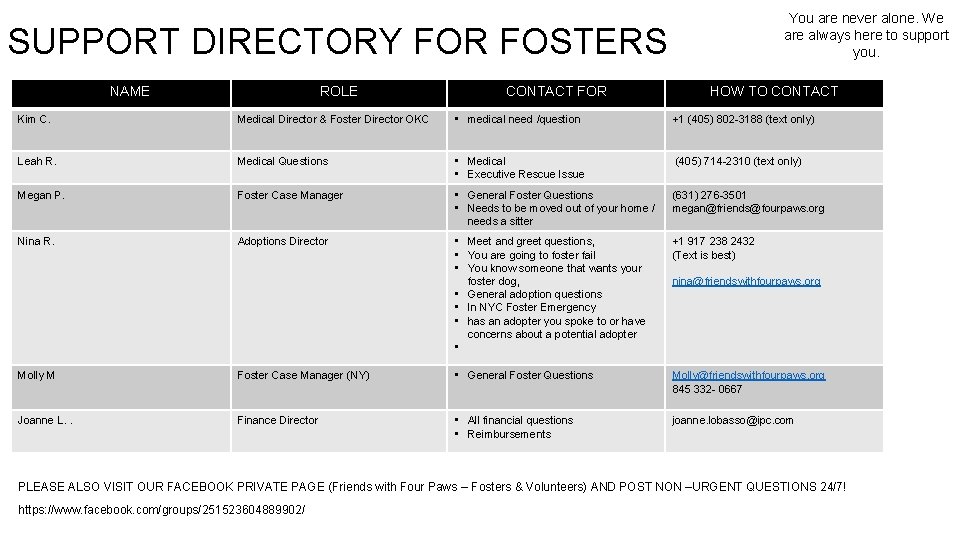
You are never alone. We are always here to support you. SUPPORT DIRECTORY FOR FOSTERS NAME ROLE CONTACT FOR HOW TO CONTACT Kim C. Medical Director & Foster Director OKC • medical need /question +1 (405) 802 -3188 (text only) Leah R. Medical Questions • Medical • Executive Rescue Issue (405) 714 -2310 (text only) Megan P. Foster Case Manager • General Foster Questions • Needs to be moved out of your home / needs a sitter (631) 276 -3501 megan@friends@fourpaws. org Nina R. Adoptions Director • Meet and greet questions, • You are going to foster fail • You know someone that wants your foster dog, • General adoption questions • In NYC Foster Emergency • has an adopter you spoke to or have concerns about a potential adopter • +1 917 238 2432 (Text is best) nina@friendswithfourpaws. org Molly M Foster Case Manager (NY) • General Foster Questions Molly@friendswithfourpaws. org 845 332 - 0667 Joanne L. . Finance Director • All financial questions • Reimbursements joanne. lobasso@ipc. com PLEASE ALSO VISIT OUR FACEBOOK PRIVATE PAGE (Friends with Four Paws – Fosters & Volunteers) AND POST NON –URGENT QUESTIONS 24/7! https: //www. facebook. com/groups/251523604889902/
THE ROLE OF A FOSTER The role of a foster is to not only offer our dogs a safe place to stay while they wait for their forever families but to help create positive good habits that make the dog even more adoptable. In order to do that we have some recommendations for foster boundaries and behavior that are very important! Setting up your dog for success in his forever home can make the difference between a dog that stays with his family or ends up being returned. Affection for a foster dog is great – but dogs need discipline, exercise and boundaries even MORE than they need affection. Dogs require exercise, discipline, and affection - in that order. Exercise lowers their energy level; discipline guides and fulfills their minds; and, although affection is important, to maintain a balanced and harmonious pack, this always comes last. Affection is used as a reward for calm, submissive behavior.
PACK LEADERS & THE ITTY BITTY DOGS It is incredibly tempting to look at a small scared dog and want to baby or pamper him/her. ESPECIALLY when they are very small dogs like a Chihuahua or a toy breed you can easily scoop up. Please remember – dogs no matter how small, dogs are not human babies and WANT to be treated like dogs. Even the smallest of dogs need to be treated like dogs – they need walks on leashes, not to be held all day, and to be allowed to be DOGS. Please respect your foster dog as a dog. Treat your foster Chihuahua the same way you would a Rottweiler and they will be truly happier and better behaved for it! § Never hold your dog as as someone says hello. (In fact, do not hold your dog unless necessary) § Do not let your foster dog sleep in your bed. § Limit time on your lap. § Never baby talk or reassure your dog “they are okay” or coddle them when they are afraid. That petting and coddling is a positive reward that just reinforces they should be afraid. Ignore their fears so they can learn it makes no sense to be afraid!
CARING FOR YOUR FOSTER DOG : SAFETY & COMING HOME
FOSTER DOG GEAR… • The following items are things you will need to have in your home. q Dog Crate q Water Bowl q Food Dish q Collar, Leash & Harness q Emergency Dog Kit q Pedialyte (in the case of dehydration) q Baby Gate (optional – if you plan on allowing a dog in only one room) q Play toys q Training treats q Doggie Poo Bags q Wee wee pads q Dog Bed PLEASE NOTE MOST OF, IF NOT ALL, OF THESE ITEMS WILL BE PROVIDED TO YOU BY FWFP WITH YOUR FIRST FOSTER DOG. FOR LOW COST TOYS PLEASE VISIT A HOME GOODS, TJ MAAX OR MARSHALLS – THEY HAVE LOW COST GREAT DOG TOYS & ANTLE (no rawhides please!)
COMING HOME: DAY 1 STEPS, TRICKS & TIPS 1. Remain calm – The calmer and confident you are, the better your dog will feel and behave. 2. Take a long walk – A long walk gets them familiar with your neighborhood and drains them of energy to reduce stress. (See the next slide if you have a dog your foster must meet) 3. Show your pup the house by walking him/her through it while still on the leash – show the dog each room of your home. Make sure you walk in first so she knows it is YOUR house and YOU are the leader. Keep talking to a minimum and just let her sniff around. 4. Show her where to eat – Give a snack and water in her food and water bowl. 5. Allow her to relax in her “special place” – Bring the dog over to his or her crate, dog bed or small room where they will be sleeping. You may now take off the leash. If you have a dog that is very scared and skittish in nature DO NOT REMOVE THE LEASH. Leaving the leash on will allow you to move the dog around your home without having to TOUCH the dog. This is really important because if you are forced to chase the dog at any point or “grab” him or her quickly it can really destroy the bonding and safe feeling you want your foster to get from you.
INTRODUCING YOUR DOGS TO YOUR NEW FOSTER 1. Your introduction should start with a walk. It creates the proper atmosphere for introducing dogs safely and it helps tire out the dogs – remember a tired dog is a good dog! 2. Try to talk a walk on neutral territory and remember never let dogs meet face to face first!!! 3. You may need a friend or another foster to help you. Simply take your current dogs on a walk and have your friend hold the foster’s leash behind following you. After a while, it’s time to drop back and let your original dog sniff the new dog’s rear, but don’t let them meet face-to-face yet, as that can lead to fights. Resume the walk with the original dog in front, and then let the new dog have a sniff. 4. Gradually, you can bring the entire pack together, with the dogs walking on the outside and the humans inbetween. When they are in a calm state and walking together without incident, then it’s time to bring the pack home.
KEEPING YOUR DOG SAFE: INSIDE THE HOME § Do not leave your dog unattended in your home. He/she should remain within your line of sight. § His/her crate should be in the same room as you at all times with the door open so your dog can go to his “safe” place if he wishes. § When you leave please make sure your dog stays in a confined area with no hazardous chemicals, exposed wires, etc. We strongly recommend leaving your dog in a crate when you are not home. § Do not leave your foster dog alone with your other pets. No matter how well they appear to get along unsupervised pets can lead to tragedies. § Watch resources carefully the first few days especially – observe how your new dog behaves around water, food, toys, chews, etc. Make sure you supervise all play and interactions carefully especially in the first few days. § Many of our fosters have children. Children and dogs are meant to be together. That being said children need to be respectful of dogs – they are NOT toys. Supervise your child’s behavior and remember even if it is your child’s bad behavior, the dog will ultimately be blamed. Please do not leave your children unattended and make sure they have good dog manners. (For more on this read this great article – (https: //drsophiayin. com/blog/entry/kids-and-dogs-how-kids-should-and-should-not-interact-with-dogs/_
KEEPING YOUR DOG SAFE: INSIDE THE HOME Many dogs will come to us sick, dehydrated, stressed, and/or older. Some common (and no reason to panic) symptoms include: q Diarrhea (you can replace regular food with white rice and a little chicken broth if your dog’s stomach is upset) q Loss of Appetite q Vomits (stress, eating grass, new foods, etc. all can cause a dog to vomit) q Not peeing or pooping (sometimes stress can cause dogs not to want to eat or drink or even have to go to the bathroom. Under 48 hours of this behavior is fine and of no concern) q Coughing (If a dog has kennel cough he will come to you with medications to ensure he is not contagious) q An incision and/or little blue line on his belly (this is a tattoo to mark the dog has been fixed) q Has fleas - If your dog has fleas (notify us first) or is in need of a bath, please mix: Dr. Bronner’s liquid soap (almond or no scent), apple cinder vinegar, and a pinch of baking soda.
KEEPING YOUR DOG SAFE: INSIDE THE HOME If you have an emergency please your case manager with the word EMERGENCY and the DOG’S NAME. You will need to contact us immediately if your dog: q Begins to vomit excessively (more than three times in one hour) q Appears to be lethargic or not conscious (eyes glazed over or not focusing) q Has bloody or black tar stools (more than just a little red blood as they may be caused by straining) q Begins to get heavily winded or struggling to breath after very minimal activity q Foaming at the mouth q Is attacked by another dog q Can not seem to stop coughing q Begins to walk in to walls, experience loss of vision or seizure q Has not peed or pooped in more than 24 hours q Is injured/bleeding/hurt
KEEPING YOUR DOG SAFE: OUTSIDE THE HOME § No retractable leashes (they are not secure and can also cause damage to a dog’s neck as they “snap”) § Please make sure your pup is properly secure. All harnesses and collars need to be fitted to the extent that you can only get two fingers underneath the strap. If you can get more than two fingers, the gear is too loose! § Your leash and collar/harness should not be slippery fabric. § Please make sure your pup has their tags on at all times. § The most secure way to hold a leash is to place the loop around your thumb and then cover it with your fingers in your palm. It is physically impossible to drop a leash if you hold it this way. If your dog gets off leash or escapes please contact your CASE MANAGER ASAP!!!.
KEEPING YOUR DOG SAFE: OUTSIDE THE HOME § NO off leash EVER outside of your home or a confined safe area (like a fenced in yard, dog park). Even a dog that listens like CLOCKWORK in your home can become distracted or fail to listen outside. Your dog must ALWAYS be on a leash outside of your home or fenced in area. § Use common sense and caution at public dog parks. § Do NOT leave your dog unattended in a public place at ANY TIME. Not to get a cup of coffee, not with a nice stranger, not tied up for a second as you run in to a store. NEVER. § If you need someone to take your dog overnight you must notify FWFP that another person will be caring for your dog. § Do not leave your dog outside, or tethered outside. If your dog gets off leash or escapes please contact XXXX with LOST DOG + Dog name immediately.
HELP, MY FOSTER DOG IS SICK…. Hopefully this page is not needed while you are fostering, but if you think your foster needs medical attention please consider the following: § We have 2 veterinary clinics that we work with in NY and NJ, those are able to provide us with rescue rates which are substantially lower than what you pay without this discount: § Astoria Veterinary Group in Queens, Astoria, NY § Veterinary Medical Center, Dr. Fedina in Caldwell, NJ § Please contact the foster coordinator if your foster has any issues, they will advice of the best cause of action and make an appointment with the vet if appropriate § If there is an emergency: please use your best judgement obviously. But always try to reach us ASAP. If the foster coordinator is not there, please try any of our core volunteers. We are there to help.
EAT. SLEEP. DRINK Eat. Your dog will likely come to you with food (Purina most likely), however if he does not please supply a dry dog food. Many reasonable options are available even in human food stores. Also consider the size of your dog when selecting the size of the kibble. Your dog can eat just one time per day if they are overweight but many of our dogs are severely underweight. Please feed your foster dog once in the morning and once in the evening. If your dog is severely underweight (ribs exposed) please feed at least three times a day. Sleep. Ideally your foster dog should sleep in your room in their own crate or on a dog bed on the floor. Feel free to give him a dog bed or plush blankets inside of the crate however we ask that foster do not let dogs sleep in their beds. Many adopters do not want to allow dogs to sleep in their beds and it is a hard habit to break once established. Additionally allowing a dog on furniture can lead to dominance and other behavioral issues as well. Drink. Please be sure your dog has access to water through out the day to prevent dehydration. It is very important - especially on hot days your dog drink regularly. A great way to check if your dog is dehydrated is to pull the skin on the back of their neck. If it stands up or stays stiff your dog is dehydrated. Please give him/her some pedialyte to restore electrolytes. You CAN limit water after 8 pm to prevent night time accidents.
(GOOD DOG!) BEHAVIOR & TRAINING TIPS
EXERCISE. DISPLINE. AFFECTION Dogs are pack animals that do not have the same emotions we do. Please understand that a dog’s love language is not the same as ours. We often make the mistake of giving them the life WE want (soft beds, lots of affection, being treated like a prince or princess, toys, treats) and not the life THEY want (exercise, work, protection, rules, and structure). They WANT calm, strong, leadership. Boundaries and rules help them to feel protected and cared for. They are not “jealous” of the leader. In fact dogs WANT to be told what to do and when. Leadership does not mean yelling, negative reinforcement or being “tough”. NEVER yell at or strike your dog and think that makes you a powerful or good leader. It does not. Ignoring your dog when they do not do what you want or giving a short firm correction (a TSCH!) is far more powerful and humane. Being a good pack leader means being calm, confident, and showing love when it is deserved because your dog earned it.
EXERCISE. DISPLINE. AFFECTION § The most important thing you can do with your foster dog is provide physical and mental exercise. § A minimum of three walks per day are necessary to help your foster dog stay balanced and avoid behavioral issues. If you work a full time job out of the home, the morning and evening walks can be longer with the middle walk done on a lunch break or by a dog walker. § Play ball! Off leash exercise is important to. Toss a ball, Frisbee, roll small toys, etc. Interacting with your dog is important just for the fun of it! (Just make sure you always end with the toy in YOUR hand. You must always “win” to reinforce your place as top dog!)
EXERCISE. DISPLINE. AFFECTION § Thirty minutes of clicker training in a dedicated session in a day is fantastic for mental stimulation. § Also be sure through out the day you make your dog work for their food, their treats, etc. In order to gain the most benefit from their training, it’s best to just use the dog’s obedience everyday throughout their daily routine. Doing this is FAR more effective than you just going home, going in your backyard, and doing come, sit, place (etc. ), repeatedly for 45 minutes. § Example: When it’s time to feed your dog, have them sit, walk away, sit their food bowl down, make them wait a minute, and release them. § Example: When you go out a door, make them sit, you walkout, and make them wait until you release them. § Example: When someone comes to the door, “place” them on their dog bed, make them wait patiently, and the release them.
EXERCISE. DISPLINE. AFFECTION Training is not mandatory although it is a lot of fun and rewarding • Clicker Training and NILF (Nothing In Life is Free) concepts are great for foster dogs because it helps reinforce their instincts to respect their leaders and work for what they want. You can be the nicest boss your dog has ever had – but you must always be the boss. Having a strong leader helps dogs feel calm, safe, and cared for. • Clicker training is also a very fun way for you to bond and play with your foster dogs! It is super rewarding to watch them learn, grow, become more confident and be more ready for the wonderful life ahead of them! • Some great links to clicker training can be found here: 1. Getting started – Love this video for explanation as to how to make this training technique work and why : https: //www. youtube. com/watch? v=om. Zt 5 Eu 8 nf. E 2. This is a great HOW to - https: //www. youtube. com/watch? v=HPDOr. EEs. AJ 8
EXERCISE. DISPLINE. AFFECTION Discipline is so incredibly important for your foster dog. Teaching him or her how to be a “good dog” will help them be a wonderful dog that is adopted and cherished in their new home. Discipline and rules are a vital part of the fostering process. Discipline means rules, and you calling the shots. It never means scolding, hitting, yelling or being cruel. Ever. The best behaved dogs have learned to TRUST their human leaders. This trust is a vital part of the relationship.
EXERCISE. DISPLINE. AFFECTION House Breaking Many foster dogs will not be housebroken. This does not mean your house has to be destroyed! Most dogs can be trained rather quickly provided you remain disciplined and do the following: 1. Keep your dog in his crate when he can not be supervised. Dogs instinctually will not eliminate where they must sleep. Keep the area in the crate small enough that a dog can stand up and turn around but not pee or poop and then push it aside. 2. Take your dog out IMMEDIATELY when he comes out of the crate. Do not let him/her sniff or roam inside. He/she WILL have to go so carry him/her RIGHT OUT or lead with the leash immediately outside. He should go out every 3 -4 hours or so (puppies may need to go out every 2 hours). 3. Dogs (puppies especially) will need to go out within 15 minutes of eating. Make sure they go out immediately after eating/drinking. 4. An untrained dog or puppy can not roam around the house without supervision. Keep the dog on a leash if needed to make sure he can not wonder off and have an accident. If you see your dog is about to go in the house, state a firm “no”, immediately carry him out or place where he SHOULD go and praise if he does!! Offering a treat IMMEDIATELY AFTER HE GOES IN THE SPOT HE WENT HELPS CREATE A POSITIVE ASSOCIATION AND IS GREAT POSITIVE REINFORMCENT. 5. When you are not able to watch the dog and pick him up immediately if he is about to have an accident, he needs to be in a crate. 6. When they DO go outside IMMEDIATELY REWARD with a treat and celebrate!!! They learn fast!
EXERCISE. DISPLINE. AFFECTION Why Crate Training Is Important Some fosters feel guilty placing a dog in a crate when they are not home, or at night. Do not. Dogs are den animals. This means they prefer to have places of their own that are structured and smaller to make them feel safe. Further, making sure your dog is safe, and follows the rules set forth in your house is part of the discipline they need. Your dog’s crate is their home within a home and a vital piece of the puzzle to feel safe. Allowing dogs to sleep on furniture, elevates them to human status – it can lead to dominance and behavioral issues if they are given this privilege before it is truly earned.
EXERCISE. DISPLINE. AFFECTION Crate Training Tips § Introduce it casually - Never just throw your dog in to a crate. § Make it a Happy Place. - Place the crate in an area of the house he likes to be in. Add a blanket and a toy or two, and keep the door open. Then back off and give him a chance to explore it. Some dogs will immediately start sniffing around and going into the crate, which is a great sign. If your puppy isn’t quite so bold, encourage him to check it out by placing favorite foods and toys near and inside the crate. The ultimate goal is to get him comfortable with going inside, and this is something that could take days. Be patient with the process. § Use it for meal time - One of the best ways to do this (and create a positive association with the crate) is to start putting her food in the crate. If possible, you want to place the food at the back of the crate so that your dog goes all the way in. Some dogs may not be willing to do this, though, so you can start with the food just inside the crate and slowly move it back with successive meals.
EXERCISE. DISPLINE. AFFECTION Crate Training Tips § Close the crate. As soon as your dog is eating his meals while standing all the way inside the crate, it’s time to close the door. After he’s done eating that first time, open the door immediately. You’ll leave him in longer and longer with each meal, adding just a few minutes every time. § Extend crate time. Once your dog is hanging out in her closed crate without signs of stress, it’s time to lengthen her stay. Use a favorite toy or treat to encourage her to enter the crate, then close it. Hang out by the crate for several minutes, then go into a different room for a few minutes so she gets used to the idea of staying in the crate alone. When you return, don’t open the crate immediately. Instead, sit with her again for a few more minutes and then open the door. § Leaving and returning. A tired dog is less likely to hate being in his crate. Going IN to the crate it is best if your dog is already tired. The key here is to make crating seem completely normal and avoid excitement. Encourage him to get into the crate and praise him when he does so, but keep it brief. When you come home, stay low-key and ignore any excited behavior that he shows. Do not let the dog follow you around as you get ready as it builds anxiety and excitement. Place your dog in his crate about 15 minutes or so before you leave so he can get settled. § Ignore the whining. On initial introduction It’s possible that your dog may whine. If this happens, open the crate immediately and don’t leave him in as long next time. However, if he whines again, wait until he stops before letting him out or you will teach him that whining equals open door. •
EXERCISE. DISPLINE. AFFECTION • Affection can be plentiful provided it is ONLY given when deserved. Affection after a dog has followed a command, is remaining calm, or on your terms (when the dog is doing something desirable) it important. • Do not pet any dog that is showing signs of unwanted behavior, fear, anxiety, growling, etc. • Do not pick dogs up and make them say hello while people are holding them– this is an absolute no no in dog behavior.
TRAVEL & FOSTER BABYSITTERS • From time to time we all need help with our fosters. Whether it is an overnight business trip or a week long vacation the group is here to support you! • Only an approved FWFP foster may take care of your dog in your absence. As soon as you realize you will need support please post in the Friends with Four Paws Volunteer Page and share the dates you will need coverage. • Please be sure to tag Megan Penney to let her know of any foster transfers. • If you would like a personal friend or family member to watch your foster they MUST COMPLETE a foster application and attain approval first.

HELPING YOUR FOSTER DOG GET ADOPTED
OOPS! YOU FELL IN LOVE AND WANT TO ADOPT YOUR FOSTER DOG? § We will never discourage “foster failure”, after all you have offered your home for a foster, so you will surely make a great adopter for us. There is no need to fill out an adoption application as your foster app was approved already § We grant our fosters a $50 discount off the adoption fee § Imagine you would be told “You are a great adopter but somebody is better than you”. We don’t want this to happen to us so we ask that you let the case manager or foster coordinator know as soon as possible but latest before the meet and greet: you have the right of first refusal up until the meet and greet is set up. Then it’s potential adopter first (pending of course the application approval)
FAQ FROM POTENTIAL ADOPTERS When walking around town with your pup (especially if he or she is wearing an adopt me bandana you may need to know the following responses to commonly asked questions…. § The adoption fee is $475 and covers all medical expenses § All dogs are: up to date on vaccines, microchipped, are on heartworm prevention & have been declared healthy by our vet unless specifically stated (which the case manager will ensure to mention to the potential adopter). Older dogs usually get a dental cleaning too! § The approval process for adoption application is easy: 1. Fill out app, 2. Achieve a positive impression from the interview with case manager, 3. Receive positive feedback from the meet & greet. 4. Positive references check. We do not conduct home visits as we do not have the resources and also the additional information you get from it is not warranting additional resources 5. Contract has been signed & adoption fee has been paid. Any process questions or questions you don’t have an answer for they should direct to your case manager or by contacting the rescue directly.
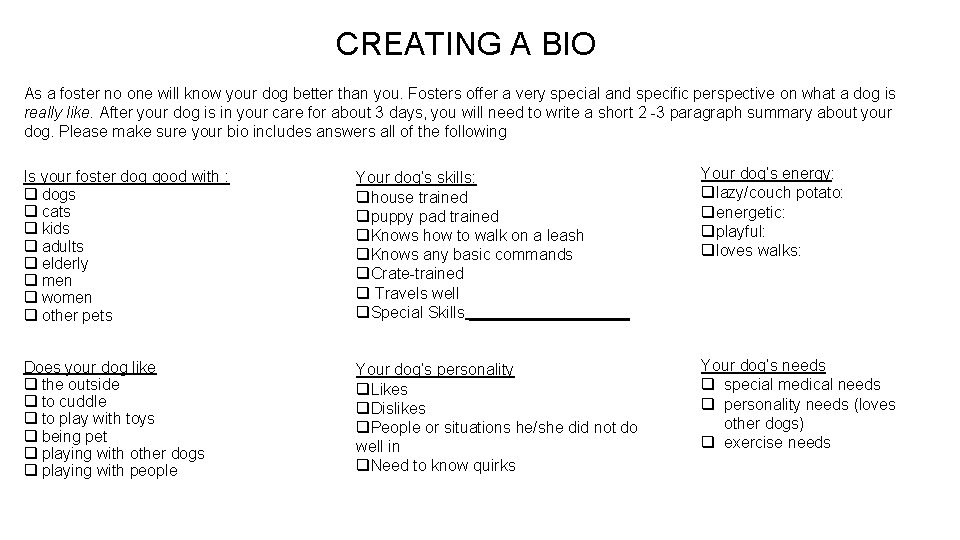
CREATING A BIO As a foster no one will know your dog better than you. Fosters offer a very special and specific perspective on what a dog is really like. After your dog is in your care for about 3 days, you will need to write a short 2 -3 paragraph summary about your dog. Please make sure your bio includes answers all of the following Is your foster dog good with : q dogs q cats q kids q adults q elderly q men q women q other pets Your dog’s skills: qhouse trained qpuppy pad trained q. Knows how to walk on a leash q. Knows any basic commands q. Crate-trained q Travels well q. Special Skills _________ Your dog’s energy: qlazy/couch potato: qenergetic: qplayful: qloves walks: Does your dog like q the outside q to cuddle q to play with toys q being pet q playing with other dogs q playing with people Your dog’s personality q. Likes q. Dislikes q. People or situations he/she did not do well in q. Need to know quirks Your dog’s needs q special medical needs q personality needs (loves other dogs) q exercise needs
TAKING PHOTOS & VIDEOS PHOTOS While the written bio is important photos and videos are worth a thousand words with our dogs! Please make sure your take at least three photos of your dog including: 1. Close up to give a sense of their face (no sleeping photos as it is hard to see their cuteness in these photos!) 2. A full body shot that will show entire shape of dog Please be sure the photos are in a well lit area, give an accurate picture of what your dog really looks like (no glamour shots!) and are not blurry. VIDEOS Also please provide a 1 -2 minute video of your foster dog if possible. Your dog just being generally adorable works. When your Bio & Photos (and optional video) are complete please send to:
TALKING TO ADOPTERS After potential adopters are screened you will be asked to have a brief phone conversation to tell them a bit more about your foster dog. Please understand honesty (with no sugar coating) is critical on this call. Painting an honest picture of what your dog is really like (both the “good” and the “bad”) is important to finding great matches. The last thing we want to see is a foster dog bounced around or returned. Realize that since your bio was written you may know even more about your foster dog – so share especially if there have been any changes. Please ask as many question of the adopter as you feel you need to to make sure you are confident they are a good match. Questions about lifestyle, what type of dog they are looking for, what would be a “deal breaker” are all important questions. At the end of the call you MUST tell the adopter that they can THINK about the call and do not need to give you an immediate answer if they want a Meet and Greet HOWEVER if they are interested in the dog they MUST arrange for a meet and greet within three days of the call. WE DO NOT HOLD DOGS for anyone. Potential adopters must travel to the foster’s home or place of a foster’s choosing at a time that is convenient for the foster. If you have questions about your meet and greet you can contact the Case Manager that assigned the potential adopter to you. .
ATTENDING A MEET & GREET DO’S & DON’TS § Do not feel obligated to have potential adopters come to your home. Meeting in safe, public places is encouraged. § Always have a potential adopter bring current dogs in their family. It is essential they meet. § Do not have a Meet & Greets in loud or busy places or with other attendees. § Do not have Meet & Greets in the dark as it can be hard for dogs to see and lead to nervous dogs. § Meet on neutral territory outside but in a safe environment (unless you are adopting a puppy that has not been fully vaccinated. ) § Do not pet any dog that is showing signs of unwanted behavior, fear, anxiety, growling, etc. § Do not pick dogs up and make them say hello while people are holding them– this is an absolute no no in dog behavior.
ATTENDING A MEET & GREET STEP BY STEP 1. First things first – potential adopter and foster/the humans, should say hello first. Potential adopter should not say hello to the dog (before the walk). 2. Dogs should not say hello to each other / Sniff – (before the walk has happened). 3. The foster should give the adopter the leash and immediately go for the walk. This is key with introductions, as it establishes the potential adopter as the calm, assertive pack leader. 4. Here is the proper way to walk a dog: https: //www. cesarsway. com/dog-training/walking/6 -tips-for-mastering-the-dogwalk 5. After a few blocks of the potential adopter walking the dog on leash, you can either go inside or remain outside in a safe non-distracting area for everyone to meet. If you bring your dog, have the dogs say hello themselves. Keep leashes relaxed and watch for any tense body movement 6. If the dogs are saying hello – the humans should not pet, or pick the dogs up. Let the dogs say hello on their own first. Once they have said hello, the human can interact.
ATTENDING A MEET & GREET NEXT STEPS • Encourage an open dialogue • Listen to your instincts and observe how the potential adopter and dog interact to see if you have any concerns about the match • Allow the potential have private time with the dog but do not leave them completely unattended • Answer questions honestly. • Meet and Greets are NOT for adoption and applicants will attend understanding they MAY NOT adopt the dog that day. If the adopter would like to adopt the dog they need to go home, sign the contract and provide payment in full BEFORE returning to get the dog. • IF YOU HAVE ANY CONCERNS ABOUT THE DOG BEING ADOPTED BY THE APPLICANT DO NOT RELEASE THE DOG TO THEM AND CONTACT THE ADOPTION CASE MANAGER IMMEDIATELY AFTER THE MEET & GREET.
ADOPTION DAY No matter how long or how many dogs you foster, watching a dog leave is always bitter sweet. Remember to take a photo for your own memory box or scrapbook so that you can remember all of the dogs you have helped. And of course, please consider opening home to the next dog in need…. because found their forever home today, another now needs you. while one dog has
AFTER ADOPTION DAY… We sure hope that you will foster for us again, but in the meantime consider the following: § We are eternally thankful for what you have done for the dog(s), you changed the life for not only the dog but also it’s new family – thank you § Please return the items we have borrowed you such as crate, harness and others. The adopter should only get the dog & collar with the tags. We are always short on harnesses and crates, so please try to return to one of our core volunteers. Your foster coordinator can help with locating the closest one to you § If something has not met your expectations: please let us know so we can improve, after all we are only volunteers and have developed tunnel vision to what we do
ONLINE SUPPORT & RESOURCES § We are always here to support you!!! Our community can be found on Facebook on our private page – Friends With Four Paws – Fosters & Volunteers. Post questions, share your funny stories or concerns, ask advice 24/7 on our Facebook page! § For great information on a wide range of all things “dog” Visit http: //stories. barkpost. com/ § http: //fosterdogsnyc. com/ is a great resource for information about foster events, connecting with NYC fosters, etc. § Check out this national foster manual http: //fosterdogsnyc. com/manual/ § Check out this great article about Foster Hacks from our very own Megan Penney http: //fosterdogsnyc. com/megans-foster-hacks
- Slides: 40