
A Plasma Wakefield AcceleratorBased Linear Collider Vision for
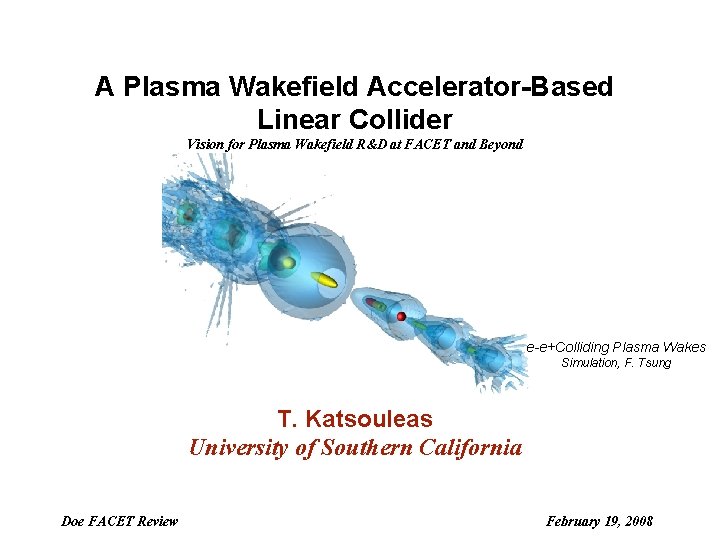
A Plasma Wakefield Accelerator-Based Linear Collider Vision for Plasma Wakefield R&D at FACET and Beyond e-e+Colliding Plasma Wakes Simulation, F. Tsung Beyond 10 Ge. V: Results, Plans and Critical Issues T. Katsouleas University of Southern California Doe FACET Review February 19, 2008
Outline • • • Brief History and Context Introduction to plasma wakefield accelerators Path to a high energy collider Critical issues, milestones and timeframe What can and cannot be addressed with FACET
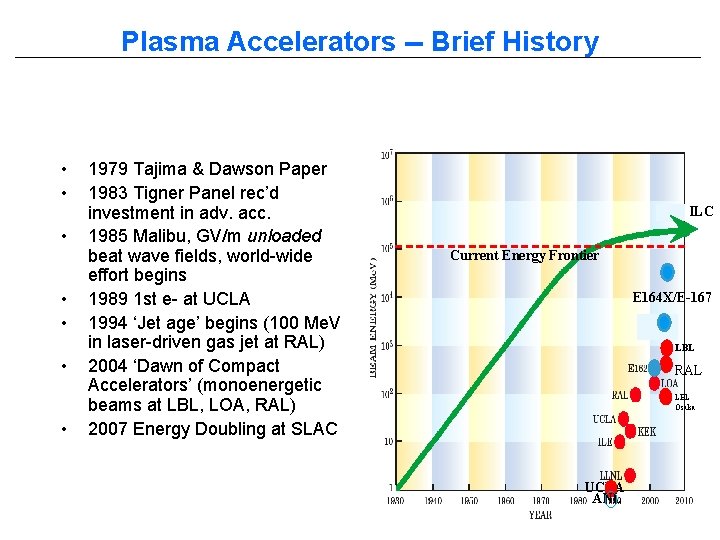
Plasma Accelerators -- Brief History • • 1979 Tajima & Dawson Paper 1983 Tigner Panel rec’d investment in adv. acc. 1985 Malibu, GV/m unloaded beat wave fields, world-wide effort begins 1989 1 st e- at UCLA 1994 ‘Jet age’ begins (100 Me. V in laser-driven gas jet at RAL) 2004 ‘Dawn of Compact Accelerators’ (monoenergetic beams at LBL, LOA, RAL) 2007 Energy Doubling at SLAC ILC Current Energy Frontier E 164 X/E-167 LBL RAL LBL Osaka UCLA ANL
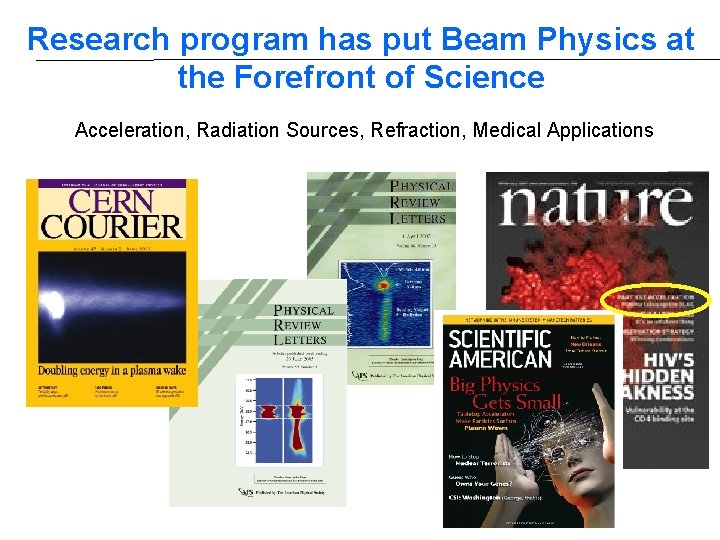
Research program has put Beam Physics at the Forefront of Science Acceleration, Radiation Sources, Refraction, Medical Applications
Charge
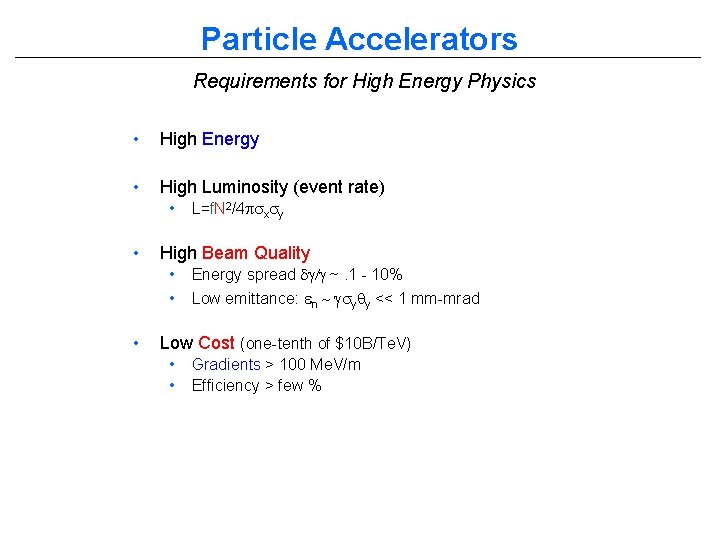
Particle Accelerators Requirements for High Energy Physics • High Energy • High Luminosity (event rate) • • High Beam Quality • • • L=f. N 2/4 psxsy Energy spread dg/g ~. 1 - 10% Low emittance: en ~ gsyqy << 1 mm-mrad Low Cost (one-tenth of $10 B/Te. V) • • Gradients > 100 Me. V/m Efficiency > few %
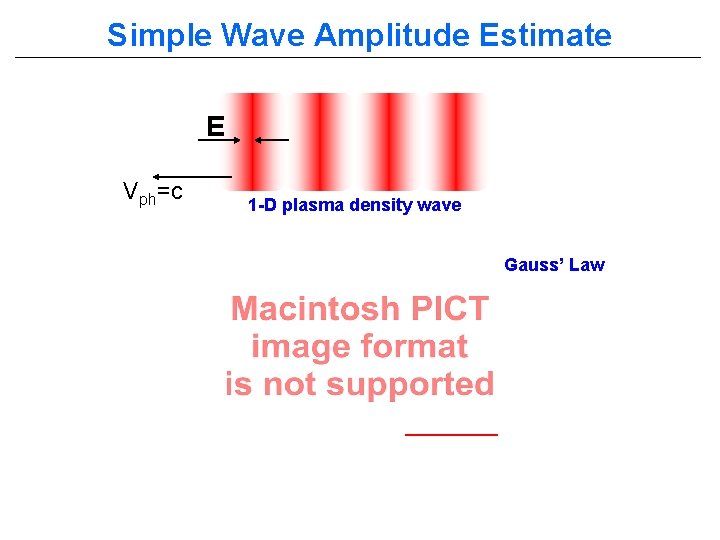
Simple Wave Amplitude Estimate E Vph=c 1 -D plasma density wave Gauss’ Law
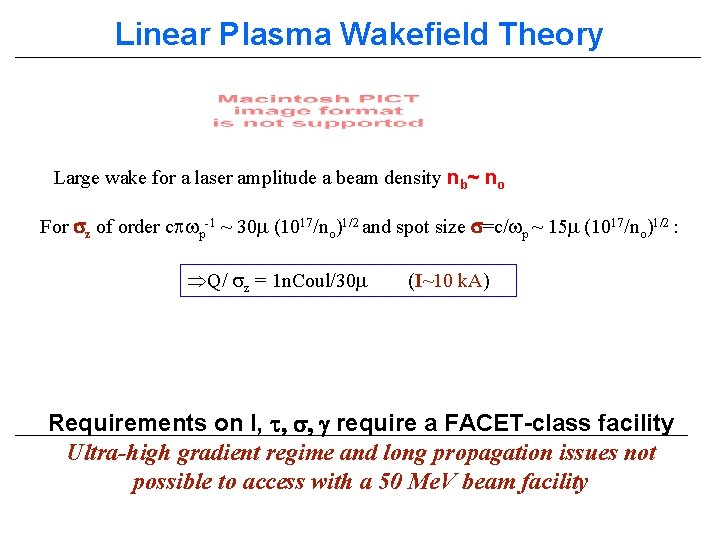
Linear Plasma Wakefield Theory Large wake for a laser amplitude a beam density nb~ no For sz of order cpwp-1 ~ 30 m (1017/no)1/2 and spot size s=c/wp ~ 15 m (1017/no)1/2 : ÞQ/ sz = 1 n. Coul/30 m (I~10 k. A) Requirements on I, t, s, g require a FACET-class facility Ultra-high gradient regime and long propagation issues not possible to access with a 50 Me. V beam facility
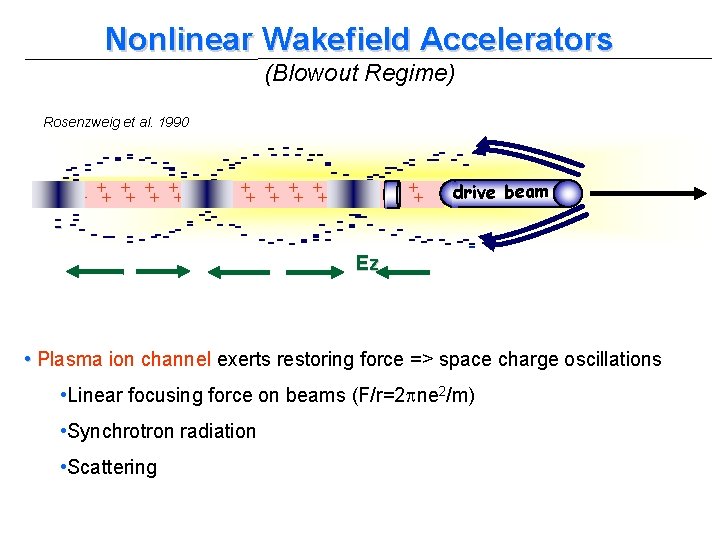
Nonlinear Wakefield Accelerators (Blowout Regime) Rosenzweig et al. 1990 -- -----++- ++ ++ ++ ---++-- -+-+------++ ++ ++ --+-+- +--+----+-+- ++ + +--+ ++++ -+++-+------++- ++++ ++ ++--++++ ++ drive ------- -- -- - ---- -- --- beam Ez • Plasma ion channel exerts restoring force => space charge oscillations • Linear focusing force on beams (F/r=2 pne 2/m) • Synchrotron radiation • Scattering
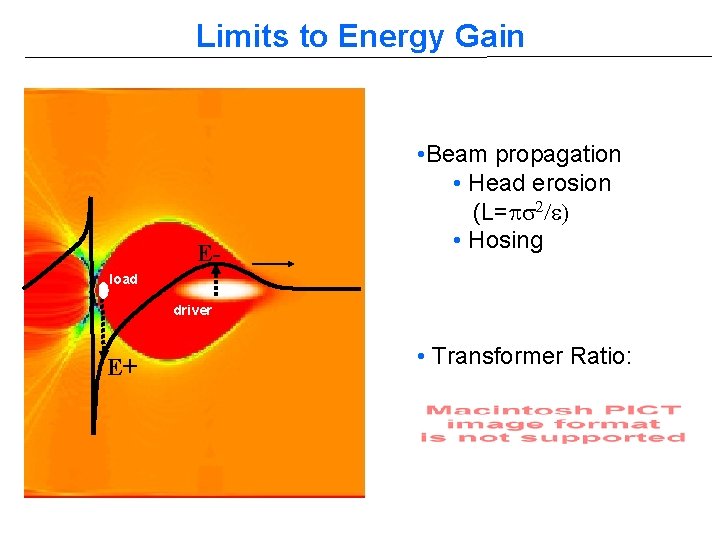
Limits to Energy Gain E- • Beam propagation • Head erosion (L=ps 2/e) • Hosing load driver E+ • Transformer Ratio:
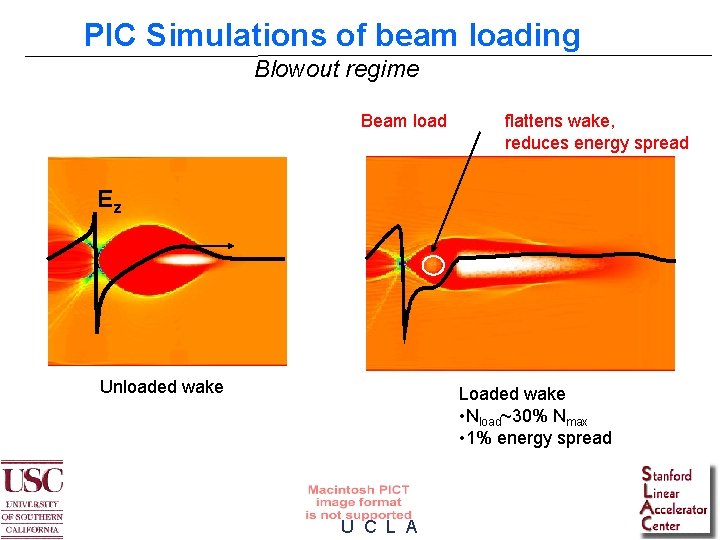
PIC Simulations of beam loading Blowout regime Beam load flattens wake, reduces energy spread Ez Unloaded wake Loaded wake • Nload~30% Nmax • 1% energy spread U C L A
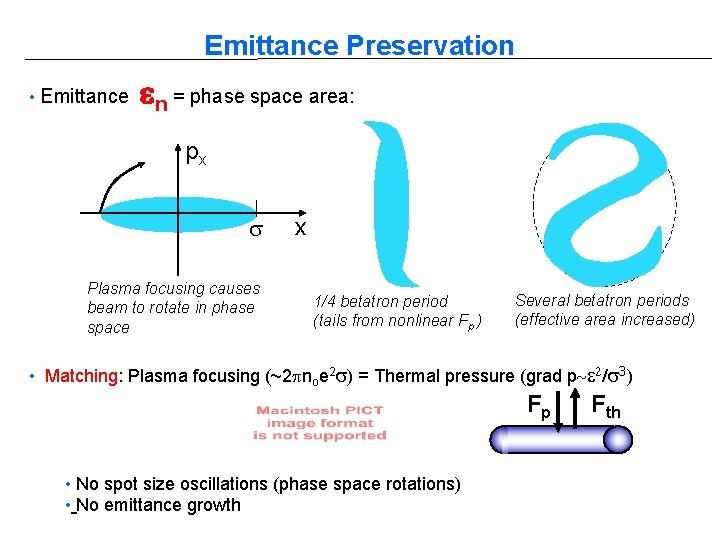
Emittance Preservation • Emittance en = phase space area: px s Plasma focusing causes beam to rotate in phase space x 1/4 betatron period (tails from nonlinear Fp ) Several betatron periods (effective area increased) • Matching: Plasma focusing (~2 pnoe 2 s) = Thermal pressure (grad p~e 2/s 3) Fp • No spot size oscillations (phase space rotations) • No emittance growth Fth
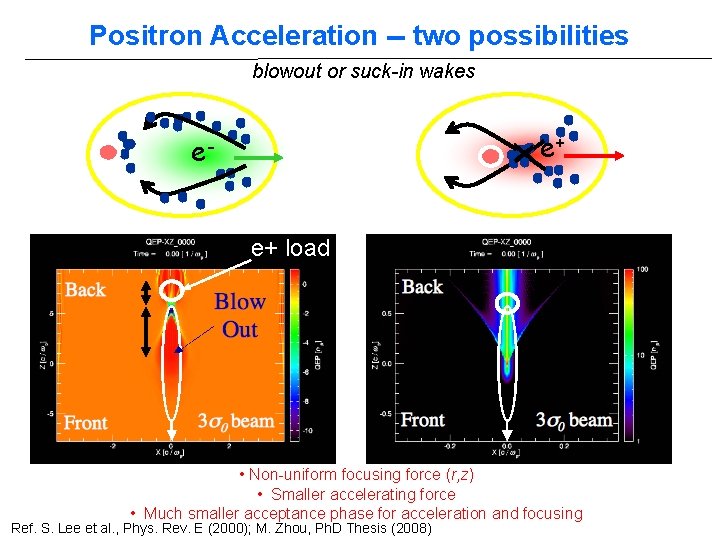
Positron Acceleration -- two possibilities blowout or suck-in wakes e+ ee+ load • Non-uniform focusing force (r, z) • Smaller accelerating force • Much smaller acceptance phase for acceleration and focusing Ref. S. Lee et al. , Phys. Rev. E (2000); M. Zhou, Ph. D Thesis (2008)
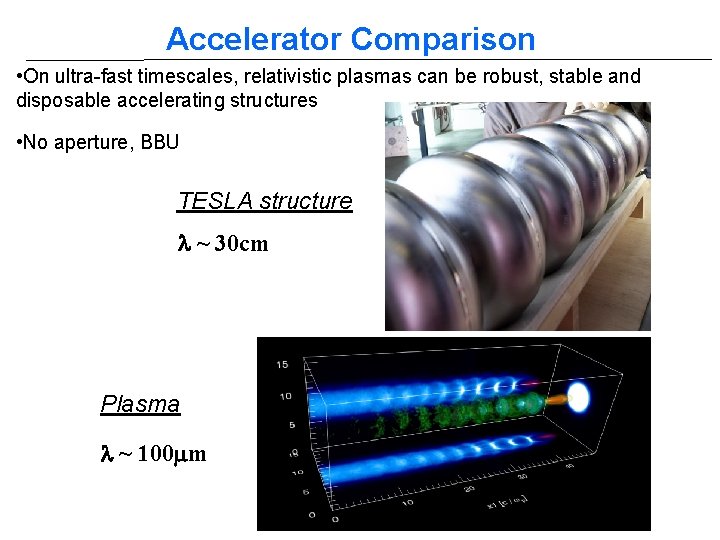
Accelerator Comparison • On ultra-fast timescales, relativistic plasmas can be robust, stable and disposable accelerating structures • No aperture, BBU TESLA structure l ~ 30 cm Plasma l ~ 100 mm 2 a
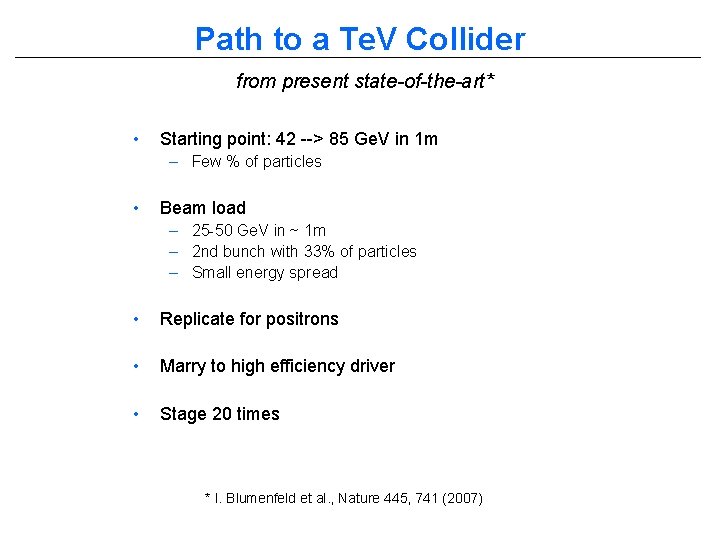
Path to a Te. V Collider from present state-of-the-art* • Starting point: 42 --> 85 Ge. V in 1 m – Few % of particles • Beam load – 25 -50 Ge. V in ~ 1 m – 2 nd bunch with 33% of particles – Small energy spread • Replicate for positrons • Marry to high efficiency driver • Stage 20 times * I. Blumenfeld et al. , Nature 445, 741 (2007)
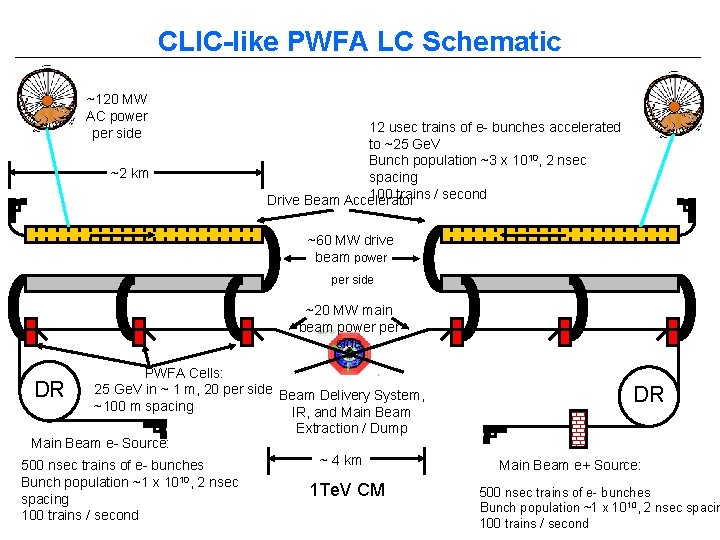
CLIC-like PWFA LC Schematic ~120 MW AC power per side 12 usec trains of e- bunches accelerated to ~25 Ge. V Bunch population ~3 x 10¹⁰, 2 nsec spacing 100 trains / second Drive Beam Accelerator ~2 km ~60 MW drive beam power per side ~20 MW main beam power per side PWFA Cells: DR 25 Ge. V in ~ 1 m, 20 per side Beam Delivery System, ~100 m spacing IR, and Main Beam Extraction / Dump Main Beam e- Source: ~ 4 km 500 nsec trains of e- bunches Bunch population ~1 x spacing 100 trains / second 1010, 2 nsec 1 Te. V CM DR Main Beam e+ Source: 500 nsec trains of e- bunches Bunch population ~1 x 10 10, 2 nsec spacin 100 trains / second
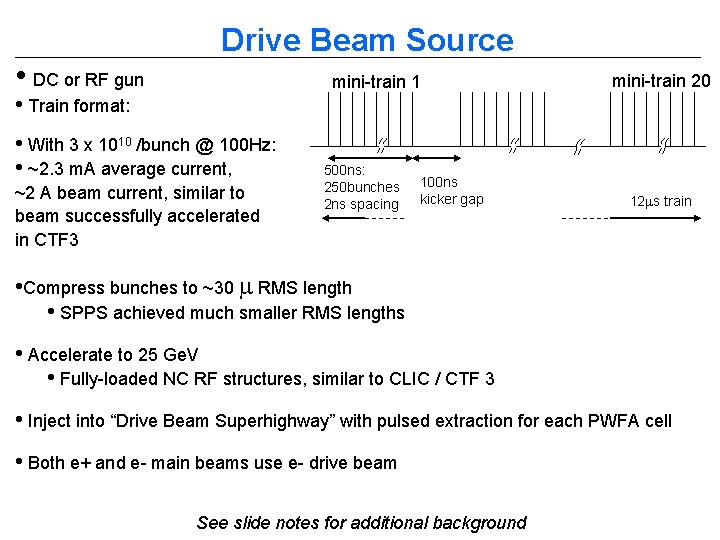
• DC or RF gun Drive Beam Source mini-train 1 • Train format: • With 3 x 10¹⁰ /bunch @ 100 Hz: • ~2. 3 m. A average current, ~2 A beam current, similar to beam successfully accelerated in CTF 3 500 ns: 250 bunches 2 ns spacing 100 ns kicker gap mini-train 20 12 ms train • Compress bunches to ~30 m RMS length • SPPS achieved much smaller RMS lengths • Accelerate to 25 Ge. V • Fully-loaded NC RF structures, similar to CLIC / CTF 3 • Inject into “Drive Beam Superhighway” with pulsed extraction for each PWFA cell • Both e+ and e- main beams use e- drive beam See slide notes for additional background
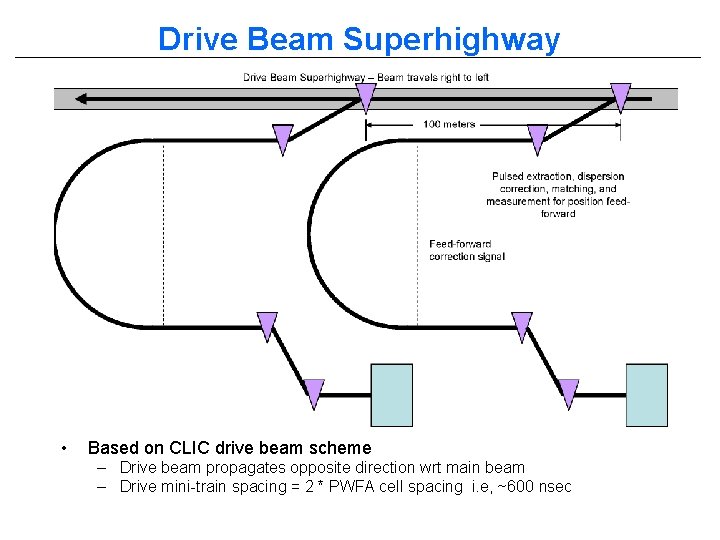
Drive Beam Superhighway • Based on CLIC drive beam scheme – Drive beam propagates opposite direction wrt main beam – Drive mini-train spacing = 2 * PWFA cell spacing i. e, ~600 nsec
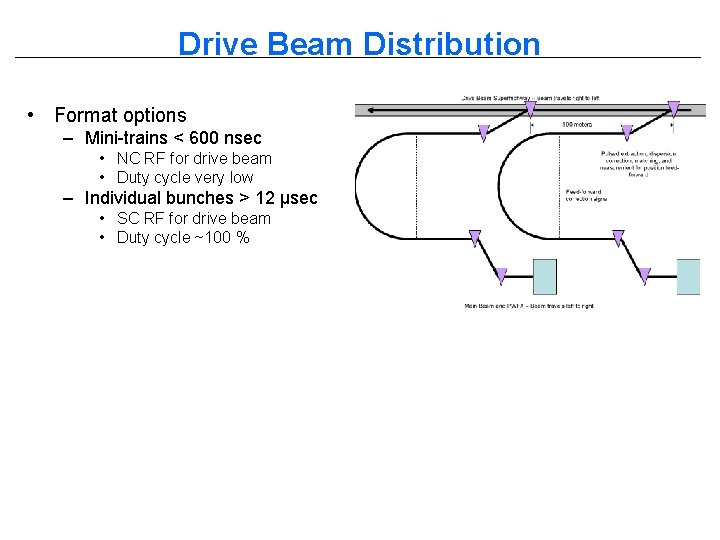
Drive Beam Distribution • Format options – Mini-trains < 600 nsec • NC RF for drive beam • Duty cycle very low – Individual bunches > 12 μsec • SC RF for drive beam • Duty cycle ~100 %
Main Beam Source and Plasma Sections • Electron side: • DC gun + DR • Compress to 10 m (achieved in SPPS) • 20, +25 Ge. V plasma sections, each 1 E 17 density, <1. 2 meters long • Gaussian beams assumed -shaped beam profiles => larger transformer ratio, higher efficiency • Final main beam energy spread <5% • Positron side: • conventional target + DR • Positron acceleration in electron beam driven wakes (regular plasma or hollow channel) • Will have tighter tolerances than electron side
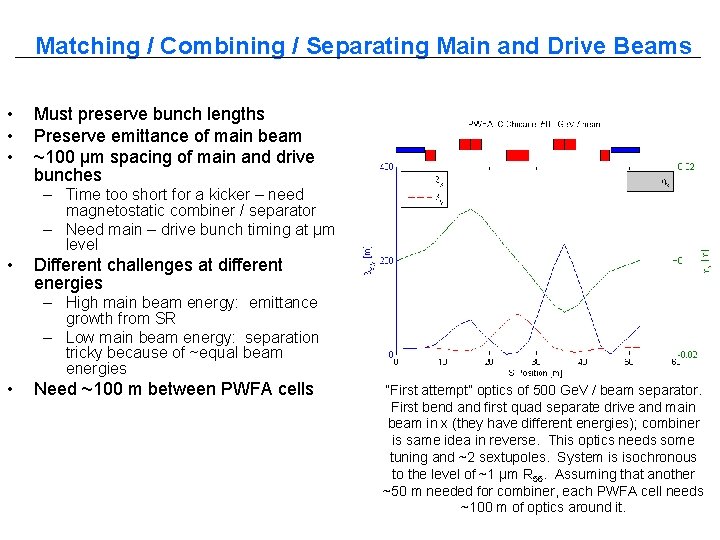
Matching / Combining / Separating Main and Drive Beams • • • Must preserve bunch lengths Preserve emittance of main beam ~100 μm spacing of main and drive bunches – Time too short for a kicker – need magnetostatic combiner / separator – Need main – drive bunch timing at μm level • Different challenges at different energies – High main beam energy: emittance growth from SR – Low main beam energy: separation tricky because of ~equal beam energies • Need ~100 m between PWFA cells “First attempt” optics of 500 Ge. V / beam separator. First bend and first quad separate drive and main beam in x (they have different energies); combiner is same idea in reverse. This optics needs some tuning and ~2 sextupoles. System is isochronous to the level of ~1 μm R 56. Assuming that another ~50 m needed for combiner, each PWFA cell needs ~100 m of optics around it.
![Te. V Beam Parameter Summary E CM at IP [Ge. V] N, drive bunch](http://slidetodoc.com/presentation_image_h2/3db05abb398c626c99769000d6e2bd64/image-22.jpg "Te. V Beam Parameter Summary E CM at IP [Ge. V] N, drive bunch")
Te. V Beam Parameter Summary E CM at IP [Ge. V] N, drive bunch N, high energy bunch n h. e. bunch/sec [Hz] Main beam train length [nsec] Main beam bunch spacing [nsec] Main beam bunches / train Repetition rate, Hz PWFA voltage per cell [GV] PWFA Efficiency [%] # of PWFA cells n drive bunch/sec [Hz] Drive bunch energy [Ge. V] Power in h. e. beam [W] Power in drive beam [W] Avg current in h. e. beam [u. A] Avg current in drive beam [m. A] Modulator-Drive Beam Efficiency [%] Site power overhead [MW] Total site power [MW] Wall Plug Efficiency 1000 2. 9 E+10 1. 0 E+10 25000 500 2 250 100 25 35 20 500000 25 2. 0 E+07 5. 7 E+07 40. 05 2. 29 54 71 283 14% IP Parameters* h. e. bunch gameps. X [m] h. e. bunch gameps. Y [m] beta-x [m] beta-y [m] sigx [m] sigy [m] sigz [m] Dy Uave delta_B P_Beamstrahlung [W] ngamma Hd Lum. [cm-2 s-1] Int. Lum. [fb-1 per 2 E 7 s] Coherent pairs/bc e+ e 2. 0 E-06 5. 0 E-08 5. 0 E-02 2. 0 E-04 3. 2 E-07 3. 2 E-09 1. 0 E-05 5. 6 E-01 2. 81 0. 14 2. 9 E+06 0. 79 1. 2 2. 4 E+34 474 2. 2 E+07 *If DR emittance is preserved
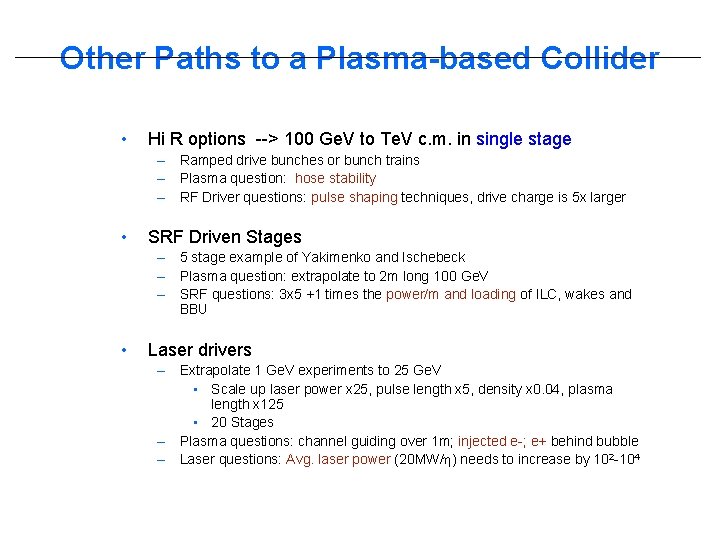
Other Paths to a Plasma-based Collider • Hi R options --> 100 Ge. V to Te. V c. m. in single stage – Ramped drive bunches or bunch trains – Plasma question: hose stability – RF Driver questions: pulse shaping techniques, drive charge is 5 x larger • SRF Driven Stages – 5 stage example of Yakimenko and Ischebeck – Plasma question: extrapolate to 2 m long 100 Ge. V – SRF questions: 3 x 5 +1 times the power/m and loading of ILC, wakes and BBU • Laser drivers – Extrapolate 1 Ge. V experiments to 25 Ge. V • Scale up laser power x 25, pulse length x 5, density x 0. 04, plasma length x 125 • 20 Stages – Plasma questions: channel guiding over 1 m; injected e-; e+ behind bubble – Laser questions: Avg. laser power (20 MW/h) needs to increase by 102 -104
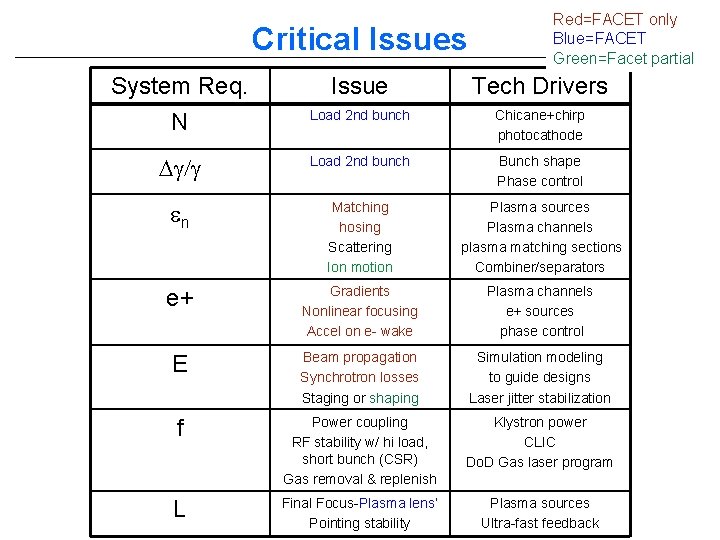
Critical Issues System Req. N Red=FACET only Blue=FACET Green=Facet partial Issue Tech Drivers Load 2 nd bunch Chicane+chirp photocathode Dg/g Load 2 nd bunch Bunch shape Phase control en Matching hosing Scattering Ion motion Plasma sources Plasma channels plasma matching sections Combiner/separators e+ Gradients Nonlinear focusing Accel on e- wake Plasma channels e+ sources phase control E Beam propagation Synchrotron losses Staging or shaping Simulation modeling to guide designs Laser jitter stabilization f Power coupling RF stability w/ hi load, short bunch (CSR) Gas removal & replenish Klystron power CLIC Do. D Gas laser program L Final Focus-Plasma lens’ Pointing stability Plasma sources Ultra-fast feedback
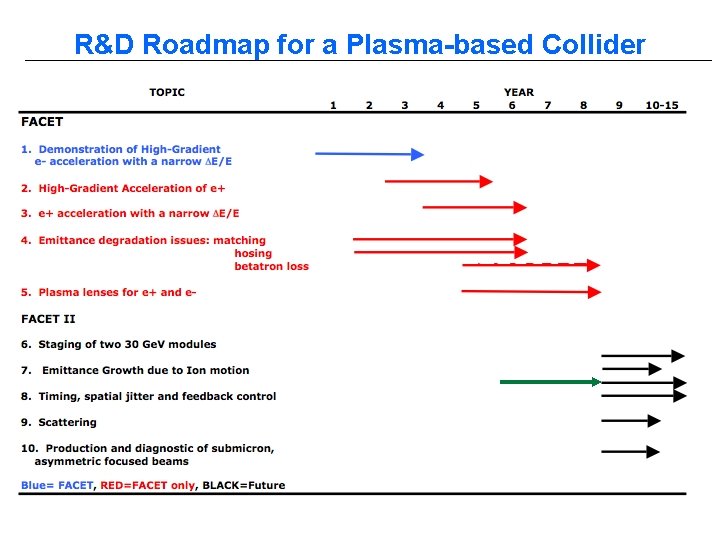
R&D Roadmap for a Plasma-based Collider
Summary • Recent success is very promising • No known show stoppers to extending plasma accelerators to the energy frontier • Many questions remain to be addressed for realizing a collider • FACET-class facility is needed to address them – Lower energy beam facilities cannot access critical issues in the regime of interest – FACET can address most issues of one stage of a 5 -20 stage e-e+ Te. V collider

Backup and Extra
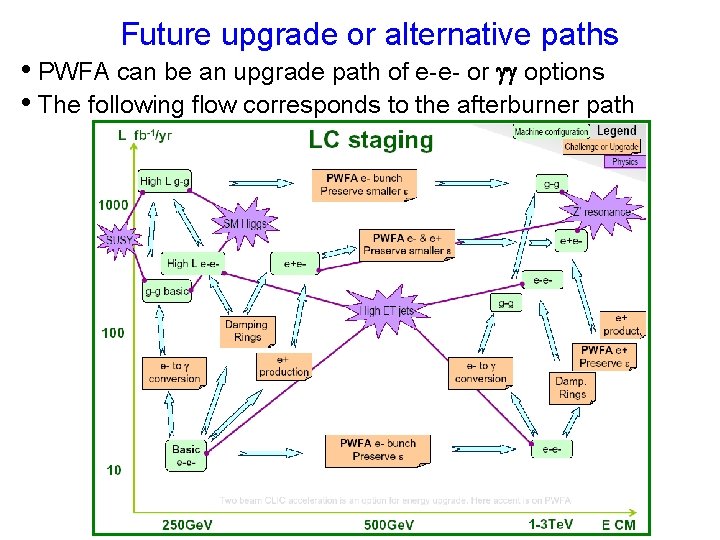
Future upgrade or alternative paths • PWFA can be an upgrade path of e-e- or gg options • The following flow corresponds to the afterburner path
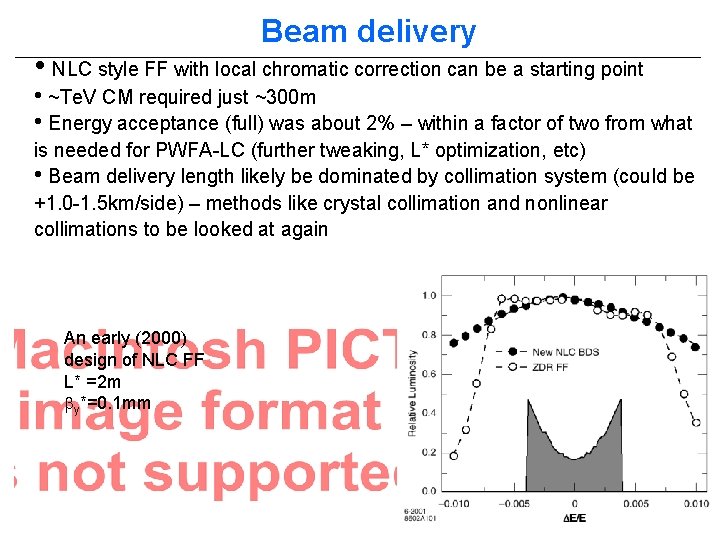
Beam delivery • NLC style FF with local chromatic correction can be a starting point • ~Te. V CM required just ~300 m • Energy acceptance (full) was about 2% – within a factor of two from what is needed for PWFA-LC (further tweaking, L* optimization, etc) • Beam delivery length likely be dominated by collimation system (could be +1. 0 -1. 5 km/side) – methods like crystal collimation and nonlinear collimations to be looked at again An early (2000) design of NLC FF L* =2 m by*=0. 1 mm
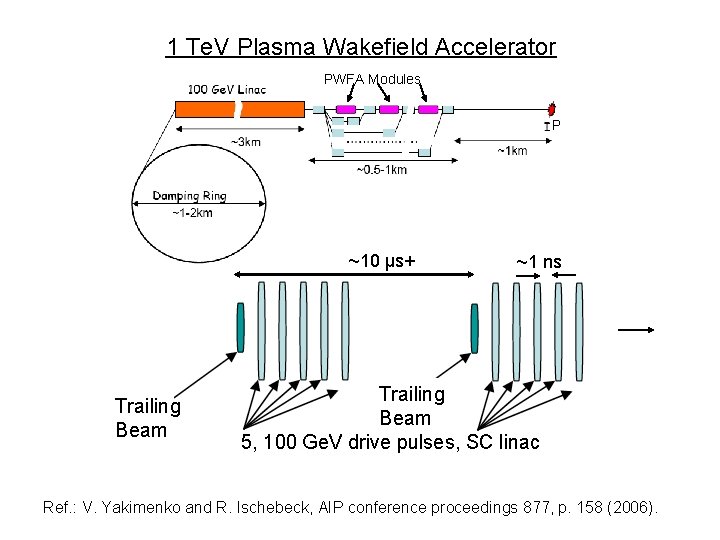
1 Te. V Plasma Wakefield Accelerator PWFA Modules P ~10 µs+ Trailing Beam ~1 ns Trailing Beam 5, 100 Ge. V drive pulses, SC linac Ref. : V. Yakimenko and R. Ischebeck, AIP conference proceedings 877, p. 158 (2006).
- Slides: 30