
A plane monochromatic wave Section 83 Monochromatic plane
- Slides: 16
A plane monochromatic wave Section 83
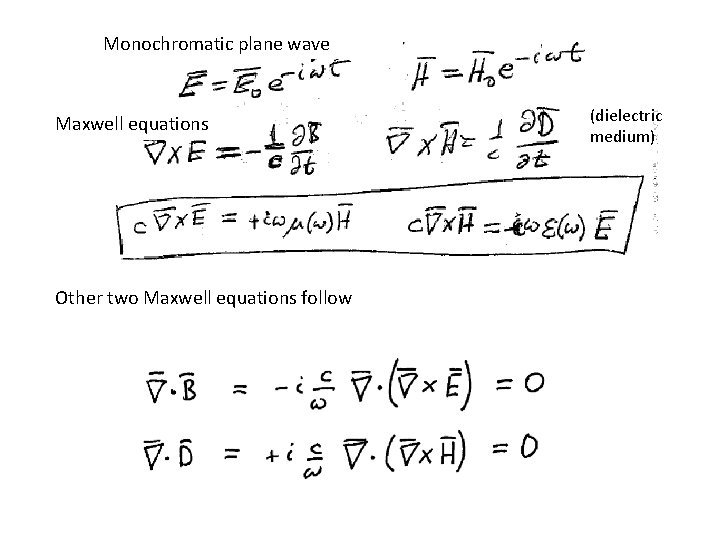
Monochromatic plane wave Maxwell equations Other two Maxwell equations follow (dielectric medium)
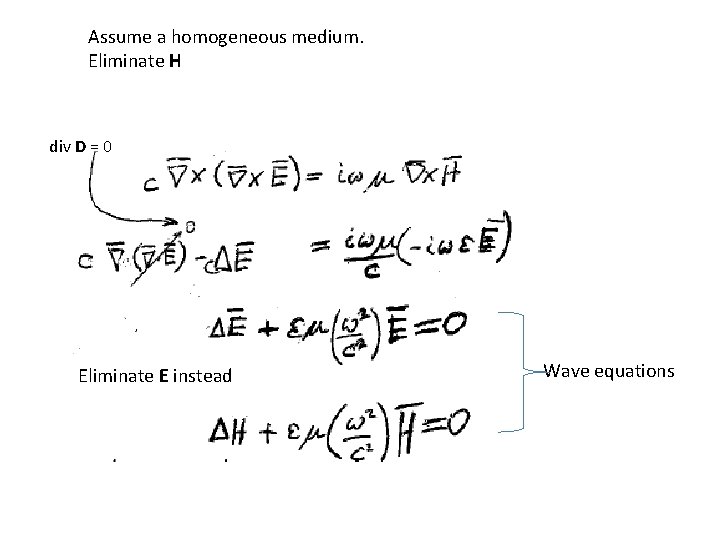
Assume a homogeneous medium. Eliminate H div D = 0 Eliminate E instead Wave equations
Compare waves in vacuum and in medium Plane wave in vacuum has spatial dependence eik. r, with real wave vector k A wave in an infinite homogeneous dielectric has a complex wave vector k = k’ + i k” Real numbers
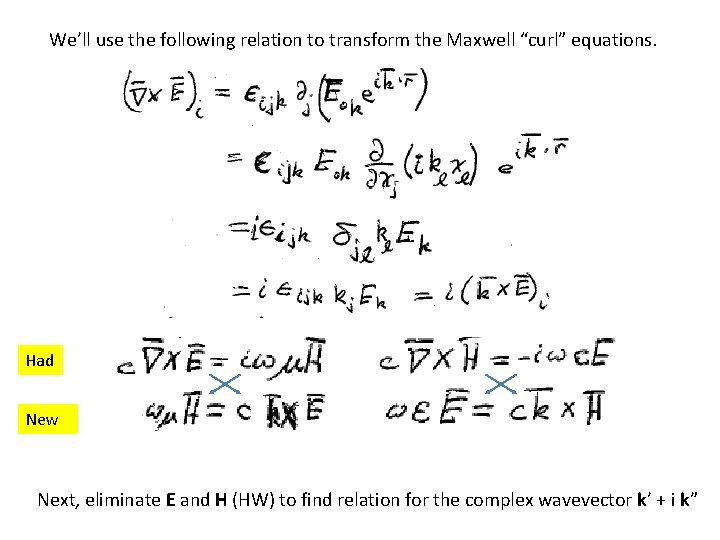
We’ll use the following relation to transform the Maxwell “curl” equations. Had New Next, eliminate E and H (HW) to find relation for the complex wavevector k’ + i k”
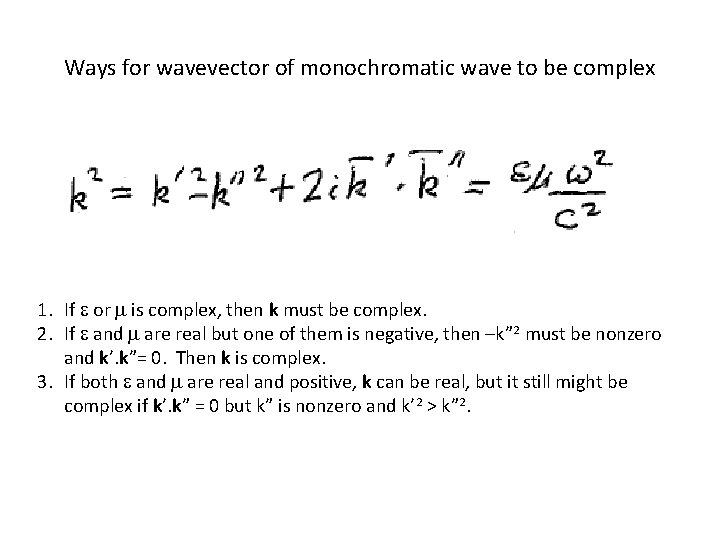
Ways for wavevector of monochromatic wave to be complex 1. If e or m is complex, then k must be complex. 2. If e and m are real but one of them is negative, then –k” 2 must be nonzero and k’. k”= 0. Then k is complex. 3. If both e and m are real and positive, k can be real, but it still might be complex if k’. k” = 0 but k” is nonzero and k’ 2 > k” 2.
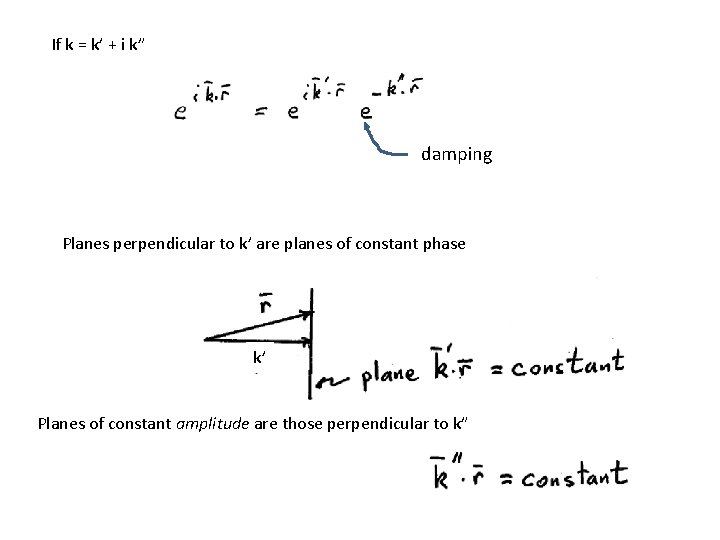
If k = k’ + i k” damping Planes perpendicular to k’ are planes of constant phase k’ Planes of constant amplitude are those perpendicular to k”
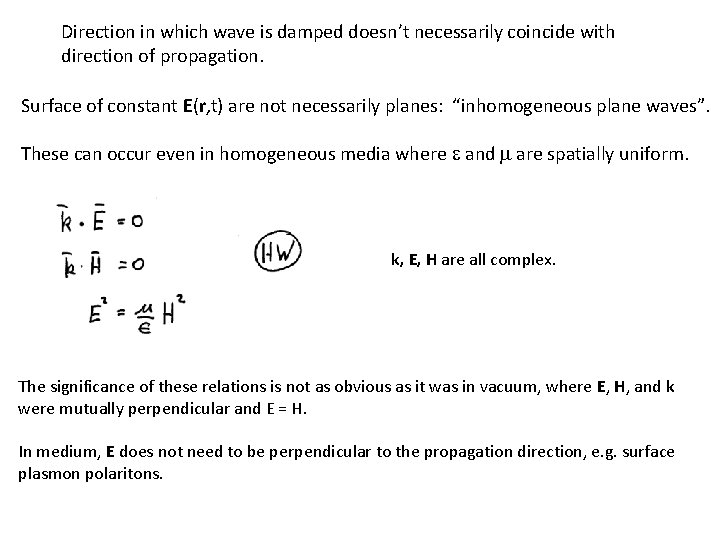
Direction in which wave is damped doesn’t necessarily coincide with direction of propagation. Surface of constant E(r, t) are not necessarily planes: “inhomogeneous plane waves”. These can occur even in homogeneous media where e and m are spatially uniform. k, E, H are all complex. The significance of these relations is not as obvious as it was in vacuum, where E, H, and k were mutually perpendicular and E = H. In medium, E does not need to be perpendicular to the propagation direction, e. g. surface plasmon polaritons.
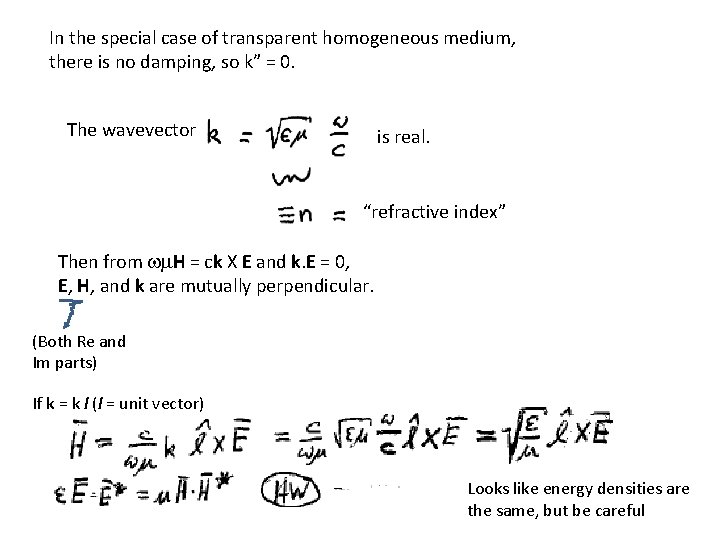
In the special case of transparent homogeneous medium, there is no damping, so k” = 0. The wavevector is real. “refractive index” Then from wm. H = ck X E and k. E = 0, E, H, and k are mutually perpendicular. (Both Re and Im parts) If k = k l (l = unit vector) Looks like energy densities are the same, but be careful
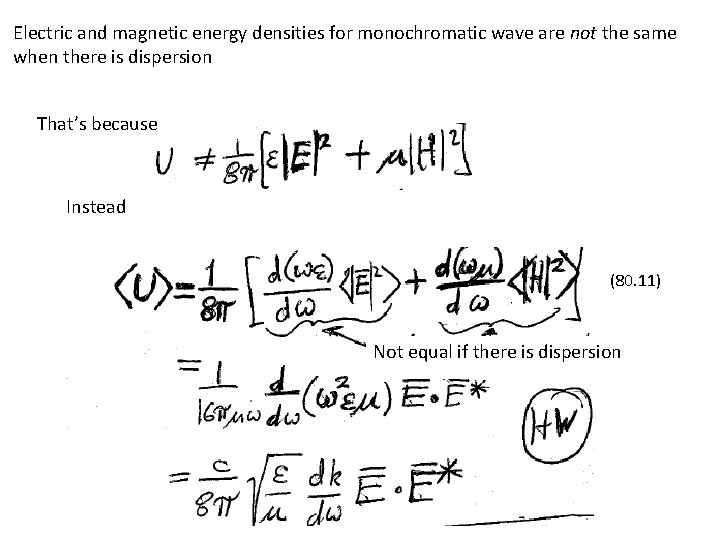
Electric and magnetic energy densities for monochromatic wave are not the same when there is dispersion That’s because Instead (80. 11) Not equal if there is dispersion
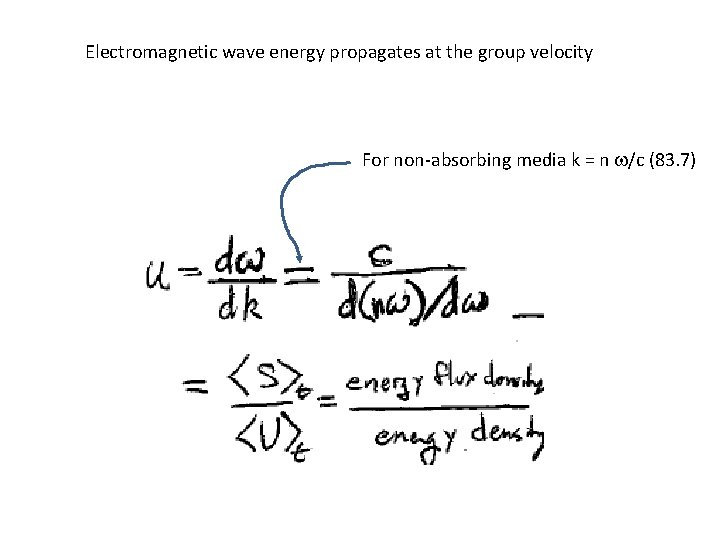
Electromagnetic wave energy propagates at the group velocity For non-absorbing media k = n w/c (83. 7)
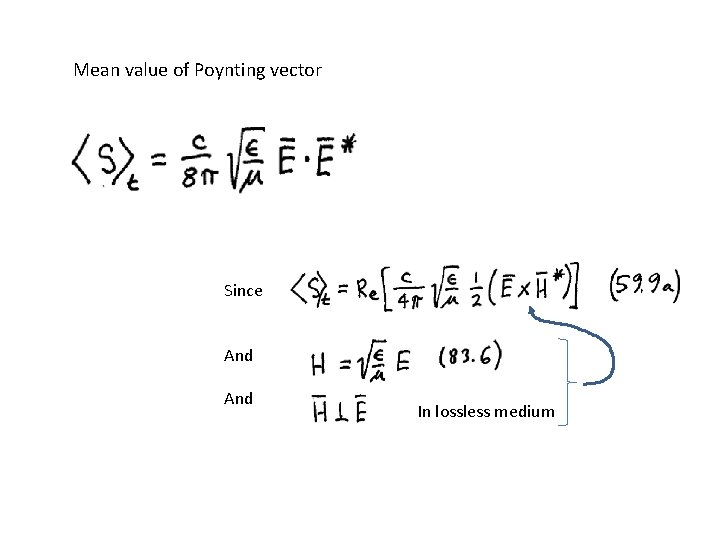
Mean value of Poynting vector Since And In lossless medium
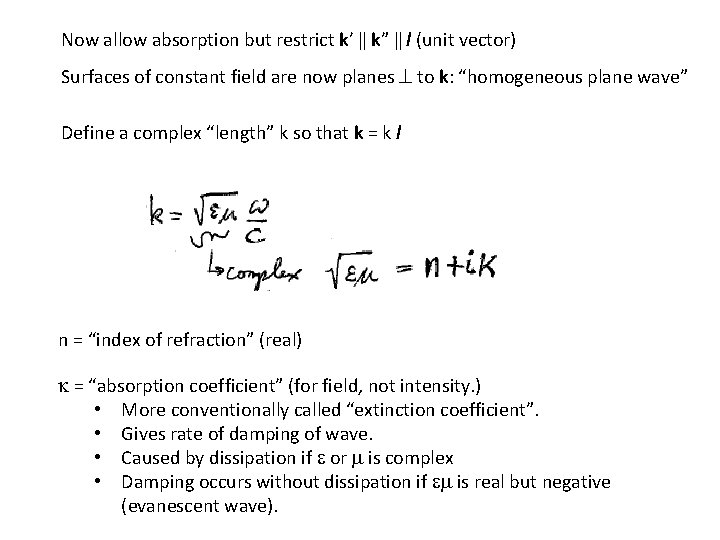
Now allow absorption but restrict k’ || k” || l (unit vector) Surfaces of constant field are now planes ^ to k: “homogeneous plane wave” Define a complex “length” k so that k = k l n = “index of refraction” (real) k = “absorption coefficient” (for field, not intensity. ) • More conventionally called “extinction coefficient”. • Gives rate of damping of wave. • Caused by dissipation if e or m is complex • Damping occurs without dissipation if em is real but negative (evanescent wave).
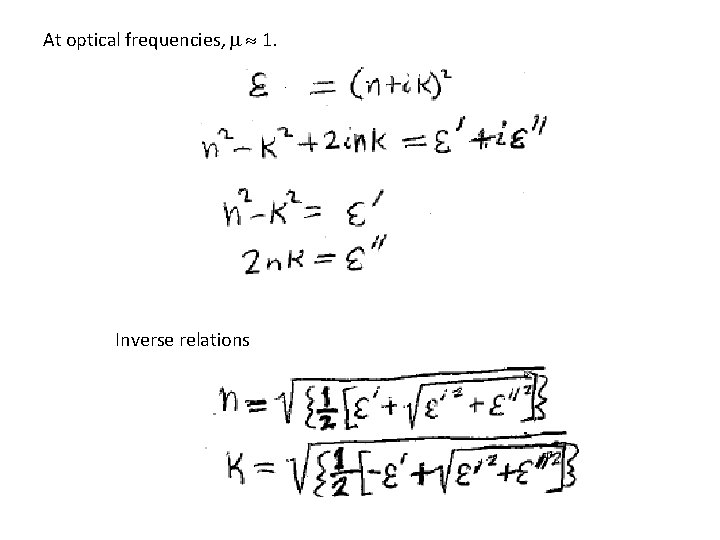
At optical frequencies, m » 1. Inverse relations
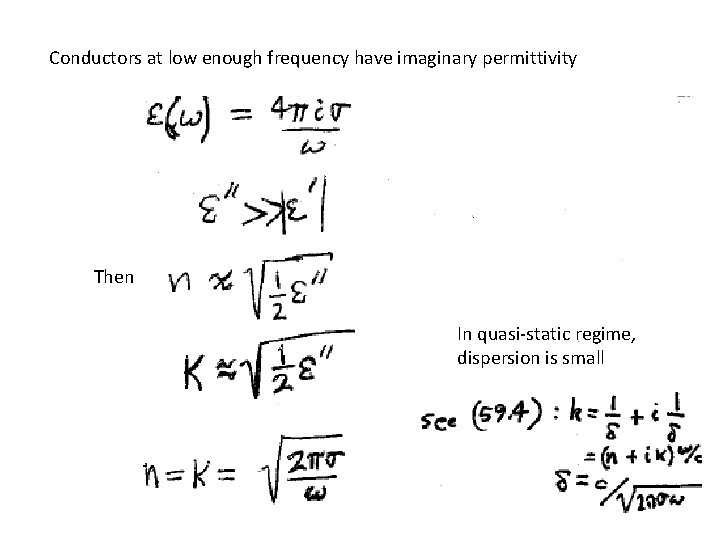
Conductors at low enough frequency have imaginary permittivity Then In quasi-static regime, dispersion is small
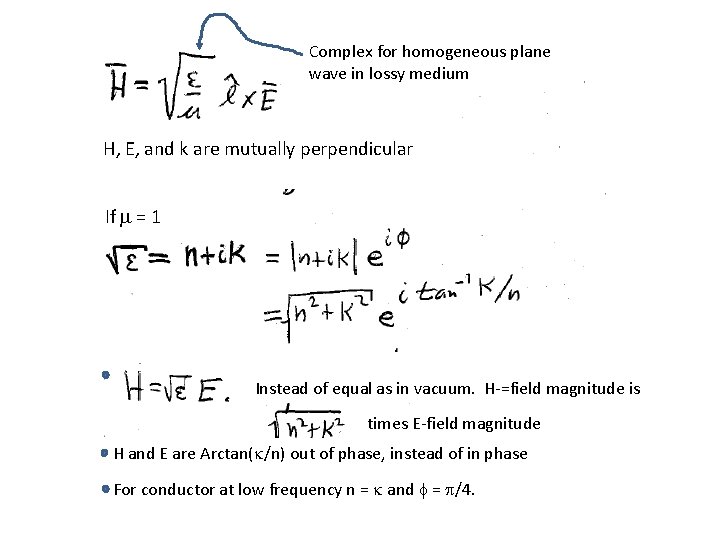
Complex for homogeneous plane wave in lossy medium H, E, and k are mutually perpendicular If m = 1 Instead of equal as in vacuum. H-=field magnitude is times E-field magnitude H and E are Arctan(k/n) out of phase, instead of in phase For conductor at low frequency n = k and f = p/4.