
A Photoplethysmography Based Heartrate Monitoring System Vinila Baljepally
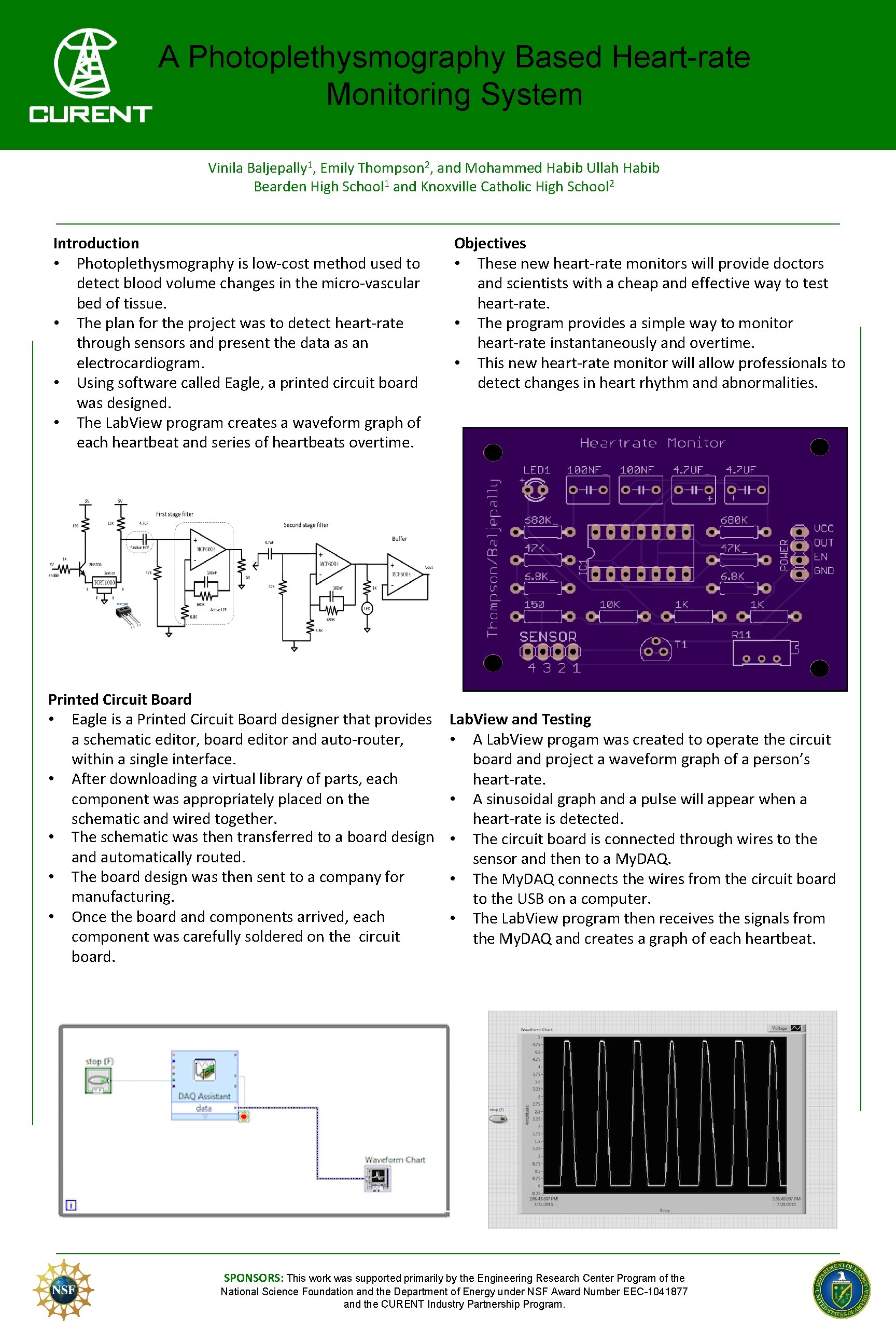
A Photoplethysmography Based Heart-rate Monitoring System Vinila Baljepally 1, Emily Thompson 2, and Mohammed Habib Ullah Habib Bearden High School 1 and Knoxville Catholic High School 2 Introduction • Photoplethysmography is low-cost method used to detect blood volume changes in the micro-vascular bed of tissue. • The plan for the project was to detect heart-rate through sensors and present the data as an electrocardiogram. • Using software called Eagle, a printed circuit board was designed. • The Lab. View program creates a waveform graph of each heartbeat and series of heartbeats overtime. Printed Circuit Board • Eagle is a Printed Circuit Board designer that provides a schematic editor, board editor and auto-router, within a single interface. • After downloading a virtual library of parts, each component was appropriately placed on the schematic and wired together. • The schematic was then transferred to a board design and automatically routed. • The board design was then sent to a company for manufacturing. • Once the board and components arrived, each component was carefully soldered on the circuit board. Objectives • These new heart-rate monitors will provide doctors and scientists with a cheap and effective way to test heart-rate. • The program provides a simple way to monitor heart-rate instantaneously and overtime. • This new heart-rate monitor will allow professionals to detect changes in heart rhythm and abnormalities. Lab. View and Testing • A Lab. View progam was created to operate the circuit board and project a waveform graph of a person’s heart-rate. • A sinusoidal graph and a pulse will appear when a heart-rate is detected. • The circuit board is connected through wires to the sensor and then to a My. DAQ. • The My. DAQ connects the wires from the circuit board to the USB on a computer. • The Lab. View program then receives the signals from the My. DAQ and creates a graph of each heartbeat. SPONSORS: This work was supported primarily by the Engineering Research Center Program of the National Science Foundation and the Department of Energy under NSF Award Number EEC-1041877 and the CURENT Industry Partnership Program.
- Slides: 1