
A Perspective on Network Interference and Multiple Access
- Slides: 22
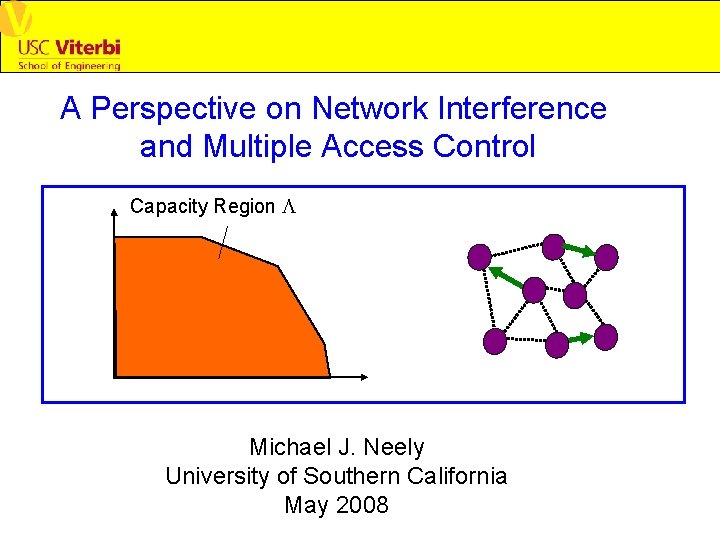
A Perspective on Network Interference and Multiple Access Control Capacity Region L Michael J. Neely University of Southern California May 2008
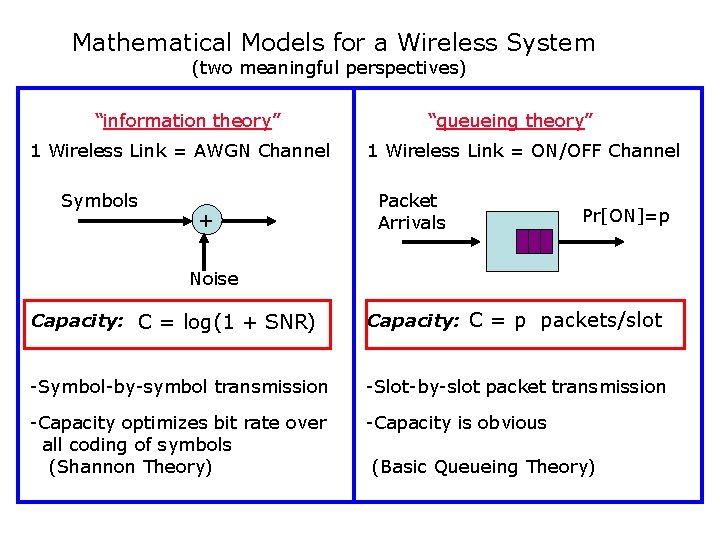
Mathematical Models for a Wireless System (two meaningful perspectives) “information theory” 1 Wireless Link = AWGN Channel Symbols + “queueing theory” 1 Wireless Link = ON/OFF Channel Packet Arrivals Pr[ON]=p Noise Capacity: C = log(1 + SNR) Capacity: C = p packets/slot -Symbol-by-symbol transmission -Slot-by-slot packet transmission -Capacity optimizes bit rate over all coding of symbols (Shannon Theory) -Capacity is obvious (Basic Queueing Theory)
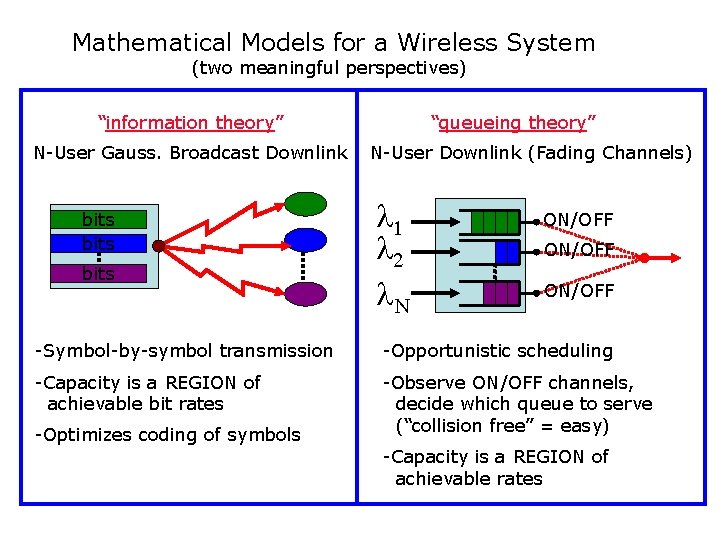
Mathematical Models for a Wireless System (two meaningful perspectives) “information theory” N-User Gauss. Broadcast Downlink bits “queueing theory” N-User Downlink (Fading Channels) l 1 l 2 l. N ON/OFF -Symbol-by-symbol transmission -Opportunistic scheduling -Capacity is a REGION of achievable bit rates -Observe ON/OFF channels, decide which queue to serve (“collision free” = easy) -Optimizes coding of symbols -Capacity is a REGION of achievable rates
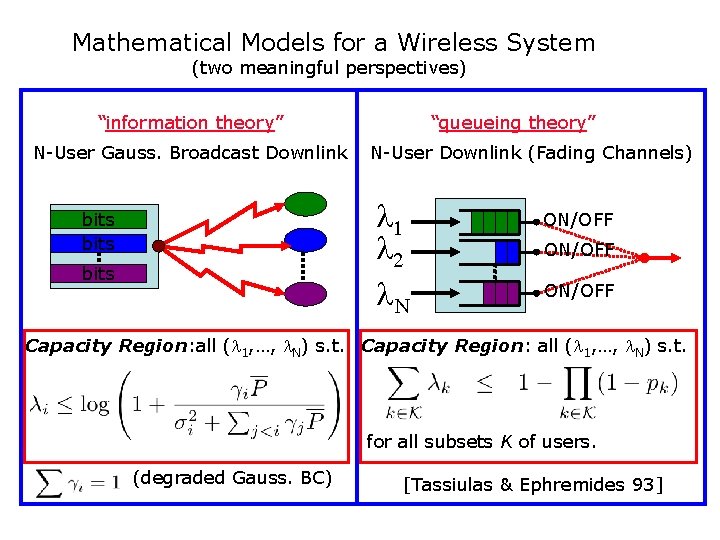
Mathematical Models for a Wireless System (two meaningful perspectives) “information theory” N-User Gauss. Broadcast Downlink “queueing theory” N-User Downlink (Fading Channels) l 1 l 2 l. N bits ON/OFF Capacity Region: all (l 1, …, l. N) s. t. for all subsets K of users. (degraded Gauss. BC) [Tassiulas & Ephremides 93]
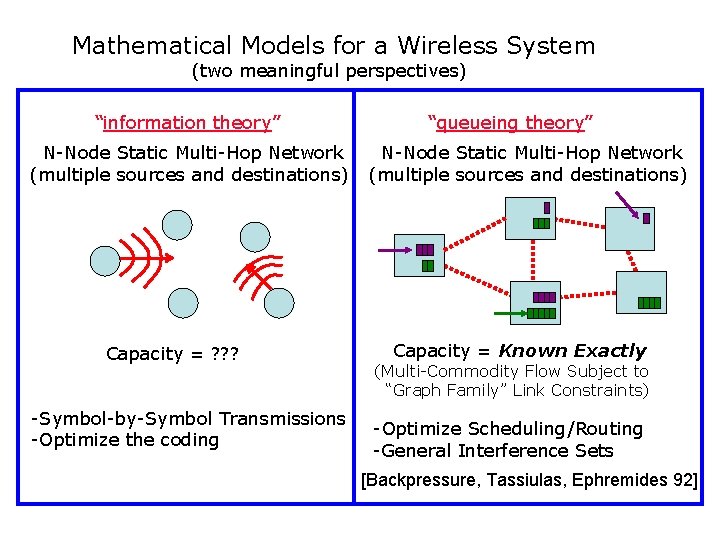
Mathematical Models for a Wireless System (two meaningful perspectives) “information theory” N-Node Static Multi-Hop Network (multiple sources and destinations) Capacity = ? ? ? -Symbol-by-Symbol Transmissions -Optimize the coding “queueing theory” N-Node Static Multi-Hop Network (multiple sources and destinations) Capacity = Known Exactly (Multi-Commodity Flow Subject to “Graph Family” Link Constraints) -Optimize Scheduling/Routing -General Interference Sets [Backpressure, Tassiulas, Ephremides 92]
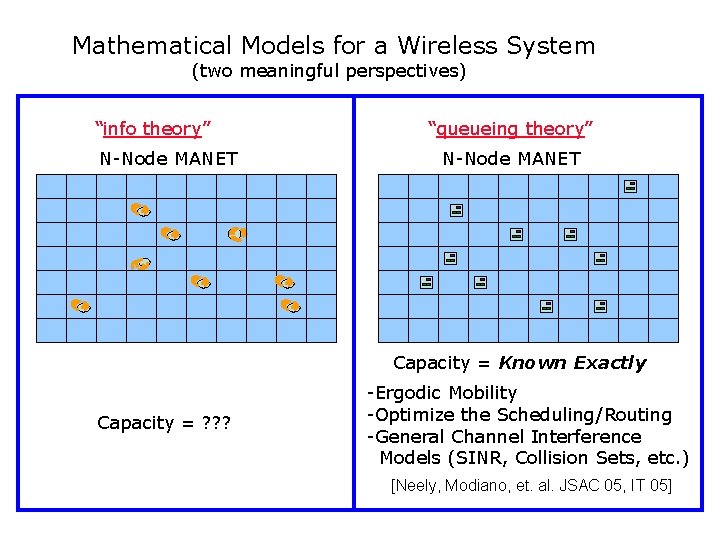
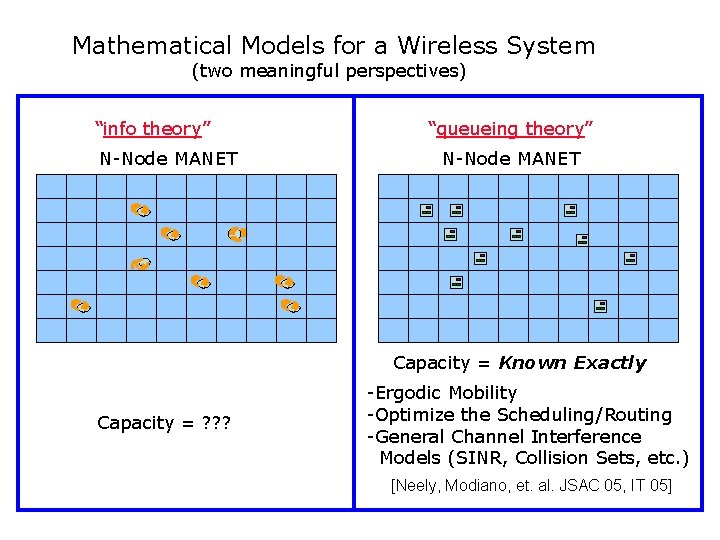
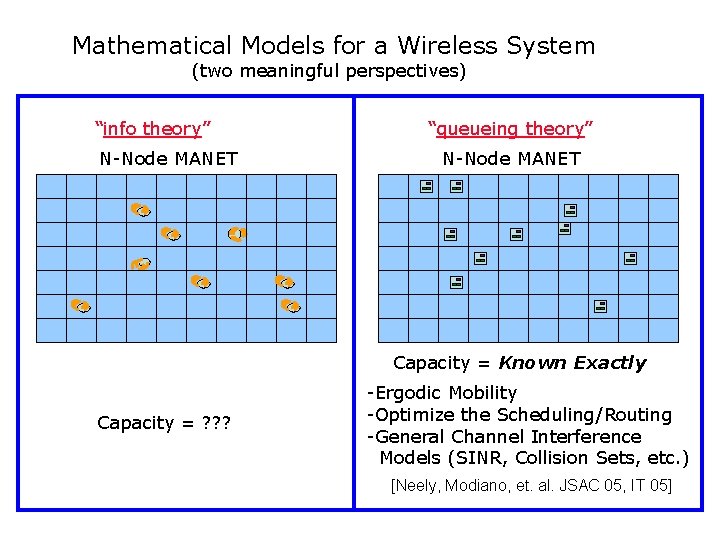
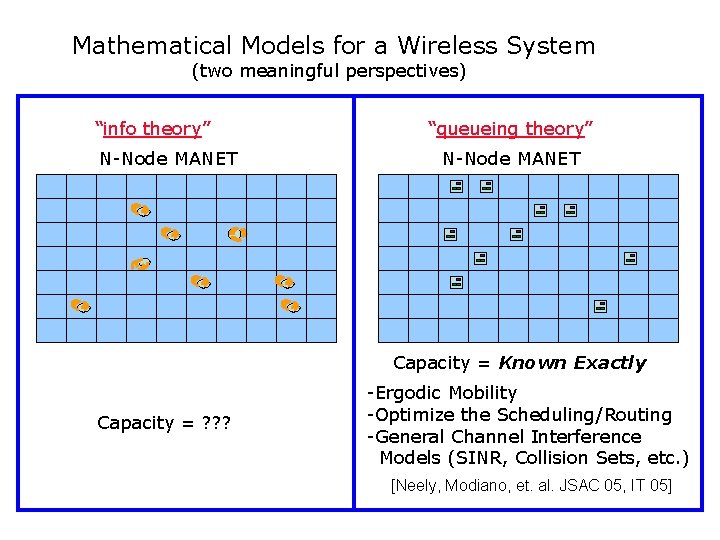
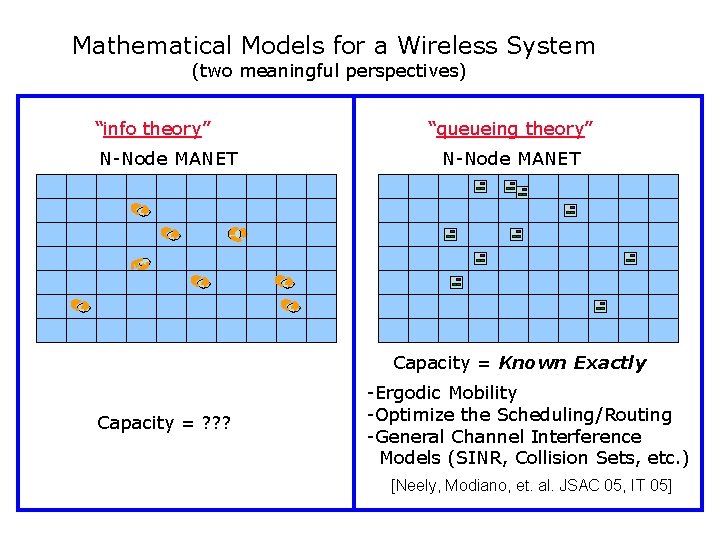
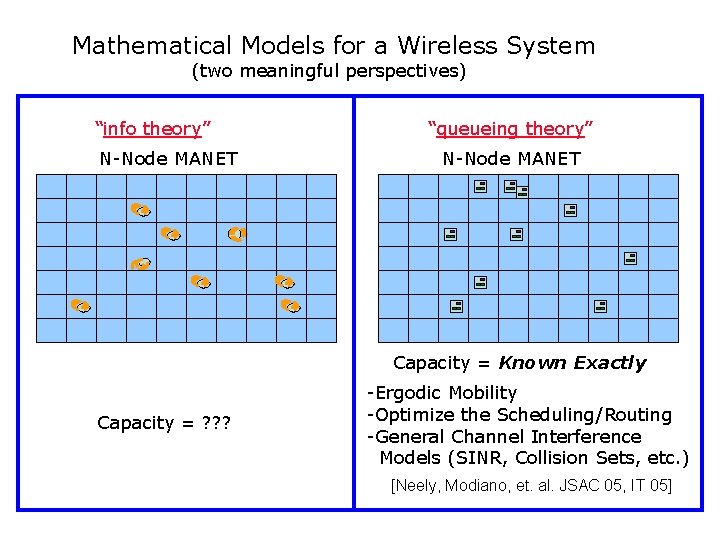
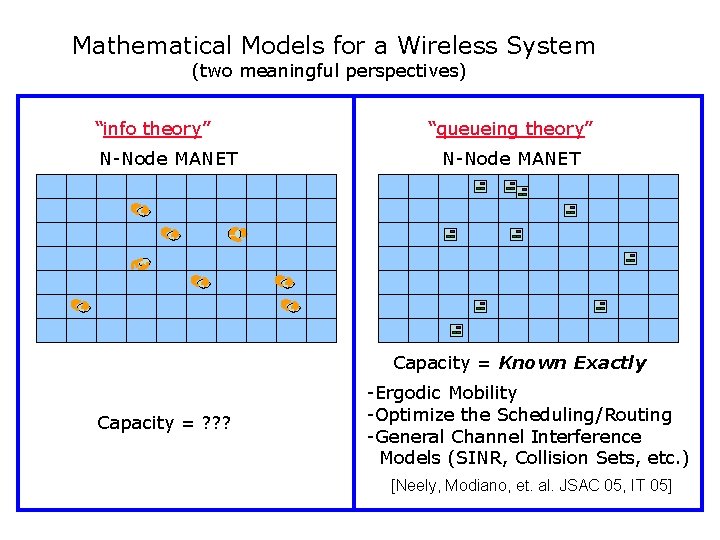
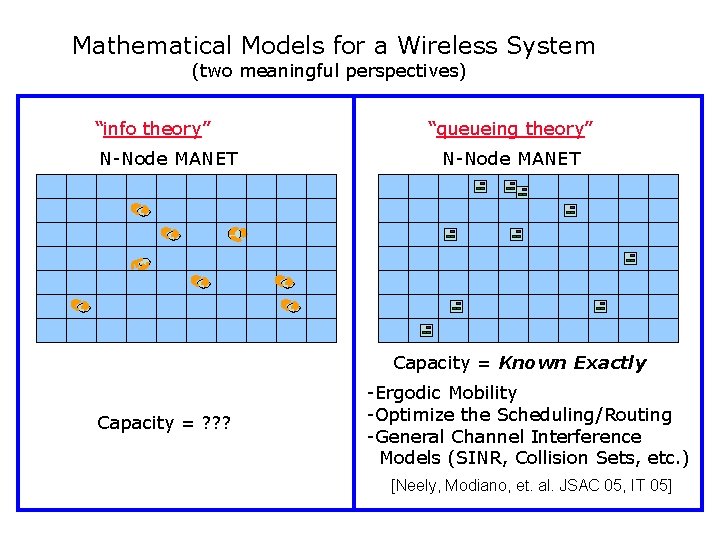
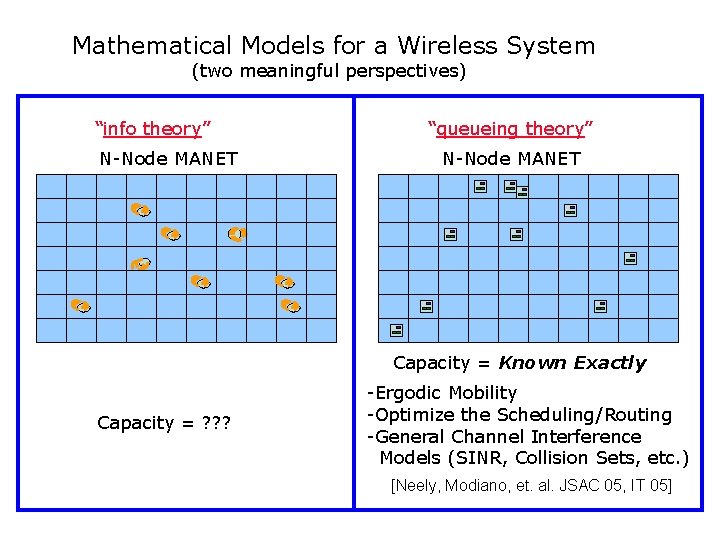
Mathematical Models for a Wireless System (two meaningful perspectives) “info theory” N-Node MANET “queueing theory” N-Node MANET Capacity = Known Exactly Capacity = ? ? ? -Ergodic Mobility -Optimize the Scheduling/Routing -General Channel Interference Models (SINR, Collision Sets, etc. ) [Neely, Modiano, et. al. JSAC 05, IT 05]
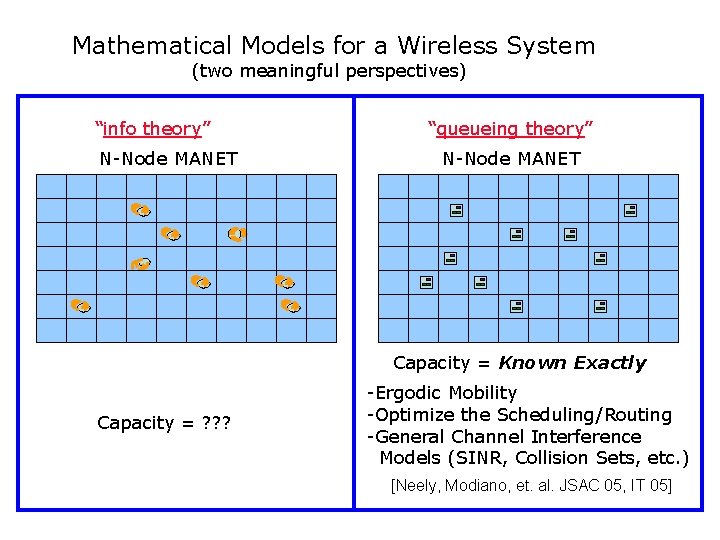
Mathematical Models for a Wireless System (two meaningful perspectives) “info theory” N-Node MANET “queueing theory” N-Node MANET Capacity = Known Exactly Capacity = ? ? ? -Ergodic Mobility -Optimize the Scheduling/Routing -General Channel Interference Models (SINR, Collision Sets, etc. ) [Neely, Modiano, et. al. JSAC 05, IT 05]
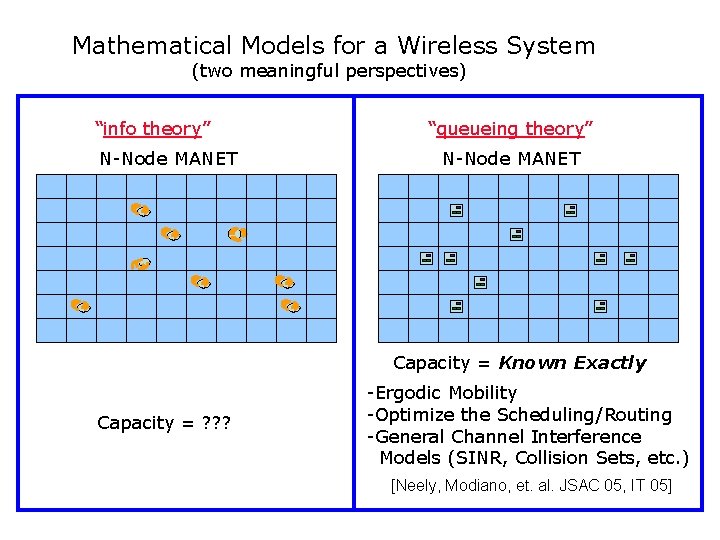
Mathematical Models for a Wireless System (two meaningful perspectives) “info theory” N-Node MANET “queueing theory” N-Node MANET Capacity = Known Exactly Capacity = ? ? ? -Ergodic Mobility -Optimize the Scheduling/Routing -General Channel Interference Models (SINR, Collision Sets, etc. ) [Neely, Modiano, et. al. JSAC 05, IT 05]
Mathematical Models for a Wireless System (two meaningful perspectives) “info theory” N-Node MANET “queueing theory” N-Node MANET Capacity = Known Exactly Capacity = ? ? ? -Ergodic Mobility -Optimize the Scheduling/Routing -General Channel Interference Models (SINR, Collision Sets, etc. ) [Neely, Modiano, et. al. JSAC 05, IT 05]
Mathematical Models for a Wireless System (two meaningful perspectives) “info theory” N-Node MANET “queueing theory” N-Node MANET Capacity = Known Exactly Capacity = ? ? ? -Ergodic Mobility -Optimize the Scheduling/Routing -General Channel Interference Models (SINR, Collision Sets, etc. ) [Neely, Modiano, et. al. JSAC 05, IT 05]
Mathematical Models for a Wireless System (two meaningful perspectives) “info theory” N-Node MANET “queueing theory” N-Node MANET Capacity = Known Exactly Capacity = ? ? ? -Ergodic Mobility -Optimize the Scheduling/Routing -General Channel Interference Models (SINR, Collision Sets, etc. ) [Neely, Modiano, et. al. JSAC 05, IT 05]
Mathematical Models for a Wireless System (two meaningful perspectives) “info theory” N-Node MANET “queueing theory” N-Node MANET Capacity = Known Exactly Capacity = ? ? ? -Ergodic Mobility -Optimize the Scheduling/Routing -General Channel Interference Models (SINR, Collision Sets, etc. ) [Neely, Modiano, et. al. JSAC 05, IT 05]
Mathematical Models for a Wireless System (two meaningful perspectives) “info theory” N-Node MANET “queueing theory” N-Node MANET Capacity = Known Exactly Capacity = ? ? ? -Ergodic Mobility -Optimize the Scheduling/Routing -General Channel Interference Models (SINR, Collision Sets, etc. ) [Neely, Modiano, et. al. JSAC 05, IT 05]
Mathematical Models for a Wireless System (two meaningful perspectives) “info theory” N-Node MANET “queueing theory” N-Node MANET Capacity = Known Exactly Capacity = ? ? ? -Ergodic Mobility -Optimize the Scheduling/Routing -General Channel Interference Models (SINR, Collision Sets, etc. ) [Neely, Modiano, et. al. JSAC 05, IT 05]
Mathematical Models for a Wireless System (two meaningful perspectives) “info theory” N-Node MANET “queueing theory” N-Node MANET Capacity = Known Exactly Capacity = ? ? ? -Ergodic Mobility -Optimize the Scheduling/Routing -General Channel Interference Models (SINR, Collision Sets, etc. ) [Neely, Modiano, et. al. JSAC 05, IT 05]
Mathematical Models for a Wireless System (two meaningful perspectives) “info theory” N-Node MANET “queueing theory” N-Node MANET Capacity = Known Exactly Capacity = ? ? ? -Ergodic Mobility -Optimize the Scheduling/Routing -General Channel Interference Models (SINR, Collision Sets, etc. ) [Neely, Modiano, et. al. JSAC 05, IT 05]
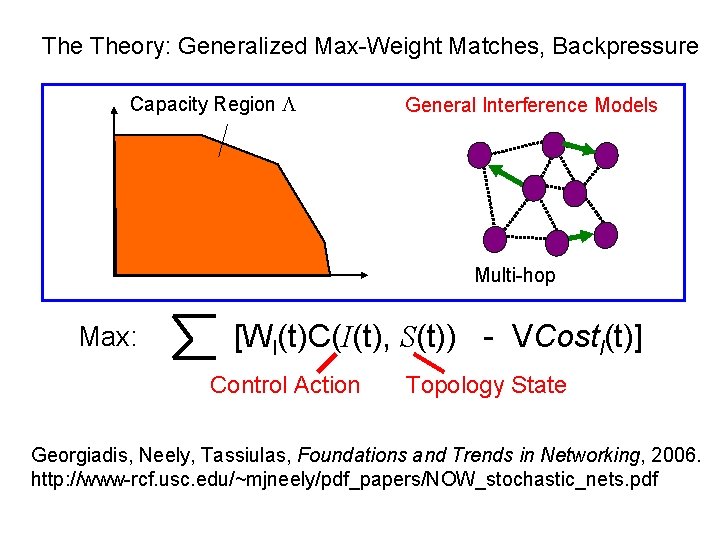
The Theory: Generalized Max-Weight Matches, Backpressure Capacity Region L General Interference Models Multi-hop Max: [Wl(t)C(I(t), S(t)) - VCostl(t)] Control Action Topology State Georgiadis, Neely, Tassiulas, Foundations and Trends in Networking, 2006. http: //www-rcf. usc. edu/~mjneely/pdf_papers/NOW_stochastic_nets. pdf
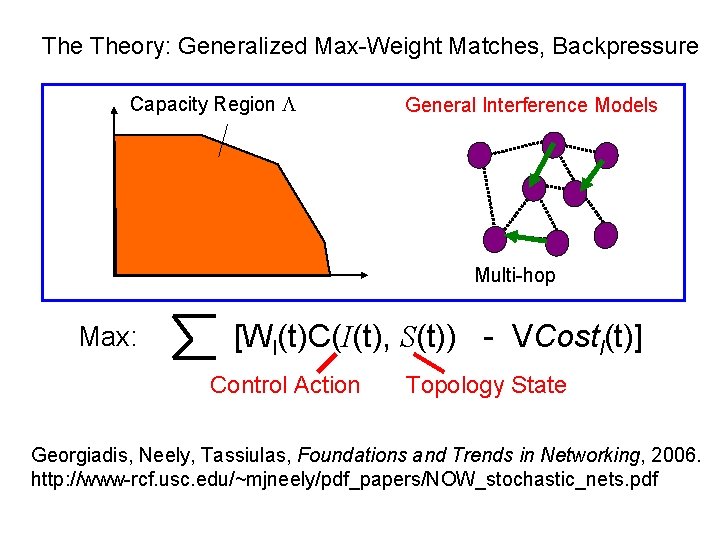
The Theory: Generalized Max-Weight Matches, Backpressure Capacity Region L General Interference Models Multi-hop Max: [Wl(t)C(I(t), S(t)) - VCostl(t)] Control Action Topology State Georgiadis, Neely, Tassiulas, Foundations and Trends in Networking, 2006. http: //www-rcf. usc. edu/~mjneely/pdf_papers/NOW_stochastic_nets. pdf
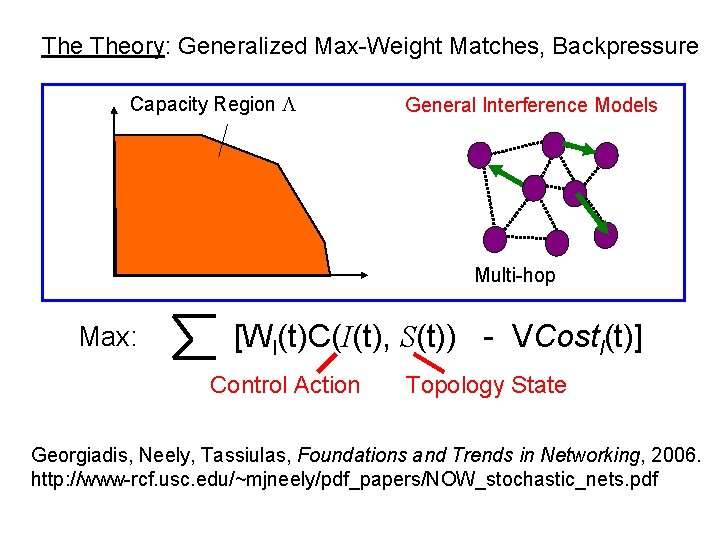
The Theory: Generalized Max-Weight Matches, Backpressure Capacity Region L General Interference Models Multi-hop Max: [Wl(t)C(I(t), S(t)) - VCostl(t)] Control Action Topology State Georgiadis, Neely, Tassiulas, Foundations and Trends in Networking, 2006. http: //www-rcf. usc. edu/~mjneely/pdf_papers/NOW_stochastic_nets. pdf
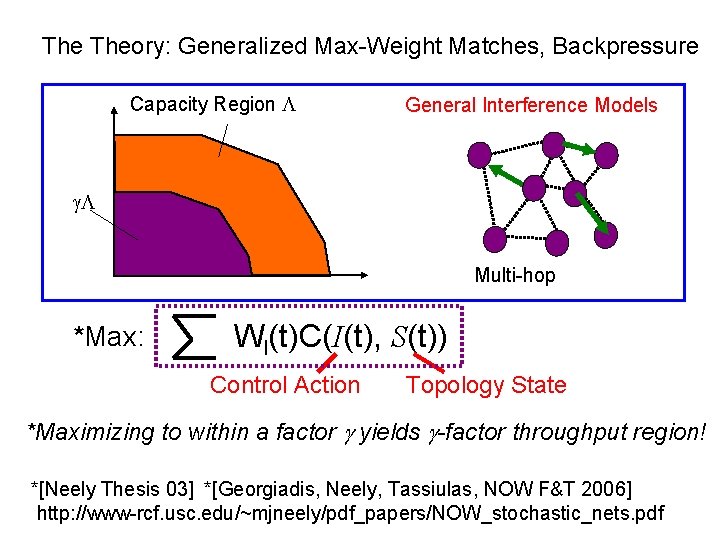
The Theory: Generalized Max-Weight Matches, Backpressure Capacity Region L General Interference Models g. L Multi-hop *Max: Wl(t)C(I(t), S(t)) Control Action Topology State *Maximizing to within a factor g yields g-factor throughput region! *[Neely Thesis 03] *[Georgiadis, Neely, Tassiulas, NOW F&T 2006] http: //www-rcf. usc. edu/~mjneely/pdf_papers/NOW_stochastic_nets. pdf
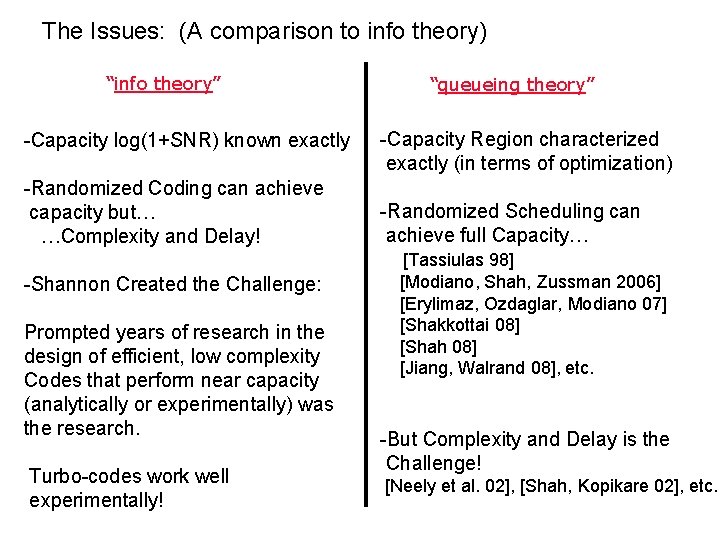
The Issues: (A comparison to info theory) “info theory” -Capacity log(1+SNR) known exactly -Randomized Coding can achieve capacity but… …Complexity and Delay! -Shannon Created the Challenge: Prompted years of research in the design of efficient, low complexity Codes that perform near capacity (analytically or experimentally) was the research. Turbo-codes work well experimentally! “queueing theory” -Capacity Region characterized exactly (in terms of optimization) -Randomized Scheduling can achieve full Capacity… [Tassiulas 98] [Modiano, Shah, Zussman 2006] [Erylimaz, Ozdaglar, Modiano 07] [Shakkottai 08] [Shah 08] [Jiang, Walrand 08], etc. -But Complexity and Delay is the Challenge! [Neely et al. 02], [Shah, Kopikare 02], etc.
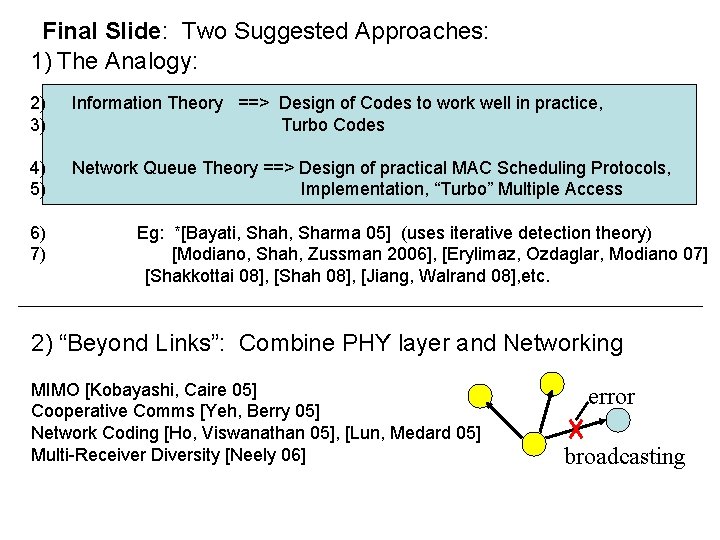
Final Slide: Two Suggested Approaches: 1) The Analogy: 2) 3) Information Theory ==> Design of Codes to work well in practice, Turbo Codes 4) 5) Network Queue Theory ==> Design of practical MAC Scheduling Protocols, Implementation, “Turbo” Multiple Access 6) 7) Eg: *[Bayati, Shah, Sharma 05] (uses iterative detection theory) [Modiano, Shah, Zussman 2006], [Erylimaz, Ozdaglar, Modiano 07] [Shakkottai 08], [Shah 08], [Jiang, Walrand 08], etc. 2) “Beyond Links”: Combine PHY layer and Networking MIMO [Kobayashi, Caire 05] Cooperative Comms [Yeh, Berry 05] Network Coding [Ho, Viswanathan 05], [Lun, Medard 05] Multi-Receiver Diversity [Neely 06] error broadcasting