
A perspective on FAANG Elisabetta Giuffra Animal Genetics
A perspective on FAANG Elisabetta Giuffra Animal Genetics Div. , INRA, France Elisabetta. giuffra@inra. fr Workshop on Animal genomics and breeding for sustainable production – Brussels, 10 -11/10/2016
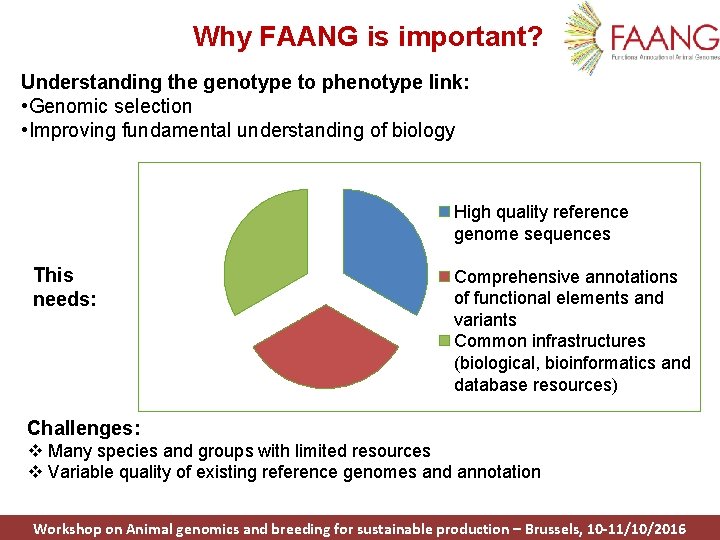
Why FAANG is important? Understanding the genotype to phenotype link: • Genomic selection • Improving fundamental understanding of biology High quality reference genome sequences This needs: Comprehensive annotations of functional elements and variants Common infrastructures (biological, bioinformatics and database resources) Challenges: v Many species and groups with limited resources v Variable quality of existing reference genomes and annotation Workshop on Animal genomics and breeding for sustainable production – Brussels, 10 -11/10/2016
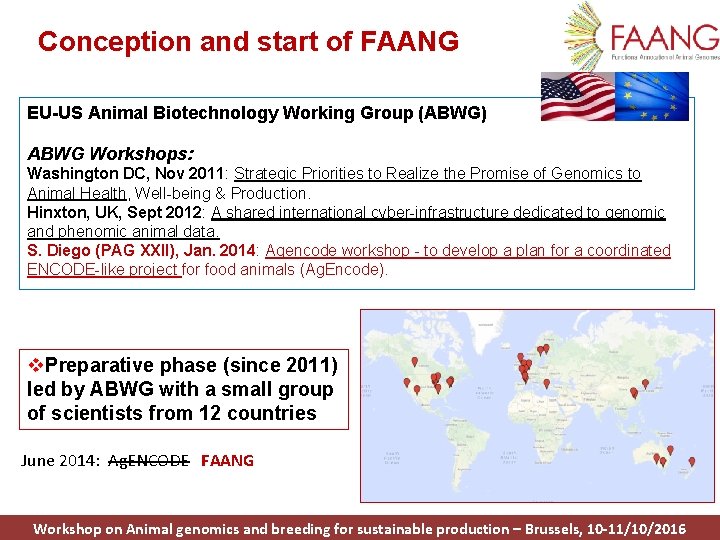
Conception and start of FAANG EU-US Animal Biotechnology Working Group (ABWG) ABWG Workshops: Washington DC, Nov 2011: Strategic Priorities to Realize the Promise of Genomics to Animal Health, Well-being & Production. Hinxton, UK, Sept 2012: A shared international cyber-infrastructure dedicated to genomic and phenomic animal data. S. Diego (PAG XXII), Jan. 2014: Agencode workshop - to develop a plan for a coordinated ENCODE-like project for food animals (Ag. Encode). v. Preparative phase (since 2011) led by ABWG with a small group of scientists from 12 countries June 2014: Ag. ENCODE FAANG Workshop on Animal genomics and breeding for sustainable production – Brussels, 10 -11/10/2016
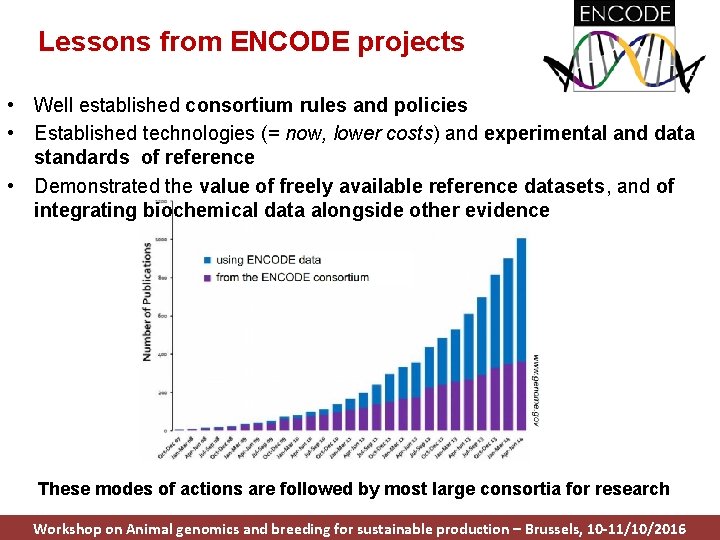
Lessons from ENCODE projects • Well established consortium rules and policies • Established technologies (= now, lower costs) and experimental and data standards of reference • Demonstrated the value of freely available reference datasets, and of integrating biochemical data alongside other evidence These modes of actions are followed by most large consortia for research Workshop on Animal genomics and breeding for sustainable production – Brussels, 10 -11/10/2016

FAANG ‘is a coordinated international action to accelerate genome to phenome’ AIMS: ØStandardize core assays and experimental protocols ØCoordinate and facilitate data sharing ØEstablish an infrastructure for the analysis of these data ØProvide high quality functional annotation of animal genomes In adherence to the "FAANG Data Sharing Statement" Workshop on Animal genomics and breeding for sustainable production – Brussels, 10 -11/10/2016
How achieving the goals of FAANG? White Paper: Andersson et al. Genome Biol. 2015 Mar 25; 16: 57 The ‘unique value’ of domesticated animal species across several topics of research and applications First phase: Obtain a biological reference for main farm species (i. e. with sufficiently annotated genomes) Next phase: ‘Expansion’: different developmental stages, different physiological conditions, additional species… ‘Genotype-to-phenotype’: new breeds/phenotyped populations (involving industry) Workshop on Animal genomics and breeding for sustainable production – Brussels, 10 -11/10/2016
Working Groups • Animal, Samples and Assays – AS&A – Elisabetta Giuffra and Huaijun Zhou • Bioinformatics and Data Analysis – B&DA – James Reecy and Mick Watson • Communications – Coms – Chris Tuggle and Jeff Silverstein • Metadata and Data Sharing – M&DS – Laura Clarke and Carl Schmidt Working with the community by: – Periodic video-conferences and wiki – Reporting at workshops, e. g. http: //faang. org/bbsdb/PAG 2016/ www. faang. org @faangomics faang@iastate. edu Workshop on Animal genomics and breeding for sustainable production – Brussels, 10 -11/10/2016

FAANG events Since 2014: dedicated meetings/workshops at PAG conferences (San Diego) 2015: GO-FAANG meeting (Washington DC) • Several representatives of Funding Agencies • Outcomes reported in: Animal Genetics (Vol. 47, Issue 5, pages 528 -533, 24 JUL 2016) 2016: FAANG -ASAS-ISAG Joint Symposium (hosted by the 35 th ISAG conference, Salt Lake City) • >400 participants www. faang. org/Publications Workshop on Animal genomics and breeding for sustainable production – Brussels, 10 -11/10/2016
Some elements for a discussion on FAANG perspectives (and sustainability) Wokshop on Animal genomics and breeding for sustainable production – Brussels, 10 -11/10/2016
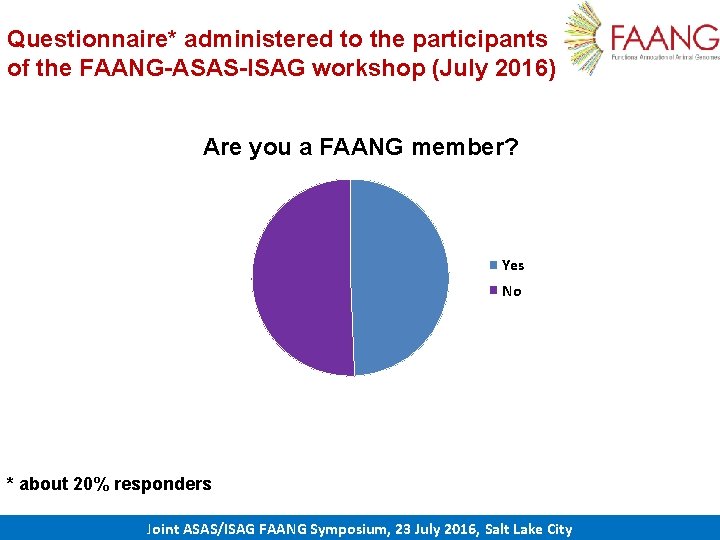
Questionnaire* administered to the participants of the FAANG-ASAS-ISAG workshop (July 2016) Are you a FAANG member? Yes No * about 20% responders Joint ASAS/ISAG FAANG Symposium, 23 July 2016, Salt Lake City
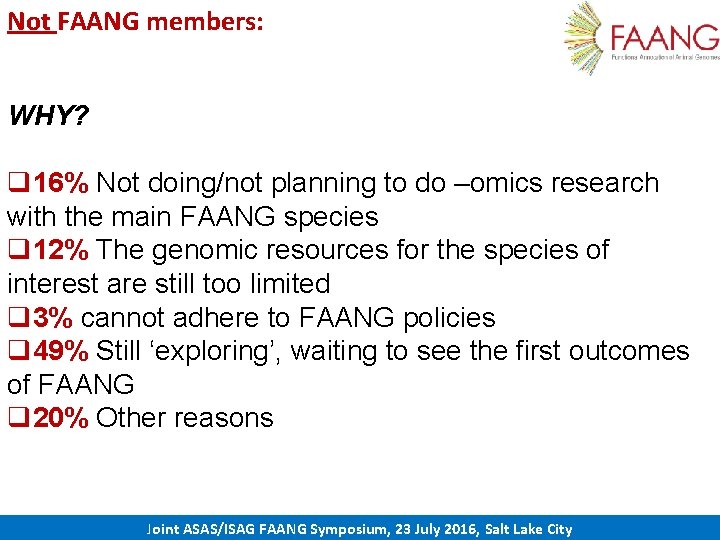
Not FAANG members: WHY? q 16% Not doing/not planning to do –omics research with the main FAANG species q 12% The genomic resources for the species of interest are still too limited q 3% cannot adhere to FAANG policies q 49% Still ‘exploring’, waiting to see the first outcomes of FAANG q 20% Other reasons Joint ASAS/ISAG FAANG Symposium, 23 July 2016, Salt Lake City
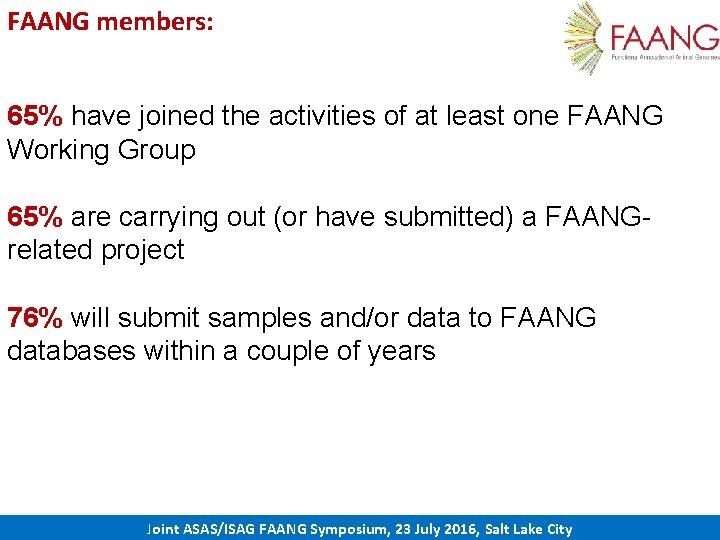
FAANG members: 65% have joined the activities of at least one FAANG Working Group 65% are carrying out (or have submitted) a FAANGrelated project 76% will submit samples and/or data to FAANG databases within a couple of years Joint ASAS/ISAG FAANG Symposium, 23 July 2016, Salt Lake City
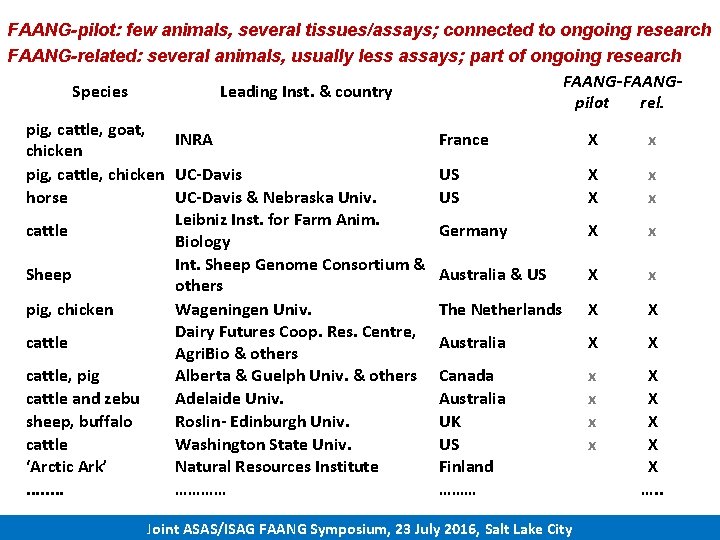
FAANG-pilot: few animals, several tissues/assays; connected to ongoing research FAANG-related: several animals, usually less assays; part of ongoing research FAANG- FAANGSpecies Leading Inst. & country pilot rel. pig, cattle, goat, INRA France X x chicken pig, cattle, chicken UC-Davis US X x horse UC-Davis & Nebraska Univ. US X x Leibniz Inst. for Farm Anim. cattle Germany X x Biology Int. Sheep Genome Consortium & Sheep Australia & US X x others pig, chicken Wageningen Univ. The Netherlands X X Dairy Futures Coop. Res. Centre, cattle Australia X X Agri. Bio & others cattle, pig Alberta & Guelph Univ. & others Canada x X cattle and zebu Adelaide Univ. Australia x X sheep, buffalo Roslin- Edinburgh Univ. UK x X cattle Washington State Univ. US x X ‘Arctic Ark’ Natural Resources Institute Finland X. . . . ………… …. . Joint ASAS/ISAG FAANG Symposium, 23 July 2016, Salt Lake City
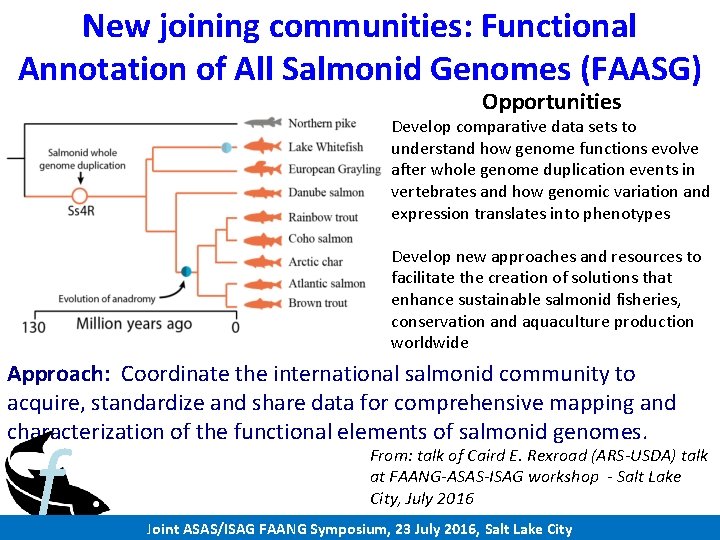
New joining communities: Functional Annotation of All Salmonid Genomes (FAASG) Opportunities Develop comparative data sets to understand how genome functions evolve after whole genome duplication events in vertebrates and how genomic variation and expression translates into phenotypes Develop new approaches and resources to facilitate the creation of solutions that enhance sustainable salmonid fisheries, conservation and aquaculture production worldwide Approach: Coordinate the international salmonid community to acquire, standardize and share data for comprehensive mapping and characterization of the functional elements of salmonid genomes. f From: talk of Caird E. Rexroad (ARS-USDA) talk at FAANG-ASAS-ISAG workshop - Salt Lake City, July 2016 Joint ASAS/ISAG FAANG Symposium, 23 July 2016, Salt Lake City
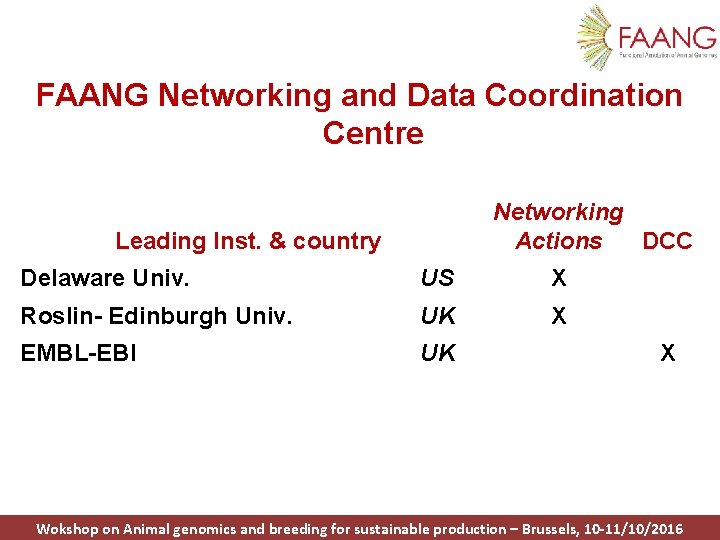
FAANG Networking and Data Coordination Centre Networking Actions DCC Leading Inst. & country Delaware Univ. US X Roslin- Edinburgh Univ. UK X EMBL-EBI UK X Wokshop on Animal genomics and breeding for sustainable production – Brussels, 10 -11/10/2016
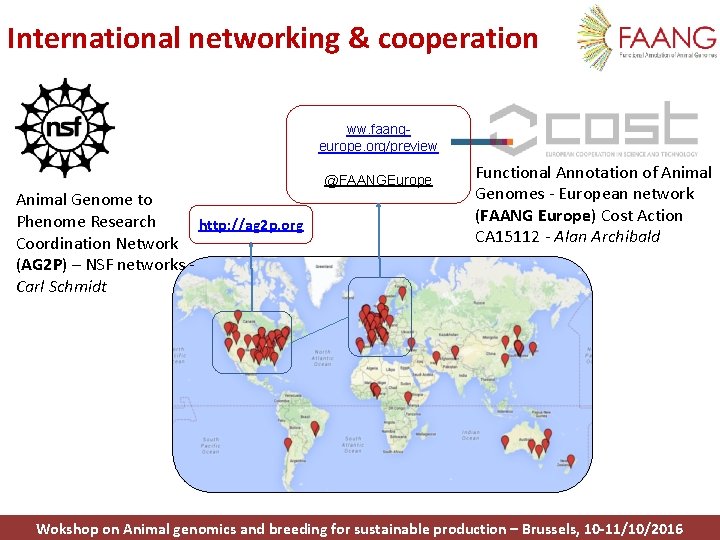
International networking & cooperation ww. faangeurope. org/preview @FAANGEurope Animal Genome to Phenome Research http: //ag 2 p. org Coordination Network (AG 2 P) – NSF networks Carl Schmidt Functional Annotation of Animal Genomes - European network (FAANG Europe) Cost Action CA 15112 - Alan Archibald Wokshop on Animal genomics and breeding for sustainable production – Brussels, 10 -11/10/2016
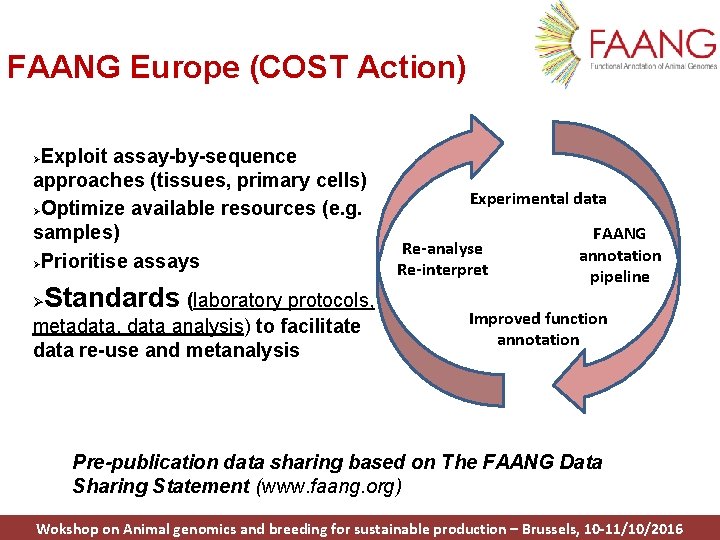
FAANG Europe (COST Action) Exploit assay-by-sequence approaches (tissues, primary cells) ØOptimize available resources (e. g. samples) ØPrioritise assays Ø Ø Standards (laboratory protocols, metadata, data analysis) to facilitate data re-use and metanalysis Experimental data Re-analyse Re-interpret FAANG annotation pipeline Improved function annotation Pre-publication data sharing based on The FAANG Data Sharing Statement (www. faang. org) Wokshop on Animal genomics and breeding for sustainable production – Brussels, 10 -11/10/2016
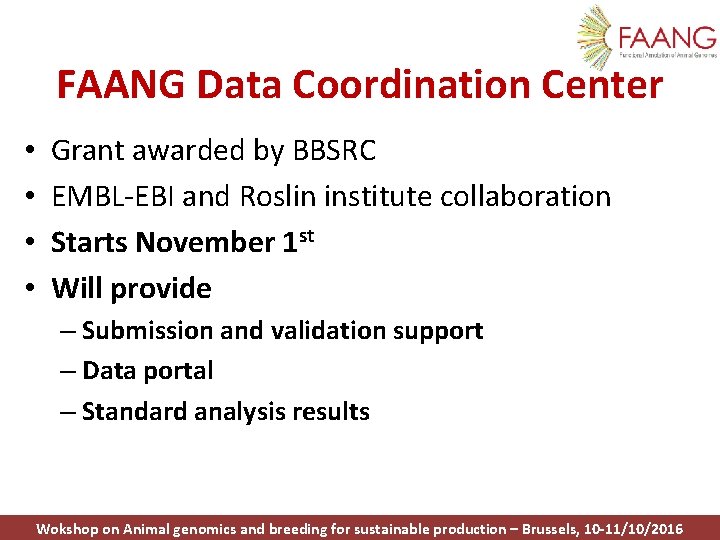
FAANG Data Coordination Center • • Grant awarded by BBSRC EMBL-EBI and Roslin institute collaboration Starts November 1 st Will provide – Submission and validation support – Data portal – Standard analysis results Wokshop on Animal genomics and breeding for sustainable production – Brussels, 10 -11/10/2016
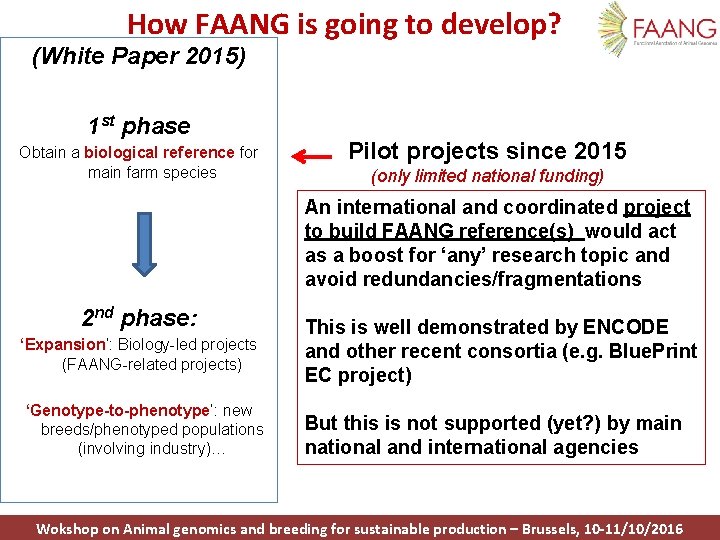
How FAANG is going to develop? (White Paper 2015) 1 st phase Obtain a biological reference for main farm species Pilot projects since 2015 (only limited national funding) An international and coordinated project to build FAANG reference(s) would act as a boost for ‘any’ research topic and avoid redundancies/fragmentations 2 nd phase: ‘Expansion’: Biology-led projects (FAANG-related projects) ‘Genotype-to-phenotype’: new breeds/phenotyped populations (involving industry)… This is well demonstrated by ENCODE and other recent consortia (e. g. Blue. Print EC project) But this is not supported (yet? ) by main national and international agencies Wokshop on Animal genomics and breeding for sustainable production – Brussels, 10 -11/10/2016
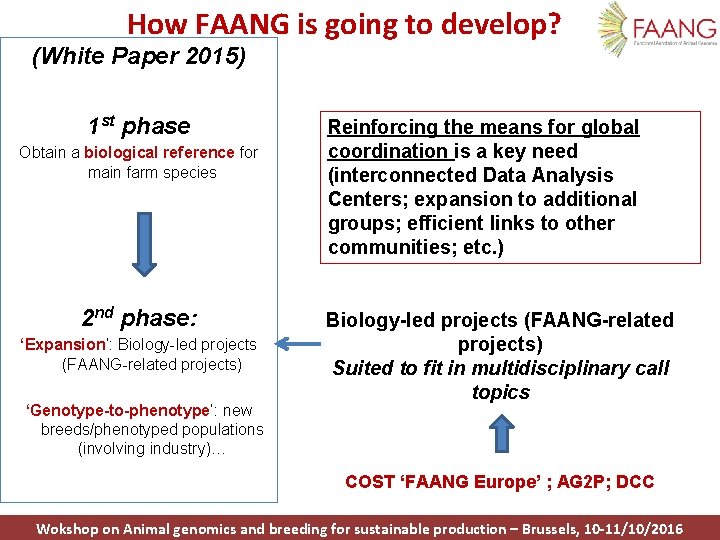
How FAANG is going to develop? (White Paper 2015) 1 st phase Obtain a biological reference for main farm species 2 nd phase: ‘Expansion’: Biology-led projects (FAANG-related projects) ‘Genotype-to-phenotype’: new breeds/phenotyped populations (involving industry)… Reinforcing the means for global coordination is a key need (interconnected Data Analysis Centers; expansion to additional groups; efficient links to other communities; etc. ) Biology-led projects (FAANG-related projects) Suited to fit in multidisciplinary call topics COST ‘FAANG Europe’ ; AG 2 P; DCC Wokshop on Animal genomics and breeding for sustainable production – Brussels, 10 -11/10/2016
- Slides: 20