
A PERMEABLE REACTIVE BARRIER PRB FOR THE IMMOBILIZATION
A PERMEABLE REACTIVE BARRIER (PRB) FOR THE IMMOBILIZATION OF SELENIUM IN MINE SEEP WATER AND GROUNDWATER William J Walker, Ph. D Seattle, WA David Tooke, Ph. D Matthew Wright PE, Missoula, MT Jeffrey Hamilton, JR Simplot New. Fields Mining and Energy Services ASMR Conference Big Sky, MT June 3 -7, 2019
Objective • Test the efficacy of a permeable reactive barrier (PRB) to remove Se from shallow mine seep water and groundwater, • Capable of reducing Se to below Idaho water quality standard (50 ug/L) without appreciably altering other water quality parameters • Constructed of materials easy to locate locally, and • The PRB would have a reasonable life time with low O&M costs. New. Fields Mining and Energy Services
Contents • Site Description • Methods • Characterization of water and media • Batch leach test • Column test • Results • Se content of mine waters • Media and seep water interaction • Column – reduction of Se by pore volume (PV) • On-Going Lab Work • Full-Scale System Design and Performance New. Fields Mining and Energy Services
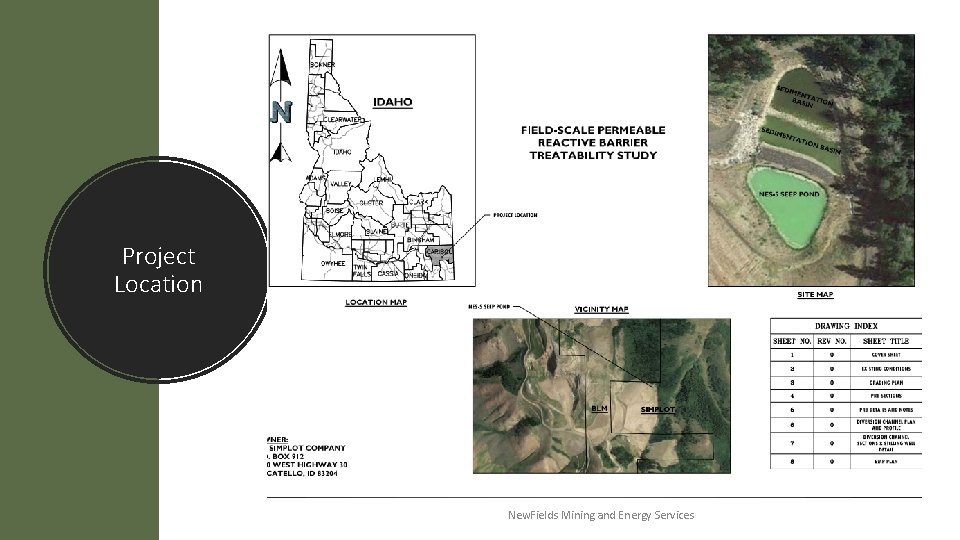
Project Location New. Fields Mining and Energy Services
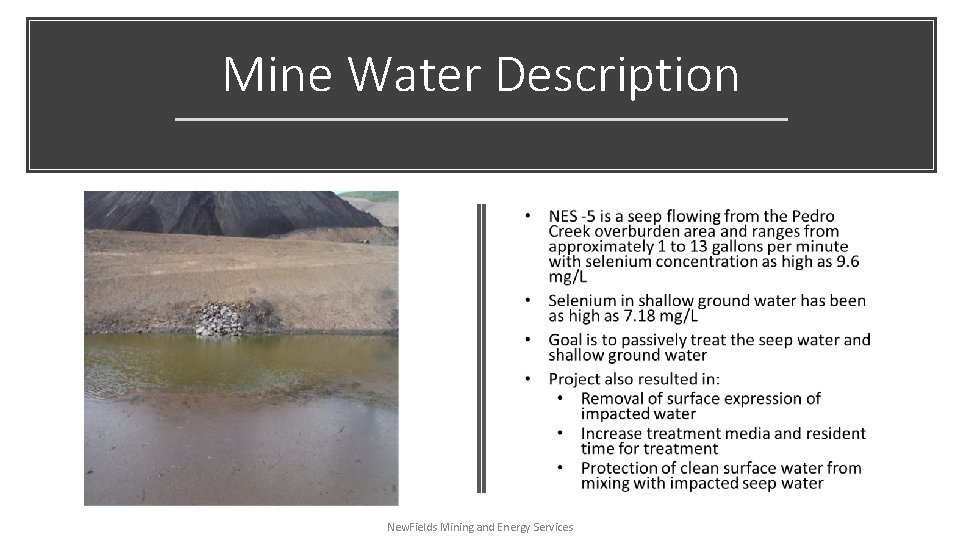
Mine Water Description New. Fields Mining and Energy Services
Mine water • 200 L of each water (Seep and Groundwater) shipped to lab, no preservative, zero headspace, sampled before and after shipment Methods. Materials New. Fields Mining and Energy Services Media • PRB composed of sand, wood chips and alfalfa (from previous testing) • Sand – porosity • Wood chips – long term carbon source and porosity • Alfalfa – readily available soluble carbon
Batch leach testing Methods. Testing • ASTM D-4646 -02 (24 -h Batch-Type Measurement of Contaminant Sorption by Soils and Sediments) • Seep water containing elevated Se added to each component separately and mixed for 24 hrs • Determine fate of Se and determine if other metal(oid)s possibly released by media components Column • Columns of mixed media (50% sand, 37. 5% wood chips and 12. 5% alfalfa) and replicated (2 Seep water columns and 2 groundwater columns) New. Fields Mining and Energy Services
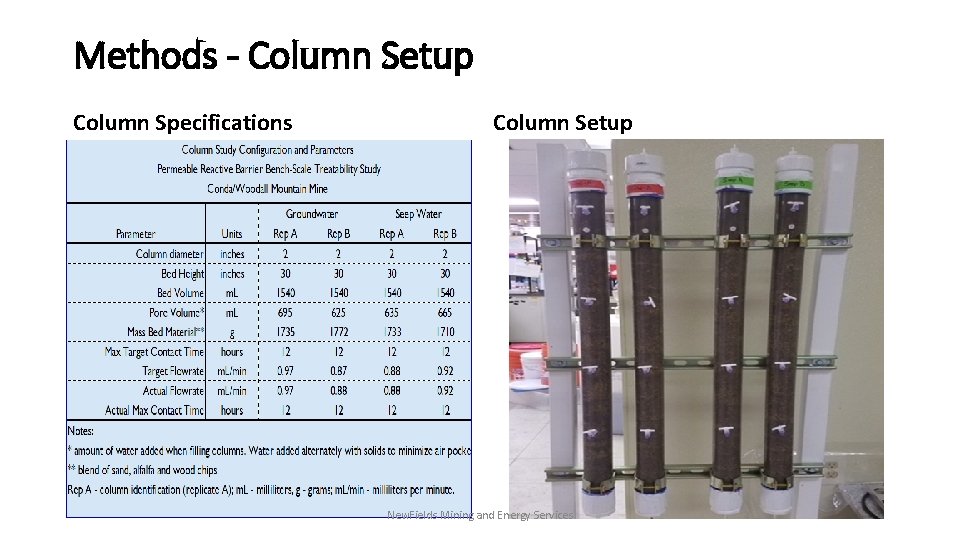
Methods - Column Setup Column Specifications Column Setup New. Fields Mining and Energy Services
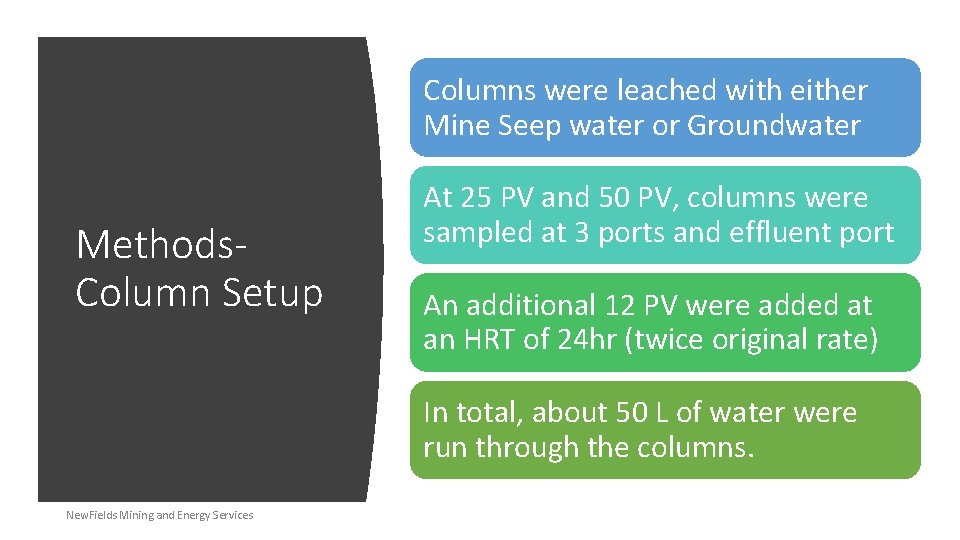
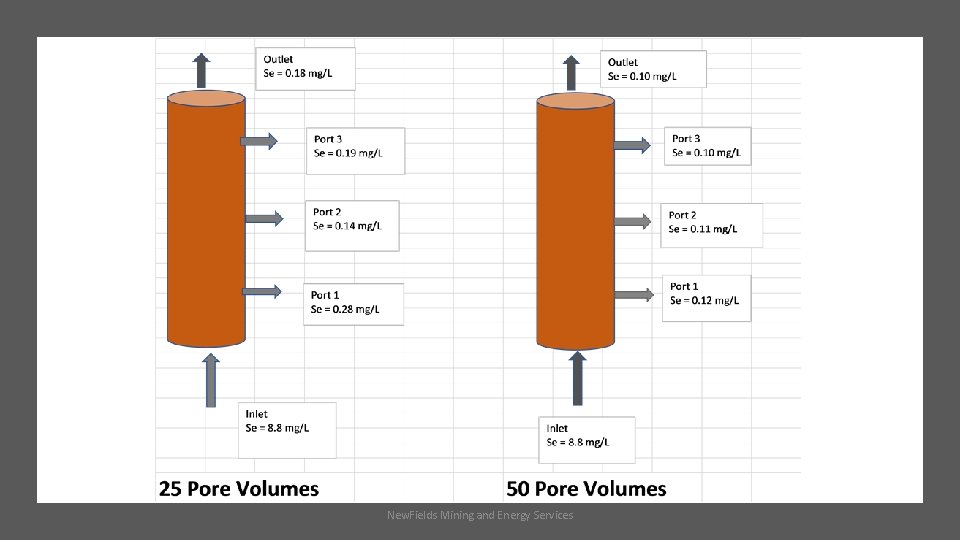
Columns were leached with either Mine Seep water or Groundwater Methods. Column Setup At 25 PV and 50 PV, columns were sampled at 3 ports and effluent port An additional 12 PV were added at an HRT of 24 hr (twice original rate) In total, about 50 L of water were run through the columns. New. Fields Mining and Energy Services
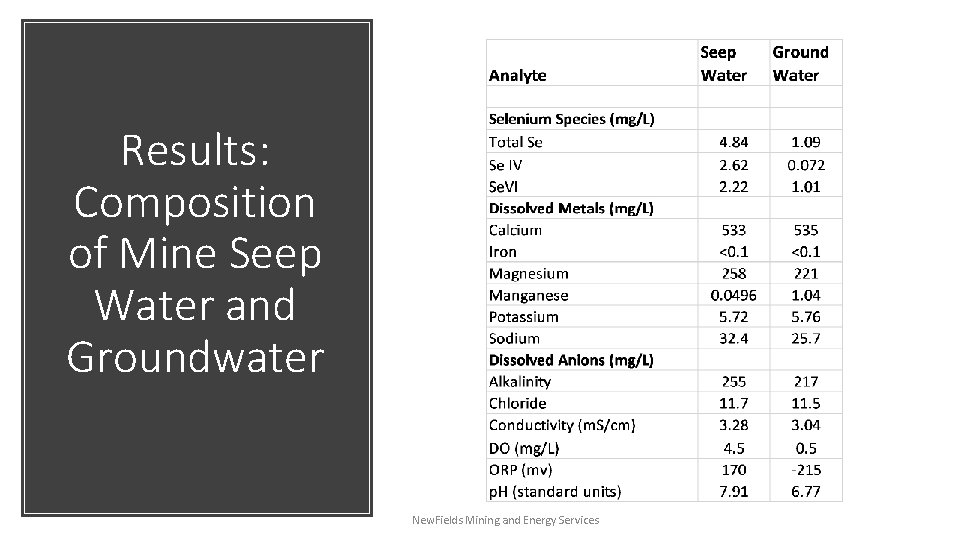
Results: Composition of Mine Seep Water and Groundwater New. Fields Mining and Energy Services
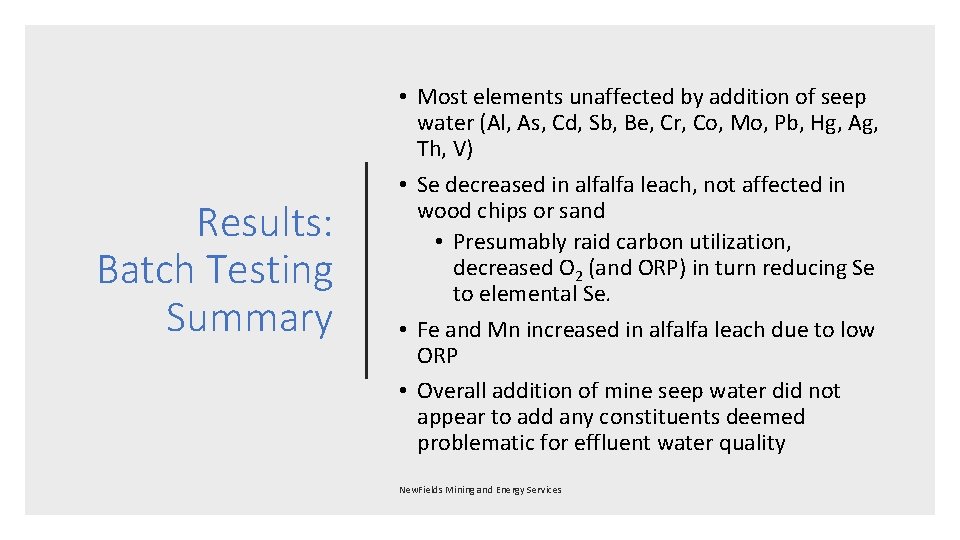
Results: Batch Testing Summary • Most elements unaffected by addition of seep water (Al, As, Cd, Sb, Be, Cr, Co, Mo, Pb, Hg, Ag, Th, V) • Se decreased in alfalfa leach, not affected in wood chips or sand • Presumably raid carbon utilization, decreased O 2 (and ORP) in turn reducing Se to elemental Se. • Fe and Mn increased in alfalfa leach due to low ORP • Overall addition of mine seep water did not appear to add any constituents deemed problematic for effluent water quality New. Fields Mining and Energy Services
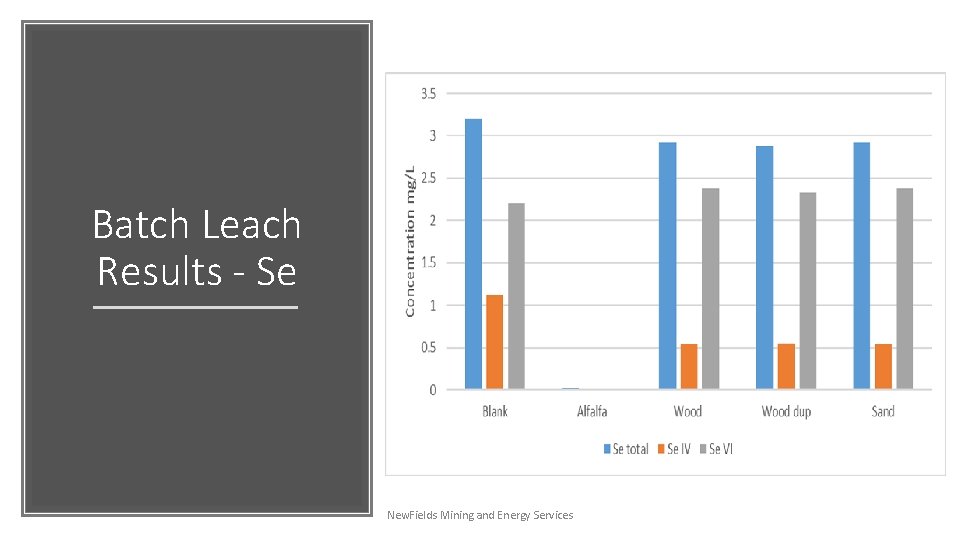
Batch Leach Results - Se New. Fields Mining and Energy Services
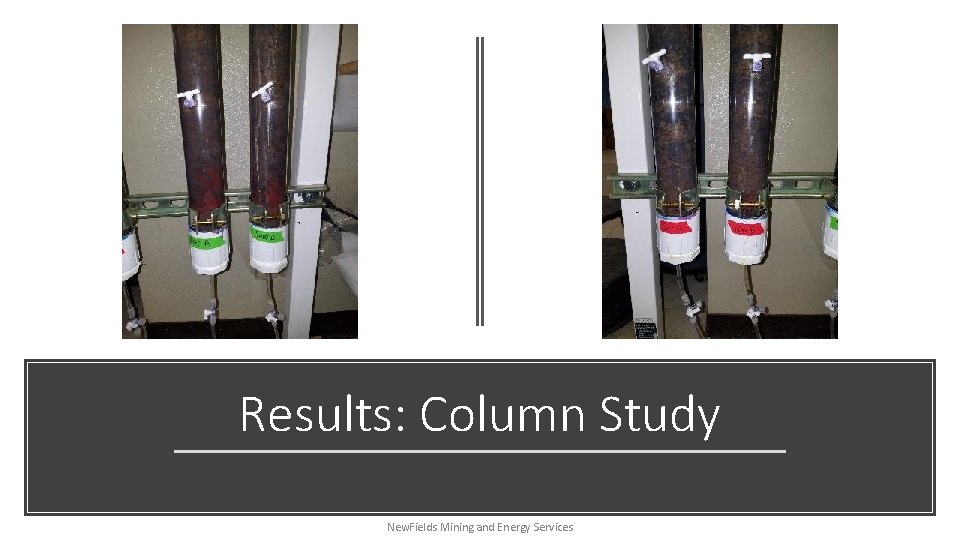
Results: Column Study New. Fields Mining and Energy Services
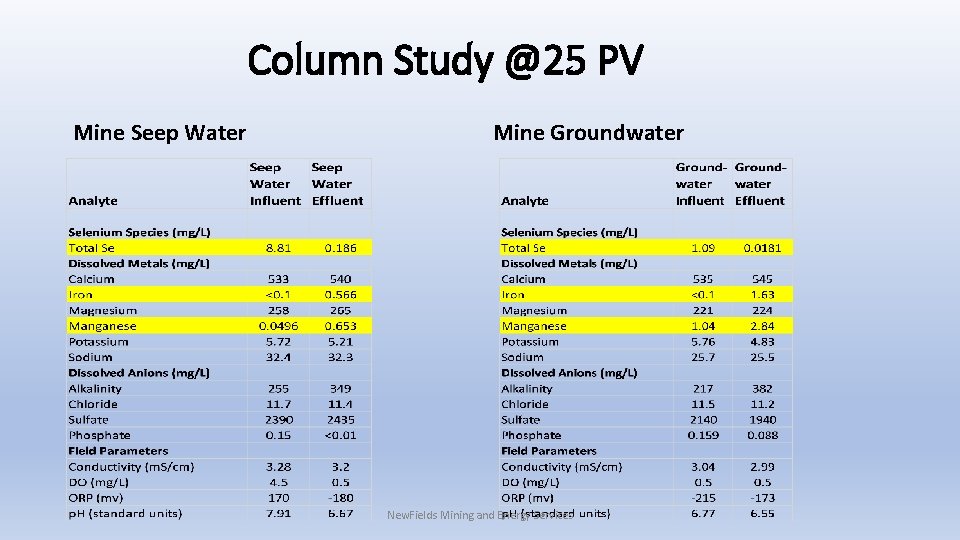
Column Study @25 PV Mine Seep Water Mine Groundwater New. Fields Mining and Energy Services
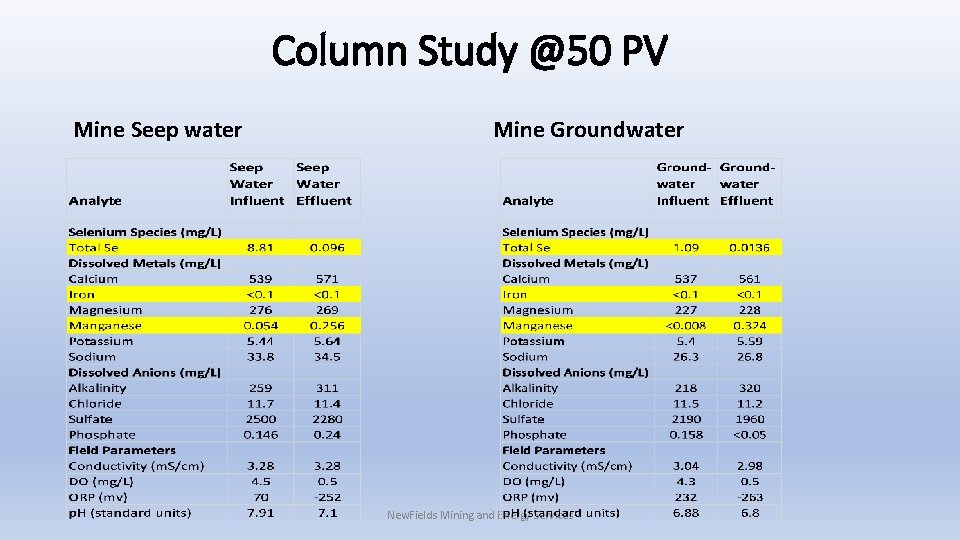
Column Study @50 PV Mine Seep water Mine Groundwater New. Fields Mining and Energy Services
New. Fields Mining and Energy Services

Column Study Summary New. Fields Mining and Energy Services
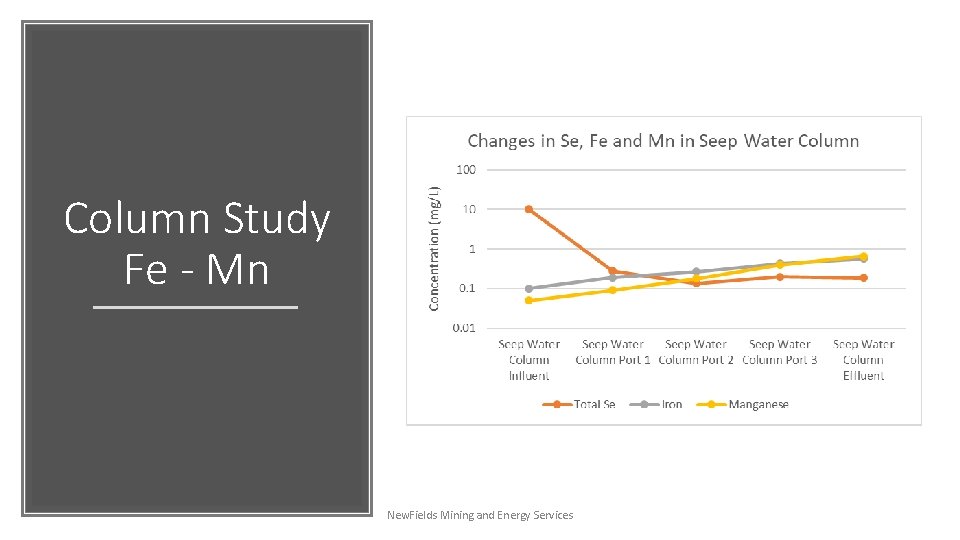
Column Study Fe - Mn New. Fields Mining and Energy Services
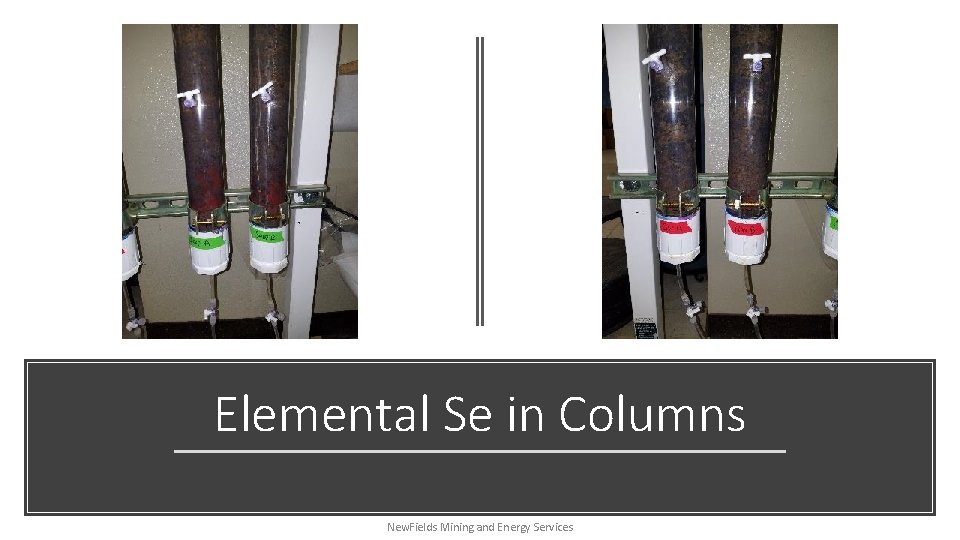
Elemental Se in Columns New. Fields Mining and Energy Services
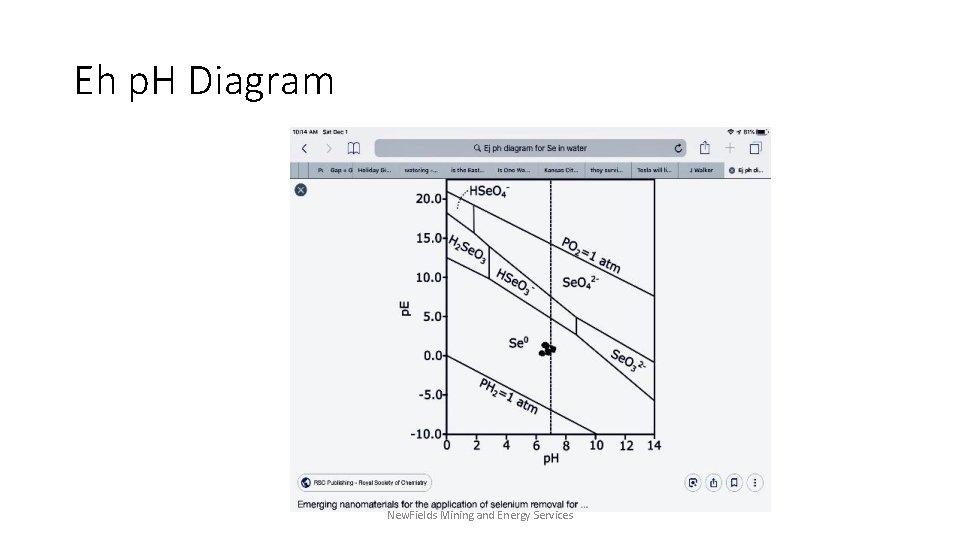
Eh p. H Diagram New. Fields Mining and Energy Services
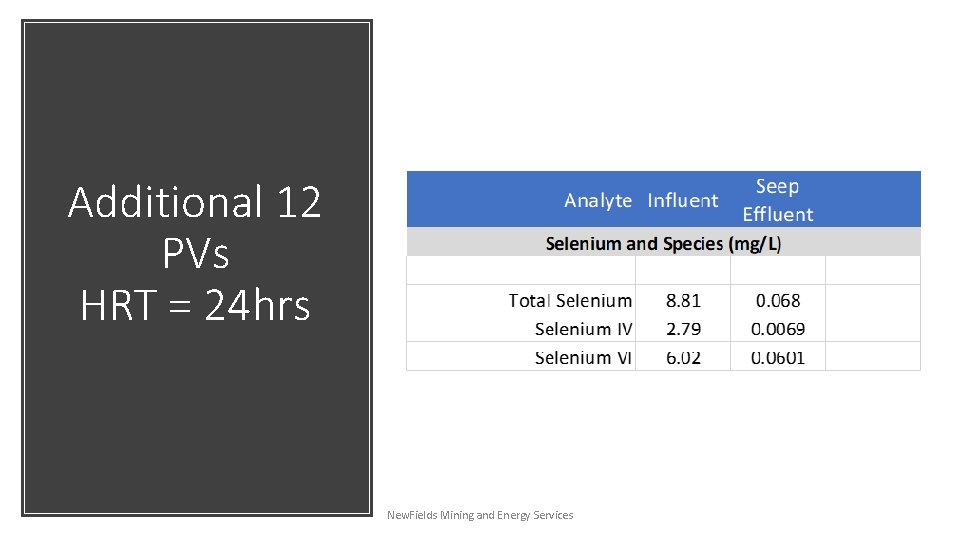
Additional 12 PVs HRT = 24 hrs New. Fields Mining and Energy Services
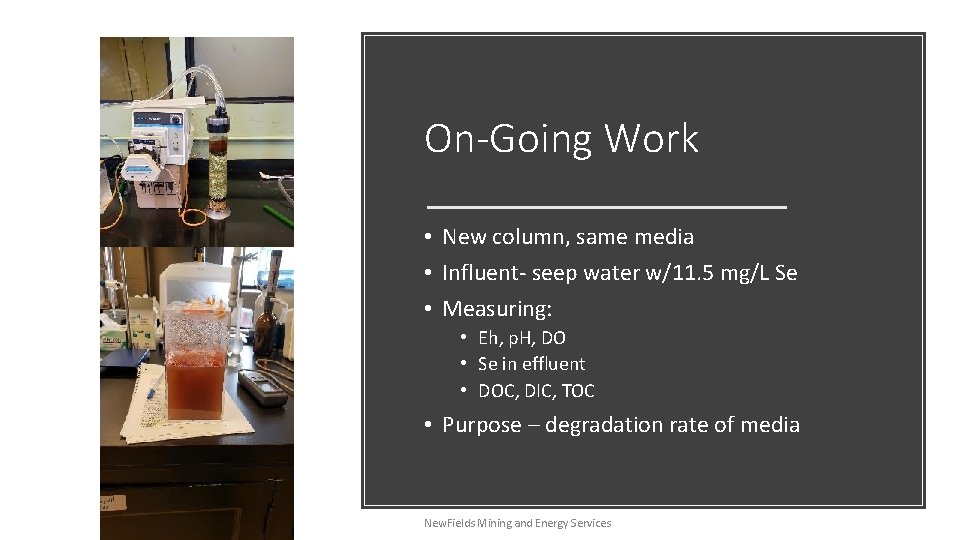
On-Going Work • New column, same media • Influent- seep water w/11. 5 mg/L Se • Measuring: • Eh, p. H, DO • Se in effluent • DOC, DIC, TOC • Purpose – degradation rate of media New. Fields Mining and Energy Services
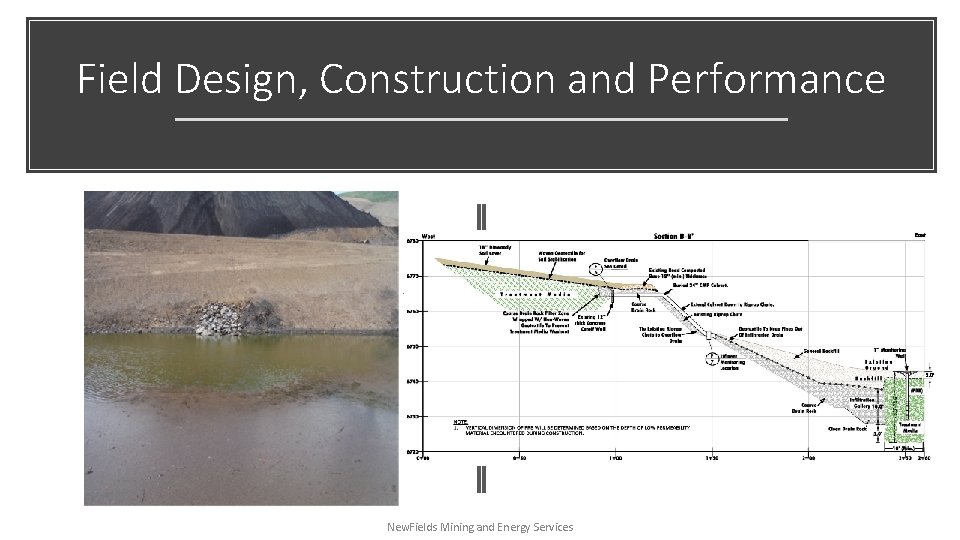
Field Design, Construction and Performance New. Fields Mining and Energy Services
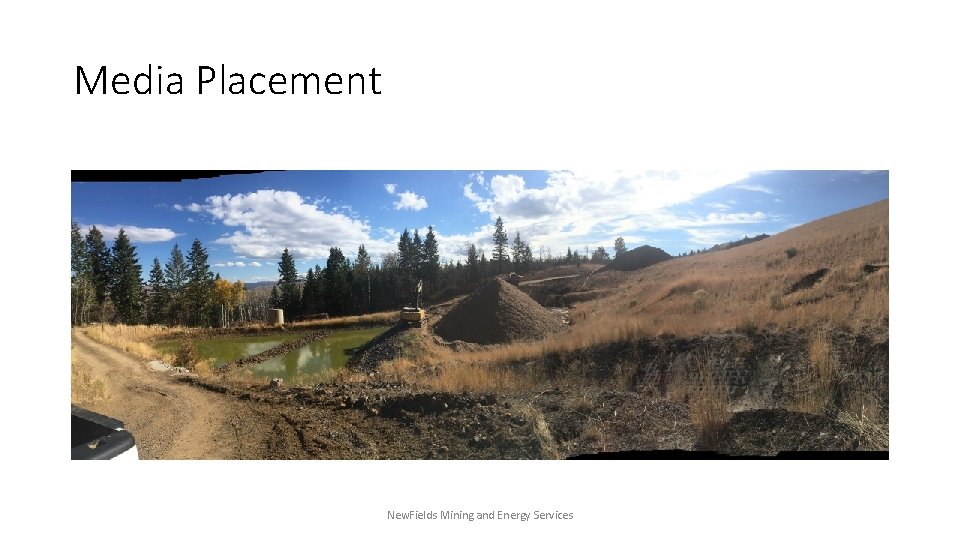
Media Placement New. Fields Mining and Energy Services
The column testing indicated Se was effectively removed from the influent solutions. The Se concentration in seep water was initially about 9 mg/L and was reduced to about 0. 2 mg/L after 25 PV and 0. 1 mg/L after 50 PV. Summary (cont) Increasing the HRT to 24 hr (a factor of 2) decreased the Se to just above (0. 07 mg/L) the 0. 05 mg/L water quality goal. The groundwater Se, initially about 1 mg/L was reduced to less than 0. 02 in the first 3 hours of column contact time, well below the 0. 05 mg/L water quality goal. New. Fields Mining and Energy Services
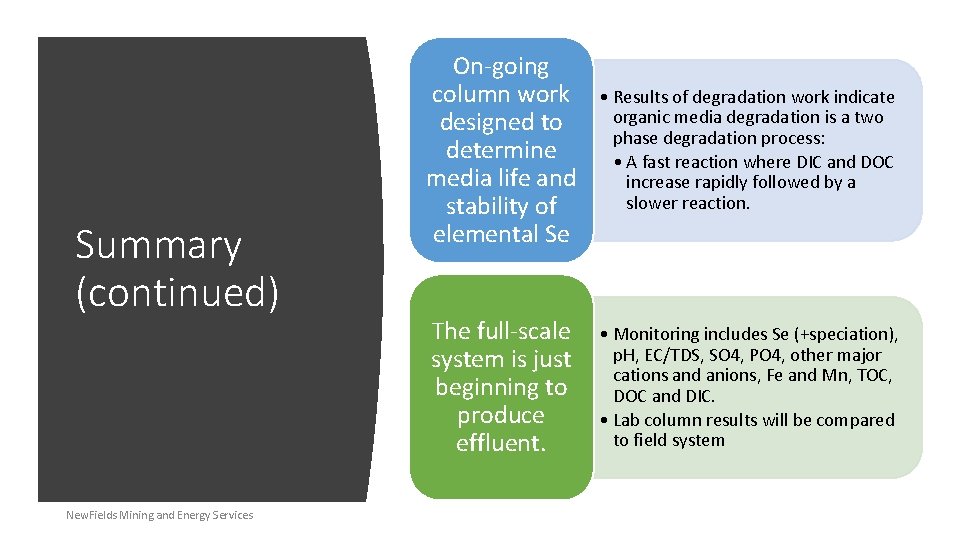
Summary (continued) New. Fields Mining and Energy Services On-going column work designed to determine media life and stability of elemental Se • Results of degradation work indicate organic media degradation is a two phase degradation process: • A fast reaction where DIC and DOC increase rapidly followed by a slower reaction. The full-scale system is just beginning to produce effluent. • Monitoring includes Se (+speciation), p. H, EC/TDS, SO 4, PO 4, other major cations and anions, Fe and Mn, TOC, DOC and DIC. • Lab column results will be compared to field system

New. Fields Mining and Energy Services • Hiring – Seattle WA and Missoula, MT • Senior Geochemist • Senior Environmental ngineer • Laboratory Chemist bwalker@newfields. com 425 785 1550 New. Fields Mining and Energy Services
- Slides: 27