
A pedagogical framework for teaching English as an






- Slides: 52
A pedagogical framework for teaching English as an international language(EIL) WEN Qiufang National Research Center for Foreign Language Education, BFSU
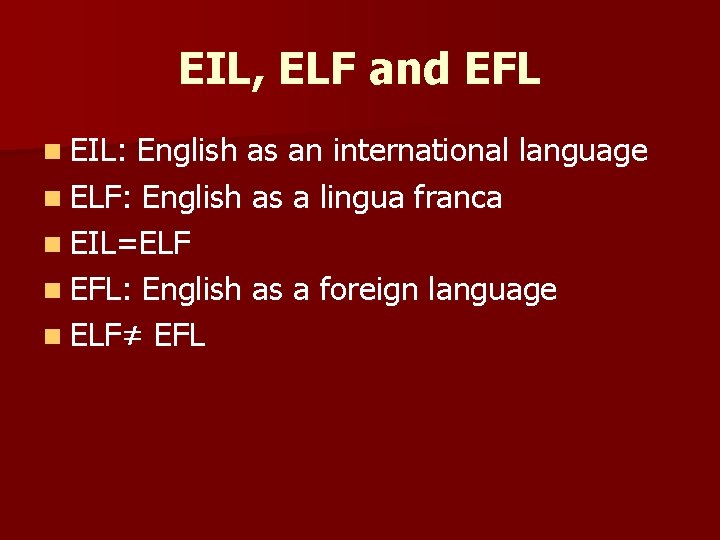
EIL, ELF and EFL n EIL: English as an international language n ELF: English as a lingua franca n EIL=ELF n EFL: English as a foreign language n ELF≠ EFL
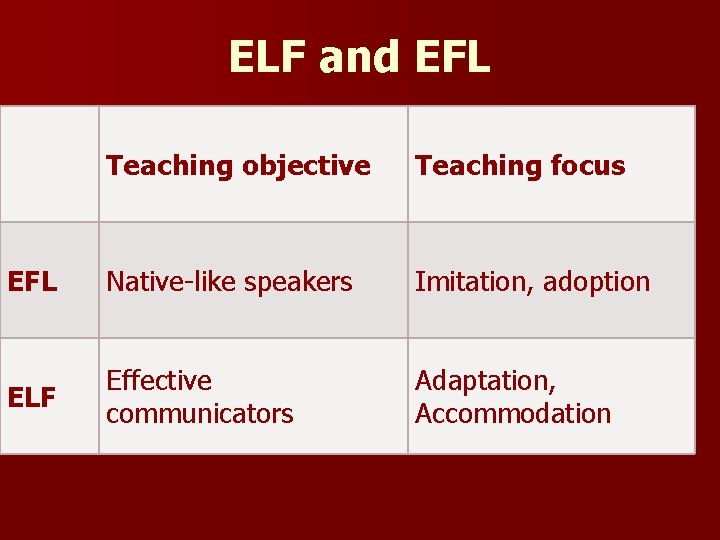
ELF and EFL Teaching objective Teaching focus EFL Native-like speakers Imitation, adoption ELF Effective communicators Adaptation, Accommodation
The focus of my talk n. A framework for teaching English as a lingua franca or an international language n From the teacher’s perspective
Topics to be addressed n Motivation n Two proposed solutions and their problems n A pedagogical framework n Advantages of the proposed framework
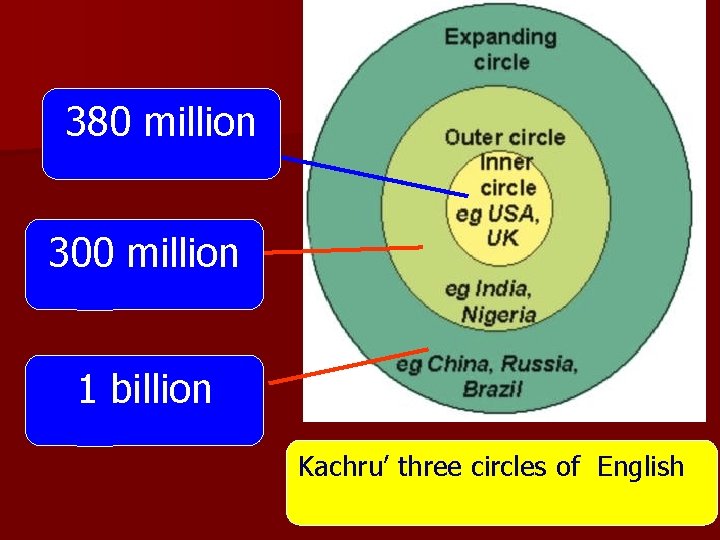
1. Motivation Who owns English? n Non-native speakers outnumber English native speakers The total number of native speakers ? The total number of non-native speakers?
380 million 300 million 1 billion Kachru’ three circles of English
n Graddol (1997) –The center of authority regarding the language would shift from native speakers to nonnative speakers.
“English as a world language does not ‘belong’ to mother tongue speakers of English alone, but to all those who can make effective use of it. ” (Lee, 1981: 1)
Conceptual and practical n Quite a number of scholars have made a strong argument against taking the native-speaker’s English as a norm for non-native speakers. In their view, we should teach English as a lingua franca rather than as a foreign language. We shoud promote ELF-oriented pedagogy.
Conceptual and practical n Conceptual – Many people think this kind of revolutionary idea cannot be refuted easily. n Practical – What to be taught in classroom? – How to evaluate our students’ performance?
Topics to be addressed n Motivation n Two proposed solutions and their problems n A pedagogical framework n Its advantages
Proposal 1 n L 2 user model(Cook,1999)
Vivian Cook (1999) n The language used by successful L 2 users can be a model for L 2 learners. n Treat L 2 users in their own right but not imitation of native speakers, deficient native speakers, failed natives. n Comparing the characteristics of native speakers and of L 2 users is like comparing tomatoes and apples, useful only at a gross level.
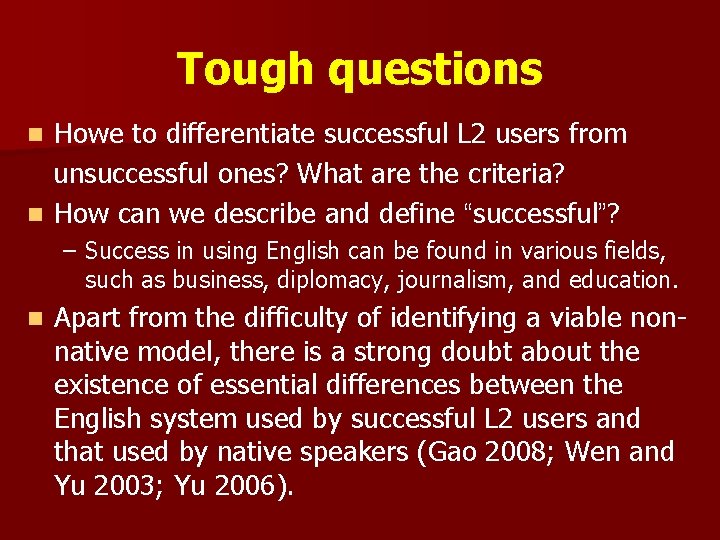
Tough questions Howe to differentiate successful L 2 users from unsuccessful ones? What are the criteria? n How can we describe and define “successful”? n – Success in using English can be found in various fields, such as business, diplomacy, journalism, and education. n Apart from the difficulty of identifying a viable nonnative model, there is a strong doubt about the existence of essential differences between the English system used by successful L 2 users and that used by native speakers (Gao 2008; Wen and Yu 2003; Yu 2006).
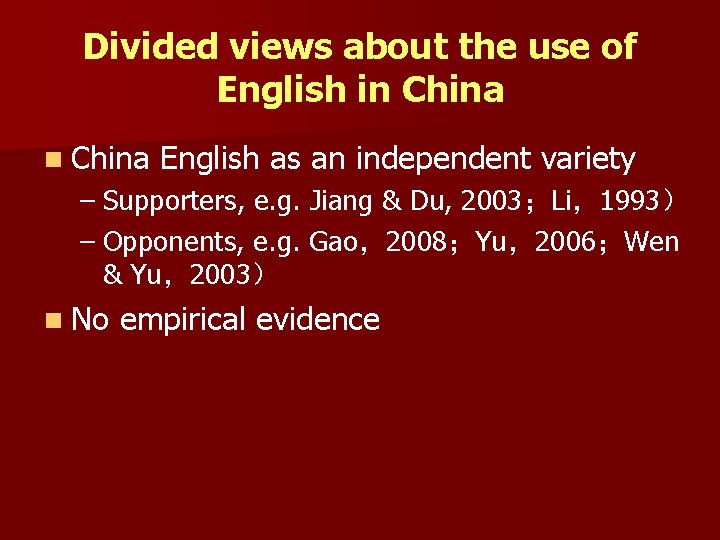
Divided views about the use of English in China English as an independent variety – Supporters, e. g. Jiang & Du, 2003;Li,1993) – Opponents, e. g. Gao,2008;Yu,2006;Wen & Yu,2003) n No empirical evidence
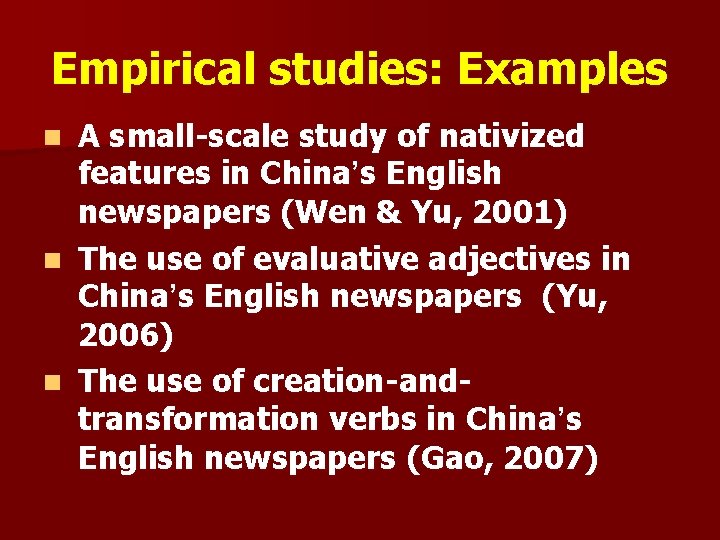
Empirical studies: Examples A small-scale study of nativized features in China’s English newspapers (Wen & Yu, 2001) n The use of evaluative adjectives in China’s English newspapers (Yu, 2006) n The use of creation-andtransformation verbs in China’s English newspapers (Gao, 2007) n
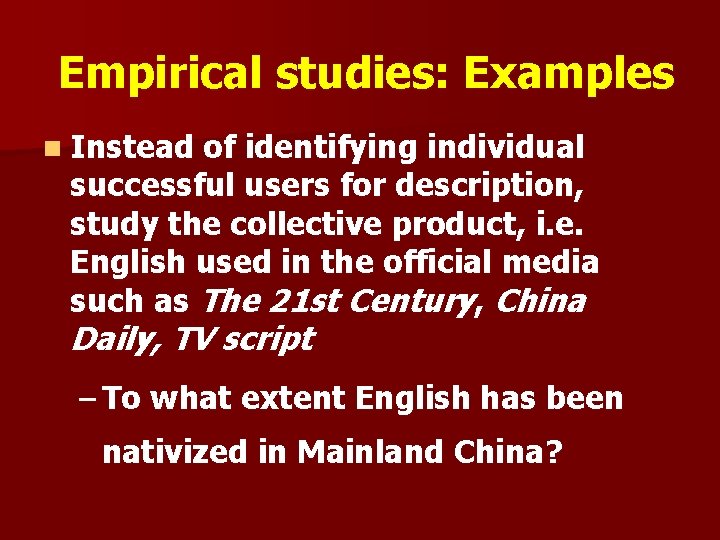
Empirical studies: Examples n Instead of identifying individual successful users for description, study the collective product, i. e. English used in the official media such as The 21 st Century, China Daily, TV script – To what extent English has been nativized in Mainland China?
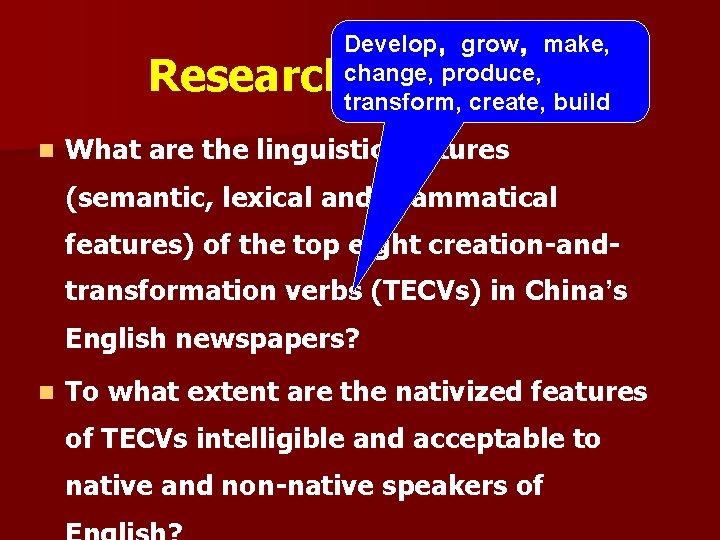
Develop,grow,make, change, produce, transform, create, build Research questions n What are the linguistic features (semantic, lexical and grammatical features) of the top eight creation-andtransformation verbs (TECVs) in China’s English newspapers? n To what extent are the nativized features of TECVs intelligible and acceptable to native and non-native speakers of
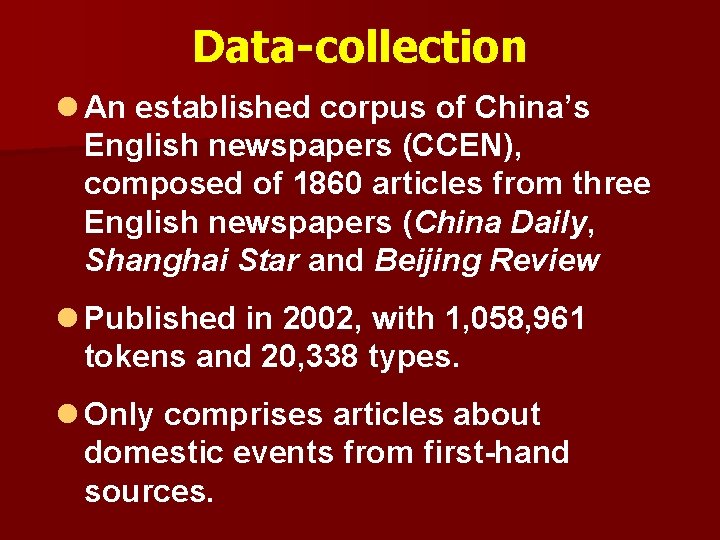
Data-collection l An established corpus of China’s English newspapers (CCEN), composed of 1860 articles from three English newspapers (China Daily, Shanghai Star and Beijing Review l Published in 2002, with 1, 058, 961 tokens and 20, 338 types. l Only comprises articles about domestic events from first-hand sources.
Questionnaire n Intelligibility and acceptability – Five-point scale on intelligibility – Ask them to write down what they have understood – Five-point scale on acceptability
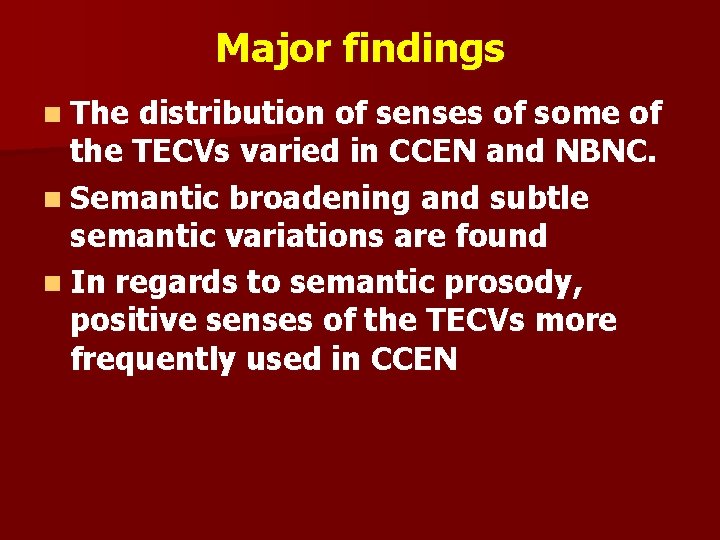
Major findings n The distribution of senses of some of the TECVs varied in CCEN and NBNC. n Semantic broadening and subtle semantic variations are found n In regards to semantic prosody, positive senses of the TECVs more frequently used in CCEN
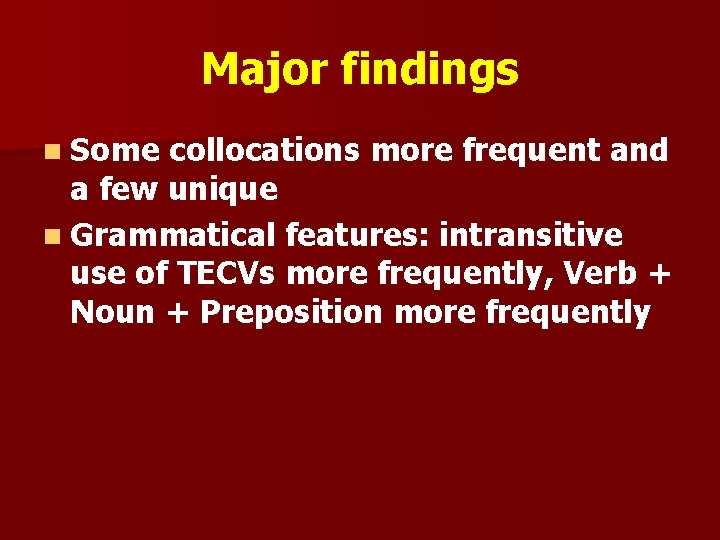
Major findings n Some collocations more frequent and a few unique n Grammatical features: intransitive use of TECVs more frequently, Verb + Noun + Preposition more frequently
Major findings n Most of nativized English in China’s context can be understood and accepted by both native and nonnative speakers of English. n Native and non-native English speakers’ interpretations of the verb collocations varied.
Major findings n Native speakers tend to show higher degree of acceptability than nonnative speakers. n The nativized features tend to be more intelligible to female respondents than to male respondents.
General conclusions n More quantitative differences than qualitative ones n Almost all the qualitative differences being lexical rather than grammatical
Proposal 2 n …. the result of the description of how English is being used in the international context could be potentially used as a model for L 2 learners(Seidlhoufer, 2001) n the assumption underlying this proposal has been challenged by several scholars (Alptekin 2010; Canagarajah 2007; Ferguson 2009).
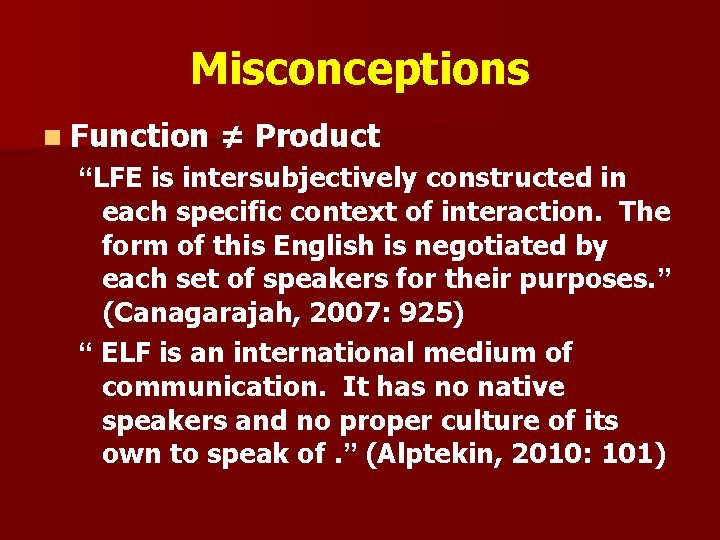
Misconceptions n Function ≠ Product “LFE is intersubjectively constructed in each specific context of interaction. The form of this English is negotiated by each set of speakers for their purposes. ” (Canagarajah, 2007: 925) “ ELF is an international medium of communication. It has no native speakers and no proper culture of its own to speak of. ” (Alptekin, 2010: 101)
Misconceptions n. Impossible and unnecessary to codify an ELF but possible and necessary to research the use of ELF
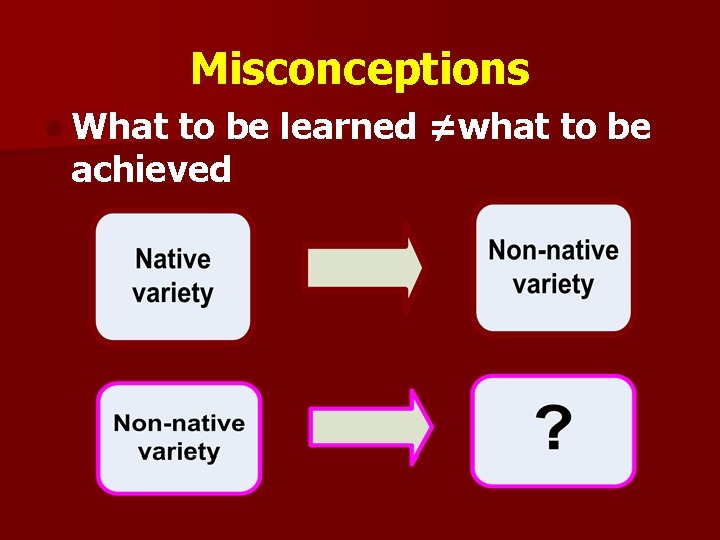
Misconceptions l What to be learned ≠what to be achieved
Conceptual issues There is a danger that the overemphasis on the nativized variety will move nonnative variety further and further apart until a stage is reached where English can no longer be served as lingua franca
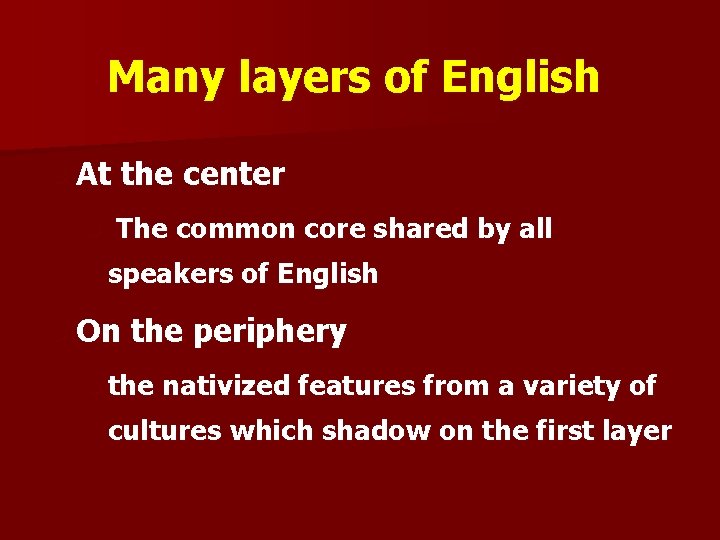
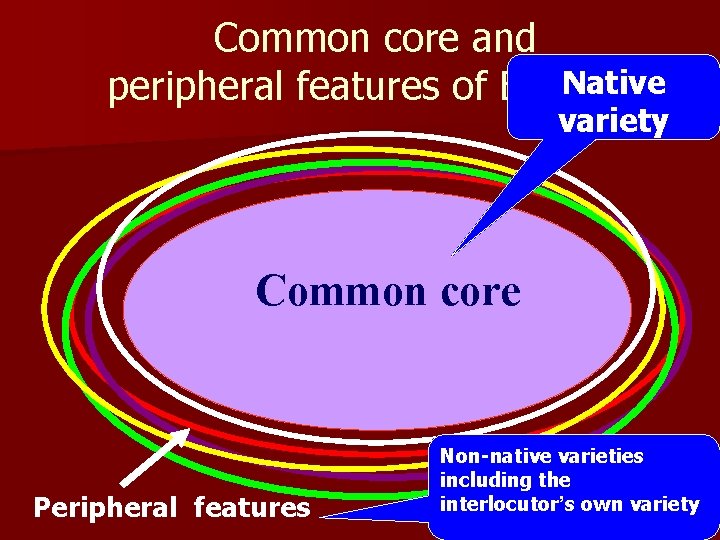
Many layers of English l At l the center The common core shared by all speakers of English l On the periphery l the nativized features from a variety of cultures which shadow on the first layer
Topics to be addressed n Motivation n Two proposed solutions and their problems n A pedagogical framework n Its advantages
3. A pedagogical framework
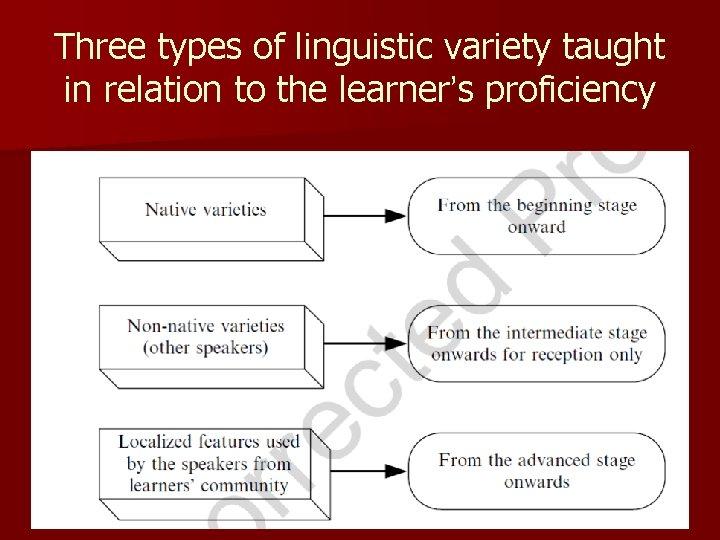
Three types of linguistic variety taught in relation to the learner’s proficiency
Common core and Native peripheral features of English variety Common core Peripheral features Non-native varieties including the interlocutor’s own variety
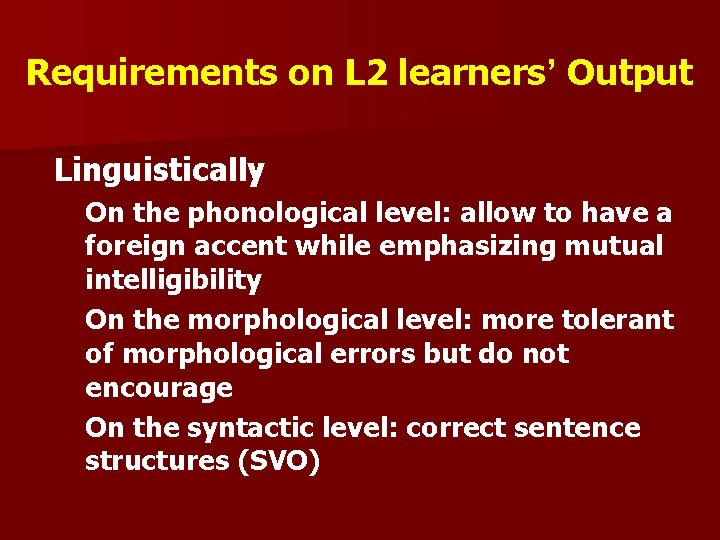
Requirements on L 2 learners’ Output l Linguistically l On the phonological level: allow to have a foreign accent while emphasizing mutual intelligibility l On the morphological level: more tolerant of morphological errors but do not encourage l On the syntactic level: correct sentence structures (SVO)
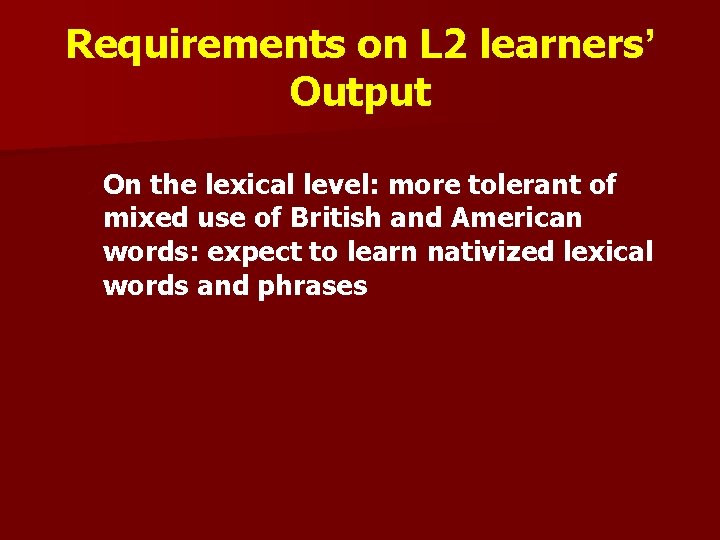
Requirements on L 2 learners’ Output l On the lexical level: more tolerant of mixed use of British and American words: expect to learn nativized lexical words and phrases
3. A pedagogical framework
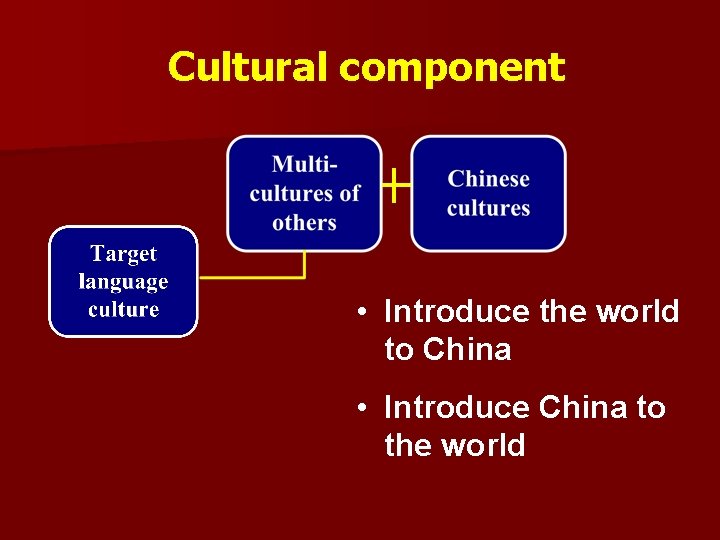
Cultural component • Introduce the world to China • Introduce China to the world
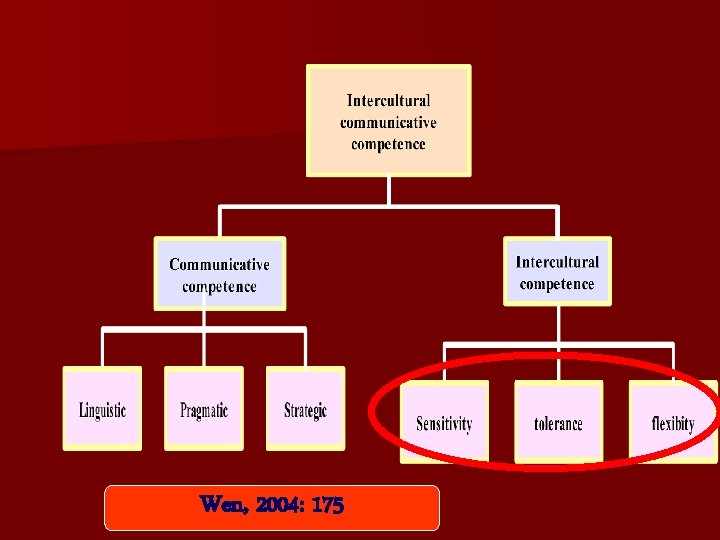
Wen, 2004: 175
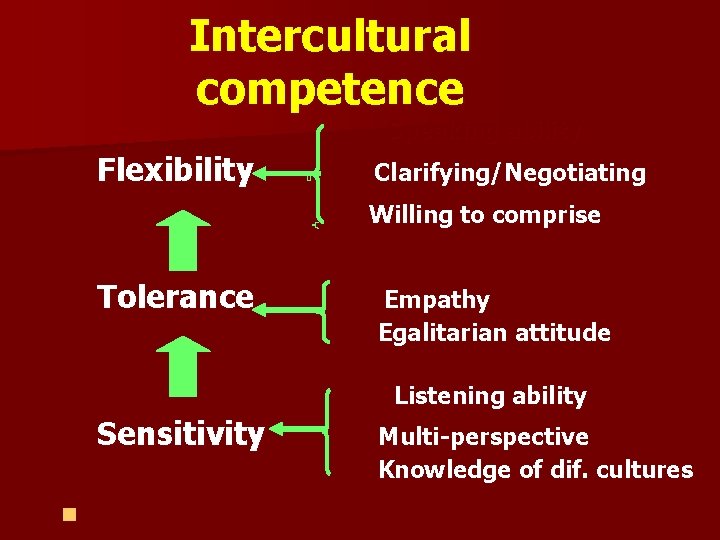
Intercultural competence Speaking ability Flexibility Clarifying/Negotiating Willing to comprise Tolerance Empathy Egalitarian attitude Listening ability Sensitivity n Multi-perspective Knowledge of dif. cultures
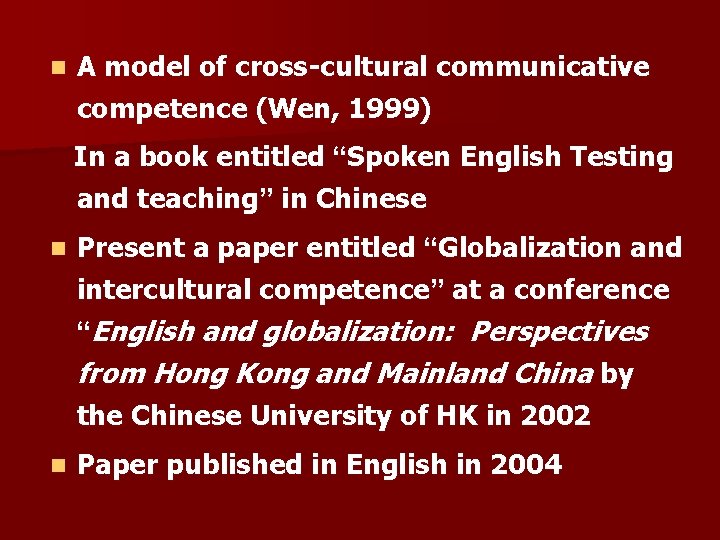
n A model of cross-cultural communicative competence (Wen, 1999) In a book entitled “Spoken English Testing and teaching” in Chinese n Present a paper entitled “Globalization and intercultural competence” at a conference “English and globalization: Perspectives from Hong Kong and Mainland China by the Chinese University of HK in 2002 n Paper published in English in 2004
3. A pedagogical framework
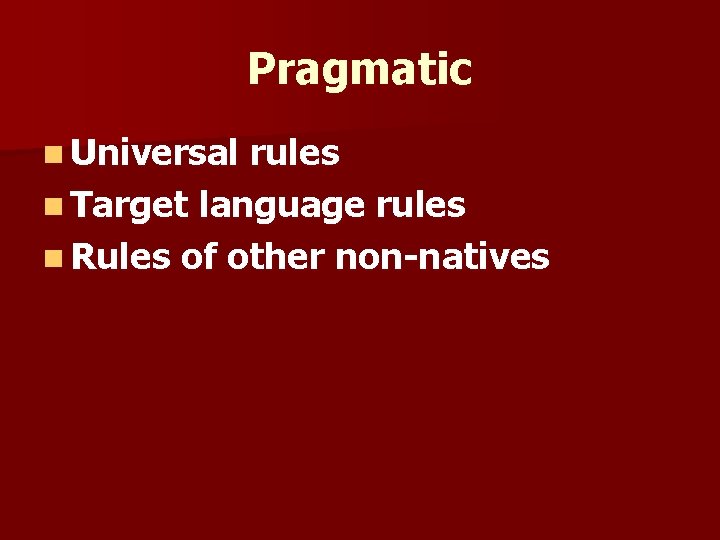
Pragmatic n Universal rules n Target language rules n Rules of other non-natives
matic What kind of English will be used here? What kind of pragmatic rules will be used? P
Setting for ELF
Pragmatic Open, dynamic, on-line generated
Pragmatic objective n Abilities to generate appropriate communicative rules and strategies
Topics to be addressed n Motivation n Two proposed solutions and their problems n A pedagogical framework n Advantages of the proposed framework
Advantages n Balancing globalization and localization – Unlike the traditional view that the native variety is the only norm – unlike the radical view that the model is that created by successful non-native speakers or the codified ELF n Making a clear distinction between what is to be taught and what is to be achieved – Specifying the three components of teaching: linguistic, cultural and pragmatic – All the objectives having the same focus, the successful accomplishment of communication in English
Thank you!