
A parsimonious energy balance snowmelt model and its
A parsimonious energy balance snowmelt model and its use in spatially distributed modeling David G. Tarboton Charlie Luce Jinsheng You Utah Water Research Laboratory Utah State University email: david. tarboton@usu. edu www: http: //www. engineering. usu. edu/dtarb/snow. html

Why a simple, physically based snowmelt model • Physically based – Predictive capability in changed settings – Get sensitivities to changes right • Simple – Avoid assumptions and parameterizations that make no difference – Computational efficiency and feasibility
Utah Energy Balance Model design considerations • Physically based calculation of snow energy balance. • Simplicity. Small number of state variables and adjustable parameters. • Transportable. Applicable without calibration at different locations. • Match diurnal cycle of melt outflow rates • Match overall accumulation and ablation for water balance. • Distributed by application over a spatial grid. • Subgrid variability using depletion curve approach. • Spatial variability due to wind blown snow drifting • (Effects of vegetation on interception, radiation, wind fields)
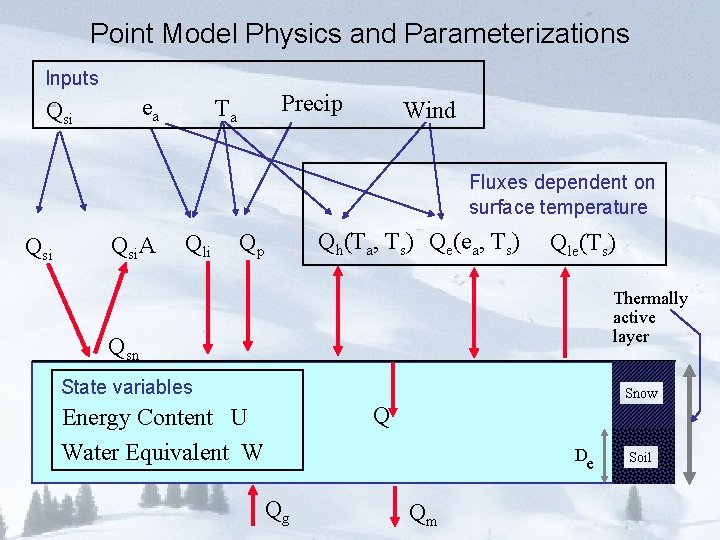
Point Model Physics and Parameterizations Inputs ea Qsi Precip Ta Wind Fluxes dependent on surface temperature Qsi. A Qli Qh(Ta, Ts) Qe(ea, Ts) Qp Qle(Ts) Thermally active layer Qsn State variables Snow Q Energy Content U Water Equivalent W De Qg Qm Soil
Focus on parameterizations of • Snow surface temperature • Refreezing at the surface • Spatial variability

Snow surface temperature Heat diffusion into a semi-infinite medium with periodic (diurnal) boundary conditions where, k = /C Solution where, d = (2 k )1/2 Three Alternative Models Equilibrium Gradient (EQG) Force-Restore (FR) Modified Force-Restore (MFR)
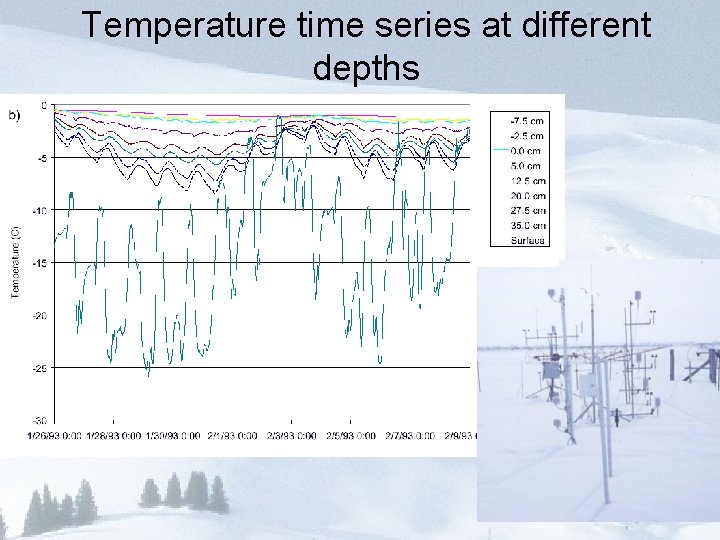
Temperature time series at different depths
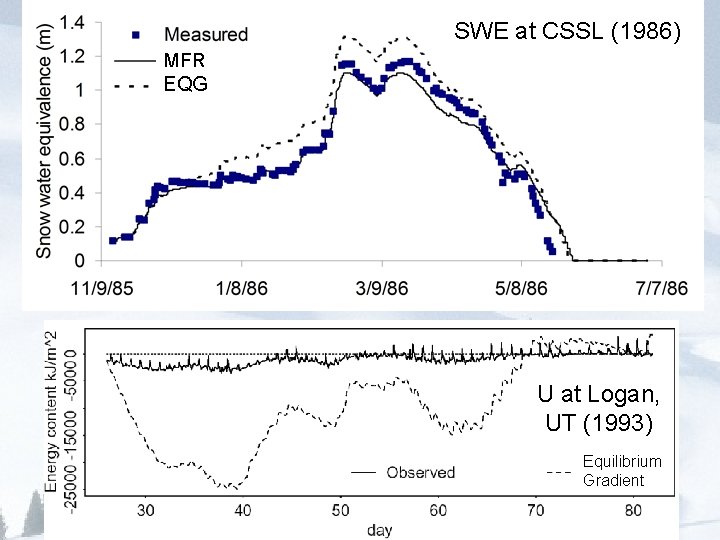
SWE at CSSL (1986) MFR EQG U at Logan, UT (1993) Equilibrium Gradient
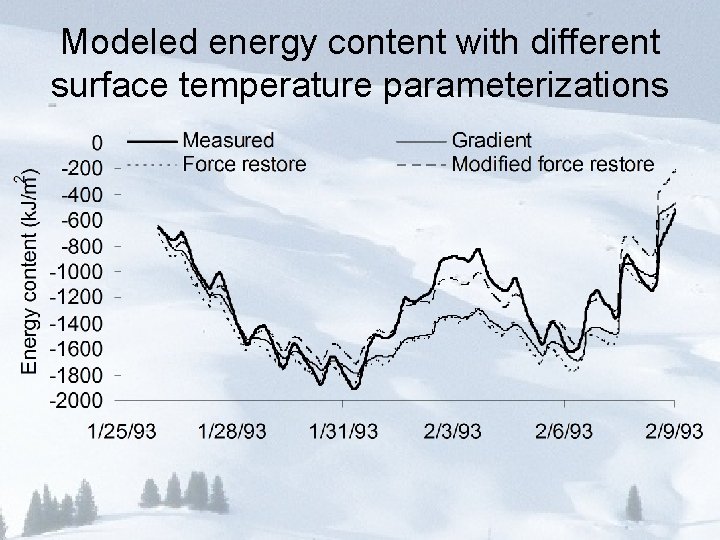
Modeled energy content with different surface temperature parameterizations
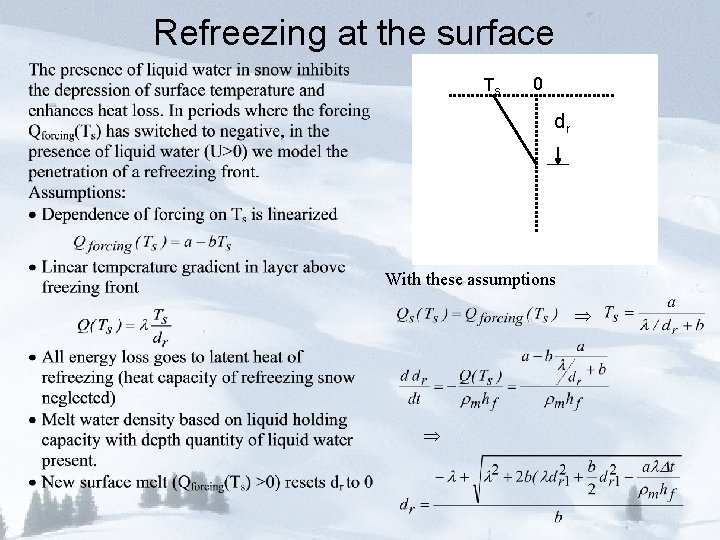
Refreezing at the surface Ts 0 dr With these assumptions
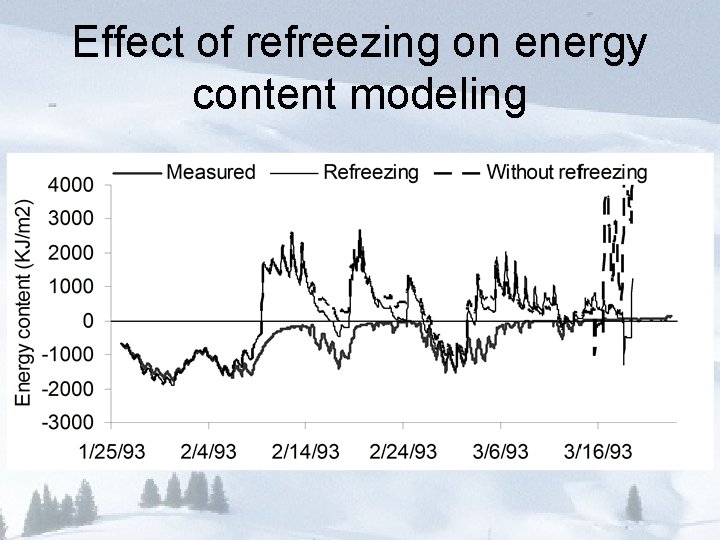
Effect of refreezing on energy content modeling
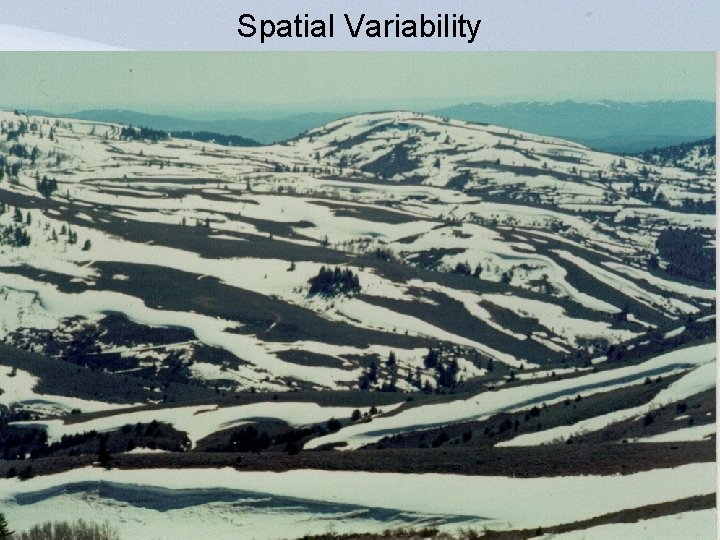
Spatial Variability

Semi distributed implementation: Extending model over elements that include spatial variability
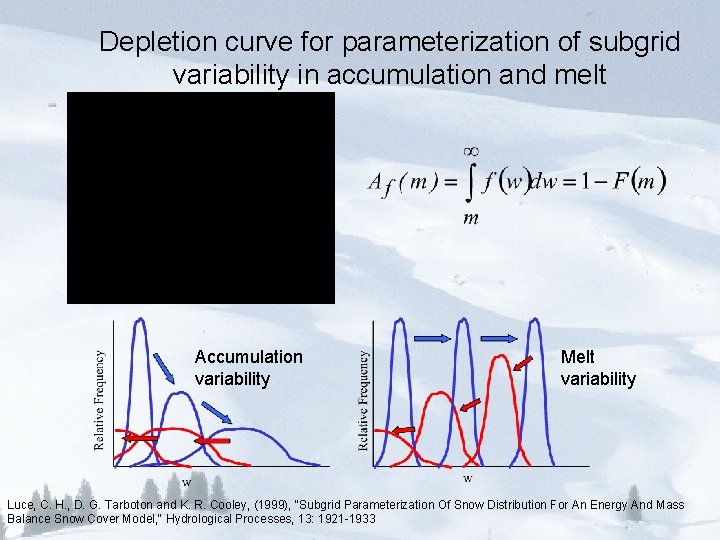
Depletion curve for parameterization of subgrid variability in accumulation and melt Accumulation variability Melt variability Luce, C. H. , D. G. Tarboton and K. R. Cooley, (1999), "Subgrid Parameterization Of Snow Distribution For An Energy And Mass Balance Snow Cover Model, " Hydrological Processes, 13: 1921 -1933
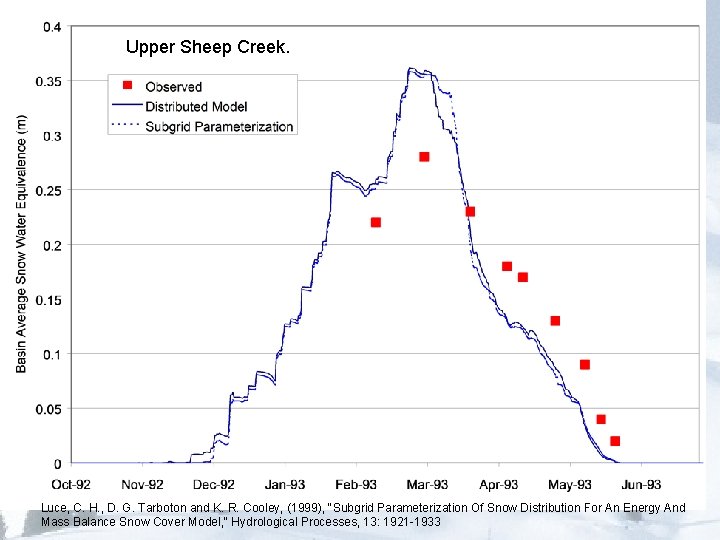
Upper Sheep Creek. Luce, C. H. , D. G. Tarboton and K. R. Cooley, (1999), "Subgrid Parameterization Of Snow Distribution For An Energy And Mass Balance Snow Cover Model, " Hydrological Processes, 13: 1921 -1933
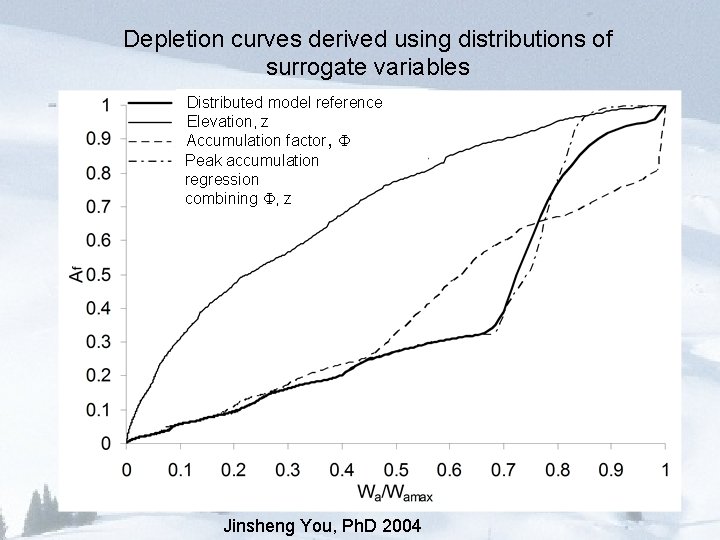
Depletion curves derived using distributions of surrogate variables Distributed model reference Elevation, z Accumulation factor, Peak accumulation regression combining , z Jinsheng You, Ph. D 2004
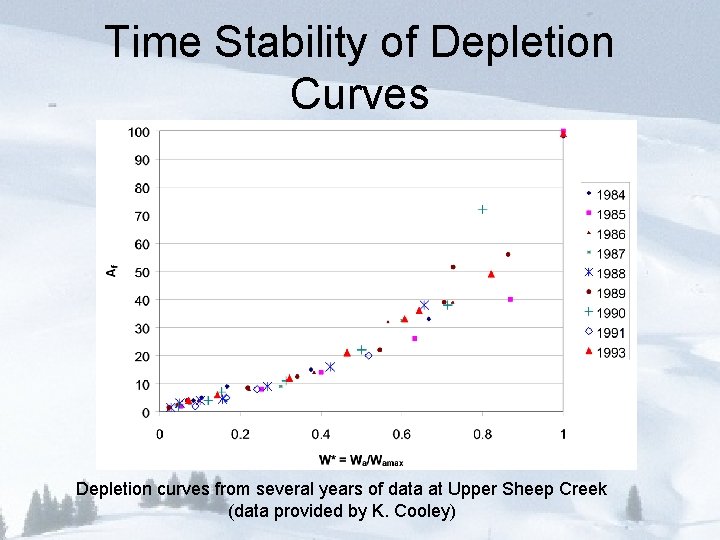
Time Stability of Depletion Curves Depletion curves from several years of data at Upper Sheep Creek (data provided by K. Cooley)
Conclusions • Able to obtain satisfactory results from a parsimonious one layer model that is efficient for distributed application over a watershed • Modified force restore approach works well as a parameterization for snow surface temperature • Refreezing heat conduction scheme improves modeling of the heat loss during the melting/refreezing period • The depletion curve approach is an effective parameterization for spatial (subgrid) variability (but is empirical so may not be stable under climate/land use changes)
- Slides: 18