
A Paired Think Aloud Model for Solving Mathematical


- Slides: 31
A Paired Think Aloud Model for Solving Mathematical Word Problems Julie Horn Deer Park ISD
A=attempted
Types of writing: 1. Journal writing 2. Creative writing involving math 3. Writing solutions to math problems 4. Writing about their thinking processes
National Council of Teachers of Mathematics (1989) • Learn to value mathematics, • Become confident in one’s own ability, • Become a mathematical problem solver • Learn to communicate mathematically • Learn to reason mathematically
NCTM • “Students gain insights into their thinking when they present their methods for solving problems, when they justify their reasoning to a classmate or teacher, or when they formulate a question about something that is puzzling them. ” (NCTM, 2000)
Texas Essential Knowledge and Skills (6) Underlying mathematical processes. Many processes underlie all content areas in mathematics. As they do mathematics, students continually use problem-solving, computation in problem-solving contexts, language and communication, connections within and outside mathematics, and reasoning, as well as multiple representations, applications and modeling, and justification and proof.
Think Aloud
Objectives: • Model the Think Aloud strategy • Show it can be used to help students solve word problems • Show to expand the Think Aloud strategy to include a written solution
What is the Think Aloud strategy? “Think Aloud” is a strategy which includes vocalizing “all of your thoughts, decisions, analyses, and conclusions” when trying to solve a problem or read a text. (Whimbey, 1999)
Meaning • “The Think Aloud strategy helps readers think about how they make meaning. ” (Beers, 2003)
Golf
Brain
My students? • Poor problem solvers frequently remark, “either you know the answer to a problem or you don’t know it – you might as well give up or guess”. (Whimbey, 1999)
Pair Think Aloud • “The THINKER must vocalize very step in her reasoning, and the LISTENER must listen and understand every step the problem solver takes. ” (Whimbey, 1999)
Subvocalize • “All the evidence indicates that you should subvocalize freely when you read. It can produce better comprehension of technical material and a fuller appreciation of literary writing where alliteration and other poetic devices depend on hearing the words. ” (Whimbey, 1999)
Prediction • “Challenging students to predict the question makes them more curious about what the question will be. When students make predictions they pay closer attention to details and nuances of meaning, which sharpens their thinking and improves their comprehension. For years, experts have advocated the practice of making predictions while reading (Stauffer, 1969; Britton, 1970; Weaver, 1988). The latest research supports prediction-making as an effective learning strategy in any subject area (Nystrand, 1997; Marzano, 2001). ” (Nessel, 2003)
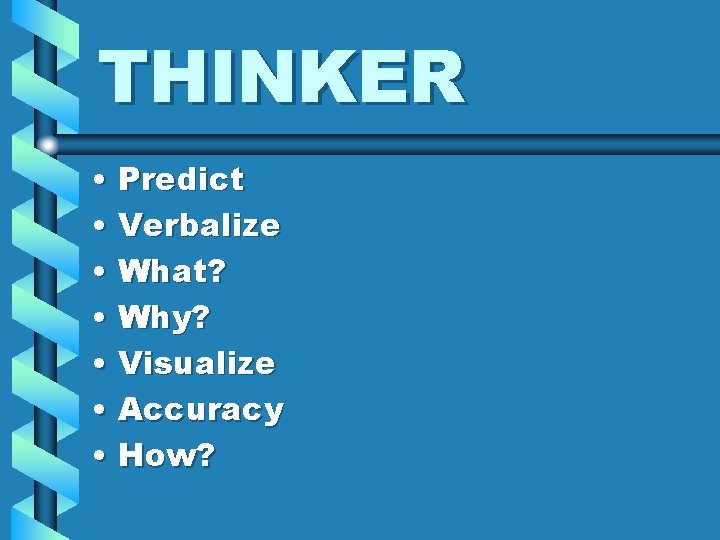
THINKER • Predict • Verbalize • What? • Why? • Visualize • Accuracy • How?
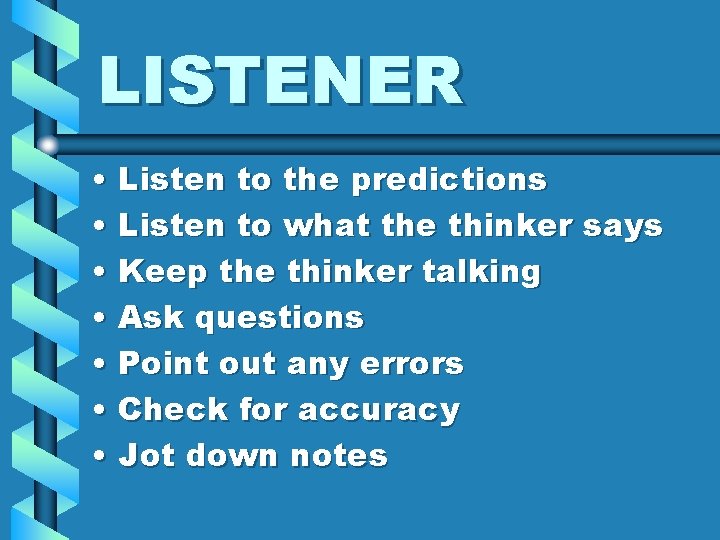
LISTENER • Listen to the predictions • Listen to what the thinker says • Keep the thinker talking • Ask questions • Point out any errors • Check for accuracy • Jot down notes
Feedback • “Every time you are a listener you are learning about problem solving by paying careful attention to what the problem solver does and does not do. Every time you are the problem solver you are indirectly observing the listener who is listening to you. The process has built into it all the feedback you need. ” (Whimbey, 1999)
Make it your own • “Writing is a way to work yourself into a subject and make it your own. ” (Zinsser, 1993)
• “Just like writing, mathematics requires “gathering, organizing, and clarifying thoughts. ” (Burns, 1995)
Writing in math class • “The writing students do in math class, however, differs in several ways from much of the writing they do for language arts assignments. Their math writing is typically not creative writing, and having a final product suitable for publication isn’t the goal. Rather, what they write in math class is a way for students to reflect on their learning and communicate their ideas about mathematics. ” (Burns, 1995)
Goals • Help students make sense of mathematics • Help teachers understand what children are learning
Correct answers aren’t everything • “Correct answers can hide a lack of understanding, but writing about the problemsolving strategies used can reveal levels of conceptual understanding. ” (Goldsby, 2002)
Creating Word Problems • “Devising problems based on other problems allows you to see them from the inside out. ” (Whimbey, 1999)
ESL • Pair with another ESL student and allow them to Think Aloud and write with each other in their native language. • Let them observe a Thinker. Listener pair first, then move into one of the roles.
Learning Challenged • Allow the student to draw a picture rather than verbalize, and then, also, draw their solution. • Do the Think Aloud with the teacher as Listener. • Record their solution on a tape recorder.
Gifted and Talented • Assign more complex and thought provoking problems. • Encourage original and independent problem solving. • Let them be the Listener for a struggling Thinker.
• Next year is going to be a great year for writing!
Resources • Beers, Kylene, (2003). When Kids Can’t Read, What Teachers Can Do, A Guide for Teachers 6 -12. Portsmouth, NH. : Heinemann. • Burns, Marilyn, (1995). Writing in Math Class, A Resource for Grades 2 -8. Math Solutions Publications. • Goldsby, Diane S. & Barbara Cozza, (2002). Writing Samples to Understand Mathematical Thinking. Mathematics Teaching in the Middle School, v. 7, no. 9, p. 517. • National Council of Teachers of Mathematics (1989). Curriculum and Evaluation Standards for School Mathematics. Reston, VA. : NCTM.
Resources • Nessel, Denise & Newbold, Ford (2003). 180 Think-Aloud Math Word Problems. New York: Scholastic Professional Books. • Richardson, Judy S. (2000). Read It Aloud! Using Literature in the Secondary Content Classroom. Newark, DE: International Reading Association. • Tierney, Richard J. , Readence, John E. , & Dishner, Ernest K. (1995). Reading Strategies and Practices, A Compendium. MA: Allyn and Bacon. • Whimbey, Arthur & Lochhead, Jack (1999). Problem Solving and Comprehension. Mahwah, NJ: Lawrence Erlbaum Associates, Publishers. • Zinsser, William K. (1993). Writing to Learn. Harper Collins.